



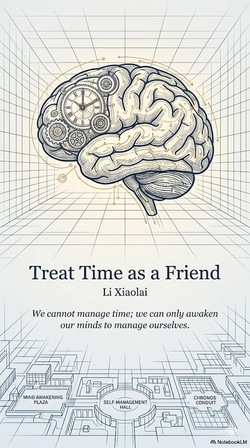
Li Xiaolai explains that treating time as a friend requires delayed gratification, which feels like a muscle you can train through consistent small choices instead of relying on willpower to beat the clock.
Your Review
Li Xiaolai explains that treating time as a friend requires delayed gratification, which feels like a muscle you can train through consistent small choices instead of relying on willpower to beat the clock.
The concept of treating time as a friend instead of an enemy changed how I view my daily struggles with procrastination and anxiety.

I felt relieved learning that time is a friend who rewards patience and consistency instead of an enemy we must fight.

I used to think I was failing at time management until Li Xiaolai explained that my unopened mind was actually the problem. The book reframes time panic disorder as a mental trap rather than a lack of hours, which was a huge relief. Instead of trying to cram more tasks into my day, I learned to focus on delaying gratification and building patience like a muscle. The section on time logging was especially eye-opening; I realized I was wasting hours on trivial emails instead of working on my long-term goals. By treating time as a loyal ally rather than an enemy to beat, I stopped rushing through superficial tasks and started making intentional choices that actually lead to growth. This book doesn't offer quick fixes but provides a sustainable framework for shifting from anxiety to peace, helping me understand that consistent small steps are far more powerful than frantic bursts of activity. It is a transformative guide for anyone feeling overwhelmed by the pressure to be constantly productive.

The idea that time is a friend not an enemy changed my view on daily stress and productivity habits.

This book changed my perspective on time.
The idea of treating time as a friend instead of an enemy resonated deeply with my experience of feeling constantly rushed and anxious about not having enough hours in the day to accomplish everything on my list, making me realize that my panic often stems from trying to control time instead of collaborating with it patiently.

The concept of time panic disorder really resonated with my busy work life.

The idea that our closed minds turn time into an enemy instead of a friend really changed how I see my daily struggles with productivity.

Li Xiaolai reframes time as a friend, not an enemy to race against.

Finally, a book that says time is a friend not an enemy.

I felt stuck in time panic until Li Xiaolai explained that our fear of running out of time actually makes us waste it on quick tasks instead of important ones.

The concept of treating time as a friend rather than an enemy really changed how I see my daily routine and priorities. I used to panic about deadlines, but now I focus on consistent small steps instead of rushing. The idea that instant gratification traps us in a cycle of anxiety was eye-opening for me. I finally understand why I keep procrastinating on important long-term goals. This book helped me shift from feeling overwhelmed to feeling calm and in control of my time.

I found the shift from seeing time as a scarce resource to a partner rewarding my patience to be incredibly liberating and motivating for my career growth.

This book changed my view on time.

Li Xiaolai shows how short-sightedness makes us skip small steps like looking up a word, which actually wastes more time later than taking the slow, steady path.

A few chapters really stood out. Enjoyed the pace.

I realized my brain is defaulting to instant pleasure instead of long-term growth, which explains why I keep skipping deep work for quick tasks.

The idea that treating time like a friend rather than an enemy changed my daily routine and reduced my constant stress about never having enough hours to get everything done.

Time is a friend if we treat it with patience.