
Trend Following: Complete Chapter-by-Chapter Summary

Welcome to our deep dive into "Trend Following" by Michael W. Covel. Today, we're exploring an evidence-based framework designed to capture asymmetric profits across bull, bear, and even black swan markets.
Unlike traditional investing that relies on predicting the future, trend following is about recognizing and riding the momentum that is already happening. It's a philosophy built on the simple yet powerful principle of cutting losses short and letting profits run. By staying objective and avoiding emotional traps, trend followers position themselves to profit from the very behaviors that often trap other investors.
Whether you're navigating a roaring bull market or a crashing bear one, this strategy offers a disciplined path forward. It's not about being right; it's about being consistent. Join us as we unpack how this approach transforms uncertainty into opportunity.
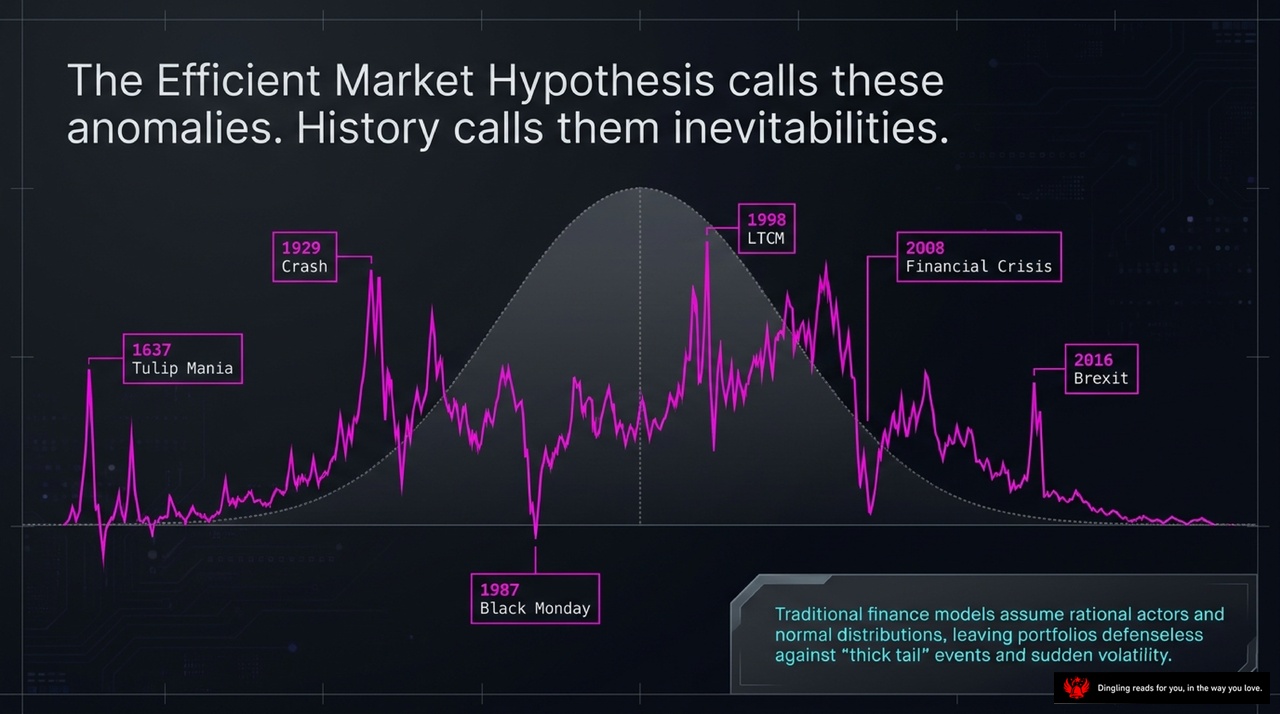
The slide highlights a stark contrast between how theory sees the market and how history actually behaves. While the Efficient Market Hypothesis dismisses these sharp spikes as mere "anomalies," history labels them as "inevitabilities." Look at the timeline: from the Tulip Mania in 1637 to the 1929 Crash, the LTCM collapse in 1998, the 2008 Financial Crisis, and even the 2016 Brexit shock. These aren't random glitches; they are recurring patterns that traditional finance models simply fail to predict.
The problem lies in our assumptions. As the text at the bottom explains, traditional models assume rational actors and a "normal distribution"—a neat, bell-shaped curve. But the real world doesn't fit that mold. It is plagued by "thick tail" events—those extreme, sudden volatility spikes that happen far more often than standard math suggests. Because portfolios are built to defend against normal distributions, they are completely defenseless when these inevitable black swans strike. History proves that while models call these events anomalies, the market treats them as the only thing that truly matters.

Trends aren't magic; they are the mathematical manifestation of human emotion. Look at this split image: on the left, the "Rational Economic Actor"—a cold, logical machine. On the right, our actual brain, glowing with the raw energy of fear, greed, and panic. The market doesn't move because of facts; it moves because of how we feel.
This slide breaks down exactly how those emotions drive the numbers you see on your screen. First, consider Prospect Theory. As the text explains, investors feel the pain of loss twice as strongly as the joy of gain. This creates irrational holding when things go up, and panic selling when they go down. That emotional asymmetry is the fuel for every trend.
Then, look at Greed and Momentum. When prices rise, humans mimic the actions of the group, creating a self-sustaining cycle that pushes prices higher regardless of value. This is Herd Mentality in action. Finally, there's Reaction Lag. Markets don't instantly price in news. Human bias causes us to underreact to new realities, creating that exploitable trend curve we see forming.
So, the next time you feel the urge to chase a gain or flee from a drop, remember this: you are looking at the very mechanism that creates the trends you are trying to follow. The market is simply the sum of our collective emotions, mathematically expressed.
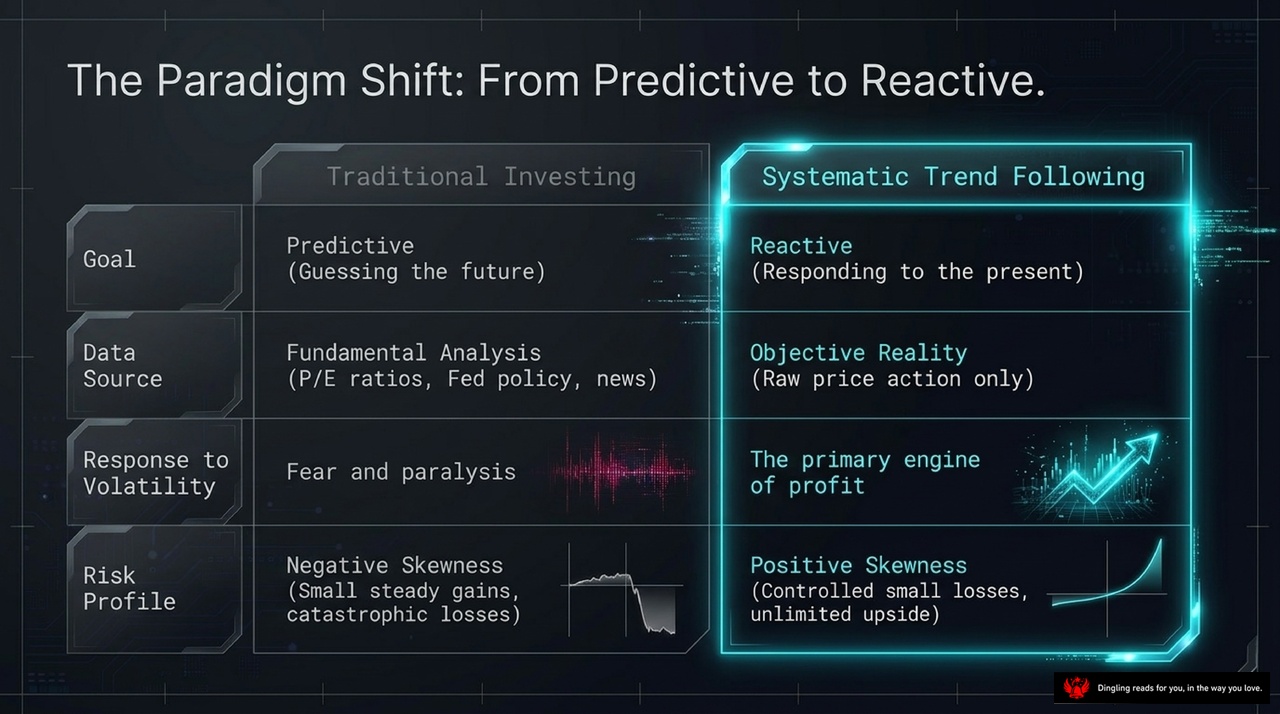
In the high-stakes arena of trading, the biggest enemy isn't the market itself—it's your own intuition. We often fall into the trap of believing that "buy and hold" is the golden rule, or that we can outsmart the system with complex, over-optimized models. But history has a way of proving these instincts wrong.
Consider the legendary "Holy Grail" of investing: simply buying and holding. While it sounds safe, data from the last few decades tells a harsher story. During crashes like the 2000 dot-com bubble or the 2008 financial crisis, stubbornly holding onto losing positions often leads to catastrophic losses. As Jerry Parker, a master trend follower, pointed out, this is the "dream of the loser." You don't buy the dip; you get trapped in a falling knife.
So, how do you actually win? The answer lies in a counter-intuitive approach: stop trying to predict the future and start respecting the data. Instead of relying on gut feelings or waiting for a "perfect" entry, successful trend followers use a strict, rule-based system. They accept that losing is part of the game. Their goal isn't to be right on every trade, but to cut losses quickly when the market turns against them and let profits run when the trend is in their favor.
This mindset shift—from hoping for a miracle to executing a plan—is what separates the amateurs from the pros. It's about managing risk, not avoiding it. By sticking to the system, even when it feels uncomfortable, you align yourself with the market's natural rhythm and turn uncertainty into an advantage.

The market is the news, and price is the only objective truth. Think of all the noise flooding your screen—GDP forecasts, CNBC pundits, earnings reports, geopolitics, and Fed rate hikes. It's an overwhelming storm of opinions trying to tell you what to do. But here's the hard reality: by the time the fundamentals finally explain a market move, the trend is already over. A true trend follower doesn't ask "why" the market is moving; they simply follow the price.
This slide illustrates that beautiful, simple funnel. At the top, we have "The Noise"—all those confusing stories and predictions. They get filtered through "Algorithmic Objectivity," stripping away the emotion and the guesswork. What remains at the bottom is "The Signal"—a clear, actionable price trend.
The logic is counter-intuitive but powerful. You aren't predicting the future; you are identifying what the market has already decided. As the text reminds us, if you wait for the news to catch up with the price, you'll always be late. The smart money doesn't try to be right about the fundamentals; they just stay on the right side of the price. It's about cutting losses quickly when the signal fails and letting profits run when the trend takes off. In a world full of noise, the only truth you need to trust is the price itself.
Imagine you're flipping a coin. Heads, you lose your bet; tails, you win double. It sounds like a 50/50 game where luck rules everything, right? But here's the twist: your fate doesn't depend on the coin's spin. It depends entirely on one variable you control—how much you bet. This simple analogy perfectly captures the essence of trend following: risk management isn't about predicting the future; it's about mastering the size of your position.
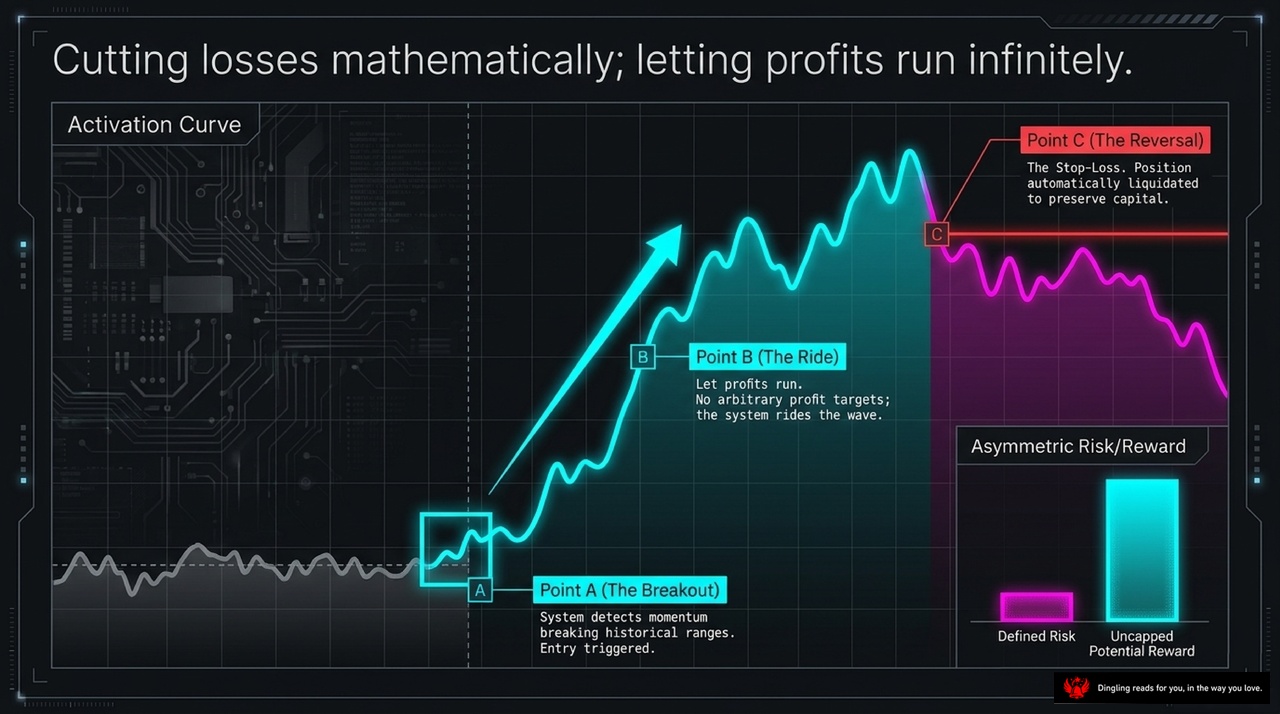
In the world of trend following, the core principle is "cut losses mathematically; let profits run infinitely." As you see in the chart, this strategy relies on asymmetric risk and reward. At Point A, the breakout, the system detects momentum and triggers an entry. The goal isn't to guess the peak, but to catch the wave. At Point B, during the ride, you let profits run without setting arbitrary targets. You ride the trend as long as it lasts, capturing the bulk of the move. But when the trend reverses at Point C, the stop-loss kicks in, automatically liquidating the position to preserve your capital.
This approach creates what experts call an "asymmetric risk/reward" profile. Your risk is defined and capped at the moment of entry, but your potential reward is uncapped. You might lose small, frequent amounts, but one big trend can make up for many losses. This is the power of positive skewness—limiting downside while allowing unlimited upside. By sticking to this logic, trend followers turn the chaos of the market into a predictable game of probabilities, proving that in trading, discipline beats intuition every time.
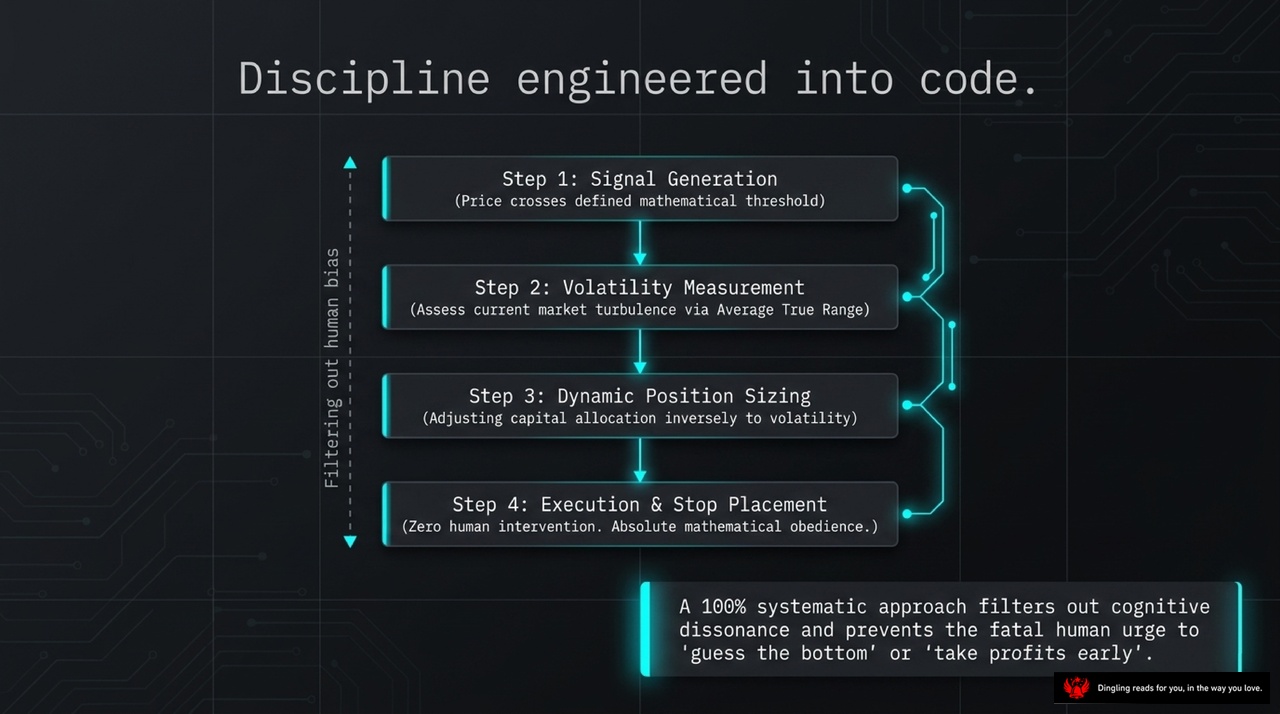
Look at this slide. It shows the exact moment where discipline stops being a feeling and starts being code. We aren't relying on gut instinct anymore; we are engineering discipline directly into the algorithm.
The process is a clean, four-step machine designed to filter out human bias. It starts with Signal Generation, where the system simply waits for the price to cross a defined mathematical threshold. No guessing, no waiting for confirmation that never comes. Next comes Volatility Measurement, using tools like Average True Range to assess how turbulent the market actually is right now.
This data feeds into Step 3: Dynamic Position Sizing. Here is the critical part: the system automatically adjusts your capital allocation inversely to volatility. If the market is calm, you size up. If chaos hits, you shrink your exposure. This removes the emotional urge to over-leverage when you feel confident or panic when you feel scared. Finally, Step 4 is Execution and Stop Placement. It's absolute mathematical obedience. Zero human intervention.
The result, as the text at the bottom explains, is a 100% systematic approach that eliminates cognitive dissonance. It prevents the fatal human urge to try and guess the bottom or to take profits too early. In a world full of noise, this is the only way to stay on the right side of the trend.
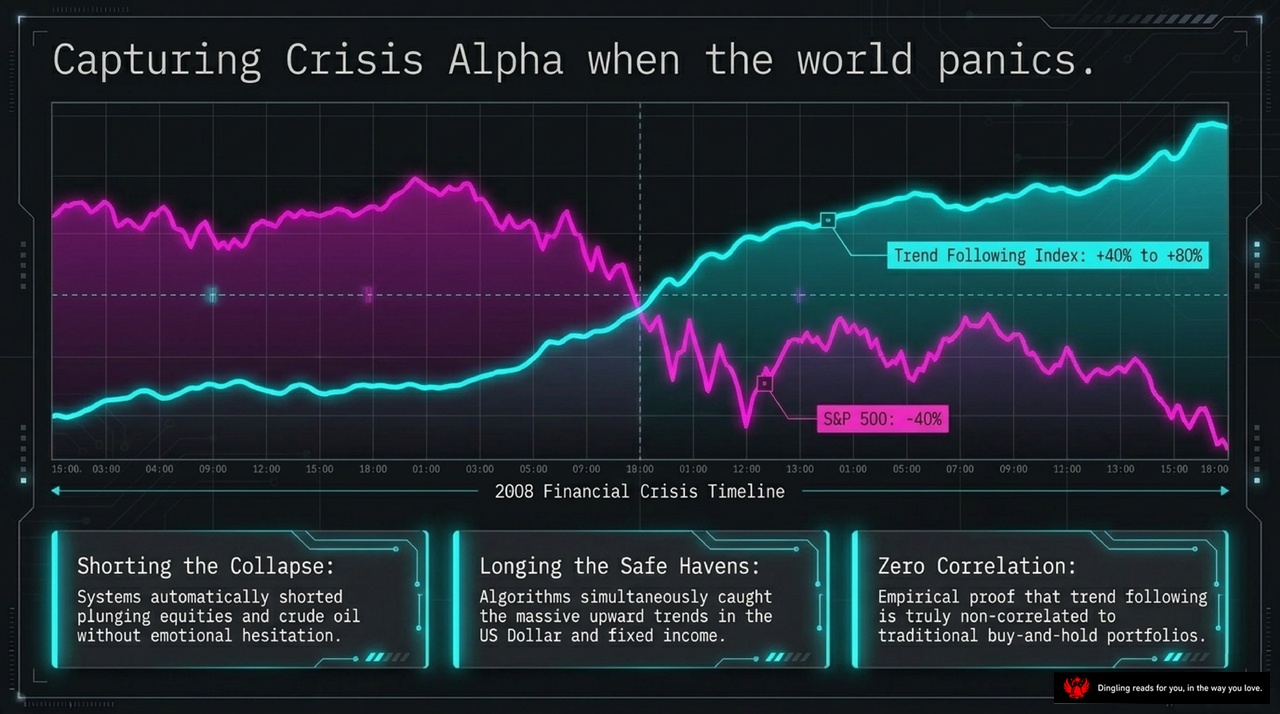
Imagine a world where the biggest opportunities hide right in the middle of the chaos. Look at this chart from the 2008 Financial Crisis. While the S&P 500—represented by that crashing purple line—plummeted by 40%, a simple trend-following strategy, shown in bright cyan, surged between 40% and 80%. This isn't magic; it's the power of capturing crisis alpha.
The secret lies in three distinct actions. First, we short the collapse. Our systems automatically sold plunging equities and crude oil without a single moment of emotional hesitation. Second, we long the safe havens. Algorithms simultaneously caught the massive upward trends in the US Dollar and fixed income, riding the wave while others fled. Third, and most importantly, we prove zero correlation. Empirical data confirms that this trend-following approach is truly non-correlated to traditional buy-and-hold portfolios.
While the rest of the market panicked and suffered, we were the ones profiting from the very volatility that terrified everyone else. It's not about predicting the crash; it's about having the system to ride the recovery immediately after.
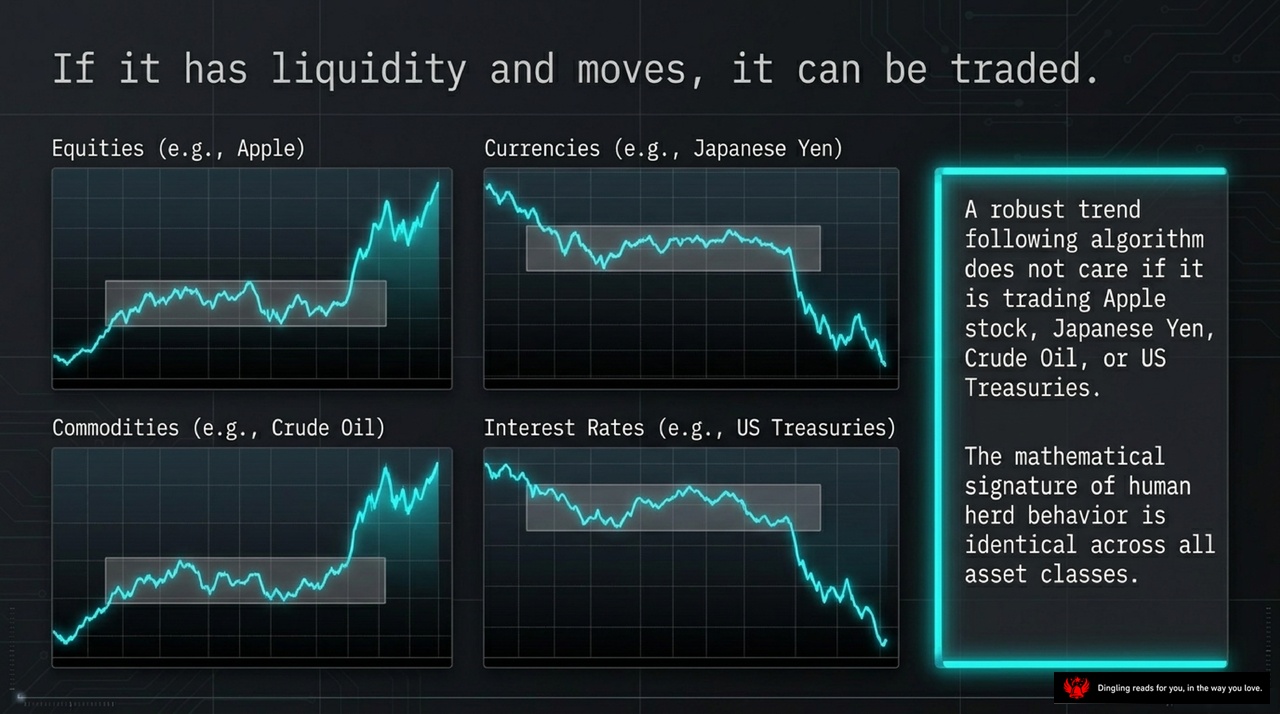
If it has liquidity and moves, it can be traded. That is the fundamental rule. Look at these charts: Equities like Apple, Currencies like the Japanese Yen, Commodities like Crude Oil, and even Interest Rates on US Treasuries. Notice the pattern? A robust trend following algorithm doesn't care if it's trading Apple stock or crude oil. The mathematical signature of human herd behavior is identical across all asset classes. Whether the market is rallying or crashing, the logic remains the same. When price moves with enough momentum, it creates an opportunity. When it stalls, it signals a reversal. This universality is what makes trend following so powerful—it allows you to capture the same human impulses driving the market, regardless of what you are actually buying or selling.

Human nature never changes, and neither do trends. That's the core truth we're uncovering today, backed by a staggering 800 years of empirical data. Look at this timeline: from the Tulip Mania in the 1630s to the commodities boom of the 1800s, the bond crises of the 1980s, and right up to the 2008 Financial Crisis. The history of finance is just a repeating cycle of human emotion and market divergence.
So why does this strategy work so well? Because it's built on a permanent reality. It thrives on the biological constant of human emotion. When everyone else is panicking or getting greedy, the trend follower is simply executing the rules. This approach has delivered a 13% annualized return over eight centuries of multi-asset data. It's not about predicting the future; it's about capturing the momentum that is already happening.
You'll also notice the concept of positive skewness here. This means the strategy maintains positive returns across vastly different economic eras—whether we're under a gold standard or a fiat regime. It's designed to cut losses quickly and let profits run. In a world where most strategies fail when the unexpected happens, this approach turns chaos into opportunity. It's not magic; it's simply the only strategy that aligns with how the market actually behaves over the long run.
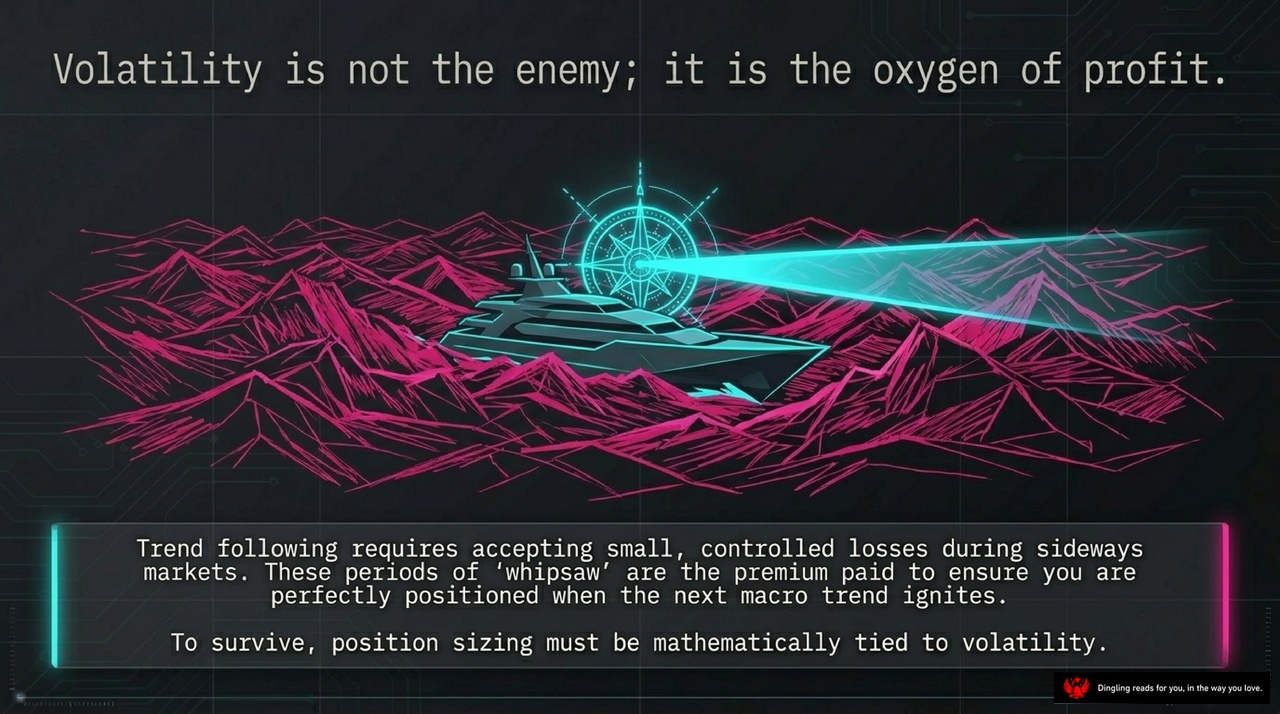
Volatility isn't the enemy; it's actually the oxygen of profit. Think of it this way: you aren't a boat trying to stay perfectly still in a storm; you're a vessel navigating rough, jagged waters, using the movement itself to find your path.
In trend following, we have to accept that sideways markets—those frustrating periods where nothing seems to happen—are just the price we pay. These "whipsaws" are the premium we buy to ensure we're perfectly positioned when the next major macro trend ignites. If you skip these moments, you miss the setup entirely.
But to survive this game, one rule is non-negotiable: your position sizing must be mathematically tied to volatility. You can't just guess how much to bet; you have to calculate it based on how wild the market is right now. By respecting volatility as a tool rather than a threat, you turn chaos into your greatest advantage.
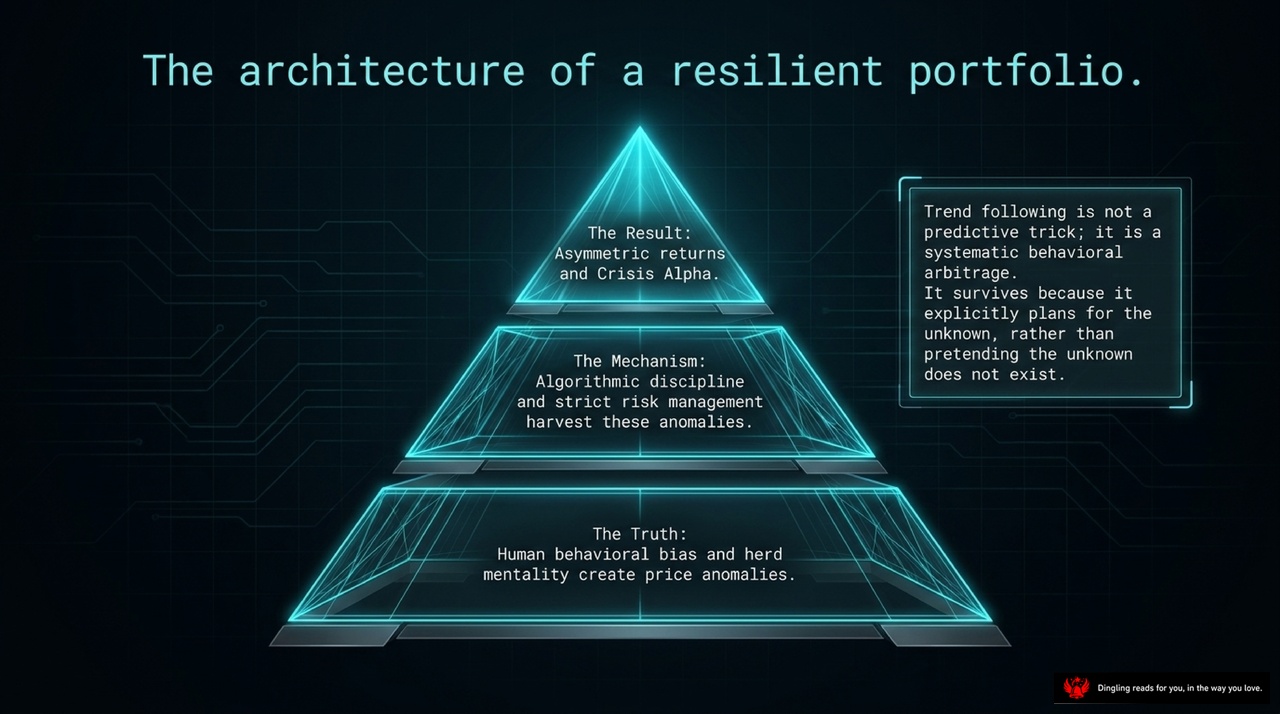
The architecture of a resilient portfolio rests on a simple, powerful pyramid built on human nature. At the base lies **The Truth**: price anomalies aren't random glitches; they are created by **human behavioral bias and herd mentality**. We all have a tendency to panic during crashes and get greedy during rallies, pushing prices away from their true value.
This creates the opportunity at the middle layer, **The Mechanism**. This is where **algorithmic discipline and strict risk management** come into play. Instead of trying to predict the future, trend followers harvest these very anomalies. By sticking to a rigid system, they can objectively buy when others are fearful and sell when others are euphoric, effectively arbitraging human psychology.
The result, at the top of the pyramid, is **Asymmetric returns and Crisis Alpha**. Trend following isn't about predicting where the market will go; it's a **systematic behavioral arbitrage**. It survives because it explicitly plans for the unknown, rather than pretending the unknown doesn't exist. As the slide notes, **trend following is not a predictive trick**. While traditional investors lose money when the herd rushes in or panics out, a resilient portfolio uses these emotional swings to generate profits, turning the market's biggest mistakes into your biggest wins.
Are you investing based on the objective reality of the market, or the fragile illusion of your own predictions? This slide cuts to the heart of everything we've discussed. Prediction is an illusion. Price is reality. By systematically cutting losses and riding market momentum, trend following transforms human panic into structural profit.
Think about it: most of us try to be prophets, guessing where the market is going before it moves. But the truth is, you can't know the future. You can only react to what is happening right now. When you stop trying to predict and start following the price, something magical happens. You stop fighting the market and start letting it work for you.
This approach turns our natural fear into an advantage. When everyone else is panicking because they predicted a crash and got trapped, trend followers are actually profiting from that chaos. They cut their losses quickly and wait for the next opportunity. It's not about being right; it's about being in the game when the money is flowing.
So, the next time you look at your portfolio, ask yourself: Am I making decisions based on the hard data of what the market is doing today, or am I clinging to a story about what I think will happen tomorrow? The former is a business. The latter is a gamble. Choose reality over illusion, and you'll find that the market rewards those who simply have the courage to follow the trend.