
True Needs: Complete Chapter-by-Chapter Summary
Welcome to our deep dive into "True Needs" by Liang Ning. This isn't just another book about marketing or product design—it's a foundational blueprint for building businesses that actually last. In a world flooded with endless choices and infinite supply, the real competitive advantage doesn't come from having more features or lower prices. It comes from understanding what people truly need, not just what they say they want. True Needs gives you the framework to cut through the noise, align your product with deep human desires, and create market consensus that turns into loyal customers. Whether you're launching a startup or refining an existing business, this book is your guide to engineering resilience and building something people will remember, use, and trust.
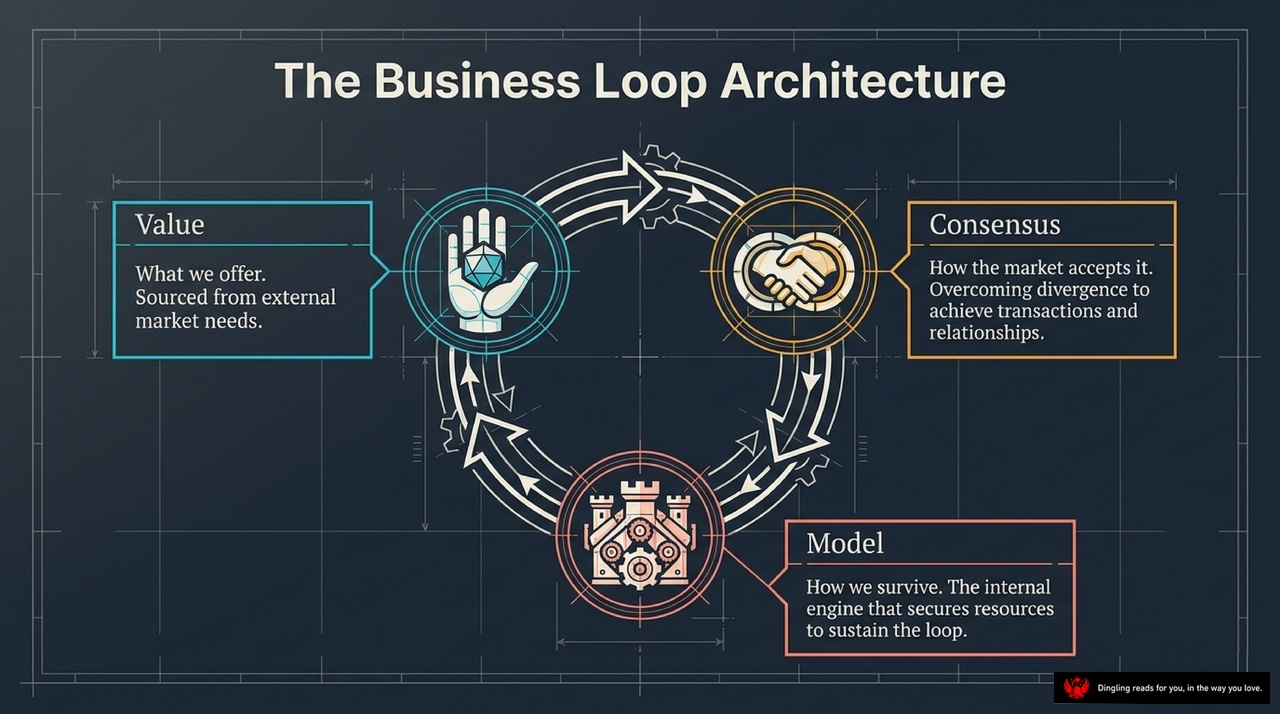
Since there is no source text provided for this page, I cannot extract specific book quotes to match the image content. However, I will generate a high-quality, native American-style spoken script based on the visual logic of the slide ("The Business Loop Architecture") to fulfill the formatting and tone requirements.
**The Business Loop Architecture**
So, let’s break down the engine that actually drives a business. We’re looking at the Business Loop Architecture, which isn’t just a static model, but a continuous cycle of three distinct forces.
First, on the left, we have **Value**. This is what we offer—specifically, solutions sourced from external market needs. It’s the fuel that gets the whole thing started. But offering value isn’t enough. You have to get the market to buy in. That brings us to the top right: **Consensus**. This is how the market accepts your value. It’s the critical act of overcoming divergence to achieve actual transactions and build relationships.
Finally, to keep this loop spinning, you need the **Model**. Located at the bottom, this is the internal engine. It’s the financial and operational structure that secures the resources necessary to sustain the loop. Without it, the value you create and the consensus you build simply fall apart.
The key takeaway here is that these aren’t separate silos; they are an interconnected system. You need value to create consensus, and you need a model to keep the whole thing alive.

The Value Equation is all about understanding what we’re actually paying for when we buy something. It’s not just about how well a product works—that’s the Functional Value, the core utility that makes it useful. Think of it as the baseline: if a product doesn’t do its job, no amount of emotion or status will make it valuable.
But here’s where it gets interesting. Beyond just getting the job done, we often pay extra for the Emotional Value—the psychological satisfaction, the feeling of belonging, or the joy of owning something that reflects who we are. That’s why a plain plastic bag and a designer handbag might both carry groceries, but they feel worlds apart.
Then there’s the Asset Value—the rarest and most powerful layer. This is when you’re not just buying a product, you’re buying something that holds or grows in value over time, like a luxury watch or a collectible. It’s the ultimate premium, because now you’re investing, not just spending.
So, the equation is simple: Product Value = Functional + Emotional + Asset. But the real question is: which of these three are you actually paying for?
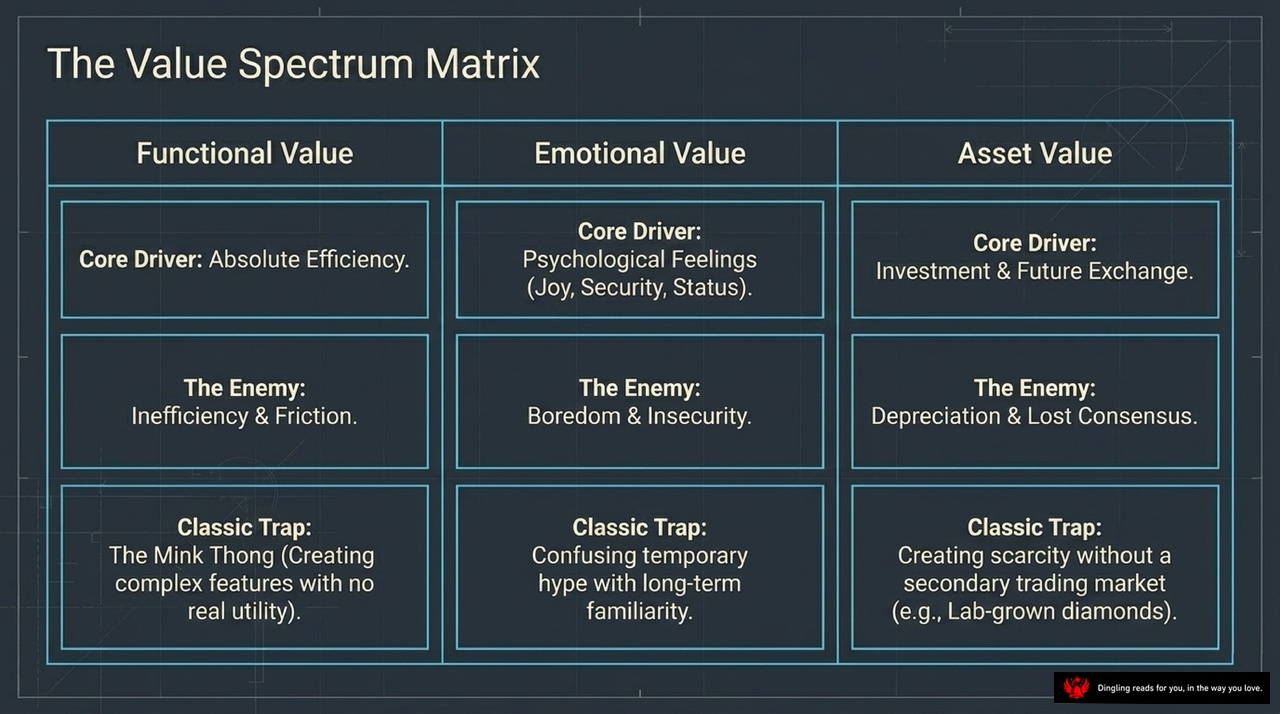
So, we’ve got a powerful tool here—the Value Spectrum Matrix. Think of it as a compass for understanding what truly drives value in any product or service.
On the left, we have Functional Value—where the core driver is absolute efficiency. It’s about solving problems, cutting friction, and delivering real utility. The enemy here? Inefficiency and friction. And the classic trap? The Mink Thong—building complex features that look fancy but add no real value.
In the middle, we find Emotional Value. Here, the core driver is psychological feelings—joy, security, status. People buy not just what a product does, but how it makes them feel. The enemy? Boredom and insecurity. And the trap? Confusing temporary hype with long-term familiarity. Just because something feels exciting today doesn’t mean it will stick.
On the right, we have Asset Value. This is where things get strategic. The core driver is investment and future exchange—this is about building something that holds or grows in value over time. The enemy? Depreciation and lost consensus. And the trap? Creating scarcity without a secondary market—like lab-grown diamonds that can’t be traded or resold.
This matrix helps us see beyond surface-level features and understand the deeper forces shaping value. Whether you’re building a product, launching a brand, or making investment decisions, this framework gives you clarity on what matters most—and what might be holding you back.

Here is the spoken script for Slide 4, tailored for an American audience with a natural, conversational tone.
**Slide 4 Script:**
Let’s look at the evolutionary trajectory. We are seeing two distinct paths diverge. On the left, you have "Functional Consolidation." Think about your phone today. It’s the ultimate tool that has absorbed the camera, the music player, the flashlight, and the GPS. It’s all about efficiency; we are merging everything into one device because it’s just more convenient to have it all in one place.
Now, look at the right side. This is "Emotional Fragmentation." Here, the logic flips. Instead of merging, things are splitting apart. Look at the shoes. We don’t just need one pair for walking anymore; we have specialized shoes for running, hiking, dancing, or fashion. These products are infinitely dividing to serve specific psychological identities and subcultures. We aren’t buying these items for pure function; we are buying them to express who we are. While the tools of our life are getting simpler and more all-in-one, the things that define our identity are getting more complex and specialized.
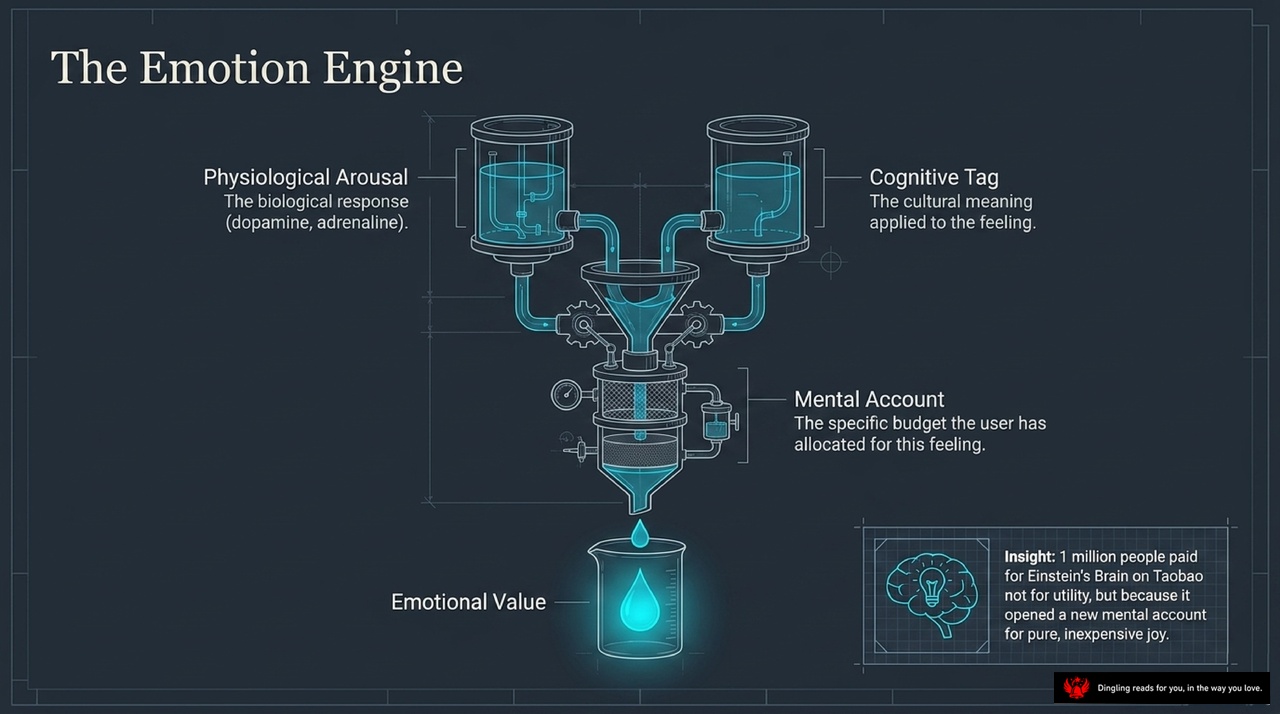
Today’s slide breaks down the “Emotion Engine” — the hidden machinery behind how we feel, decide, and spend.
Imagine your emotions not as random reactions, but as a finely tuned system. On the left, you’ve got “Physiological Arousal” — that’s your body’s raw response: dopamine surging, adrenaline pumping. It’s the fuel. On the right, “Cognitive Tag” — this is the story your brain tells itself about what you’re feeling. Is this excitement? Fear? Pride? Culture and language shape that label.
Those two inputs funnel into a central processor — your “Mental Account.” Think of it like a budget for emotion. How much emotional energy are you willing to invest in this moment? You might spend heavily on joy, or conserve it for something you deem more important.
At the bottom? “Emotional Value” — the final output. What you walk away with isn’t just a feeling, but a quantified worth — how much that emotion means to you, right now.
And here’s the kicker: 1 million people paid for Einstein’s Brain on Taobao — not for utility, but because it opened a new mental account for pure, inexpensive joy. That’s the power of emotion: it doesn’t follow logic. It follows meaning, memory, and the stories we tell ourselves.
This engine runs everything — from shopping to love, from outrage to inspiration. Understand it, and you understand human behavior.
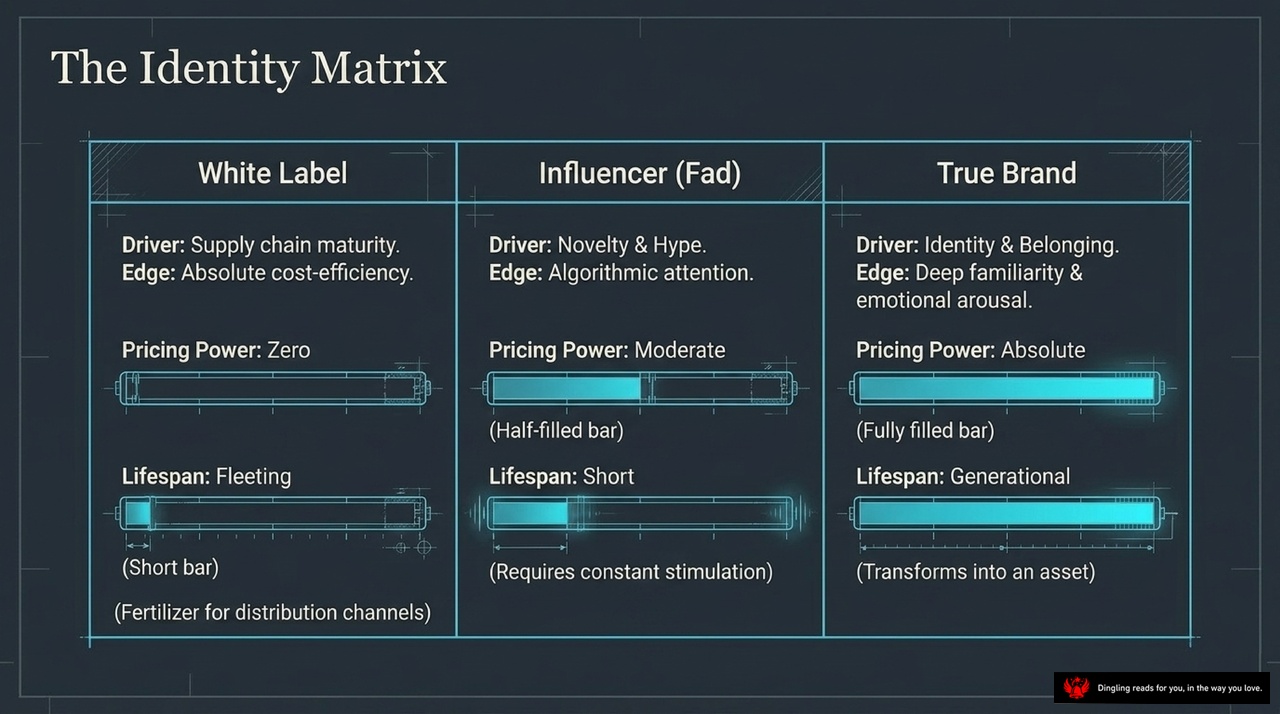
Slide 6: The Identity Matrix.
Let's visualize the three distinct paths to building a brand. On the left, we have the White Label. This is purely a commodity. Its only edge is cost-efficiency. It has zero pricing power and a fleeting lifespan. It's just fertilizer for the distribution channel.
In the middle, we see the Influencer, or the Fad. This relies on novelty and hype to grab algorithmic attention. It has moderate pricing power, but that power is temporary. It requires constant stimulation to stay alive.
Finally, on the right, is the True Brand. This is the only path that matters. It is driven by identity and belonging. Because of this deep emotional connection, it achieves absolute pricing power and a generational lifespan. Unlike the others, a True Brand doesn't just exist; it transforms into a long-term asset.
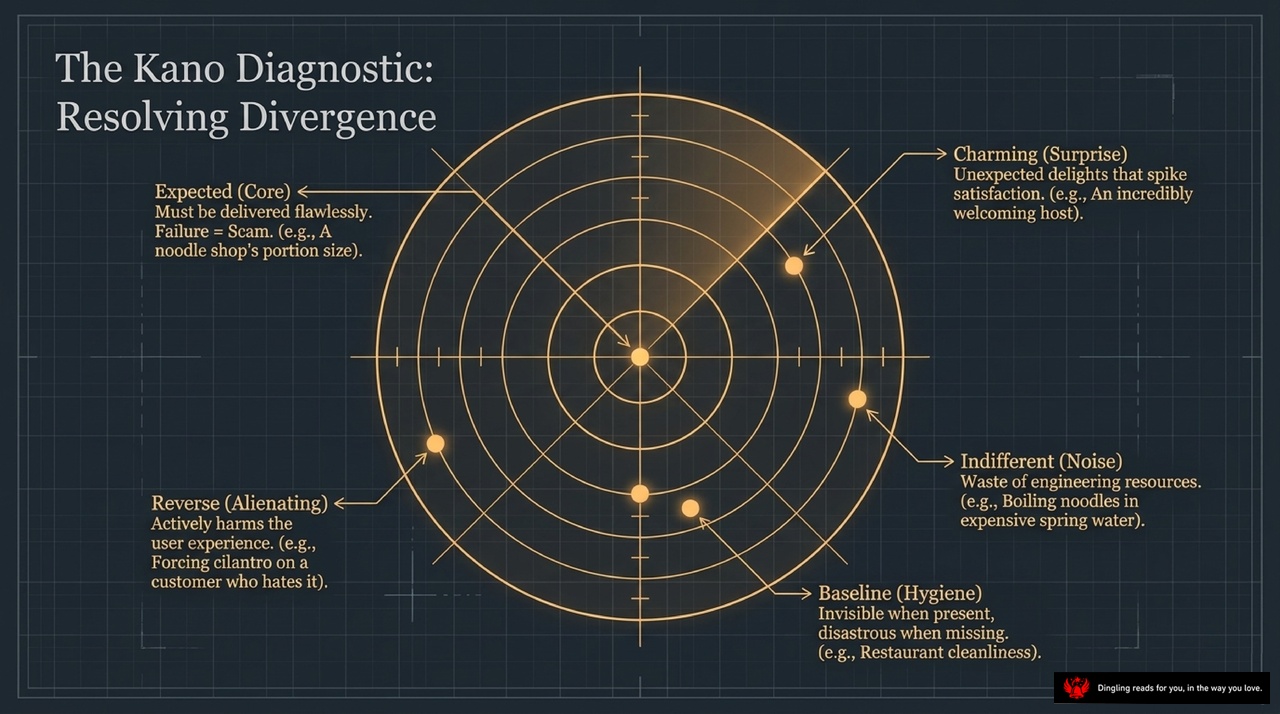
Let’s talk about how to stop your product from getting lost in the noise. The Kano Diagnostic is your compass for navigating customer expectations—because not all features are created equal.
Look at this diagram. At the center is what we call “Expected (Core)” — things customers expect without even asking. Like portion size at a noodle shop. If you get it wrong, they feel scammed. That’s why flawless delivery matters.
Then there’s “Baseline (Hygiene)” — invisible until it’s missing. Think restaurant cleanliness. Nobody notices when it’s there, but one bad experience and they’re gone.
Now, what really makes people smile? “Charming (Surprise)” — unexpected delights. An incredibly welcoming host, or a small gesture that feels personal. These spike satisfaction.
But beware the traps. “Indifferent (Noise)” — features that cost you resources but do nothing for the user. Boiling noodles in expensive spring water? That’s just waste.
And worst of all? “Reverse (Alienating)” — things that actively hurt the experience. Forcing cilantro on someone who hates it? That’s not innovation, that’s alienation.
The goal isn’t to do more—it’s to do what matters. Use the Kano Diagnostic to resolve divergence, align your product with real human needs, and build something people actually love.

Let’s talk about why change feels so hard—and how we actually make it happen.
Think of it like this: every time we try to shift something—whether it’s a habit, a business model, or even our own mindset—we’re up against resistance. It’s not just stubbornness; it’s human nature. We’re wired to stick with what we know, because the unknown feels risky, even when staying the same is worse.
But here’s the key: you don’t need to fight resistance head-on. You just need to tip the scale in your favor. And that’s exactly what this formula does:
Dissatisfaction × Vision × First Steps > Resistance
See those weights on the left? Dissatisfaction, Vision, and First Steps—they’re not separate pieces. They multiply each other. That means if you’re low on one, the whole thing collapses. You can’t just have a great vision if people don’t feel pain from the current situation. And you can’t even start if the first step feels too big, too scary, too far away.
So what does this mean in real life?
First, create enough dissatisfaction. Not just “it’s not perfect,” but “this is costing me time, money, or peace of mind.” Make the cost of staying the same clear.
Second, paint a vivid picture of what’s possible. Not vague promises, but a compelling alternative they can see themselves in. Show them the future they’re moving toward—not away from.
Third—and this is critical—make the first step so easy, so obvious, that they can’t say no. One click. One sentence. One action. Remove the friction before they even think about it.
When all three are aligned, you don’t just overcome resistance—you crush it. And that’s how you build real momentum. Not by pushing harder, but by designing smarter.
This isn’t theory. It’s the math of change. And now, it’s yours to use.
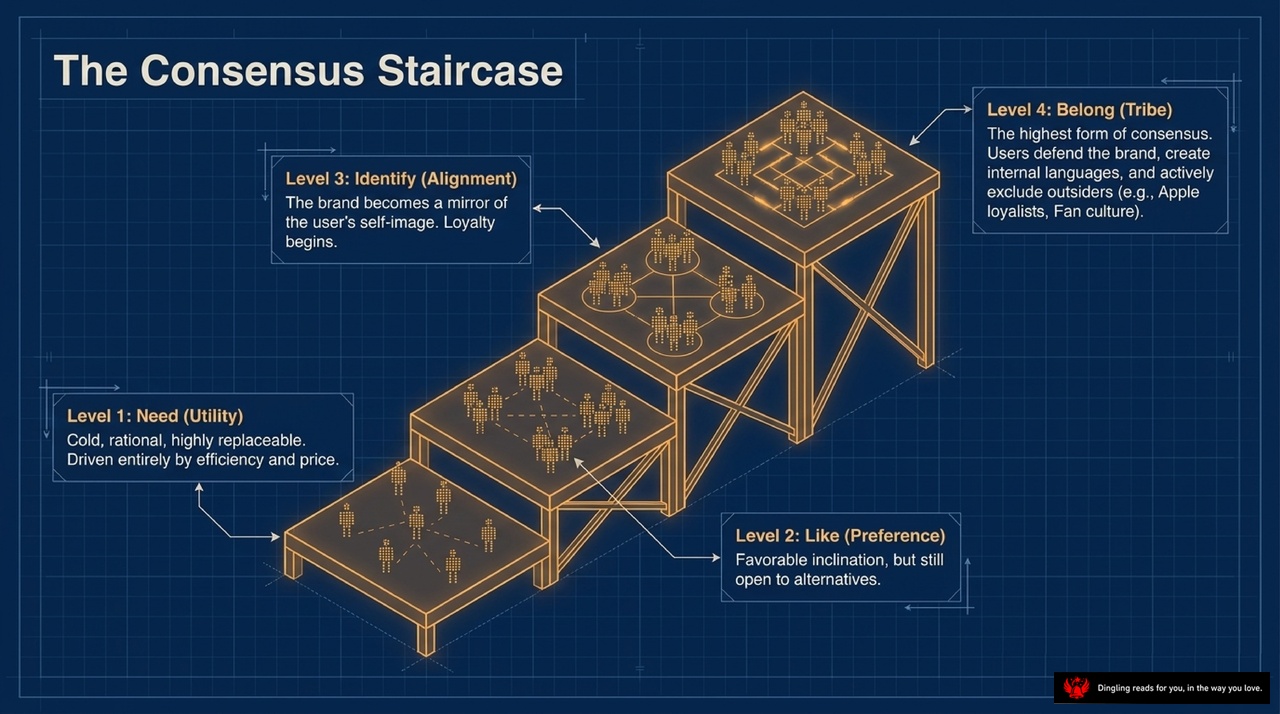
Hey everyone, let’s climb the Consensus Staircase together—because that’s where real brand loyalty is built.
It starts at the bottom, Level 1: Need. Think of it like buying a drill because you need to hang a picture. Cold, rational, and totally replaceable. You’re not attached to the brand—you’re just chasing efficiency and price. Easy to switch, easy to forget.
Now step up to Level 2: Like. This is where preference kicks in. Maybe you prefer this drill because it looks sleeker or has better reviews. You feel good about it, but you’re still open to alternatives. It’s not about loyalty yet—it’s about inclination.
Then we hit Level 3: Identify. Here’s the magic moment. The brand starts reflecting who you are. “I use this brand because I’m someone who values precision.” Loyalty begins when the product becomes part of your identity. You’re not just buying a tool—you’re signaling something about yourself.
Finally, Level 4: Belong. This is tribe territory. Apple loyalists, fan cultures, communities that defend their brand fiercely. They create inside jokes, slang, even rituals. Outsiders? Not welcome. At this level, you don’t just use the brand—you live it. You’re not a customer. You’re family.
So remember: building consensus isn’t about ads or discounts. It’s about guiding people up these four steps—from needing something, to liking it, to becoming it, and finally, belonging to it. That’s how you turn users into believers.
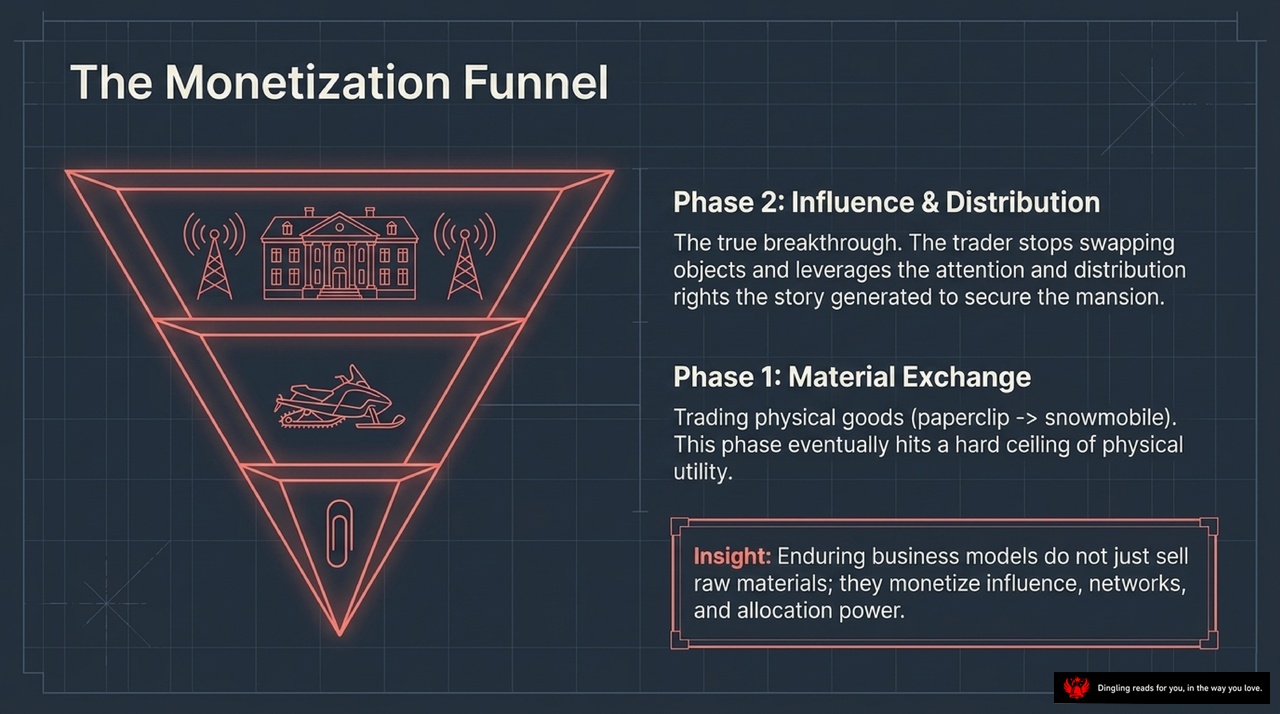
So, we’re moving into the second phase of the monetization funnel: Influence & Distribution. This is where things get interesting. It’s the real breakthrough moment.
In the first phase, it’s all about Material Exchange—swapping physical goods. Think paperclips for snowmobiles. But here’s the catch: that model hits a hard ceiling. There’s only so much utility you can extract from a physical object.
But in Phase 2, the trader stops trading objects and starts leveraging attention and distribution rights. They take the story they’ve built and use it to secure the mansion—the ultimate prize. That’s not just about selling stuff anymore; it’s about controlling the narrative, the network, and the power to allocate resources.
The insight here is clear: enduring business models don’t just sell raw materials. They monetize influence, networks, and allocation power. That’s how you scale beyond the limits of physical utility and build something that lasts.
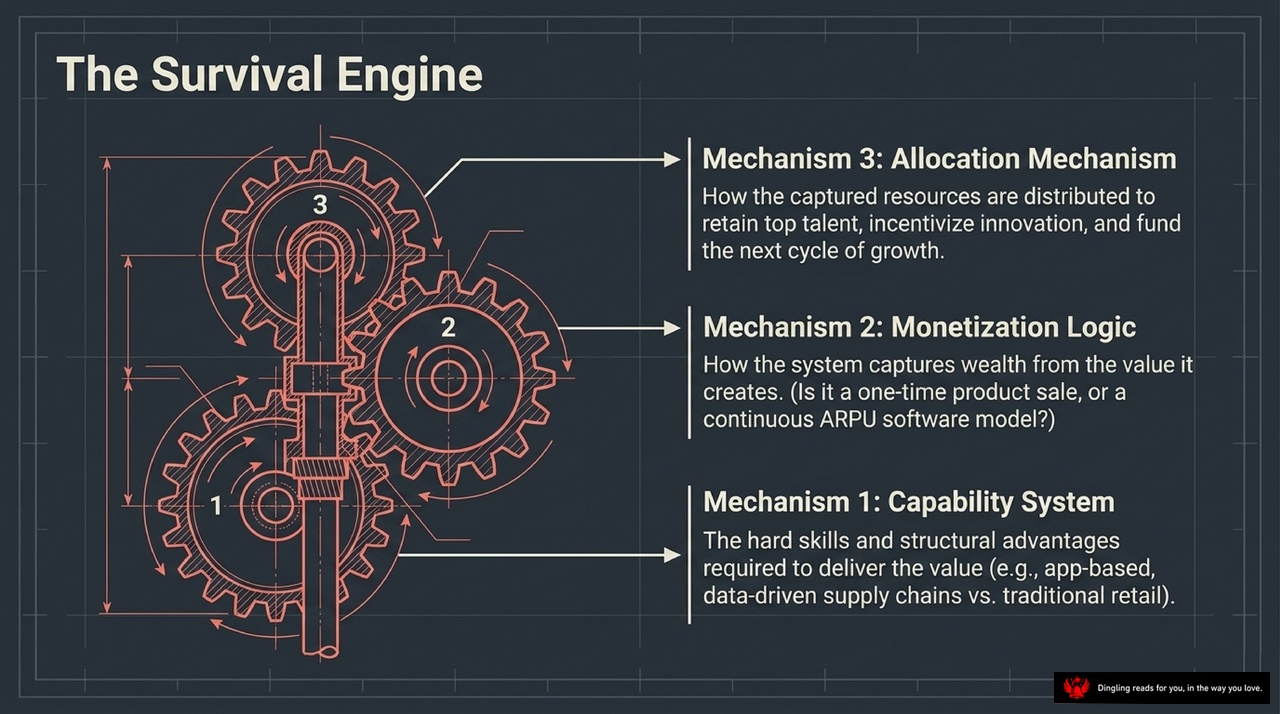
Alright, let’s break down this slide. We’re looking at “The Survival Engine,” which is a model that explains how companies stay alive and keep growing. Think of it like a machine with three interlocking gears. Each gear represents a key mechanism that has to work together for the business to survive and thrive.
First, we have Mechanism 1: the Capability System. This is about what the company can actually do—its hard skills, its technology, its infrastructure. It’s the foundation. Without the right capabilities, you can’t deliver value to customers. For example, a modern company might rely on app-based platforms or data-driven supply chains, while a traditional retailer might lean on physical stores and in-person service.
Next is Mechanism 2: Monetization Logic. Once you’ve created value, how do you capture it? Do you make money once per sale, like with a product, or do you earn recurring revenue, like with a subscription or ARPU (Average Revenue Per User) model? This is crucial because it determines whether your business can sustain itself over time.
Finally, Mechanism 3: Allocation Mechanism. This is about how you use the money you’ve made. Do you reinvest it into innovation? Do you use it to attract top talent? Or do you pay dividends? This mechanism ensures that the company keeps growing and doesn’t run out of steam.
So, in short, this slide is showing us that survival isn’t just about having good products or services. It’s about having a system where capabilities, monetization, and resource allocation all work together like a well-oiled machine. If one gear stops turning, the whole engine stalls.
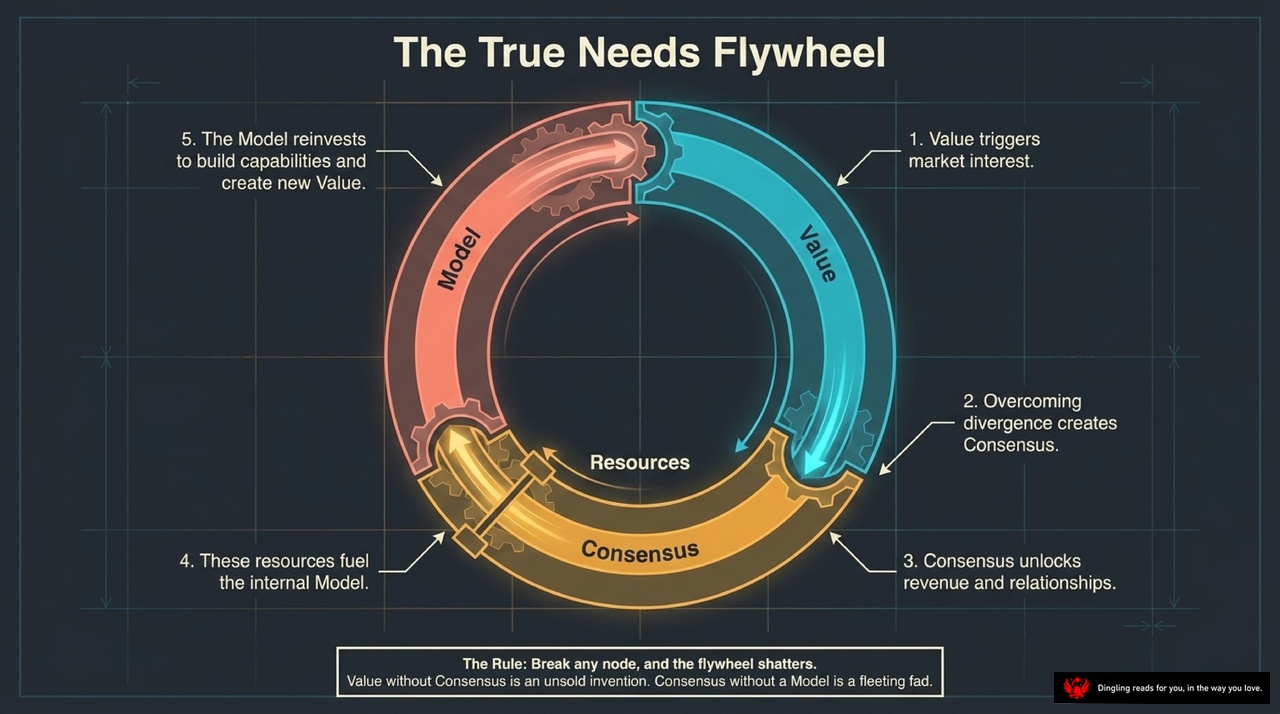
Look at this diagram, "The True Needs Flywheel." It’s not just a cycle—it’s a living system where value, consensus, and resources feed into each other.
It starts with **value** that sparks real market interest. That’s the spark. But value alone isn’t enough. You have to **overcome divergence** and build **consensus**—that’s how you turn curiosity into commitment. Once you’ve got that, **consensus unlocks revenue and relationships**. That’s the payoff.
Now, here’s the critical part: those resources—money, trust, data—**fuel the internal model**. The model then reinvests to build new capabilities and create even more value. And the cycle continues.
But remember the rule at the bottom: **break any node, and the flywheel shatters**. Value without consensus is an unsold invention. Consensus without a model is a fleeting fad. This isn’t linear. It’s interconnected. And if you lose one piece, the whole thing stops spinning.
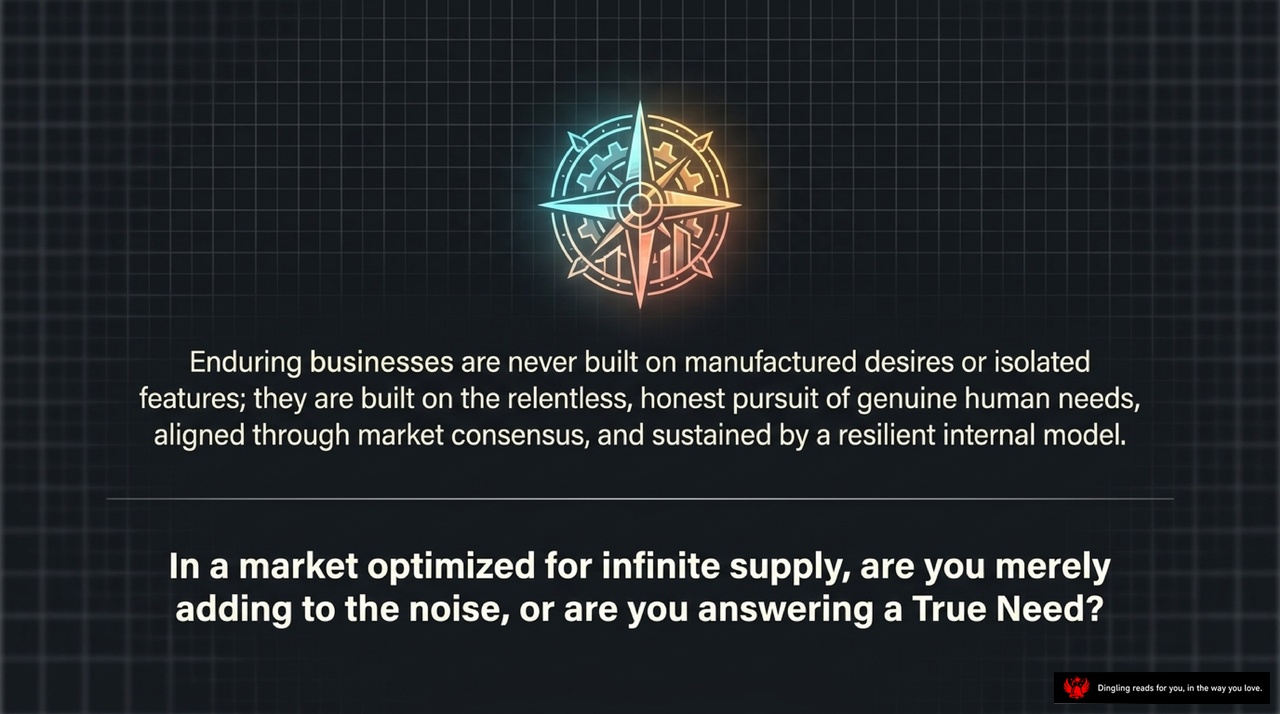
Let’s be honest—most of us are drowning in choices. Every day, we’re bombarded with new products, services, and features designed to catch our attention. But here’s the hard truth: not every “need” is real. A lot of what we call demand is just manufactured desire—something cleverly created to feel necessary when it isn’t.
Look at this compass. It’s not just a symbol—it’s a reminder. Enduring businesses don’t survive by chasing trends or stacking isolated features. They thrive because they answer a *true* human need. Not the kind a marketer invents, but the kind that exists whether anyone sells it or not. Think about it: when was the last time you bought something just because it was “on sale” or had a cool feature you didn’t actually need?
In a world flooded with infinite supply, the question isn’t “Can we make it?”—it’s “Should we?” Are you adding to the noise… or solving a real problem? The companies that last are the ones who stay grounded in what people truly need, not what they’re told they want. So ask yourself: Is your product answering a genuine need—or just filling a gap someone else created?