
Turbulent Thirty Years: Complete Chapter-by-Chapter Summary

Welcome to our book club session on "Turbulent Thirty Years" by Wu Xiaobo. Tonight, we dive into the chaotic, miraculous, and unprecedented rise of Chinese enterprises from 1978 to 2008. Picture this: the glittering skyline of Shanghai at night, reflecting on turbulent waters—this is the backdrop for a story that reshaped a nation. In 1978, China stood at a crossroads, shifting its focus from class struggle to modernization. Just days later, the Baosteel project kicked off in Shanghai, a bold gamble to catch up with global industrial standards. While the world celebrated the rise of Microsoft and Ford's comeback, China was still figuring out how to open its doors. The year 1978 also saw the birth of the Special Economic Zones, with Shenzhen emerging as a beacon of innovation despite limited resources. By the early 1980s, the spirit of entrepreneurship began to take root, challenging old norms and sparking a new era of economic transformation. This journey from isolation to integration sets the stage for the incredible story of China's economic awakening.
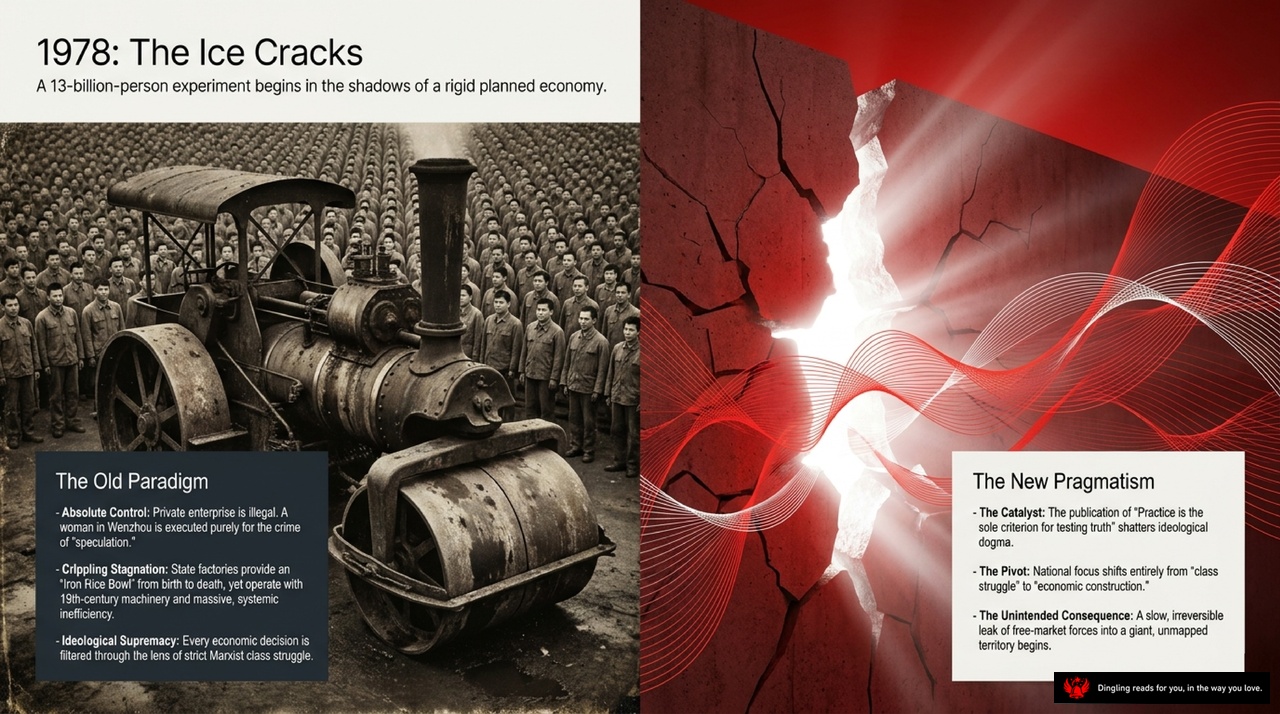
Welcome to the story of 1978, the year the ice finally began to crack. On the left, you see a powerful image of the old paradigm: rigid control, stagnation, and an ideology that stifled everything. But look at the right side—the new pragmatism is breaking through. The catalyst? A simple shift in thinking: "Practice is the sole criterion for testing truth." This single phrase shattered decades of dogma.
Suddenly, the focus moved away from class struggle and toward economic construction. This pivot unleashed a slow but irreversible leak of free-market forces into a giant, unmapped territory. We saw this in action almost immediately. Just days after the pivotal meeting, the Baosteel project broke ground in Shanghai, importing massive technology from Japan to chase the world's industrial standards. While the West was launching personal computers and mobile phones, China was opening its eyes. The first group of scholars left for the U.S., and soon, the floodgates opened for students to see the outside world.
But the real revolution was economic. Deng Xiaoping invented the "Special Economic Zones," starting with Shenzhen. With almost no money from the state, developers had to get creative. They rented out land—a concept that was considered heresy at the time. The result? A housing project sold out in just three days. From 1980 to 1985, foreign capital poured in, building industrial zones that would change everything.
This era wasn't just about factories; it was about the human spirit. Censorship loosened, emotions returned, and people began asking new questions about life. Entrepreneurs like Chen Chunxian dared to turn their research institutes into businesses, planting the seeds for the tech giants we know today. And in the provinces, bold leaders like Ren Zhongyi and Xiang Nan fought against all odds to push forward, proving that reform could happen even when the winds were blowing against them.
1978 wasn't just a date on a calendar; it was the moment a 13-billion-person experiment began in the shadows of a rigid past, stepping boldly into a future defined by opportunity and innovation.

Welcome to the third chapter of our journey, "The March of National Brands," covering the turbulent years from 1993 to 1997. This was the decade where Chinese companies stopped just surviving and started fighting for their identity against global giants.
In the mid-90s, the stage was set for a fierce battle. On one side were the powerful multinational corporations; on the other, a rising tide of Chinese brands ready to prove they belonged. This wasn't just about selling products; it was about a national awakening.
Look at the strategies they used. While foreign brands like GE and Whirlpool struggled to adapt to China's unique culture and decision-making speeds, Chinese leaders found their edge. Take Haier's Zhang Ruimin. Instead of just competing on price, he built an unshakeable brand fortress through service. His "Star Service" promised a response within four hours and repairs within 24. This commitment built trust where others couldn't. Similarly, TCL's Li Dongsheng used a "floor price agreement" to undercut Japanese competitors, effectively flooding the market with affordable color TVs. And then there was Changhong, which made a bold move by slashing prices by up to 30% to clear massive inventory. It was a gamble, but it worked, pushing domestic market share to over 71%.
This era also saw the rise of a new kind of entrepreneur who dared to take risks. Zhao Xinxian, founder of Nine Dragons Paste, didn't just build a factory; he created a unique management model that gave him total control, allowing him to acquire dozens of companies rapidly. His aggressive expansion and marketing stunts, like the famous taxi-top ads, made him a household name and a symbol of what a Chinese company could achieve.
However, this period wasn't without its shadows. The market was volatile, and trust was fragile. We saw the rise and fall of the health supplement industry, where companies like Sanzh and Shenyang Feilong relied heavily on aggressive advertising rather than product quality, leading to a massive credibility crisis. It was a wild west era where marketing often trumped substance.
But amidst the chaos, a clear lesson emerged: to succeed in China, you needed patience, deep local understanding, and an unwavering commitment to quality. As the 90s closed, these lessons laid the groundwork for the next generation of global champions.

Look at this powerful visual: a massive red arrow shattering a gray concrete wall. This image perfectly captures the chaotic yet explosive energy of China's reform between 1978 and 1983. The title tells us the truth: "Reform Begins with Violation." Progress wasn't a neat, top-down design; it was forced by individuals breaking outdated rules just to survive.
Let's look at the first spark on the left: "The 'Idiot' Capitalist." This refers to Nian Guangjiu, an illiterate street vendor who built a massive sunflower seed business. He hired over 105 workers, directly defying the Marxist dogma that claimed hiring more than eight people constituted "capitalist exploitation." He didn't care about the rules; he cared about growth.
On the right, we see "The Grassroots DNA." These pioneers weren't elites. They were ex-convicts, repairmen, peasants, and marginalized youths. Having absolutely nothing to lose made them fearless. They were the ones breaking the wall.
Finally, the top section explains "The Silent Permission." Instead of crushing these anomalies, top leadership adopted a "wait and see" approach. Deng Xiaoping established a crucial precedent: let the results dictate the policy, not the ideology. This silent approval gave the brave individuals the space to break the concrete wall, launching China into its modern era.

1984 wasn't just a year on the calendar; it was the birth year of the modern Chinese corporation. Think of it as the moment the rules finally changed, unleashing a wave of institutional entrepreneurship that would reshape the nation. The catalyst was simple but powerful: the government allowed state-owned enterprises to keep a portion of their profits. Suddenly, the engine of the economy was no longer just the state; it was the people.
Look at the giants that emerged from this single year. On one side, you have Liu Chuanzhi, a 40-year-old researcher who started Lenovo in a dusty 20-square-meter guardhouse at the Chinese Academy of Sciences. He didn't have a factory; he had an idea and a tiny office. On the other side, Wang Shi, a 33-year-old former railway worker, launched Vanke in Shenzhen by trading exhibition equipment and animal feed. He wasn't building skyscrapers yet; he was just making his first dollar in the market. And then there was Zhang Ruimin, who took over Haier when it was a nearly bankrupt, debt-ridden refrigerator factory that couldn't even pay its salaries. He didn't just fix the machines; he fixed the culture.
These three stories, along with hundreds of others, prove that 1984 was the true genesis of Chinese business. It was the year the "glass ceiling" cracked, allowing private ambition to rise alongside state power. The government's decision to let companies keep their profits inadvertently created a new class of entrepreneurs who would go on to dominate global markets. This wasn't just about making money; it was about proving that in China, if you had an idea and the guts to execute it, you could build something from nothing. The stage was set, and the show was about to begin.
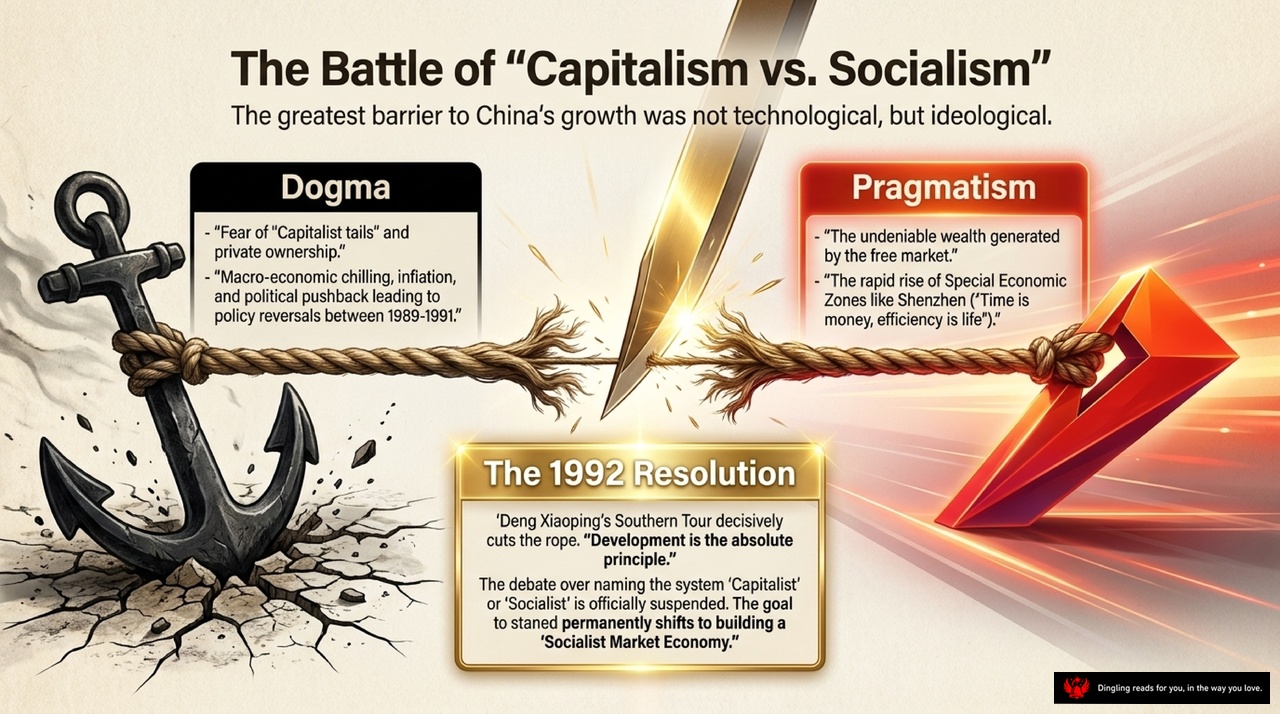
The Battle of "Capitalism vs. Socialism" isn't just a historical debate; it was the defining struggle that determined China's future. As the slide illustrates, the greatest barrier to China's growth wasn't technology, but ideology. On the left, we see "Dogma"—anchored by a heavy anchor representing the fear of "capitalist tails," private ownership, and the macroeconomic chills of the late 80s. This mindset threatened to pull the country back into stagnation.
But on the right, a sharp blade cuts through the rope, symbolizing "Pragmatism." This side embraces the undeniable wealth generated by free markets and the rapid rise of Special Economic Zones like Shenzhen, where the mantra was simple: "Time is money, efficiency is life."
The climax of this battle is the "1992 Resolution." During Deng Xiaoping's Southern Tour, he decisively cut the rope holding the nation back. His famous declaration that "Development is the absolute principle" suspended the endless debate over whether China was becoming capitalist or socialist. Instead, the goal permanently shifted to building a "Socialist Market Economy." This moment didn't just change policy; it liberated a generation of entrepreneurs, allowing the spirit of capitalism to thrive within a socialist framework and setting the stage for the economic explosion that followed.
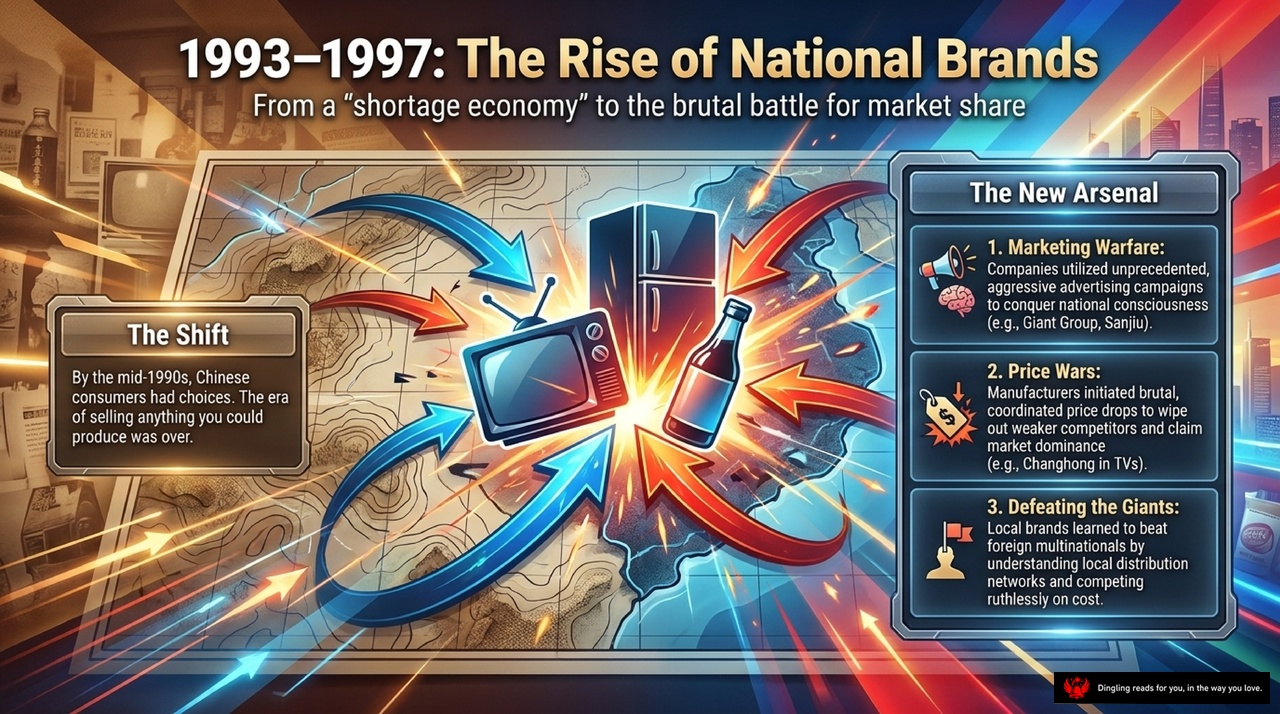
By the mid-1990s, the narrative of China's economy shifted dramatically. We moved away from a "shortage economy" where anything produced could be sold, into a brutal, high-stakes battle for market share. This era, spanning from 1993 to 1997, is defined by the rise of national brands and the birth of a fierce new arsenal for competition.
The shift was driven by three powerful strategies. First, marketing warfare. Companies like Giant Group and Sanjiu launched unprecedented, aggressive advertising campaigns designed to conquer national consciousness. They weren't just selling products; they were selling a sense of identity.
Second, price wars. Manufacturers initiated brutal, coordinated price drops to wipe out weaker competitors. A prime example is Changhong in the TV industry, which used aggressive pricing to claim market dominance. This wasn't just competition; it was a survival of the fittest.
Third, defeating the giants. Local brands learned to beat foreign multinationals by understanding local distribution networks and competing ruthlessly on cost. While global players like GE and Whirlpool struggled with cultural gaps and high costs, Chinese brands like Haier and TCL adapted. Haier built a service network promising repairs within 24 hours, while TCL sold TVs at one-third the price of Japanese brands.
The result was a decisive victory for domestic industry. By 1997, Chinese color TVs held over 71% of the national market. Foreign giants found it nearly impossible to compete. This period proved that with the right mix of cost efficiency, localized service, and patriotic branding, local companies could not only survive but dominate the global stage.

The Hubris of Rapid Expansion: Why the brightest stars of the 90s burned out so quickly. Look at this crumbling tower of cards—it's a perfect metaphor for the era's most ambitious companies. On the left, we see the mechanism of failure: core neglect, unrelated diversification, and capital hemorrhage. These giants abandoned their cash-cow products to chase unrelated industries like real estate and manufacturing without any real expertise. They drained internal cash flows without mature banking support, building empires on shaky ground. On the right, the illusion of invincibility. Empowered by sudden wealth, companies launched multi-front wars. Take Giant Group, originally a software and healthcare leader, which famously attempted to build a 70-story skyscraper purely out of ego, ignoring financial reality. The lesson is stark: a great market opportunity does not guarantee a great company. Survival required a discipline that most first-generation founders lacked. They mistook speed for strategy and scale for stability, forgetting that true resilience comes from focus, not just from the rush to expand.
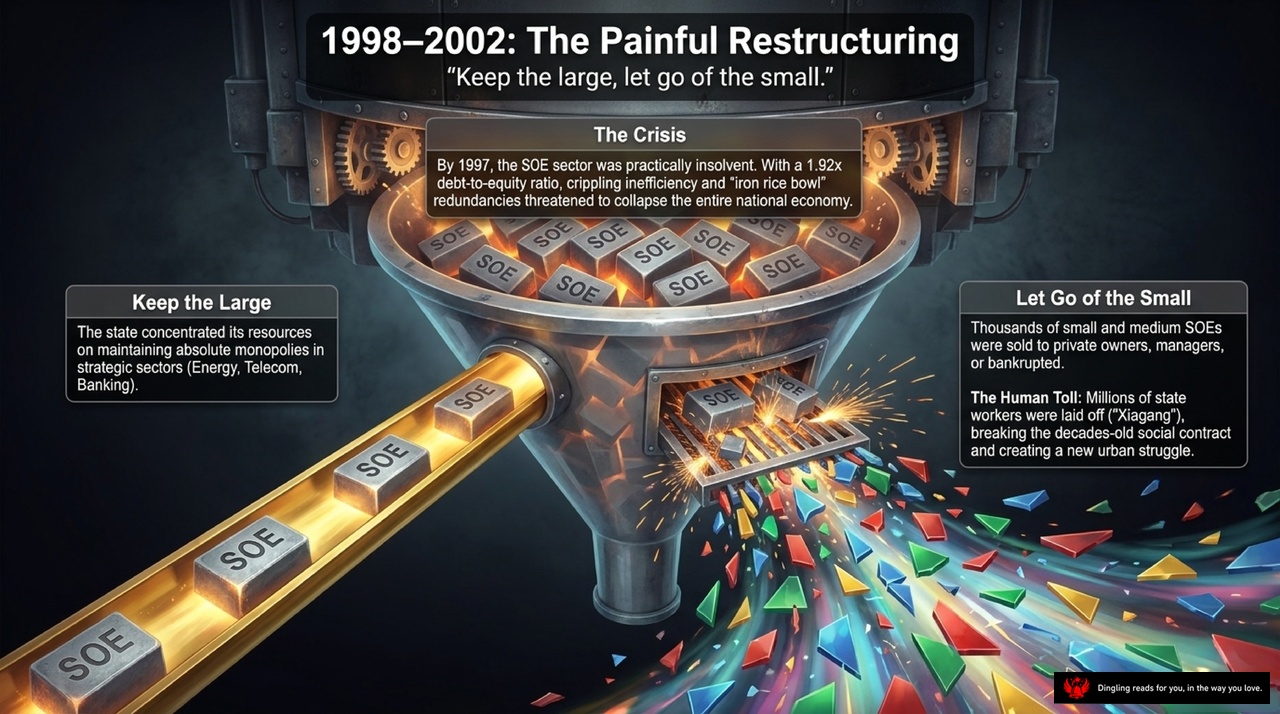
In the late 1990s, China stood at a precarious crossroads. By 1997, the state-owned enterprise sector was practically insolvent, crippled by a massive debt-to-equity ratio and inefficiency that threatened to collapse the entire national economy. The old social contract, often referred to as the "iron rice bowl," had become a burden that could no longer be sustained.
Facing this crisis, the government made a painful but necessary choice: "Keep the large, let go of the small." This strategy involved concentrating resources to maintain absolute monopolies in strategic sectors like energy, telecom, and banking, while selling off or bankrupting thousands of small and medium-sized SOEs. The result was a dramatic reshaping of the economic landscape.
However, the human cost of this restructuring was staggering. Millions of state workers were laid off, breaking the decades-old promise of lifetime employment and creating a new wave of urban struggle. This era of painful restructuring marked a difficult transition, where the old system crumbled to make way for a more competitive, albeit harsher, market reality.
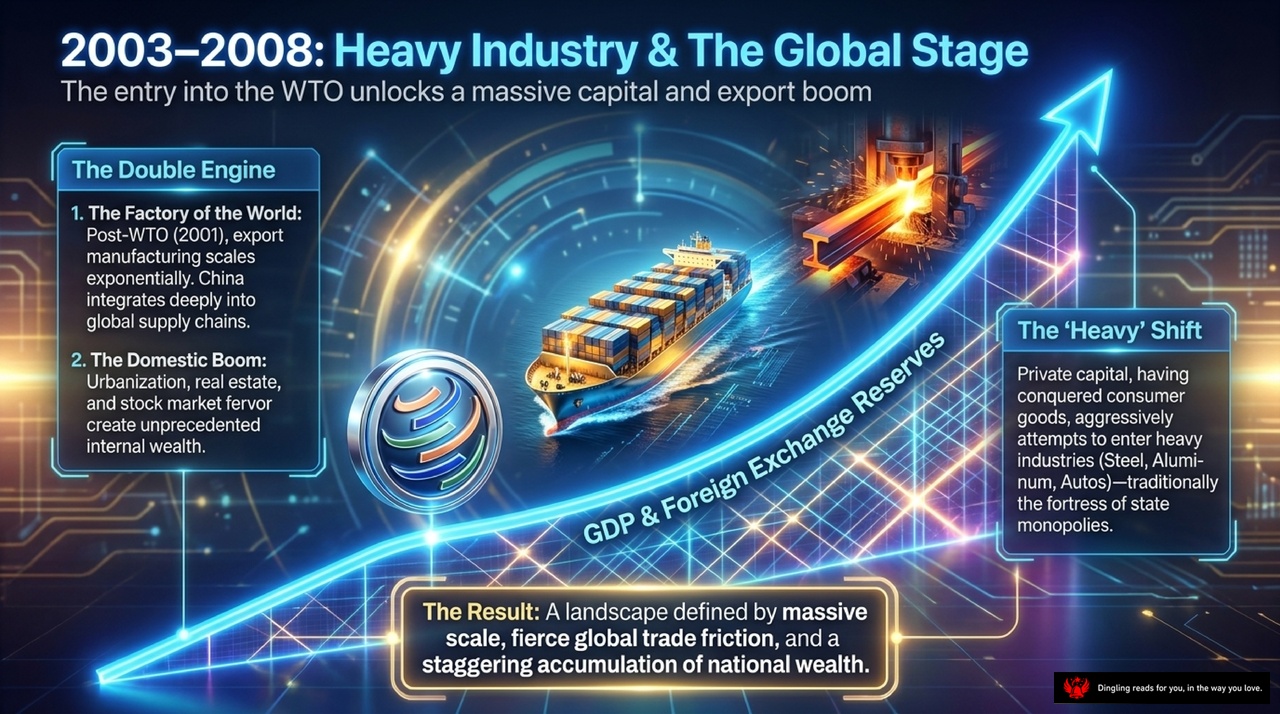
Welcome back. Today, we're diving into a pivotal chapter in China's economic story: the era from 2003 to 2008, a time often described as the "Great Leap." As the slide illustrates, this period was defined by the entry into the WTO, which unlocked a massive capital inflow and triggered an export boom, propelling China onto the global stage.
The graphic highlights what we call "The Double Engine" driving this growth. First, China became "The Factory of the World." Post-2001, export manufacturing scaled exponentially as the nation integrated deeply into global supply chains. Simultaneously, a powerful "Domestic Boom" surged from within. Rapid urbanization, a real estate frenzy, and stock market excitement created unprecedented internal wealth.
But there was another major shift, labeled here as "The 'Heavy' Shift." Private capital, having previously conquered consumer goods, aggressively moved into heavy industries like steel, aluminum, and autos—sectors traditionally dominated by state monopolies. This private sector push, combined with soaring GDP and foreign exchange reserves, created a landscape defined by massive scale and fierce global trade friction.
The result, as our chart shows, was a staggering accumulation of national wealth. However, this rapid ascent wasn't without its challenges. The text reveals that while China's GDP grew at 9.1%, the economy faced a critical bottleneck: upstream energy shortages. The 2003 "electricity crisis" forced cities to cut power, pushing the economy from a light industrial model to a heavy one. This triggered a "heavy industrialization" movement among private firms like Tietben and Fosun, who invested billions in steel and aluminum projects.
Yet, this momentum hit a wall in 2004. The government launched a strict macro-control to cool the overheating economy. This led to the infamous "Tietben Incident," where a massive private steel project was abruptly halted, and its founder arrested. This event, along with the collapse of the Delong Group, exposed the "Glass Door" phenomenon—a metaphor for the barriers that allowed private capital to see opportunities but prevented them from fully entering key sectors.
Amidst this turbulence, giants like Lenovo made historic moves. In 2004, Lenovo acquired IBM's PC business, a risky gamble that eventually made it a global player. By 2007, China's GDP surpassed Germany to become the world's third-largest economy, fueling a surge of national pride. But this boom came at a steep environmental cost. By 2007, China consumed 40% of the world's coal and 48% of its cement, leading to severe pollution crises like the 2007 Taihu Lake algae bloom.
So, this era was a double-edged sword: it delivered incredible wealth and global status, but it also left China with a high-carbon legacy and structural challenges that would define the next decade.
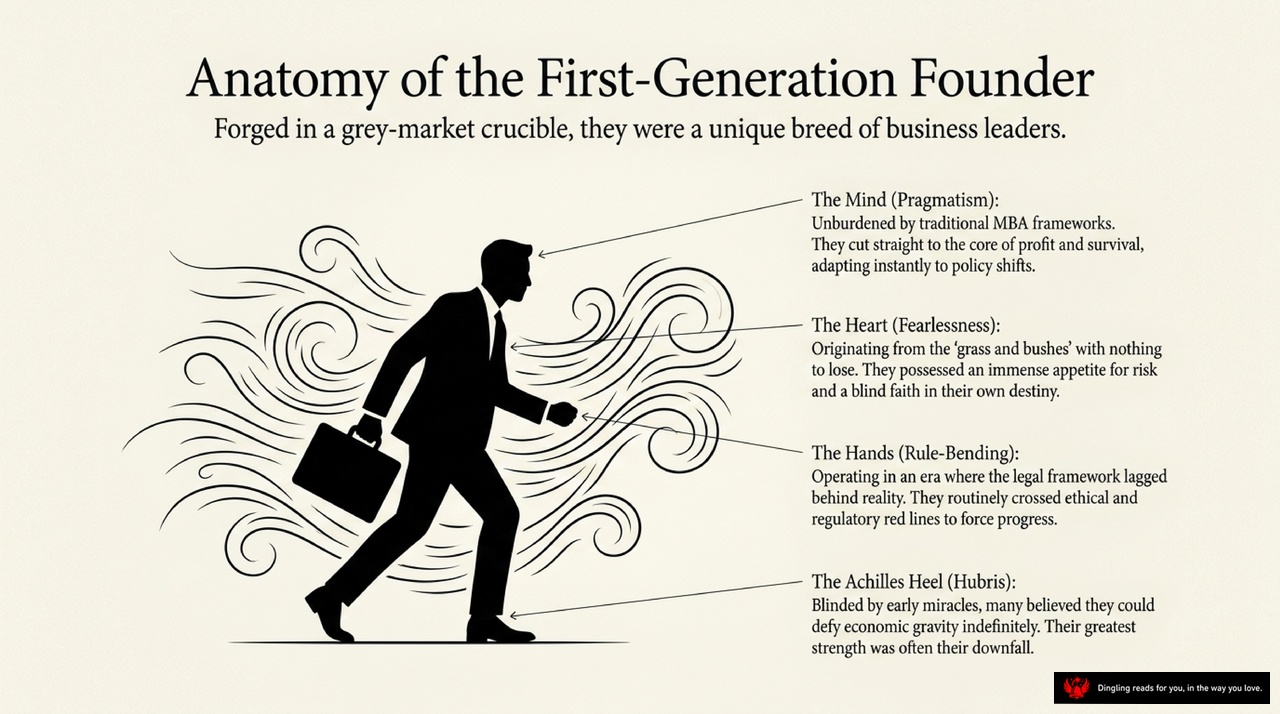
Today's slide breaks down the "Anatomy of the First-Generation Founder," a unique breed of business leaders forged in China's grey-market crucible during the chaotic 1978 to 1983 era. These pioneers weren't shaped by traditional MBA frameworks; instead, their pragmatic mindset cut straight to the core of profit and survival, adapting instantly to a rapidly shifting policy landscape.
Their heart was defined by an unshakeable fearlessness. Originating from humble beginnings with literally nothing to lose, they possessed an immense appetite for risk and a blind faith in their own destiny, often crossing ethical and regulatory red lines simply to force progress in an era where the legal framework lagged far behind reality.
However, this same drive carried a dangerous Achilles' heel: hubris. Blinded by early miracles and rapid success, many believed they could defy economic gravity indefinitely. Tragically, their greatest strength—their audacity—often became their downfall, as they underestimated the limits of the system they were trying to reshape.

Today's slide reveals a critical trap that many developing nations fall into: "The Curse of the Latecomer." While double-digit economic growth looks impressive on paper, it often masks a dangerous illusion. The image on the left shows the "Easy Path"—technological imitation. It's tempting. Developing countries can achieve rapid, visible wealth simply by copying Western technology, manufacturing processes, and management models. It feels like a shortcut, a way to catch up without doing the hard work.
But look at the right side. That's the "Hard Path": Institutional Reform. This is the true foundation of a durable economy. It requires the rule of law, clear property rights, and fair market governance. These are the invisible pillars that hold a society together. The danger, as highlighted at the bottom, is using technological imitation as an excuse to delay these painful reforms. When the state acts as both the "referee and player," rapid short-term growth becomes a smokescreen. It hides deep, systemic vulnerabilities that will eventually crash the entire system. In short, copying the rules of the game might get you a quick score, but only building the game itself ensures you can win in the long run.
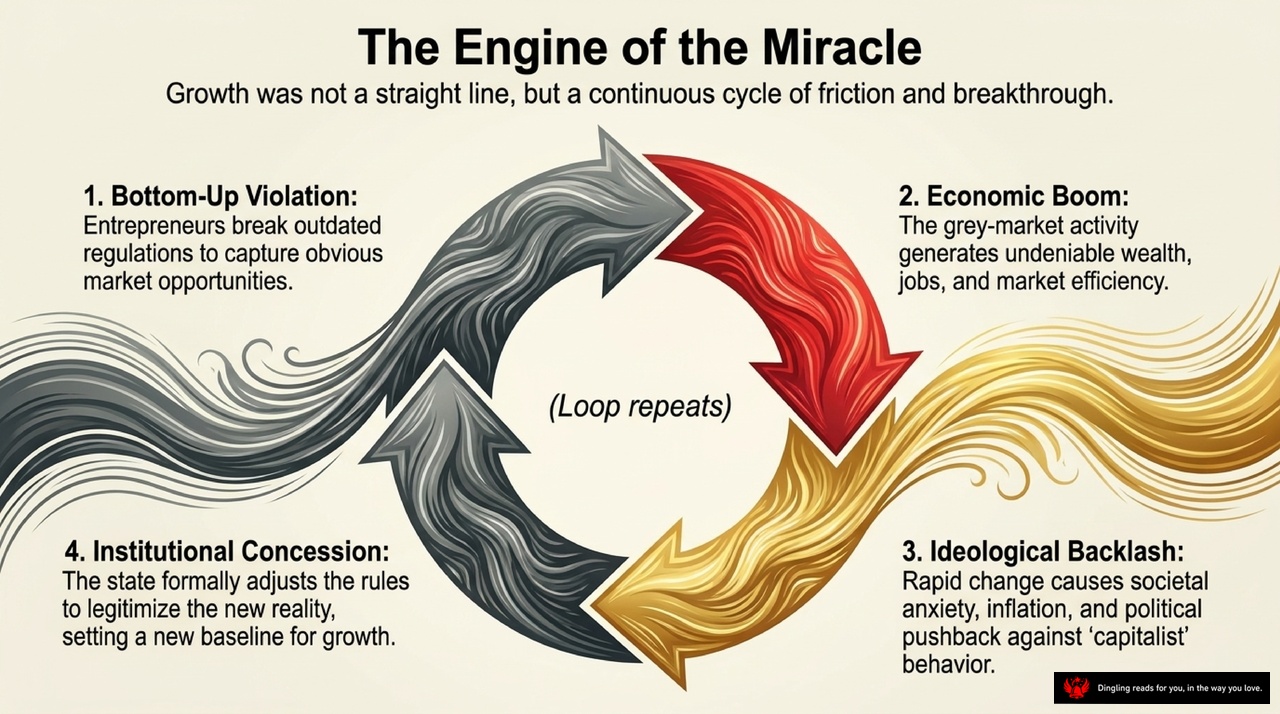
The Engine of the Miracle is not a straight line; it's a relentless cycle of friction and breakthrough. Look at this loop: it starts with **Bottom-Up Violation**, where entrepreneurs boldly break outdated regulations to seize obvious market opportunities. That risky energy then fuels an **Economic Boom**, generating undeniable wealth, jobs, and efficiency. But rapid change inevitably triggers an **Ideological Backlash**, sparking societal anxiety and political pushback against what critics call 'capitalist' behavior. In response, the state eventually makes an **Institutional Concession**, formally adjusting the rules to legitimize the new reality and set a higher baseline for growth. Once the rules are rewritten, the cycle repeats. This is how China's miracle was built—through constant tension between breaking the old order and building the new one.

Look at this summary on the screen. It tells the story of China's last three decades: a rigid, impoverished nation didn't become a global economic titan through perfect planning. Instead, it transformed through the relentless, pragmatic, and often chaotic struggles of millions of individuals who dared to break the rules in pursuit of a better life.
We have proven our ability to generate unprecedented wealth through sheer survival instinct and imitation. But the real question remains: do we have the institutional wisdom and moral restraint to build a sustainable, respected civilization from it?
This slide captures the essence of the journey we've documented. From the early days of breaking old rules to the current challenges of building a mature society, the path has been defined by bold action, but the future demands wisdom. We created wealth by doing what others wouldn't dare to do, but now the test is whether we can do the right things. The era of chaotic growth is over; the era of responsible leadership is just beginning.