
Ultralearning: Complete Chapter-by-Chapter Summary
Welcome to "Ultralearning" by Scott H. Young. Imagine mastering hard skills, outsmarting the competition, and accelerating your career through aggressive, self-directed learning. This isn't just about working harder; it's about learning smarter. The book explores how superlearners use targeted strategies to achieve what once seemed impossible, proving that with the right methods, anyone can unlock their potential.

The Era of Average is Over. Today, we're looking at a fundamental shift in how the economy works, and why your old playbook for success might no longer apply.
As the slide illustrates, we are living in a time of Economic Polarization. Technology and automation are hollowing out mid-level skills, heavily rewarding high-skill operators instead. It's a simple reality: if you want to thrive, you need to be at the top of the curve, not stuck in the middle.
This creates a massive pressure on our Educational Inflation. Traditional degrees are yielding rapidly diminishing returns against skyrocketing tuition costs. You can spend years and thousands of dollars in a classroom, only to find your degree doesn't match the skills the market actually demands.
But there is a third pillar driving this change: the Technological Frontier. Infinite knowledge is freely accessible online, yet the frameworks required to master it remain rare. Anyone can read the data, but few know how to synthesize it into true expertise.
This is where the "Super Learner" mindset becomes your competitive advantage. Instead of waiting for a degree or hoping for an average outcome, you take control. You leverage technology to bypass the noise, focus on high-skill mastery, and build the kind of core competency that automation can't touch. The era of the average is over; the era of the exceptional self-taught expert is here.

Look at this blueprint for "The Paradigm Shift." It visualizes the massive gap between how we've traditionally learned and how we *should* learn in today's world.
On the left, you see **Traditional Education**. It's rigid. The pacing is standardized and slow, dictated by an institution rather than you. The environment is often an artificial classroom, completely decoupled from the real world. Feedback is delayed—you might wait weeks for a grade, only to realize you've been practicing wrong for that long. And the objective? It's mostly about passively accumulating knowledge.
Now, look at the right side: **Ultralearning**. This is the shift. The pace becomes intense, self-directed, and aggressive. You control the speed. The environment moves directly into real-world application contexts; you learn by doing, not by watching. Feedback is immediate, high-velocity, and corrective—you fix mistakes the moment they happen. Finally, the objective changes from just knowing facts to mastering skill execution, intuition, and true mastery.
This isn't just a minor update; it's a complete overhaul of the learning machine. Instead of waiting for permission to learn or hoping for a delayed grade to tell you where you went wrong, ultralearning puts you in the driver's seat, giving you the tools to master skills in a fraction of the time it used to take.

Look at this blueprint of the "9-Principle Engine." This isn't just a diagram; it's the complete operating system for becoming a super-learner. It maps out exactly how you move from a novice to an expert in any field, broken down into three distinct phases.
First, we have **Phase 1: Architect**. Before you even start building, you need to lay the structural map. This is where you engage in metalearning and focus. You define your goals, understand the underlying logic of the skill, and create a roadmap. You aren't just jumping into the deep end; you are designing the pool first.
Next is **Phase 2: Execute**. This is the engine room, the active, high-intensity learning loop. Here, you apply the principles of directness, drill, feedback, and retrieval. You aren't passively consuming information; you are actively testing yourself, making mistakes, getting immediate feedback, and drilling until the skill becomes automatic. It's the hard work where the real transformation happens.
Finally, we reach **Phase 3: Transcend**. Once you've built the map and executed the drills, you move to securing long-term memory and achieving unique expertise. This is where retention, intuition, and experimentation take over. You stop just knowing the facts and start developing a gut feeling for the subject, allowing you to solve problems creatively that you've never seen before.
This cycle repeats, pushing you further. It proves that mastery isn't magic; it's a structured process. By architecting your path, executing with intensity, and transcending into intuition, you unlock the ability to master anything.
Let's talk about how we actually learn. Most of us think learning is just about sitting down, reading a book, and memorizing facts. But what if that's completely wrong? The real secret to mastering any skill lies in a specific, often overlooked strategy called "Retrieval Practice."
Imagine your brain is like a library. If you just read the books on the shelf over and over, you might recognize the titles, but you won't be able to find the specific information you need when you walk out the door. That's the trap of passive studying. It feels easy in the moment, but it fails when it counts.
The solution is to stop reading and start recalling. Instead of checking your notes, close the book and try to write down everything you remember. This might feel frustrating, right? You'll feel like you're blanking out. But that struggle is actually where the magic happens. Psychologists call this "desirable difficulty." The act of forcing your brain to fish for information strengthens the neural pathways far more than simply re-reading them.
Think about the difference between a multiple-choice test and an open-ended essay. The multiple-choice option gives you a clue, making it too easy. The essay forces you to retrieve the answer from scratch, creating a much deeper memory. This is why "free recall"—trying to remember everything without hints—is so powerful. It builds a robust mental map that you can navigate under pressure.
So, how do you apply this tomorrow? Stop highlighting every sentence. Instead, turn your notes into questions. After a lecture or a chapter, close the material and ask yourself: "What were the three main points?" or "How does this concept work in real life?" If you get stuck, that's your signal to go back and study that specific gap.
This isn't just about cramming for an exam. It's about building a skill that lasts. Whether you're learning a language, coding, or fixing an engine, the moment you stop consuming information and start pulling it out of your head, you're actually learning. It's a simple shift from passive consumption to active construction, and it's the most effective way to turn knowledge into true mastery.
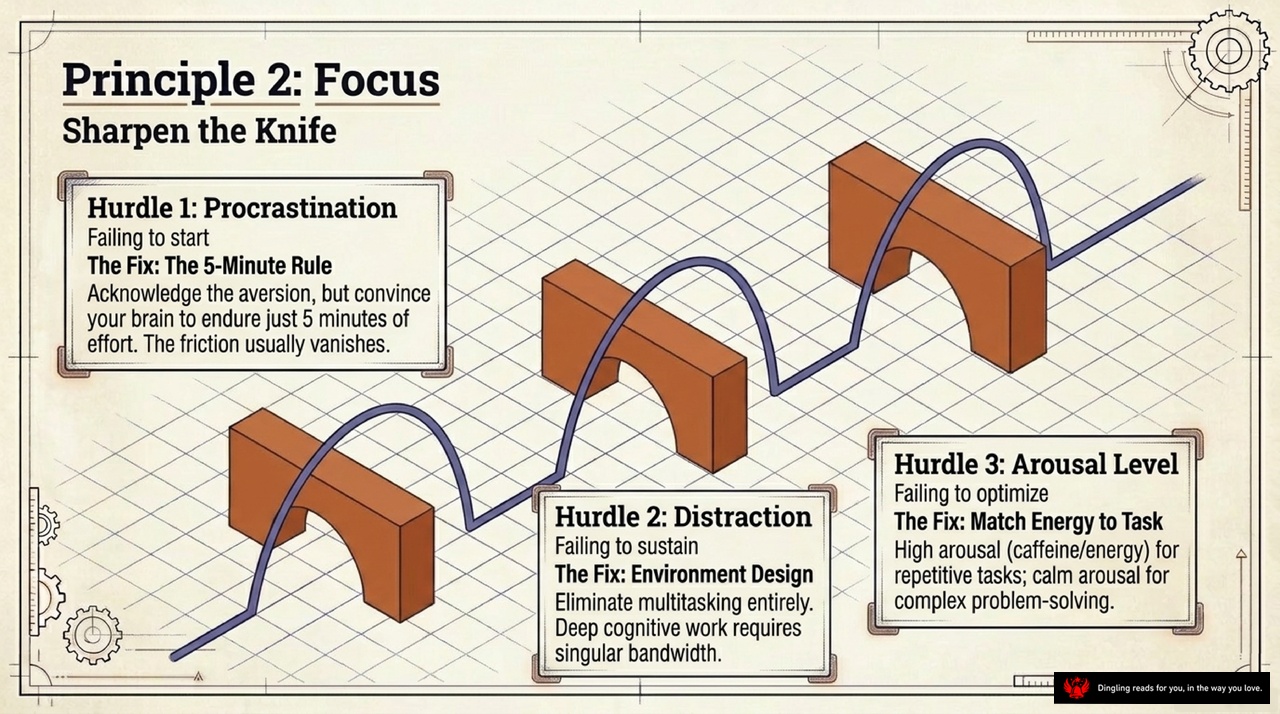
Principle 2: Focus. Think of your brain as a razor-sharp knife; without focus, it's dull and useless. But even with the sharpest tool, three hurdles stand in your way.
First, you have Procrastination. You fail to start because the task feels too heavy. The fix? The 5-Minute Rule. Just tell yourself you'll work for five minutes. Acknowledge the dread, but convince your brain to endure just that short burst. Usually, the friction vanishes, and you'll keep going.
Next comes Distraction. You fail to sustain your effort because your environment is full of noise or you're trying to multitask. The solution is Environment Design. Eliminate distractions entirely. Deep cognitive work requires singular bandwidth; you can't split your attention between a complex problem and a phone notification.
Finally, there's the Arousal Level. You fail to optimize because you're either too calm or too wired for the task at hand. Match your energy to the task. Use high arousal, like caffeine, for repetitive grunt work. But switch to a calm state for complex problem-solving. By managing these three hurdles, you sharpen the knife and unlock your true potential.
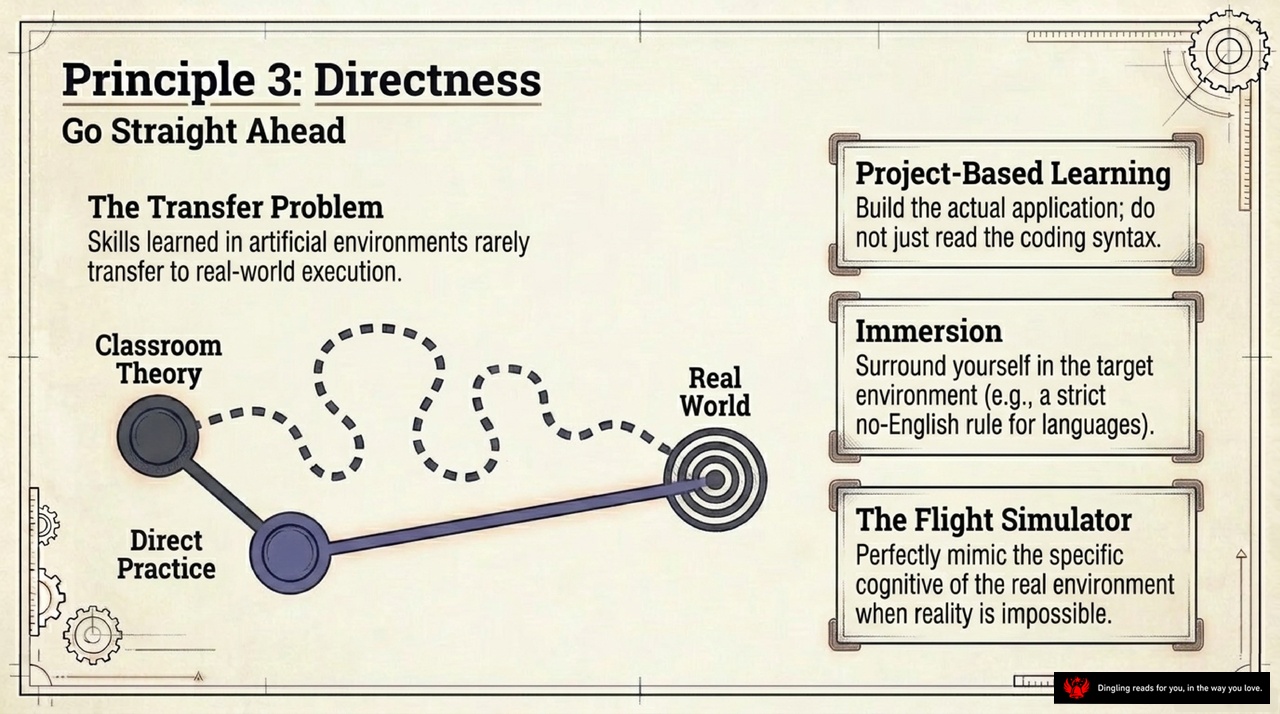
Look at this slide. It introduces "Principle 3: Directness," which simply means going straight ahead to the real world. The core problem here is the "Transfer Problem." We often learn skills in artificial, safe environments like classrooms, but those skills rarely translate to real-world execution. That dotted, winding line from "Classroom Theory" to "Real World" shows exactly how inefficient that gap can be.
So, how do we bridge it? The slide offers three powerful strategies. First is Project-Based Learning. Instead of just reading code or theory, you build the actual application. You learn by doing, not by watching. Second is Immersion. You surround yourself in the target environment. Think of language learners who enforce a strict no-English rule, or developers joining open-source teams. You need to be in the arena. Third is The Flight Simulator. When reality is impossible to access, you build a simulation that perfectly mimics the specific cognitive challenges of the real environment. You train the decision-making and judgment, not just the visuals.
The goal is to replace that long, winding dotted path with a direct, straight line. By practicing in the real context or a high-fidelity simulation, you ensure your skills transfer seamlessly when it matters most.
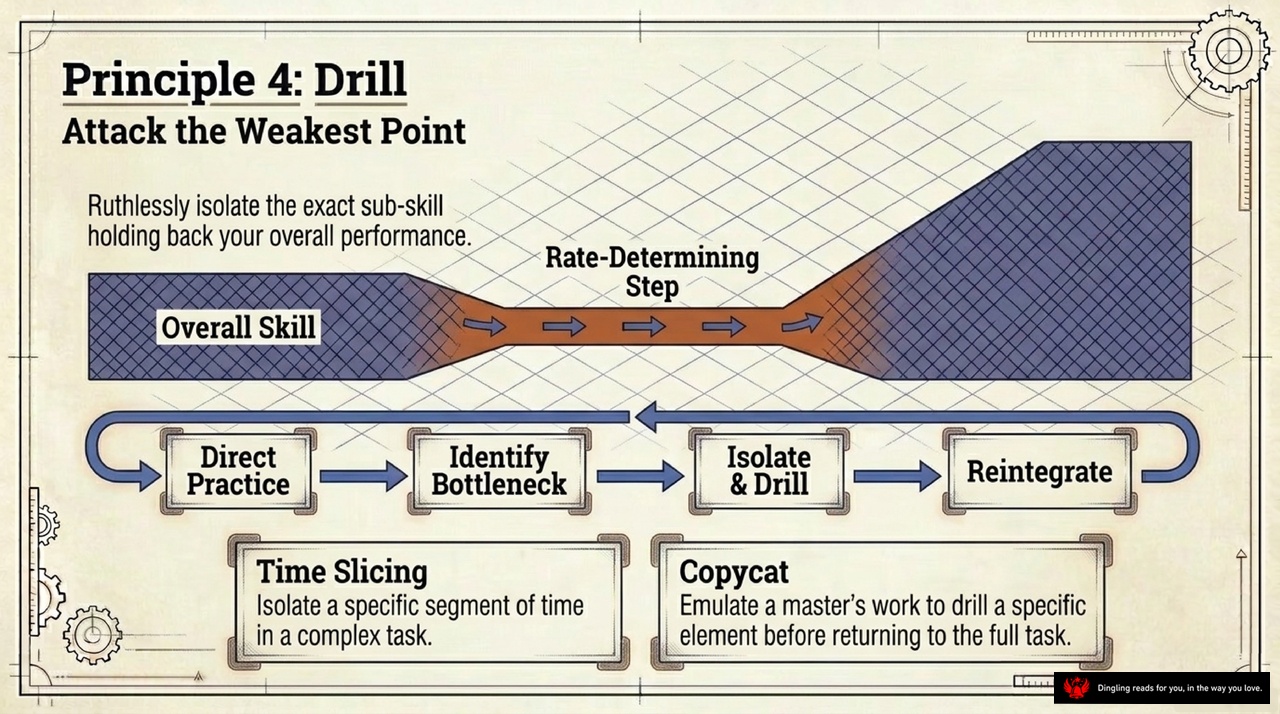
Look at this flowchart. It's all about Principle 4: Drill. The core idea here is simple but ruthless: attack your weakest point.
Instead of grinding through an entire skill like a marathon runner, you need to identify that specific "Rate-Determining Step"—the exact sub-skill holding you back. Think of it as finding the narrowest part of a funnel; that's where everything gets stuck.
The process starts with Direct Practice to see where you fail, then you Identify the Bottleneck. Once you've pinpointed it, you Isolate and Drill that specific element. You might use "Time Slicing" to focus on just one segment of a task, or the "Copycat" method to emulate a master's work on that specific detail before you Reintegrate it back into the full skill.
This isn't just about repetition; it's about precision. By ruthlessly isolating the exact thing stopping your progress and drilling it until it's solid, you turn your biggest weakness into your strongest asset. That is the power of drilling.
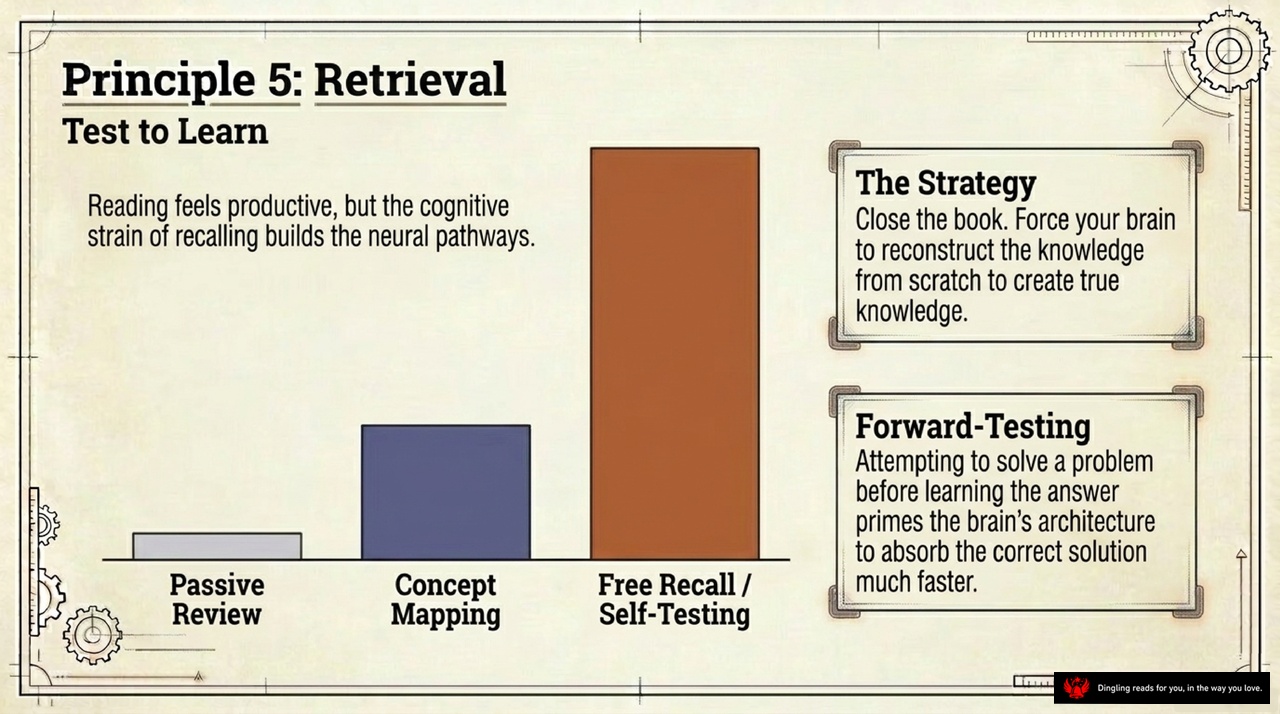
Principle 5 is all about Retrieval, and the core idea is simple but powerful: Test to Learn. As the slide shows, while passive review feels productive, it actually builds very weak neural pathways. The real cognitive strain comes from forcing your brain to recall information from scratch. This active struggle is what actually creates strong, lasting memory.
Look at the bar chart comparing different study methods. Passive review yields the lowest results, concept mapping is better, but free recall or self-testing produces the highest impact. The strategy here is to close the book and force your brain to reconstruct the knowledge itself. This might feel difficult, but that difficulty is exactly what you need.
There's also a concept called Forward-Testing. This means attempting to solve a problem before you've even learned the answer. It primes your brain's architecture, making it ready to absorb the correct solution much faster once you see it. So, stop just reading and start testing yourself. That's the key to unlocking true mastery.

Here is the spoken-word script for Slide 9, tailored for an American audience:
"Look at this diagram on the right. It perfectly illustrates why we must stop dodging feedback. The outer rings represent 'Noise' and 'Ego-Validation'—that comforting but useless praise we often crave. But right in the center is the 'Actionable Signal.' That's where real growth happens.
Principle 6 is simple: Don't Dodge the Punches. Feedback is raw information, not a validation of your ego. You need to seek it rapidly and intensely. The slide breaks this down into three layers. First, Outcome Feedback tells you if you won or lost. Second, Informational Feedback reveals exactly what you did wrong. And the most critical one? Corrective Feedback. That's the answer to how you fix the specific error. It's the ultimate accelerator.
Notice the warning at the bottom? Overly positive feedback actually stagnates growth. Highly unpredictable, difficult feedback drives maximum learning adaptation. Think about it: if you only hear 'Great job,' you never know what to improve. But if you face a tough critique, you get a clear signal on how to adjust.
Super-learners embrace this. They know that fear of criticism is just fear of discomfort. But once you face it, the fear vanishes, and your progress skyrockets. So, stop hiding from the hard stuff. Dive straight into the center of that target and extract those actionable signals. That's how you turn noise into mastery."

Imagine your brain as a bucket with a massive hole in the bottom. Every time you learn something new, information pours in, but without aggressive countermeasures, the Ebbinghaus Forgetting Curve ensures it leaks out almost immediately. You might cram for an exam, feel like you've mastered the material, only to forget it all by next week. This is exactly why we say: don't fill a leaky bucket. You need four specific plugs to stop the water from escaping.
First, plug the bucket with Spacing. Instead of pouring all your knowledge in at once, distribute your learning sessions over time. Spaced repetition fights the natural decay of memory, turning fragile short-term facts into solid long-term knowledge.
Next, use Proceduralization. Think of the difference between knowing how to ride a bike and just knowing the theory about it. You need to turn declarative facts into automatic physical and mental habits. When a skill becomes second nature, it no longer requires conscious effort to remember.
Then, apply Overlearning. This means pushing your competence one level above your target goal. If you just stop when you reach a passing grade, you're still in the danger zone. By continuing to practice until the basics become unbreakable, you create a safety buffer against forgetting.
Finally, use Mnemonics for those rigid, hard-to-remember facts. When logic fails, use intense visual associations. Create vivid mental images or stories that link abstract concepts to something your brain can easily visualize and recall.
By combining these four plugs—Spacing, Proceduralization, Overlearning, and Mnemonics—you transform your brain from a leaky bucket into a reservoir capable of holding complex knowledge for the long haul.

Let's talk about how we actually build true expertise. It starts with a simple but often overlooked rule: dig deep before you build anything. Too many of us fall into the trap of confusing memorizing a name with understanding a concept. We fool ourselves into thinking we know something just because we can recite it, but that's fragile. Real intuition requires you to confront your ignorance directly.
That's exactly what the Feynman Technique is all about. It's a loop designed to expose the gaps in your knowledge. First, you write down the target concept on a blank page. Then, you try to explain it out loud as if you're teaching a beginner or a child. If you stumble, get confused, or find yourself using jargon to hide your ignorance, that's your signal. You've found a blind spot.
So, you go back to your source material to patch that specific hole, and then you repeat the process. This cycle forces you to move from shallow, fragile understanding to deep, robust mastery. As the slide warns, shallow understanding breaks easily under pressure, but deep understanding stands the test of time. Don't just memorize the steps; make sure you truly understand the underlying principles before you try to apply them.
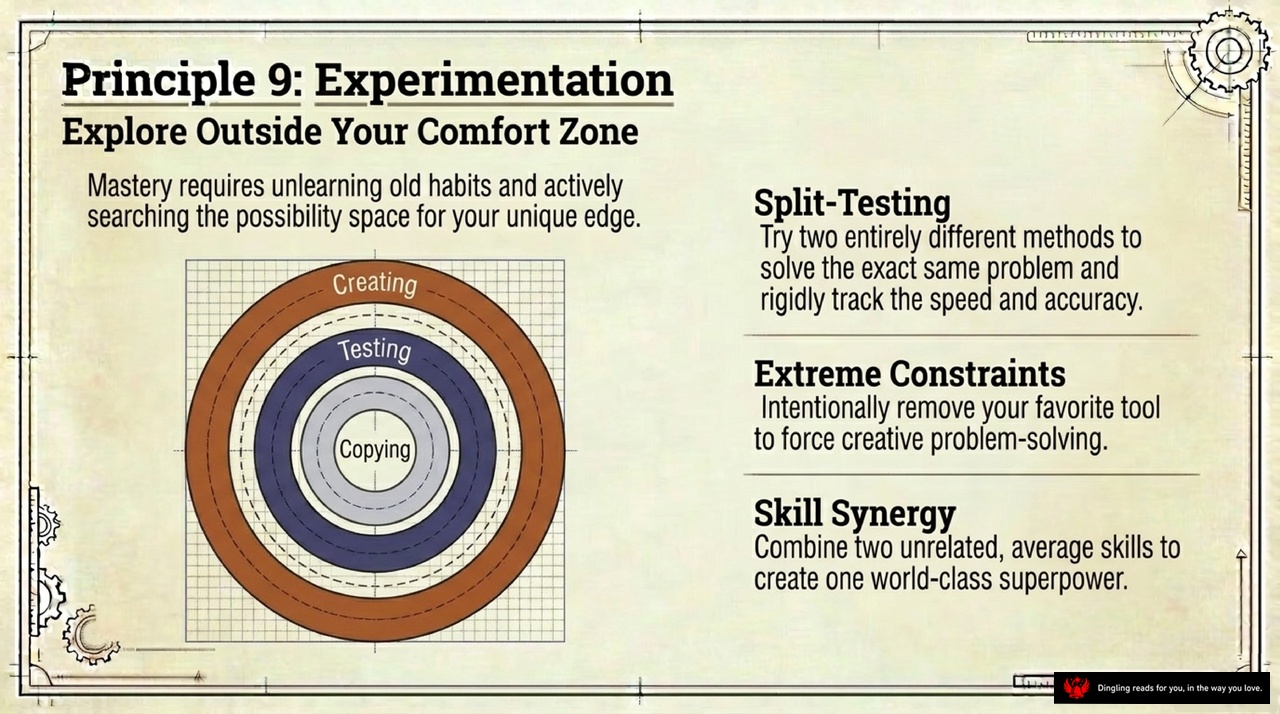
Principle 9 is all about stepping out of your comfort zone to unlock true mastery. As the slide suggests, mastering a skill isn't just about repeating what you know; it's about actively searching for your unique edge by unlearning old habits.
Think of learning as a set of concentric circles. At the center is **Copying**—passively absorbing information. Moving outward, you enter **Testing**, where you validate what you've learned. And finally, at the outermost ring, is **Creating**, where you generate something entirely new. To reach that outer layer, you have to push beyond the safety of the inner circles.
So, how do we actually do that? The slide outlines four powerful strategies. First, try **Split-Testing**. Instead of sticking to one method, try two completely different approaches to solve the exact same problem, and rigorously track which one is faster and more accurate. Second, embrace **Extreme Constraints**. Intentionally remove your favorite tool or resource. By forcing yourself to solve a problem without your usual crutches, you trigger creative problem-solving that wouldn't happen otherwise.
Third, look for **Skill Synergy**. This is about combining two unrelated, average skills to create a world-class superpower. You don't need to be the best at both things; just finding the right intersection can give you a competitive advantage. Finally, remember that this entire process is driven by **Experimentation**. Don't fear failure; treat every attempt as data. By exploring outside your comfort zone and applying these strategies, you stop just learning and start innovating.
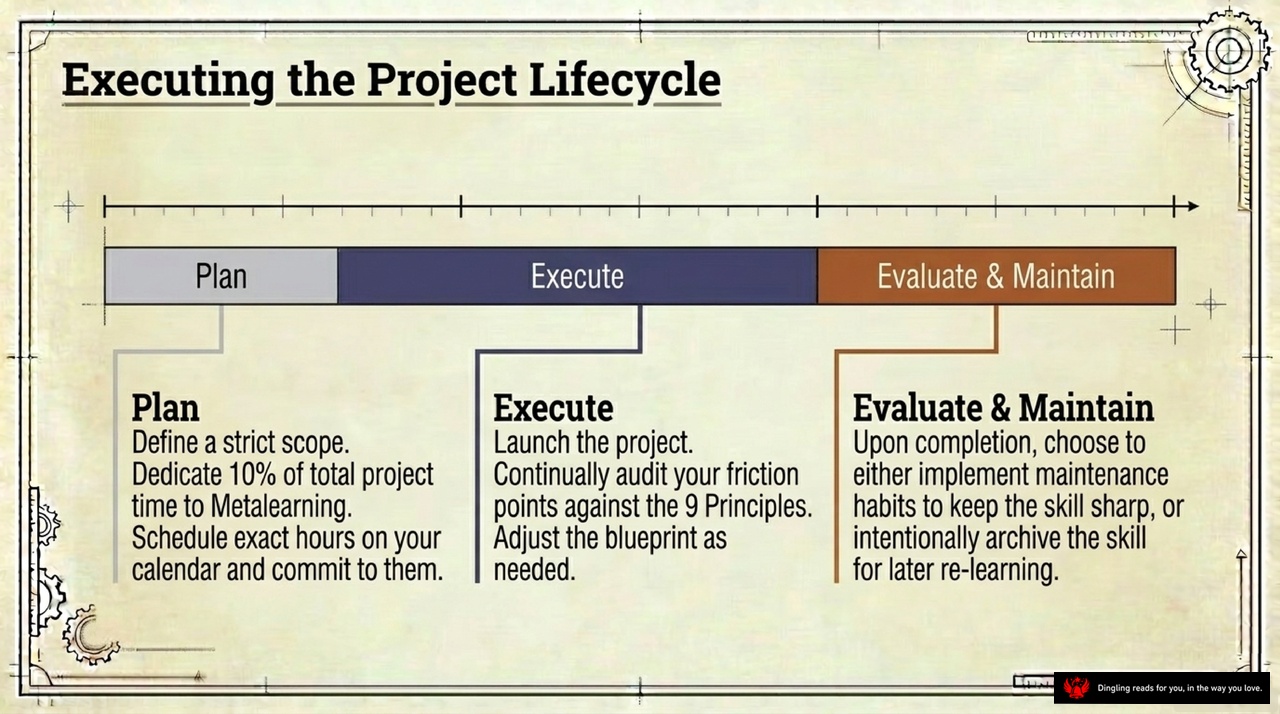
Today's slide breaks down the entire Superlearning lifecycle into three distinct phases: Plan, Execute, and Evaluate & Maintain. Think of this not just as a project timeline, but as the rhythm of your own growth.
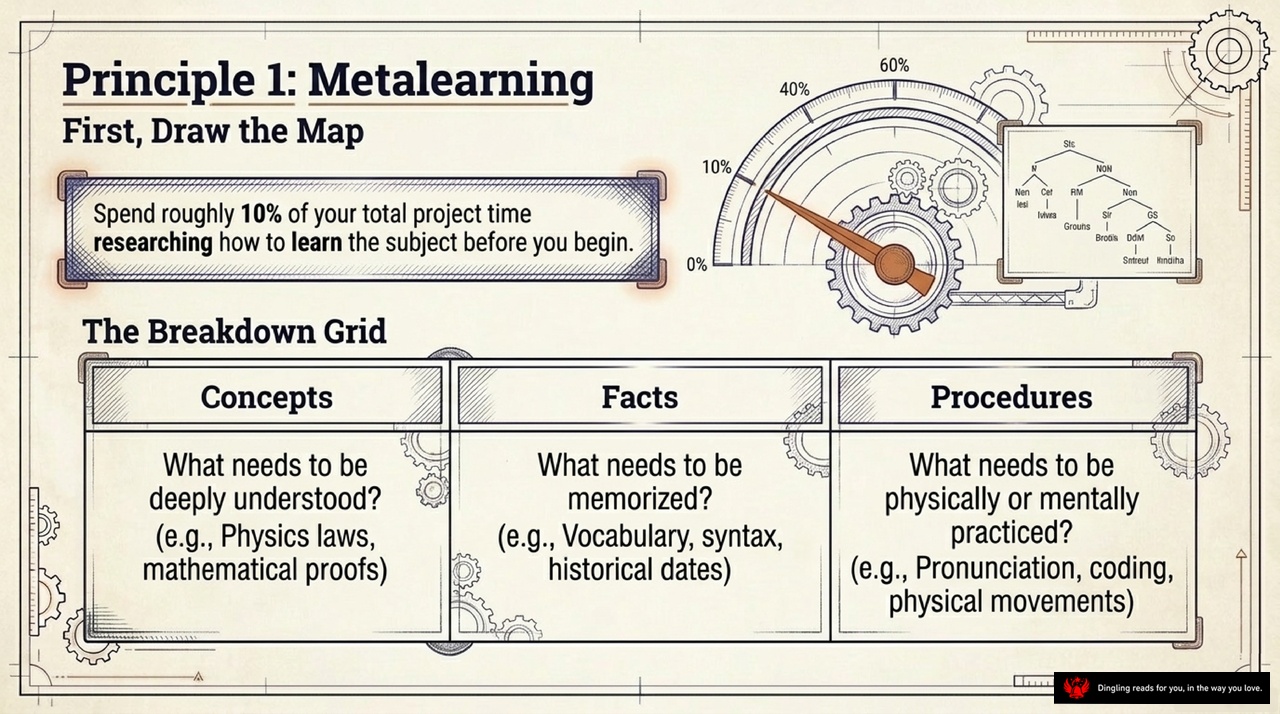
First, we have the **Plan** phase. This is where you define a strict scope and commit to the process. The slide highlights a crucial rule: dedicate 10% of your total project time to "Metalearning." This means you aren't just learning the material; you are learning *how* to learn it. You schedule exact hours on your calendar, turning your study sessions from optional tasks into non-negotiable commitments.
Next is the **Execute** phase, which takes up the bulk of your timeline. Here, you launch the project and keep the momentum going. The key is to continually audit your "friction points"—those moments where you get stuck—against the nine Superlearning Principles. You adjust your blueprint as needed, treating every obstacle as data for improvement rather than a reason to quit.
Finally, we reach **Evaluate & Maintain**. Once the project is complete, you face a choice. Do you implement maintenance habits to keep that skill sharp for the long haul, or do you intentionally archive the skill for later re-learning? This decision ensures you don't waste time on things you don't need, while preserving your core competencies. By cycling through these three stages, you turn every learning project into a permanent upgrade to your capabilities.
Ultralearning is not a genetic gift; it is an engineered strategy. By aggressively mapping domains, stripping away passive illusions, and embracing the discomfort of direct retrieval and brutal feedback, anyone can accelerate their mastery of complex skills.
Think about it: what if the gap between "good" and "great" wasn't about raw talent, but about the specific strategies you choose? The world is shifting. In an era where the speed of your learning dictates the ceiling of your success, the old rules no longer apply. You can't just rely on a degree or a lucky break anymore.
So, when you look at your own career or personal goals, ask yourself: what will you choose to master next? Don't wait for inspiration. Design your path. Pick a skill, apply these engineered principles, and build the future you want, one mastered skill at a time.