
Understanding Human Nature: Complete Chapter-by-Chapter Summary
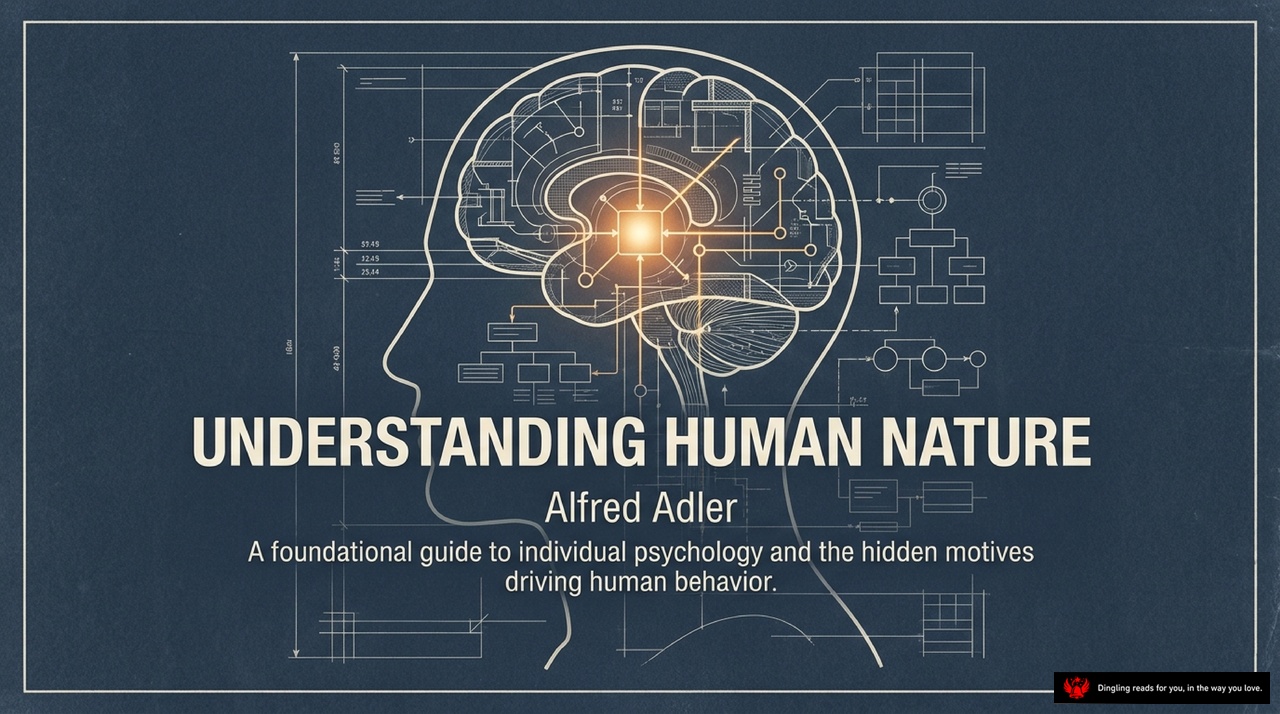
Welcome to our deep dive into "Understanding Human Nature" by Alfred Adler. This isn't just another book about psychology; it's a foundational map for decoding the hidden motives that drive every single one of us.
Look at that brain diagram in the center. It represents the core idea of this book: human behavior is never random. Every action, every thought, and every feeling is a strategic move toward a specific goal. We are not isolated islands of emotion; we are social creatures constantly trying to navigate our way through life.
Adler argues that to truly understand someone, you have to look beyond their surface behavior. Are they acting out? Are they withdrawing? The answer lies in their "life style"—the unique pattern of thinking and acting they built from childhood. It's about how they pursue a sense of superiority to overcome their innate feelings of inferiority.
This book serves as a practical guide. It teaches us that mental health isn't about being perfect, but about finding our place in the community. By understanding these hidden drivers, we stop blaming people for their actions and start helping them find a more constructive path. Whether you are a parent, a teacher, or just trying to understand yourself better, this framework offers a powerful lens to see the world clearly. Let's begin this journey into the mind.

The mind isn't a static thing sitting in your head; it's a powerful engine designed for movement. Look at this diagram: it starts with a chaotic burst of raw psychic elements—our thoughts, feelings, and memories—and channels them through the obstacles of life, ultimately converging on a single, unifying goal.
This visual perfectly captures the core of Individual Psychology: we are not isolated parts, but a system built for continuous adaptation. Every psychological phenomenon, from a fleeting thought to a deep-seated fear, is integrated and directed toward that one destination. Think of it this way: just as a car needs a unified vector to reach a destination, your entire psyche is working in concert to achieve a specific life goal.
If you feel scattered or confused, it's often because you're looking at your thoughts as random fragments. But the truth is, even your doubts and fears are serving a purpose. They are part of your system's attempt to navigate life's obstacles and reach that unifying goal. By understanding that your mind is an organ of movement, you stop fighting your own internal chaos and start aligning your energy toward where you're actually trying to go.

We often hear that human progress is driven by our inherent physical weakness. But what if that feeling of inferiority isn't a disease to be cured, but actually the very engine of our development? As the chart illustrates, we all start in what we call the "Minus Zone"—a state of infantile weakness and dependency. From this low point, a critical fork in the road appears. One path leads to healthy compensation, fueled by courage and adaptation, where we rise steadily to overcome our limitations. The other path spirals into the inferiority complex, a chaotic cycle of overcompensation and neurosis that traps us in anxiety. The text reminds us that this feeling is the universal catalyst for all human striving. Our minds are constantly trying to compensate for vulnerability. The difference lies in our choice: do we develop tools to adapt and connect with others, or do we develop a desperate, neurotic striving for power? Ultimately, human progress is not about ignoring our fragility, but using it as the fuel to build a stronger, more connected life.
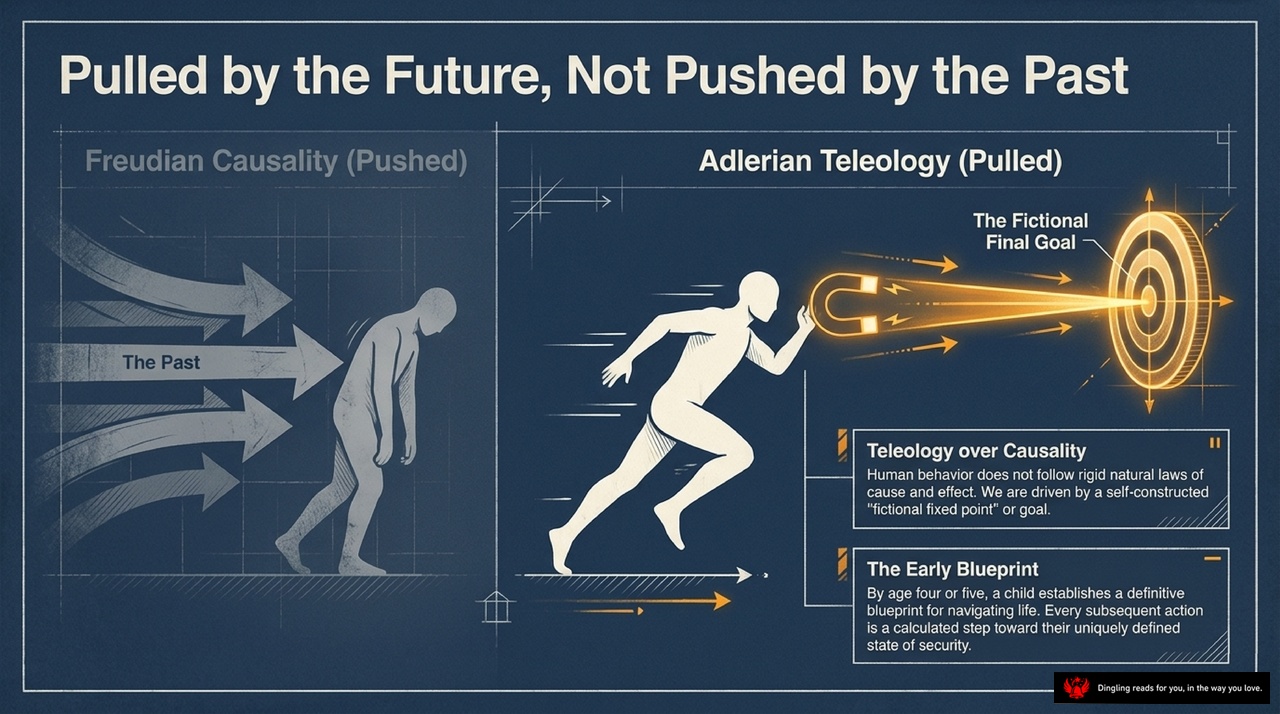
Imagine a person walking forward, but instead of being pulled by a magnet ahead of them, they are being pushed by a heavy wind coming from behind. On the left side of our slide, we see this exact scenario labeled "Freudian Causality." Here, the past is the driver. The arrows labeled "The Past" are pushing the individual, forcing them to react to what has already happened. This creates a person who is bent over, weighed down by history, constantly trying to fix old mistakes or escape old traumas. They are a prisoner of their backstory.
Now, look at the right side. This is "Adlerian Teleology," and the logic is completely different. Instead of being pushed, this person is being pulled. Notice the glowing target ahead, labeled "The Fictional Final Goal." This isn't a guaranteed outcome; it's a self-constructed idea of where they want to go. This is the concept of Teleology over Causality. Human behavior doesn't follow rigid cause-and-effect laws like physics; instead, we are driven by a future goal. We act now based on what we believe our life is heading toward.
The slide also highlights "The Early Blueprint." By the time a child is four or five, they establish a definitive plan for navigating life. Every step they take becomes a calculated move toward that unique state of security or superiority they have imagined. If you are stuck in the past, you are reacting. But if you are pulled by the future, you are creating. We aren't defined by our childhood scars, but by the goals we choose to chase today. So, stop asking what happened to you, and start asking where you are going.
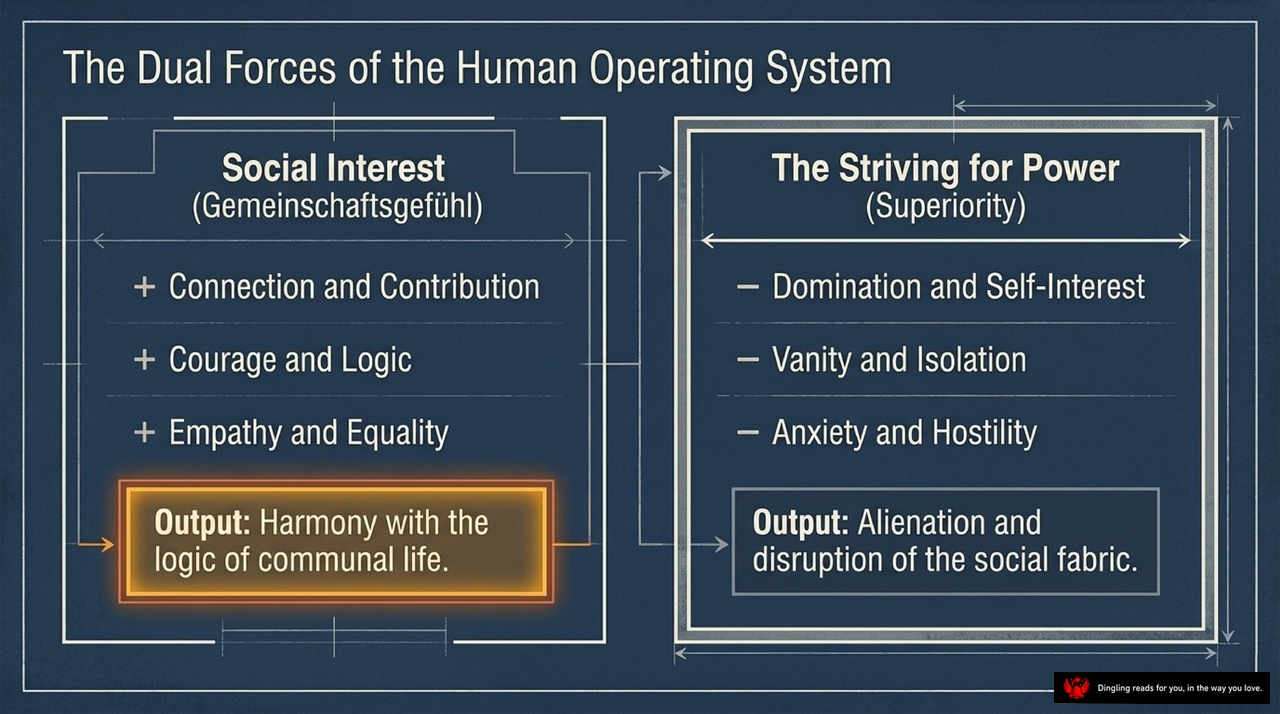
The slide before us maps the two opposing engines driving every human being: Social Interest versus the Striving for Power. Think of this not as a philosophical debate, but as a battle for your daily life. On the left, we see Social Interest, or Gemeinschaftsgefühl. This is the force that pulls us together. It's about connection, contribution, and empathy. When this force is strong, your output is harmony. You find yourself naturally aligned with the logic of communal life, feeling courageous and logical because you are part of something bigger than yourself.
Now, look at the right side: The Striving for Power. This is the drive for superiority, often disguised as domination and self-interest. When this engine takes over, the results are isolation, vanity, and anxiety. The output here isn't harmony; it's the alienation and disruption of the social fabric. You might feel brave, but it's a fragile bravery built on the fear of being ignored.
The key takeaway is simple: which force are you feeding? Are you building bridges through connection and equality, or are you building walls through domination and self-interest? Your entire life—your relationships, your career, your peace of mind—is just the output of whichever force you choose to prioritize today.

Welcome back. Today, we are diving deep into the hidden drivers of human behavior. Specifically, we are looking at how our emotions are not just spontaneous reactions, but calculated tools we use to navigate the world.
In our previous discussions, we established that all human action points toward a single goal: overcoming inferiority and seeking superiority. But how do we feel our way toward that goal? The answer lies in what we call "separating feelings"—anger, sorrow, and fear. These emotions often isolate us from others, turning the world into an enemy, a victim, or a protector we desperately need.
Let's start with **anger**. Think of it not as a loss of control, but as a strategic weapon. When someone feels their sense of power is threatened, or when they feel inferior, anger becomes their shield. It's a primal mechanism to destroy obstacles and dominate others. As the text highlights, those who lack confidence but crave power are often the most easily triggered. They believe that by lashing out, they can elevate their status. Alcohol often acts as an amplifier for this tendency, stripping away the social mask and revealing a raw, aggressive need to control.
Next, consider **sorrow**. On the surface, it looks like vulnerability, but psychologically, it is a sophisticated tool for manipulation. When an individual feels powerless or deprived, they may retreat into sorrow. By playing the victim, they subtly force others to take responsibility for their happiness. They say, in effect, "Look at my pain; you must fix it." This transforms their weakness into a demand for superiority, creating a parasitic relationship where others are constantly obligated to care for them.
Finally, there is **fear**. Fear is the ultimate escape hatch. It allows individuals to avoid the challenges of life by pretending they are helpless. By convincing others that they are in danger, they can secure a protector and gain a sense of power through dependency. It's a way to say, "I cannot handle this alone, so you must control the situation for me."
The text warns us that these emotions, when abused, sever our connection to society. Anger turns people into enemies, sorrow turns them into servants, and fear turns them into hostages. Instead of using these feelings to connect and collaborate, we see them used to isolate and control. True emotional health comes from understanding these patterns and choosing to connect with others rather than using emotions as weapons.

We often think of emotions as natural reactions, but in reality, they are tools we use to protect our ego and overcome feelings of inferiority. When emotions are misused, they stop being bridges that connect us to others and become weapons used to control them.
Consider anger. It is rarely about a specific trigger; it is actually a desperate bid for power. People who lack confidence but crave dominance are easily ignited by the slightest provocation. They believe that exploding in rage is the only way to crush obstacles and assert superiority. Even if they apologize later, the damage is done. Alcohol only amplifies this destructive urge, stripping away the last vestiges of social connection.
Then there is sadness. While it looks like weakness, it is often a sophisticated strategy for gaining attention. When someone feels deprived or powerless, they may exaggerate their suffering to force others into a caretaker role. They turn their own misery into an obligation for everyone around them, manipulating the environment to make themselves the center of attention. This is not about healing; it is about maintaining a false sense of superiority through dependency.
Fear operates similarly. It is a mechanism to avoid responsibility. By acting helpless and terrified, an individual forces others to take charge, creating a one-sided relationship where they are protected but never truly empowered. This fear is often a cover for a deep-seated desire for control and privilege.
When we abuse our emotions—whether through explosive anger, performative sadness, or paralyzing fear—we sever the ties that bind us to society. We treat others as enemies, objects to manipulate, or tools for our own security. The result is isolation. True emotional health comes from understanding these patterns and choosing to connect with others authentically, rather than using feelings as a shield against the real world.

Look at this blueprint of family dynamics. This slide breaks down the "Family Constellation" by defining three specific environmental parameters based on birth order: The Oldest, The Middle, and The Youngest. Each position comes with a distinct psychological role and a unique set of challenges.
First, we have The Oldest, labeled here as "The Dethroned." Once the sole center of attention, this child is now displaced by siblings. To cope with this loss of dominance, they tend to value power, authority, and conservative rule-following as a way to maintain control. The graphic on the left shows a structure where a smaller block sits atop a larger one, symbolizing this shift from being the main focus to becoming a subordinate part of a hierarchy.
Next is The Middle, or "The Pacemaker." Born into a competitive environment, this child operates with a marathon-runner mentality. They are highly competitive, constantly striving to overtake the leader ahead of them. The arrows in the middle section, racing upward, perfectly illustrate this relentless drive to surpass the one in front.
Finally, we have The Youngest, known as "The Pampered." This is the smallest and most protected child in the family. Their development takes one of two paths: they either develop wild ambition to surpass everyone, or they become completely avoidant, using weakness as an excuse to escape the tests of life. The circular graphic on the right represents this protected, enclosed space where they operate.
Understanding these roles helps us see that these aren't just personality traits, but survival strategies shaped by the family's structural environment.

Character is not a fixed trait you're born with; it's a constructed toolkit you build to survive. Think of it like a Swiss Army knife: the blade isn't just metal; it's a tool shaped for a specific purpose. In our slide, we see this visualized through different "tools" people use daily. That "Anxiety Mechanism" or "Avoidance Tactic"? These aren't personality flaws. They are strategic adaptations.
Adler teaches us that whether someone appears lazy, studious, anxious, or even aggressive, these are all specific strategies developed to adapt to their environment. The knife in the image has a corkscrew, a saw, and a blade—each serving a function. Similarly, a person's "Aggressive Posturing" or "Studious Compensation" is just their way of protecting their self-esteem and achieving a hidden goal of superiority.
The most critical takeaway on this slide is that character is not genetic destiny. We are not trapped by our biology. Instead, we acquire these social tools through our life experiences. If someone seems stuck in a loop of anxiety or avoidance, they aren't broken; they are just using a tool that no longer fits their current life. The good news? You can swap out the tools. By understanding that your current behaviors are just strategies for survival, you gain the power to choose new ones and build a more effective toolkit for your future.
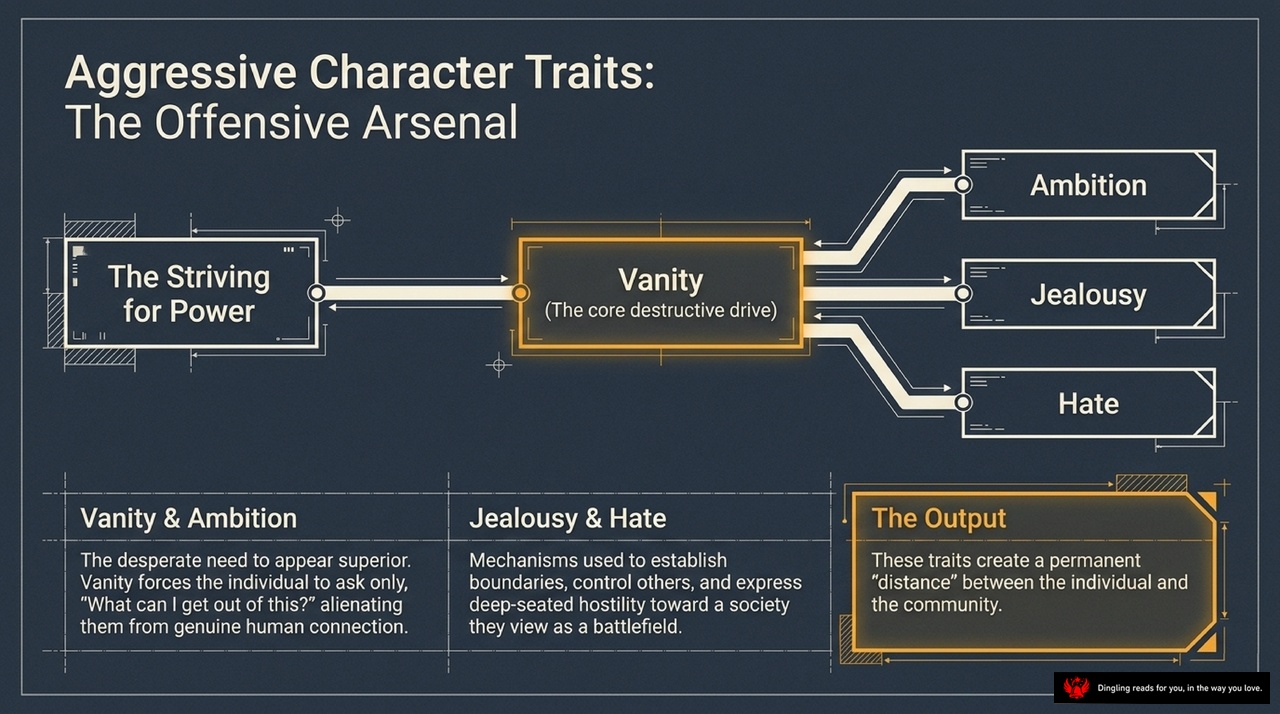
Look at this slide titled "Aggressive Character Traits: The Offensive Arsenal." It maps out exactly how aggression isn't just about being mean, but a calculated strategy for survival.
It starts with "The Striving for Power," which acts as the fuel for everything else. When that drive gets twisted, it hits the core destructive engine: Vanity. As the diagram highlights, Vanity is the "core destructive drive." It's that desperate need to appear superior, forcing us to ask, "What can I get out of this?" instead of connecting with others.
From this central hub of Vanity, the aggression branches out into three specific weapons. First, you have Ambition. But in this context, it's not healthy ambition; it's the push to dominate. Then, you have Jealousy. The slide describes this as a mechanism to establish boundaries and control others, often by viewing society as a battlefield rather than a community. Finally, there's Hate, which represents deep-seated hostility.
All of these traits—Ambition, Jealousy, and Hate—feed into "The Output." The result? A permanent "distance" between the individual and the community. When someone is driven by these aggressive traits, they create a wall. They isolate themselves, unable to form genuine human connections because they are too focused on winning and controlling.
So, remember this: Aggressive character traits are an offensive arsenal. They might feel powerful in the moment, but ultimately, they destroy the very social bonds we need to thrive. True strength comes from cooperation, not from building walls of vanity and hate.
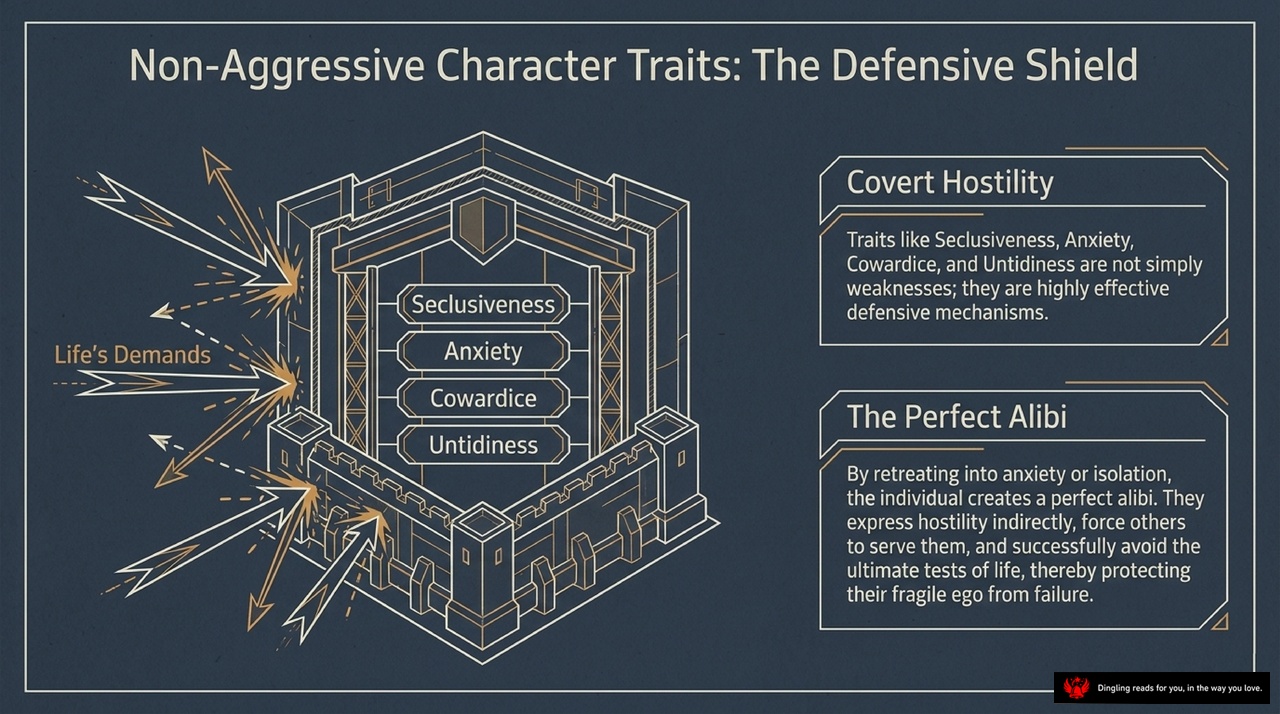
Non-Aggressive Character Traits: The Defensive Shield. Look at this fortress diagram. It illustrates a crucial, often misunderstood concept: traits like seclusiveness, anxiety, cowardice, and untidiness aren't just weaknesses. They are highly effective defensive mechanisms.
Think of it this way: when life's demands hit you, do you stand your ground, or do you retreat? This slide shows exactly that. By retreating into anxiety or isolation, the individual creates what we call "The Perfect Alibi." They express hostility indirectly, forcing others to serve them, while successfully avoiding the ultimate tests of life. This protects their fragile ego from the very real possibility of failure.
So, why does someone hide behind these traits? It's not about being lazy or weak. It's about safety. When you feel you can't win, you build a shield. You become anxious so no one expects you to act. You stay secluded so no one can judge your performance. You let things get untidy so you have a valid excuse to avoid responsibility. It's a clever strategy to avoid the risk of being exposed as inadequate. But remember, while this shield protects your ego in the short term, it ultimately isolates you from the world and prevents you from achieving your true potential. True strength isn't about building a wall; it's about facing the storm.

Emotions aren't just random outbursts; they are strategic discharges. Think of your psyche as a pressurized system, and emotions are the controlled release valve designed to rapidly alter a situation. When we feel anger, we aren't just losing control; we are deploying a tool to force submission or intimidate an opponent. Conversely, when we shed tears, we are strategically demanding sympathy, service, and control over a partner or parent.
The slide illustrates this perfectly: "Purposeful Eruptions." Emotions are intense, sudden releases of psychological pressure used to shift the dynamics of our environment. They are not mysterious forces overwhelming us; they are calculated moves. As the graphic shows, these "Tools of Coercion" are leveraged to achieve specific goals—whether it's making someone back down or securing care through vulnerability.
This perspective changes everything. Instead of asking, "Why am I so angry?", we ask, "What am I trying to achieve with this anger?" Are we trying to dominate? Are we trying to hide our own weakness? Understanding that our emotions are weapons we choose to wield allows us to step back, recognize the strategy, and decide if it's actually serving our best interests or just trapping us in a cycle of conflict.
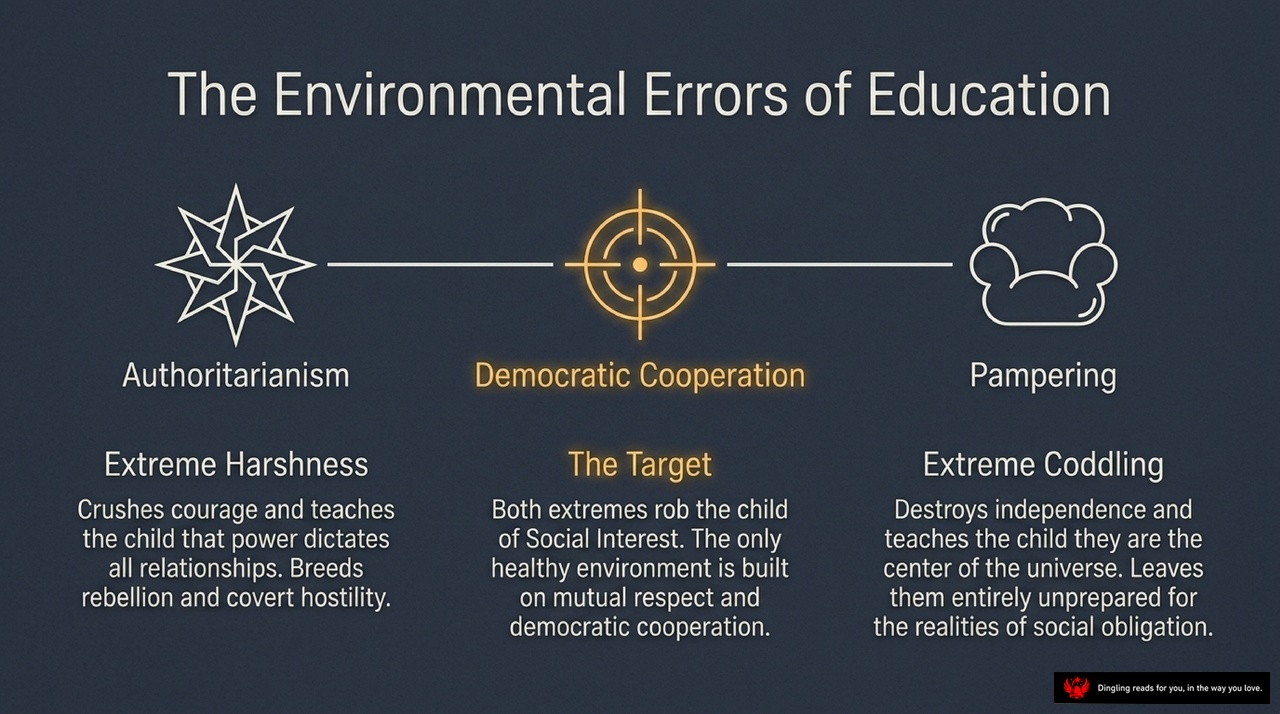
Today's slide outlines what I call the "Environmental Errors of Education." We see three distinct paths that parents and teachers often take, and only one leads to a truly healthy child.
On the far left, we have Authoritarianism, represented by that sharp, aggressive starburst. This path relies on extreme harshness. It crushes a child's courage and teaches them a dangerous lesson: that power dictates all relationships. When raised this way, children don't learn to connect; they learn to rebel or hide their hostility behind a mask.
On the far right, we see Pampering, symbolized by that soft, cloud-like shape. This is the trap of extreme coddling. It destroys independence by convincing the child they are the center of the universe. These children leave home entirely unprepared for social obligation, believing the world owes them everything.
So, where does that leave us? Right in the middle is our target: Democratic Cooperation. The slide correctly identifies that both extremes—tyranny and spoiling—steal the child's natural social interest. The only environment that truly works is one built on mutual respect. Here, children learn that they are not rulers to be feared, nor are they the world's center to be served. Instead, they learn to cooperate as equals. This is the only way to build a healthy social mind.

The blueprint for psychological health isn't about fixing a broken person; it's about building a thriving community. As we see here, the only real cure for that deep-seated inferiority complex and our selfish drive for power is the conscious cultivation of social interest. When we shift our focus from dominating others to contributing to the community, we unlock true psychological well-being.
But how do we measure if someone is truly healthy? The ultimate metric isn't dominance, vanity, or how much control they have over others. True human value is measured exclusively by one's contribution to the community and their ability to operate harmoniously within the logic of human society. Think about it: a person who lifts others up creates more value than someone who just climbs over them. This isn't just a nice idea; it's the fundamental design of our survival. We are social beings, and our greatest strength comes from how well we integrate into the group, not how loudly we try to stand above it.

Human behavior isn't random; it's a deliberate journey toward a goal we created for ourselves, often shaped by our childhood. Think of your character traits not as a fixed destiny you were born with, but as a toolkit you've chosen to carry. True psychological health happens when you put down the selfish grip on power and pick up courage and cooperation instead.
As you look back at your own actions and the tools you've gathered, ask yourself the hard question: Are you actually shaping your life through genuine contribution to others, or are you just hiding a deep, hidden drive to dominate? The difference between a fulfilling life and a lonely struggle often comes down to this simple choice.