
Upside Down Years: Complete Chapter-by-Chapter Summary
Welcome to *Upside Down Years*, Xu Xiaodi's powerful memoirs of the Cultural Revolution. This book isn't just a personal story; it is an analytical distillation of a micro-history, examining the systemic psychological and social mutations of an entire Chinese generation. Through Xu Xiaodi's eyes, we witness how a normal childhood was upended, how education was halted, and how a generation was forced to grow up in chaos. From the innocent days of primary school to the harsh realities of the countryside, these memoirs offer a profound look into a time that changed everything.

Look at this slide titled "The Redacted Archive." It presents a stark contrast between two moral worlds. At the top, we see "Traditional Morality," defined by filial piety, protecting the vulnerable, and the pursuit of truth. But below it, in a dark box, lies "The Nightmare Version of Alice in Wonderland." This image captures the terrifying inversion of human values during the Cultural Revolution.
The text explains that during this period, the fundamental rules of interaction were completely flipped. State ideology demanded that basic morality—empathy, familial loyalty, and innocence—be replaced by encouraged, institutionalized cruelty. Children were actively trained to view the former as a crime and the latter as the ultimate virtue.
This graphic perfectly illustrates the concept of "Revolutionary Morality" shown at the bottom. Instead of valuing kindness, the era glorified ideological denunciation, class hatred, and the manufacturing of falsehoods. It was a time where a mother's love could be seen as treason, and a child's honesty could be punished as rebellion. The slide reminds us that when a society inverts its moral compass, the result is not progress, but a deep, haunting nightmare where the innocent become the guilty, and cruelty becomes the highest form of virtue.
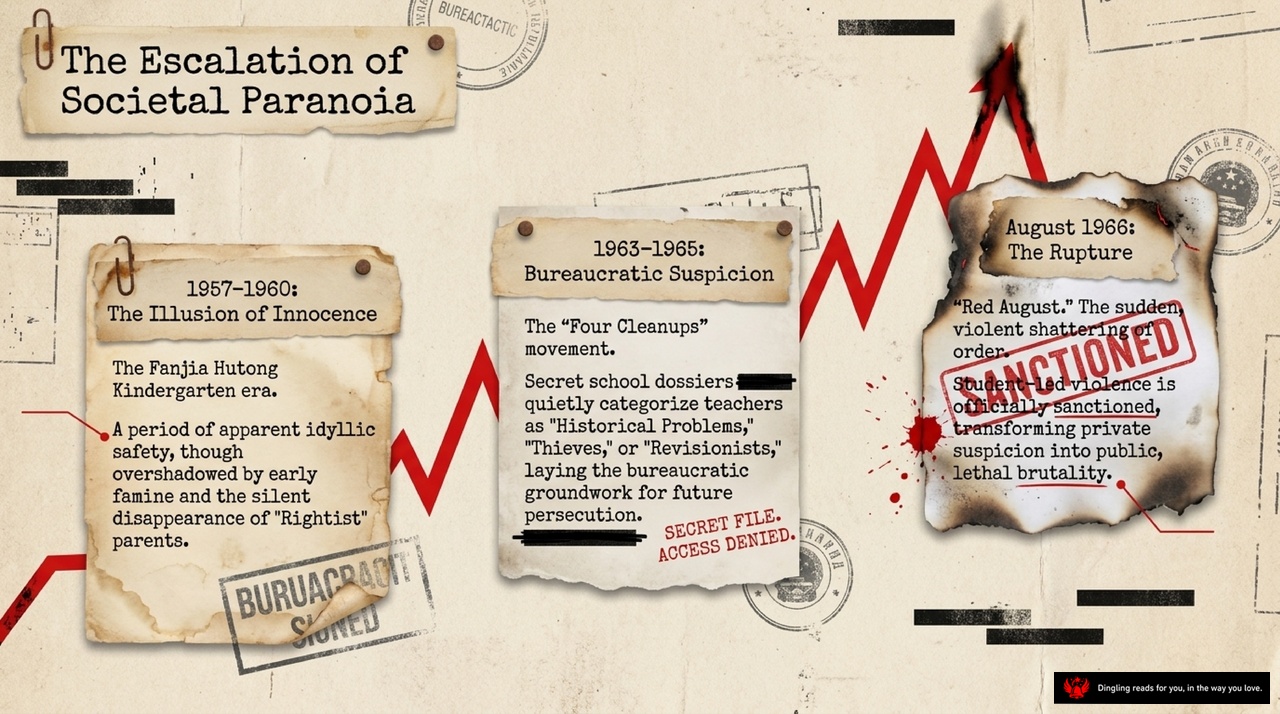
The Escalation of Societal Paranoia. Look at this timeline. It captures the terrifying shift from 1957 to 1966, a period where innocence didn't just vanish—it was systematically dismantled.
First, we have 1957 to 1960, labeled "The Illusion of Innocence." On the surface, it looked like an idyllic era in the Fanjia Hutong Kindergarten. But beneath that calm, there was a silent crisis: early famine and the mysterious disappearance of "Rightist" parents. The safety was a facade, built on lies.
Then, move to the middle section: 1963 to 1965, titled "Bureaucratic Suspicion." This is where the machinery of fear began to turn. We see the "Four Cleanups" movement and the creation of secret school dossiers. Teachers and students were quietly categorized as "Historical Problems," "Thieves," or "Revisionists." This wasn't just gossip; it was the bureaucratic groundwork for future persecution. The text explicitly states this was laying the foundation for what was coming next.
Finally, we reach the breaking point on the right: August 1966, "The Rupture." This was "Red August," a sudden, violent shattering of order. Student-led violence was no longer private suspicion; it was officially sanctioned. The slide even shows the word "SANCTIONED" stamped in red over the chaos, transforming private doubts into public, lethal brutality.
This trajectory shows how a society can move from a false sense of safety to organized, state-sanctioned violence in just a few short years.
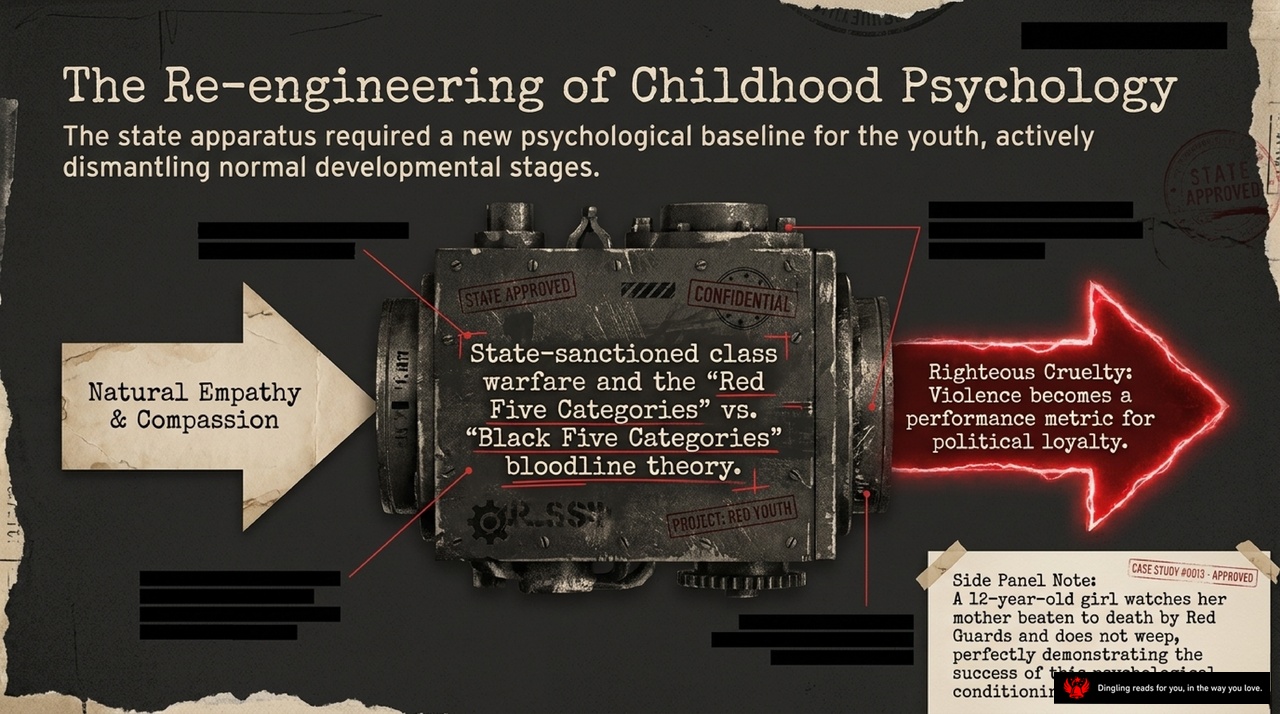
Look at this slide. It illustrates the brutal re-engineering of childhood psychology during that era. Instead of nurturing natural empathy and compassion, the state apparatus actively dismantled normal developmental stages, forcing youth into a new, distorted psychological baseline.
The diagram shows a machine labeled "State Approved" and "Project: Red Youth." This machine takes "Natural Empathy" as input and processes it through "State-sanctioned class warfare," specifically the "Red Five Categories" versus the "Black Five Categories" bloodline theory. The output is a terrifying reality: "Righteous Cruelty." In this new world, violence became a performance metric for political loyalty.
This wasn't just theory; it was a case study. Think of the 12-year-old girl mentioned in the corner. She watched her mother beaten to death by Red Guards. In a normal childhood, she would have wept. But she didn't. Her lack of tears was the ultimate success of this conditioning. She had been successfully reprogrammed to view cruelty as duty and silence as virtue.
This slide captures the tragic loss of innocence. The state didn't just educate children; they psychologically weaponized them, turning the next generation into agents of their own oppression.

Back in 1970, life in the border region wasn't just hard; it was dangerously careless. Everyone took their medicine with zero regard for side effects. If you got sick, it was almost a badge of honor, a chance to escape the brutal heat of harvesting wheat or the freezing cold of midnight drills. I even envied the sick. But then, I learned a harsh lesson about my own body. I was curious, so I took a pink sleeping pill without a prescription. Within minutes, I was gasping for air in a noisy, dark pool, my vision fading until I passed out. When I woke up, the doctor gave me a sick leave, but I hid the truth, terrified that being "too healthy" would make me an even worse liability in a system that offered no rest.
By late 1970, I was desperate to be named a "Five-Good Soldier," hoping to send my奖状 to my lonely mother in Beijing and finally give her a moment of pride. But my dreams were crushed. My squad leader, Zhang, pulled my award, accusing me of spreading "bourgeois ideology" for showing photo albums, telling Grimm's Fairy Tales, or even just admiring the delicious snacks of Daoxiangcun. She even used my notebook of difficult Chinese characters from the *Quotations* as proof of my disrespect. When I argued back, I was forced to write a self-criticism and became the target of a public critique session. The atmosphere was numb; everyone sat close together, repeating the same lines, with snoring filling the silence. I ran to the riverbank and cried until the stars came out, but my class monitor, the daughter of a postal director, simply didn't understand my pain.
The situation grew darker. My medic, a Beijing native who had barely finished his medical school when the Cultural Revolution hit, was a rogue figure who answered only to himself. When I accidentally cut my hand while mowing grass, he didn't just bandage it; he made me wear a hard cardboard splint on my chest. He became my only friend, asking me to write for the bulletin board and lending me a collection of Lu Xun's poetry. In a time of chaos, Lu Xun's words about sacrifice and separation were the only cultural anchor I had left, keeping me from losing my humanity. But even that fragile connection to my mother was broken. When I tried to apply for a visit home, my request was rejected with the excuse that "farm work is busy." My mother, stubbornly refusing to lie and sign fake telegrams about her "critical illness," was left behind. Seeing others leave while I was stuck, I took two more sleeping pills, not to end my life, but just to numb the suffocating reality.
The next morning, everyone panicked. The medic dragged me to the regiment hospital on a cart through eighteen miles of muddy terrain. When I woke up, my symptoms had faded, but I couldn't speak clearly, only repeating the word "book"—referring to the Lu Xun collection I wanted. The real shock came weeks later when a letter arrived from Beijing: my mother had remarried a man twenty years her senior, with a gift from Zhou Enlai's secretary at her wedding. My world collapsed. I ran to the river, consumed three more pills, and waited for death. But the morning bugle rang, and I woke up. That day, I realized that running away on drugs was an act of weakness. Eighteen-year-old me finally stood up, finding a strange strength in survival.
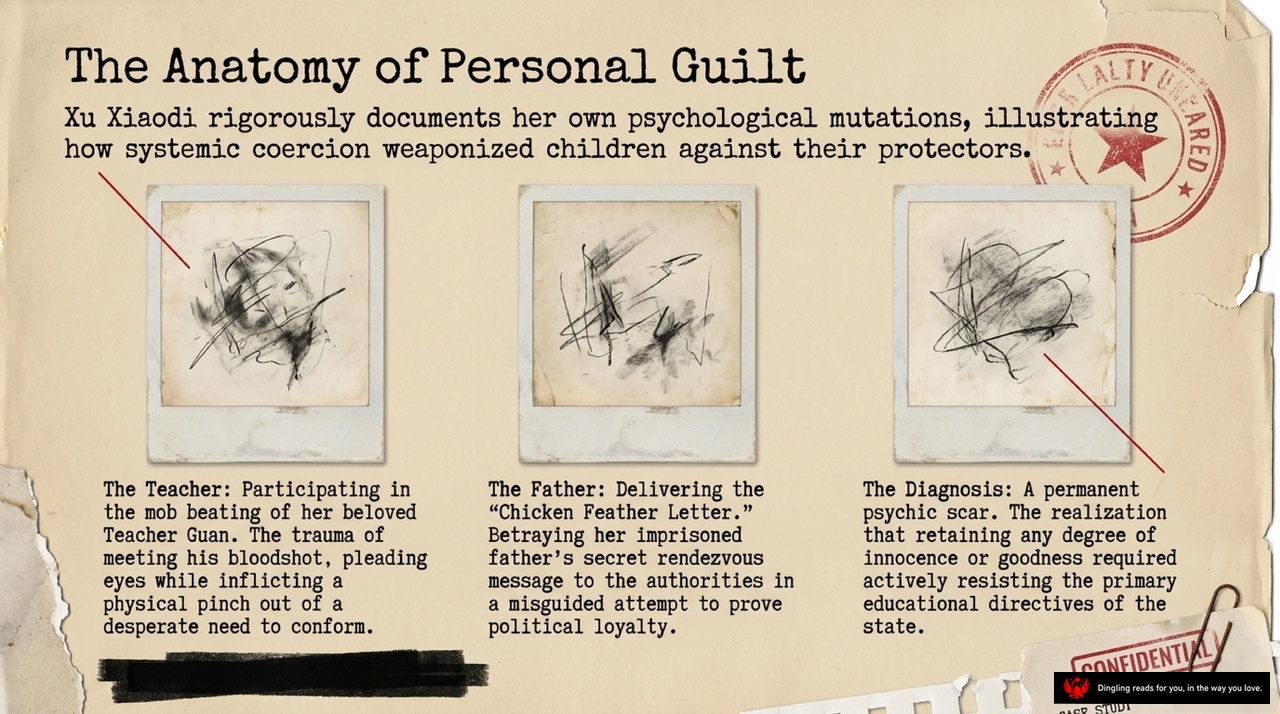
Look at this slide titled "The Anatomy of Personal Guilt." It presents a haunting triptych of Xu Xiaodi's psychological mutations, illustrating how systemic coercion weaponized children against their own protectors.
First, we see "The Teacher." This refers to the memory of participating in the mob beating of her beloved Teacher Guan. The text describes the trauma of meeting his bloodshot, pleading eyes while she inflicted a physical pinch out of a desperate need to conform. It captures that moment where a child is forced to become the aggressor against the very adult meant to care for them.
Next is "The Father," representing the delivery of the infamous "Chicken Feather Letter." This act symbolizes betraying her imprisoned father's secret rendezvous message to the authorities in a misguided attempt to prove political loyalty. It highlights the tragic irony where a child's attempt to please the state results in the destruction of their own family's safety.
Finally, we arrive at "The Diagnosis." This is described as a permanent psychic scar: the realization that retaining any degree of innocence or goodness required actively resisting the primary educational directives of the state. This slide argues that the system didn't just punish adults; it rewrote the children's moral compass, forcing them to view their own parents and teachers as enemies to survive. Together, these three elements show the complete internalization of guilt, where the child becomes the executioner of their own humanity.

The Criminalization of Individuality begins long before the chaos of 1966. It starts with the quiet destruction of difference. Look at Exhibit Label A: The Case of Pu Jing. She was a Shanghai transfer student who initially dazzled her peers with her ballet steps and pearl-adorned dresses. But her grace was not celebrated; it was condemned. Exhibit Label B shows The Theatrical Performance. Assigned to play a "bourgeoisie lady" in a school play, Pu Jing performed with exceptional talent and theatrical flair. She added her own details, dancing with a natural elegance that made the audience gasp. Yet, this excellence was not a triumph; it was a crime. Exhibit Label C reveals The Backlash. Peers violently attacked her, not for failing her task, but for performing it too well. Her innate grace was condemned as a longing for the capitalist lifestyle, foreshadowing the lethal anti-intellectual violence of Red August. This slide illustrates how the system didn't just punish bad behavior; it punished excellence itself. Any sign of individuality, of being different, was instantly labeled "bourgeois" and destroyed. The tragedy wasn't that she was bad; it was that she was too good. And in that world, being too good was the same as being an enemy.

Back in the 1960s, life wasn't about comfort; it was about survival. I remember my father, a man with a "gray identity" who worked secretly for the party, being arrested in 1967. He was accused of being a counter-revolutionary and smuggler, stripped of his dignity, and sent away for over seven years. Even his daughter, my sister, was falsely accused of class revenge just because she had left a tap running, a crime that didn't exist in reality but was invented by a jealous cadre.
My childhood friend, Yu Xin, a once-great pianist, suffered a different kind of torture. He was locked up for eight years, forced to wear a "Peace Jacket" that crushed his body, and when he finally emerged, he was broken. He lost his wife, his career, and his peace of mind. Yet, even after being compensated years later, he couldn't bring himself to forgive her, carrying the scars of that era for the rest of his life.
And then there was the story of my friend, the legendary YRY. He was a young worker who served in the capital's guard, only to be sent to the Inner Mongolia frontier as a platoon leader. Unlike the arrogant officers of his time, he lived among us, shared our oil, and never used class struggle as a weapon to punish mistakes. He cared for us like family, even after returning to the city, he gave up his government housing twice, living in a tiny, dilapidated room until the very end.
These stories remind us that behind the grand narratives of history, there were real people—ordinary fathers, daughters, artists, and heroes—who paid the ultimate price for an era that demanded their silence and sacrifice.
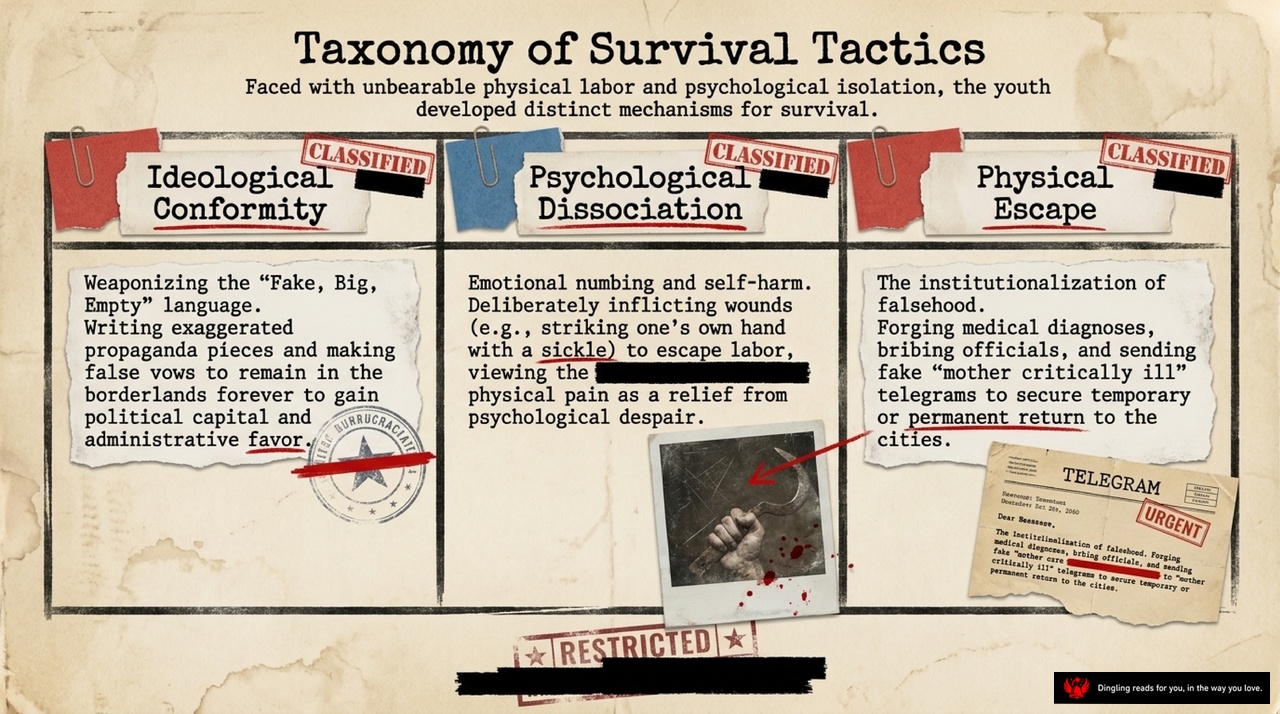
Facing unbearable physical labor and crushing psychological isolation, the youth in the borderlands didn't just survive—they invented a survival manual. This slide breaks down their "Taxonomy of Survival Tactics" into three distinct, desperate strategies.
First, Ideological Conformity. To escape the chaos, some weaponized the very language of the state. They learned to write exaggerated propaganda, making false vows to stay forever in the borderlands just to gain political capital and administrative favor. They used the "Fake, Big, Empty" language as a shield, turning their own words into a tool for protection within the bureaucracy.
Second, Psychological Dissociation. When the pain became too much, they chose emotional numbness. The slide shows a harrowing image of self-harm—striking one's own hand with a sickle. Why? Because they viewed that physical pain as a relief from the paralyzing despair of the mind. They deliberately inflicted wounds to escape the invisible torture of their thoughts.
Finally, Physical Escape. This was the institutionalization of falsehood. Faced with no legal way out, they forged medical diagnoses, bribed officials, and even sent fake telegrams claiming a "mother was critically ill." These lies were their only ticket to secure temporary or permanent return to the cities.
These weren't just random acts; they were calculated mechanisms born from a broken system. Whether through fake loyalty, self-inflicted pain, or elaborate lies, these tactics reveal how far humanity was pushed to survive when the rules of the game had completely changed.

Look at this pink pill in the center of the slide. It's not just a medicine; it was a desperate lifeline for a generation. The text on the right tells us the "Catalyst": ingesting Promethazine, an antihistamine. But for Xu Xiaodi and others, this wasn't about treating an allergy. It was about survival.
The slide explains the "Physical Reaction" clearly: severe allergic shock, extreme pallor, palpitations, and total physical collapse. In the harsh reality of the 1970s, facing this terrifying medical crisis was actually a choice. Why? Because the "Sociological Outcome," as the bottom left corner notes, was that fainting in the fields or during denunciation sessions successfully halted political attacks.
It sounds absurd, but the physical danger of the drug was considered far preferable to the psychological torture of ideological persecution. The body became the ultimate instrument of evasion. When the world demanded you speak and you were forced to suffer, the only way to escape was to let your body shut down. This "Promethazine Protocol" wasn't a medical treatment; it was a silent rebellion, a way to say "no" to a system that demanded everything from them, using their own biology as the only weapon they had left.
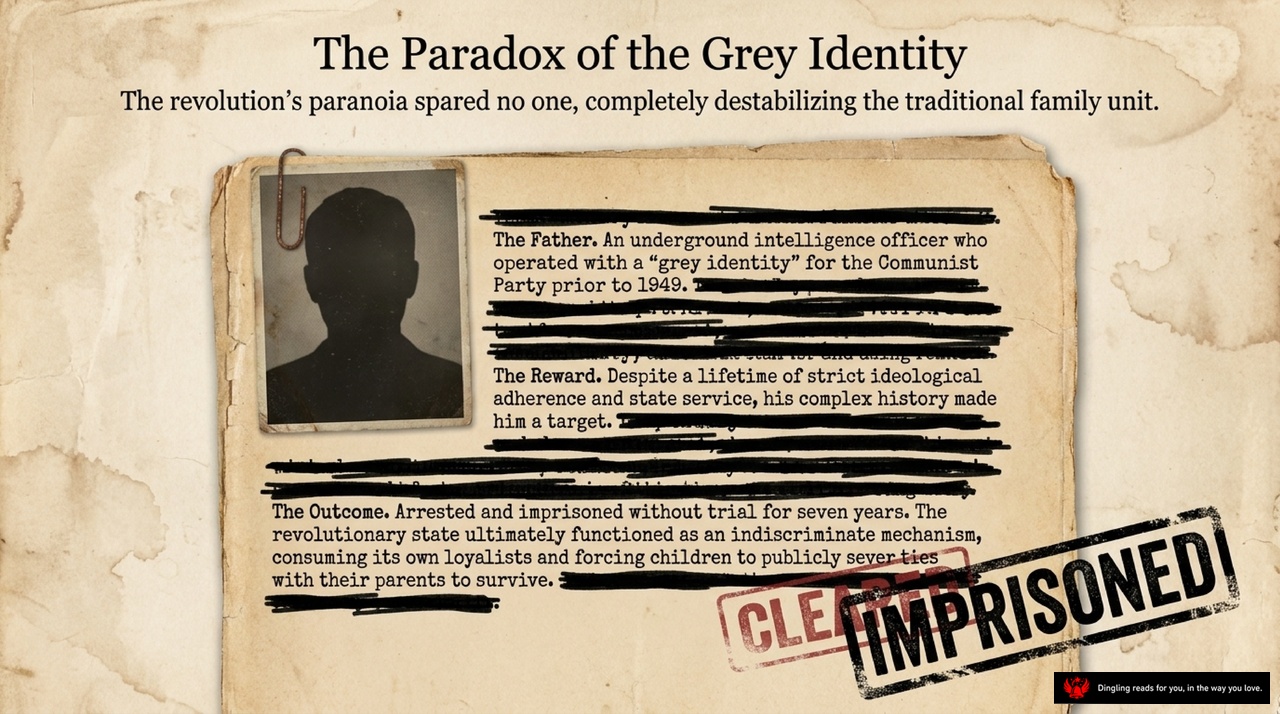
The image before us captures a chilling moment in history: the "Paradox of the Grey Identity." It tells the story of a father, an underground intelligence officer who served the Communist Party with a "grey identity" before 1949. Despite a lifetime of strict ideological adherence and state service, his complex history made him a target. The revolutionary state, fueled by paranoia, ultimately functioned as an indiscriminate machine, consuming its own loyalists. The outcome was devastating: arrested and imprisoned without trial for seven years, forcing children to publicly sever ties with their parents just to survive. This slide illustrates how the revolution's paranoia spared no one, completely destabilizing the traditional family unit.
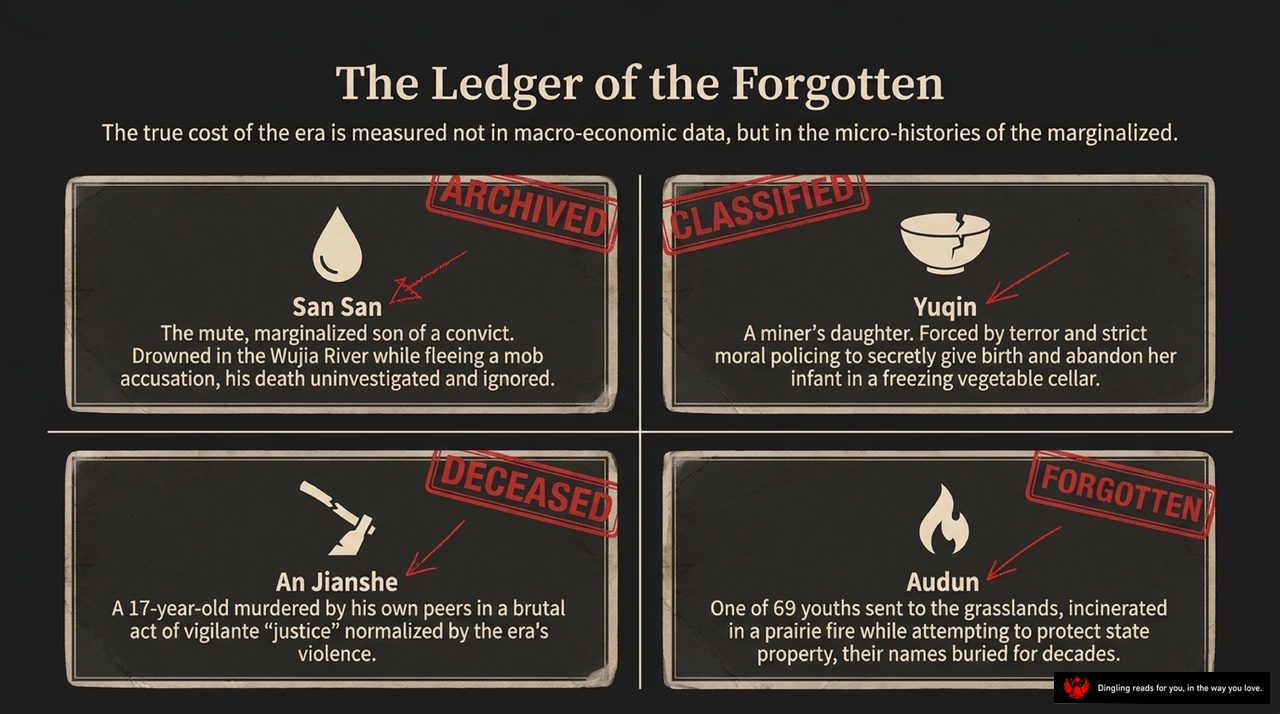
The Ledger of the Forgotten: The True Cost of an Era
Today's slide is titled "The Ledger of the Forgotten." It reminds us that the true cost of a historical era isn't found in macroeconomic data or official statistics, but in the micro-histories of the marginalized—the lives that were erased.
Look at the four stories presented here. First, we have San San, marked "Archived." He was the mute son of a convict who drowned while fleeing a mob, his death completely uninvestigated. Next is Yuqin, labeled "Classified." A miner's daughter forced by terror to abandon her newborn in a freezing cellar. Then there is An Jianshe, marked "Deceased," a 17-year-old murdered by peers in an act of vigilante violence that was normalized by the era. Finally, Audun, stamped "Forgotten." One of 69 youths sent to the grasslands who died in a prairie fire while trying to protect state property, their names buried for decades.
These aren't just statistics; they are real people whose tragedies were swept under the rug. This ledger forces us to confront the human price paid by the times we often only remember for its grand narratives.

The enduring societal mutation isn't just a headline; it's the very foundation of who we are today. The generation raised during those chaotic "Upside Down Years" didn't simply vanish into history; they are the architects of the present.
Look at the foundation beneath us. On the left, we see "The Normalization of Deception." During that era, survival tactics like forged documents and the cynical language of "Fake, Big, Empty" permanently altered our relationship with truth and trust. We learned early on that reality was negotiable. On the right, the slide highlights "The Trauma of Betrayal." A generation was taught to view human connection through the lens of class warfare and political utility. This mindset now occupies senior roles in our government, education systems, and even family structures.
Understanding modern Chinese sociology requires excavating this specific, redacted generation. We must look at the cracked pillars of the 1966-1976 period to understand how psychological conditioning reshaped an entire society. The scars from that time are not just historical footnotes; they are the invisible forces shaping our current world.
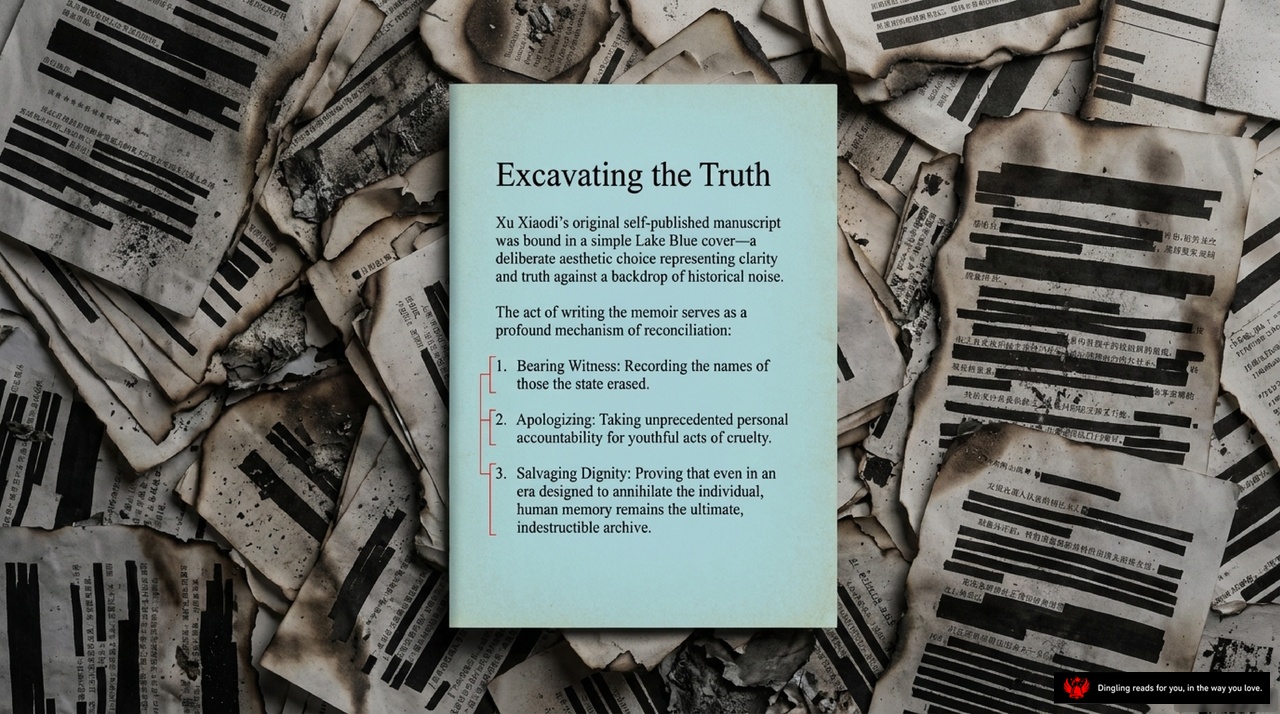
Look at this image of burnt papers. It's a powerful visual metaphor for the chaos of the Cultural Revolution, where history was literally being incinerated. But right in the center, amidst the ashes, stands a clear, light blue manuscript titled "Excavating the Truth." This represents Xu Xiaodi's original self-published work, a deliberate choice to represent clarity and truth against a backdrop of historical noise.
The act of writing this memoir serves as a profound mechanism of reconciliation, broken down into three key points. First, it is about Bearing Witness: recording the names of those the state tried to erase. Second, it is about Apologizing: taking unprecedented personal accountability for youthful acts of cruelty, like the author's own past mistakes. And third, it is about Salvaging Dignity: proving that even in an era designed to annihilate the individual, human memory remains the ultimate, indestructible archive. By preserving these stories, we ensure that the truth survives the fire.