
Upward Growth: Complete Chapter-by-Chapter Summary

Welcome to our book club session on "Upward Growth" by Jiu Bian. Today, we're diving into the core philosophy of this book: how to break through the trap of involution and entropy increase to achieve real class leaps.
The image on your screen perfectly captures this journey. You see a staircase leading upward, symbolizing our path from micro habits to macro wealth. But why is upward growth so hard? The book explains it using a natural law called the Second Law of Thermodynamics, or "entropy increase." Think of it like a fire in a stove; without constantly adding fuel, everything turns to ash. For humans, knowledge and information are that fuel. If we stop learning, we essentially stop living, slowly getting replaced by those who keep upgrading.
So, how do we climb these stairs? The book suggests that we need to stop relying on fragmented, low-effort inputs that feed our entropy, like mindlessly scrolling through short videos. Instead, we must actively seek "negative entropy"—high-quality information that challenges us. It's about moving from passive consumption to active creation.
The visual also highlights the concept of "breaking through involution." Involution is when everyone runs faster just to stay in the same place, competing on diminishing returns. To escape this, we need to change the game itself. The book argues that true growth comes from accumulating enough quantity to trigger a qualitative leap. Whether it's writing, coding, or learning a language, you have to push past the initial plateau where effort feels useless. Trust the process, keep stacking your habits, and eventually, you'll reach that critical mass where everything clicks into place.
Remember, growth isn't about avoiding discomfort; it's about embracing the friction that leads to expansion. Let's take that first step together.
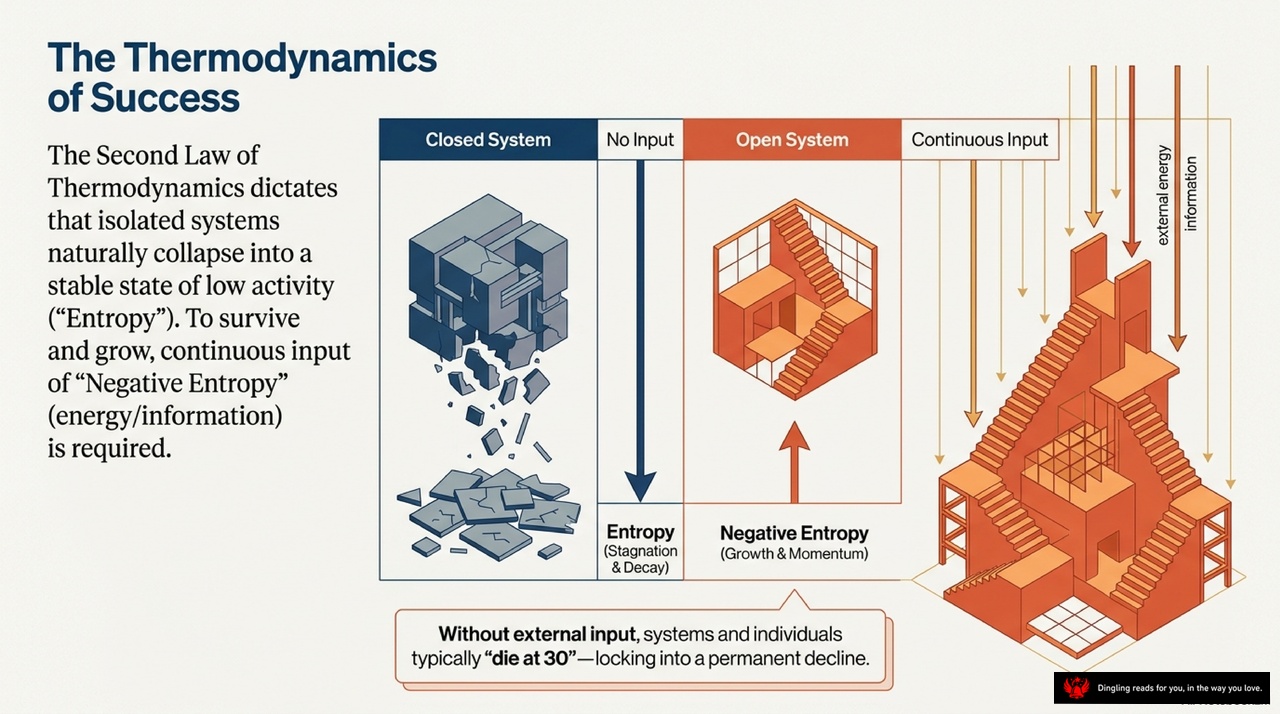
Have you ever wondered why success isn't a one-time event but a constant struggle? The answer lies in a fundamental law of nature: the Second Law of Thermodynamics. As the slide illustrates, isolated systems naturally collapse into a state of low activity known as "Entropy." Think of it like a room that, without cleaning, inevitably becomes messy and chaotic. If you stop adding energy, everything decays.
But here's the key for your personal growth: you are not an isolated system. To survive and thrive, you must be an "Open System" that accepts "Continuous Input." The diagram shows that without external energy and information flowing in, you lock into a permanent decline—what people often call "dying at 30." This continuous input is what we call "Negative Entropy." It's the fuel that fights against decay.
For you, this energy comes in two forms: physical resources and, more importantly, information. When you stop learning, your brain's neural pathways weaken, and your skills stagnate. That's why reading a book feels like hard work while scrolling through your phone feels effortless; the phone feeds you passive entertainment that aligns with entropy, while learning requires you to climb uphill against the natural trend of decay.
So, how do you break this cycle? You must actively seek out new information, skills, and perspectives. Whether it's reading, coding, or engaging in deep conversations, every bit of new input is a brick in the structure of your future. Don't wait for the system to fix itself. Inject energy into your life today, or risk becoming just another part of the crumbling foundation.
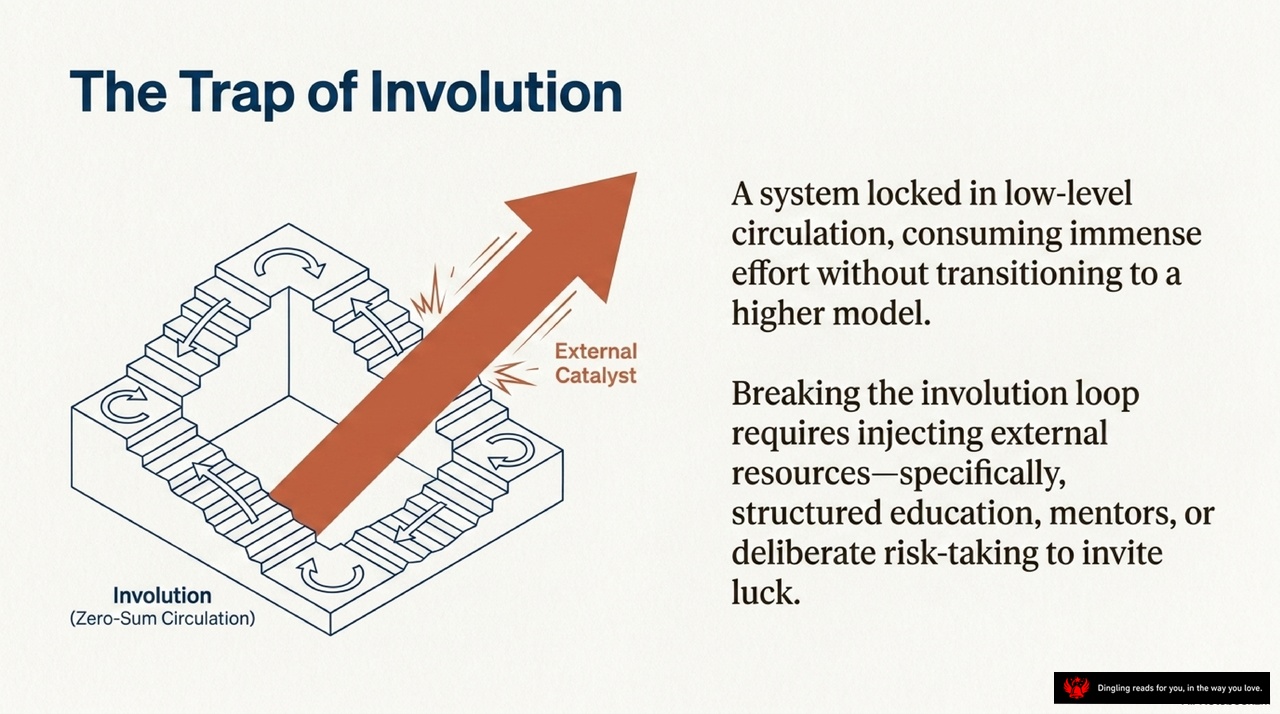
Have you ever wondered why so many people feel trapped in a cycle of endless effort, only to see no real breakthrough? This slide illustrates a concept called "Involution"—a system locked in low-level circulation where immense energy is consumed just to stay in place, without transitioning to a higher model.
Imagine a staircase that loops back on itself. No matter how hard you climb, you end up exactly where you started. This is the trap of involution: a zero-sum game where everyone races harder, but the overall level of success remains stagnant. The graphic shows an "External Catalyst" pushing through this loop. Breaking out of this cycle isn't about working harder within the same system; it requires injecting new resources from the outside. Think of structured education, finding a mentor, or deliberately taking risks to invite luck. These external forces are the only way to break the loop and move from a repetitive cycle to genuine upward mobility. Without that catalyst, you're just running on a treadmill that never moves forward.

The slide we are looking at breaks down the vicious cycle of the poverty trap, illustrating how a lack of resources triggers a biological response that makes escaping even harder. It starts with Node 1, Scarcity, which is simply a lack of time and money. This immediate pressure triggers Node 2, High Cortisol. Cortisol is the stress hormone our bodies release when we feel threatened. But here is the critical part: high levels of cortisol actually damage the brain's prefrontal cortex, which is responsible for planning and delaying gratification.
This damage leads directly to Node 3, Eroded Delayed Gratification. When your brain is under constant stress, it stops thinking about long-term goals and focuses entirely on immediate survival. This forces you into Node 4, Short-term Relief Spending. Instead of investing in your future, the brain seeks instant dopamine hits through entertainment or luxury spending to cope with the stress. This cycle then feeds back into Node 1, increasing scarcity further and locking you in.
The text on the right highlights a powerful distinction: simple desires are achieved through indulgence, but advanced desires require discipline and restraint. The core issue isn't just a lack of capital; as the slide states, it is an overabundance of cortisol. Understanding this physiology is the first step to breaking the cycle, because you can't simply will your way out of a stress-induced brain state. You have to manage the stress first to restore the ability to think long-term.
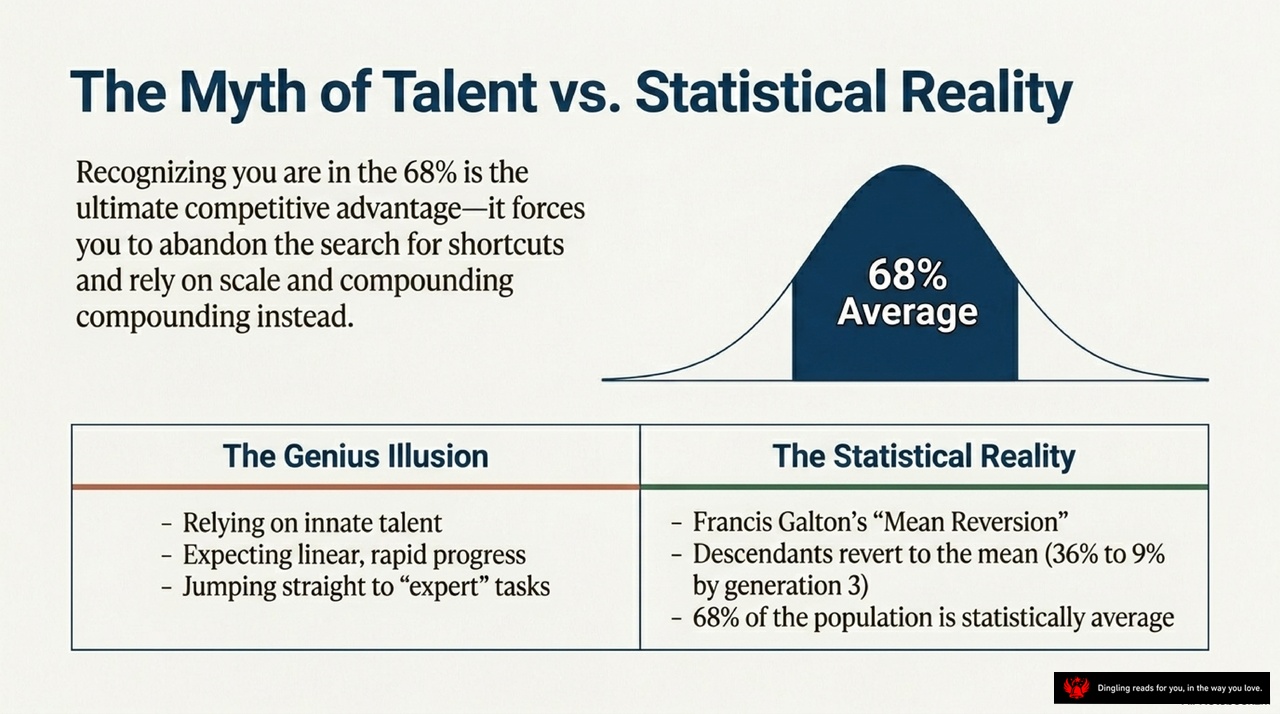
Imagine a world where your success isn't about being the smartest person in the room, but about understanding a simple, terrifying statistical truth: you are almost certainly average. The slide highlights this "68% Average," representing the vast middle of the bell curve where Francis Galton's concept of "Mean Reversion" takes hold. It means that even if your parents were geniuses, there is a powerful natural force pulling your descendants back toward the mean. By generation three, that high achievement often drops from 36% down to just 9%.
This is the "Statistical Reality" that clashes with our favorite "Genius Illusion." We love to believe in innate talent, expecting linear, rapid progress, and trying to jump straight to expert-level tasks without the necessary foundation. But the data tells a different story. Recognizing that you are in that 68% isn't a failure; it is your ultimate competitive advantage. Once you accept that you aren't a statistical outlier, you stop chasing shortcuts and stop waiting for a magical breakthrough. Instead, you commit to scale and compounding. You realize that for the vast majority of people, including you, the path to mastery isn't a sprint; it's the slow, relentless accumulation of doing the basics right, day after day, until the average finally shifts in your favor.
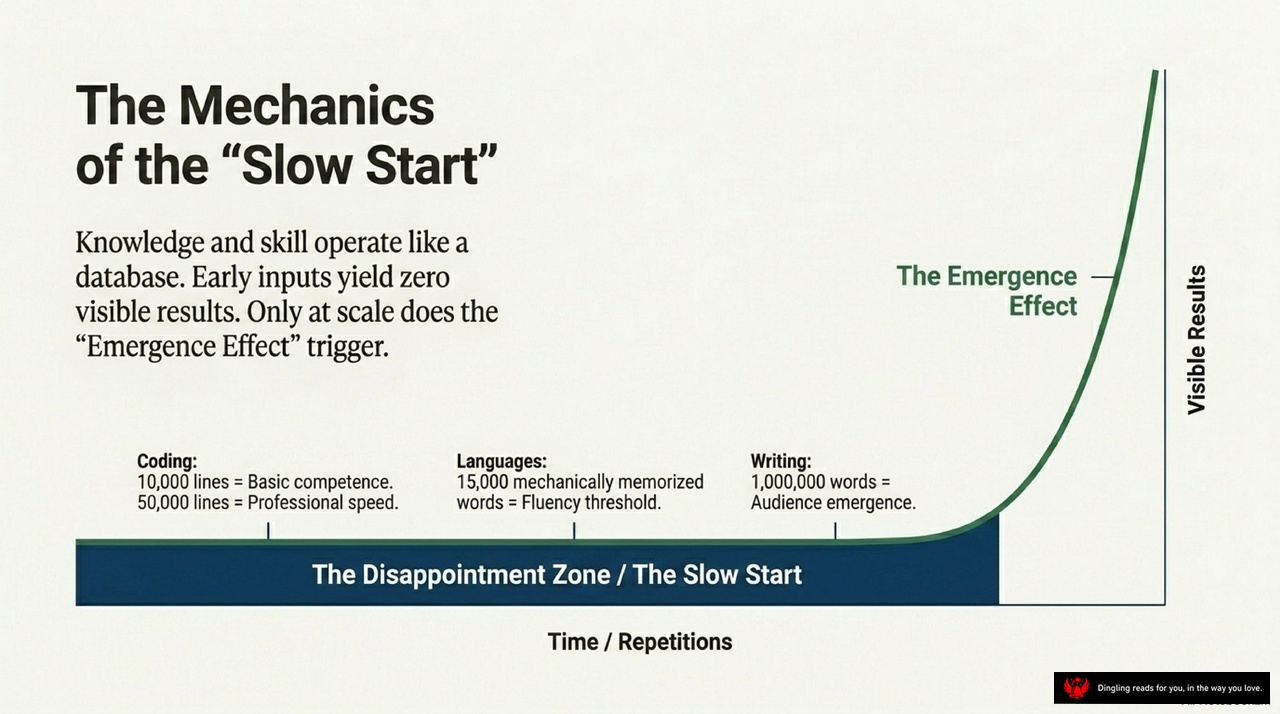
Here is the spoken-word script for Slide 5, tailored for an American audience.
The Mechanics of the "Slow Start"
Think of your brain like a database. In the beginning, every piece of information you absorb feels useless. You code lines, memorize words, or write pages, yet you see zero visible results. This flat line at the bottom is what I call "The Disappointment Zone." It's where most people quit because they expect immediate rewards. But here's the truth: knowledge and skills operate on an emergence effect. You have to hit a critical mass before the breakthrough happens. Look at the graph: it takes 10,000 lines of code to reach basic competence, but you need 50,000 to work at a professional speed. Similarly, fluency in a language isn't about understanding a few phrases; it requires mechanically memorizing around 15,000 words. For writers, the magic doesn't happen until you've written a million words. That's when the audience emerges. Don't let the slow start fool you. Your results aren't missing; they're just being built in the background. Trust the accumulation, keep pushing through the plateau, and eventually, that green curve will shoot up.

Most people believe that true growth requires constantly pushing themselves into the "Panic Zone," thinking that only extreme stress creates results. But as this slide illustrates, operating exclusively in the Panic Zone is actually a recipe for failure. Progress stalls in comfort, yes, but it completely aborts when we hit panic. Elite growth happens in the middle—the "Training Zone."
The core strategy here is to lower the daily barrier to entry. Instead of trying to do 50 burpees when you only want to do 5, you set a micro-goal of just five. This bypasses the brain's immediate resistance. Once you successfully complete that tiny task, you build momentum, and often, scale takes over organically. You might end up doing twenty or fifty, but the key was starting small enough to say "yes" every single day.
This same logic applies to mastering basic functions. Think of how KIPP schools operate: they ignore advanced distractions and laser-focus on reading, writing, and math. By targeting these fundamentals and staying in your Training Zone, you create a compounding effect where your skills expand naturally without the burnout of trying to conquer the Panic Zone too early. It's about consistent execution, not heroic sprints.

The Architecture of Wealth: Consumers vs. Producers. Look at this table, and you'll see the fundamental divide that separates the wealthy from everyone else. It's not about luck; it's about how you deploy your capital.
Consumers, that's most of us, use our wages—what we call "blood-money"—to buy depreciating luxuries. We play the game that others built. Producers, on the other hand, use capital to buy cash-flowing assets. They aren't just playing the game; they are building it.
Then there is leverage. Consumers either avoid debt or use it to consume. Producers, however, use Other People's Money at up to 50 times leverage for acquisitions. Finally, look at risk tolerance. Consumers rely on a single wage point, making them incredibly fragile. Producers utilize global allocation and "Limited Liability" to isolate risk.
The core message is simple: to escape the cycle of poverty, you must shift your identity from a consumer to a producer. Stop spending your time on other people's products and start creating value that others will pay for. That is the only way to break the ceiling.

Imagine a crowded room where everyone is fighting for the same limited resources. This is the "Static View"—the classic "Limits to Growth" fallacy. It suggests that wealth is fixed, like water in a sealed box, and if you take more, someone else gets less. But this is a trap. The 1972 Club of Rome predicted our collapse based on this static thinking, assuming resources were finite and unchangeable.
However, look at the second side: the "Dynamic View." Wealth isn't about hoarding a finite pie; it's about expanding the network itself. Think of it not as a closed box, but as an open web of connected nodes. When you stop competing in crowded, local pools—what we call "involution"—and instead step outward to build new connections, you fundamentally expand the resource boundary.
The core truth here is simple: connections equal wealth. By expanding your node network, you generate non-linear opportunities that a static model could never predict. The rich aren't just those who found more gold; they are the ones who built a larger map where the gold can be found. So, don't just fight for a seat at the existing table; build a new table entirely.
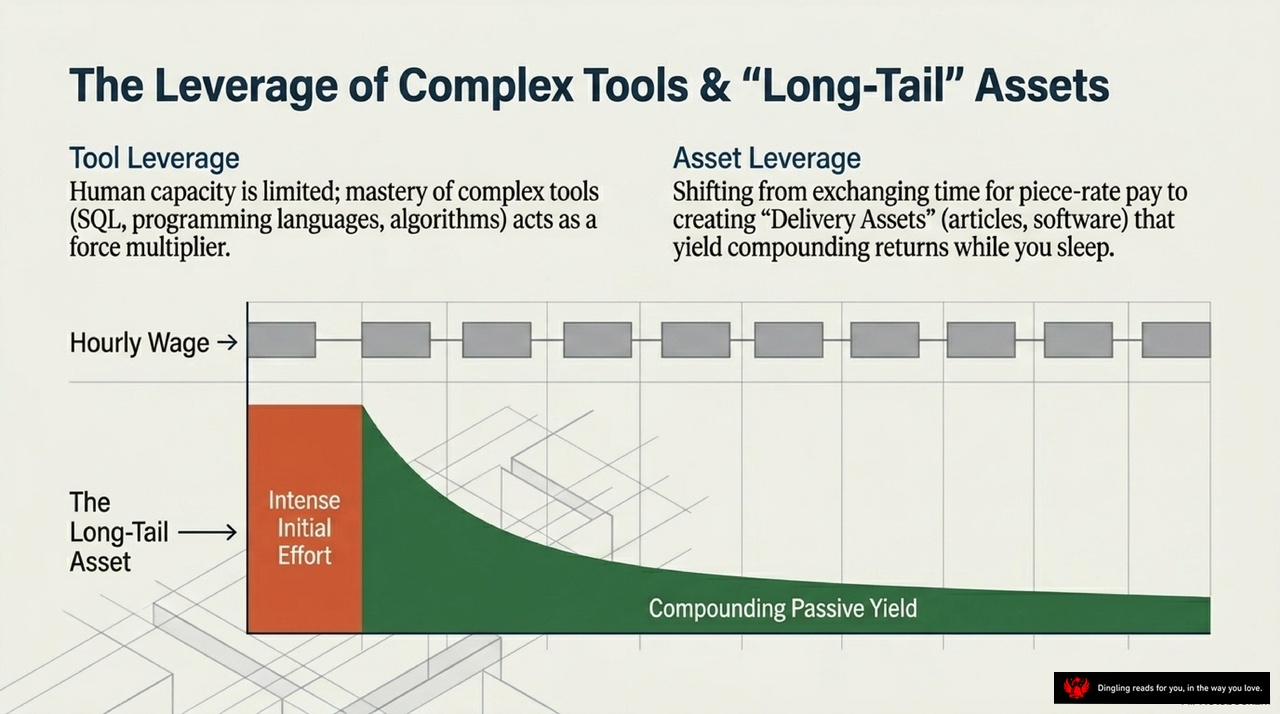
Imagine you're trading your time for dollars, hour by hour. You get paid for what you do right now, and the moment you stop, the money stops. That's the trap of an hourly wage—a flat line of income that never grows while you sleep. But what if you could build something that works for you, even when you're offline? This slide highlights the power of shifting from selling time to creating "Delivery Assets"—like articles or software—that generate compounding returns over time.
To make this happen, you need two levers. First, master complex tools like SQL, programming languages, or algorithms. Think of these as force multipliers; they expand your limited human capacity, allowing you to do the work of many. Second, invest in "Long-Tail" assets. Yes, it starts with an intense initial effort. You have to grind hard at the beginning to build that asset. But once you cross that threshold, the curve shifts dramatically. Instead of a flat hourly wage, you unlock compounding passive yield. The initial struggle pays off with long-term freedom. Don't just trade your time; build assets that work for you.

Mastering the Macro Game: Credit & Cycles. Let's break down how the global economy actually breathes.
First, look at the mechanism on the left. All modern economic crises are fundamentally debt crises. Think about the 1847 UK crisis or the 2008 Subprime meltdown—they all started the same way. Economic growth isn't magic; it's fueled by credit expansion. When the economy is booming, businesses and individuals borrow heavily to expand production and buy homes. This surge in borrowing pushes the curve upward, creating a bubble of prosperity.
But every peak brings a crash. As you can see in the dip labeled "Crisis / Correction," when the debt becomes unsustainable or the asset prices stop rising, the credit expands no more. The bubble bursts, companies go bankrupt, and we enter a recession. This cycle repeats itself, just like a heartbeat.
Now, look at the right side of the chart. We are currently approaching a new reality: The Zero-Interest Reality. Notice the line flattening out into "Negative / Zero Interest Rates." This isn't just a minor fluctuation; it's a massive signal. It tells us that high-yield opportunities have been exhausted. When interest rates hit zero or go negative, it means the economy is under severe deflationary pressure. There are simply no good projects left to fund.
In this environment, the old rules of aggressive growth don't apply. Cash flow and defensive scaling become paramount. If you can't find a profitable project, you stop borrowing. You hold onto your cash. You focus on survival. So, instead of chasing the next boom, the smartest move right now is to prepare for the long haul, protect your assets, and wait for the next cycle to turn.
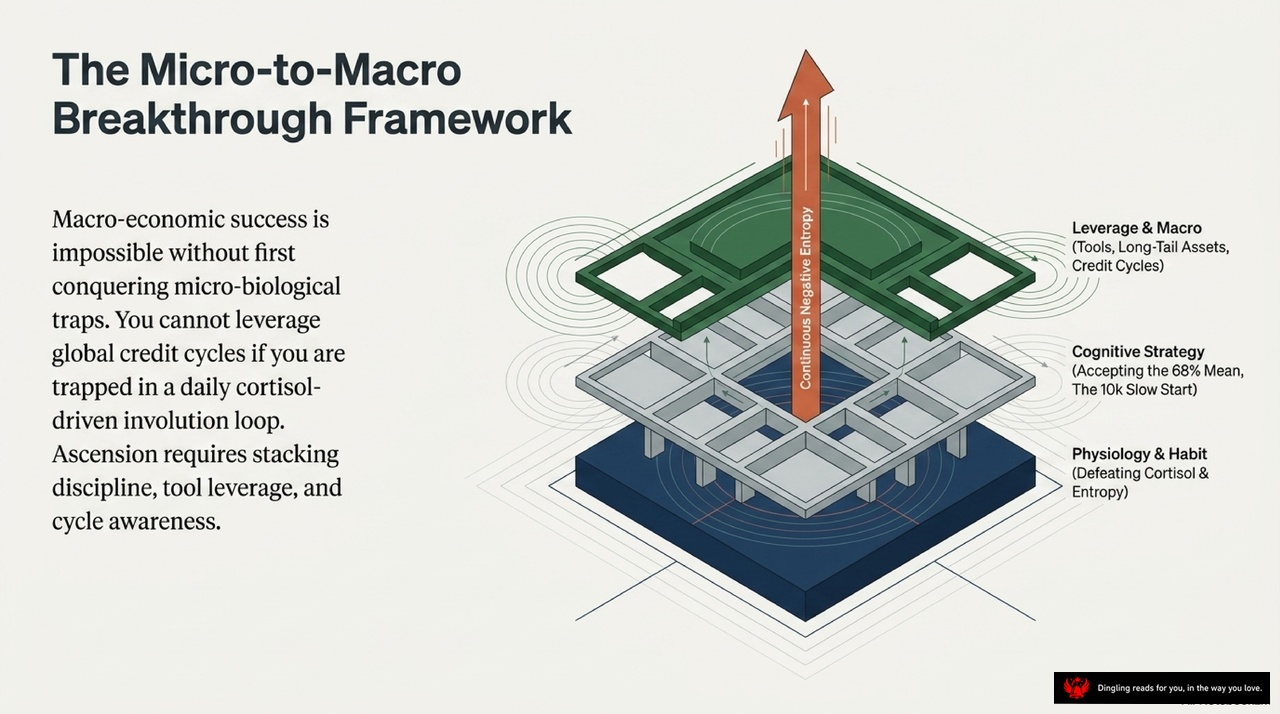
Let's talk about how you actually climb the ladder, moving from the micro level of your daily habits to the macro level of global economic success.
Look at this three-layer framework on the screen. It all starts at the bottom with **Physiology & Habit**. Before you can conquer the world, you must first defeat the cortisol-driven trap that keeps you stuck in a loop of stress and inaction. If your biology is running on empty, no strategy will work. This is about stacking discipline and building the physical foundation that allows you to show up every day.
Once that base is solid, you move up to the **Cognitive Strategy** layer. Here, you stop chasing the impossible and start accepting the **68% Mean**. You embrace the **10k Slow Start**, understanding that true breakthroughs come from consistent, boring accumulation rather than overnight miracles. You build a mental model that values long-term value over short-term dopamine hits.
Finally, at the top, you unlock **Leverage & Macro**. Only when your habits and mindset are aligned can you effectively use tools, long-tail assets, and credit cycles to multiply your results. You stop trying to leverage global economic trends while you are still trapped in a local biological trap. True ascension requires stacking all three: discipline, tool leverage, and cycle awareness. Don't skip the foundation; build it layer by layer.

Wealth transcendence is never about innate talent or chasing shortcuts. Instead, it requires continuously injecting "negative entropy" into your life—persisting in deliberate practice even during long periods of mean reversion. This is the difference between riding the wave and mastering the cycle.
Look at the slide: it asks a critical question. When the tide recedes and the era of low interest rates and involution fully arrives, will you choose to remain a "consumer" addicted to short-term pleasure, or become a "game-changer" who masters cycles and leverage?
Most people get stuck in the "consumer" trap. They wait for the next boom, consume content, and buy things that offer fleeting dopamine hits. But true wealth comes from becoming a producer. You need to leverage tools and economic cycles to create value that compounds over time.
Think about the concept of leverage. It's not just about money; it's about using time, code, media, and capital to amplify your efforts. While the rest of the world is busy consuming, you should be building systems that work for you.
So, when the going gets tough, don't retreat into comfort. Use that pressure to refine your skills and expand your leverage. That is how you move from being a passenger in the economy to the one steering the ship.