
Urban and Rural China: Complete Chapter-by-Chapter Summary
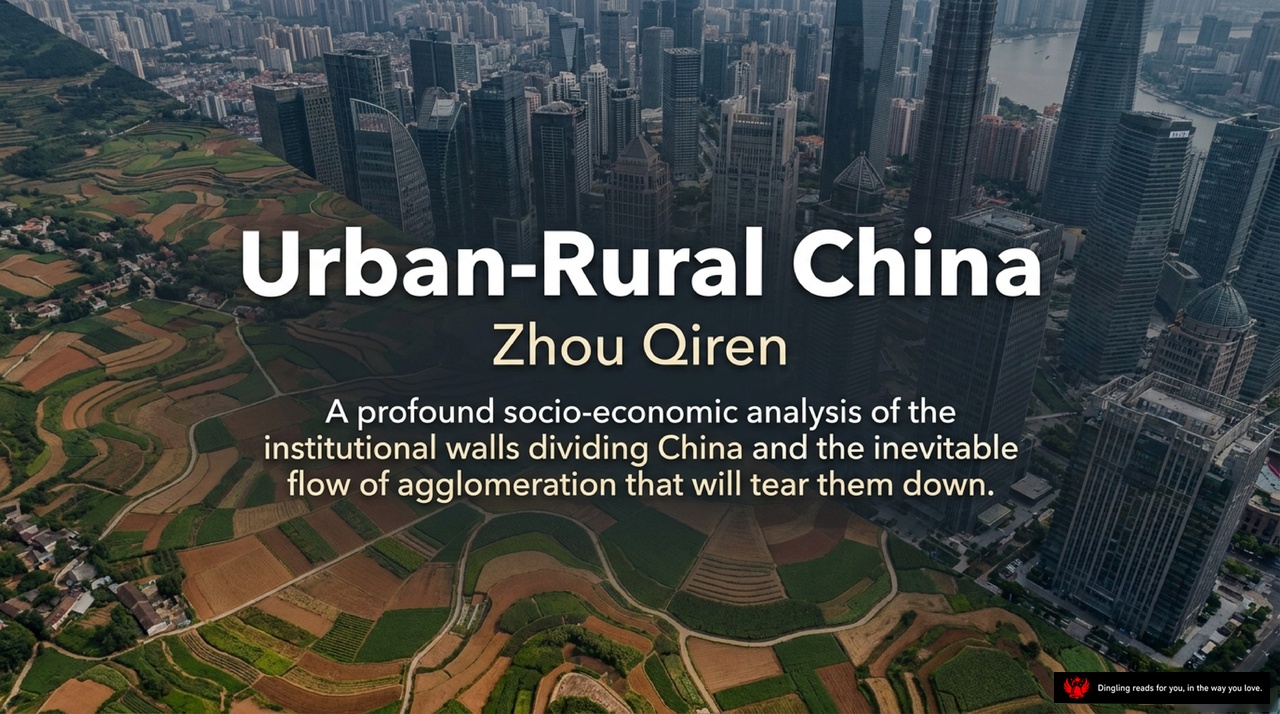
Welcome to our deep dive into Zhou Qiren's groundbreaking analysis of Urban-Rural China. This presentation explores the profound socio-economic forces shaping our nation's future.
The image before you captures the stark contrast that defines our story: the gleaming skyscrapers of our modern metropolises standing side-by-side with the vibrant, patchwork fields of our rural heartland. This visual split isn't just scenery; it represents the central tension we face today. As the slide notes, this is a story about the institutional walls that have long divided these two worlds and the inevitable, powerful flow of agglomeration that is destined to tear them down.
We are moving from a fragmented past toward an integrated future. The sheer scale of this transformation is reshaping everything from how we live to how our economy functions. Join me as we unpack the logic behind this divide and the forces driving us toward a truly unified China.
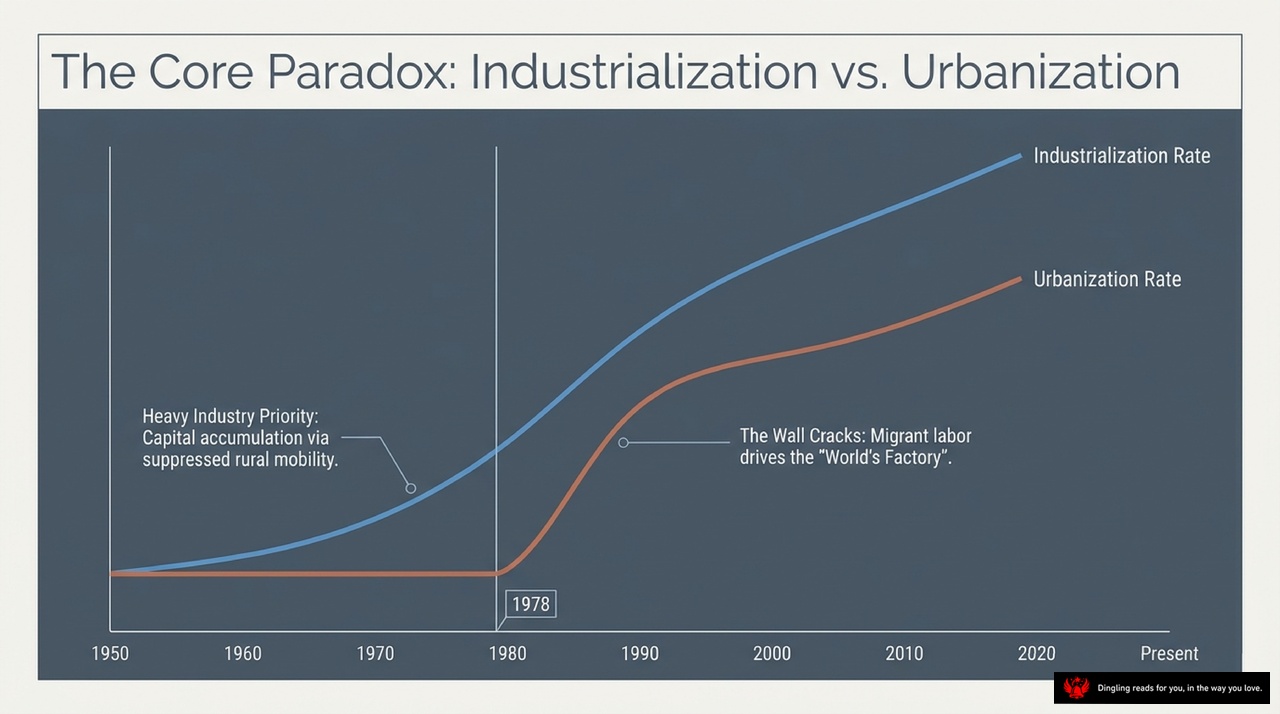
The Core Paradox: Industrialization vs. Urbanization
Look at this graph. It tells a story of missed timing. From 1950 to the present, the blue line—our Industrialization Rate—soared way ahead of the orange line, our Urbanization Rate. By 1980, we had built the factories, but the people hadn't yet moved to the cities.
Why the gap? In the early decades, we prioritized heavy industry. We needed capital, so we suppressed rural mobility. Farmers were kept in place to feed the cities and fund the factories. The industrial engine started running, but the workforce was stuck in the fields.
Then, around 1978, the wall finally cracked. That's when migrant labor surged. Suddenly, the "World's Factory" could run because people could actually move to where the jobs were. This wave of migration drove urbanization up, but by then, the industrial structure was already set.
The result is a structural mismatch. We have a highly industrialized economy, but our urbanization lagged behind. We built the infrastructure for a different kind of city than the one our population actually created. This disconnect is at the heart of many of our current challenges, from housing shortages to uneven regional development. Understanding this timeline is the first step to fixing it.
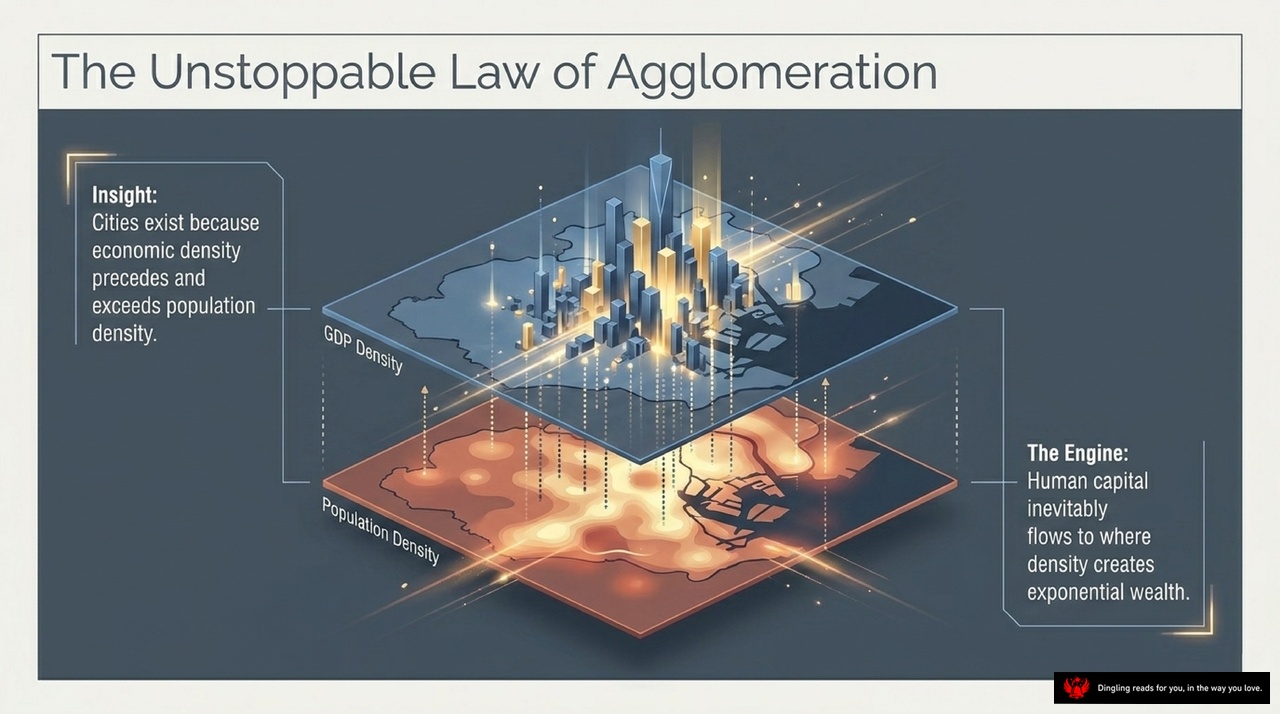
Why do cities exist? It's not just because people cluster together; it's because wealth does. As we see on this slide, the "unstoppable law of agglomeration" reveals a simple but powerful truth: cities exist because economic density precedes and exceeds population density. Look at the layers here—the bottom layer shows where people live, but the top layer, glowing with light, shows where the real money is made. Human capital inevitably flows to where density creates exponential wealth. That's the engine. People don't just follow crowds; they follow high incomes and opportunity. Take Tokyo, for instance. It occupies only 4% of Japan's land but generates 40% of the country's GDP. Even with policies to spread people out, they keep crowding into Tokyo because the returns are simply too high elsewhere. Conversely, when population density matches economic density, like in Seoul, growth stalls. This isn't just theory; it's the fundamental logic of why we build cities and why we keep moving toward them.

The Institutional Wall: A Dual Structure.
On the left, we see the Rural Collective, a reservoir of resources—labor, grain, and raw materials—locked in place. On the right stands the Urban State, the engine of industry and growth. Between them rises a formidable barrier: the Hukou and Rationing System.
This isn't just a bureaucratic line; it's a mechanism designed to lock peasants to the land. As the slide illustrates, the flow is one-sided. Resources are extracted from the countryside, flowing upward to subsidize state-led industrialization in the cities. Meanwhile, human mobility is strictly blocked. The arrows show that while capital and goods can cross the wall, people cannot.
This top-down system created a rigid dual structure. It allowed the Urban State to thrive by drawing strength from the Rural Collective, effectively freezing the rural population in place to fuel the nation's rapid modernization. This structural divide defined China's economic landscape for decades, prioritizing industrial output over the natural movement and integration of its people.
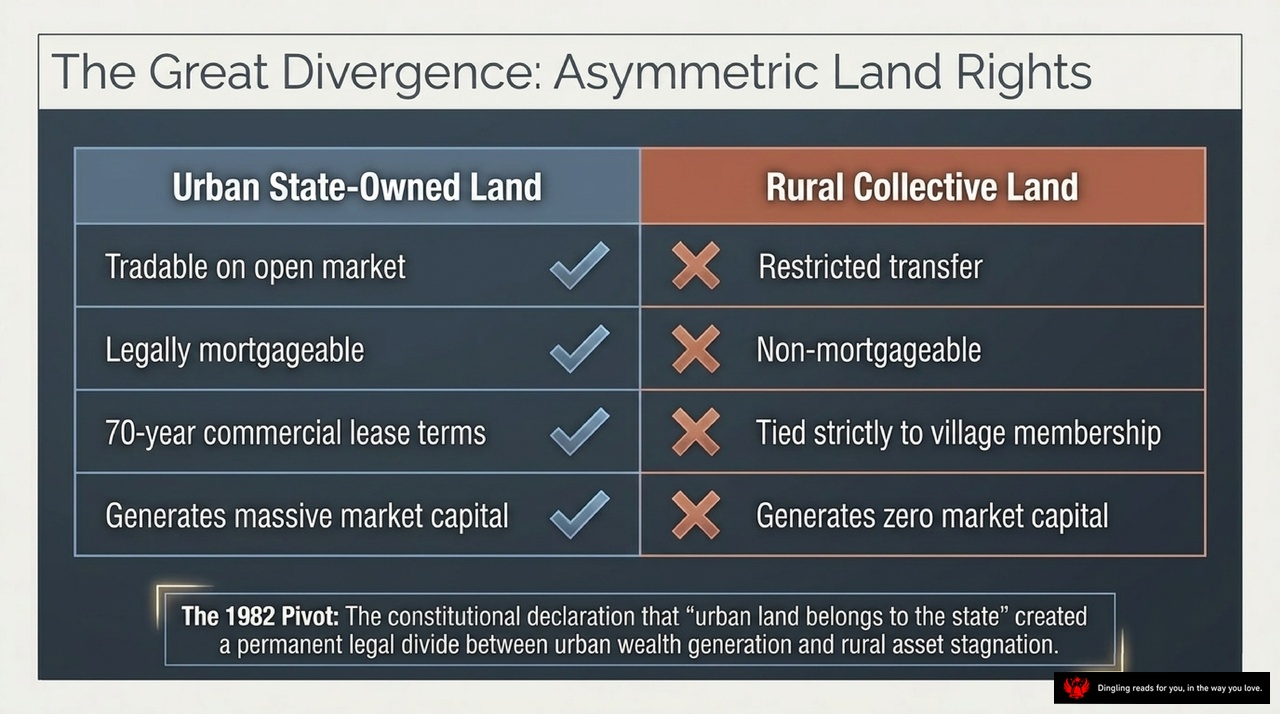
The Great Divergence: Asymmetric Land Rights. Look at this chart. It tells a stark story of how one simple rule created two completely different worlds in China. On the left, urban land owned by the state. On the right, rural land held collectively. The difference? One side is a thriving engine of wealth; the other is stuck in place.
Urban land is tradable on an open market, legally mortgageable, and comes with a 70-year commercial lease. This generates massive market capital. It's liquid, flexible, and creates real value. But look at the rural side. Restricted transfer, non-mortgageable, tied strictly to village membership, and it generates zero market capital. It's an asset that sits still, unable to be leveraged or sold.
This isn't an accident. It stems from the 1982 Pivot. The constitutional declaration that "urban land belongs to the state" created a permanent legal divide. It cemented urban wealth generation while locking rural assets in stagnation. While cities could borrow against their land to build skyscrapers and drive growth, rural areas were left with a dead asset that could never appreciate or finance development. This asymmetry is the root cause of the Great Divergence, shaping the economic destiny of millions by denying them the same financial tools available to their urban counterparts.

Why does China's urbanization look so different from the rest of the world? The answer lies in a structural imbalance: industrialization raced far ahead of urbanization. While factories were booming, the cities themselves couldn't keep up with the influx of people. This disconnect stems from a rigid system where land ownership was the key lever. Under the 1982 Constitution, all urban land was declared state-owned, while rural land remained collective. This created a massive wedge. To bring land into the market, the government had to forcibly convert collective rural land into state-owned urban land. This process, known as administrative expropriation, allowed local governments to act as the sole gatekeepers of land supply. They could acquire vast amounts of cheap rural land at a tiny price tag, then repackage it as high-value commercial land for auctions. The massive difference in value between the acquisition cost and the auction price became a source of immense profit, or "value capture," flowing directly into municipal finance. This mechanism fueled rapid urban expansion, but at a steep cost: it effectively froze rural wealth and prevented farmers from participating in the land market. Instead of a free exchange of property rights, the system relied on state monopoly to capture the price differential, creating a friction that continues to shape China's economic landscape today.
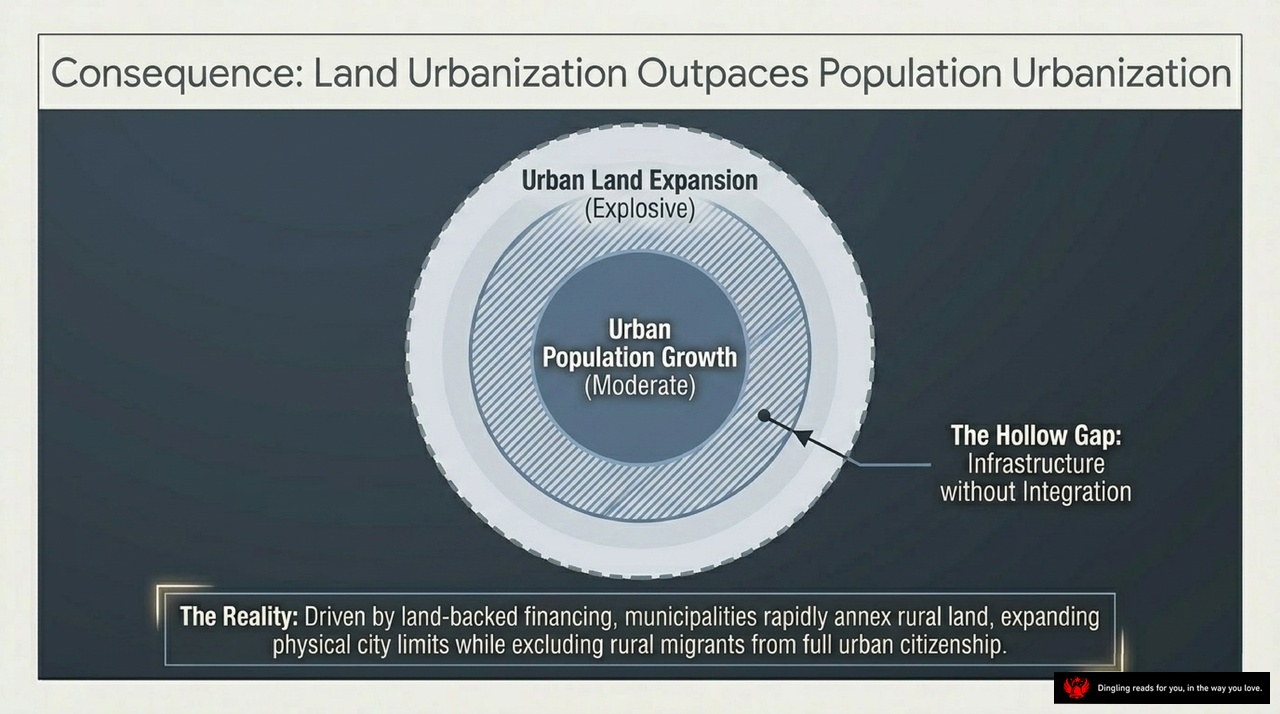
Land urbanization is racing far ahead of population urbanization, creating a massive "hollow gap" where infrastructure exists without true integration. The core reality driving this disconnect is simple: municipalities are rapidly annexing rural land to expand the physical footprint of cities, fueled by land-backed financing, while simultaneously excluding rural migrants from full urban citizenship. This imbalance means that while the city's borders explode outward, the actual population growth remains moderate. The result? A sprawling landscape of roads and buildings that fails to serve the people who need them most. Instead of a cohesive urban ecosystem, we see a fragmented reality where the land belongs to the state, but the people are left behind, unable to fully participate in the economic and social life of the city they helped build. This structural lag is not just a planning failure; it's a fundamental mismatch between how we acquire land and how we include people.
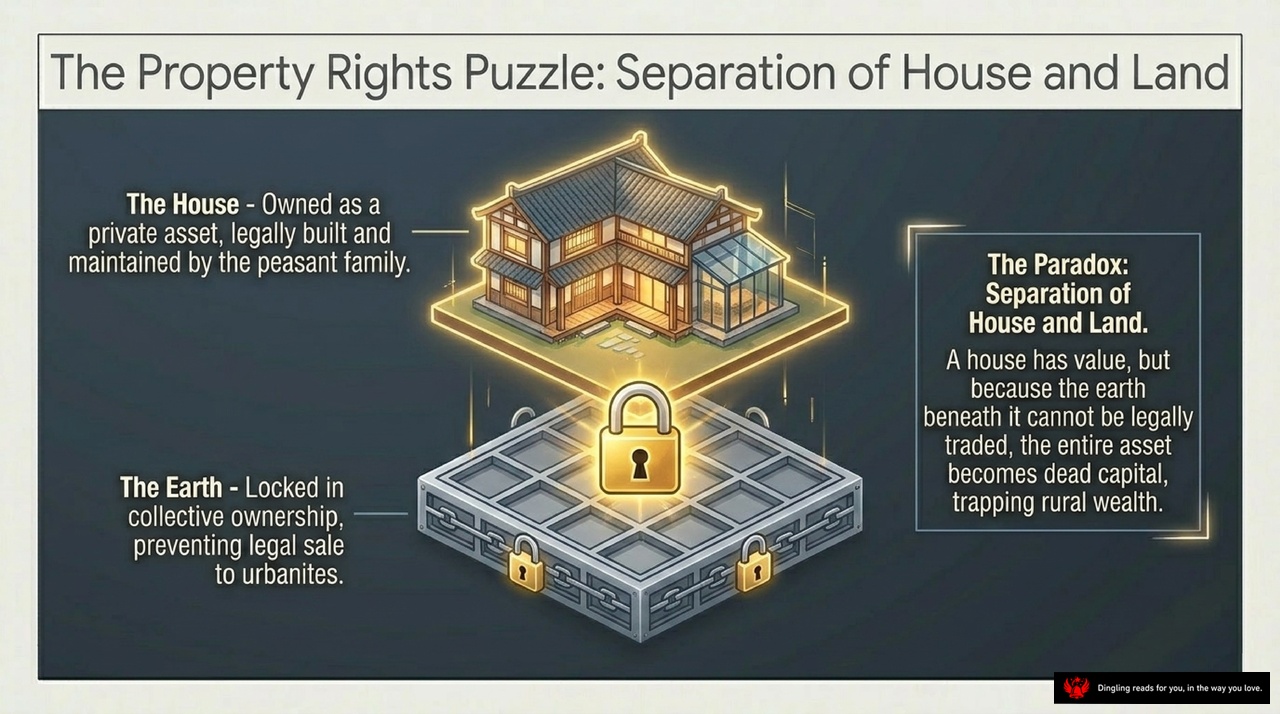
Today's slide reveals a critical paradox at the heart of our property rights puzzle: the separation of house and land. Look closely at the image. We see a house, glowing as a private asset, legally built and maintained by a family. Yet, beneath it lies the earth, locked in collective ownership, barred from legal sale to anyone outside the village. This physical disconnect creates a massive economic trap.
As the slide illustrates, this separation creates a deadly paradox. A house has immense value, but because the land beneath it cannot be legally traded, the entire asset becomes "dead capital." It's like having a powerful engine that is chained to a floor that no one can sell. This rigidity traps rural wealth, preventing farmers from turning their land into liquid assets that could fuel investment or urbanization. In a healthy market, the value of the land should flow to the owner of the house, but our current system freezes that value, stalling economic growth and keeping rural communities disconnected from the broader market.

The Catalyst: The 'Linkage' Innovation. Look at this three-step process that changed everything. First, we clear out unused rural homes to restore the land. Second, that physical action creates an abstract Development Quota. Third, and most importantly, we transfer that quota to the urban fringe, allowing legal city expansion. This is the breakthrough: decoupling physical land from its right to develop. By separating the two, we created a new conduit for wealth to flow back to the countryside. Instead of just grabbing land, farmers now trade a development right they can't use themselves for cash that actually builds their future. This linkage innovation breaks the deadlock, turning idle rural assets into a powerful engine for urban growth and rural prosperity all at once.
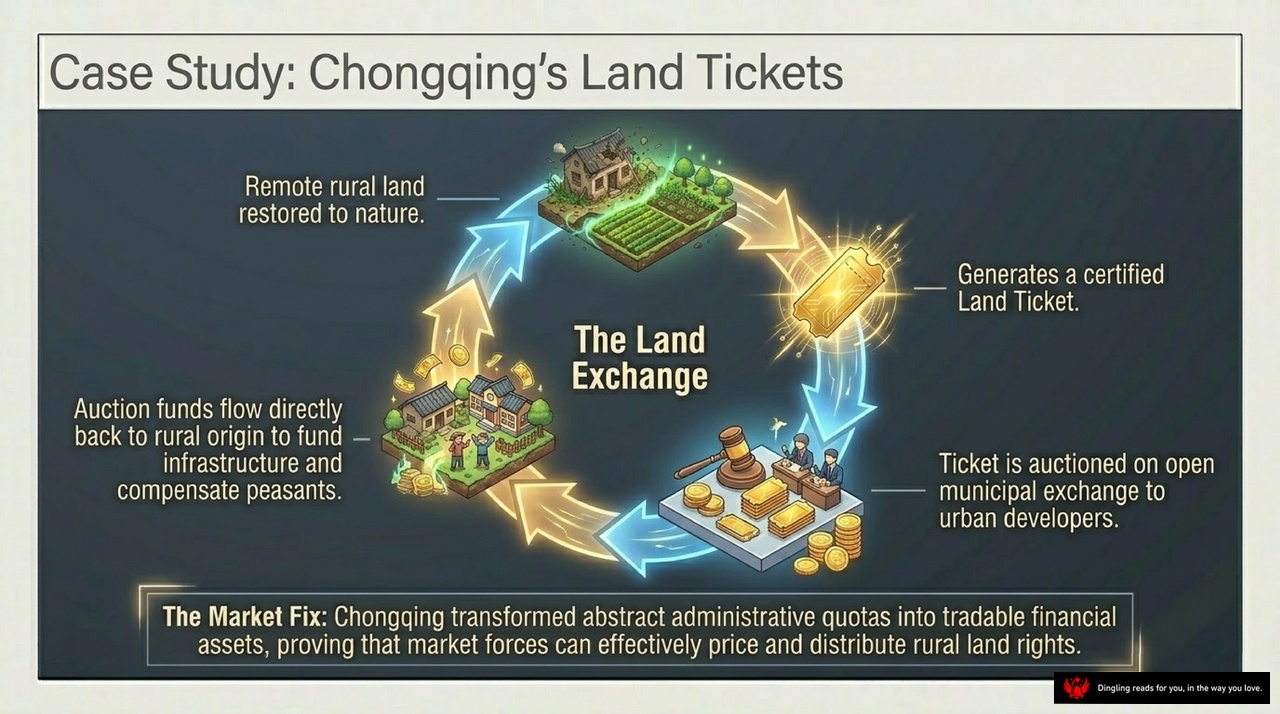
Let's talk about the final and most critical hurdle in China's urban-rural reform: opening the door to the land market. While agricultural products and migrant labor flows were unlocked from the countryside, land reform had to radiate outward from the cities, driven by the massive value gap between urban and rural land. This is where the real breakthroughs happened.
Take Shanghai's "Three Concentrations" pilot in 2005, where farmers swapped their scattered old homesteads for modern apartments in new communities. The reclaimed land was then sold on the market to fund construction, creating a true win-win for both city and country. But the most innovative example comes from Chongqing, which launched the "Land Ticket" system in 2007. This mechanism solved a major mismatch: rural land was shrinking while urban demand was exploding. Farmers voluntarily reclaimed idle construction land into farmland, generating tradable land tickets. These tickets were then auctioned on an open municipal exchange to urban developers, with the majority of the proceeds going directly back to the farmers.
The result was transformative. In the first auction, private enterprises bought hundreds of acres of land tickets, proving that market forces could effectively price and distribute rural land rights. This system didn't just provide funds; it allowed even remote farmers to share in the wealth generated by urban expansion. From Shanghai's housing swaps to Chongqing's land tickets, and Shenzhen's unique approach of turning vague land rights into clear property ownership and equity, these practices show a clear trend. Markets, backed by clear property rights, are unstoppable. The future of urban-rural integration lies not in restricting these flows, but in fully opening the land market to let resources work where they create the most value.

Today's case study zooms in on Chengdu's groundbreaking "Returning Rights" initiative, a real-world blueprint for true urban-rural integration. The slide breaks this transformation into three clear phases. First, we have Measurement. This is the foundation where surveyors and villagers work side-by-side to resolve complex historical boundary disputes, turning vague claims into precise, agreed-upon lines on a map. Without this step, trust cannot be built.
Next comes Certification. Once boundaries are clear, the government issues legally binding, permanent property certificates directly to individual households. This isn't just a piece of paper; it's the moment land transforms from a collective abstraction into a tangible asset owned by the family.
Finally, we reach Marketization. Here, the magic happens. By unlocking these assets, farmers gain the legal right to trade, mortgage, or consolidate their land. The slide beautifully illustrates this with an unlocked padlock and rising dollar signs, symbolizing how dead capital becomes a living engine for wealth creation.
The core takeaway, labeled Empowerment, is simple yet profound: true reform requires granting peasants the exact same property right powers enjoyed by urban citizens. When farmers hold full title, they stop being passive recipients of state decisions and become active participants in the economy, driving growth from the ground up.

The image illustrates a powerful economic concept known as the "Shadow Market," specifically focusing on "Small Property Rights." Think of this as an iceberg: the visible tip above the water represents the highly regulated, expensive legal land market, while the massive base hidden underwater is the vast, spontaneous, informal market where rural homes are sold or rented to urbanites.
This dual structure exists because of a fundamental mismatch between urban demand and rural supply. As the image notes, where the law is slow to act, the market steps in. Economic gravity dictates that this informal market will persist as long as the legal dual-structure remains intact. In the context of Chinese urbanization, this "shadow market" isn't a failure; it's a rational response to rigid regulations. When formal channels for rural land and housing are blocked, people create their own solutions. From small property rights to informal rentals, these underground transactions allow resources to flow where they are needed most, bridging the gap that official policy leaves behind. Ultimately, true urbanization can't happen until these hidden rights are brought into the light and integrated into the formal system.
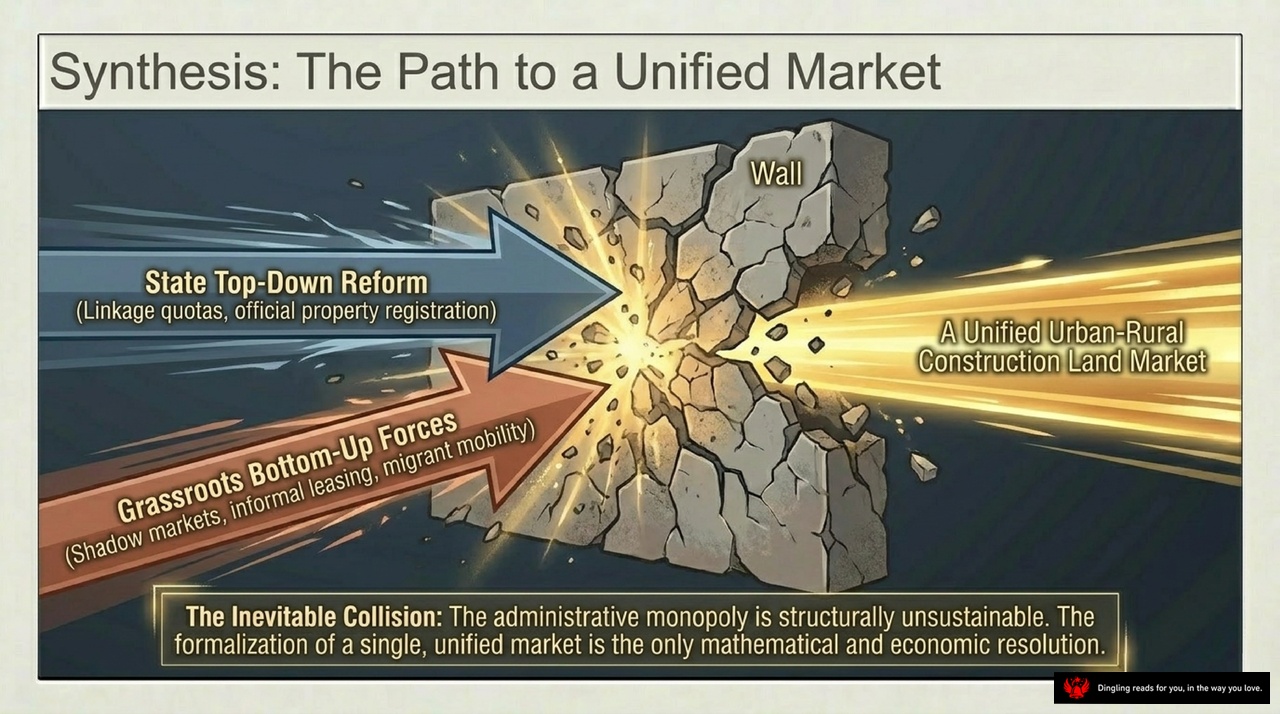
Synthesis: The Path to a Unified Market. Look at this image: a massive wall labeled "Wall" stands between the status quo and a "Unified Urban-Rural Construction Land Market." But notice the force breaking it. On the left, we have "State Top-Down Reform"—linkage quotas and official property registration. On the bottom, "Grassroots Bottom-Up Forces"—shadow markets, informal leasing, and migrant mobility. These aren't opposing forces; they are converging arrows smashing the same barrier. Why? Because the current administrative monopoly is simply structurally unsustainable. The text at the bottom makes it clear: formalizing a single, unified market is the only mathematical and economic resolution. Think about it: if you have a thriving, efficient black market for land, as we've seen in places like Chongqing's "diapiao" or Chengdu's property exchanges, and the government is trying to impose a rigid, inefficient system on top of it, the result is always friction and waste. History shows us that when bottom-up demand for rights meets top-down supply mechanisms, the wall eventually cracks. The state can try to slow it down, but the economic logic of a unified market is too powerful to ignore. We are moving from a fragmented system where land is a political tool to a unified market where land is a true asset. This collision is inevitable, and the path forward is clear: break the wall and let the market flow.
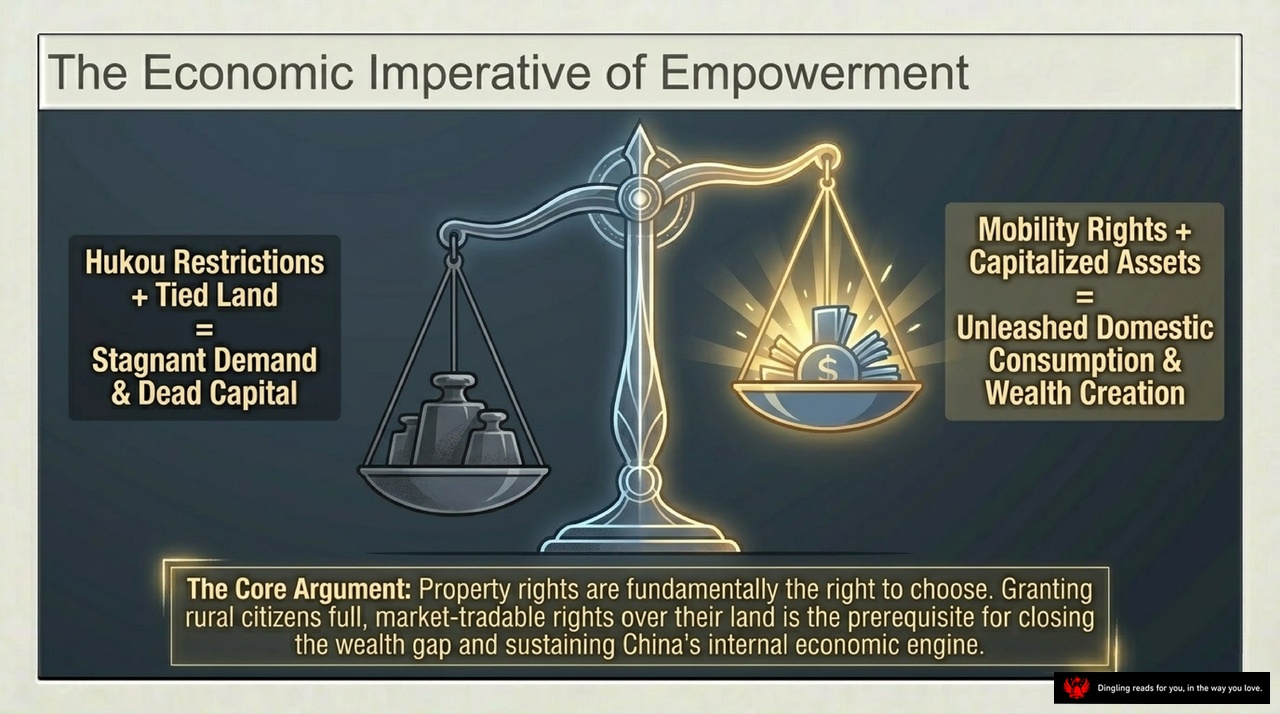
Look at this balance scale: on the left, we have "Hukou Restrictions plus Tied Land," which creates stagnant demand and dead capital. On the right, we see "Mobility Rights plus Capitalized Assets," leading to unleashed domestic consumption and wealth creation. This visual perfectly captures the core argument: property rights are fundamentally the right to choose. For decades, the Hukou system and land restrictions kept rural citizens tethered to the soil, turning their assets into something they couldn't use or sell—essentially dead capital that couldn't fuel growth. Without the freedom to move and the ability to trade their land, demand remained suppressed, and the economy lost a massive engine. But when we grant full, market-tradable rights over land, we do more than just adjust property laws; we unlock human potential. Suddenly, rural land becomes a source of wealth that can be leveraged for education, housing, and investment. This shift transforms stagnant assets into dynamic capital, allowing people to participate fully in the national economy. By removing these artificial barriers, we close the wealth gap and ignite the internal economic engine, proving that true empowerment is the key to sustainable prosperity.

The dual structure of China's urbanization—built on asymmetric land rights and administrative monopolies—has reached its structural limits. For too long, the state has treated rural land as a source of capital accumulation rather than a property right for citizens. This system created a massive reservoir of "dead capital," trapping billions of farmers in low-value assets they couldn't trade, mortgage, or truly own.
The slide asks a critical question: granting full, market-tradable property rights to rural citizens is the only mechanism to transform this dead capital into the engine of China's next era of prosperity. When the institutional wall finally falls, the result won't be chaos. Instead, it will unleash a powerful flow of capital. The real challenge isn't whether this change will happen, but how we harness it. Will we let the flood of liquidity overwhelm our cities, or will we build the channels to power the future? The answer lies in finally treating rural land not as a political tool, but as a vibrant asset that can fuel the next great wave of economic growth.