
Value-Based Selling: Complete Chapter-by-Chapter Summary
Welcome to today's session on Value-Based Selling by Cui Jianzhong. Think of this not just as a sales book, but as a strategic blueprint for transforming your B2B approach. We are moving away from the old way of simply pitching product features and getting stuck in price wars. Instead, we are shifting to a model where you architect measurable performance value.
The core idea is simple yet powerful: stop selling products and start selling outcomes. Traditional sales often focus on solving the problems a customer tells you about, which leaves you vulnerable to competitors undercutting your price. Value-Based Selling flips this script. You become a partner in your client's success, digging up hidden problems they haven't even realized yet and offering systemic solutions that improve their entire business performance.
This approach is designed for complex B2B environments where decisions involve multiple stakeholders and long cycles. By creating value that goes far beyond the product itself—like optimizing workflows or driving strategic growth—you make your solution unique and hard to copy. This allows you to command higher prices, secure larger deals, and build long-term partnerships that last. It's about turning sales from a transactional activity into a strategic engine for your company's growth and profitability.
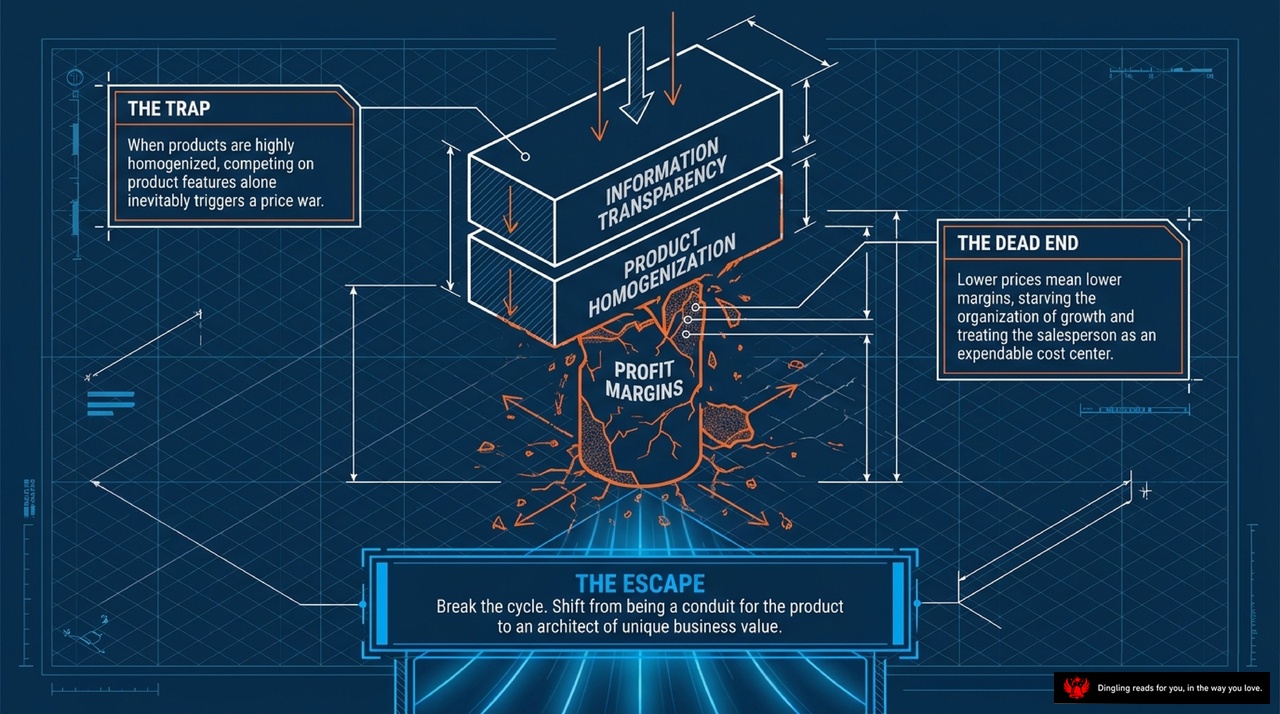
When information becomes fully transparent and products look identical, we hit a trap: competing on features alone inevitably triggers a price war. As the slide illustrates, this creates a deadly cycle. Product homogenization and total transparency crush profit margins, leading to a dead end where lower prices mean lower margins, starving the organization of growth and forcing salespeople to be treated as expendable cost centers.
But there is a way out. The escape lies in breaking this cycle by shifting from being a mere conduit for the product to becoming an architect of unique business value. Instead of fighting on price, you must build a differentiated advantage that justifies a premium. This means moving beyond simple transactions to create deep, systemic value that competitors cannot easily copy. By redefining your role from a seller to a strategic partner, you stop the race to the bottom and start building a sustainable, high-value business model.

Imagine a world where sales isn't about pushing a product, but about engineering the customer's success. This slide, "The Evolution of Sales Methodologies," maps exactly that journey, showing how we've moved from simple relationship building to the sophisticated, high-margin dominance of Value-Based Selling.
Look at the progression. We started with Relationship Selling, where the focus was purely on personal emotion and dinners. While it built bonds, it created a hidden cost of high compliance risk and hit a structural ceiling. Then we moved to Product Selling, which shifted focus to features and pitching. This led to extreme price wars and eventually irrelevance. Next came Consultative Selling, which was a step forward by focusing on stated needs and Q&A. However, it still suffered from high reaction times and the ultimate fate of commoditization—becoming just another interchangeable option.
But the game-changer is the highlighted section on the right: Value-Based Selling. This is where the real transformation happens. Instead of focusing on personal emotion or product features, the core focus shifts entirely to Organizational Performance. The primary tactic isn't just pitching; it's Frame of Reference Engineering—redefining how the customer sees their problems. This requires high intellectual capital, moving the conversation from "what can you sell me?" to "how do we improve your business?" The result? High-Margin Dominance.
While traditional methods often trap sellers in price wars or irrelevant feature battles, Value-Based Selling breaks the cycle. It creates a unique value that competitors can't easily copy, allowing you to charge a premium and build long-term partnerships. As we dive deeper into the next slides, you'll see exactly how to execute this shift from being a product pusher to becoming a strategic partner who drives real business results.

Look at this blueprint-style formula on the screen. It breaks down exactly how we calculate the "Actual Value" in a deal. Notice the equation: it's not just about the product. It's the sum of Product Value and Salesperson Value, multiplied by Customer Cognition, and then we subtract the Customer Cost.
Here's the critical insight: The arrow pointing to the Salesperson Value highlights what we call the "Critical Variable." In today's market, the product itself is often commoditized. The real differentiator is the soft value you bring—the knowledge, process optimization, and insights you offer beyond the box.
But here's the catch, and the blue circle emphasizes this: Value only exists if the customer perceives it. The architect's job, which is yours, is to engineer this perception. You can't just deliver a great solution; you must make the customer *see* its worth. When you successfully engineer high perceived value, as the note on the right suggests, you justify higher costs and premium pricing. You stop competing on price and start competing on the value you create. This shift from selling features to engineering perception is what separates a standard transaction from a high-value partnership.
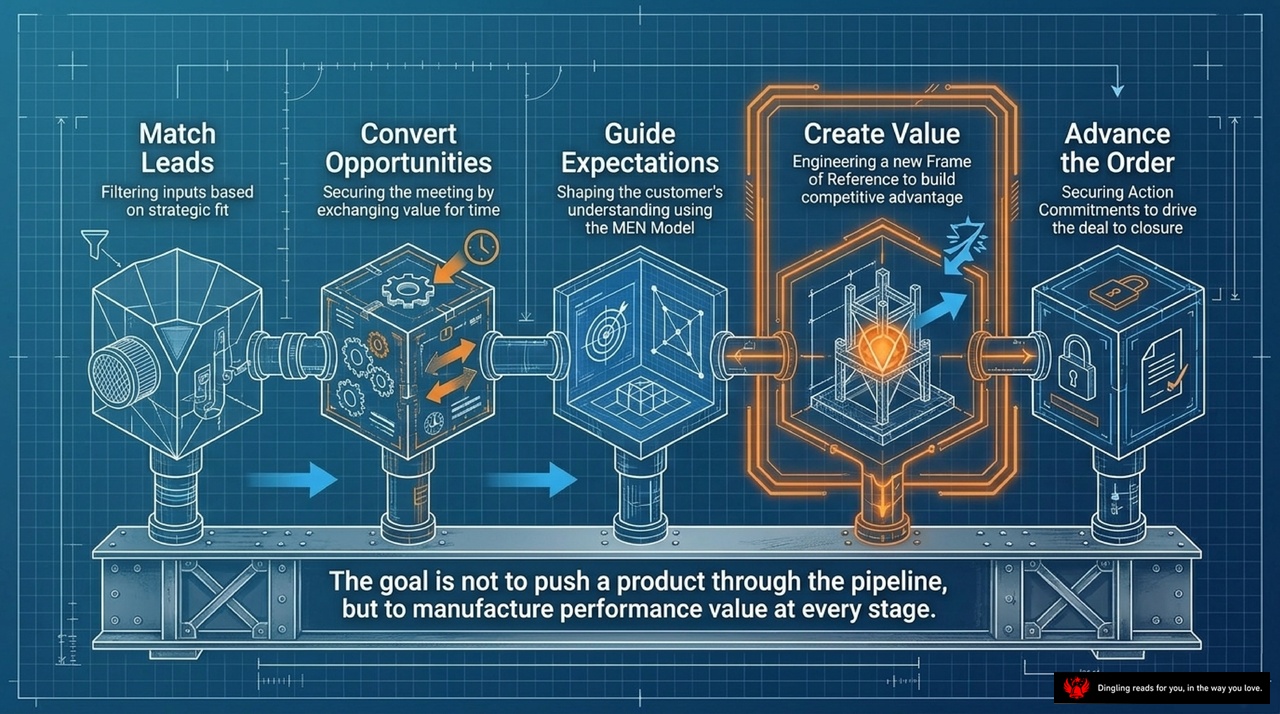
Today's slide visualizes the entire Value-Based Sales engine as a high-performance manufacturing line. Notice how the first three stages—Matching Leads, Converting Opportunities, and Guiding Expectations—are depicted in blue, representing the foundational setup. But look closely at the fourth stage, **Create Value**. It's highlighted in orange and glowing, signifying that this is the core engine where real competitive advantage is manufactured.
The text at the bottom sums it all up: "The goal is not to push a product through the pipeline, but to manufacture performance value at every stage." This is the critical mindset shift. Traditional sales try to shove a product down a customer's throat. Value-based sales, however, act like a factory. At the **Match Leads** stage, we filter inputs based on strategic fit. At **Convert Opportunities**, we secure the meeting by exchanging value for time. Then, at **Guide Expectations**, we use the MEN Model to shape the customer's understanding.
But the magic happens at **Create Value**. Here, we aren't just fixing a broken part; we are engineering a new Frame of Reference. We are building a system that delivers competitive advantage, shifting the conversation from "what this product does" to "how this improves your entire business performance." Finally, we move to **Advance the Order**, securing the action commitments needed to drive the deal to closure.
Remember, if you are just pushing a product through this pipeline, you will eventually run out of steam. But if you are actively manufacturing performance value at every single stage, you stop competing on price and start winning on undeniable, high-value results.
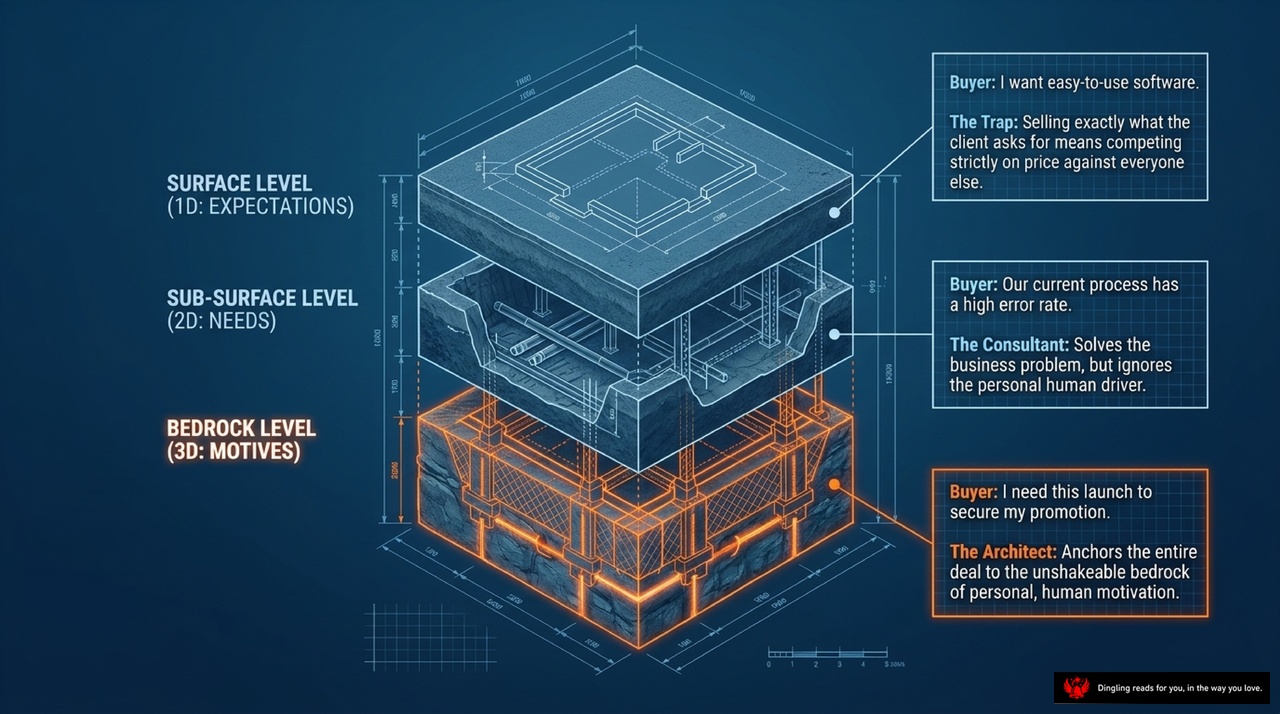
Look at this blueprint of the sales process. We often get stuck at the surface level, where the buyer simply says, "I want easy-to-use software." If we sell exactly what they ask for, we are just competing on price against everyone else. That's a trap.
But a true Value-Based Sales Architect digs deeper. They don't stop at the surface expectations or even the mid-level business needs like high error rates. Instead, they anchor the entire deal to the bedrock level—the unshakeable foundation of personal, human motivation.
As the buyer says, "I need this launch to secure my promotion." That is the real driver. By aligning our solution with that personal ambition, we transform the conversation from a simple product transaction into a strategic partnership. We aren't just selling software; we are helping them secure their future. That's how you build an unshakeable deal.
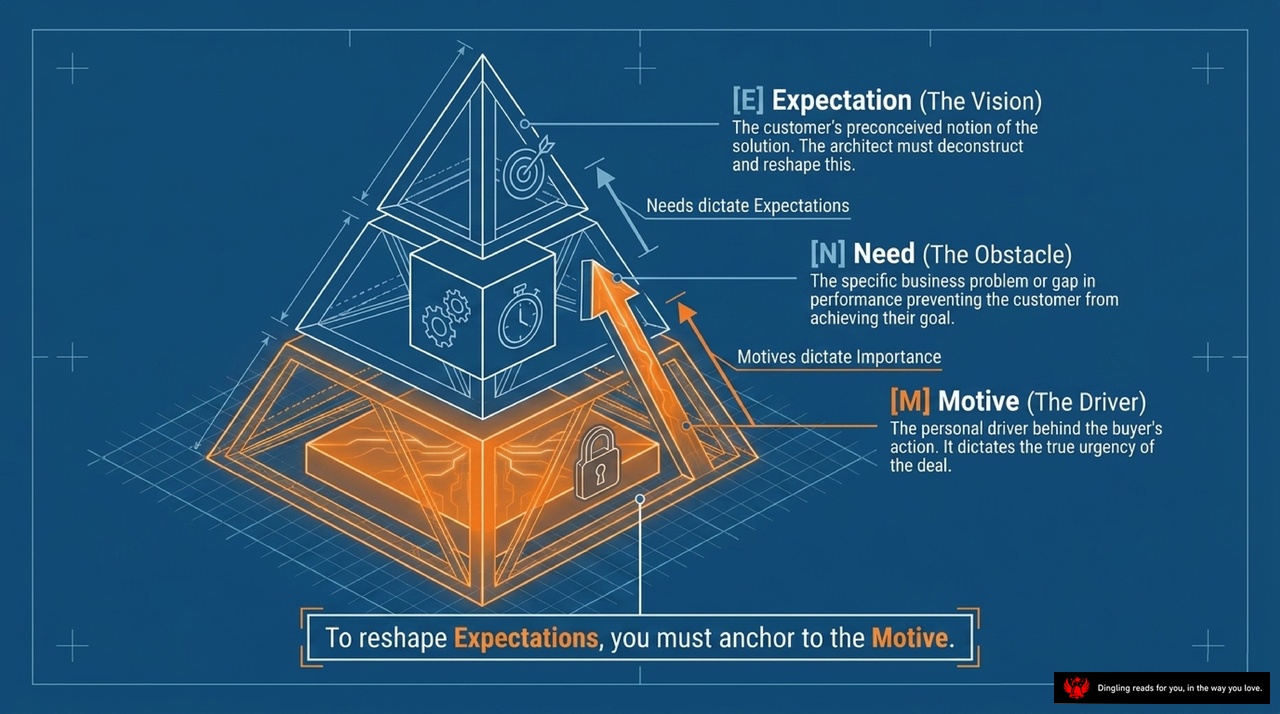
To reshape customer expectations, you absolutely cannot rely on features alone. You must anchor your entire pitch to their deep-seated personal motives. Think of it like this: the customer's "Expectation" is the vision they hold of the perfect solution, but that vision is actually dictated by their specific "Need"—the performance gap they are struggling to close. However, the true driver that dictates the urgency and importance of that need is their personal "Motive." Whether it's fear of job loss, a desire for recognition, or protecting their reputation, this hidden motive is the engine behind every decision. If you ignore the motive and only talk about the product, you're just reshaping a vision that doesn't matter to them. To truly win, you have to connect the solution directly to what drives them personally. Once you anchor your value to their motive, you don't just meet their expectations; you redefine them in your favor, making your solution the only logical choice.

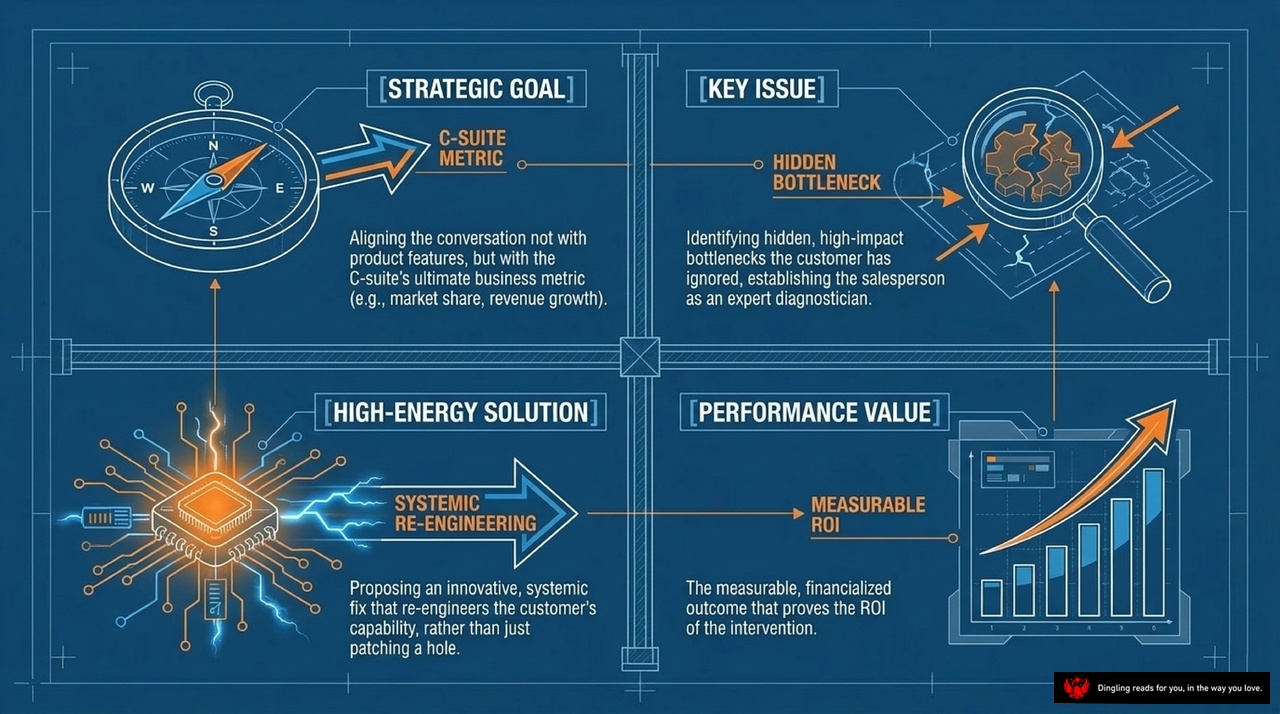
Imagine sales not as a simple transaction, but as a sophisticated machine designed to transform how a customer sees the world. As you can see in this blueprint, we are building a system where the "Strategic Goal" drives a series of interconnected gears. The first gear, fueled by identifying "Key Issues," meshes with "High-Energy Solutions" and delivers tangible "Performance Value." This entire mechanism doesn't just move parts; it generates a powerful force that points directly to a "New Customer Perception."
The core insight here is that customers don't evaluate your product based on its features alone; they judge it through their existing "Frame of Reference." Traditional sales try to fit their product into this old frame, often leading to a price war. But the Value Architect takes a different approach. Instead of competing within the customer's old mental model, we engineer a completely new one. By systematically reshaping how the customer defines success and value, we make the competition irrelevant. We aren't just selling a product; we are redefining the rules of the game so that your solution becomes the only logical choice.
Here is the spoken-word script for Slide 8, tailored for an American audience with a natural, engaging tone.
**Slide 8 Script:**
"Let's look at the engine that drives the entire Value-Based Sales methodology. This slide breaks down the four critical phases that turn a random lead into a loyal, high-value partner.
First, you have **Matching Leads**. Think of this as finding the right pond before you start fishing. Instead of blindly casting a net everywhere, you use industry analysis to identify hidden pain points and ensure you're only talking to clients who actually have the budget and need for your solution. It's about precision over volume.
Next is **Converting Opportunities**. This is where the real work happens. You aren't just selling a product anymore; you're shifting the client's mindset. You use psychological triggers—fear, curiosity, pressure, and ego—to move them from 'maybe later' to 'I need this now.' You're turning a passive observer into an active buyer who sees a problem they can't ignore.
Then comes the core of our strategy: **Creating Value**. This is where you stop patching holes and start re-engineering their entire capability. You present a high-energy solution that addresses their strategic goals, not just their immediate complaints. You show them a measurable ROI that proves you're not just a vendor, but a performance improvement partner.
Finally, you **Push the Order**. This isn't about aggressive closing; it's about aligning with their internal procurement process. You get small, specific commitments at every step, handle their personal objections, and guide them smoothly from interest to signature.
When you execute these four stages in order, you create a closed loop. You don't just make a sale; you build a system that makes the sale inevitable."
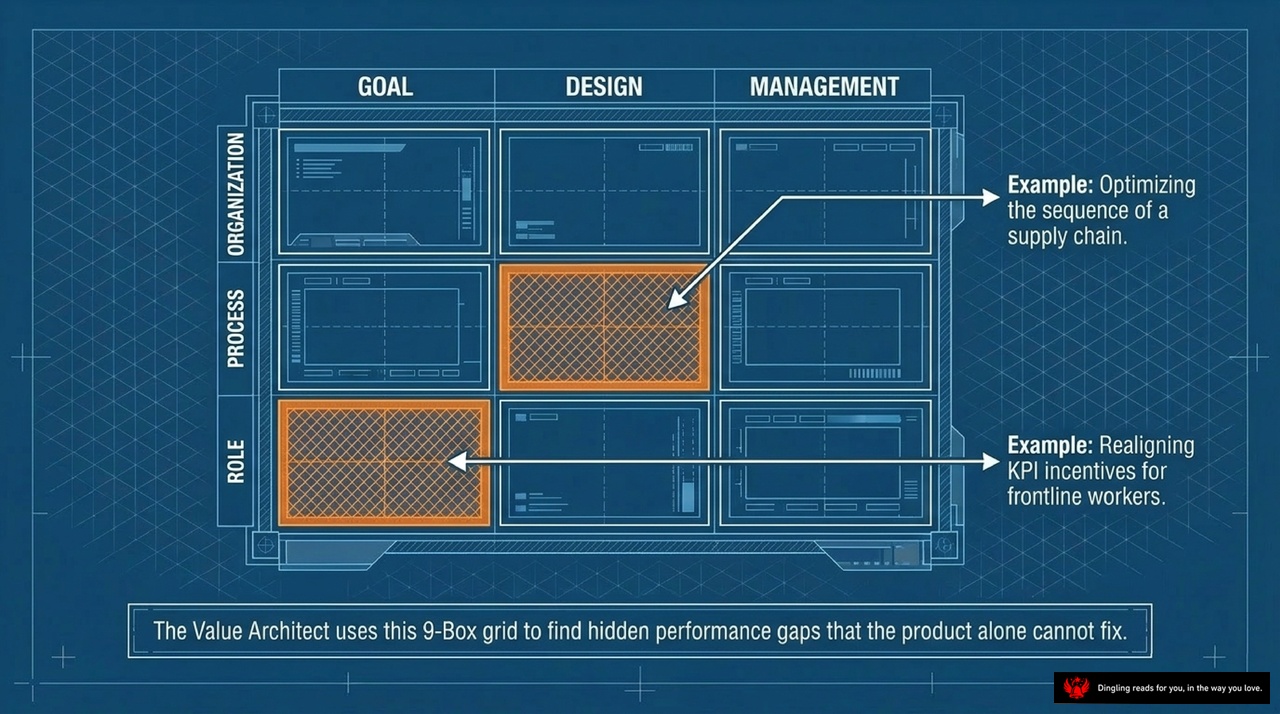
The Value Architect uses this 9-Box grid to find hidden performance gaps that the product alone cannot fix. Think of this matrix not just as a chart, but as a diagnostic tool for your entire business ecosystem. We break it down into three critical dimensions: Role, Process, and Organization, intersecting with Goal, Design, and Management.
Look at the highlighted areas. In the bottom-left, under Role and Goal, we see a direct link to aligning incentives. For example, this is about realigning KPI incentives for frontline workers. If your sales team is rewarded for volume but your customers value quality, your grid shows that disconnect immediately. It tells you that no amount of product improvement will fix a broken incentive structure.
Then, look at the center-right, where Process meets Management. Here, the example points to optimizing the sequence of a supply chain. This is where efficiency hides. Often, your product is perfect, but the way it moves through the client's operations creates bottlenecks. This grid forces you to look beyond the features of your offering and ask: How does our solution fit into their workflow? How does our management style match their organizational goals?
Traditional sales often focus only on the product itself, but this framework reveals that true value lies in these structural alignments. By using this 9-Box grid, you stop selling a commodity and start selling a performance improvement project. You identify exactly where the gaps are—whether it's a misaligned role, a clunky process, or a flawed design—and fill them with your organization's expertise. This is how you move from competing on price to competing on the ability to transform the client's entire operation.
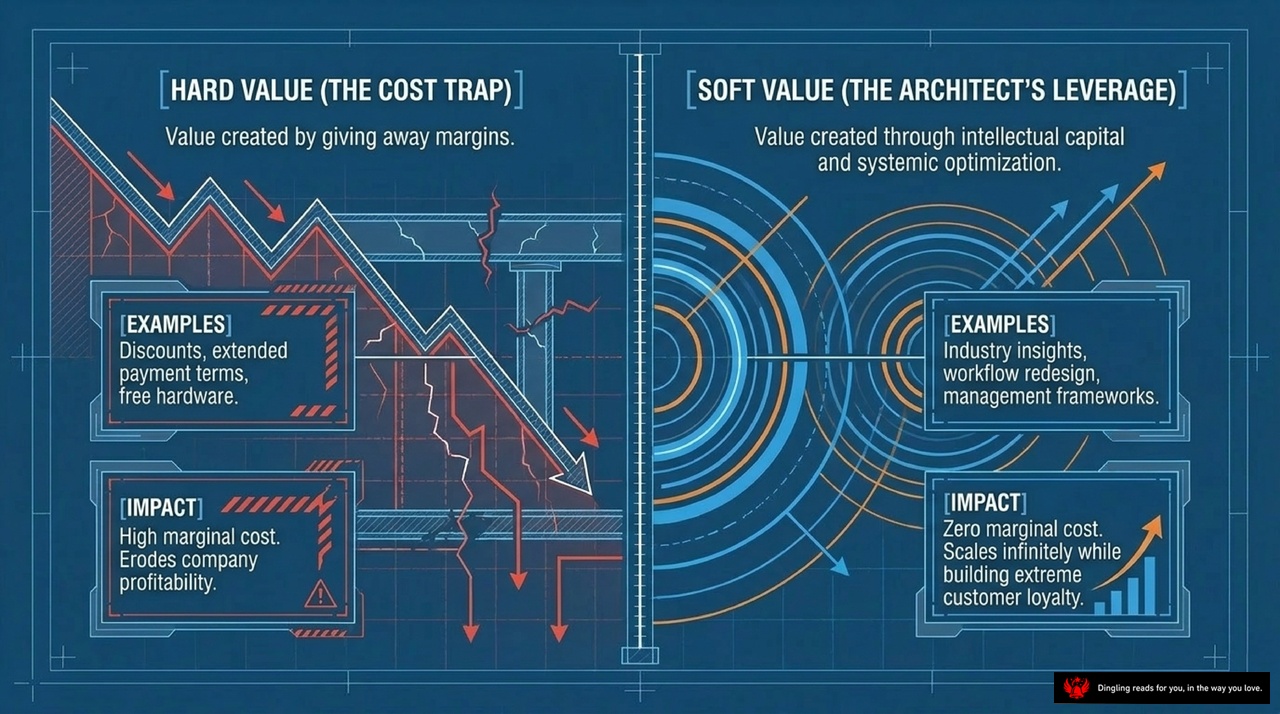
Look at this split-screen comparison. On the left, we see "Hard Value," which the book calls "The Cost Trap." This is value created simply by giving away margins—think discounts, extended payment terms, or free hardware. The impact is clear: high marginal costs that slowly erode your company's profitability. It's a race to the bottom.
On the right, we have the game-changer: "Soft Value," or "The Architect's Leverage." Instead of cutting prices, you create value through intellectual capital and systemic optimization. Your examples? Industry insights, workflow redesign, and management frameworks. The result is zero marginal cost that scales infinitely while building extreme customer loyalty.
The core lesson here is simple but powerful: stop competing on price, which is a finite resource, and start competing on value, which is infinite. By shifting from a product-seller mindset to a performance-partner mindset, you don't just sell a solution; you become an essential part of the client's success story. That is how you build an unshakeable competitive advantage.
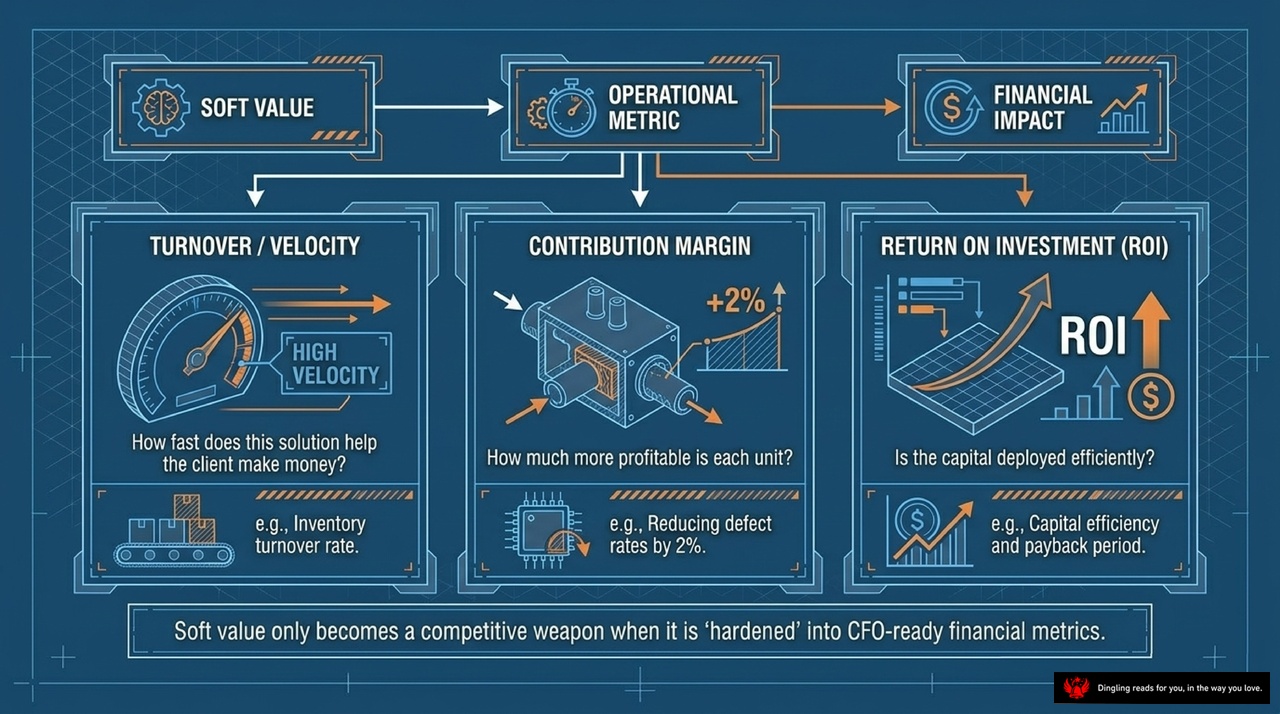
Here is the spoken-word script for Slide 11, tailored for an American audience with a natural, engaging tone.
Soft value on its own is just a nice-to-have; it only becomes a real competitive weapon when it gets "hardened" into financial metrics the CFO actually cares about. As this slide illustrates, the journey starts with soft value—things like your expertise and insights—and transforms into operational metrics that drive real business results.
Look at the first pillar: Turnover or Velocity. It answers the question, "How fast does this solution help the client make money?" Think inventory turnover rates or high-velocity processes. It's about speed and efficiency. Next is Contribution Margin, which focuses on profitability per unit. For example, reducing defect rates by just two percent directly boosts your bottom line. Finally, we have Return on Investment, or ROI. This is the ultimate test: "Is the capital deployed efficiently?" It covers capital efficiency and payback periods.
The key takeaway here is clear. In today's market, you can't just talk about how great your solution is; you must prove the financial impact. By translating your soft value into these hard numbers—velocity, margin, and ROI—you stop competing on price and start competing on performance. That is how you win the deal.
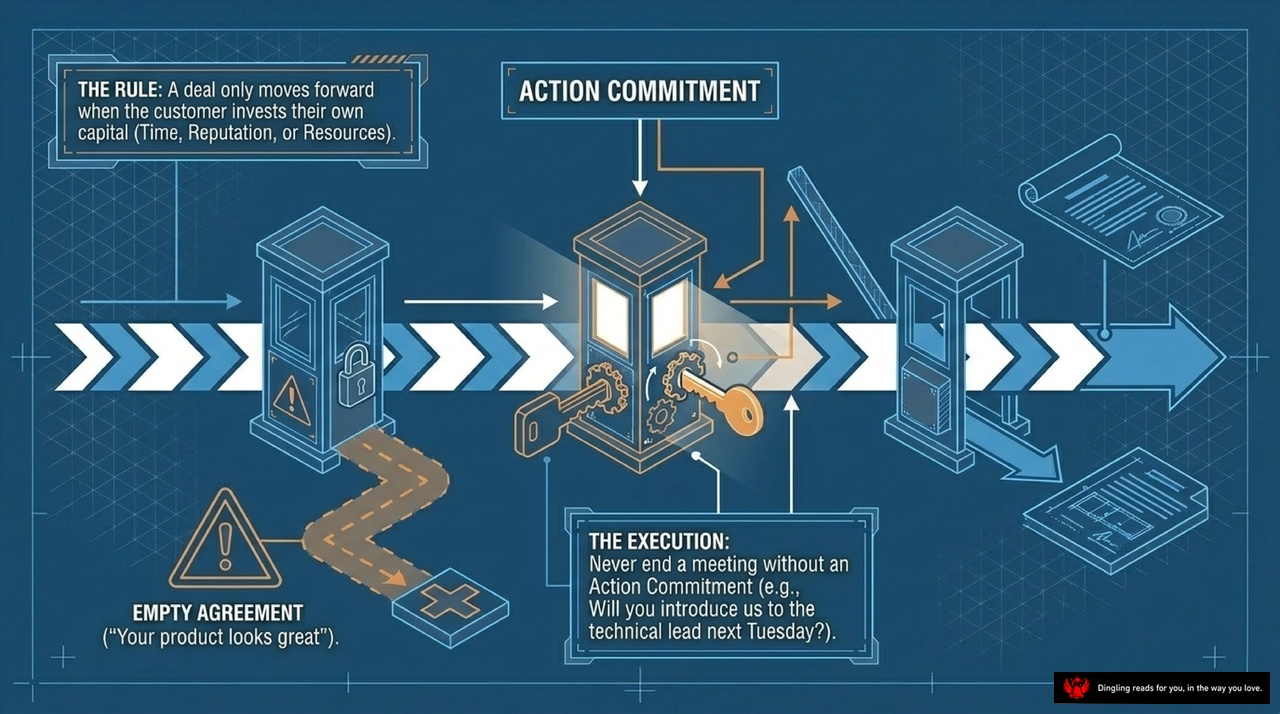
Here is the spoken-word script for the current slide, tailored for a US audience with natural, engaging delivery.
The Rule is simple: a deal only moves forward when the customer invests their own capital—whether that's time, reputation, or resources. Look at this flow. If you skip to an empty agreement, like just saying "your product looks great," you hit a dead end. That's a wasted effort with no commitment. But when you build an Action Commitment, you unlock the deal. The execution is clear: never end a meeting without securing a specific next step. For example, ask directly, "Will you introduce us to the technical lead next Tuesday?" This shifts the dynamic from a passive pitch to an active partnership, ensuring the deal actually progresses.
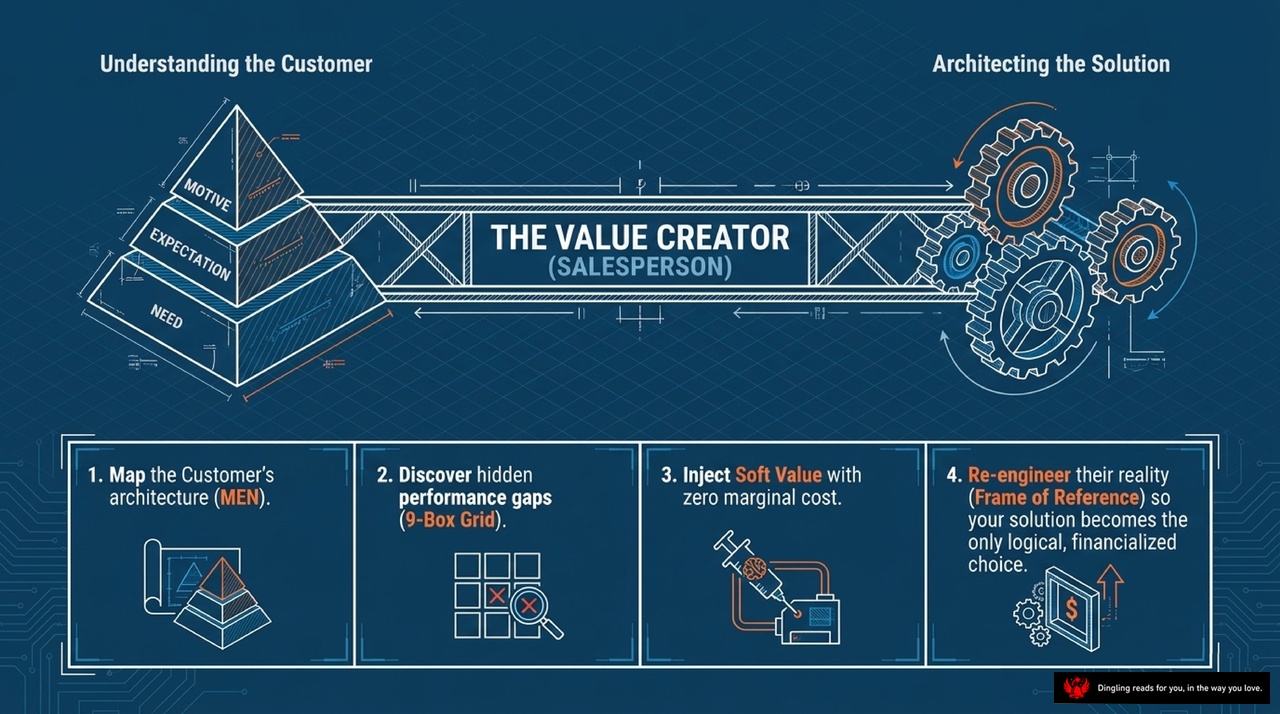
Welcome back. Today, we're diving into the core engine of Value-Based Selling: the four-step framework that transforms a salesperson from a product pusher into a true Value Creator.
Look at this diagram. On the left, we have "Understanding the Customer," built on a pyramid of Need, Expectation, and Motive. This isn't just about what a client says they want; it's about digging deep into their hidden performance gaps and personal drivers. On the right, we see "Architecting the Solution," where gears turn into action, powered by your ability to re-engineer their reality.
The process starts with Step 1: Map the Customer's Architecture. We use the MEN model—Expectations, Needs, and Motives—to understand the full landscape of their decision-making. Next, in Step 2, we Discover hidden performance gaps using the 9-Box Grid. This helps us pinpoint the critical, often overlooked issues that are actually stopping them from reaching their strategic goals.
Once we've identified those gaps, Step 3 is where we Inject Soft Value. Think of this as providing insights, frameworks, or strategic advice that costs the client nothing extra but delivers massive impact. This builds the trust needed to move forward. Finally, Step 4 is where we Re-engineer their reality by shifting their Frame of Reference. We show them that your solution isn't just another option; it's the only logical, financially sound choice to solve the problem we just uncovered together.
By following this flow, you stop competing on price and start competing on the unique value you bring to their business.
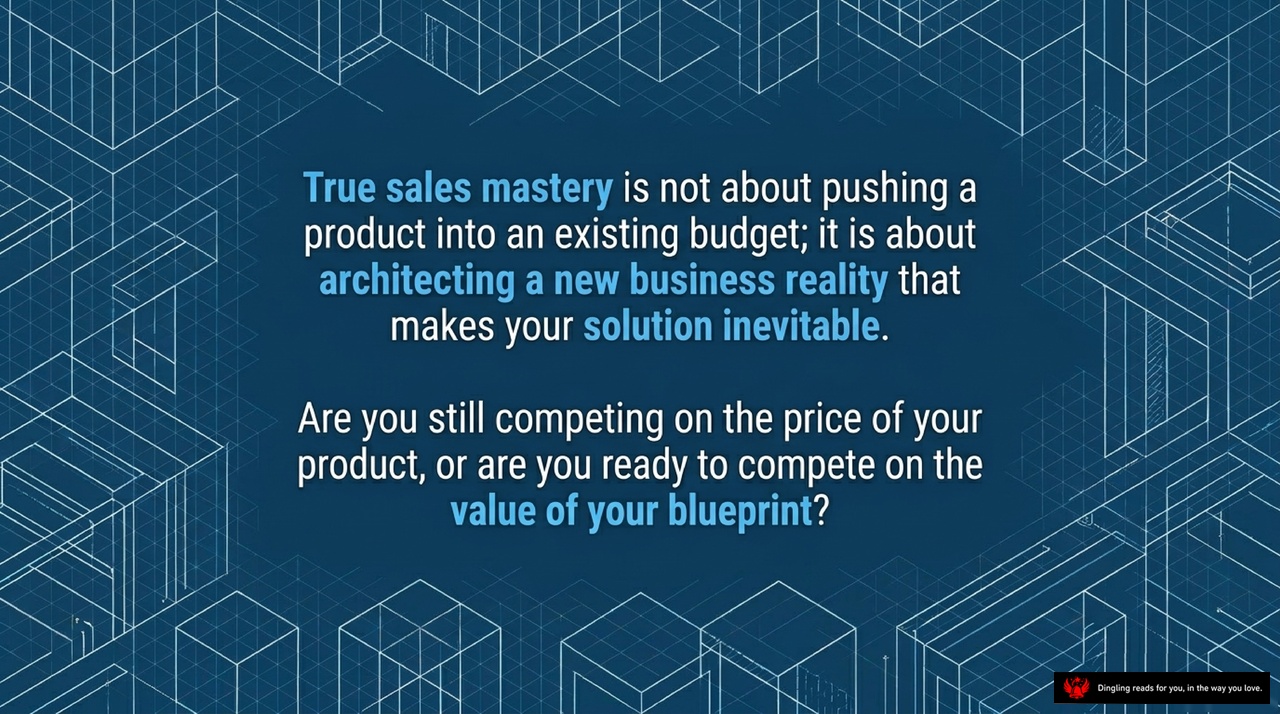
True sales mastery isn't about shoving a product into an existing budget; it's about architecting a new business reality that makes your solution inevitable. Think about it: are you still competing on the price of your product, or are you ready to compete on the value of your blueprint?
In today's market, low prices are a trap that erodes your margins and devalues your brand. The real breakthrough comes when you stop being a product pusher and start acting as a performance improvement partner. By creating a new business reality for your client—where your solution becomes the only logical choice—you transform the conversation from a price negotiation into a strategic necessity.
So, ask yourself: are you stuck in a race to the bottom, or are you building a blueprint so valuable that your customer has no choice but to say yes? That is the difference between selling a commodity and selling an indispensable advantage.