
Van Gogh: The Life: Complete Chapter-by-Chapter Summary
Van Gogh: The Life. Presented by Steven Naifeh and Gregory White Smith. This isn't just a biography of a "mad genius." It's a definitive deconstruction of history's most mythologized artist, revealing the fanatical discipline and lifelong codependency behind the caricature of the mad genius. We're peeling back the layers to see the real man.
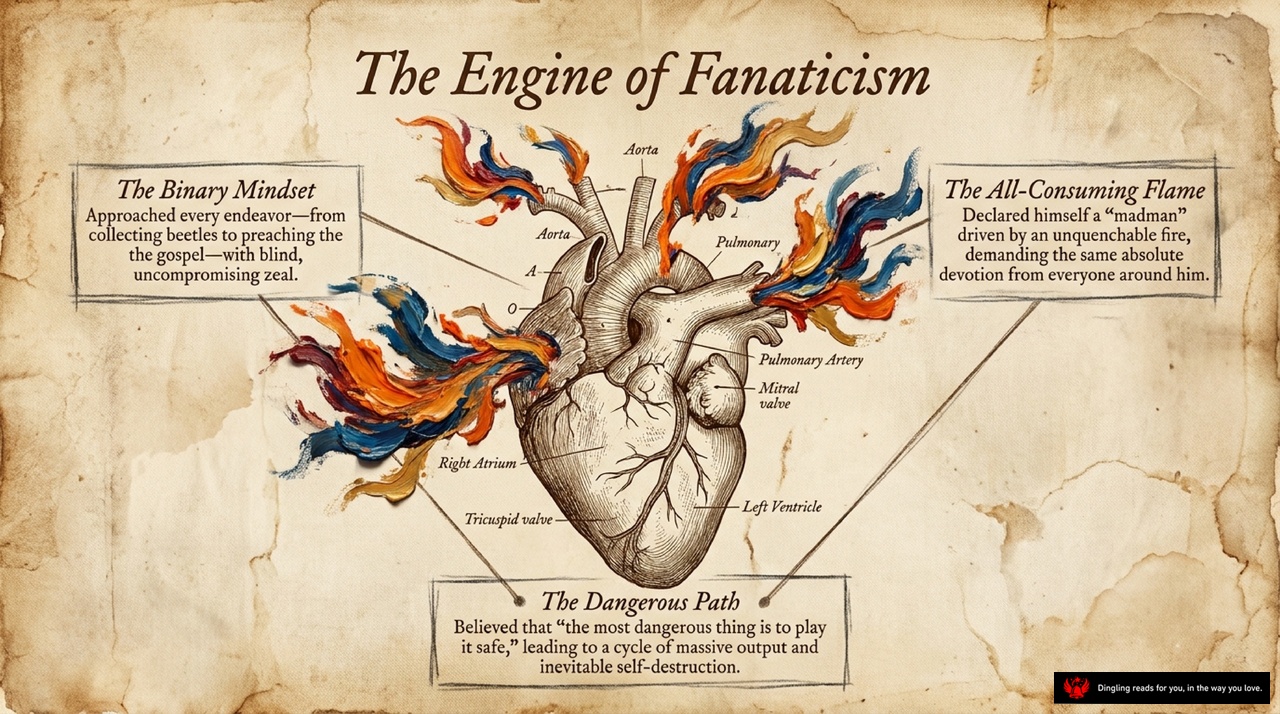
The Engine of Fanaticism isn't just a title; it's the blueprint for Vincent van Gogh's entire life. Look at this heart, burning with fire. This image distills the three destructive engines that drove him toward self-destruction.
First, on the left, is The Binary Mindset. Van Gogh approached everything with an uncompromising zeal. Whether he was collecting beetles in nature or preaching the gospel, there was no middle ground. It was all-or-nothing. This rigid thinking meant he couldn't adapt, and when his methods failed, he didn't pivot; he just intensified his struggle.
Then, on the right, sits The All-Consuming Flame. He declared himself a "madman" driven by an unquenchable fire. He demanded absolute devotion from everyone around him—his family, his friends, even his art dealers. When they couldn't or wouldn't give it to him, the fire didn't cool down; it consumed him from the inside out.
Finally, at the bottom, is The Dangerous Path. He believed that "the most dangerous thing is to play it safe." This belief led him into a cycle of massive output and inevitable self-destruction. He refused to compromise, refused to take a steady job, and refused to accept help on his own terms. Instead, he poured everything into a desperate quest for validation, believing that only through total sacrifice could he achieve greatness.
Van Gogh didn't just live his life; he lived it as a high-stakes experiment in intensity. And while that intensity created masterpieces, it also ensured that his own story ended in tragedy.

Welcome to the story of Vincent van Gogh, but let's start not with his famous paintings, but with the shadow that followed him from the very beginning. Look at this map of the Groot-Zundert heathlands, where Vincent was born in 1852. He wasn't just born into a family; he was born into a graveyard. His mother, Anna, had lost a son to stillbirth the year before, and Vincent was named after him, effectively becoming a replacement child in a house that felt more like a mausoleum.
This origin story shaped his entire worldview. He inherited his mother's fatalistic outlook, a belief born from the Dutch history of floods and trauma that happiness is incredibly fragile and disaster is always around the corner. It's a heavy burden to carry from day one. You can see this reflected in the imagery here: the dark, stormy skies over the heathlands and the grave marker bearing his name.
But it wasn't just about grief; it was about duty. Raised in a strict Calvinist environment, Vincent was taught that duty should mask emotional distance. This created a profound sense of alienation, forging his identity as the "eternal stranger" in the world. He felt disconnected from everyone around him, unable to find a place where he truly belonged.
So, how did a boy raised in such gloom and duty become the artist we know? The answer lies in his desperate need to escape. While his mother wanted him to maintain social order, Vincent found solace in the wild. He would squat by the streams, observing water beetles and collecting wildflowers. This wasn't just play; it was his first rebellion against the rigid world of his parents. He was searching for a connection with nature that he couldn't find in his family's strict social rules.
As he grew older, this need for escape drove him further away. He left his strict home to work in art galleries, only to feel more isolated. He tried religion, immersing himself in the Bible and church services, hoping to find a spiritual home. But even that failed to comfort him. The religious fervor he adopted was just another form of escaping his own loneliness, not a true solution.
Every step he took—from the heathlands of his childhood to the bustling streets of London and Paris—was an attempt to outrun the "shadow of the dike" that defined his life. He was constantly running, searching for a light that he felt was permanently out of his reach, all while carrying the weight of being the child who was never quite enough.

Have you ever tried to build a community on shaky ground, only to find your partners view the world through a completely different lens? This slide, titled "The Pilgrim's Failures," captures the tragic collision of two brilliant but incompatible souls: Vincent and Gauguin. It breaks down their shared downfall into three distinct archetypes: The Art Dealer, The Teacher, and The Preacher.
Let's look at The Art Dealer first. This represents Vincent's desperate attempt to sell his work. He became obsessed with a fanatical method, fixated on the religious morality of his art and lecturing his clients on what they should buy. He alienated buyers and management, culminating in his dismissal from the Paris branch. He was trying to force a market that simply didn't exist for his style.
Next, we see The Teacher. This mirrors Vincent's relationship with Gauguin, who acted as a mentor but failed to truly understand Vincent's raw, intuitive nature. Gauguin adopted a Dickensian martyr complex, working endless hours and preaching intense, disjointed sermons about his own superiority. This dynamic starved Vincent creatively and emotionally, frightening him into a corner where he felt he had to compete rather than collaborate.
Finally, there is The Preacher. This describes Gauguin's own spiritual approach, which was panatical. He took imitating Christ literally, giving away his clothes, sleeping on dirt floors, and embracing absolute poverty among coal miners to prove his holiness. This extreme behavior was not just misunderstood by Vincent; it was ultimately fired by the Church for being too extreme and undignified for the clergy.
The result of these three failed roles was a complete collapse. The Art Dealer lost his job; the Teacher lost his students and income; and the Preacher lost his soul. Together, these failures created the pressure cooker that led to the infamous ear incident and the end of their dream commune in Arles.

The Pivot to Observation marks a profound transformation in Vincent's life, where he stopped looking at the world through religious dogma and started seeing it through the lens of raw reality. This shift was driven by three critical factors. First, it was the New Gospel: Vincent abandoned traditional religious texts to obsessively study Barge's Drawing Course and Cassagne's perspective manuals, seeking a new spiritual truth in technique rather than scripture. Second, he adopted The Grid System, commissioning a wooden perspective frame to mathematically capture reality. This tool forced the chaotic nature of the world into a structured grid, allowing him to dissect the scene with scientific precision. Finally, this technical rigor led to The Peasant Reality. By shifting his zeal from saving souls to documenting the brutal, unvarnished truth of weavers, miners, and laborers, Vincent found his true voice. He realized that the suffering of the working class was the ultimate expression of the divine, turning his art into a powerful testament to the human condition.

The Illusion of Family. Here, Vincent's desperate need for connection twisted into a dark, controlled performance. He didn't just paint scenes; he manufactured them. He used Sien Hoornik—a pregnant, impoverished prostitute he took in—as a captive model, alongside her mother and baby, to stage the perfect domestic life he craved but could never organically achieve. Vincent became the absolute Master of the House, dictating their clothes, their poses, and even their daily routines to fit his specific aesthetic needs. But this manufactured warmth came at a terrible cost. Theo, his only lifeline, issued a brutal Ultimatum: he demanded Vincent abandon Sien or lose his financial lifeline entirely. Forced to choose between his manufactured family and his art, Vincent was left with no choice but to let go, shattering the fragile illusion he had built to survive.
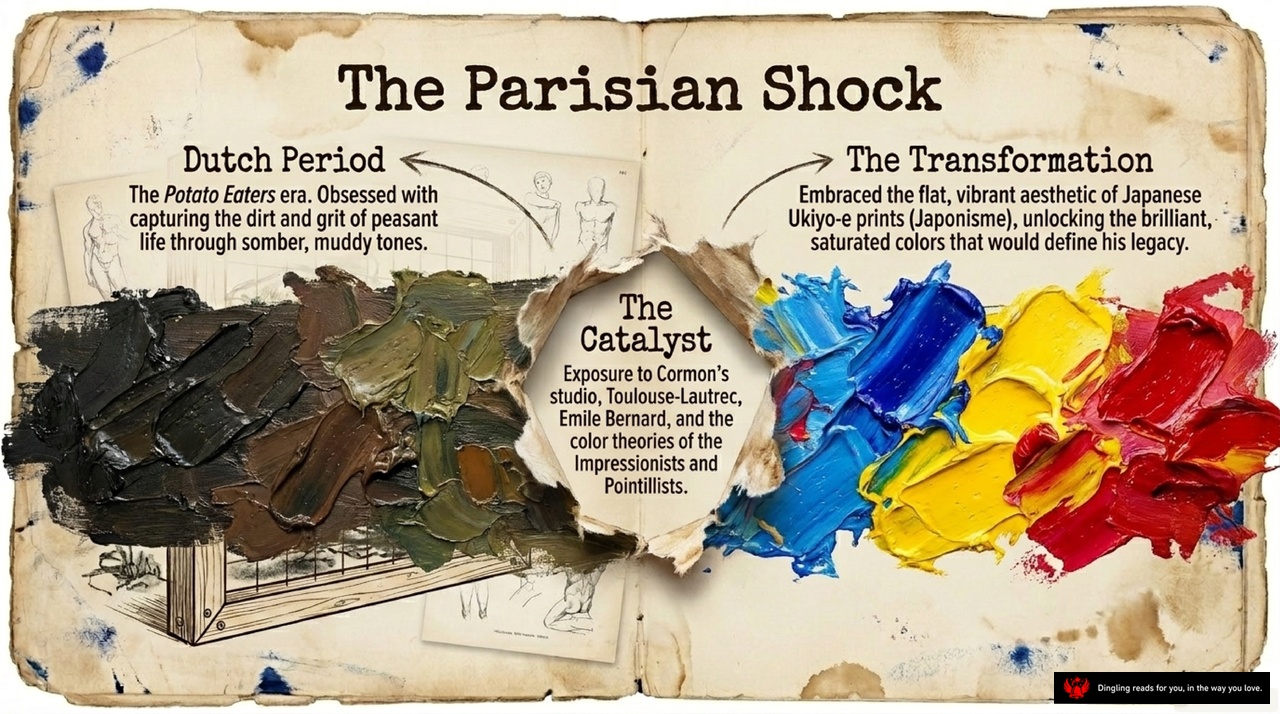
The Parisian Shock marks a dramatic turning point in Vincent's journey, a violent but necessary collision of two distinct artistic worlds. On the left, we see the **Dutch Period**, rooted in the *Potato Eaters* era. This was a time obsessed with capturing the raw dirt and grit of peasant life, defined by somber, muddy tones that reflected the harsh reality of the soil. But this heavy, earthbound style was about to shatter.
The real transformation happened when Vincent embraced the flat, vibrant aesthetic of Japanese Ukiyo-e prints, a movement known as Japonisme. This exposure unlocked the brilliant, saturated colors that would eventually define his legacy, moving him away from the gloom of the Dutch masters.
But what triggered this shift? The image calls it **The Catalyst**. It wasn't just one thing; it was a convergence of influences. Vincent was exposed to Cormon's studio, where he rubbed shoulders with figures like Toulouse-Lautrec and Emile Bernard. He was also deeply impacted by the color theories of the Impressionists and Pointillists. It was this collision—the clash between his traditional Dutch roots and these radical new French ideas—that forced him to abandon the dark palette of the past and step into the explosive, colorful future that the world would soon recognize as his own.

Imagine the Yellow House in Arles not just as a building, but as a battlefield where two opposing worlds collided. On one side, you have the Utopian Vision: a radiant sunflower blooming in a field of pure gold, symbolizing Vincent's dream of a monastic brotherhood where artists shared ideas and expenses without judgment. He painted these vibrant sunflowers to welcome Gauguin, casting him as the Abbot of their new order, a leader who would guide them toward a brighter future.
But on the other side lies the Claustrophobic Reality, depicted by two stark wooden chairs facing each other in the shadows. This was the brutal truth that awaited them. The weather trapped them indoors, and their opposing artistic philosophies ignited explosive arguments. Gauguin felt suffocated by Vincent's obsessive intensity and erratic mood swings, while Vincent felt betrayed by Gauguin's cold rationality. What began as a hopeful experiment quickly turned into a psychological trap, where the very walls they painted together became the prison that drove Vincent to the brink of madness.

The Breaking Point: The Activation Curve.
Look at this jagged red line. It's not just a graph; it's the timeline of Vincent's final, desperate year in Arles. We are tracing the moment everything snapped.
It starts on the left with **The Argument**. A fierce debate over artistic theory pushed his already strained relationship with Gauguin right to the brink. The tension was already high, but this was the spark.
Then comes **The Threat**. Gauguin leaves the house after feeling threatened by Vincent's erratic behavior. The pressure cooker is sealed.
And then, we hit the peak—**The Mutilation**. In a state of total breakdown, Vincent severs his ear, wrapping it in newspaper and delivering it to a local brothel. This is the absolute breaking point. The activation curve spikes violently, and the red paint on the page looks like blood spilling from that moment of pure, uncontrolled chaos.
But the story doesn't end there. The curve crashes down into **The Lockout**. Thirty neighbors sign a petition declaring him a public danger, resulting in police boarding up the Yellow House. That locked chest at the bottom of the image represents Vincent's total isolation. He is physically trapped, socially exiled, and mentally shattered.
From the peak of that madness to the silence of the locked room, this activation curve shows us exactly how close Vincent came to the abyss, and how quickly the world closed its door on him.

Sanctuary in the Asylum. Look at this striking contrast: on one side, the chaotic, swirling cosmos of *The Starry Night*; on the other, the stark, confined reality of a cell. This image perfectly captures the paradox of Vincent van Gogh's life in the asylum. Inside the cell, life was defined by strict daily routines, iron bars on the windows, and the constant, paralyzing fear of the next mental attack. It was a place of isolation and restriction. Yet, look at what happened outside those walls. Stripped of human models and social connection, Vincent turned his gaze outward to the olive groves, the cypress trees, and the night sky. Instead of being broken by his isolation, he transformed it into the most swirling, cosmic, and expansive masterpieces of his career. The asylum didn't just confine his body; it became the catalyst for his greatest artistic freedom.
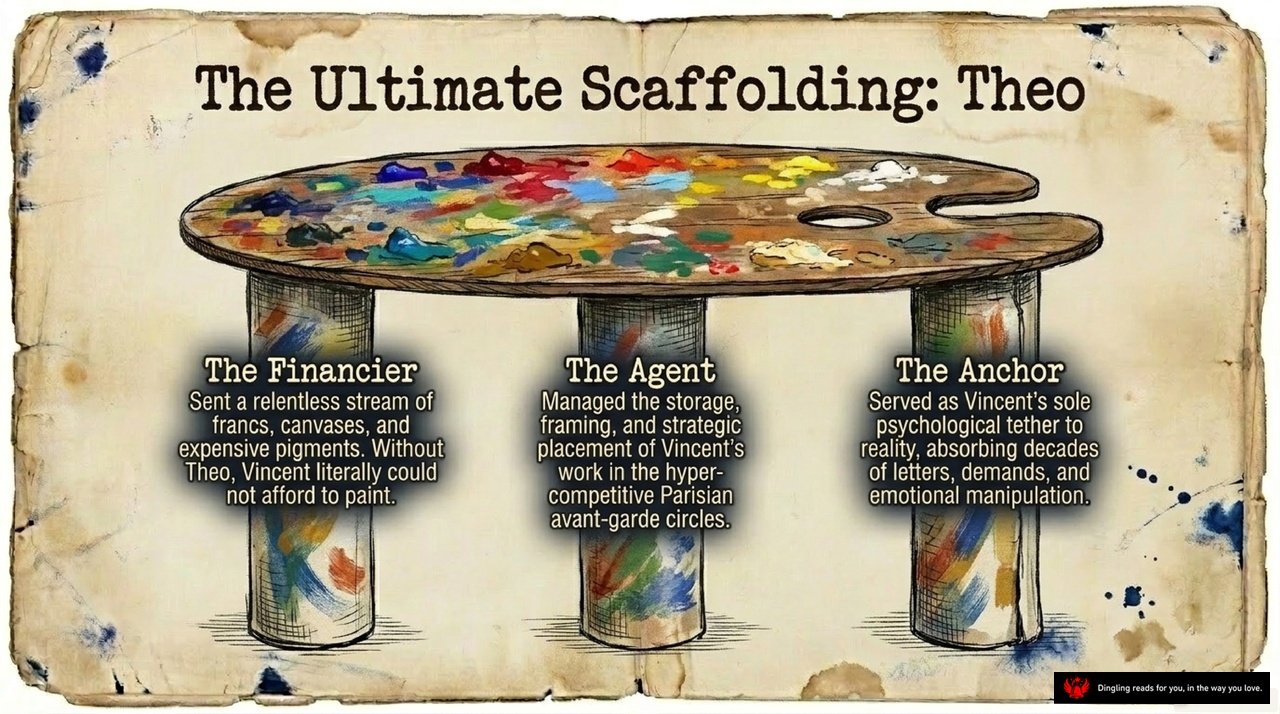
Look at this palette, resting on three sturdy legs. It's not just a tool for mixing colors; it's a visual metaphor for the invisible architecture that held Vincent van Gogh's life together. We call this "The Ultimate Scaffolding," and the central figure supporting it is Theo. Without Theo, Vincent's story simply wouldn't exist.
The first leg is labeled "The Financier." This represents the relentless stream of francs, canvases, and expensive pigments that Theo sent. It was the financial lifeline that allowed Vincent to literally afford to paint. Without this constant flow of money, Vincent would have been forced to choose between starving and starving artistically.
The middle leg is "The Agent." Here, Theo managed the storage, framing, and strategic placement of Vincent's work within the hyper-competitive Parisian avant-garde circles. He was the bridge between Vincent's isolated world and the art market, navigating the complex social dynamics that Vincent often struggled to understand.
The third and perhaps most crucial leg is "The Anchor." This served as Vincent's sole psychological tether to reality. Theo absorbed decades of Vincent's letters, demands, and emotional manipulation, acting as a stabilizing force when Vincent's mental state was volatile. He was the only person who could reach Vincent when the world felt like it was collapsing.
Together, these three roles formed the foundation upon which Vincent's artistic legacy was built. Theo wasn't just a brother; he was the financier, the agent, and the anchor all rolled into one.
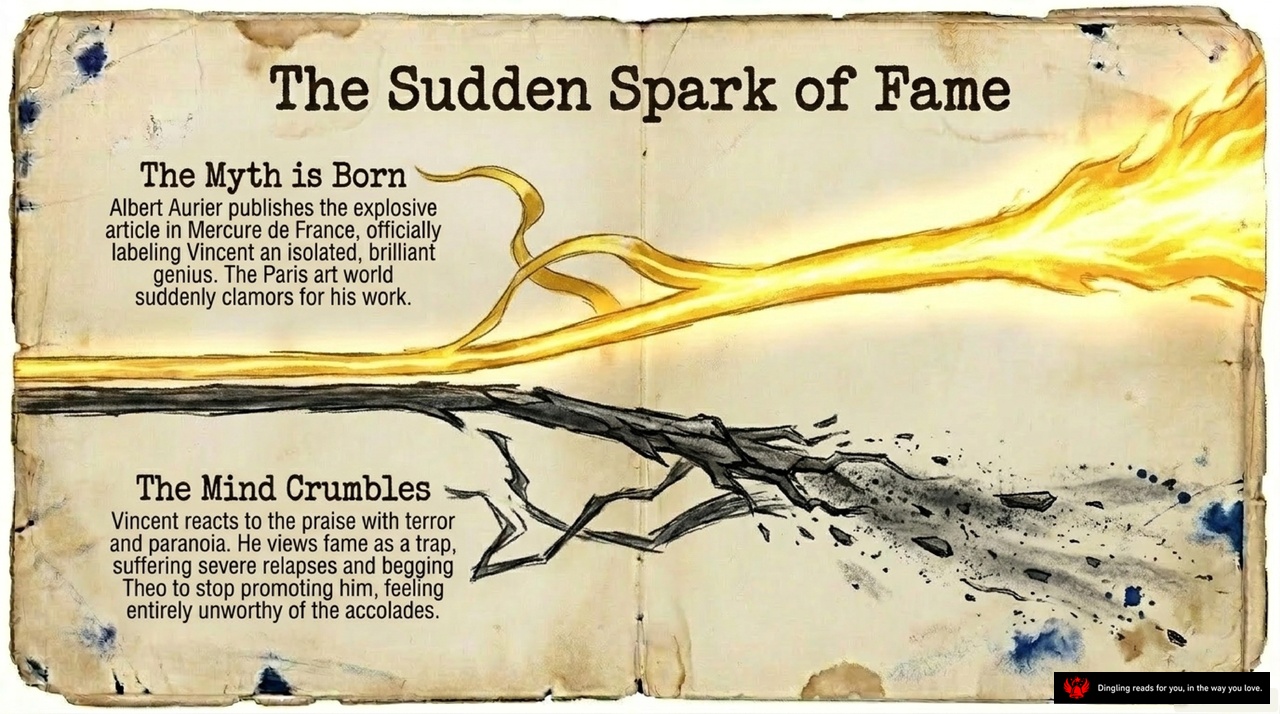
The sudden spark of fame wasn't a gentle sunrise for Vincent; it was an explosive firestorm that nearly burned his world to the ground. It all began when critic Albert Aurier published a scathing yet brilliant article in *Mercure de France*, officially labeling Vincent an isolated genius. Overnight, the Paris art world clamored for his work. But while the outside world saw a miracle, Vincent's internal reality was crumbling.
He reacted to the praise with terror and paranoia, viewing fame not as a triumph, but as a dangerous trap. The accolades only deepened his suffering, triggering severe relapses. In his desperation, he begged his brother Theo to stop promoting him, convinced that he was entirely unworthy of the sudden attention. The image captures this painful duality: a brilliant, golden flame of fame rising from the earth, while beneath it, the foundation of his mind shatters into dark, jagged pieces. For Vincent, the myth of the genius was born, but the cost was the disintegration of his own sanity.
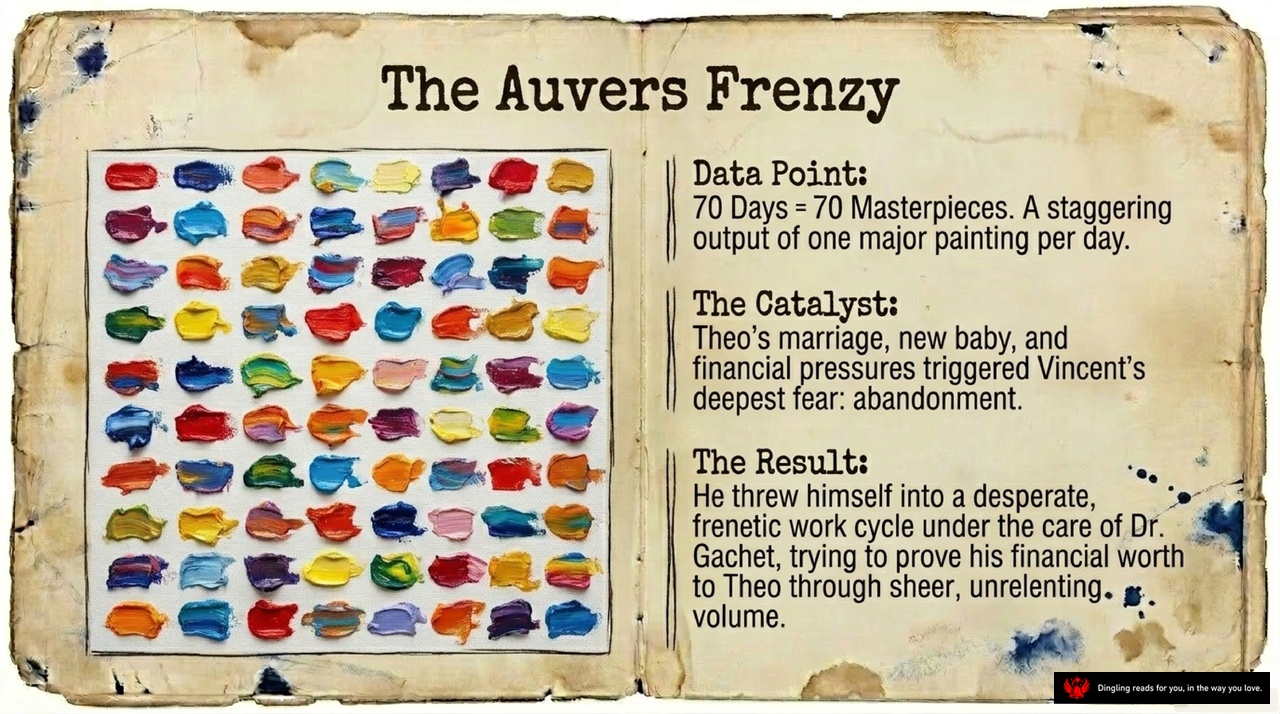
The Auvers Frenzy wasn't just a burst of creativity; it was a desperate, high-stakes gamble for survival. As the slide illustrates, the data is staggering: 70 days, 70 masterpieces. That's one major painting every single day, a pace that feels almost impossible to sustain. But look closer at the catalyst behind this frenzy. It wasn't just artistic ambition; it was fear. Theo's marriage, the arrival of a new baby, and mounting financial pressures triggered Vincent's deepest terror: abandonment. He felt the weight of being left behind, of becoming a burden. So, what was the result? He threw himself into a frantic, relentless work cycle under the care of Dr. Gachet. It was a desperate attempt to prove his financial worth to Theo through sheer volume, trying to buy his way back into the family dynamic before it was too late. This wasn't painting for art's sake; it was painting for love, painting to hold on.
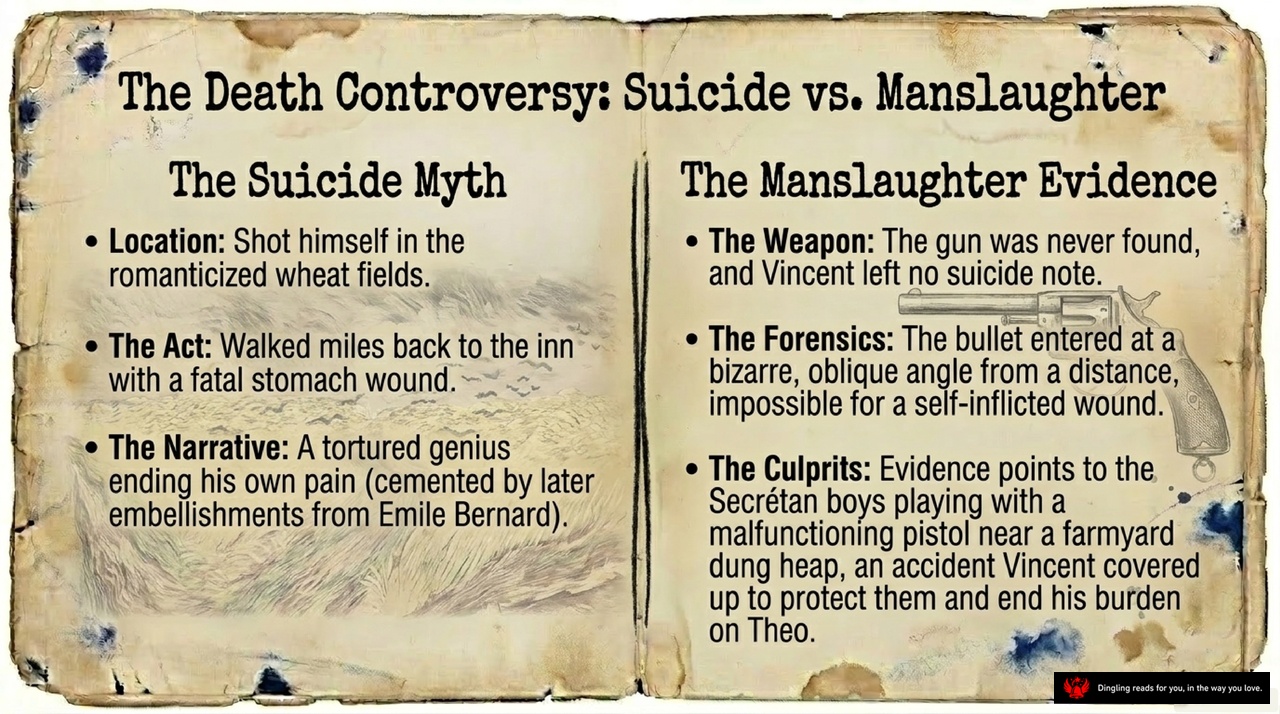
The Death Controversy: Suicide vs. Manslaughter. On the surface, Vincent's story ends with a tragic, romanticized image: a tortured genius shooting himself in the wheat fields, walking miles back to the inn with a fatal wound. This narrative cemented his legacy as a martyr, a figure whose pain defined his art. But look closer at the evidence, and the story flips entirely. The gun was never found, and Vincent left no suicide note. Forensics reveal a bizarre, oblique angle of entry—physically impossible for a self-inflicted wound. The truth points to a different culprit: the Secrétan boys playing with a malfunctioning pistol near a farmyard dung heap. Vincent didn't kill himself; he was the victim of a cruel accident. Yet, he chose to cover it up, taking the burden onto himself to protect the boys and spare his brother, Theo, from the shame. The myth of the suicide is a lie, but the tragedy of his silence is very real.
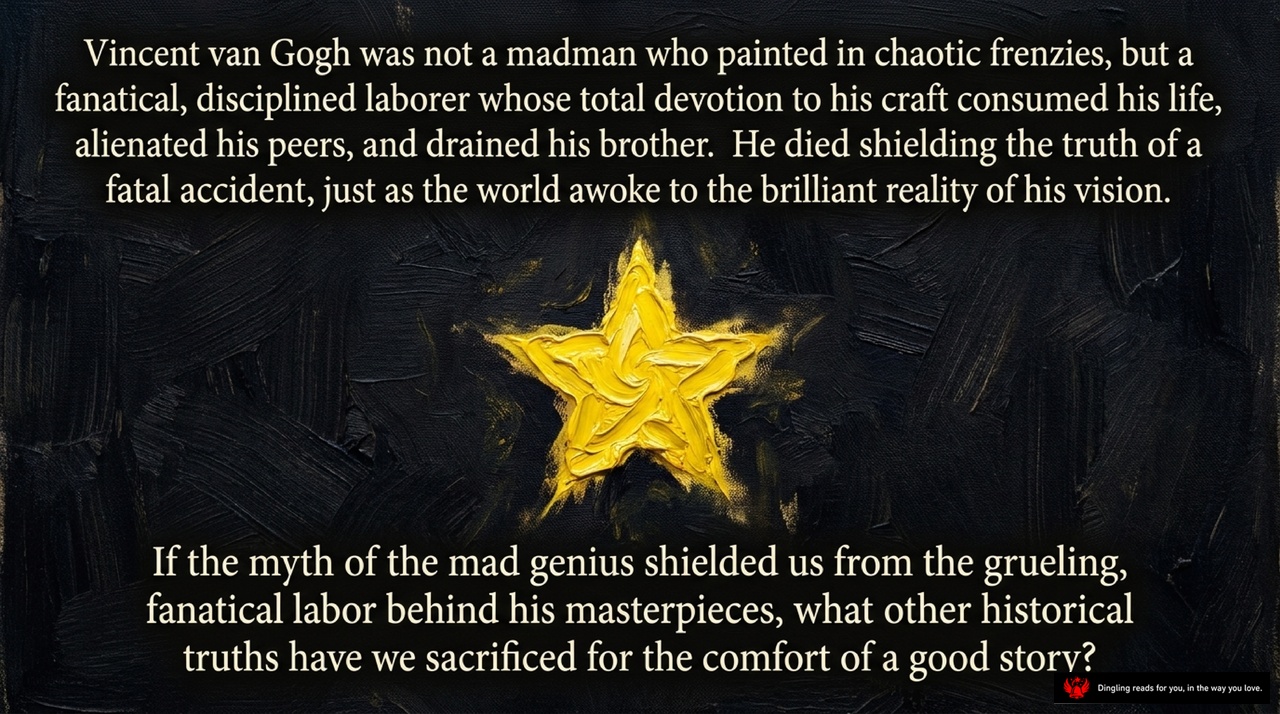
Vincent van Gogh was never the chaotic madman the world likes to imagine. He was a fanatical, disciplined laborer whose total devotion to his craft consumed his life, alienated his peers, and drained his brother. He died shielding the truth of a fatal accident, just as the world awoke to the brilliant reality of his vision.
If the myth of the mad genius shielded us from the grueling, fanatical labor behind his masterpieces, what other historical truths have we sacrificed for the comfort of a good story?