
Voices from Chernobyl: Complete Chapter-by-Chapter Summary

Welcome to Voices from Chernobyl, an oral history of the human tragedy, systemic deception, and existential fallout from the world's worst nuclear disaster.
This is Svetlana Alexievich.
Behind these words lies the haunting image of a forgotten world: a rusted Ferris wheel standing silent in the mist, surrounded by a forest that has reclaimed what was once a bustling life. This is the landscape of Chernobyl, a place where time seems to have stopped, yet the past continues to bleed into the present.
The book is not just about the explosion; it is about the voices of those who lived through it. It captures the shock, the silence, and the slow, terrifying realization that the invisible enemy—radiation—had already taken everything. From the first strange smell in the air to the final, agonizing silence in the evacuation zones, these voices tell the true story of a disaster that changed humanity forever.

Look at this map. It shows the invisible epicenter of a tragedy that reshaped an entire continent. Seventy percent of the fifty million curies of radioactive nuclides fell directly on Belarus. This wasn't just a disaster; it was a contamination that seeped into the very soil, leaving twenty-three percent of the territory with Cesium-137 levels exceeding one curie per square kilometer.
But the numbers on the right tell only part of the story. The real impact is human. Two million people were forced to live in these contaminated zones, including seven hundred thousand children. For them, the land that should have been home became a prison. The map also highlights the lost geography: four hundred and eighty-five villages permanently lost, with seventy buried entirely underground, erased from existence.
This is the reality of "The Contaminated Zone." It's not just about radiation levels; it's about the lives trapped within them. It's about the silence of empty villages and the struggle of families who, despite the danger, found themselves with nowhere else to go. The map captures the scale of this loss, a ghostly green overlay marking where life was forced to pause, or where it simply ended.
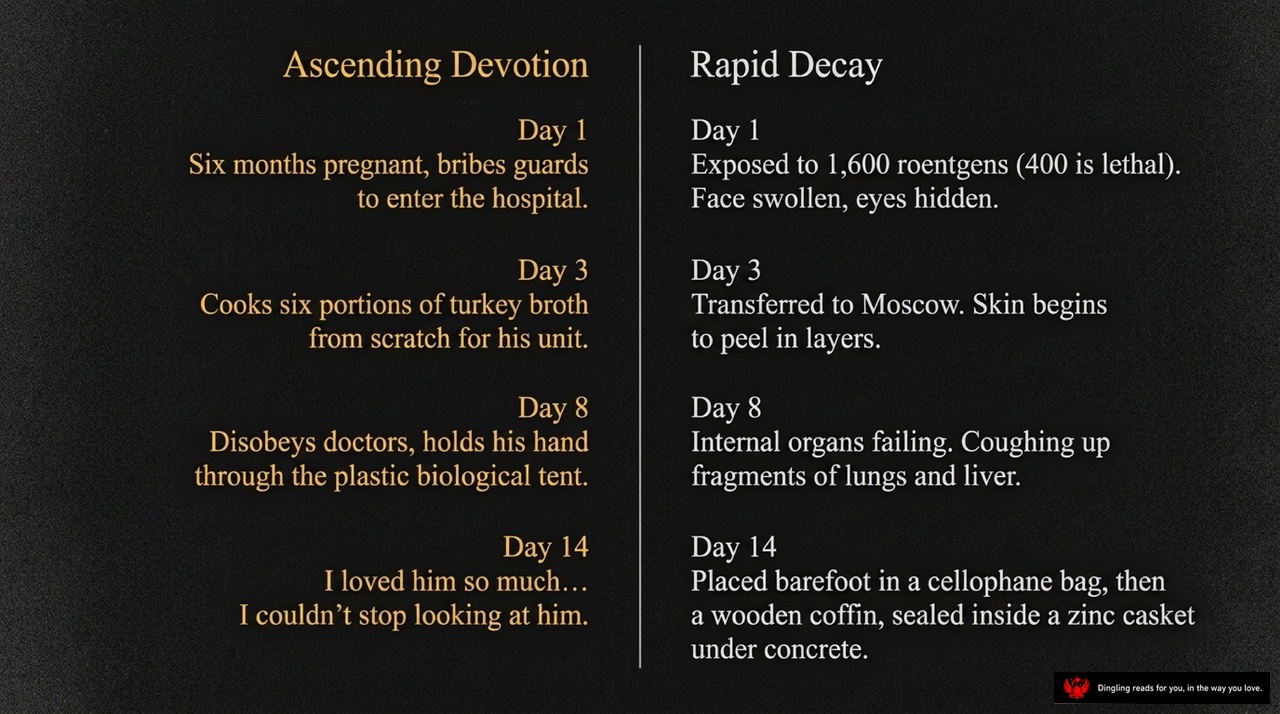
Look at this heartbreaking split-screen. On the left, under "Ascending Devotion," we see the desperate, loving struggle of a man who refused to let go. On Day 1, he bribed guards just to enter a hospital while six months pregnant. By Day 3, he was cooking six portions of turkey broth from scratch, feeding his unit. On Day 8, he disobeyed doctors, reaching through a plastic biological tent just to hold his wife's hand. And by Day 14, his final thought was simply, "I loved him so much... I couldn't stop looking at him."
But look at the right side, under "Rapid Decay." This is the cruel reality of radiation's toll. On Day 1, he was exposed to 1,600 roentgens—more than four times the lethal dose of 400. His face swelled, and his eyes were hidden. By Day 3, transferred to Moscow, his skin began peeling in layers. By Day 8, his internal organs were failing, coughing up fragments of his own lungs and liver. And by Day 14, he was placed barefoot in a cellophane bag, then a wooden coffin, sealed inside a zinc casket under concrete.
This image captures the tragic paradox of Chernobyl: the depth of human love versus the absolute indifference of physics. While he cooked soup and held hands, his body was being systematically dismantled by invisible forces. It is a stark reminder that while devotion can transcend time, radiation does not care about love, and in the end, it reduces a life to a sealed box under the earth.

Imagine a battlefield where you can't see the enemy, where the weapons aren't bullets but a glass of milk and a spring rain, and where there is no trench to hide in. This is the reality of the "Chernobyl War," a conflict that stands in stark, terrifying contrast to the Great Patriotic War of WWII.
In the war we know, the enemy was visible—fascists, soldiers, tanks. The weapons were bullets, bombs, and artillery, and the shelter was a trench or a bunker. The casualties were immediate; one in four died, villages were destroyed, and the trauma was sharp and sudden. You knew when the fighting was over.
But in Chernobyl, the enemy was invisible—atoms, isotopes, and a silence that screamed louder than any explosion. The weapons were the very things meant to sustain life: fresh apples, a beautiful spring rain, a glass of milk, and the dust itself. There was nowhere to hide because the threat was in the air, the soil, and the water. The shelter was non-existent. The casualties weren't just immediate deaths; they were generational mutations, a permanent genetic fallout where one in five people living in the radiation zone carried the burden forever.
This invisible war reshaped everything. It turned ordinary life into a slow, agonizing decay. It made heroes out of those who couldn't run, and victims of those who couldn't stop. It was a war fought not with steel, but with the very elements of nature, leaving a legacy that no amount of time could ever truly erase.

The image before us captures a hauntingly simple yet devastating reality: "The Liquidators: Human Shields." It strips away the glamour of heroism to reveal the brutal truth of what it meant to fight a nuclear fire with nothing but a canvas shirt, a metal shovel, and a bottle of vodka.
Look closely at the equipment listed here. The suit is described as a standard canvas shirt and pants with absolutely no lead lining. The mask is just a basic fabric muzzle or a surgical mask. Against a roof that could deliver up to 10,000 roentgens of radiation, these are not protective gear; they are paper shields. The tool is a standard metal shovel, used to manually scoop highly radioactive graphite. This is the most powerful metaphor in the slide: "we were fighting atoms with shovels."
Why did they do this? The quote on the right answers it all. "The robots couldn't work, they all broke down. But we could work." When the machines failed, these men and women stepped in as the final line of defense. They knew the heat was melting asphalt and burning graphite, yet they climbed onto those roofs, exposed to lethal doses, because they had no other choice.
Even the "medicine" listed—vodka—speaks to the desperate reality of the time. Officially and unofficially, it was believed to wash away radiation. It wasn't a cure; it was a coping mechanism for a trauma that had no cure. These liquidators weren't soldiers in a traditional war; they were human shields, sacrificing their very lives to hold back the invisible apocalypse, proving that in the face of total technological failure, human courage was the only thing that could stand firm.

Look at this slide. It maps out the terrifying, step-by-step erasure of reality in Chernobyl. It's not just a disaster; it was a calculated campaign to control the truth.
First, we see **Information Blackout**. The state cut off the world. Phones were tapped, radio broadcasts went silent for days, and even library books on radiation mysteriously vanished. They created a vacuum of information, leaving people confused and helpless.
Next comes **Forced Normalcy**. While the city was dying, life in neighboring areas continued as if nothing happened. Parades marched on, children played, and people sunbathed under a radioactive cloud. The government didn't just hide the danger; they actively forced people into a trance of normalcy to avoid panic.
Then, we hit **Confiscation of Truth**. The military hid dosimeters from the public. Doctors were ordered to lie, classifying acute radiation sickness as common illnesses or vegetative dystonia. They stole the language of reality, replacing the truth with a comforting lie.
Finally, the slide shows **The Human Cost**. Unwarned citizens drank contaminated milk, dug in radioactive soil, and lived their lives while their bodies absorbed lethal doses of Cesium and Strontium. They were told they were safe while their very cells were being destroyed. This wasn't just an accident; it was a slow, systematic poisoning of an entire generation, all while they were told everything was fine.
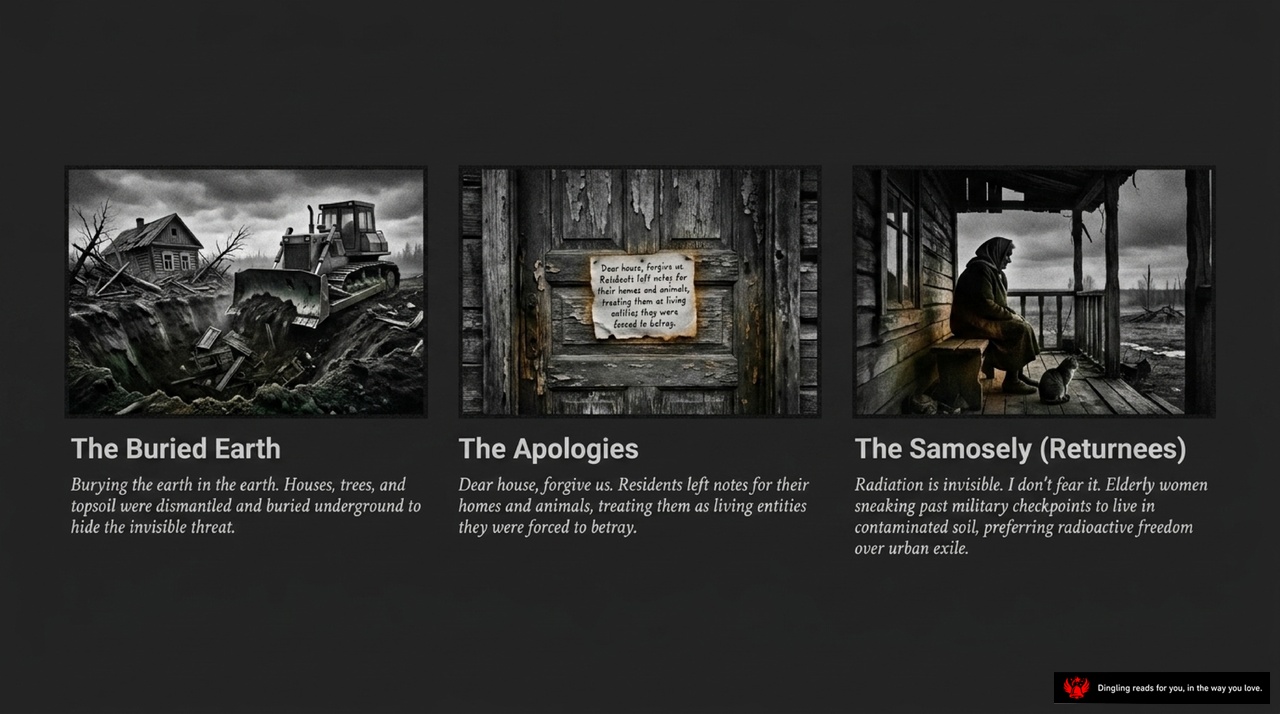
Look at this slide. It captures three haunting realities of the Chernobyl zone: the buried earth, the apologies left behind, and the returnees who chose the radioactive home.
First, we see "The Buried Earth." This isn't just about soil; it's about erasing history. As the text describes, the authorities buried houses, trees, and even the fertile topsoil underground to hide the invisible threat. They treated the land itself as a criminal to be disposed of, leaving behind a landscape where life was literally buried alive.
Then, there are "The Apologies." In the middle image, a note is pinned to a rotting door: "Dear house, forgive us." This is a heartbreaking moment where residents, forced to betray their homes and animals by the evacuation orders, left behind notes treating their belongings as living entities they were forced to abandon. It's a silent plea for forgiveness from a displaced generation to the very walls they once called home.
Finally, we see "The Samosely," or the Returnees. The right image shows an elderly woman sitting alone on a porch, staring into the desolate distance. The text explains that for these returnees, radiation is invisible, and they don't fear it. They sneak past military checkpoints, choosing to live in contaminated soil rather than face urban exile. They prefer the "radioactive freedom" of their ancestral land over a life where they are treated as outcasts in the city. These are people who have rejected the outside world, finding a twisted kind of belonging in the very place that destroyed them.

Look at this scene. On the left, we see "The Illusion of Spring"—a perfect, beautiful day. The sky is blue, the sun is shining, and the apple orchards are in full bloom. It looks like the most normal, peaceful spring day imaginable. But look at the right side, titled "The Silent Rebellion." This is where the truth hides beneath the beauty.
While the blossoms bloom perfectly, they are stripped entirely of their scent. The birds, usually joyful, are blinded by radiation and crash repeatedly into car windows. Under the soil, moles are suffocating and driving themselves up out of the earth just to breathe. The bees, sensitive to the slightest shift, refuse to leave their hives for three full days, sensing the atmospheric change before any human instrument could.
This slide captures the terrifying disconnect of Chernobyl. Nature didn't stop; it just changed. The animals and the land were fighting a silent war against an invisible enemy, while humans were still celebrating a spring that was already dead. This is the reality that the soldiers and cleanup crews faced every single day—a paradise on the surface, and a death sentence underneath.
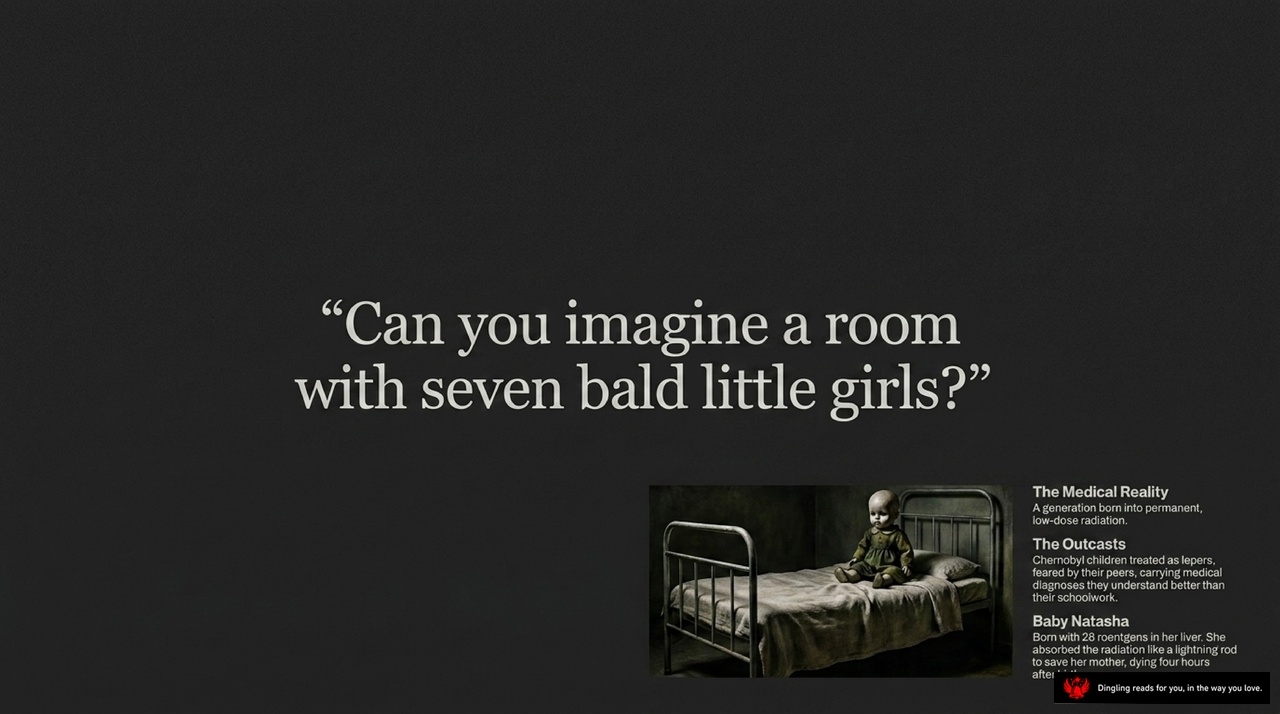
Can you imagine a room with seven bald little girls? That haunting question, displayed prominently on this slide, captures the sheer horror that defined life for many families in the aftermath of Chernobyl. This image isn't just a graphic; it represents a medical reality that shattered the innocence of childhood. For children like those in the photo, radiation wasn't a distant threat; it was a permanent, low-dose presence that rewrote their biology from the moment of birth.
These children became outcasts, treated like lepers by their own peers. They carried medical diagnoses that their classmates couldn't even pronounce, let alone understand. One tragic story is that of Baby Natasha, who was born with 28 roentgens in her liver. She acted as a lightning rod, absorbing the radiation to save her mother, only to die four hours later. These stories highlight the brutal cost of the disaster: a generation born into permanent fear, isolated and misunderstood, forced to grow up in the shadows of a catastrophe that no one could see but everyone could feel.

Before 1986, humanity stood tall, convinced it had cracked the code of the universe. We believed in the Age of Physics, where man was the absolute master, and the atom was just a quiet, reliable worker—a symbol of Soviet technological perfection. We trusted our leaders with blind faith, believing that science and politics were one and the same. If the state said it was safe, it was safe.
But then came 1986, and everything shattered.
On the other side of that broken wall lies the Age of the Black Box. Suddenly, man transformed from a master into a fragile victim of his own creation. The atom, once a symbol of power, became an invisible, omnipresent terror that replaced religion. We no longer trusted the state; we realized that political regimes could hide history, but they could never legislate physics.
This isn't just about a nuclear disaster; it's about a fundamental shift in how we see ourselves. We went from believing we could control nature to realizing we are powerless in the face of forces we cannot see or stop. The certainty of the past is gone, replaced by the terrifying uncertainty of the future.
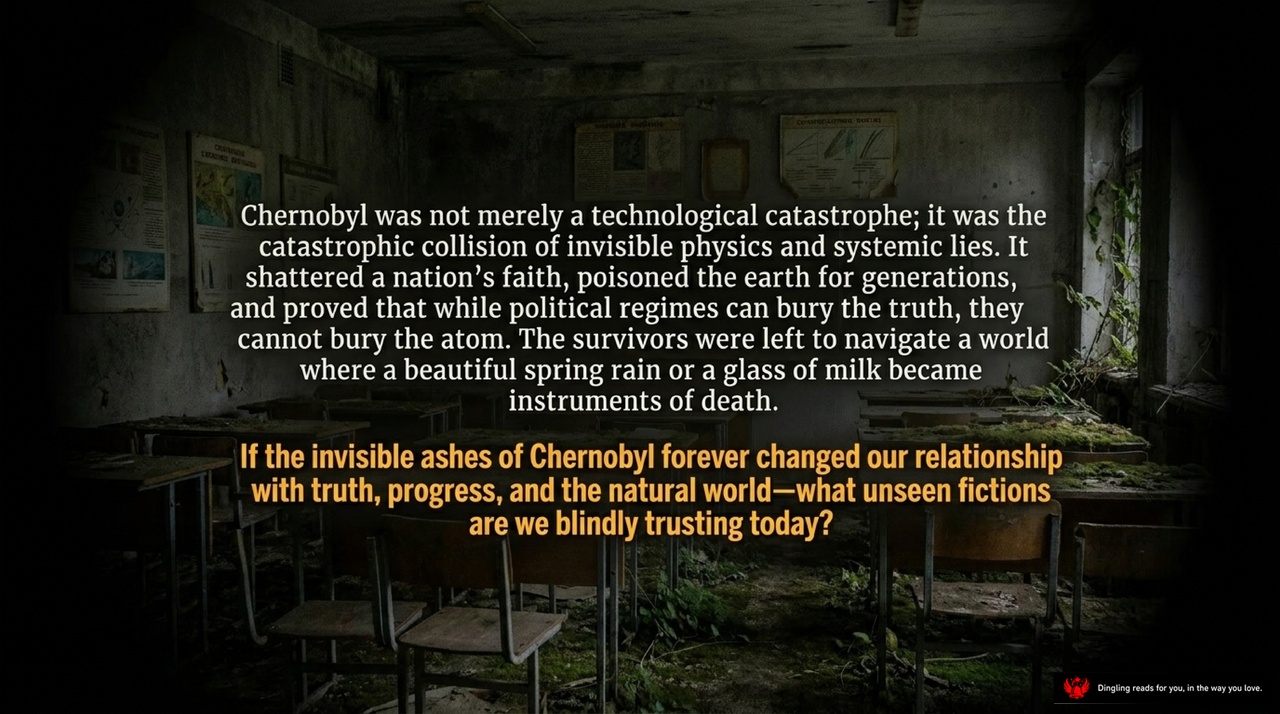
Chernobyl was never just a technological failure; it was the catastrophic collision of invisible physics and systemic lies. As we look at this abandoned classroom, we see the aftermath of a nation's shattered faith. The disaster poisoned the earth for generations, proving a terrifying truth: while political regimes can bury the truth, they can never bury the atom.
For survivors like Zina, life became a nightmare where the beautiful spring rain or a simple glass of milk could become instruments of death. The invisible ashes of Chernobyl forever changed our relationship with progress and the natural world. But as we reflect on this tragedy, a haunting question remains: what unseen fictions are we blindly trusting today?