


Larissa's four-year fight to prove her daughter's disabilities were caused by radiation feels heartbreaking and necessary.
Your Review
Larissa's four-year fight to prove her daughter's disabilities were caused by radiation feels heartbreaking and necessary.


The book feels heavy but necessary.

The stories of cleanup workers forced to shoot their own dogs haunt me deeply.

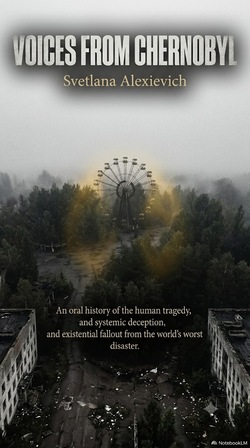
The book centers unedited voices instead of official reports, showing how institutions erase pain when it contradicts official narratives.

The book gives raw voice to people erased by official stories. I was deeply moved by how Larissa battled bureaucrats who refused to connect her daughter's severe congenital disabilities to the Chernobyl disaster. Her desperate letters and willingness to let her child be a test subject show how ordinary people suffer when institutions prioritize control over compassion. The story of Zina, the elderly woman who refused evacuation orders and stayed alone in her contaminated village, highlights the immense courage required to hold onto one's home and identity against a system that treats survivors like outcasts. While the text is heavy with grief, it remains a powerful testament to resilience, reminding us that true history lives in the voices of those on the ground, not in sanitized reports. This oral history collection does not just recount a nuclear tragedy; it exposes the human cost of institutional silence and lies, making it a vital read for anyone concerned about truth in crisis.

The voices of the children are unforgettable and deeply sad.

Larissa's fight for her disabled daughter.

This book feels too dark because it focuses on lies that killed people. The cleanup workers were used and then abandoned, which makes me angry about how the government treated them instead of helping them survive the radiation.

Valentin Alekseyevich tried to warn everyone but was ignored by his own government. His story shows how quickly faith in science can turn into horror when leaders choose propaganda over safety, leaving families to suffer while officials hide the truth behind fake photos and lies.

Larissa's fight to be heard is heartbreaking and so real.

Larissa's fight to be heard while her daughter suffered from unexplained disabilities feels incredibly painful and real.

The way children grew up knowing only death and being called glowing because of radiation is a tragedy that shows how a disaster steals innocence and makes them feel like outcasts forever.

This book shatters the myth of a controlled disaster by giving voice to those ignored. Larissa's fight against bureaucrats who called her daughter's disabilities bad luck is heartbreaking. The story of elderly villagers refusing evacuation orders feels terrifyingly familiar today. It exposes how institutional lies turned a technical failure into a generational tragedy. The cleanup workers' guilt over shooting trusting dogs haunts me deeply. While some might call it history, this is a raw, unfiltered mirror of human suffering that refuses to fade away.

Alexievich's raw oral histories reveal how the Soviet lie machine erased ordinary pain, turning a technical disaster into a generational tragedy that still haunts us today.

The stories of Zina and Nikolai show how people refused to leave their homes, keeping their dignity when the government treated them like outcasts.

Larissa spent years fighting doctors who blamed her daughter's birth defects on bad luck instead of radiation. Her persistence proves that truth matters even when institutions try to erase the pain of ordinary families.
Raw, unedited oral histories make the human truth of Chernobyl impossible to ignore.

The story of Larissa fighting for her disabled daughter is heartbreaking and shows how the system failed ordinary people when they needed help most.

The book exposes how officials silenced ordinary voices like Larissa, dismissing her daughter's radiation-linked disabilities as bad luck for four long years while she begged for help, only to face a system that prioritized control over her child's life until she finally fought hard enough to prove the truth and stop the denial that kept families in danger while bureaucrats ignored the obvious signs of harm.

A powerful reminder of how silence kills more than radiation ever could.