
War and Peace: Complete Chapter-by-Chapter Summary

Welcome to our journey into Leo Tolstoy's masterpiece, *War and Peace*. This isn't just a book; it is a panoramic exploration of human destiny, weaving the intimately personal with the inexorable machinery of history. Imagine a world where the grand turning points of empires collide with the quiet, beating hearts of ordinary families.
The cover image captures this duality perfectly. On one side, you see the cold, metallic gears of history—those unyielding mechanisms of war, strategy, and political ambition. On the other, the faint, ancient map lines representing the vast, unpredictable terrain of human life. Tolstoy invites us to look at how these two forces interact. He doesn't just tell us about battles or kings; he shows us how a single family's love, loss, and growth are inextricably linked to the rise and fall of nations. It is a story that reminds us that while history may feel like a machine, the human spirit is the variable that keeps it moving, unpredictable, and profoundly alive.

When we talk about *War and Peace*, we aren't just discussing a book; we are looking at a monumental effort that took nearly a decade to craft. This slide breaks down the sheer scale of Tolstoy's masterpiece, revealing the "anatomy" of an epic.
First, look at the timeline. The story spans **15 years**, covering the critical period from 1805 to 1820. This era is centered around the cataclysmic 1812 Napoleonic invasion, capturing the full arc of war and peace in early 19th-century Russia.
Then, consider the **population** within this narrative. Tolstoy wove together over **500+** characters. That includes more than 70 fully realized portraits, blending historical figures like Napoleon and Kutuzov with fictional giants like Pierre and Natasha. It creates a living, breathing society rather than just a backdrop for battles.
The **volume** is staggering: **1.27 million words**. Originally, this was structured across four massive volumes plus an epilogue, creating a depth that no short story could ever hope to match.
Finally, there is the **labor** behind it all. It took Tolstoy **6 years** of obsessive drafting and historical research between 1863 and 1869. The dedication was so intense that he reportedly tried 15 different versions just for the opening scene alone. This wasn't just writing; it was a lifelong pursuit to understand the human condition.
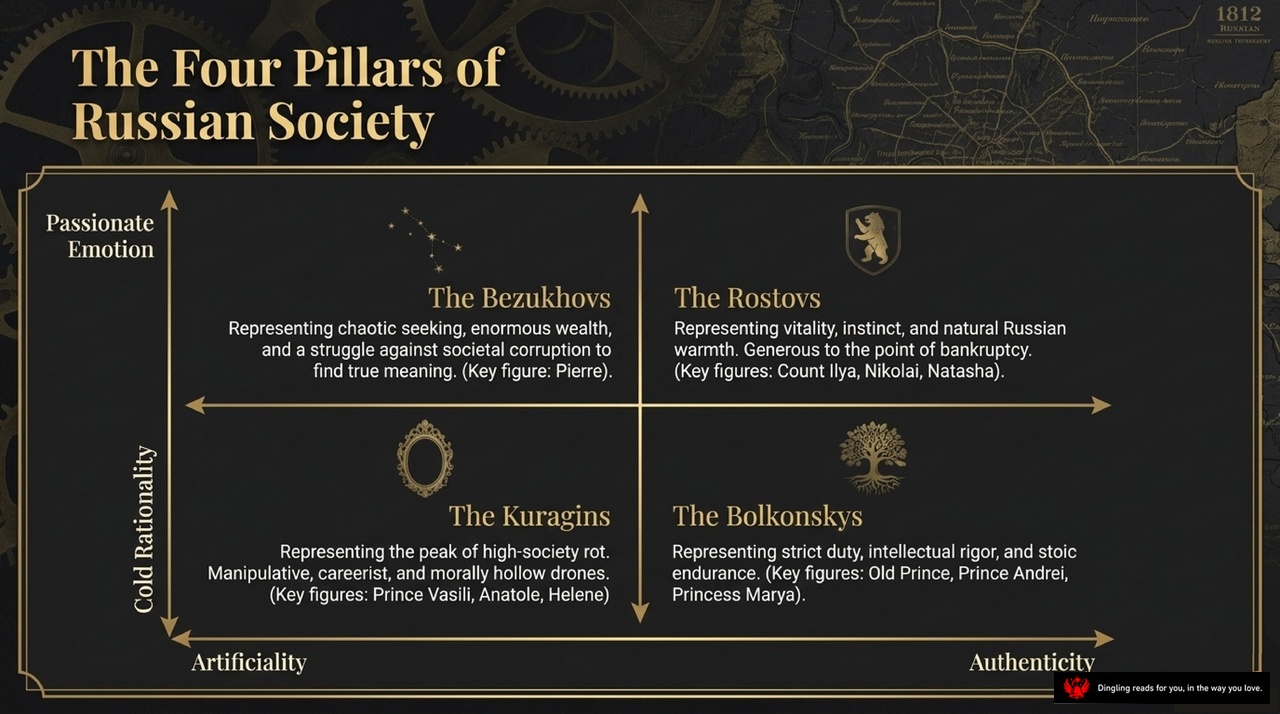
Imagine a four-quadrant map that perfectly captures the soul of 19th-century Russia, dividing society into four distinct families, each representing a unique pillar of the national character. At the top left, we find the Bezukhovs, epitomizing chaotic passion. Led by Pierre, this family embodies a frantic search for meaning amidst enormous wealth and societal corruption, driven by a desperate need to find true purpose in a chaotic world.
Moving to the top right, the Rostovs represent the vibrant, instinctive heart of the nation. They are defined by natural warmth and generosity, often to the point of bankruptcy. Figures like Natasha and Count Ilya bring an infectious vitality and a deep, unpretentious connection to life, reflecting the authentic spirit of the Russian people.
In the bottom left quadrant lie the Kuragins, the cold and artificial peak of high-society rot. Representing the worst of aristocratic decay, they are manipulative, careerist, and morally hollow drones. From the cunning Prince Vasili to the reckless Anatole, this family illustrates the dangers of cold rationality devoid of any moral compass or genuine emotion.
Finally, at the bottom right, stand the Bolkonskys, the guardians of strict duty and intellectual rigor. They embody stoic endurance and authenticity, often struggling with their own rigidity but remaining grounded in principle. Characters like Prince Andrei and Princess Marya show how a commitment to duty and truth, even when it brings pain, forms the bedrock of a resilient society.
Together, these four pillars—passionate chaos, natural warmth, hollow artificiality, and stoic authenticity—create the complex, dynamic tapestry of Russian society as seen through the eyes of Tolstoy.

Today's slide contrasts the two most compelling journeys in *War and Peace*: Prince Andrei Bolkonsky and Count Pierre Bezukhov. Think of them as two sides of the same coin. Andrei is cynical, disciplined, and obsessed with glory and order, while Pierre is clumsy, idealistic, and driven purely by emotion. Their crises couldn't be more different. Andrei faces a crushing disillusionment at Austerlitz, realizing the vanity of ambition, whereas Pierre is trapped in the moral void of high society and a loveless marriage to Helene.
But look at how they resolve these struggles. Andrei finds inner peace only through detachment, realizing a universal, divine love on his deathbed. Pierre, conversely, discovers the meaning of life through shared suffering as a prisoner and the simple, fatalistic wisdom of the peasant Karataev. One finds truth by letting go of the world; the other finds it by embracing it. These opposing paths reveal the book's core dialectic: that true wisdom often lies not in conquering life, but in understanding our place within it.
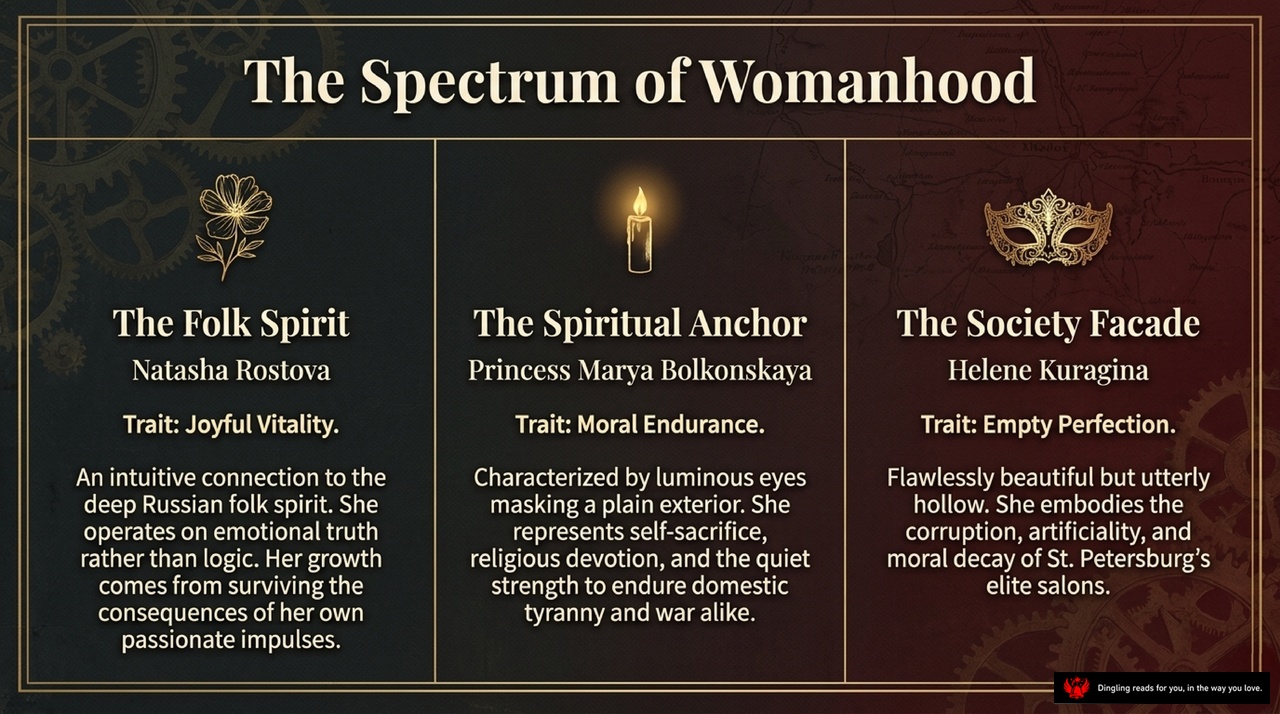
Look at this slide titled "The Spectrum of Womanhood." It breaks down three distinct archetypes of femininity found in *War and Peace*, each representing a different way of navigating the chaos of that era.
First, we have "The Folk Spirit," embodied by Natasha Rostova. Her defining trait is joyful vitality. She isn't driven by rigid logic or social rules; instead, she connects intuitively to the deep, raw spirit of the Russian people. Her growth isn't about perfection, but about surviving the messy consequences of her own passionate impulses. She is the pulse of the nation.
In the center stands "The Spiritual Anchor," Princess Marya Bolkonskaya. Her trait is moral endurance. She represents the quiet strength required to endure both domestic tyranny and the horrors of war. Characterized by luminous eyes that mask a plain exterior, she embodies self-sacrifice and religious devotion. She is the steady light that keeps others from being consumed by the darkness around them.
Finally, on the right, we see "The Society Facade," Helene Kuragina. Her trait is empty perfection. She is flawlessly beautiful but utterly hollow. She serves as a symbol of the corruption and artificiality of St. Petersburg's elite salons. While the others represent the soul of the nation, she represents its moral decay.
Together, these three characters show us that womanhood in *War and Peace* isn't a single story. It is a spectrum ranging from the raw energy of the folk, to the steadfast anchor of faith, to the hollow mask of high society.

The Great Man Illusion isn't just a title; it's the central argument that Tolstey fights with every page of War and Peace. Look at the slide: it contrasts two opposing forces—Napoleon as the False Titan and Kutuzov as the Vessel.
On the left, we see Napoleon. Tolstoy paints him not as a genius, but as a delusion. Napoleon believes his sheer will commands history, fixated on his legacy and military genius. But Tolstoy's verdict is brutal: a delusion. He likens Napoleon to a child holding the reins inside a carriage, convinced he is driving it, when in reality, he is just along for the ride.
Now, look at the right side. This is Mikhail Kutuzov. He is the Vessel. He rejects personal glory and refuses to force events. Instead, he relies on patience and time, understanding that he cannot control the flow of history, only ride it. Tolstoy calls him the true leader. Why? Because his will aligns seamlessly with the unspoken, collective will of the Russian people.
This is the core of Tolstoy's philosophy: history isn't driven by a few supermen, but by the invisible force of the masses. Napoleon thinks he is the driver, but Kutuzov understands he is merely the vessel, letting the people's spirit steer the ship to victory.

Look at this striking image: a simple wooden cudgel smashing a gleaming sword. This isn't just art; it's the core truth of 1812. In the chaos of war, the rules of aristocratic combat—the polished swords and formal tactics—shattered. When the French burned Smolensk, everything changed. The rigid codes of war evaporated, replaced by a raw, visceral struggle for survival.
This is the "swarm." Napoleon's massive army didn't fall because of a single brilliant battle plan. It was destroyed by the decentralized, spontaneous resistance of peasants and partisans. These ordinary people, burning their own supplies and fighting with nothing but their homes at stake, became an unstoppable force. They didn't need generals or uniforms; they just needed to survive.
So, who was the true driver of victory? It wasn't the emperors or the generals. It was the unrecorded masses. These were the people who abandoned reason and self-preservation to repel the invader. As the text shows, victory belonged to the collective. The sword of the elite might be sharp, but in the end, it was the cudgel of the people that broke it.

Today, we dive into the final chapter of our journey: the "Clockwork of Determinism." Look at those intricate gears in the image. For centuries, we've been told that history is driven by "Great Men"—kings, generals, and emperors who turn the gears of time with their sheer will. The slide suggests this is just an illusion.
In reality, history isn't propelled by the command of a single king. Instead, it's driven by the mathematical integration of millions of independent human wills. Think of it this way: a king is merely history's slave, just a label stuck onto an event that was already predetermined by the churning of countless microscopic gears below.
The true mechanical force behind history lies in "Individual Human Actions"—the masses. When we look at the "Historical Milestones" of war, peace, and conquest, we see that the outcome wasn't decided by a master strategist alone. It was the result of how ordinary people reacted, suffered, and chose to fight or survive. The victory of 1812 wasn't because Napoleon made a mistake or Kutuzov made a genius move; it happened because the collective will of the Russian people refused to be crushed.
So, forget the idea that one person can steer the ship of history. The real power lies in the synchronized movement of the masses. It's not about a hero pulling the lever; it's about the entire machine of humanity turning together. That is the true clockwork of our past.
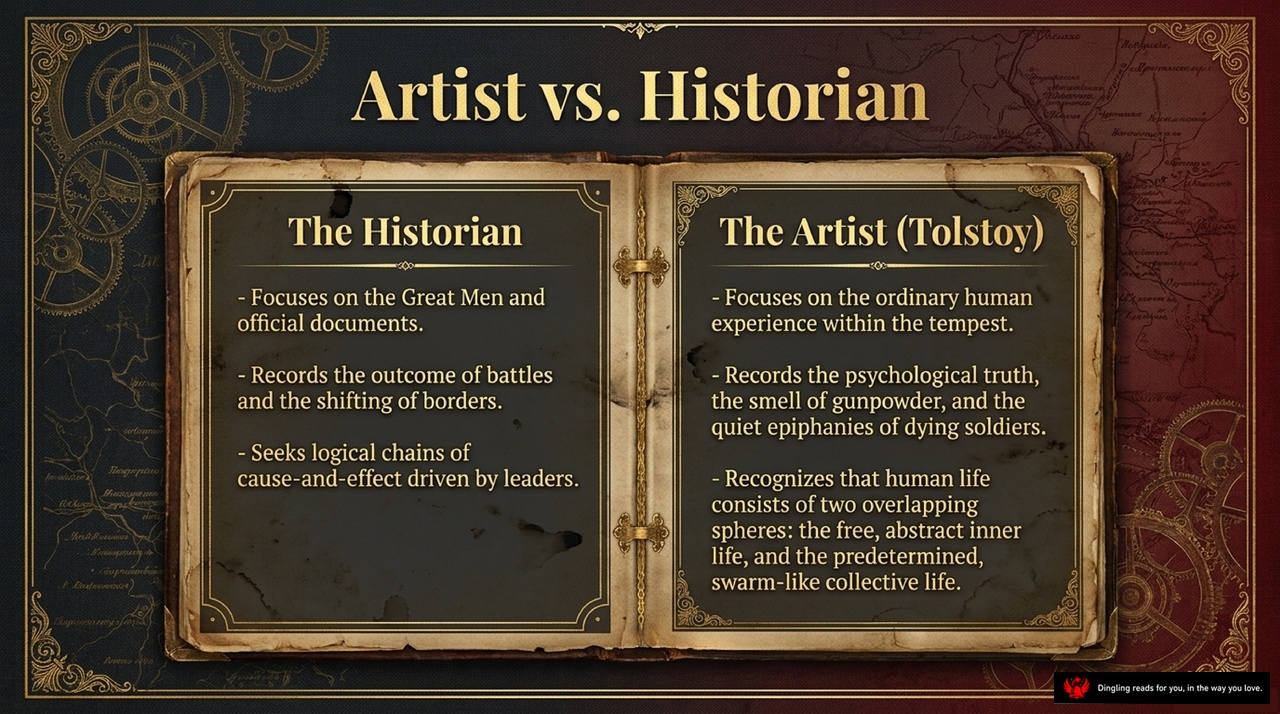
Look at this slide comparing the Historian and the Artist, specifically how Tolstoy reimagines the role of the artist. While a traditional historian focuses on "Great Men," official documents, and logical cause-and-effect chains driven by leaders, Tolstoy flips the script. He argues that the artist's true job is to focus on the ordinary human experience within the tempest. Instead of just recording the outcome of battles or shifting borders, the artist records the psychological truth—the smell of gunpowder and the quiet epiphanies of dying soldiers.
This distinction is crucial because it reveals a deeper philosophical insight about human life. Tolstoy suggests that our existence consists of two overlapping spheres: the free, abstract inner life, where we make choices and find meaning, and the predetermined, swarm-like collective life, where we are swept along by history like leaves in the wind. The historian tries to explain the world through the former, often ignoring the latter, while the artist captures the tension between them. By prioritizing this psychological truth over political strategy, Tolstoy doesn't just tell us what happened; he helps us understand how it felt to be alive during those chaotic times, making the history not just a record of events, but a reflection of the human soul.
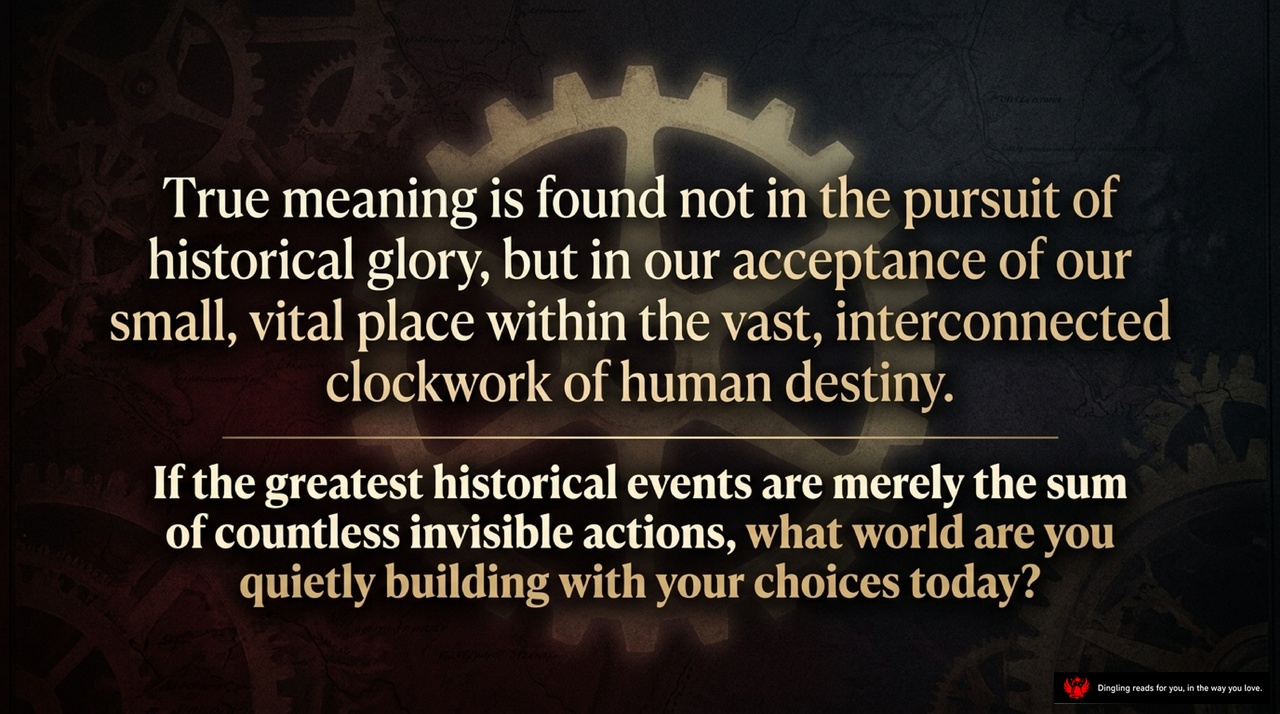
True meaning isn't found by chasing the glory of history, but by accepting our small, vital place within the vast, interconnected clockwork of human destiny. Think about it: if the greatest historical events are merely the sum of countless invisible actions, what world are you quietly building with your choices today?
In *War and Peace*, Tolstoy shatters the myth that history is driven by great men. He shows us that Napoleon, the "hero" of textbooks, was actually just a man swept along by the tide of events, his orders often ignored by his own starving army. Real victory didn't come from a single commander's genius, but from the collective will of ordinary soldiers and farmers who refused to surrender their land. It was the quiet, stubborn resistance of millions—the burning of crops, the refusal to feed the enemy, the simple courage of a cannon crew like Tushin—that turned the tide.
So, when you look at the gears of history, don't just see the big leaders turning the wheel. See the countless tiny cogs working together. Your daily choices, your kindness, your refusal to give up—these are the invisible actions that shape the world. What legacy are you quietly building right now?