
Weapons of Math Destruction: Complete Chapter-by-Chapter Summary

Welcome to today's session on Cathy O'Neil's groundbreaking book, *Weapons of Math Destruction*. The cover image you see here sets a powerful tone: a solitary human figure standing beneath a towering, opaque cube. This visual metaphor perfectly captures the book's central thesis. We are not dealing with neutral, objective mathematics. Instead, we are facing "Weapons of Math Destruction"—algorithms that are opaque, scalable, and destructive.
As the text on the slide explains, these weapons increase inequality and threaten democracy by scaling opaque, unregulated algorithms. Unlike a baseball model, where data is transparent and the goal is clear, these math weapons hide subjective biases inside their code. They don't just make mistakes; they systematically harm specific groups, often the poor and marginalized, while amplifying their misfortune on an industrial scale.
The core danger lies in the fact that these models are not blind; they are intentionally designed to prioritize efficiency over fairness. By using "proxy variables"—like zip codes or social connections as stand-ins for creditworthiness or risk—they codify historical biases into seemingly scientific rules. Once these models are deployed at scale, they create self-reinforcing loops that trap individuals in cycles of poverty, incarceration, or debt, all while convincing us that the outcome was simply "the math." Today, we will explore how these invisible algorithms are reshaping our society, from our criminal justice system to our job prospects, and why understanding them is the first step toward reclaiming our future.
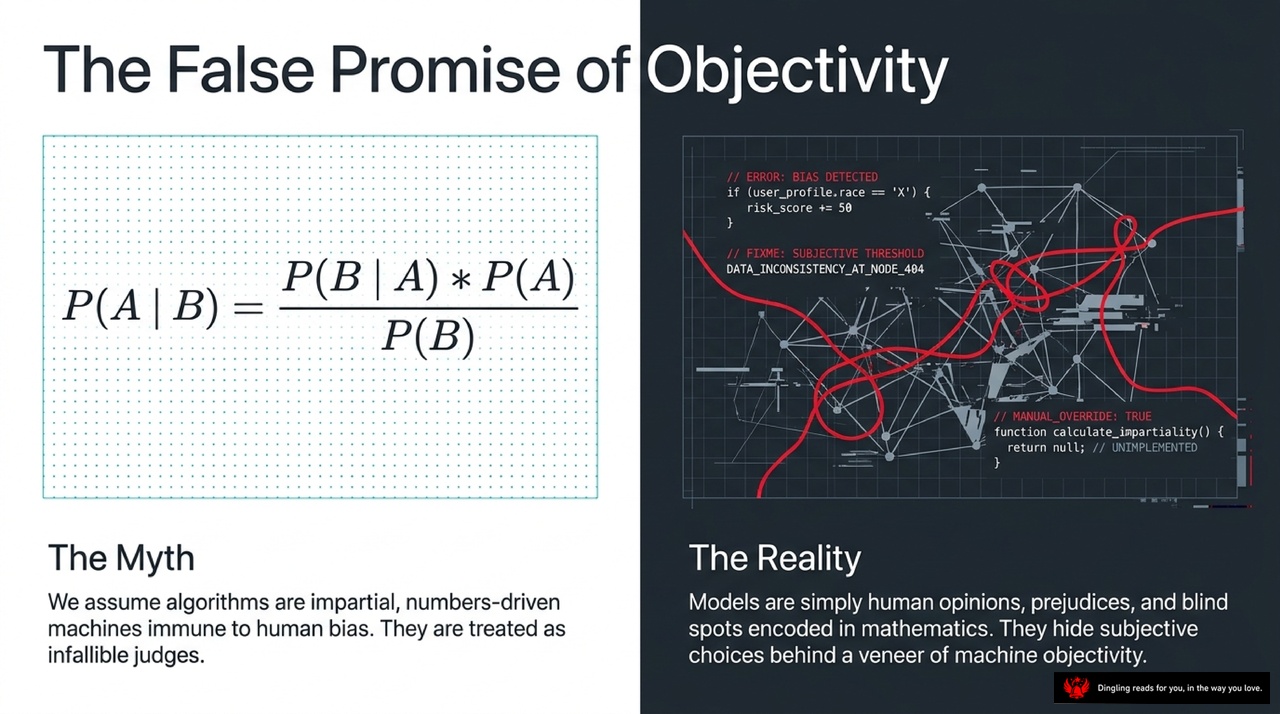
We often fall into a trap: we assume that because something is driven by math, it must be fair. Look at the slide. On the left, we see the classic formula for probability, $P(A|B)$. It looks cold, logical, and perfectly objective. On the right, we see a chaotic code snippet with error messages like "BIAS DETECTED" and "SUBJECTIVE THRESHOLD." This visual contrast captures the core truth of today's topic: the false promise of objectivity.
The reality is that algorithms are not impartial judges. They are simply human opinions, prejudices, and blind spots encoded in mathematics. When we build a model, we make choices about what data to include and what to ignore. Those choices reflect our values. For instance, a model might use a person's zip code to predict credit risk, effectively equating poverty with dishonesty. Or it might use a job applicant's social media activity as a proxy for their character, ignoring the fact that these metrics often correlate with gender or race rather than actual work ethic.
We treat these models as infallible because they hide behind a veneer of machine objectivity. But underneath that smooth surface lies a messy reality. A model designed to predict recidivism might penalize someone for living in a poor neighborhood, not because they are dangerous, but because the data shows that people from those areas have been arrested more often. The model isn't seeing the individual; it's seeing a stereotype. And once these subjective choices are locked into code and scaled up to millions of users, they become powerful, invisible weapons. They don't just make mistakes; they systematically close doors for specific groups of people, all while convincing us that the results are just "the math."
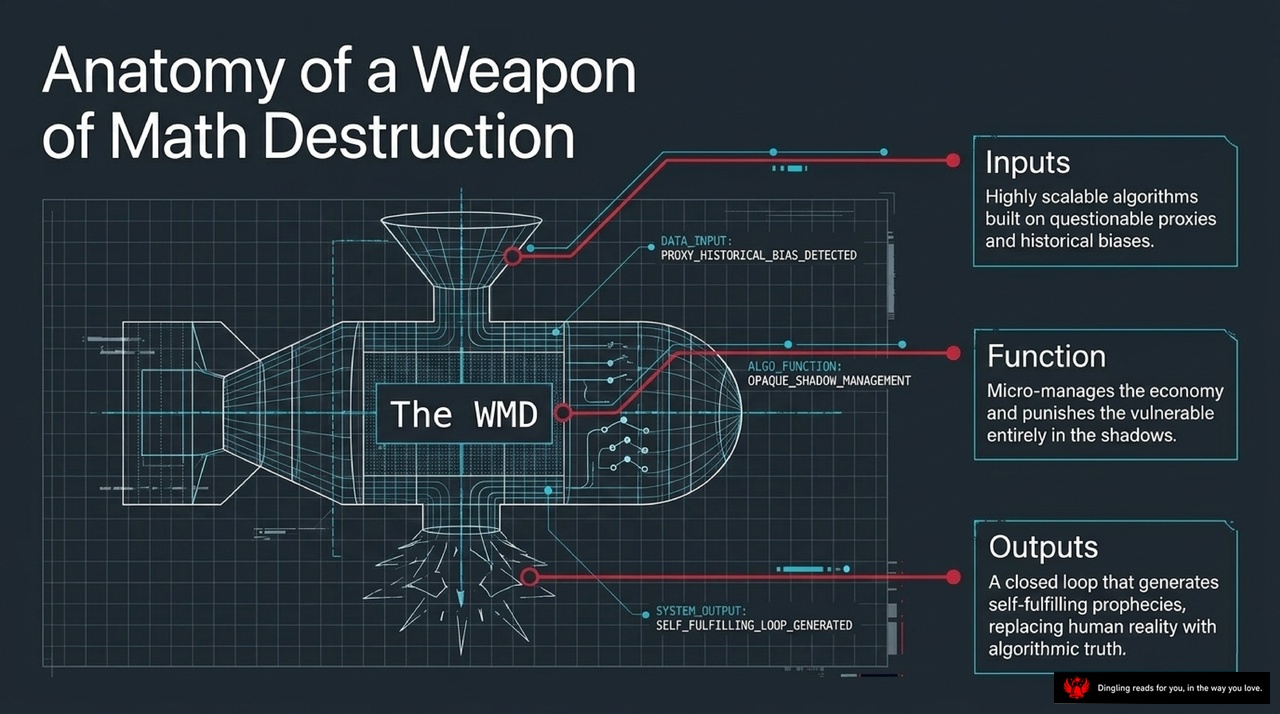
Imagine a world where your future isn't decided by your actions, but by a number generated by an algorithm you never saw. This is the reality for millions of Americans trapped in the "math destruction" cycle.
Let's look at the diagram we have here. It breaks down exactly how this weapon works. First, we have the **Inputs**. These aren't neutral facts; they are "highly scalable algorithms built on questionable proxies and historical biases." Think about it: instead of measuring your actual creditworthiness, a model might use your zip code or your social media habits. It's using the wrong data to make life-or-death decisions.
Next is the **Function**. The system "micro-manages the economy and punishes the vulnerable entirely in the shadows." This isn't about stopping crime or improving efficiency; it's about squeezing value out of the poor. Whether it's a predatory loan offer appearing on your phone or a job application being auto-rejected because your name sounds "unreliable," the algorithm is working silently to keep you down.
Finally, look at the **Outputs**. This creates a "closed loop that generates self-fulfilling prophecies." Here is the trap: if you are marked as "high risk" for a loan, you get rejected. Because you can't get the loan, you can't pay your bills, your credit score drops, and the model now sees you as even higher risk. You are punished for the very poverty the system helped create.
This isn't just a glitch; it's a feature. The system replaces human reality with "algorithmic truth," turning our lives into a predictable, unbreakable loop of disadvantage.
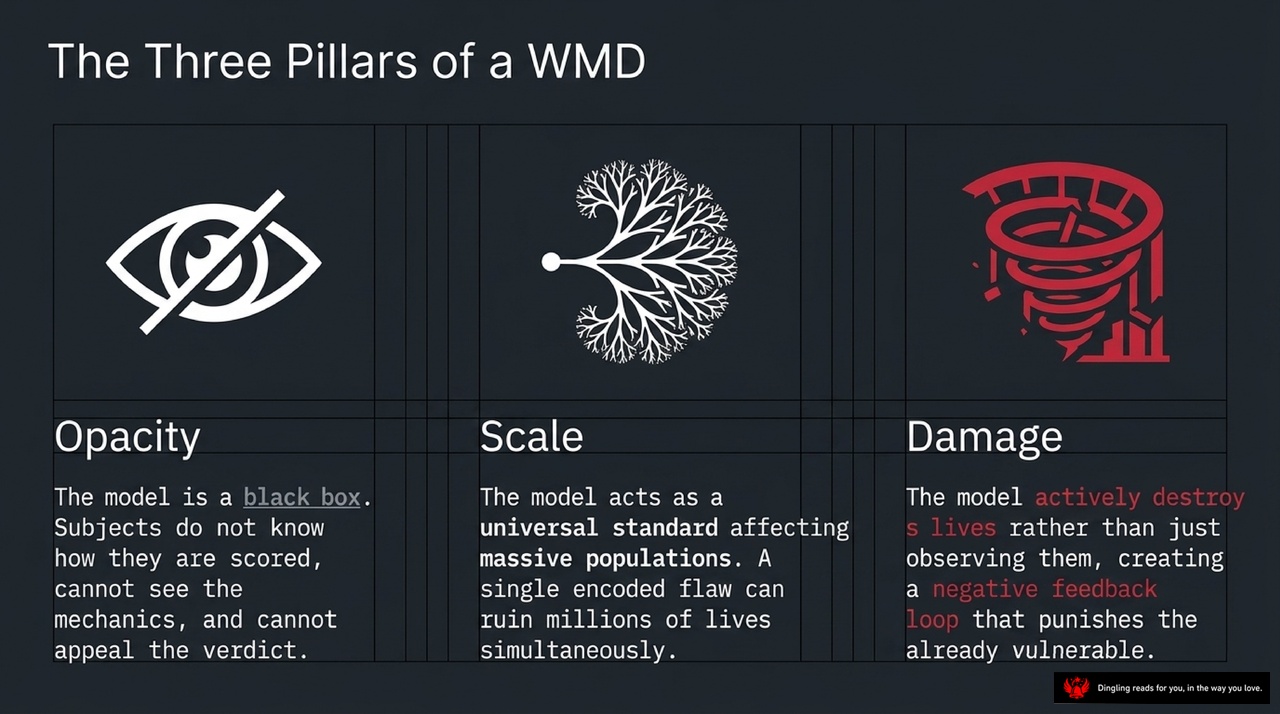
Imagine a world where your future isn't decided by your actions, but by a label you can't see. That's the reality of what we call "Mathematical Killing Weapons"—algorithms that are opaque, massive in scale, and destructive in their impact.
Look at the first pillar: **Opacity**. Think of these models as a "black box." You might be rejected for a job, denied a loan, or marked as high-risk for a crime you didn't commit, but you have no idea why. The mechanics are hidden, and you can't appeal the verdict. It's like being judged by a stranger who refuses to show you the scorecard.
Now, consider the second pillar: **Scale**. These aren't just small mistakes; they are universal standards applied to millions of people at once. A single flaw in the code—like using a zip code to predict creditworthiness—can ruin the lives of an entire neighborhood simultaneously. It's not an individual error; it's a systemic engine of exclusion.
Finally, we arrive at the third pillar: **Damage**. This is where things get dangerous. These models don't just observe us; they actively destroy lives. By creating a negative feedback loop, they punish the vulnerable. For example, a poor young man might be flagged as high-risk, sentenced to a longer prison term, and then find himself unable to get a job upon release, which forces him back into crime. The model "proved" itself right, trapping him in a cycle it created.
When you combine a black box, massive scale, and active destruction, you get a weapon that is invisible, unstoppable, and deeply unfair.

So, let's talk about how efficiency, when pushed too far, can actually destroy fairness. Look at this slide comparing "Healthy Models" against what we call WMDs—Weaponized Math Devices. On the left, you have the ideal: a model like the one used in baseball analytics. It relies on direct variables like hit rates, it's completely transparent to players and fans, and most importantly, it has a feedback loop. It constantly updates based on actual mistakes on the field, learning and improving over time.
Now, look at the red side: the LSI-R Recidivism Risk Model. This is where things go wrong. Instead of direct variables, it relies on proxy variables like zip codes and friends' arrest records. It operates as a proprietary corporate secret, hidden from the subject, and it has no feedback loop. It generates self-fulfilling prophecies with no error correction.
Think about the consequences. When a model lacks that feedback loop, it never learns from its mistakes. If it wrongly marks someone as high-risk, it just keeps doing the same thing. This creates a vicious cycle where the model's bias is constantly reinforced by the very outcomes it helps create, trapping people in a system that refuses to let them out.

The algorithm doesn't punish you for who you are, but for who the math says you're like.
Look at this funnel. On the left, we have abstract concepts like "trustworthiness" or "reliability." These are hard to measure directly, so algorithms rely on indirect, measurable substitutes. On the right, you see those substitutes: Zip Codes and Credit Scores.
Here's the trap: A Zip Code becomes a proxy for race. A Credit Score becomes a proxy for job performance. The system takes these flawed stand-ins and funnels them into a final judgment.
The result? As the bottom of the slide warns, the algorithm punishes you not for what you actually do, but for the statistical behaviors of "people like you." It assumes that because your neighbor or your past had a certain risk profile, you must share that fate. This is the core poison of proxy variables. It turns social inequality into a mathematical inevitability, locking people into cycles of failure based on their background rather than their actions.

The slide you're seeing right now illustrates the most insidious part of the "Omnipresent Algorithmic Filter": it doesn't just exist in one place; it acts as a series of invisible gates that control nearly every major aspect of our lives.
Look at the red line labeled "Human Life." It's being squeezed and shaped by four specific pillars: Education, Employment, Finance, and Justice.
In **Education**, algorithms act as predatory gatekeepers. They use college rankings to create artificial scarcity and target vulnerable students with ads that promise a future they can't afford, exploiting their desperation.
Move to **Employment**. Here, automated resume screeners and rigid personality tests filter out qualified candidates based on hidden biases, often rejecting people before a human ever sees their application.
Then comes **Finance**. This is where "E-Scores" and shadow credit scores decide who gets a loan and at what interest rate, often locking low-income individuals into high-cost debt traps.
Finally, in **Justice**, predictive policing and automated sentencing tools determine who gets locked up and for how long, often using factors like zip code rather than actual criminal behavior to decide a person's freedom.
The key takeaway here is that these aren't isolated systems. They feed into each other. A poor student gets rejected by a predatory college, lands a dead-end job due to an automated resume filter, gets trapped in debt by predatory lending, and eventually ends up in the justice system where an algorithm decides their sentence. It's a self-reinforcing cycle that systematically pushes certain groups deeper into poverty while locking them out of opportunity, all powered by math that claims to be neutral but is actually designed to extract value and enforce inequality.

Mathematical weapons of mass destruction are weaving a deadly web of poverty around us. Imagine a person living in a high-crime neighborhood. A crime prediction model flags their address, leading to frequent police stops and searches. Even for minor infractions, these encounters leave criminal records. Those records feed into recidivism algorithms, inflating their "risk score" and resulting in longer prison sentences. Once released, a criminal record makes finding stable work nearly impossible. Desperate for survival, they may turn back to crime, which only reinforces the model's original prediction.
Simultaneously, their financial life crumbles. Poverty and unstable income drag down their credit scores, locking them out of fair loans and forcing them into predatory payday lenders. They face exorbitant insurance premiums and are bombarded with ads for for-profit colleges and high-interest loans. Every step of this cycle—from policing to banking—drains their resources, turning temporary hardship into a permanent trap.
This isn't just about individuals; it's about the entire social fabric. Algorithms sort us into tiers, directing resources to the favored few while starving the rest. The wealthy see ads for private schools and tailored investments, while the poor are fed a diet of debt traps. Even the middle class isn't safe; a single awkward answer on a personality test can block a job, and ranking pressure forces families into crippling student debt.
Worse, this technology is eroding democracy. Micro-targeting in elections shows voters only what they want to hear, silencing dissent and ignoring "low-value" voters. When algorithms decide who gets heard and who gets ignored, we lose our shared reality. To stop this, we need rigorous algorithmic audits and a moral compass that prioritizes human dignity over efficiency. Only by refusing to let math dictate our fate can we break this cycle and rebuild a truly fair society.
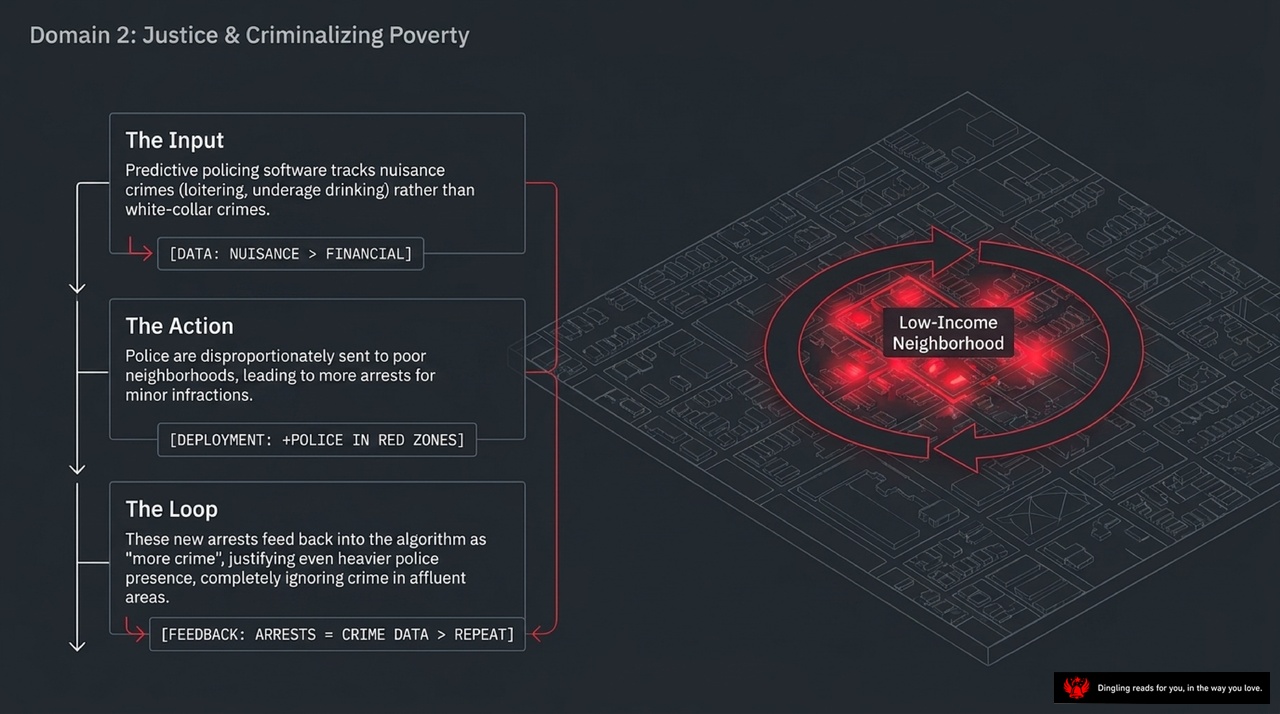
We see a self-perpetuating trap in the way modern policing operates, a cycle that turns poverty into crime and crime into punishment. It starts with the input: predictive software tracks nuisance crimes like loitering or underage drinking, ignoring white-collar crimes entirely. This data bias tells the system that danger lives in poor neighborhoods.
Consequently, the action shifts. Police are disproportionately deployed to these "red zones," leading to a surge in arrests for minor infractions. But here is the loop that seals the deal: these new arrests feed back into the algorithm as proof of "more crime." The system justifies even heavier police presence, completely ignoring crime in affluent areas. This feedback loop—where arrests equal crime data, which leads to more arrests—creates a vicious cycle. It's not just about catching criminals; it's about mathematically manufacturing the very problem it claims to solve, trapping low-income communities in a state of perpetual surveillance and incarceration.

Domain 3: Finance & The E-Score Shadow.
Look at this comparison between the regulated FICO score and the unregulated E-Score. While traditional credit scores are bound by law and transparency, data brokers are now using hidden "E-scores" to determine your worth without any oversight. These shadow algorithms don't just look at your debt; they scrape your browsing habits, clickstreams, and even your geographic data to evaluate your financial desperation.
The damage is real and targeted. These systems trigger predatory ads for payday loans and for-profit colleges precisely when you are at your most vulnerable, effectively bypassing fair credit laws. Instead of helping you, the algorithm identifies your weakness and exploits it, turning your struggle into profit for others. This is the essence of the E-Score shadow: a system designed not to lift you up, but to keep you trapped in a cycle of debt and desperation.
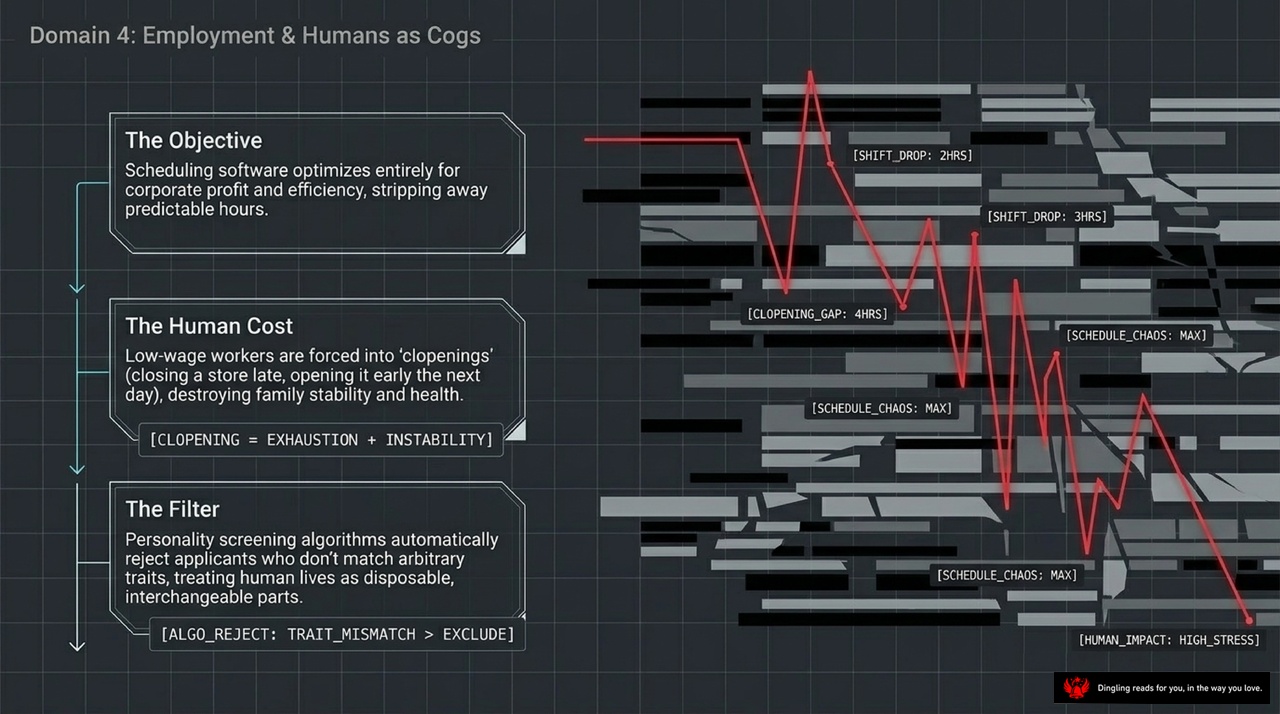
Look at this chaotic red line on the right. It's not just a graph; it's a visual representation of a life being systematically dismantled by an algorithm designed to save the company a few dollars. This slide, "Domain 4: Employment & Humans as Cogs," exposes the brutal reality of how modern scheduling software turns human beings into interchangeable parts.
On the left, we see the cold logic behind the chaos. First, "The Objective." The software isn't designed to help employees; it's built to optimize entirely for corporate profit and efficiency, stripping away any need for predictable hours. The result? The jagged red line you see on the right, marked with things like "[SHIFT_DROP: 2HRS]" and "[SHIFT_DROP: 3HRS]." This isn't a schedule; it's a schedule of instability.
Then comes "The Human Cost." Because the algorithm ignores the human element, low-wage workers are forced into what experts call "clopensings"—closing a store late, only to be forced back to open it early the next morning. The slide explicitly defines this as "Exhaustion + Instability." Imagine trying to care for a family when your work hours are a moving target. The red line spikes and crashes, destroying family stability and health.
Finally, we have "The Filter." Before you even get a chance to fight back, personality screening algorithms automatically reject applicants who don't match arbitrary traits. The text notes that these models treat human lives as disposable, interchangeable parts. If your personality doesn't fit the algorithm's narrow definition of "reliable," you're excluded before you've ever started.
This entire system creates a cycle where efficiency is prioritized over humanity. The company gets a perfectly optimized, low-cost workforce, while the worker gets a life of exhaustion, instability, and high stress. It's a stark reminder that when we build models that treat people as data points rather than humans, the cost isn't just financial—it's our very lives.

Imagine a world where your future isn't decided by your actions, but by a label stuck to your zip code. That is exactly what the "Architecture of Inequality" reveals: a self-perpetuating doom loop fueled by flawed algorithms.
It starts with **Step 1: Flawed Proxy Data Inputs**. Instead of looking at who you actually are, the system relies on shortcuts like your address, your background, or even your clickstream history. These aren't neutral facts; they are biased proxies that mistake poverty for criminality.
Once those flawed inputs are fed in, **Step 2: Algorithmic Judgment** takes over. This is the "unappealable Black Box decision." The algorithm doesn't just calculate; it judges. It takes those biased proxies and turns them into a definitive score, a verdict you cannot argue with.
The consequences hit hard in **Step 3: Denial of Opportunity**. Because you've been labeled "high risk," doors slam shut. You lose your job, get denied a loan, or face harsher sentencing. You are systematically stripped of the very resources you need to succeed.
This leads to **Step 4: Increased Poverty & Desperation**. As opportunities vanish, life becomes harder. The stress mounts, resources dwindle, and the pressure to survive often forces people into the very behaviors the system feared.
Finally, we arrive at **Step 5: Generation of 'High Risk' Data**. This is the trap that seals the deal. Because you are now poorer and struggling, you generate new data that looks exactly like the "high risk" profile the algorithm originally created. This new data feeds directly back into **Step 1**, restarting the cycle.
The result? A mathematical trap where the system's own errors create the very reality it predicted. It's not just a glitch; it's a designed feature of an inequality engine that never stops spinning.

We are living in a world where the wealthy and the poor experience reality through two completely different lenses. On one side, the privileged reality: the rich are processed by humans. They get bespoke advice, holistic college reviews, and face-to-face legal representation. Their lives are curated by people who care about their individual stories. On the other side, the algorithmic reality: the masses are processed by machines. They are filtered by automated HR screens, assigned risk scores, and managed by efficiency algorithms that don't care about their individual stories.
This stark divide is the core of what we call "Coddling the Rich" versus "Punishing the Poor." In a world dominated by these mathematical weapons, privacy and human empathy have become luxury goods. The wealthy get personalized care, while the rest of us are reduced to data points, sorted, judged, and often punished by systems we never designed and never understand. The tragedy is that these algorithms aren't just neutral tools; they are amplifiers of existing inequalities, turning small biases into massive, systemic forces that lock entire groups out of opportunity.

Bringing Algorithms to Justice. Let's look at the three locks we need to unlock to stop these "blindspot bombs" from causing harm.
First, Algorithmic Audits. We need to actively stress-test these black box models for racial, gender, and economic bias before they are deployed at scale. Just like we saw with the flawed recidivism models that trapped poor communities in a cycle of longer sentences, we can't let these tools hit the real world without a rigorous check-up first.
Second, Enforced Transparency. We must mandate that companies reveal the proxy data they use and provide citizens a direct mechanism to correct errors. Think about how opaque hiring algorithms or credit scoring models are; people often don't know why they were rejected or charged more. We need a way to see the ingredients and fix the mistakes.
Finally, a Hippocratic Oath for Data. We have to demand that data scientists pledge to design models that prioritize human fairness over raw corporate efficiency. When we build these systems, our goal shouldn't just be profit or efficiency; it has to be protecting people. Without this commitment, math will just become a weapon against the vulnerable.

Big data algorithms were once sold to us as the ultimate tools for objective truth, promising a fairer, smarter world. But without transparency and human values, they have mutated into weapons that automate inequality and accelerate social division.
Imagine a profit-driven black box encoding our deepest biases into the very foundation of society. If we continue to allow these systems to operate without accountability, we aren't designing a smarter future; we are simply optimizing our own destruction.
The danger lies in how these models treat us. They don't see individuals with unique stories and struggles; they see data points to be categorized and exploited. Whether it's predicting crime in poor neighborhoods, denying loans based on zip codes, or targeting vulnerable people with predatory ads, the result is the same: a self-reinforcing cycle where the system's mistakes become the evidence of our "guilt."
We must ask ourselves: are we building tools to serve humanity, or are we building algorithms to serve greed? The answer determines whether we escape the trap of the blind spot bomb or get trapped in it forever.