
What If?: Complete Chapter-by-Chapter Summary

Welcome to the world of "What If?" by Randall Munroe. This isn't just a book about silly questions; it's a playground for serious science. The cover itself gives us the perfect vibe: imagine a baseball, but instead of rolling across a diamond, it's strapped to a rocket, screaming through the sky at impossible speeds. That's the spirit of this book—taking the absurd and grounding it in hard physics.
Munroe dives into scenarios that sound like science fiction but are actually calculated realities. He asks, "What if the Earth stopped spinning instantly?" The answer isn't a gentle nap; it's a global apocalypse where the atmosphere keeps moving, creating supersonic winds that would shred every city on the planet. He takes us to the edge of space to calculate what happens if a billion moles of moles were dumped on Earth, creating a "mole star" that would eventually cook itself into a rock. He even explores the limits of human potential, calculating how long it would take to read every possible meaningful tweet or build a bridge from Lego bricks from New York to London.
Whether he's explaining why you'd be safe in a submarine during a lightning storm or why a nuclear sub in orbit would freeze to death, Munroe makes the complex feel accessible. He turns the universe into a giant thought experiment, proving that even the wildest "what ifs" have a logical, scientific answer. So, grab your rocket-powered baseball and let's dive into the impossible.

Imagine a scenario where a simple, innocent thought spirals into a global apocalypse. The image you see breaks down this terrifying process into three distinct stages. It starts on the left with an **Absurd Premise**: a confused figure representing a hypothetical scenario that seems ridiculous at first glance. But here's the kicker: we don't discard it. Instead, we feed that premise into the middle panel, labeled **Rigorous Math**. This isn't just random guessing; it's a strict application of the laws of thermodynamics, kinetics, and gravity. We take those equations and force them to solve the problem, no matter how crazy the starting point looks.
And that is where the real horror begins. The result, shown on the right as **Catastrophic Physics**, is an explosion. A mushroom cloud erupts, destroying a city, all because the math was flawless. The lesson here is profound: just because a conclusion sounds absurd or apocalyptic doesn't mean the math behind it is wrong. Sometimes, when you follow the physics perfectly, the universe gives you a reason to panic. It's a reminder that nature doesn't care about our sense of humor; if the equations say "boom," then "boom" is the only outcome we can trust.

Imagine a baseball pitcher unleashing a pitch at 90% the speed of light. At T=0 nanoseconds, the ball rockets away at 900 million kilometers per hour, so fast that air molecules instantly freeze in relative time. By T=30 nanoseconds, the ball slams into the air, triggering a thermonuclear fusion reaction. The impact shatters air molecules into a plasma bubble that expands near light speed.
At T=70 nanoseconds, this superheated plasma bubble reaches home plate. The batter hasn't even seen the pitch yet because light and the plasma arrive simultaneously. Before the batter can react, they receive a lethal dose of X-rays. The ball itself has been eroded into a cloud of debris.
By T=1 millisecond, the devastation is absolute. The stadium is completely vaporized, and a blast radius of 1 to 2 kilometers levels the surrounding city. It's a scene of instant, catastrophic destruction. Yet, according to MLB Rule 6.08(b), the official score would still read: "Batter is hit by pitch and takes first base." It's a tragic, hilarious reminder that even in the face of physics-defying apocalypse, the rules of the game technically still apply.

Imagine stepping forward a thousand years from today, standing in the middle of what is now New York's Times Square. The skyscrapers that define our skyline would have vanished, replaced by rolling hills, swamps, and dense forests. This landscape would mirror the descriptions of the lost continent of Willy-Atlantis, inhabited by the Lenape tribes, with wolves, mountain lions, and the now-extinct passenger pigeon roaming the woods. The vast chestnut forests, once a quarter of the region's hardwoods, would still thrive here, untouched by the chestnut blight that nearly wiped them out in the 20th century. Interestingly, this future New England wouldn't even have earthworms yet; they wouldn't arrive until European colonizers eventually set foot on the land.
Travel back further to ten thousand years ago, and you witness the Earth waking up from the Ice Age. The massive ice sheets that once covered New England have retreated north of the Canadian border, leaving behind a landscape reshaped by melting glaciers. Those ancient icebergs carved out kettle lakes like Lake Oakland, while the debris they left behind, known as glacial erratics, can still be seen in places like Central Park today. Meltwater rivers deposited vast piles of sand and gravel, creating unique landforms known as kame terraces.
Go back another ninety thousand years to the end of the Sangamon interglacial period. The climate was stable and warm, supporting a lush ecosystem. The coastline looked entirely different back then; islands like Staten Island were actually raised terraces pushed by glaciers, not recent formations. The jungles teemed not just with modern animals, but with extinct giants like dire wolves, short-faced bears, and saber-toothed cats. The pronghorn antelope, with its incredible speed of up to 88 kilometers per hour, likely evolved these traits specifically to escape these much faster and deadlier predators.
Heading back a million years, we find ourselves in a quiet period of glacial retreat during the mid-Pleistocene. The climate was warm again, allowing coyotes to cross the Bering Land Bridge into North America. You might also encounter the saber-toothed cat known as the "Bering Land Bridge sabertooth," a species that thrived in this era.
If you push your timeline back a billion years, the continent of North America didn't exist in its current form. The bedrock under Manhattan hadn't formed yet, though ancient rocks deep within the continent were already present. The oceans were teeming with single-celled life. Cyanobacteria were hard at work performing photosynthesis, releasing oxygen into the atmosphere and triggering the Great Oxidation Event, which eventually allowed more complex life forms to evolve and utilize this new oxygen.
Finally, look forward a million years into the future. Humanity is likely long gone. The future is unpredictable—perhaps we escaped to other planets, or our civilization collapsed and regressed, or maybe we were wiped out by nanotechnology. A million years is hundreds of times longer than our entire history as Homo sapiens and thousands of times longer than the invention of writing. By then, human society would be unrecognizable. Even if we disappear, geological processes continue. Wind and rain will slowly erode and bury our monuments. While our climate might have delayed the next ice age, it couldn't stop the cycle. Eventually, glaciers would advance again, and within a few million years, almost all man-made objects would vanish. The only things that might survive are plastic fragments buried in the earth. Perhaps future microbes will evolve to digest this plastic, turning these fragments into chemical monuments proving we once existed.

Imagine you're standing right there in Times Square, looking forward into the future. Now, fast-forward a thousand years. The skyscrapers you see today? Gone. In their place, you'd find rolling hills, swamps, forests, and rivers, looking remarkably like the descriptions from the "Project of the New World" that Europeans once imagined.
This isn't just a fantasy; it's a glimpse into the past. Jump back another 10,000 years, and you're in the aftermath of the last Ice Age. The massive ice sheets that once covered this land have retreated north to Canada. As those glaciers melted, they left behind unique geological features. Think of kettle lakes like Oakdale Lake, or the erratic boulders scattered across Central Park today—remnants of that ancient, powerful ice.
Fast forward to 100,000 years ago, and the climate was warm and stable. The coastline looked completely different; islands like Staten Island were actually raised terraces pushed by glaciers, not recent formations. The forests were teeming with life, including extinct giants like dire wolves, short-faced bears, and saber-toothed cats. Animals like pronghorns evolved incredible speeds, running up to 88 kilometers per hour, just to escape these faster, deadlier predators.
Go back even further to a million years ago, and you're in a quiet interglacial period. Wolves crossed the Bering Strait into North America, and even the saber-toothed cat, known as the "saber-toothed cat of the Bering Strait," thrived here.
Now, take the leap to a billion years ago. The continents were united as the supercontinent Rodinia. The bedrock under Manhattan hadn't formed yet, but deep within North America, ancient rocks did exist. The oceans were dominated by single-celled life, with blue algae performing photosynthesis and triggering the Great Oxidation Event, paving the way for life to eventually use oxygen.
Finally, push forward a million years into the future. Humanity is likely gone. We might have colonized other planets, our civilization might have collapsed, or perhaps we were ended by nanobots. A million years is hundreds of times longer than the time we've had to write language. Even if we vanish, nature will bury our traces. Wind and rain will erode our structures, and eventually, glaciers will return, wiping out almost all human-made objects. The only things that might survive are tiny plastic fragments. Maybe, in the distant future, microbes will evolve to digest plastic, turning our debris into chemical monuments to our existence.

Imagine a world where the internet, the backbone of our modern life, loses its race to the "walking net." This concept, often called "Walking Net," suggests that physically shipping data on hard drives might actually be faster than transmitting it over fiber optic cables for decades to come. It sounds counterintuitive, right? But let's break down the math.
Think about the sheer volume of data our internet handles today. Now, compare that to a FedEx plane loaded with just a single terabyte SSD. Surprisingly, that single flight can move more data than the entire internet processes in a day. If we scale this up, using high-density microSD cards, a fleet of cargo planes could theoretically transmit data at a rate 1,000 times faster than the internet does right now. Even by 2040, as internet speeds continue to climb, the physical transport of data is predicted to still outpace digital transmission.
However, there is a catch. While the "walking net" wins on raw bandwidth, it loses on speed. The latency of physically moving a hard drive across the country is massive—taking weeks or even months. It's not suitable for streaming a movie or making a quick call. But for moving massive archives, like the entire internet's history, it's unbeatable. The internet might never beat the walking net on pure capacity, but the walking net can't compete with the instant gratification of digital transmission. It's a fascinating reminder that sometimes, the old way of moving things is still the fastest way to move information, provided you don't mind waiting.
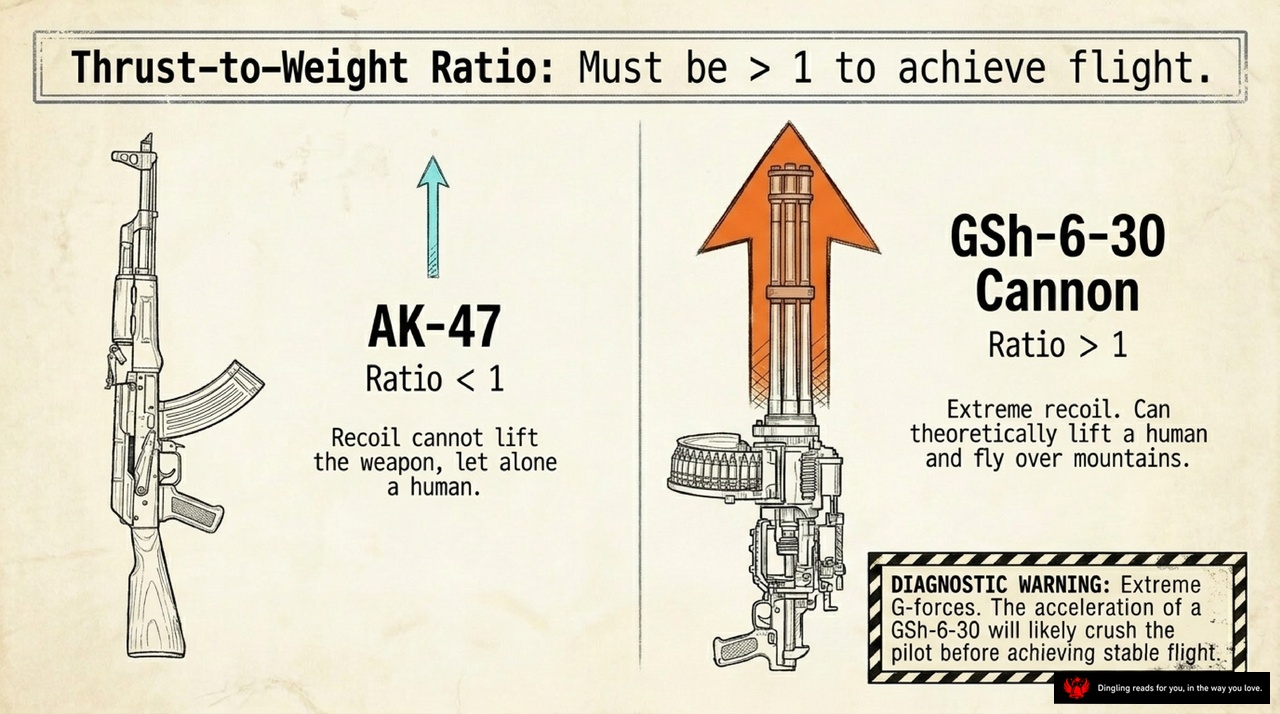
Imagine a world where the only thing standing between you and the stars is a single, absurd question: How many moles would it take to build a moon?
In this episode, we dive into the mind-bending math of "one mole of moles." Remember that number, 6.022 times 10 to the power of 23? It sounds abstract until you apply it to something real. If you took that many moles and piled them up, you wouldn't just have a mountain. You'd have a sphere roughly the size of our Moon. The sheer mass would create a gravitational pull strong enough to turn the entire pile into a dense, spherical "mole star."
But here's the twist: this isn't a paradise. Inside this mole-star, the pressure would be crushing, cooking the moles into a steaming, pressurized soup. Eventually, the heat would stop the decomposition process, turning the organic matter into oil and rock. The outside would freeze into a hard shell, trapping the heat inside until the whole thing became a bizarre, geothermal engine of dead meat.
Of course, you can't do this on Earth. The "meat mountain" would be 80 kilometers high, wiping out every living thing and crashing the global internet. But if we could send this fleet of moles to the stars, we'd have a unique, if tragic, celestial body.
And while we're talking about numbers, let's look at something even bigger: the number of possible tweets. With 140 characters and the entire Unicode alphabet, the combinations are so vast they dwarf the number of atoms in the observable universe. Yet, when you filter for actual, meaningful English sentences, the number is still so huge that it would take ten thousand "eternal centuries"—a concept where a mountain wears down to dust—to read them all.
So, while we can't build a moon out of moles or read every tweet ever written, these calculations remind us just how unimaginably large the universe of physics and information truly is.
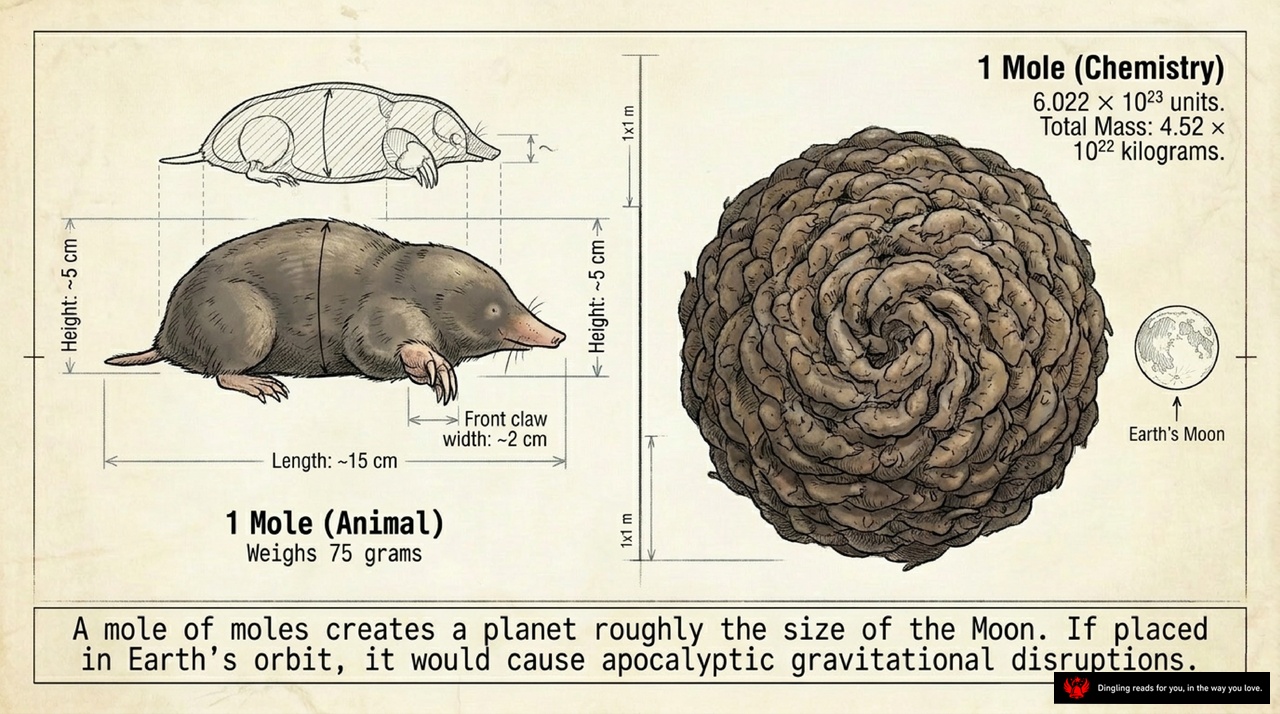
Imagine a world where the mole you know as a small, shrew-like creature becomes a unit of measurement so massive it could reshape our solar system. This slide brilliantly illustrates the shocking scale of "a mole of moles." On the left, we see the humble animal: just 15 centimeters long, weighing a mere 75 grams. It's a creature that lives underground, barely making a ripple in our world. But look at the right side of the image. When you multiply that tiny animal by Avogadro's number—6.022 times 10 to the power of 23—you get something truly apocalyptic. The total mass would be 4.52 times 10 to the power of 22 kilograms. To visualize this, the slide shows a swirling sphere of these moles reaching a height of one kilometer, yet its volume is comparable to Earth's Moon. If you were to stack a mole of these animals together, they would form a planet roughly the size of our Moon. The text at the bottom warns of the terrifying consequence: if such a planet were placed in Earth's orbit, its gravity would cause catastrophic disruptions, effectively ending life as we know it. It's a powerful reminder of how a simple number in chemistry can translate into a cosmic disaster when applied to real-world objects.

Imagine a world where the only light left for humanity is a ghostly, ethereal blue glow. This isn't from a star or a sun, but from the very remnants of our nuclear age. After we're gone, the diesel generators in remote communities will sputter and die within days or months, running out of fuel. Geothermal plants might last a few years before rust and mineral deposits seize their gears, and even our modern wind turbines, designed to run unattended, will eventually fail as their lubrication dries up.
But there is one source of light that will outlast all of them: Cherenkov radiation. Deep inside concrete storage casks, radioactive waste like Cesium-137 continues to decay. When these high-speed particles zoom through the water inside, they travel faster than light can move through that specific medium. This creates a shockwave of light, a faint but persistent azure shimmer. Even centuries later, as the radioactivity fades, this ghostly blue glow will remain, a silent, shimmering testament to our history, flickering in the darkness long after the last human has vanished.

Imagine a world where the only light left for humanity to see is a ghostly, eerie blue. This isn't from a movie, but from a real phenomenon called Cherenkov radiation. Picture a nuclear reactor's spent fuel rods, sealed deep inside a concrete vault. Even centuries after the power goes out, these rods continue to decay. As radioactive particles zip through the water in the storage pool at speeds faster than light can travel within that water, they leave behind a trail of this distinct blue glow. It's like a sonic boom for light. While the brightness fades over time—dropping to just 1% of its original intensity after two centuries—the color remains the same forever. So, if you were to wander into an abandoned nuclear facility a few hundred years from now, you wouldn't see pitch blackness. Instead, you'd see a faint, shimmering blue light, a silent, glowing monument to our nuclear age, flickering on long after the last human has vanished.

Imagine holding a bullet in your hand, but instead of lead, it's forged from the dense, crushing matter of a neutron star. To put its mass in perspective, it weighs as much as the entire Empire State Building, yet it fits in the palm of your hand. Now, visualize what happens the moment you touch it.
The image illustrates a terrifying reality: touching this bullet creates a localized vacuum of gravity so intense that it instantly extracts your entire blood volume upon contact. It's a point of no return.
Look at the "Danger Zone" marked on the diagram. Just 20 centimeters away from this tiny object, the gravitational pull exceeds human muscle strength. You wouldn't just be pulled toward it; you'd be ripped apart before you could even scream. The grid lines in the background show how the fabric of space itself is being warped into a deep, black funnel, dragging everything in its path into oblivion.
And don't be fooled by the hand reaching out to grab it. Those orange arrows represent the irresistible force pulling everything inward. At that distance, the gravity is simply too strong for any biological tissue to withstand. It's a cosmic trap disguised as a pocket-sized object, proving that with enough density, even a single bullet can become a black hole.
What if you could stop time and take a walk through history? Imagine standing in New York's Times Square, but instead of the modern skyscrapers you see today, you're looking at a landscape that looks more like Europe did centuries ago. If you fast-forward a thousand years, those towering glass buildings would have vanished, replaced by rolling hills, swamps, and dense forests. The area would be home to the Lenape tribes, and you might spot roaming wolves, mountain lions, and the passenger pigeon—a bird that was once common but is now extinct.
Travel further back to ten thousand years ago, and you'd see a world just waking up from the last Ice Age. Massive sheets of ice that once covered this region have retreated north into Canada, leaving behind unique geological features like kettle lakes and moraines that you can still see in places like Central Park. Go back another hundred thousand years, and the scene shifts dramatically again. The climate is warm and stable, but the coastlines are completely different from what we know today. The forests aren't just home to modern animals; they are also inhabited by prehistoric giants like dire wolves, short-faced bears, and saber-toothed cats. Even the pronghorn antelope had to evolve incredible speed to survive these fierce predators.
But if you keep going back to a million years ago, you enter a quiet interglacial period where the climate was again warm. This is when wolves first crossed the Bering Strait into North America, and a strange hybrid predator known as the "sea-canyon hyena" roamed the land. Pushing your timeline back to a billion years, the continent of North America as we know it didn't exist yet. Instead, there was a supercontinent called Rodinia, and the ocean was teeming with single-celled life. It was during this time that blue-green algae began releasing oxygen into the atmosphere, sparking the Great Oxidation Event that paved the way for more complex life to evolve.
So, as you traverse these vast stretches of time, you realize that the Earth is constantly changing, and the world we know today is just a fleeting moment in a much longer story.

Imagine a world where the last flicker of human-made light doesn't come from a generator or a solar panel, but from the very waste we left behind. As we move further into the future, from days to decades to centuries, our familiar sources of illumination fail one by one. Diesel generators run out of fuel, and even the most robust wind turbines eventually succumb to rust and mechanical failure. But there is one stubborn survivor. Deep underground, vitrified Cesium-137 nuclear waste continues to glow with a faint, eerie blue light. This is Cherenkov radiation, a phenomenon where radioactive particles move faster than light can travel through water or glass. Unlike our electric bulbs, this light doesn't need maintenance, wiring, or fuel. It is the enduring, silent legacy of our nuclear age, a ghostly blue beacon that will continue to shine for centuries long after humanity has vanished from the surface.

Imagine a baseball pitcher unleashing a ball at 90% the speed of light. At that velocity, the air molecules in front of the ball can't get out of the way fast enough. Instead of flowing smoothly, the air gets smashed into the ball with such force that it triggers nuclear fusion right at the point of impact.
In just 70 nanoseconds, this fusion creates a blinding flash of gamma rays and a superheated plasma bubble that expands at nearly the speed of light. By the time the ball reaches home plate, the batter hasn't even seen the pitch yet—light and the ball arrive simultaneously. The ball itself has been eroded into a cloud of plasma and debris, instantly vaporizing the batter, the bat, and the catcher's mitt.
The destruction doesn't stop there. Within the first millisecond, this expanding fireball engulfs the entire stadium, the dugouts, and even the surrounding city blocks. If you were standing on a hill outside, you'd see a flash brighter than the sun, followed by a mushroom cloud rising into the sky. The shockwave would level everything within a kilometer or two, turning the city into a crater.
Ironically, if this were a real game, the umpire would still call it a "hit by pitch" and award the batter first base. But with no one left to claim the base, this would be the ultimate, game-ending strikeout.

Imagine a world where the only thing keeping us warm is the distant, fading glow of our own machines. When humanity vanishes, our lights don't go out all at once; they fade in a slow, rhythmic decline. The first to vanish are the diesel generators in remote communities. Without fresh fuel, these engines sputter and die within days or months, leaving the first dark void.
But nature has its own persistence. Geothermal plants, tapping into the Earth's internal heat, could run for years, though eventually, rust and mineral buildup will seize their gears, turning them into silent statues. Wind turbines are the true champions of endurance. Designed for autonomy, a modern turbine can run for decades without a human touch. Its blinking LED beacon would remain a rhythmic pulse in the night sky, a ghostly reminder of our energy efforts long after we are gone.
Even when the mechanical lights finally extinguish, a strange, ethereal blue light will linger. This is Cherenkov radiation, a phenomenon created when radioactive particles travel through water faster than light can move within that medium. In the deep, concrete-sealed vaults of our nuclear waste, isotopes like Cesium-137 will continue to decay, emitting this ghostly blue glow for centuries. It won't be bright enough to see by, but it will be there—a silent, shimmering testament to our nuclear age, flickering in the eternal dark long after the last human has drawn their final breath.