
What Matters Now: Complete Chapter-by-Chapter Summary

Welcome to today's session on "The Future of Management." Imagine a world where rigid, industrial-era structures are being dismantled to make room for something entirely new. That is exactly what Gary Hamel invites us to explore in his book, *The Future of Management: 5 Essential Questions*.
As you see on the screen, the visual metaphor is striking: beneath lies a crumbling, gray grid of traditional bureaucracy—old, heavy, and restrictive. Rising above it is a vibrant, organic, golden network, representing the agile, human-centered organizations of tomorrow. Hamel's agenda is clear: we must deconstruct these outdated systems and rebuild organizations that are truly fit for the future.
This isn't just about efficiency; it's about reigniting human passion and preparing for relentless change. The core of this transformation starts with values. We need leaders who prioritize trust, integrity, and fairness over short-term gains. We must move away from the "command and control" mindset that has dominated for centuries and embrace a culture where employees are empowered, trusted, and treated as the true drivers of innovation.
The questions we ask today will challenge everything we think we know about how work gets done. Are we ready to let go of our old ways? Let's dive into these five essential questions and discover how to build the organizations of the future.

We are living in a paradox: we are fighting the hyper-connectivity, rapid commoditization, and exponential change of the 21st century using a management operating system that hasn't changed in 100 years. This mismatch is the root cause of our organizational entropy.
Look at the slide. On the right, we have "The 19th-Century Invention." Modern management—bureaucracy, fixed hierarchies, and variance control—was engineered for a different era. Its sole purpose was to turn independent craftsmen into obedient, reliable cogs. It was designed for stability, not for the volatility we face today.
On the left, we have "The 21st-Century Reality." We are navigating a world of global interconnectivity and exponential shifts with that same 100-year-old rigid framework. When you try to force a dynamic, fluid reality into a static, industrial mold, the result is predictable and devastating.
The slide concludes with the inevitable outcome: "Organizational Entropy." Companies don't die because they lack resources or talent; they die because leadership fails to adapt to a reality that outpaces their internal architecture. When your internal design cannot match the external world, stagnation sets in, innovation dies, and eventually, the organization collapses. The solution isn't to build better cogs; it's to fundamentally redesign the system itself.
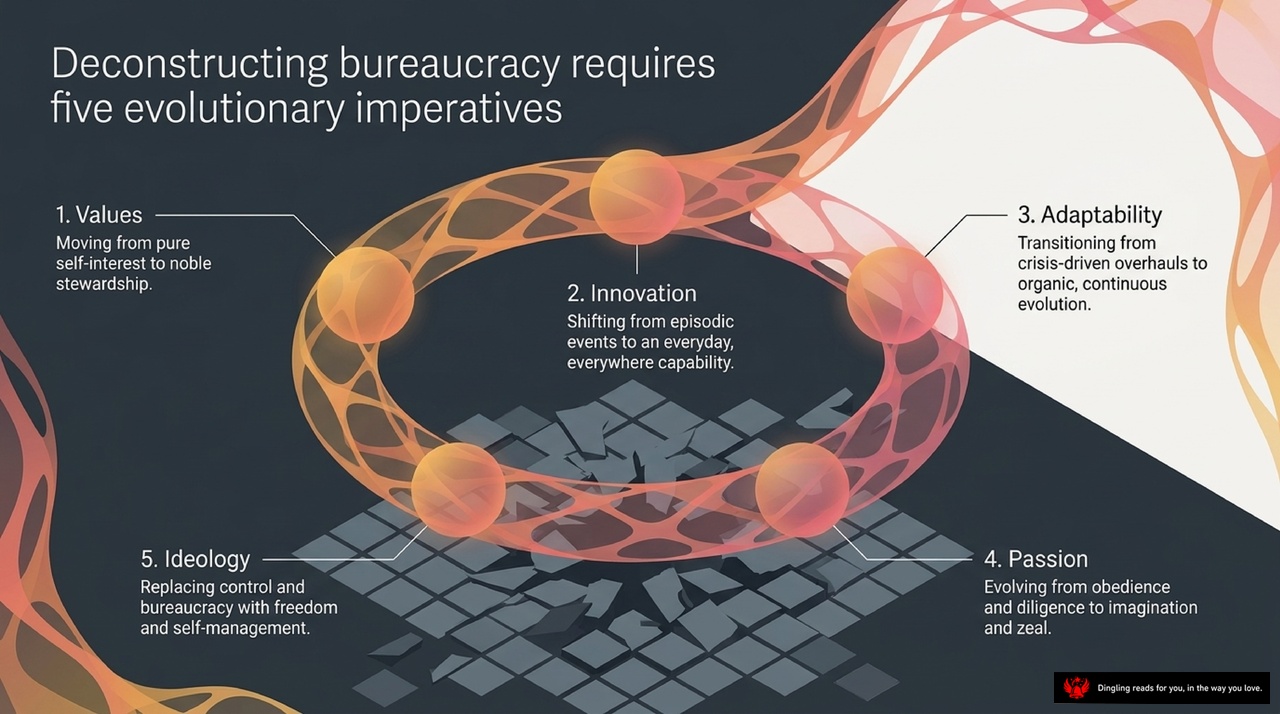
Imagine a world where your manager decides your schedule, approves your ideas, and tells you exactly how to solve every problem. It feels safe, right? Like being on a train with a conductor. But what if that conductor is actually slowing you down? What if the very system designed to bring order is strangling the creativity you need to survive?
This slide reveals the five evolutionary imperatives we must embrace to break free from the chains of bureaucracy. Think of this not as a checklist, but as a transformation of your company's DNA.
First, look at **Values**. We need to shift from pure self-interest to noble stewardship. Stop asking, "What's in it for me?" and start asking, "How can I serve this mission?" When your team feels they are guardians of something bigger than themselves, their motivation changes from compliance to commitment.
Next, **Innovation**. Bureaucracy loves episodic events—big launches and annual reviews. But true innovation isn't a special event; it needs to be an everyday, everywhere capability. It has to happen in the quiet moments, not just when the CEO is watching.
Then, we have **Adaptability**. Too many companies wait for a crisis to change. They do crisis-driven overhauls that are painful and temporary. We need to transition to organic, continuous evolution. Imagine an organism that grows its way through challenges, rather than a machine that breaks and gets repaired.
**Passion** is the fourth pillar. We are evolving from a culture of obedience and diligence—doing exactly what we are told—to a culture of imagination and zeal. When you give people the freedom to use their curiosity, they don't just complete tasks; they create solutions you didn't even know you needed.
Finally, **Ideology**. This is the hardest shift. We must replace the old control-and-bureaucracy mindset with freedom and self-management. It's about trusting that when you remove the barriers, people don't fall apart; they fly.
The graphic shows these five elements forming a dynamic loop, rising above the broken foundation of the old system. Deconstructing bureaucracy isn't about chaos; it's about building a more powerful, human-centric organization. Are you ready to let your team lead?

Look at this slide. It captures a fundamental shift in how we view capitalism. On the left, we see "The Collapse." This isn't just about broken buildings; it's about the 2008 Financial Crisis. The text reminds us that this wasn't a failure of capital, but a failure of morality. Driven by deception, hubris, greed, and denial, unchecked self-interest acted like nuclear fission—destructive and out of control. Without a moral container, profit becomes a weapon.
But on the right, we see "The Renaissance." This is the path forward. We need to shift from a system of exploitation to one of stewardship. The slide outlines five critical traits for the modern leader: Prudence, prioritizing the future over immediate gains; Tolerance, putting others' needs first; Loyalty, recognizing that authority is built on trust, not entitlement; Responsibility, owning the consequences of our actions; and Fairness, rewarding contribution rather than position.
The core message here is powerful: Unrestrained self-interest must be contained within a vessel of moral principles. We can't just have a great economy; we need a great society. If we want to rebuild trust and create lasting value, we have to stop viewing people as resources and start viewing them as partners. It's time to move from the ruins of the past to the growth of the future.

True innovation isn't just about tweaking a product; it requires rewiring the entire organizational genome. Look at this slide: on the left, we see rigid, gray blocks representing "Laggards"—organizations trapped in the past, viewing innovation as a risky expense rather than a necessity. In the middle, there are the "Cyborgs or Laureates." These are one-dimensional innovators who might push technical boundaries but rely on rigid, conventional management structures everywhere else. They are stuck.
But on the right, we see the "Born-Agains or Transformers." These are the true vanguards. They don't just innovate a product; they completely re-engineer their management processes—budgeting, hiring, KPIs, and resource allocation—to make innovation an everyday, bottom-up mandate. As the book reminds us, the real threat to capitalism isn't fraud; it's arrogant managers who confuse efficiency with excellence. To break free from the "organizational entropy" that kills giants, you must stop treating employees like cogs in a machine and start building a system where everyone acts like an owner. That is the only way to survive the future.

Breakthrough ideas aren't magic; they are the result of systematically dismantling the status quo. As this slide illustrates, true innovation happens at the intersection of three powerful forces.
First, we must challenge orthodoxy. This means identifying and breaking deep-seated industry assumptions. For example, why must software always be sold as a license? By defying the rule that software must be installed to create SaaS, companies like Salesforce unlocked entirely new markets.
Second, we need to repurpose assets. Instead of viewing a company as a portfolio of finished products, see it as a collection of unexploited skills and intellectual property. Disney, for instance, took its storytelling IP and repurposed it into English education centers, creating a massive new revenue stream from existing capabilities.
Third, and perhaps most critically, we must solve unarticulated needs. These are frustrations clients don't even know they have. By observing deep inefficiencies—like the pain of navigating complex customer service menus or the struggle to open a stubborn package—we can design solutions that feel like magic to the user.
When these three circles overlap, you get the Innovation Engine. Innovation is not a lottery; it is a systematic dismantling of conventional wisdom. It requires the courage to question what everyone else accepts as true, to look at old assets in new ways, and to solve problems people haven't yet voiced. That is how you build a company that doesn't just survive, but leads.
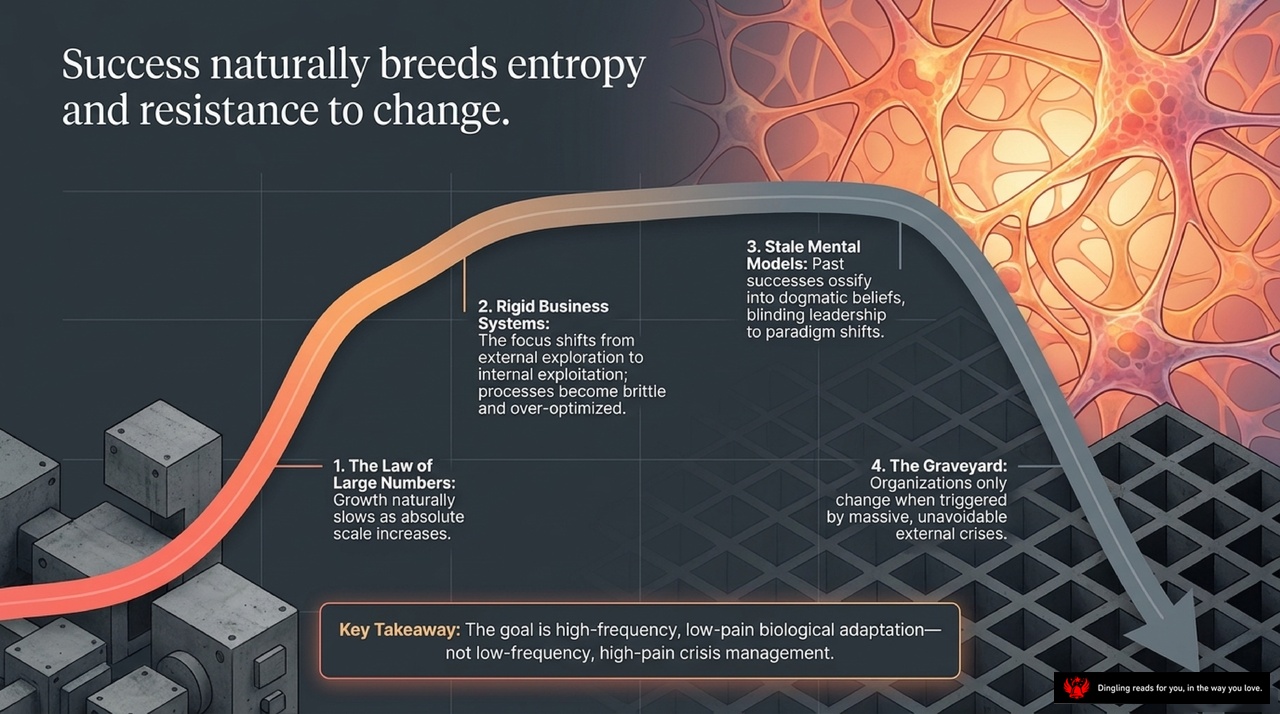
Success naturally breeds entropy and resistance to change. This isn't just a business theory; it's a biological reality. When an organization grows, it inevitably shifts from exploring the outside world to obsessing over internal efficiency. Processes become brittle, over-optimized, and eventually, past successes ossify into dogmatic beliefs that blind leadership to the need for new paradigms.
Look at the curve in our image. It starts with the Law of Large Numbers, where growth naturally slows as scale increases. Then, rigid systems take over, and stale mental models set in. The result? We end up in "The Graveyard," where organizations only change when triggered by massive, unavoidable external crises. That's a high-frequency, high-pain cycle that no modern leader wants to live in.
The real goal, as highlighted in our takeaway, is to flip the script. We need high-frequency, low-pain biological adaptation. Instead of waiting for a crisis to force a transformation, we must build organizations that adapt like living things—naturally, continuously, and without suffering. It's about breaking the cycle of success-induced stagnation and creating a culture where change is the default, not the exception.

High-frequency adaptation isn't a crisis to panic about; it's simply an automatic biological response, much like how your heart rate naturally spikes when you start running. In today's volatile world, organizations that fail to adapt this way are the ones that crumble. To build a resilient organization, we need to focus on three critical pillars.
First is Foresight. This means looking to the fringes of the market and rehearsing multiple futures before they become fatal. We have to face uncomfortable facts now, because the future is already here, just unevenly distributed. Waiting for a disaster to hit is a recipe for failure.
Second is Intellectual Flexibility. You must systematically challenge your assumptions and invest heavily in genetic and cognitive diversity within your leadership team. Encourage fierce, open debate. If your team thinks alike, you are doomed. You need people with different backgrounds and perspectives to spot threats and opportunities that others miss.
Finally, there is Strategic Variety. Instead of betting everything on one path, launch a portfolio of low-cost experiments. Create internal competition for resources to overcome the "squatter's rights" of legacy business units that are holding you back.
By combining these three pillars—foresight, flexibility, and variety—you stop reacting to chaos and start thriving within it.

You cannot command passion; you can only unleash it. Look at this pyramid. The base represents obedience, diligence, and expertise—things like showing up on time, working hard, and following basic rules. While these are essential for a company to function, they are now global commodities. You can find obedient, skilled, and hardworking people anywhere in the world, often at a very low cost. In fact, 100% of the future value creation lives in the top three tiers: initiative, creativity, and passion. These are the traits that must be volunteered by the employee; they cannot be forced.
Think about the difference. Obedience is about following orders. Initiative is about taking action without waiting for direct orders. Creativity is about challenging conventional wisdom and finding novel solutions. And at the very top, passion is treating work as a calling, the ultimate differentiator. In a modern, innovative economy, the majority of value is created at this top level. It comes from bravery, imagination, and the ability to pour your heart into what you do.
But here is the hard truth: these qualities are gifts, not obligations. You cannot demand that someone be passionate or creative; you can only create an environment where they feel safe enough to unleash it. If you try to force it, you'll just get compliance. The goal for any leader is to stop trying to command these behaviors and instead build a culture that encourages them, making it worth it for employees to bring their best selves to work every single day.

Look at the stark contrast between how we've run organizations for the last century versus how they should truly function. The top section of this slide shows "The Industrial Model." In this old paradigm, the individual submits to the organization, which then generates output and profit. Here, humans are treated like raw materials or cogs in a machine, inserted into a system to serve institutional goals. It's a rigid, top-down approach where people are just resources to be managed.
But the bottom half reveals "The Network Model," which represents a fundamental shift in thinking. Here, the organization serves the individual. It acts as a community platform that amplifies the talents of willing volunteers. Instead of suppressing human potential, this model unleashes impact and innovation by connecting people. The paradigm changes from viewing employees as cogs in a machine to cultivating an ecosystem for volunteers where everyone thrives.
So, the critical question isn't just about efficiency; it's about your philosophy. Are you currently managing employees as mechanical parts, or are you cultivating a vibrant ecosystem where human passion drives the organization? The future belongs to companies that realize they must become instruments for human passion, not the other way around.

Exponential problems simply cannot be solved with a control-based ideology. As we've seen, the 19th-century model of management, rooted in Max Weber's bureaucracy, was built on the "Ideology of Control." It prioritized precision, stability, and discipline through top-down authority and rigid hierarchies. While this might have worked for industrial assembly lines, it creates an outcome where efficiency is bought at the cost of human imagination.
But look at the alternative: The 21st-Century Network, or the "Ideology of Freedom." This modern approach shifts the goals entirely. Instead of just stability, we aim for creativity, adaptability, and resilience. The mechanics change from rigid rules to peer-to-peer collaboration, fluid meritocracy, and radical transparency. The result? High-frequency adaptation driven by collective intelligence.
The core message here is clear: when you try to force a complex, evolving world into a static, controlled box, you fail. We need to move from an era of control to an era of freedom, empowering people to innovate rather than just obey.

W.L. Gore proves that a multi-billion dollar enterprise can operate without bosses. Look at this network structure—it's not a hierarchy; it's a lattice. With 9,000 employees globally, they operate without formal titles or a traditional management pyramid. Instead, they rely on peer-to-peer communication. There are no gatekeepers to slow down innovation; ideas flow directly from one expert to another.
Leaders here aren't appointed from the top. They emerge organically because peers willingly choose to follow their vision and expertise. It's about natural leadership, not forced authority. But freedom isn't the only rule. Complete autonomy is balanced with strict accountability. At Gore, your compensation is determined entirely by peer evaluations, not by how high your rank is.
This same principle applies to Morningstar, the massive tomato processing giant. They have no supervisors. Every employee writes a personal mission statement and creates a "commitment contract" with their colleagues. They act as both customers and suppliers to each other, negotiating prices and schedules themselves. The result? Lower management costs, higher pay for employees, and incredible growth. These companies prove that you don't need a boss to get things done. You just need the right culture and the courage to trust your team.

The traditional way of running a company—relying on rigid hierarchies and bureaucratic supervisors—is breaking down. As this slide illustrates, the Morning Star model replaces the heavy "management tax" with spontaneous order and dynamic market forces.
Look at the gears on the left, labeled "Zero Formal Managers." This isn't just a small startup experiment; it's a multi-million dollar tomato processing giant that operates entirely without bureaucratic supervisors. By eliminating the middle layer of management, they cut out the massive overhead that usually slows things down.
Instead of top-down commands, the company relies on three powerful pillars. First, you have "The CLOU," or Colleague Letter of Understanding. Here, employees don't wait for a boss to tell them what to do. Instead, they negotiate their roles, responsibilities, and KPIs directly with the peers who are actually affected by their work—treating each other as internal clients and suppliers.
Second, there's "Distributed Purchasing Power." In a traditional company, you need permission from a manager to buy a tool. But here, anyone who needs the equipment can purchase it, provided they can build a solid business case. Responsibility starts with the person who needs the tool, not the person who signs the check.
The visual metaphor is clear: the rigid, grinding gears of bureaucracy are being replaced by a handshake. This shift empowers individuals to self-regulate, creating an organization that is faster, more agile, and far more human.

HCLT drives exponential value by placing management in service of the employee. This isn't just a slogan; it's a complete shift from controlling people to empowering them. As we see in the "Value Zone," the foundation is Employees First, Customers Second. The logic is simple but powerful: if management exclusively serves and enables the employees, those employees will deliver exponential value to the customers. It flips the traditional script where employees are just resources to be managed.
Next, look at Radical Financial Transparency. Every team can see the detailed financial data of every other team. This eliminates information hoarding and drives natural, peer-driven accountability. When you stop hiding the numbers, you stop hiding the problems, and you create a culture where truth matters more than politics.
Finally, there is The U & I Forum. This is an unedited, radically transparent internal platform where employees directly question leadership. This shifts the dynamic from managers evaluating employees to employees holding management accountable. It turns the organization upside down, making leadership responsible for the team's success rather than the other way around. When you combine these three elements—empowering the workforce, radical transparency, and holding leaders accountable—you create an organization that doesn't just survive change, but thrives because every single person feels like an owner, not just an employee.
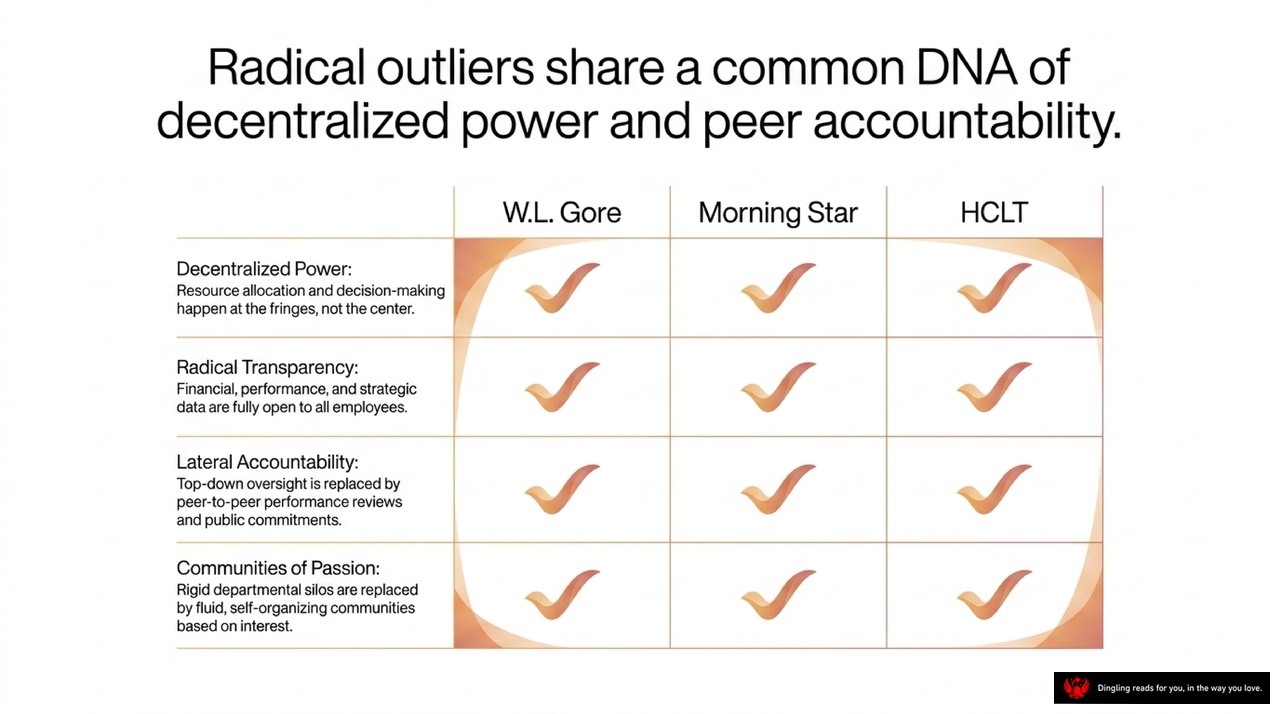
Radical outliers share a common DNA of decentralized power and peer accountability. Look at this chart comparing three powerhouse companies: W.L. Gore, Morning Star, and HCL. Despite their different industries, they all check the exact same four boxes.
First, they practice Decentralized Power. Instead of hoarding decisions at the top, resource allocation and strategy happen right at the fringes, empowering the people doing the actual work. Second, they embrace Radical Transparency. Financials, performance metrics, and strategic data aren't secret; they are fully open to every single employee. Third, they rely on Lateral Accountability. They've replaced top-down oversight with peer-to-peer reviews and public commitments, trusting colleagues to hold each other accountable. Finally, they build Communities of Passion. Rigid departmental silos are gone, replaced by fluid, self-organizing groups based on shared interests.
These aren't just nice-to-have perks; they are the operating systems of high-performance organizations. When you strip away the bureaucracy, you don't lose control—you gain agility, trust, and the ability to innovate at the speed of the market.

Upgrading the management operating system requires new corporate moonshots. Today, we're moving beyond the old industrial playbook to fix the soul and unleash the potential of our organizations.
First, let's talk about **Fixing the Soul**. Too many companies have lost their way, treating people as resources to be managed rather than partners to be inspired. To reverse this, we must ensure management serves a higher, noble purpose beyond mere shareholder wealth. We need to embed deep community and citizenship directly into the corporate structure, making it part of our DNA. And most importantly, we must humanize the language of business—embrace concepts like truth, beauty, and devotion. When we stop speaking only in metrics and start speaking in values, we rebuild the trust that drives real innovation.
Next, it's time to **Unleash Potential**. The old way of working—micromanagement, rigid hierarchies, and fear-based cultures—is killing creativity. We need to eradicate organizational fear and aggressively increase trust to foster genuine risk-taking. Instead of relying on supervisory oversight, we must shift to intrinsic self-discipline, empowering employees to take ownership of their work. Finally, we need to de-choreograph work to permanently blur the lines between duty and play. When we stop treating work as a rigid script and start viewing it as a creative expression, we unlock a level of engagement and productivity that traditional management could never achieve. This is how we build an organization that doesn't just survive change, but thrives on it.

The ultimate goal is distributing power and harmonizing competing objectives.
Let's break down what that actually looks like in practice. On the left, we see **Distributing Power**. This isn't just about letting people go; it's about fundamentally reshaping how an organization works. First, we need to establish natural, fluid hierarchies based strictly on real-time contribution, not legacy titles. Your value should be determined by what you do today, not your title yesterday. Second, we must radically expand the scope of employee autonomy, pushing it all the way to the absolute edges of the organization. Trust your team to make decisions without waiting for permission. And third, shift the definition of leadership itself. Move away from the old idea of commanders giving orders to men, and instead, become architects of collaboration. Your job is to build the system, not to control the people within it.
On the right, the slide highlights **Seeking Harmony & Reinventing Minds**. This is about solving the complex, messy reality where goals often conflict. We need to transcend traditional trade-offs. Instead of choosing between speed and quality, or cost and innovation, provide front-line workers with the data they need to balance competing objectives themselves. Give them the tools to find the balance, not the orders to pick a side. Finally, we must retrain leaders in right-brain thinking. This means moving beyond pure logic and data to embrace systems design, empathy, and creative problem-solving. It's about connecting with people and understanding the bigger picture, not just optimizing a spreadsheet.
When you combine these two sides—distributing power and seeking harmony—you create an organization that is both agile and human. You stop fighting against the system and start designing it with everyone who works in it.
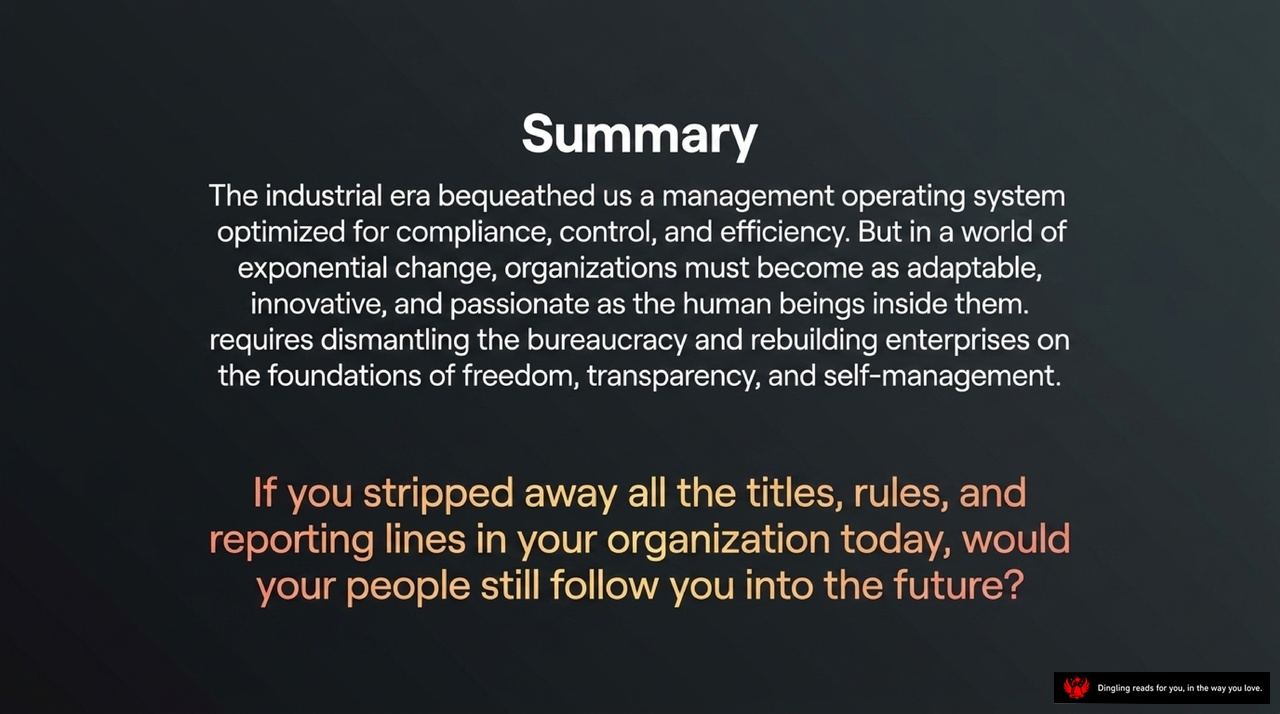
Imagine if you stripped away every title, every rigid rule, and every reporting line in your organization today. Would your people still follow you into the future? This isn't just a hypothetical question; it's the central challenge for any leader navigating our current era.
The summary on this slide captures the core tension we face. The industrial era bequeathed us a management operating system optimized for compliance, control, and efficiency. For a century, this bureaucratic model served us well, prioritizing stability and predictability. But we are no longer in that world. We live in an age of exponential change, where the threats and opportunities evolve faster than any rigid hierarchy can adapt.
In this new reality, organizations must become as adaptable, innovative, and passionate as the human beings inside them. This requires a fundamental shift: dismantling the old bureaucracy and rebuilding enterprises on the foundations of freedom, transparency, and self-management.
Think about the cost of control. When you prioritize strict oversight, you inevitably stifle the very creativity and agility you need to survive. The most successful companies today aren't the ones with the tightest chains of command; they are the ones that trust their employees to act with autonomy and purpose. As we've seen with pioneers like Gore and Morningstar, you don't have to sacrifice efficiency to embrace humanity. In fact, by empowering your team to take ownership, you unlock a level of innovation and resilience that top-down management simply cannot achieve.
So, let's take this challenge seriously. If you removed the structures that have defined management for the last hundred years, would your vision still inspire action? Or would your organization crumble without them? The answer lies in your courage to let go of control and build a culture where people are motivated by shared purpose rather than fear of punishment. That is the only way to build an organization that can truly thrive in the future.