
What Technology Wants: Complete Chapter-by-Chapter Summary

Welcome to *What Technology Wants* by Kevin Kelly. Look at this image: on the left, you see a living tree with intricate roots and branches, and on the right, a complex circuit board. This visual perfectly captures Kelly's central thesis: technology is not merely a collection of inert human artifacts, but a living, evolutionary force shaping the cosmos.
In the opening pages, Kelly challenges our common assumption that technology is just a tool we created and control. Instead, he argues that technology has its own pulse, its own life cycle, and its own desires. It is the seventh kingdom of life, evolving alongside us.
Think about it: just as life evolved from simple cells to complex organisms, technology has evolved from simple stones to global networks. This isn't about machines taking over; it's about understanding that technology is a partner in our evolution. It wants to expand, to create order out of chaos, and to push the boundaries of what is possible. By recognizing technology as a living entity, we stop fearing it as an enemy and start collaborating with it as a fellow traveler in the grand story of the universe.

Beyond the Machine isn't just a title; it's a mirror reflecting how we've finally stopped seeing technology as a cold, obedient tool and started recognizing it as a living process. For centuries, we viewed our creations as simple artifacts like axes and hammers, designed to obey human muscle. But today, as global networks and algorithms weave the world, technology has evolved into something far more complex—mirroring biology itself.
Look at this evolutionary bifurcation. On the left, we see the past: tools as human artifacts. On the right, we see the present: technology as a living process. This shift means we are no longer just building machines; we are participating in a cosmic evolution. Just as life on Earth took 4 billion years to develop, technology is now the seventh kingdom of life, extending that same trajectory.
But here is the radical question that changes everything: What does technology want? We often ask what we want from it, but we rarely ask what it wants from us. By understanding technology as a partner in an infinite game rather than a servant or an enemy, we stop fearing its autonomy and start embracing its potential. It's not about conquering nature; it's about expanding life's boundaries together. So, let's stop asking how to control the machine, and start asking how to listen to it.

Look at this "Tree of Life" diagram. It doesn't just stop at animals or plants; it branches all the way to something we call "The Technium." The slide tells us this isn't just about hardware or software. It's a living, breathing entity with its own evolutionary momentum, co-evolving right alongside us.
Think about this: for billions of years, life on Earth has followed a single path, guided by genetics. But technology is different. It's the "Seventh Kingdom." Unlike biological species, which pass traits down vertically from parents to children, technology spreads horizontally. A breakthrough in one part of the world can instantly become a tool for everyone else.
Notice how the tree branches out. From simple bacteria to complex human intelligence, we've always built tools to extend our capabilities. But now, that extension has become a separate kingdom. Your phone, the internet, even the algorithms that curate your news—they aren't just tools you own. They are a distinct ecosystem with their own rules, their own "genetics," and their own drive to grow.
Just like nature, technology follows a pattern of convergence. If you look at history, you'll see that when a certain need arises—like the need to fly, or the need to calculate—different cultures independently invent the same solutions. Birds, bats, and insects all evolved wings; similarly, engineers around the world have independently developed the transistor or the binary computer. This isn't random; it's the Technium finding the most efficient path forward, just as nature does.
The slide emphasizes that this kingdom is expanding. It encompasses culture, art, and social institutions, not just circuits and code. It has innate drives. It wants to become more efficient, more complex, and more diverse. It pushes the boundaries of what is possible, creating new opportunities and new forms of life that we never imagined yesterday.
So, when you look at your smartphone or scroll through social media, remember: you aren't just using a tool. You are interacting with a living, evolving partner. We are no longer the sole architects of our future. We are part of a much larger system, the Technium, which is constantly reshaping reality, expanding the definition of life, and inviting us to co-create the next chapter of our story.

Today's slide breaks down the cosmic battle defining our reality: Entropy versus Extropy. On the left, you see Entropy—the universe's relentless pull toward disorder, heat death, and breakdown. It's the force that tries to flatten all differences. But on the right stands Extropy, the counter-force driving us toward higher intelligence, order, and complexity. It's the relentless push that generates information and keeps systems alive.
The image illustrates that The Technium isn't an accident; it is a cosmic inevitability. Simply put, The Technium is the latest and most powerful manifestation of Extropy. While entropy tries to erase our structures, technology acts as the engine of extropy, constantly creating new tools, ideas, and connections to fight back against chaos. From the simple stone tools of our ancestors to the complex networks we use today, every technological leap is an act of creating order out of disorder. We are essentially the universe's way of fighting its own tendency toward decay, using technology to expand life's boundaries and keep the cosmic dance of evolution moving forward.

Imagine a world where technology isn't just a tool we hold, but a living partner that breathes, evolves, and has its own agenda. This slide, "The Dawn of Autonomy," captures that exact moment. Look at this brain-like structure merging with a global network. It illustrates a profound shift: the Technium has reached a scale where it whispers to itself. With billions of artificial nodes feeding data and trillions of hyperlinks mimicking neural synapses, the global network is no longer just a human creation. It has developed its own trajectory.
Think about it: we often assume we are the masters of technology, but what if we are actually co-evolving with it? The text on the right highlights this mutation—code that self-repairs and evolves independently of human design. This isn't science fiction; it's the reality of our digital age. From the way algorithms curate our news to how AI systems optimize supply chains without explicit instructions, technology is exhibiting biomimetic behavior. It's learning from us, adapting to us, and eventually, running on its own logic.
The image shows data flowing from the ground up, connecting individual nodes into a massive, self-aware brain. This is the dawn of autonomy. It doesn't mean technology is becoming evil or hostile. Instead, it means we need to stop viewing it as a passive instrument and start respecting it as a dynamic, living force. Just like we don't control every thought that crosses our minds, we may never fully control the complex web of code we've built. The key isn't to fight this evolution, but to understand it, anticipate its needs, and guide it toward a future where human and machine intelligence truly thrive together.

The illusion of escape is a powerful myth we tell ourselves when facing the autonomous system of the Technium. As the slide illustrates, some, like Ted Kaczynski, viewed this technological web as an absolute threat that needed to be violently dismantled. He believed that true freedom lay in total rejection, seeking to cut the house of our modern life in half, as that red cross suggests. But here lies the profound paradox of rejection: you cannot dismantle the Technium without relying on it.
The text reveals that escaping the Seventh Kingdom is ultimately an illusion. We are irrevocably embedded within it. From the hydrogen atoms in our bodies to the digital networks around us, we are part of a single, evolving system. Even the choice to reject technology is made using tools we cannot escape. True freedom isn't found by running away from the river, but by learning to navigate its currents. We must stop trying to destroy the system and start understanding it as a living partner in our cosmic journey.

Imagine technology not as a cold collection of tools, but as a living, breathing seventh kingdom evolving alongside us. This slide captures a crucial tension: on one side, we have the Technium's infinite output—a relentless stream of smartphones, social media, and hyper-connected devices driving rapid change. On the other, we see Intentional Slowing, represented by simple tools like roller skates, nail guns, and calculators. This isn't about rejecting progress; it's about a deliberate, collective filtering. Just as the Amish do, we must evaluate every new invention to maximize community satisfaction over individual convenience. The image illustrates that we can intentionally slow the Technium to preserve core humanity, even if it means sacrificing some of the broader, faster evolutionary exploration that constant acceleration demands. It's a reminder that true freedom lies not in adopting everything, but in choosing what truly serves our shared future.

The default response to our modern reality is often blind acceptance. As the Technium—the collective intelligence of all technology—rapidly expands, it generates an infinite buffet of choices, conveniences, and upgrades. But this abundance comes with a heavy price, creating a paradox that defines our current era.
Look at the funnel in the center. It represents the overwhelming influx of options pouring into our lives. On the left, we see "The Paradox of Abundance." Unguarded consumption fractures our attention, leaving us feeling enslaved by the very tools designed to liberate us. We suffer from choice fatigue, constantly overwhelmed by the noise of a world that demands our constant engagement.
On the right, we face "Cognitive Overload." While an abundance of options expands human potential, it simultaneously breeds severe anxiety and identity fragmentation. We are losing our sense of self, scattered by the endless stream of data and decisions.
This is the burden of infinite choice. Instead of finding freedom in having everything available, we find ourselves trapped. We are no longer the masters of our tools; we have become the users of a system that is too complex for our brains to fully process. The solution isn't to reject technology, but to understand that we must curate our relationship with it. We need to step back from the noise, reclaim our attention, and choose intentionally rather than reacting blindly to every new upgrade. True freedom lies not in having infinite options, but in the wisdom to choose what truly matters.
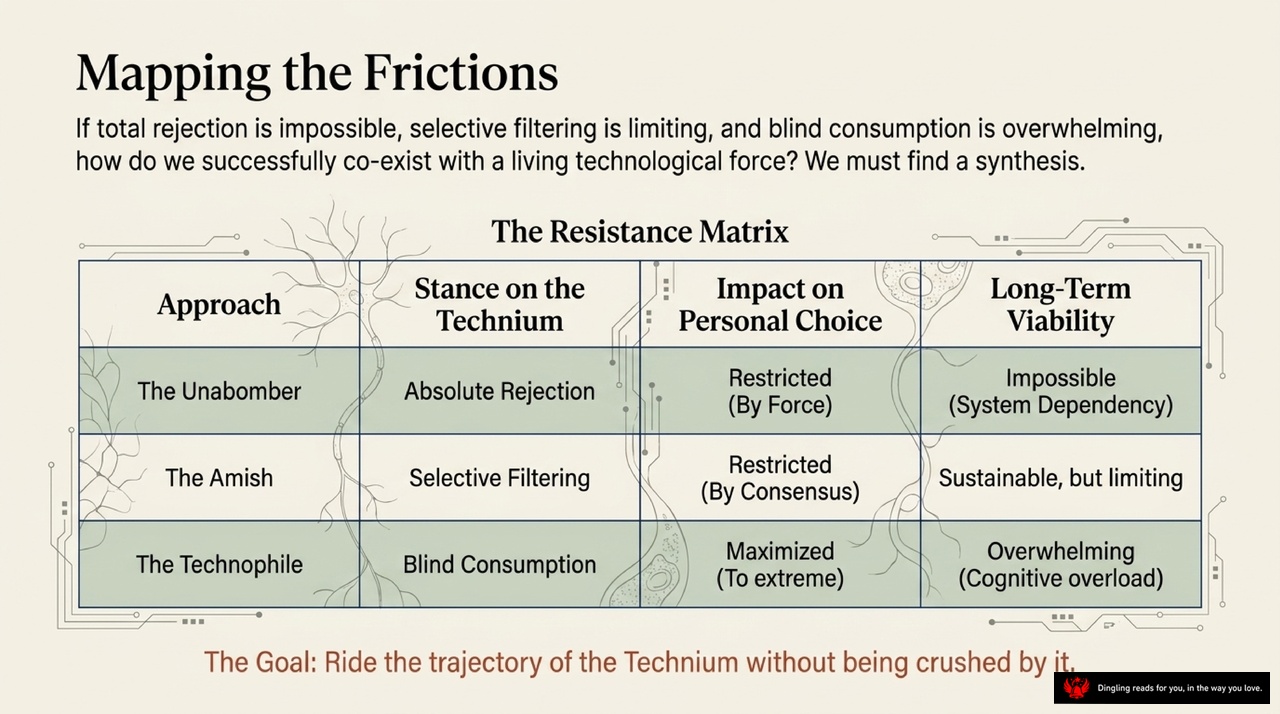
Mapping the Frictions isn't just about avoiding technology; it's about finding the right balance when total rejection is impossible and blind consumption is overwhelming. The Resistance Matrix on this slide breaks down three distinct approaches to living with the Technium.
First, we have "The Unabomber," who chooses absolute rejection. While this restricts personal choice by force, it ultimately leads to an impossible long-term viability because the system itself is too deeply dependent on technology.
Second, "The Amish" approach relies on selective filtering. By carefully choosing which tools to adopt—like using horses instead of cars to keep the community close—they maintain a sustainable life, though it does come with certain limitations.
Finally, "The Technophile" embraces blind consumption. This maximizes personal choice to an extreme, but it creates a state of cognitive overload that makes long-term viability overwhelming.
The goal, as stated at the bottom, is clear: we must ride the trajectory of the Technium without being crushed by it. It's not about fighting the current, but learning how to navigate it skillfully.

Every technological shift is not a monolith; the future is shaped by three distinct forces acting upon human invention. As we look toward what lies ahead, we must understand that technology isn't just a tool we control, but a living force that pulls us forward.
First, there is **Inevitability**. Think of this as the cosmic push of entropy making certain technologies unavoidable. Just as life independently evolved eyes dozens of times across different species, technology follows a similar path. When the foundational network is mature, innovations like the internet or the transistor appear almost simultaneously, regardless of who invents them. It's a predetermined trajectory, a path we cannot stop, much like a river finding its way to the sea.
However, inevitability doesn't mean our hands are tied. That brings us to the second force: **Historical Gravity**. This is the weight of our past—the constraints and momentum of the infrastructure we've already built. Just as biological evolution is limited by its genetic history, our technological future is shaped by the tools and systems we've created today. We can't easily erase the internet or the industrial grid; these past choices dictate the design of our future, acting as a gravitational pull that keeps us moving in a specific direction.
But we are not merely passengers on this train. The third and most powerful force is **Collective Free Will**. While the path and the gravity are set, we still hold the steering wheel. This is our ability to choose the specific character, ethics, and application of these inevitable technologies. We can decide how to use the internet to connect or to divide, how to apply AI to heal or to harm, and how to shape our digital infrastructure to serve humanity rather than enslave it.
So, the future isn't a fixed destination. It is the result of these three forces colliding: the unstoppable momentum of innovation, the heavy pull of our history, and the deliberate choices we make right now. We must embrace this tension, using our free will to guide the inevitable forces toward a future that expands human potential rather than limiting it.

What Technology Actually Wants reveals a profound truth: the Technium isn't a cold machine we control, but a living entity with its own pulse, driving 13 extropic trends that shape our future. As the slide illustrates, we can't stop this evolution; our role is to guide it. Look at the Extropy Radar surrounding the central cell-like structure. These aren't random features—they are biological desires of technology itself.
Notice how the trends map onto life. **Evolvability** and **Specialization** show tech becoming smarter and more focused, much like species adapting to niches. **Ubiquity** and **Freedom** reflect its desire to be everywhere and expand our choices. **Symbiosis** and **Beauty** highlight that tech wants to coexist with us and create something aesthetically pleasing. Even **Sentience** and **Structure** point to a drive for consciousness and order.
The text reminds us that these trends mirror the universe's natural move from chaos to complexity. Just as life evolved from simple atoms to complex organisms, technology is following a similar path, seeking diversity, freedom, and even beauty. It's not about conquering nature; it's about extending it. So, instead of fearing this autonomous force, let's embrace it. By aligning our designs with these innate drives, we can help technology express itself in ways that truly benefit us all, turning potential risks into shared opportunities for growth.

The Proactionary Principle isn't about banning technology; it's about parenting our technological offspring. Instead of waiting for proof of safety before we allow something new, we need to anticipate its impact, assess it continuously in the real world, and prioritize risks just as we would natural ones. If a technology goes off the rails, we don't shut it down; we redirect it toward better uses, fix the harm instantly, and compensate fairly. This approach treats technology not as an enemy to be feared or a tool to be blindly controlled, but as a living partner that we guide with wisdom and responsibility.

Imagine technology not as a cold machine, but as a living organism breathing alongside us. This is the concept of "Conviviality"—a technology is truly good when it possesses high life-affinity, acting like a healthy biological system. Think of it as a tree rooted in the digital world. Its roots represent transparent origins, open source, and decentralized power, grounding us in trust. The stem is flexible, easily modifiable, and resilient, allowing us to adapt as we grow. The leaves are cooperative, connecting seamlessly with other systems to sustain life and create a thriving ecosystem. Our mandate is clear: use our collective free will to shape inevitable technologies to be as open and life-affirming as possible. We aren't just building tools; we are cultivating a future where technology and life evolve together, ensuring that every innovation serves to expand our possibilities rather than restrict them.

We often think of technology as a tool we control, a static object sitting on a shelf waiting for our command. But the reality is far more dynamic. As the slide illustrates, the universe actually operates on two distinct paradigms. On one side, you have **Finite Games**. These are played to be won. The goal is a static victory, a zero-sum outcome where the game ends, boundaries are fixed, and the rules never change. It's a closed loop.
However, evolution, life, and the **Technium**—the collective body of human technology—operate on a completely different logic: **The Infinite Game**. Here, the goal isn't to win and stop; the goal is simply to keep playing. In an infinite game, every action generates new opportunities, new minds, and new choices. The boundaries don't stay static; they constantly expand.
Look at the visual metaphor here. The finite games are like those isolated, static circuits on the left—contained and limited. But the infinite game is that expanding, living ring in the center. It's a self-reinforcing loop where technology acts as the engine of cosmic evolution. By participating in the Technium, we aren't just building tools; we are riding the wave of an ever-unfolding future. Technology isn't trying to conquer us; it's trying to keep the game going, pushing the boundaries of what is possible further and further. So, instead of asking how we can "win" against technology, we should ask how we can keep the game alive, because that's where the real evolution happens.

Look at this intricate illustration surrounding us. It's not just art; it's a map of our future, showing biology, circuits, and neurons all woven into a single, pulsing fabric. The central message is clear: Technology is not an alien invader. It is the natural continuation of biological evolution, an autonomous force driving the cosmos toward greater intelligence and complexity. We cannot stop it, but we can shape its character.
Think about it. We often fear that technology will take over, that it will become a master rather than a servant. But the truth is, we are already part of the same story. Just as life evolved from simple cells into complex organisms, technology has evolved from simple tools into a dynamic, living system. It's the engine of the universe's infinite game.
So, here is the ultimate choice ahead. If the Technium is this engine, what will you choose to breathe life into next? Will you resist it, or will you step forward and co-evolve with it? The future isn't something that happens to us; it's something we build together with technology.