


A must-read.
Your Review
A must-read.


I found the Amish "presumptive rejection" model inspiring for deciding if new gadgets truly align with my core values before buying them.

Kelly explains how fire changed our biology and brains.

Interesting idea that tech acts like a living system evolving alongside us, though I still worry about losing control.

Kelly explains how efficiency drives diversity, symbiosis, and autonomy without sounding like a robot.

Kelly's story about the Amish choosing tech carefully based on values gives me a clear model for my own life choices.

The four trends of efficiency, diversity, symbiosis, and autonomy provide a practical framework for navigating future tech changes in my career.

Great idea that tech wants to evolve like living things.

The contrast between Kaczynski's fear and Kelly's view on human agency clarifies why total tech rejection is impractical and unnecessary for most people today.

Tech is a co-evolving partner, not an enemy.

Kelly explains that efficiency drives diversity, which creates symbiosis between humans and tools, eventually granting systems autonomy to handle routine tasks so we can focus on creativity and connection instead of just survival or control, making us feel less like masters and more like co-evolving partners in an infinite game where technology expands life's possibilities rather than replacing us, which changes how I view my daily gadgets from intrusive devices to essential extensions of my own capabilities that I can guide with intentionality to align with my values.

Kelly explains how stone tools started our co-evolution with tech. This changes how I see ancient history and my own daily tools. The feedback loop between smarter brains and better tools feels real, not just theory. It makes me think about how smartphones now shape my thoughts just like those tools shaped ancestors.

Kelly's concept of exotropy really changed how I see technology not as a tool but as a living partner evolving with us.

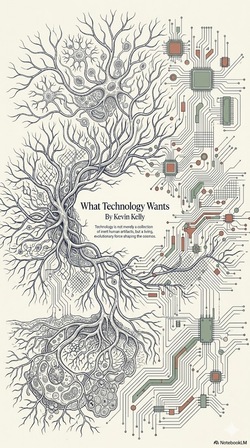
Kelly frames technology as a living seventh kingdom driven by exotropy, arguing that tools like fire and language co-evolved with us to expand our biology and collective intelligence rather than just serving as passive instruments for human control.

Understanding convergence and synchronous invention helps me see why certain tech breakthroughs happen globally at the same time almost inevitably.

Seeing technology as an infinite game partner instead of an enemy to control shifts my mindset from fear to curiosity about its potential.

I love how the book shows tech expanding human capabilities rather than just replacing us.

Kelly explains how efficiency drives diversity, which then creates symbiosis and autonomy, showing that tech evolution follows predictable patterns rather than random chance.

Kelly reframes tech as a living partner evolving alongside us, making the complex idea of exotropy feel surprisingly relatable and hopeful for our future.

The Amish choice to reject cars but accept solar panels clarified my own confusing tech habits perfectly.