
When We Cease to Understand the World: Complete Chapter-by-Chapter Summary
Welcome to the edge of human understanding. Today, we're stepping into a world where discovery doesn't just build our modern life—it shatters the very limits of what we can comprehend.
The book *When We Cease to Understand the World* by Benjamín Labatut takes us on a terrifying journey to that frontier. It explores how human genius creates the modern world while simultaneously breaking the bounds of our comprehension. We will see how a simple accident in a 18th-century paint shop gave birth to Prussian Blue, a color that changed art forever. We'll witness how a chemist's desperate flight from a pollen allergy led to the birth of matrix mechanics, rewriting the laws of physics. We'll travel to a war-trench where a soldier calculated the first exact solution to Einstein's equations, only to be consumed by a mathematical monster he called a singularity. And we'll meet the mathematician who tried to solve the deepest riddle of numbers with a theory so abstract it sounds like science fiction.
From the accidental discovery of cyanide to the invention of the Haber-Bosch process that feeds billions but also prolonged a devastating war, from the birth of quantum mechanics to the philosophical crisis it created, this book shows us that the most profound truths often hide in the most chaotic places. It's a story about the double-edged sword of science: the power to heal and the capacity to destroy.
As we begin, ask yourself: how much of the world do we truly understand? Or are we just watching the shadows dance on the wall of our own ignorance? Let's dive in.

The 20th century witnessed the greatest explosion of scientific discovery in human history, yet at the furthest frontiers of chemistry, astrophysics, mathematics, and quantum mechanics, scientists encountered an abyss. As the slide illustrates, the closer we get to the absolute truth of reality, the less the world makes sense.
This paradox is rooted in the very foundation of modern science. In the early 19th century, chemistry was still entangled with alchemy, a discipline obsessed with turning base metals into gold. It was in this chaotic, mystical environment that the first true synthetic pigment was born. In 1782, a Swiss pigment merchant named Johann Jacob Diesbach accidentally created Prussian Blue. He intended to replicate expensive red dye but, through a mixture of animal distillate and potash, stumbled upon a vibrant, stable blue. This discovery broke the monopoly of natural lapis lazuli, making blue accessible to artists everywhere and democratizing art.
However, this same drive for synthesis led to darker consequences. The very chemical process that created Prussian Blue also produced Prussian Acid, or cyanide. Later, Fritz Haber, the father of the Haber-Bosch process which saved billions from famine, weaponized nitrogen fixation to prolong World War I. He also developed chlorine gas, unleashing a nightmare in the trenches of Ypres that killed thousands instantly. The same chemistry that built our world also contained the seeds of its destruction.
Even our understanding of space has fallen into this abyss. In 1916, while fighting in the trenches of World War I, Karl Schwarzschild derived the first exact solution to Einstein's equations of general relativity. His math predicted a "singularity"—a point where space and time tear apart, density becomes infinite, and nothing can escape. This concept, now known as a black hole, was initially seen by Schwarzschild as a mathematical monster, a logical error. Yet, it turned out to be a profound truth about the universe. He died of syphilis before his work was fully recognized, haunted by the idea that his equations described a terrifying void that swallowed reality itself.
Finally, consider the birth of quantum mechanics. Scientists like Heisenberg and Schrödinger were trying to describe the subatomic world, only to find that their equations defied all common sense. Electrons do not orbit like planets; they exist as probability clouds. The act of observation itself collapses possibilities into reality. As the slide suggests, the closer we look at the fundamental nature of things, the less intuitive the world becomes. We have traded the certainty of Newton's clockwork universe for a realm of uncertainty, superposition, and observer-dependent reality.
We have pushed the boundaries of knowledge further than ever before, but in doing so, we have discovered that the deeper we dig, the more elusive the truth becomes. The paradox of discovery is that the more we know, the more we realize how little we truly understand.
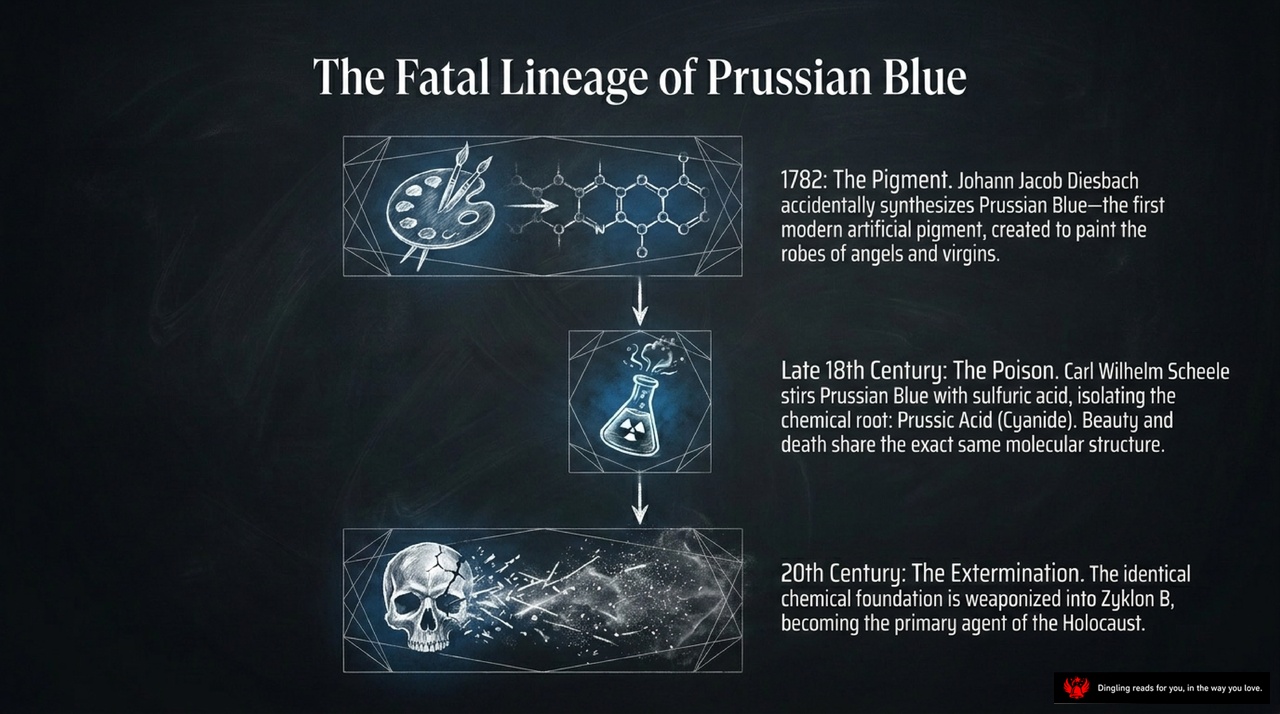
The Fatal Lineage of Prussian Blue starts as a story of artistic triumph but ends in a nightmare of industrial horror. It begins in 1782 when Johann Jacob Diesbach accidentally creates the first modern synthetic pigment, Prussian Blue, intended to paint the robes of angels and virgins. This vibrant blue broke the monopoly of expensive natural lapis lazuli, making deep blue accessible to artists everywhere.
However, the same chemical structure that gave art its beauty also hid a deadly secret. In the late 18th century, Carl Wilhelm Scheele isolated Prussic Acid—cyanide—from the pigment itself. Beauty and death shared the exact same molecular structure. This duality reached its darkest peak in the 20th century when that identical chemical foundation was weaponized into Zyklon B, becoming the primary agent of the Holocaust. From the palette of Renaissance masters to the gas chambers of the Nazi regime, the lineage of Prussian Blue reveals how a single chemical formula can shape both our greatest cultural achievements and our most profound tragedies.
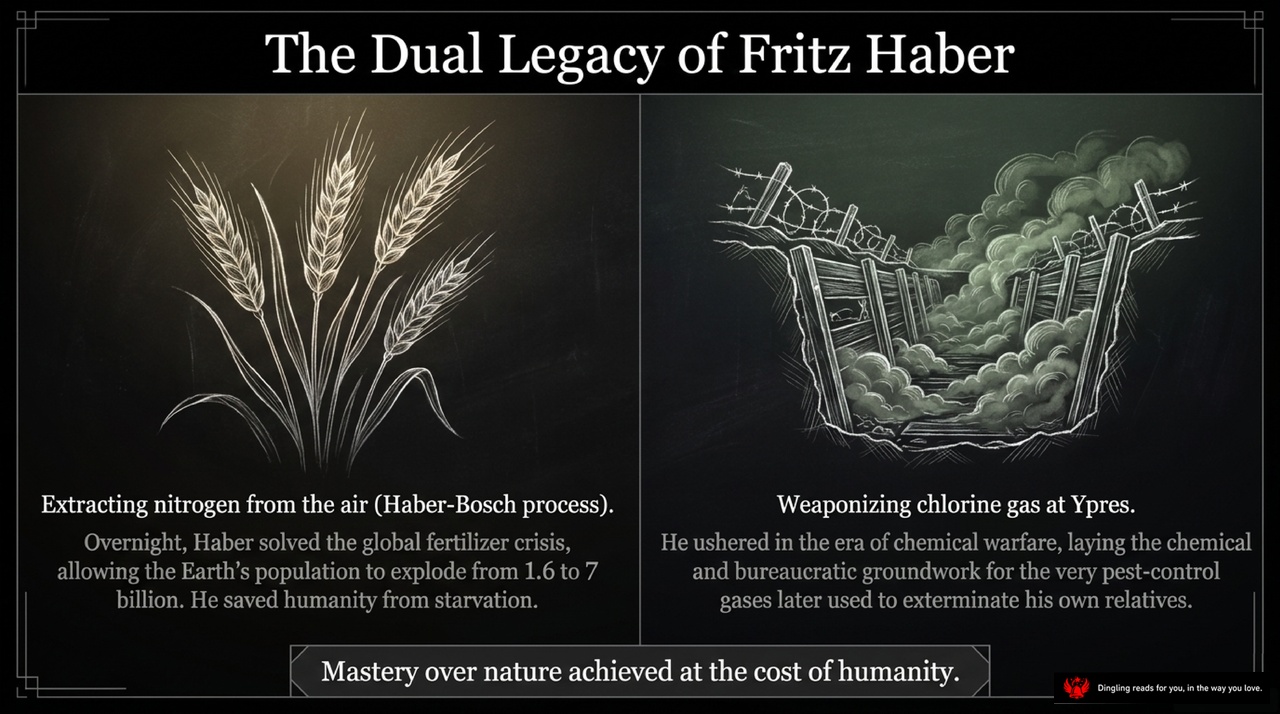
Look at this slide, "The Dual Legacy of Fritz Haber." It captures a profound paradox that defines much of modern science: the same mastery over nature that saves millions can also destroy them.
On the left, we see wheat. This represents the Haber-Bosch process, which allowed us to extract nitrogen from the air to create fertilizer. Overnight, this breakthrough solved a global crisis, enabling the Earth's population to explode from 1.6 billion to over 7 billion. It literally saved humanity from starvation.
But look to the right. The image shifts to a trench filled with toxic gas. This is the weaponization of chlorine at Ypres during World War I. Haber, the same man who fed the world, designed the very chemical warfare that ushered in the era of modern destruction. He laid the groundwork for the gases later used to exterminate his own relatives.
The slide's final line drives the point home: "Mastery over nature achieved at the cost of humanity." It reminds us that science itself is neutral, but its application is not. The tools we build to protect us can easily become the weapons that end us.
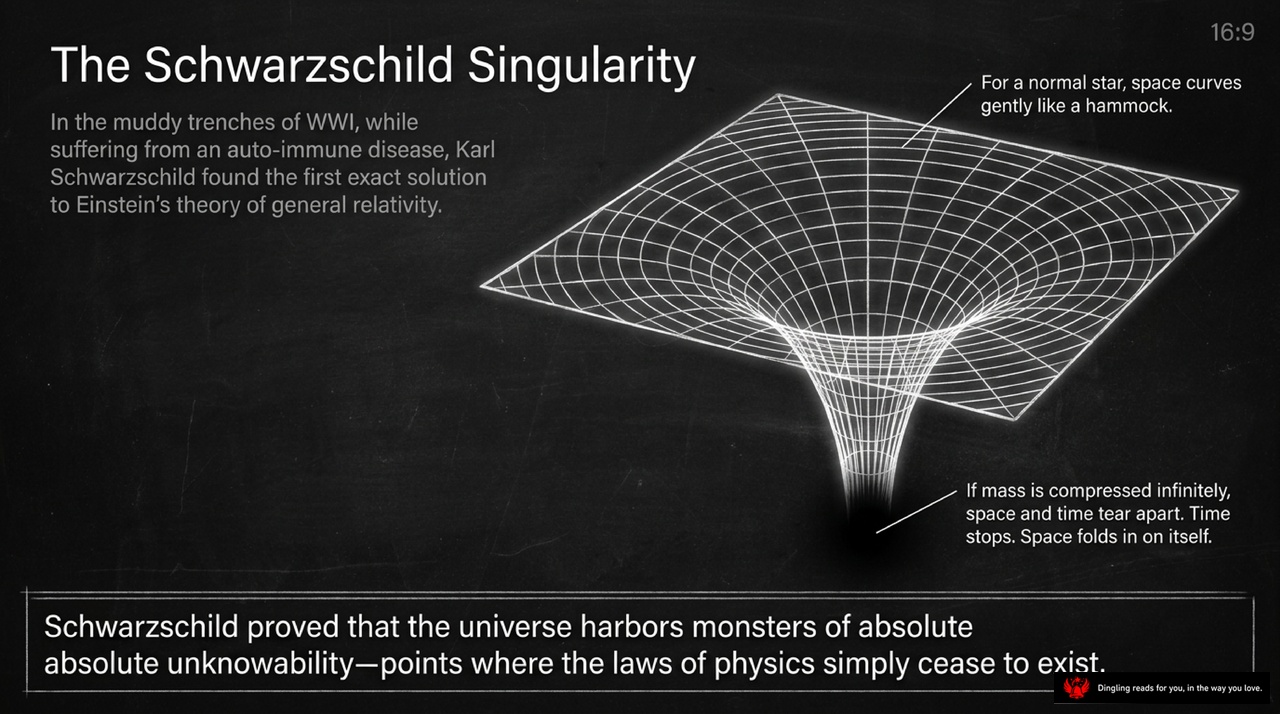
Welcome to the final chapter of our journey. Today, we look at the ultimate boundary of human knowledge.
On the left, you see a stark definition: the Schwarzschild Singularity. This isn't just a math problem; it is a point where the laws of physics simply cease to exist. In the muddy trenches of WWI, while suffering from a painful autoimmune disease, Karl Schwarzschild found the first exact solution to Einstein's theory of general relativity. He proved that the universe harbors monsters of absolute unknowability.
Look at the visualization on the right. For a normal star, space curves gently like a hammock. But if mass is compressed infinitely, space and time tear apart. Time stops, and space folds in on itself. This is the singularity—a place where density becomes infinite and our familiar concepts of space and time lose all meaning.
This terrifying reality haunted Schwarzschild until his death. He knew that once you cross this "point of no return," you are forever cut off from the rest of the universe. He spent his final days battling this phantom, realizing that even the most brilliant human mind cannot fully comprehend the abyss it has created.
Science has pushed us to the edge, only to reveal that the deeper we look, the more we realize there are things we can never know.

Mathematics and the Plunge into Madness. Look at this image. It depicts a terrifying spiral, a visual representation of what happens when the mind tries to grasp the absolute foundation of logic. The text on the left tells us that mathematicians like Alexander Grothendieck sought the "Heart of the Heart"—the ultimate, unifying root of all numerical concepts. By pulling back to an extreme level of abstraction, they sought the hidden architecture of reality. But the text on the right reveals the tragic cost of this pursuit. Peering into the absolute foundation of logic proved psychologically catastrophic. To touch the ultimate truth was to encounter something so terrifyingly vast that it drove Grothendieck into total isolation and paranoia. The central image, a swirling vortex of chaos, captures this descent. As we push further inward toward absolute understanding, we are forced to abandon human society entirely. The logic is inescapable: the deeper you dig into the pure structure of the universe, the more disconnected you become from the messy, comforting reality of people. This slide illustrates the dark side of genius, where the quest for perfect knowledge becomes a prison of madness, proving that sometimes, the truth is too heavy for a human mind to carry alone.

So, if you're not profoundly shocked by quantum mechanics, you haven't really understood it. That's the famous warning from Niels Bohr, delivered during the intense ideological battles of the 1927 Solvay Conference. Think about that for a moment: in a world where we usually rely on cause and effect, where a ball always rolls down a hill, quantum mechanics suggests that reality itself is far stranger than we ever imagined. It's a realm where particles can exist in multiple states at once, where observation changes the outcome, and where the very fabric of logic seems to fracture under the weight of the unknown.
This slide captures the essence of that shift. The Solvay Conference wasn't just a meeting; it was the battlefield where the old rules of physics collided with the new, terrifying reality of the quantum world. Figures like Einstein, Bohr, and Heisenberg stood face-to-face, arguing over whether the universe was a clockwork machine or a game of chance. They debated whether reality existed independently of us or if it was created the moment we looked at it. It was a clash that permanently altered our understanding of what it means to be real.
The text at the bottom reminds us that this wasn't just a scientific debate; it was a fracture in human logic. We spent centuries building a worldview based on certainty and predictability. But quantum mechanics forced us to accept that at the deepest level, the universe is probabilistic, fluid, and often incomprehensible. It challenged the very nature of reality, showing us that our intuition, our common sense, and our classical definitions of space and time are simply not enough to describe the true workings of the cosmos.
So, the next time you look at the world, try to let go of the need for absolute certainty. Embrace the shock. Because as Bohr so wisely put it, if that strange, unsettling feeling doesn't hit you, it's likely because you're still viewing the universe through the lens of the old world, rather than seeing it as it truly is.

The slide before us captures a pivotal moment in the history of physics: "The Battle for the Subatomic Soul." It contrasts two titans, Erwin Schrödinger and Werner Heisenberg, who were locked in a fierce intellectual duel over how to describe the invisible world of atoms.
On the left, we see Schrödinger's approach, represented by a smooth, flowing wave. His framework was Wave Mechanics. He envisioned the electron not as a chaotic speck, but as a continuous, elegant wave bound by classical determinism. To him, reality could be visualized, mapped, and understood intuitively, much like the familiar waves of water or sound. He believed that if we just used the right equations, we could see the subatomic world with our minds' eye.
On the right stands Werner Heisenberg, symbolized by a grid of numbers—a matrix. His framework was Matrix Mechanics. He saw the electron as a statistical probability, defined by discrete, erratic jumps rather than smooth curves. For Heisenberg, reality could not be visualized; it was pure abstraction, accessible only through blind mathematics. He argued that trying to picture an atom was like trying to understand a dream by drawing a map of it; the act of looking changes the dream itself.
This wasn't just a math problem; it was a clash of philosophies. Schrödinger wanted to save our intuition, to keep physics feeling like a description of a real, tangible world. Heisenberg insisted that our old intuition was broken at the atomic level and needed to be discarded entirely. As we'll see, this battle would force us to accept a universe that is fundamentally uncertain, where observation itself shapes reality.

Imagine you are looking at a particle through a microscope, trying to pin down exactly where it is. But here is the mind-bending truth: the moment you focus your eyes on its position, you violently blur its momentum. You can't know both with perfect precision at the same time. This isn't a flaw in our tools; it's a fundamental law of nature.
As the slide illustrates, the act of observation actually alters the reality being observed. We are forbidden from knowing everything about a particle. When we bring its location into sharp focus, its trajectory disappears into chaos. We do not see the universe as it truly is; we only see our own interaction with it.
Formulated by Heisenberg on the barren island of Heligoland, this Uncertainty Principle proves a structural defect in human perception. It shatters the idea of a predictable, clockwork universe. Instead, it reveals a world where certainty is an illusion, and the very act of looking changes what we are looking at. This is the absolute limit of knowledge.

For centuries, physics operated on the assumption of a "clockwork universe"—a rigid, predictable machine where every effect had a single, definite cause. If you knew the position and speed of every particle, you could theoretically predict the entire future. But the Copenhagen Interpretation shattered this comforting illusion.
As the slide illustrates, the fundamental shift is from **Cause** to **Probabilities**. In the old view, a box leads inevitably to a specific result. In the quantum world, that same box explodes into a chaotic cloud of possibilities. Niels Bohr and Werner Heisenberg argued that at the core of reality, the universe does not follow a strict chain of cause and effect. Instead, the atom is not a miniature solar system with predictable orbits; it is a realm of pure chance. Particles do not exist in a definitive state until they are measured.
This means the foundational layer of reality is not order; it is randomness. Before observation, a particle exists as a wave of probabilities, only collapsing into a single, concrete reality when we look at it. This isn't just a lack of data; it is an intrinsic feature of nature. We have moved from a world of certainty to a world where uncertainty is the only absolute truth.
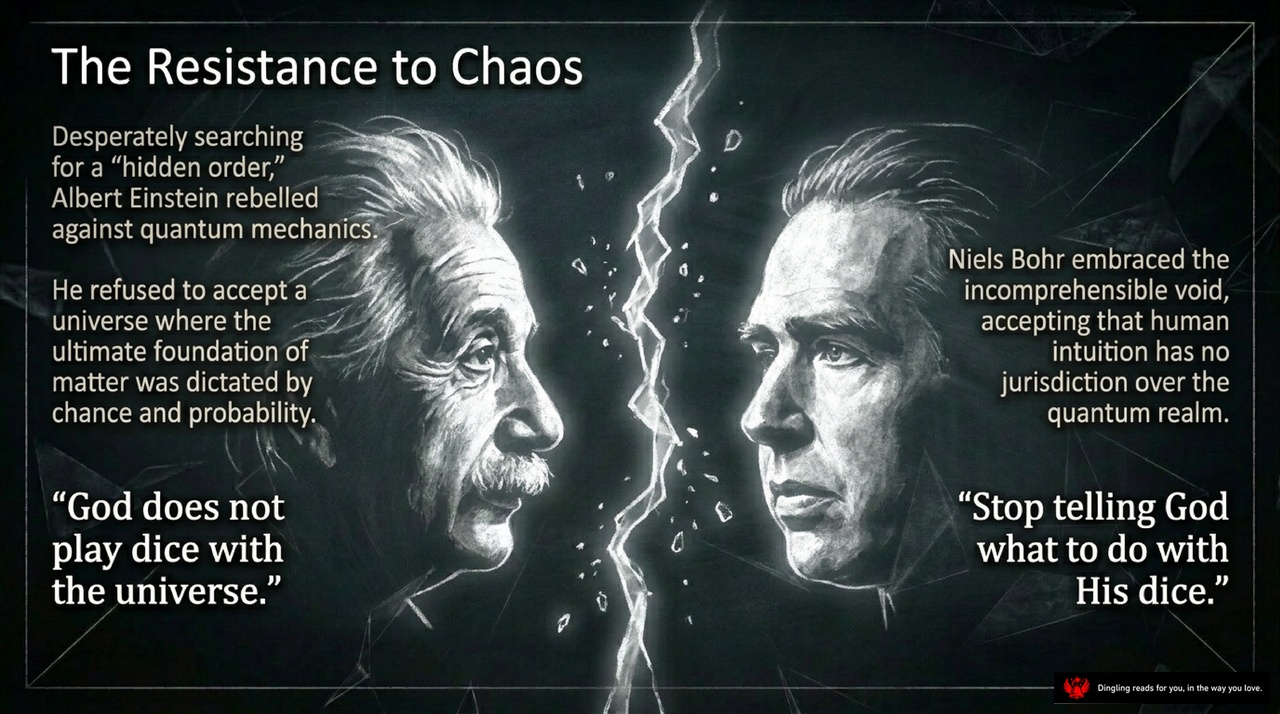
Imagine two giants staring across a chasm, separated not by distance, but by a fundamental disagreement about the nature of reality. On the left stands Albert Einstein, the man who mapped the fabric of space and time, yet here, he looks troubled. He is desperately searching for a "hidden order," refusing to accept a universe where the very foundation of matter is dictated by chance and probability. To him, the idea that the ultimate rules of the cosmos could be reduced to randomness felt like an insult to logic itself. His famous declaration, "God does not play dice with the universe," captures this deep-seated rebellion against quantum mechanics. He believed there was a deeper, deterministic script behind the chaos that we simply hadn't discovered yet.
On the other side of that lightning bolt stands Niels Bohr. While Einstein saw the void as a sign of incomplete knowledge, Bohr embraced it. He accepted the "incomprehensible void" of the quantum realm, acknowledging that human intuition simply has no jurisdiction there. To Bohr, nature wasn't a clockwork mechanism waiting to be understood, but a probabilistic dance that we must learn to accept as it is. His retort to Einstein is equally powerful: "Stop telling God what to do with His dice."
This image perfectly encapsulates the great divide of the 20th century. It wasn't just a scientific debate; it was a clash between the desire for absolute certainty and the acceptance of inherent uncertainty. Einstein wanted a predictable, logical universe where every effect had a precise cause. Bohr argued that at the most fundamental level, reality itself is fluid, defined by the act of observation and governed by probabilities rather than certainties. One side feared the chaos of the unknown; the other found freedom in it. Their disagreement forced physics to evolve, pushing us to accept that the universe is far stranger and more mysterious than our everyday experiences could ever prepare us for.
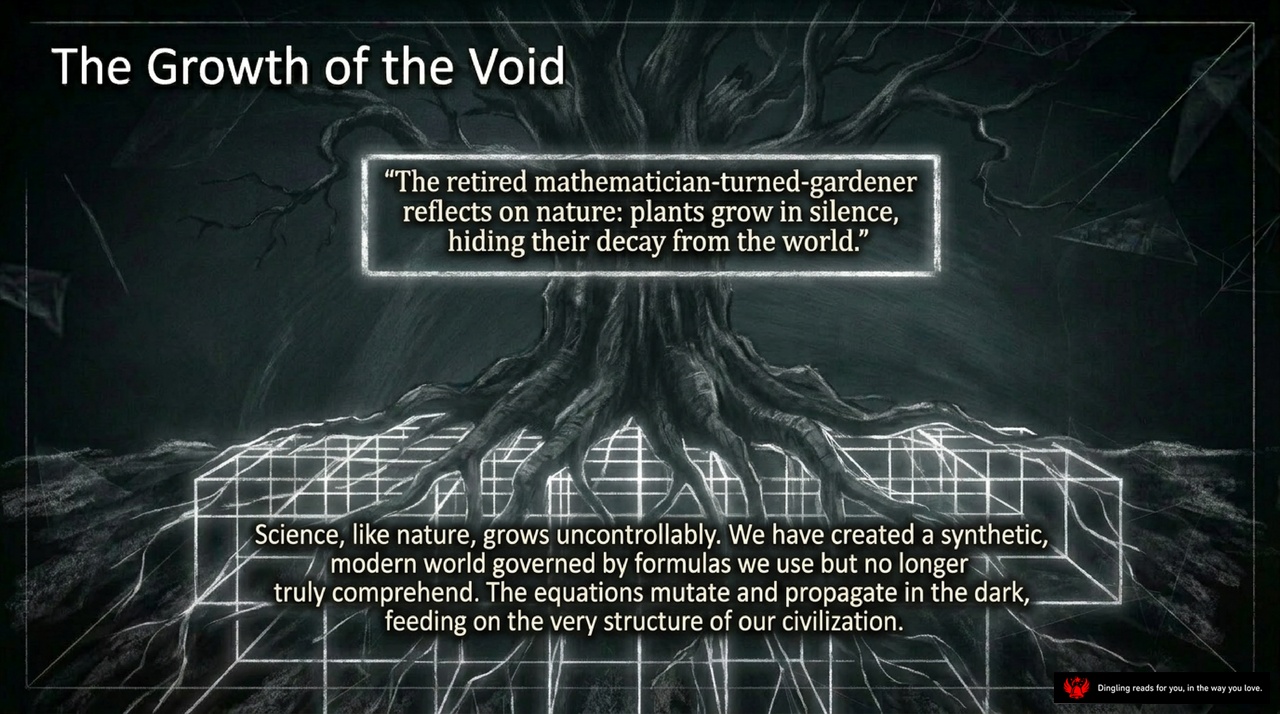
The Growth of the Void. Look at this image. It depicts a tree where the roots are not organic soil, but a cold, geometric grid. This visual perfectly captures a haunting idea from our book: Science, like nature, grows uncontrollably. We have built a synthetic, modern world governed by formulas we use but no longer truly comprehend.
The text reminds us that equations mutate and propagate in the dark, feeding on the very structure of our civilization. It's a powerful metaphor. Just as the tree in the image hides its decay and growth in silence, our scientific advancements often operate in the shadows of our understanding. We create these complex systems, these "synthetic worlds," and they expand beyond our control, becoming a force that shapes us rather than us shaping them.
This slide isn't just about math; it's about the hidden cost of progress. It suggests that our reliance on these invisible equations has created a void—a gap between what we do and what we understand. That void is where the real power, and perhaps the real danger, lies. We are living inside a system we designed, but one that is now growing on its own terms.

Look at this slide, "The Toll of Absolute Truth." It presents a haunting parallel: for every monumental breakthrough in human history, there is a staggering, often tragic cost.
Take Fritz Haber. He mastered nature's chemistry, inventing the Haber-Bosch process that synthesized nitrogen from the air. This single discovery allowed us to feed billions of people, effectively ending global famine. But the cost? He engineered the tools for mass extermination. The very chemistry that saved lives was repurposed to create mustard gas and poison gas, prolonging World War I and enabling the Holocaust.
Then there is Karl Schwarzschild. He discovered the cosmic singularity—the mathematical heart of a black hole. Yet, the cost was his own physical and psychological decay. While calculating these equations in the trenches of WWI, he was consumed by the terrifying reality of the "point of no return," eventually dying of pemphigus, a disease likely triggered by the very chemical weapons he helped refine.
Alexander Grothendieck reached the absolute center of mathematics with his revolutionary theories. But he escaped into total paranoid isolation, eventually disappearing from society entirely, unable to bear the weight of his own intellect.
And finally, Werner Heisenberg. He discovered the fundamental rules of reality—the uncertainty principle that governs our modern world. But the cost was that he erased humanity's ability to visualize the truth. He forced us to accept a universe where nothing is certain, where observation itself changes reality.
The slide drives home a brutal conclusion: The deeper the dive into truth, the higher the worldly and psychological cost. Greatness demands a sacrifice, and sometimes, the price is everything.

Science has moved so far that we've completely left the realm of human intuition behind. We live in a world governed by quantum mechanics, complex algorithms, and subatomic equations that produce miraculous, undeniable results. Yet, here is the paradox: we interact with these powerful tools like apes throwing rocks at a monolith. We can trigger the mechanisms and see the outcomes, but the underlying reality remains permanently sealed behind a veil of incomprehensible mathematics.
We have mastered the "how" without ever truly understanding the "why." The text on your screen, "Mastery Without Understanding," captures this exact dilemma. We are powerful because we can manipulate these hidden forces, but we are blind because we cannot see the hands that pull the strings. It's a profound realization: our greatest achievements in science and technology are built on foundations we can no longer fully grasp. We are the pilots flying a plane designed by someone else, trusting the instruments without knowing exactly how the engine works. This is the new reality of the 21st century—powerful, efficient, and strangely mysterious.
We've built our modern world by pushing human intellect to its absolute limits, unlocking the miraculous powers of chemistry, physics, and mathematics. Yet, in our relentless pursuit of absolute truth, we have stripped the universe of certainty, replacing a deterministic reality with shadows, probabilities, and equations that no human mind can truly visualize.
Think about it: for centuries, we believed the universe was a giant, predictable clockwork machine. Every action had a cause, every effect a result. We thought if we just gathered enough data and built better equations, we could predict the future with perfect precision. But as we dug deeper into the subatomic realm, that comforting illusion shattered.
Our greatest discoveries have revealed a terrifying truth: the foundations of reality are fundamentally unknowable. At the quantum level, particles don't have definite properties until we measure them. An electron isn't just here or there; it exists in a cloud of probabilities, a superposition of every possible state at once. It's as if the universe refuses to be pinned down, constantly shifting between potentialities only to collapse into a single reality the moment we look.
So, if our greatest discoveries only reveal that the foundations of reality are fundamentally unknowable, are we expanding our mastery over the world, or simply engineering our own intellectual exile? We have traded the comfort of a predictable, deterministic world for a chaotic landscape of shadows and equations. We built a civilization on the idea that we could understand everything, only to find that the deeper we looked, the more the ground beneath us dissolved into uncertainty.
We are no longer the masters of a predictable machine; we are passengers in a universe that actively resists our attempts to fully grasp it. This isn't a failure of our tools or our math. It's a fundamental limit of reality itself. We have reached the edge of what can be known, and beyond that horizon lies only a profound, unsettling mystery.