



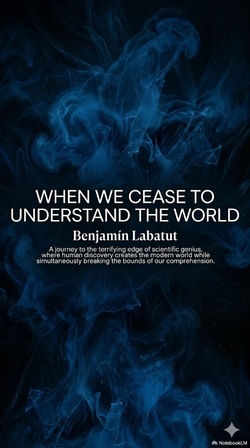
Labatut weaves the messy history of science into a gripping narrative about how every breakthrough like Prussian Blue or Haber's nitrogen synthesis carries a dark shadow that we cannot predict.
Your Review
Labatut weaves the messy history of science into a gripping narrative about how every breakthrough like Prussian Blue or Haber's nitrogen synthesis carries a dark shadow that we cannot predict.

This book made me feel the dark side of every scientific breakthrough.

The story of Prussian Blue turning into cyanide shows how quickly a life-saving invention can twist into a weapon for genocide, making the book feel less like history and more like a warning about our own future with AI and climate tech. Labatut doesn't just list facts; he forces us to feel the moral weight of every breakthrough, from the vibrant blues in Van Gogh's paintings to the poison gas used in concentration camps. It's a hard read because it challenges the idea that science is inherently good, showing instead that every leap forward carries a shadow we can't always see until it's too late. The way he connects these historical tragedies to modern dilemmas about who controls technology and for what purpose makes the book essential for anyone worried about the direction of our world.

Labatut weaves terrifying history into gripping stories, showing how every scientific breakthrough like Prussian Blue or Haber's nitrogen process carries a dark shadow of unintended destruction that haunts us still today.

Labatut shows how saving lives often kills us by creating weapons we cannot control, making us feel small against the shadow of every brilliant idea we invent today.

The story of Prussian Blue turning into poison feels incredibly scary and relevant today.

The dark side of progress is terrifyingly clear.

Labatut weaves terrifying truths about scientists like Haber and Schwarzschild into gripping narratives that show how every breakthrough, from Prussian Blue to quantum mechanics, carries a dark shadow we cannot predict. His stories of Haber feeding billions while enabling genocide, or Schwarzschild discovering black holes only to be broken by the singularity's horror, force us to confront the human cost of our obsession with control. The book doesn't offer easy answers but instead asks us to question our faith in progress, reminding us that expanding knowledge often exposes limits we didn't know existed. By showing how accidental discoveries like Prussian Blue led to cyanide, Labatut proves that the same curiosity driving beauty can fuel destruction. This is essential reading for anyone wondering why solutions sometimes feel like new problems, urging us to embrace humility over techno-optimism.

Felt more like a thriller than science history. Very gripping.

Prussian Blue

Labatut brilliantly shows how every scientific breakthrough, like Prussian Blue feeding art and poisoning camps, carries a dark shadow we must face.

Prussian Blue

Haber's story of saving lives then enabling war feels terrifyingly relevant to our own times.

Labatut shows how every scientific breakthrough carries a hidden cost we cannot predict. The story of Fritz Haber saving billions from starvation with his nitrogen synthesis only to later provide the chemical foundation for Zyklon B gas used in concentration camps is a devastating example of this paradox. His invention literally made up half of the nitrogen in our bodies today, yet the same work enabled industrialized genocide. This duality forces us to ask if we are willing to sacrifice our moral compass for the sake of feeding the world or advancing our knowledge, reminding us that the line between savior and destroyer is often determined by the systems that control the technology rather than the intent of the scientist.

Hard read but makes you question progress.

Schwarzschild finding black holes while dying in the trenches of WWI creates a haunting parallel between cosmic voids and human suffering.

Labatut shows how Prussian blue became cyanide, proving that every life-saving scientific breakthrough, like Haber's nitrogen synthesis feeding billions, inevitably carries a dark shadow that can be twisted into destruction, making us question if we ever truly understand the world we are trying to control.

The story of how Prussian Blue democratized art but also birthed cyanide used in Nazi camps shows the dangerous duality of progress.

Labatut weaves science into gripping human stories, making complex ideas feel like literary thrillers rather than dry textbooks.

The book reveals how Prussian Blue shifted from a vibrant art color to a lethal poison, showing that no invention is purely good or evil.