
White Deer Plain: Complete Chapter-by-Chapter Summary

Welcome to *White Deer Plain* by Chen Zhongshi. Set against a vast, rolling landscape under a stormy sky, this book is a sweeping, brutal epic of blood, land, and the relentless grinding of history across two Chinese families. It's not just a story about the past; it's a mirror reflecting the struggles of generations as they fight for survival, honor, and a place in an ever-changing world. Join us as we dive into this powerful tale of resilience and tragedy.
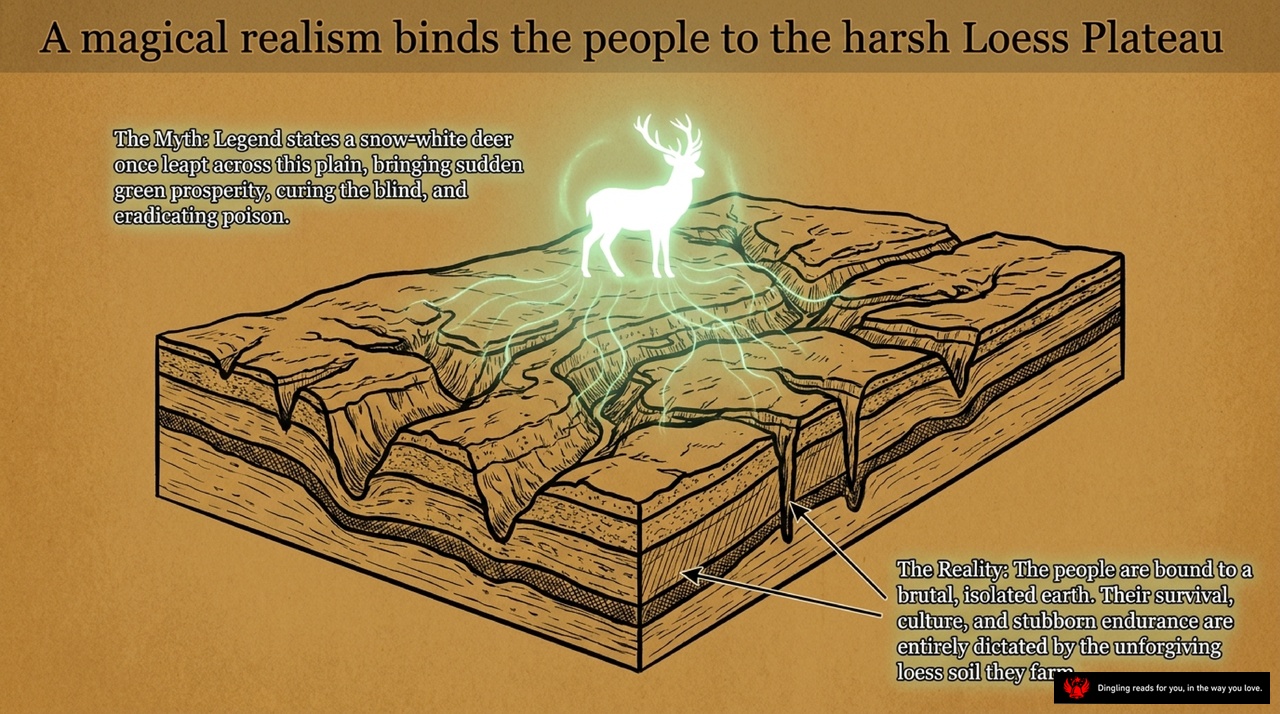
Picture this: a stark, cracked landscape of the Loess Plateau, where the earth itself feels like an unforgiving prison. But look closer. Rising from this brutal, isolated terrain is a glowing, ethereal stag—a white deer. This isn't just a drawing; it's the heartbeat of the story. On one side, we see "The Myth": a legend of a snow-white deer that leaps across the plain, bringing sudden green prosperity, curing the blind, and eradicating poison. It's the dream, the hope, the magical realism that binds the people to this harsh land.
But on the other side, we see "The Reality." The text tells us the people are bound to a brutal, isolated earth. Their survival, their culture, and their stubborn endurance are entirely dictated by the unforgiving loess soil they farm. It's a harsh truth. For decades, the people here didn't just live on the land; they were consumed by it.
This duality defines the entire saga. Take Bai Jiaxuan, for instance. He starts with a tragic life, marrying seven women who all die under mysterious circumstances. He believes he has a "hard fate," a curse. Yet, he refuses to leave. Instead, he digs deeper into the soil. He trades his fertile river land for poor, slow-slope land, believing he's buying a better fortune. He plants poppies, a crop that brings instant wealth but acts like a slow-acting poison, turning his village into a hub of addiction. He builds a grand ancestral hall and a school, trying to impose order and "benevolence" on a chaotic world.
Even when disaster strikes—the plague that blinds his wife, the famine that forces families to eat their own children—the land remains the ultimate judge. When the revolutionary tide sweeps through, tearing apart the old order, the land doesn't change. It just waits. It watches as heroes die, as tyrants fall, and as the magical deer remains a silent, glowing ghost in the cracks of the earth.
The story is a cycle of tragedy and resilience. The people love this land, but the land loves them back with a crushing grip. It gives them life, but it also demands their blood, their sanity, and their souls. In the end, whether they are fighting for the old ways or the new revolution, everyone is trapped beneath the same heavy, golden soil. They are bound to it, forever.
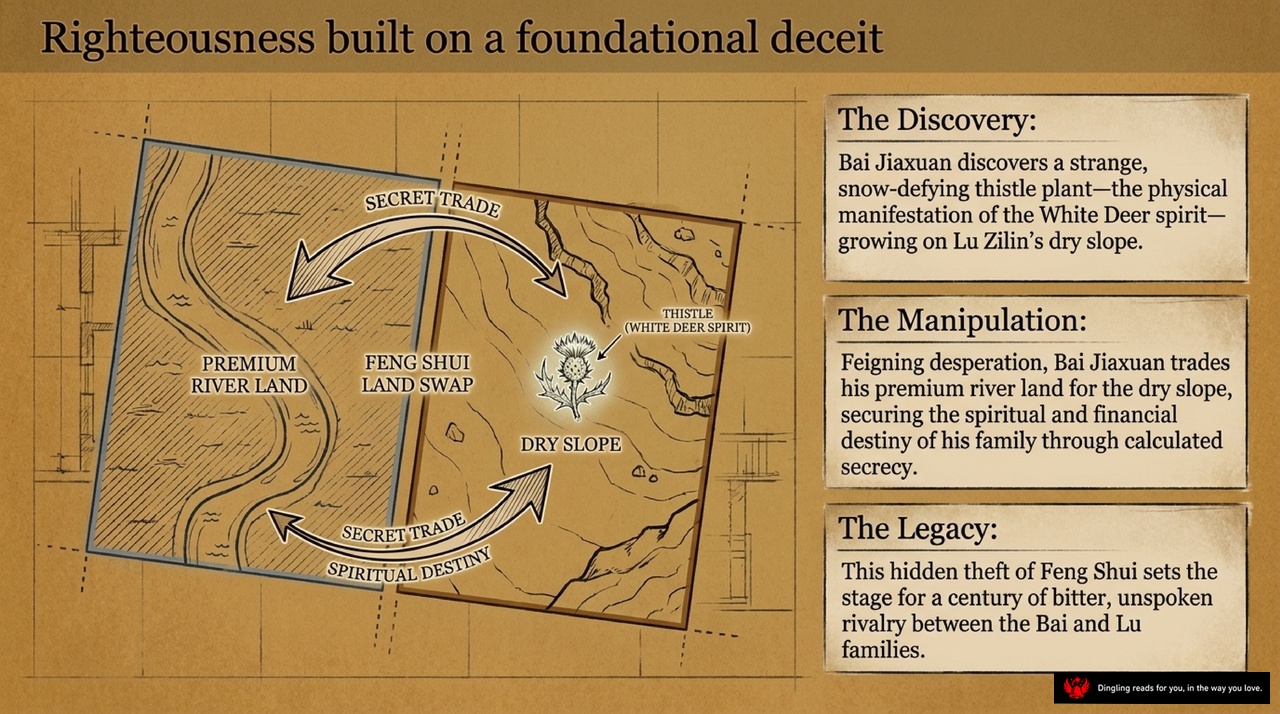
In the shadow of the White Deer Spirit, a century of rivalry begins not with a shout, but with a silent, calculated theft. Bai Jiaxuan discovers the thistle—the physical manifestation of the White Deer spirit—growing on Lu Zilin's dry slope, a secret treasure hidden in plain sight. Instead of revealing this divine sign, he feigns desperation, orchestrating a secret trade: swapping his premium river land for the dry slope. This Feng Shui land swap secures his family's spiritual destiny and financial future through calculated secrecy, setting the stage for bitter, unspoken rivalry between the Bai and Lu families. While Bai Jiaxuan builds his fortune on this foundational deceit, Lu Zilin remains unaware that the very land he coveted has been stolen, a hidden theft that will define their generations of conflict.

Two patriarchs represent the duality of the old world, a split that defines the very soul of the Bai Lu Yuan. On one side stands Bai Jiaxuan, the Stoic Traditionalist. His power isn't bought or seized; it's inherited and enforced through the rigid, unyielding rules of the Confucian Ancestral Hall. He relies on moral righteousness and strict lineage, believing that inflexibility is the only path to stability. Yet, this absolute rigidity becomes his tragic flaw. He lacks human empathy, surviving on a foundation of cold duty, a fact haunted by the memory of six wives who died in terror under his roof.
On the other side is Lu Zilin, the Pragmatic Opportunist. His source of power is entirely different: modern political maneuvering, backed by wealth, influence, and adaptable alliances. He knows how to navigate the shifting tides of power, making deals and forming connections where others see only walls. But this adaptability is his hollow core. Driven solely by greed and the need for power, he lacks any true moral compass. While Bai Jiaxuan holds firm to a broken past, Lu Zilin chases a future that offers no real redemption. Together, they embody the conflict between tradition and survival, morality and ambition, setting the stage for the inevitable clash that will shake their world to its core.
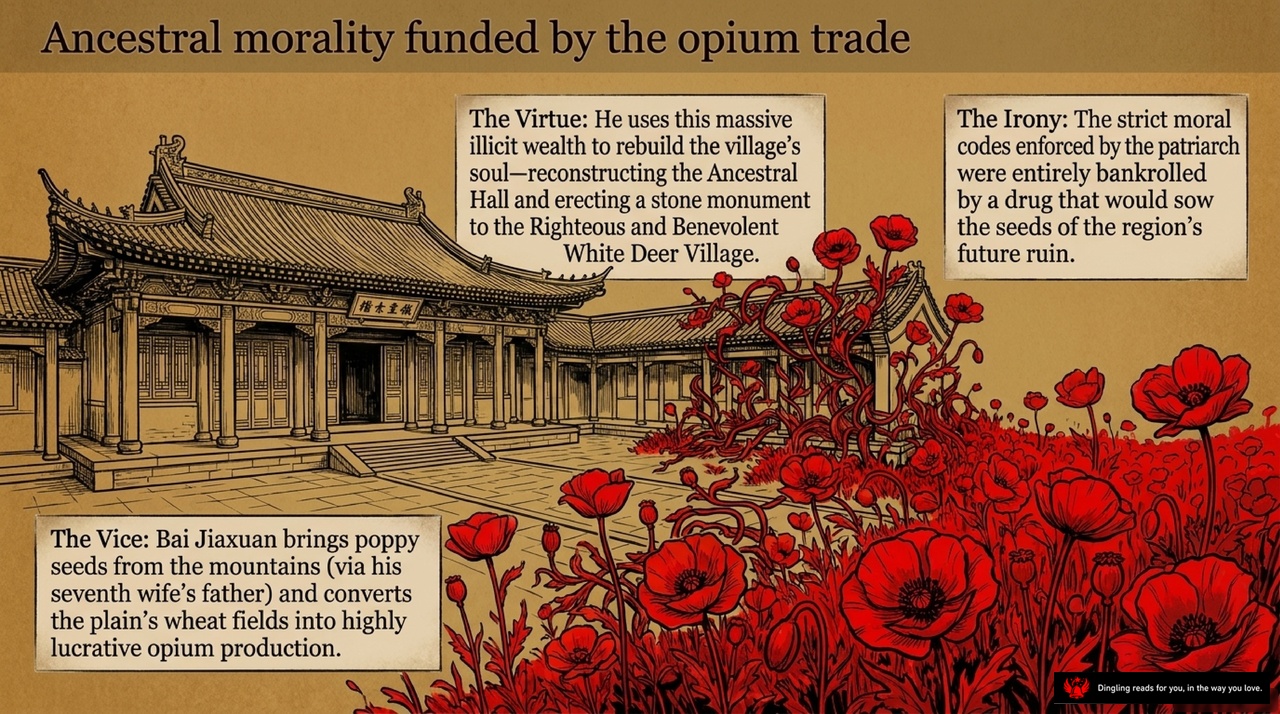
Look at this haunting image of the ancestral hall, standing tall yet overshadowed by a sea of red poppies. This visual perfectly captures the tragic paradox at the heart of Bai Jiaxuan's life.
On one hand, we see "The Virtue." Bai Jiaxuan uses his massive illicit wealth—funded entirely by the opium trade—to rebuild the village's soul. He reconstructs the Ancestral Hall and erects a stone monument to the Righteous and Benevolent White Deer Village, trying to restore the family's dignity and cultural roots.
But look at the foreground. Those vibrant red poppies represent "The Vice." Bai Jiaxuan brings poppy seeds from the mountains and converts the plain's wheat fields into highly lucrative opium production. This is the source of his fortune.
And then there is "The Irony." The strict moral codes enforced by the patriarch were entirely bankrolled by a drug that would sow the seeds of the region's future ruin. He is building a temple to morality with money built on immorality. It's a deep, tragic contradiction: he saves the village's culture by destroying its very future, creating a legacy that is both magnificent and poisonous all at once.

The image before us captures a profound tragedy: the collapse of a family built on power, pride, and calculation. Look at that broken tree. It represents the life of Lu Zilin, a man who spent his entire existence chasing status, only to be utterly shattered by the tides of history.
The roots of his story begin with a sudden rise. After the fall of the Qing Dynasty, Lu Zilin seized the opportunity to become the head of the local security office. He didn't just accept the power; he flaunted it. He renovated his home, replacing old, crooked structures with blue brick pillars and black lacquered gates, hanging up official plaques that announced his new authority. On the day he officially took office, he celebrated with firecrackers and dignitaries, feeling a deep sense of vindication, as if he had finally fulfilled his grandfather's wish to "fight for a reputation."
But power, as we see in the image, is a double-edged sword. As Lu Zilin's influence grew, so did his arrogance. He treated his old rival, Bai Jiaxuan, with open disdain, enforcing government orders with a heavy hand. Yet, this path of ambition led directly to ruin. His choices for his own children sealed his fate. His eldest son, Lu Zhaohai, chose the path of revolution, becoming a Communist leader. His second son, Lu Zhaohai, joined the Nationalists and died heroically in battle. While the second son's death brought grief, the first son's rebellion became the ultimate downfall of the family.
The tragedy deepened with the fate of his daughter-in-law. Her descent into madness and eventual death left Lu Zilin with a shame he could never wash away. When the political winds shifted again, and the very forces he once tried to control turned against him, Lu Zilin was arrested. His home was stripped, his land sold, and his dignity lost.
The final chapter of his life is one of absolute madness. After being released, he couldn't grasp the new reality. He wandered the fields, unable to distinguish between the living and the dead. In his final moments, frozen in the snow, he reportedly saw a vision of his old rival, Bai Jiaxuan. In that delirious state, he confessed that the land he had once taken was wrong, offering a final, broken peace.
This image reminds us that no amount of cunning or ambition can protect a person from the relentless march of history. Lu Zilin fought for his family's survival, but in the end, he lost everything, leaving behind only a broken tree and a legacy of regret.

Look at this chart. It captures the tragic divergence of the Bai and Lu families, showing how two sons started from similar places but walked opposite paths to survival and destruction.
Notice the top-left corner. This is the path of Lu Zhaopeng. He begins as the obedient, hypocritical heir who rejects his wealth for the Communist cause. But look where his line ends up. He adapts ruthlessly, surviving multiple regimes to become a high-ranking leader. He sacrifices his own brother and family for the revolution, turning from a rebel into a hardened, idealistic leader who survives by any means necessary.
Now, look at the bottom-right. This is the path of Bai Xiaowen. He also starts as the obedient, hypocritical heir of the Bai family. But his journey leads him to the bottom right: rebellion and ideological purity. He falls into disgrace, addiction, and beggary, completely losing his family and his status.
The chart shows that while one son sought power through the revolution and survived, the other sought purity through rebellion and was ultimately destroyed. It's a stark reminder that in this chaotic world, the path to survival often requires choices that contradict one's original ideals.

In the heart of a crumbling archway, a single red lantern hangs like a warning against the encroaching darkness. This image captures the tragic fate of those who dared to challenge the rigid order of the past. As the slide reveals, rebels of both class and sexuality were ultimately crushed by tradition.
On the left, we see Hei Wa, the class rebel. Born a son of loyal farmhands, he refused to accept his subservient destiny. He smashed the ancestral tablets, symbolizing his rejection of blind obedience, and led a violent uprising against the very system that sought to keep him in the dirt.
In the center stands Tian Xiao'e, the sexual rebel. An abused concubine, she sought nothing less than freedom and love with Hei Wa. Her defiance was absolute; she challenged every patriarchal rule regarding chastity and submission, daring to choose her own heart over societal expectations.
Yet, look to the right at the consequence. The rigid patriarchal order could not tolerate their existence. The village, acting as the enforcer of tradition, isolated, hunted, and ultimately destroyed both of them. Their rebellion was met not with understanding, but with physical and spiritual annihilation. This slide reminds us that while the lantern may shine brightly, the world outside the arch remains dark and unforgiving to those who step out of line.

The guardians of morality commit the most horrific violence. This slide captures one of the most brutal and shocking moments in the story, where the very people sworn to uphold ethics become its greatest destroyers. Look at the central image: a blood-stained ancestral spear lying in the earth. This weapon wasn't used by bandits or enemies from outside; it was wielded by Lu San, Tian Xiao'e's own father-in-law. He was the village's most loyal, morally upright farmhand, the kind of man everyone trusted implicitly. But in a twisted act of violence, he used this sacred weapon to kill his own daughter-in-law. His motive, as shown here, wasn't personal hatred, but a desperate need to "cleanse the family's shame" and protect the fragile dignity of the patriarchal order. He believed that sacrificing an innocent woman was necessary to save the family's honor. This leads us to the synthesis at the bottom: the moral foundation of the Plain is exposed as a system willing to commit barbaric, cowardly violence to maintain its absolute control. It forces us to ask a difficult question: when a system demands such cruelty to preserve its own image, where does morality truly end?

Ideological purity leads to tragic, ironic martyrdom. Look at this striking image of a red thread dropping into darkness—it symbolizes the deadly path of blind devotion.
Let's talk about Bai Ling. After escaping the oppressive countryside, she becomes a fierce, dedicated Communist operative in the city. She organizes student strikes and smuggles intelligence, driven by an absolute belief in her cause. But here lies the tragedy: she isn't killed by the Nationalist enemy, as one might expect. Instead, she is targeted during a paranoid internal purge within her own Communist base at Nanliang.
The ultimate irony? This revolutionary idealist is buried alive by her own comrades. It proves a chilling truth: the new ideological dogmas can be just as blindly destructive as the old ancestral laws. When purity becomes dogma, even the most noble sacrifice turns into a tragic, ironic martyrdom.
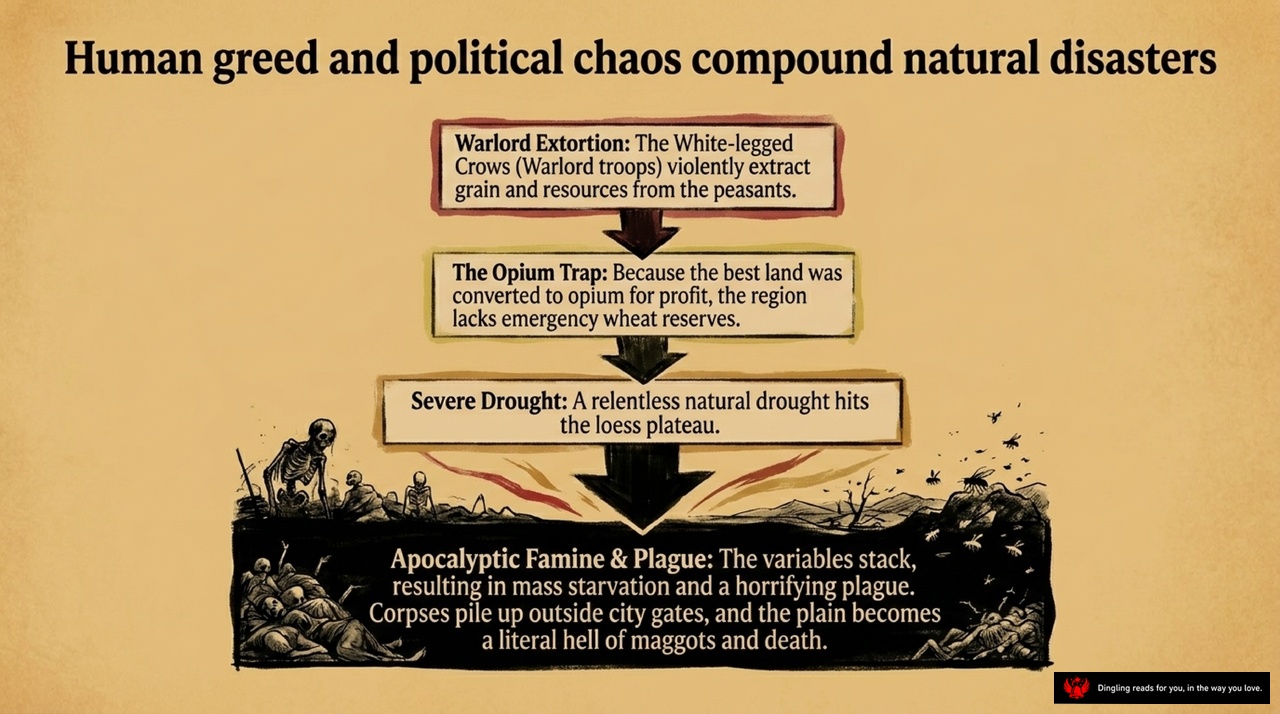
Look at this slide. It paints a terrifying picture of how human greed and political chaos don't just happen alongside natural disasters—they actually make them much worse. This is the tragic cycle that destroys the Loess Plateau.
It starts at the very top with "Warlord Extortion." The "White-legged Crows"—these are the warlord troops—violently strip grain and resources right from the peasants' hands. They leave the people with nothing to eat.
Because the land has been stripped bare, the region falls into "The Opium Trap." The best farmland is converted into poppy fields just for quick profit. The result? The region completely lacks emergency wheat reserves. When disaster strikes, there is no food left to survive on.
Then comes the natural part: "Severe Drought." A relentless, unyielding drought hits the plateau. The sky refuses to rain.
Finally, all these variables stack up at the bottom, leading to "Apocalyptic Famine & Plague." With no food and no water, mass starvation sets in. Bodies pile up outside the city gates, rotting in the sun. The plain becomes a literal hell of maggots and death. This isn't just bad luck; it's a perfect storm created by human choices meeting a cruel nature.
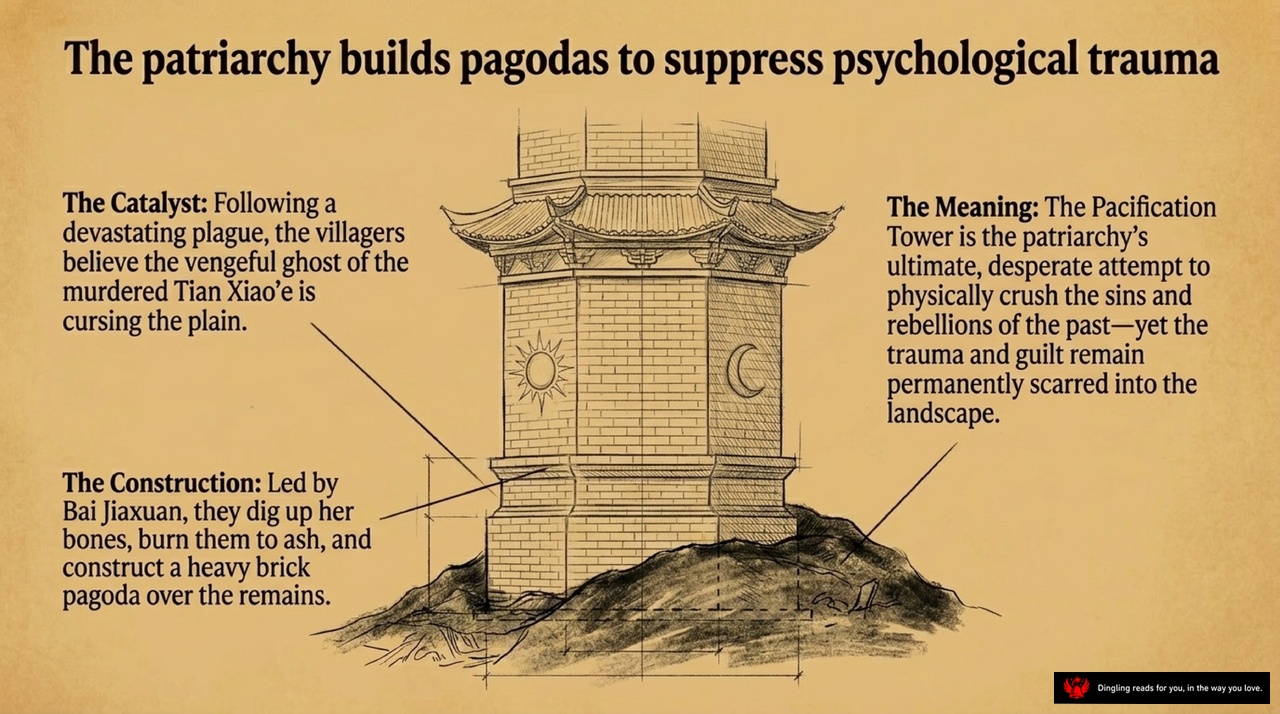
The image on your screen captures a haunting moment in history: the construction of the Pacification Tower, a structure built not for peace, but to bury a scream. This tower represents the patriarch's desperate, brutal attempt to suppress the psychological trauma of a plague that wiped out his family and neighbors.
As the slide explains, the catalyst was a devastating plague that struck the village. The villagers, terrified and superstitious, believed the vengeful ghost of Tian Xiao'e—a murdered woman—was cursing the plain. To stop this curse, they needed a physical solution. Led by Bai Jiaxuan, the community dug up her bones, burned them to ash, and constructed this heavy brick pagoda directly over the remains.
The tower stands as a monument to a twisted logic: the belief that you can physically crush sin and rebellion with brick and mortar. However, the slide's most profound point lies in its meaning. The Pacification Tower is the patriarch's ultimate, desperate attempt to silence the past, yet the trauma and guilt remain permanently scarred into the landscape. The tower might stop the ghost, but it can never stop the pain. It stands as a silent witness to the fact that while the patriarch tries to build walls to keep the world out, the scars of history will always be there, embedded in the very ground beneath their feet.

History culminates in an ironic, ruthless reversal of justice. This slide captures the tragic climax of the story, where the roles of power and morality are completely flipped.
Look at the three key figures here. On the left, we have **The Judge**: Bai Xiaowen. Once the upright, traditional leader who stood for "Ren Yi"—benevolence and righteousness—he has now become the new magistrate. He hypocritically adapted to every regime, surviving the chaos by holding onto power, only to sit in judgment as the ruler of the new Communist era.
In the center stands **The Condemned**: Hei Wa. Remember him? He was the original rebel, the one who broke the feudal chains, who burned the grain depot, and who tried to live a simple, honest life with his wife, Xiao E. He sought peace and aided the liberation, believing he had found redemption. Yet, here he is, bound and executed alongside the corrupt landlords he once fought.
And finally, **The Climax**. This is the most painful part. In the final settling of accounts, true justice is entirely subsumed by political survivalism. The chameleon—Bai Xiaowen, who changed his colors to fit the times—thrives. While the honest rebel, Hei Wa, dies. It's a stark reminder that in this turbulent history, loyalty to an idea or a person often doesn't matter as much as loyalty to the prevailing power. The system that once punished the rebels has now become the very thing that destroys them.
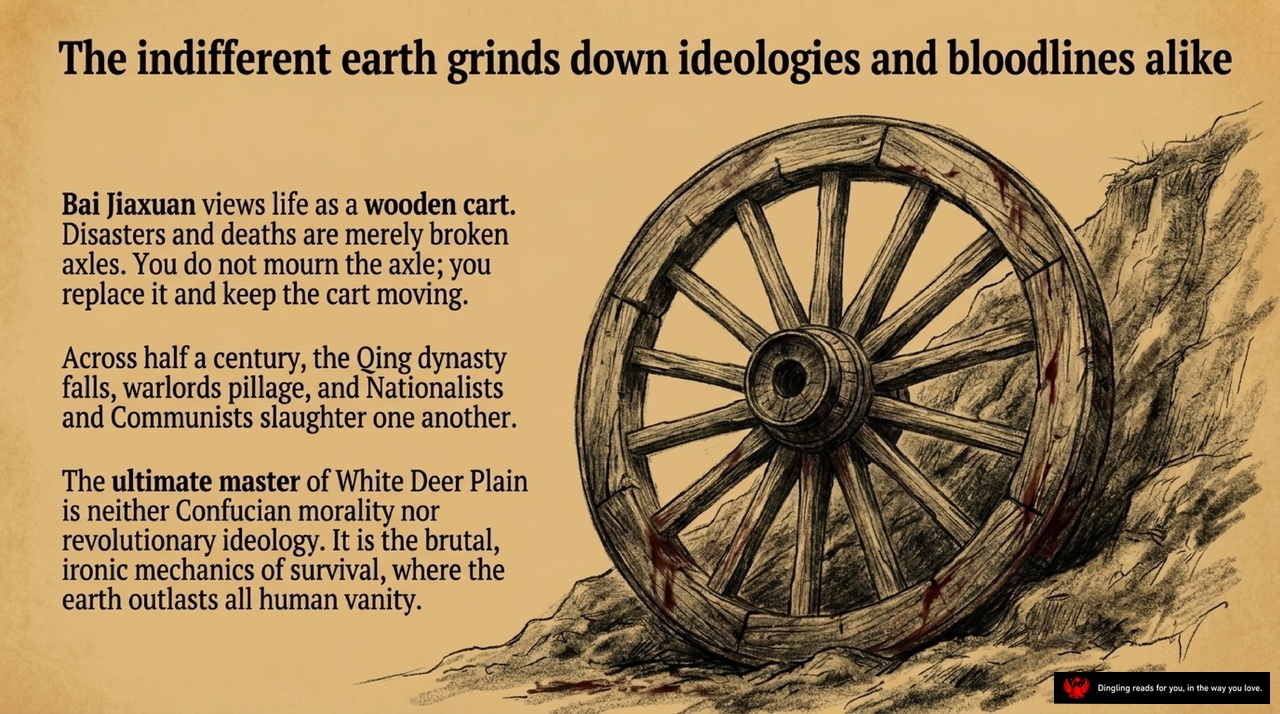
The indifferent earth grinds down ideologies and bloodlines alike. This isn't just a metaphor; it's the brutal reality of survival in *White Deer Plain*. Think of life as a wooden cart, as the character Bai Jiaxuan sees it. When disasters strike—when the axles break, when people die—you don't mourn the broken parts. You simply replace them and keep the cart moving. That is the ultimate master of this story: not Confucian morality or revolutionary slogans, but the cold, ironic mechanics of survival where the earth outlasts all human vanity.
Look at the wheel in the image. It's stained with blood, a stark reminder of the half-century of chaos. The Qing dynasty falls, warlords pillage, and factions slaughter one another. In this maelstrom, no ideology is safe, and no bloodline is guaranteed. The only thing that truly matters is the ability to endure. Whether you are a traditionalist like Bai Jiaxuan or a revolutionary like Lu Zhaopeng, the ground beneath you doesn't care about your beliefs. It only cares if you can keep moving forward. This is the harsh truth that defines their world: the earth wins, and everyone else is just trying to stay on top of it.

After half a century of relentless revolution, famine, and bloodshed, the ancestral traditions of the Loess Plateau were violently dismantled. We see that the true master of the land is neither morality nor ideology, but the brutal, ironic mechanics of survival. When the dust of revolution settles and the old gods are replaced by new dogmas, does the human soul actually evolve, or do we merely build new pagodas to suppress the same ancient sins?