
Who Says Elephants Can't Dance?: Complete Chapter-by-Chapter Summary
Who Says Elephants Can't Dance? Welcome to the definitive playbook of IBM's historic turnaround. Written by Louis V. Gerstner Jr., this book proves that strategic integration and a cultural revolution can make even the largest corporate giants agile. It is the story of how one leader dared to challenge the impossible, turning a failing tech giant into the world's most valuable company. This is not just a history lesson; it is a masterclass in leadership, showing us that no matter how big or slow an organization gets, it can still find its rhythm and dance if it has the courage to change.
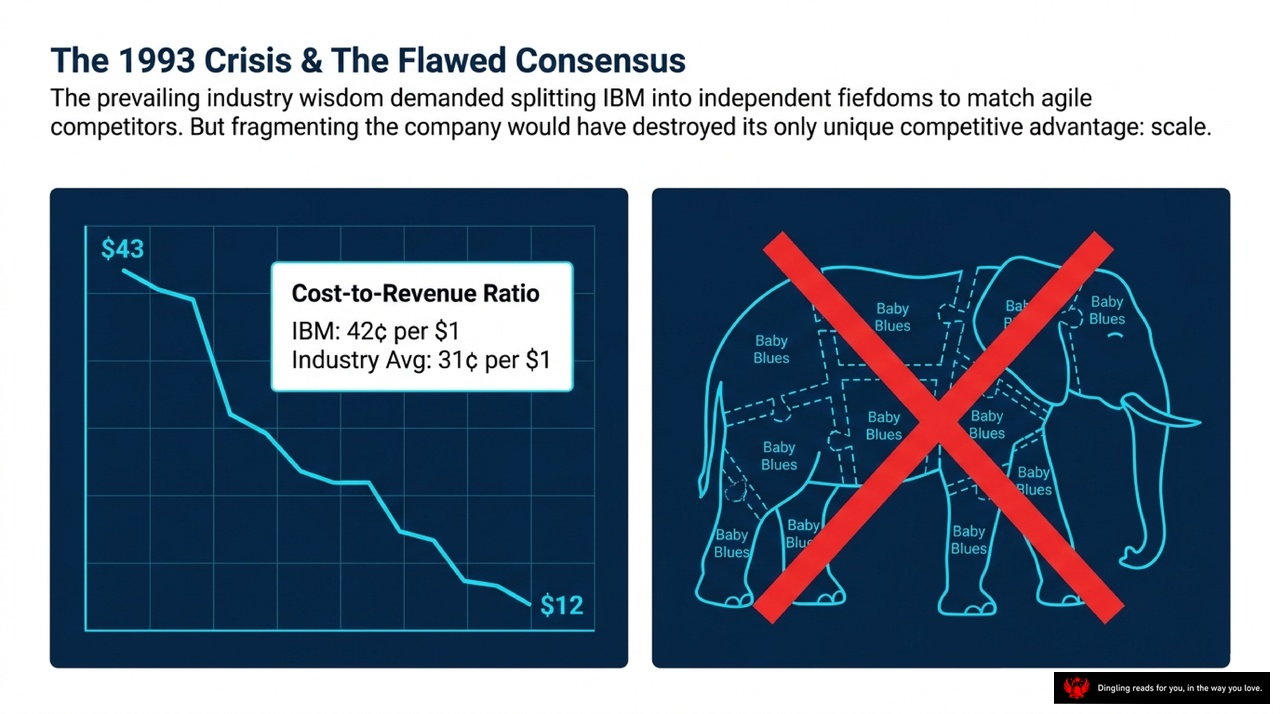
The prevailing wisdom in 1993 was simple but fatal: chop up the giant. The industry demanded we split IBM into independent fiefdoms to match our agile competitors. But as the slide clearly illustrates, that fragmentation would have destroyed our only real advantage: scale. Instead of cutting us into pieces, we needed to make the whole beast move faster.
Look at the data on the left. Our stock plummeted from $43 to just $12, and our cost-to-revenue ratio was a massive 42 cents per dollar, far worse than the industry average of 31 cents. We were bleeding cash because we were too bloated.
Now, look at the elephant on the right. The "Baby Blues" diagram represents the flawed consensus of the time—breaking the elephant into tiny, disconnected parts. We rejected that idea. We realized that a giant elephant can dance if it moves as one unit. So, instead of fragmenting, we focused on efficiency. We slashed costs by 89 billion dollars, cut our workforce by 35,000, and sold off non-core assets like our headquarters and art collections just to survive. We didn't shrink the elephant; we taught it how to run.

Before redefining the vision, the immediate priority was stabilizing the economic model. Triage required brutal, decisive action to generate positive cash flow and establish centralized control.
To halt fragmentation and stop the bleeding, we had to make tough choices. We cut the dividend from $2.16 to $1.00 and slashed $8.9 billion in expenses, which meant laying off 35,000 employees. It was painful, but we had no other choice.
Next, we reengineered core processes. We consolidated 128 CIOs down to just one and saved $2.8 billion in the first year alone. We also liquidated non-core assets, selling Federal Systems for $1.5 billion and divesting excess real estate.
These hard decisions were necessary to survive. Only by stopping the hemorrhage could we eventually redefine the vision and lead the industry again.

The slide highlights a pivotal strategic choice for IBM: the transition from a "Bundled Era" of monolithic systems to a "Fragmented Era" of chaotic, niche components. While the market splintered into PC clones and specialized vendors, forcing customers to become their own integrators, IBM's genius lay in seizing the center. By positioning itself as "The Integrator," IBM stepped into the role of the general contractor, assembling these scattered pieces into a cohesive business solution. This wasn't just about selling hardware; it was about becoming the indispensable partner that customers relied on to make sense of a complex, fragmented technology landscape.
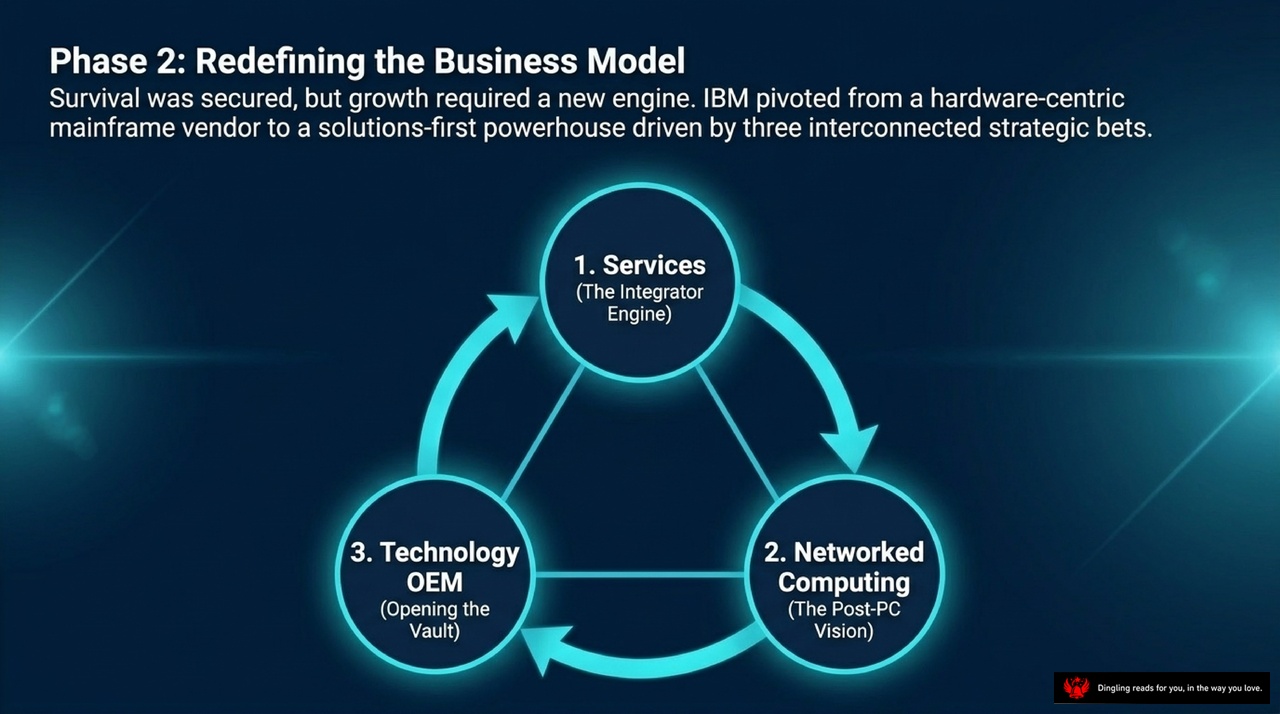
Phase 2: Redefining the Business Model. Survival was secured, but growth required a completely new engine. IBM pivoted from being a hardware-centric mainframe vendor to a solutions-first powerhouse, driven by three interconnected strategic bets.
Look at this triangle. The first leg is **Services**, acting as our Integrator Engine. We realized that clients didn't just want boxes; they needed a partner to weave technology into their business. The second leg is **Networked Computing**, or what we called the Post-PC Vision. We stopped fighting the PC and instead built the network that would power the future. And the third leg is **Technology OEM**, effectively "Opening the Vault." By selling our chips and components to other manufacturers, we unlocked massive new revenue streams beyond our own hardware sales.
This wasn't just a random shift; it was a deliberate transformation. We moved from selling isolated products to delivering integrated value. By combining these three pillars, we turned IBM from a rigid monolith into a flexible, customer-centric powerhouse, securing our place not just as a seller of hardware, but as the essential architect of the digital world.
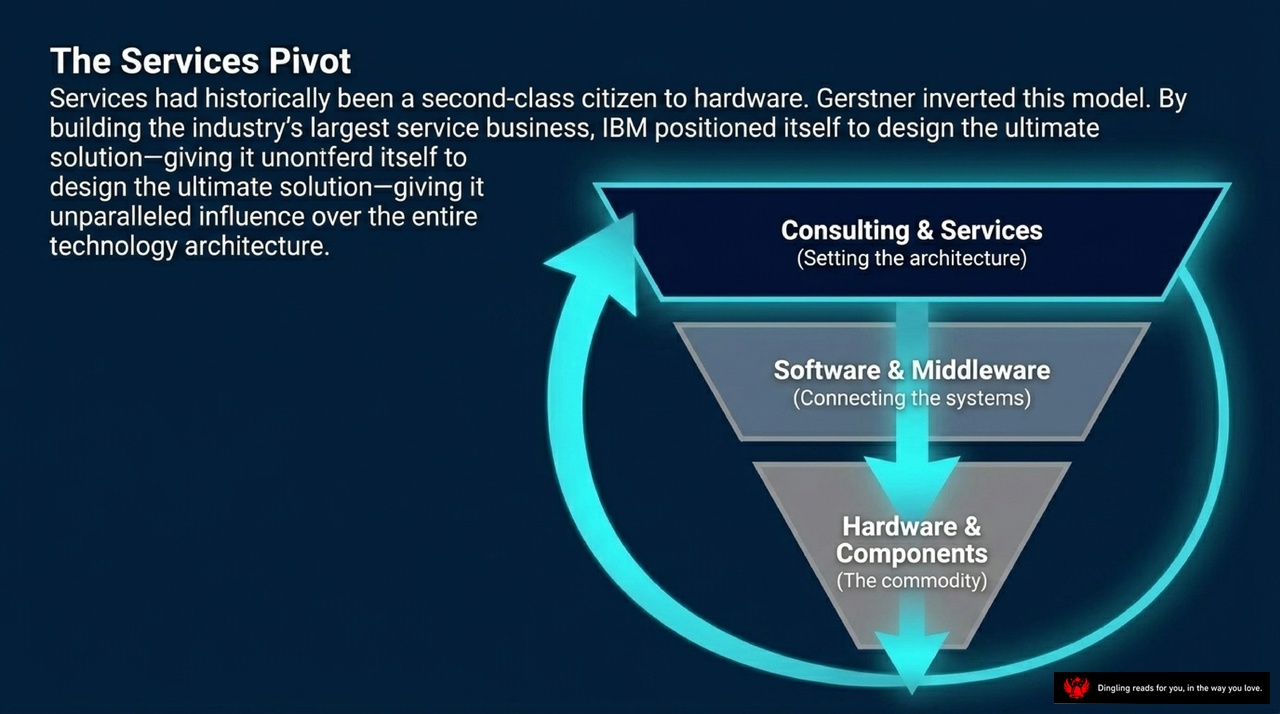
The Services Pivot
Today's slide illustrates the dramatic transformation of IBM under Lou Gerstner, a shift we call "The Services Pivot." Historically, services were treated as a second-class citizen, overshadowed by hardware. Gerstner completely inverted this model. By building the industry's largest service business, IBM positioned itself to design the ultimate solution, granting it unparalleled influence over the entire technology architecture.
As you can see in the diagram, this new hierarchy places "Consulting & Services" at the very top, responsible for setting the architecture. This strategic move allowed IBM to guide the client's entire IT landscape rather than just supplying parts. Below that sits "Software & Middleware," which connects the systems, acting as the vital glue between the custom design and the hardware. Finally, at the base, we have "Hardware & Components," now redefined not as the primary product, but as the commodity.
This visual perfectly captures Gerstner's insight: when you lead with services and strategy, hardware becomes a standard, affordable utility rather than the premium product it once was. By flipping the pyramid, IBM stopped competing solely on price and instead competed on value, becoming the essential partner for clients needing integrated solutions. This pivot didn't just save the company; it redefined the industry for decades to come.

Think about the difference between a single computer sitting alone on a desk and a massive server at the center of a digital universe. The slide on the left shows "The PC Island," representing the old days where IBM was trapped in a "Wintel Duopoly," fighting a losing battle for desktop supremacy. But the slide on the right reveals the real opportunity: "The E-Business Ecosystem." This is where the future lies.
Instead of trying to win the war for every single personal computer, IBM made a bold strategic bet. They realized that the standalone PC would become just one of billions of connected endpoints. The true value wasn't in the device itself, but in the high-bandwidth network and the massive enterprise servers connecting everything. By bypassing the battle for desktop dominance, IBM shifted its focus to the entire ecosystem. This vision transformed the company from a hardware manufacturer into the essential backbone of the global economy, powering everything from retail to manufacturing. It was a complete reinvention, turning the entire world into their customer.

Opening the Technology Vault. Imagine IBM's most valuable assets—its patents, DRAM technology, and PowerPC chips—sitting in a massive, secure vault. For decades, IBM guarded these treasures jealously. But in a radical departure from that proprietary past, the company decided to unlock the door and sell its crown jewels to its fiercest rivals like Dell, HP, and Sun.
This wasn't just about giving up secrets; it was a masterstroke for survival. By licensing these technologies, IBM generated massive new revenue streams that helped subsidize its expensive R&D costs. More importantly, it ensured that IBM's technologies drove global industry standards, keeping the company relevant even as competitors used its own inventions to build their products.
The results were staggering. Look at the bottom of the slide: Patent Revenue exploded from just $500 million in 1994 to a staggering $1.5 billion by 2001. This strategy of opening the vault transformed IBM from a struggling monolith into a licensing powerhouse, proving that sometimes, the best way to win is to let others use your tools while you focus on the next big thing.
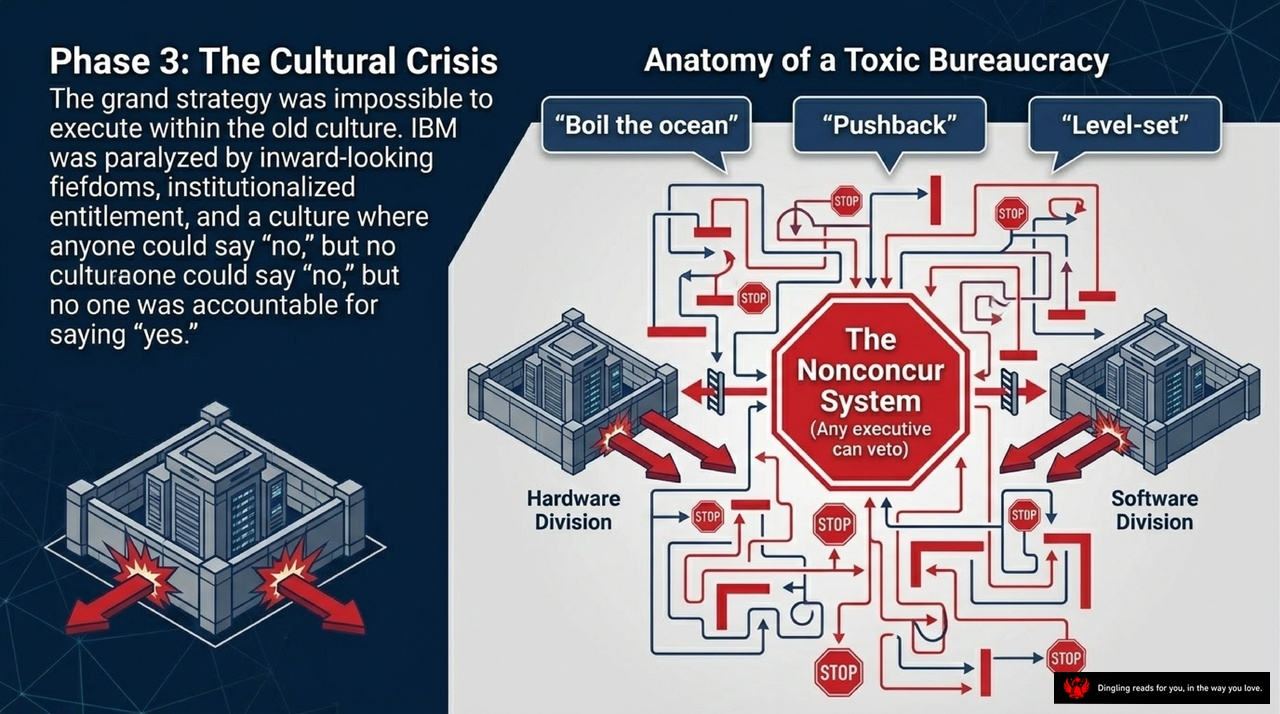
On this slide, we see the anatomy of a toxic bureaucracy that nearly killed IBM. The diagram highlights three key failure modes: "Boil the ocean," "Pushback," and "Level-set." These weren't just buzzwords; they were the daily reality that paralyzed the company. "Boil the ocean" meant trying to do too much at once, creating chaos. "Pushback" describes the culture where anyone could say "no" to protect their own turf, but no one was ever held accountable for saying "yes" to the company's goals. And "Level-set" was the endless cycle of debate that stopped any real action.
This slide perfectly captures what I call "The Cultural Crisis." When I arrived, IBM was stuck in an old culture that made executing any grand strategy impossible. The organization was paralyzed by inward-looking fiefdoms and a sense of institutionalized entitlement. It was a place where everyone had the power to block progress, yet no one owned the responsibility to drive it forward. As the diagram shows, the "Nonconcur System" allowed any executive to veto decisions, creating a gridlock between the Hardware and Software divisions. We were trapped in a system designed to fail. Recognizing that we couldn't fix this with just better strategies, I knew we had to fundamentally change the culture itself. We had to move from a culture of obstruction to a culture of execution, ensuring that saying "yes" became the default, not the exception.
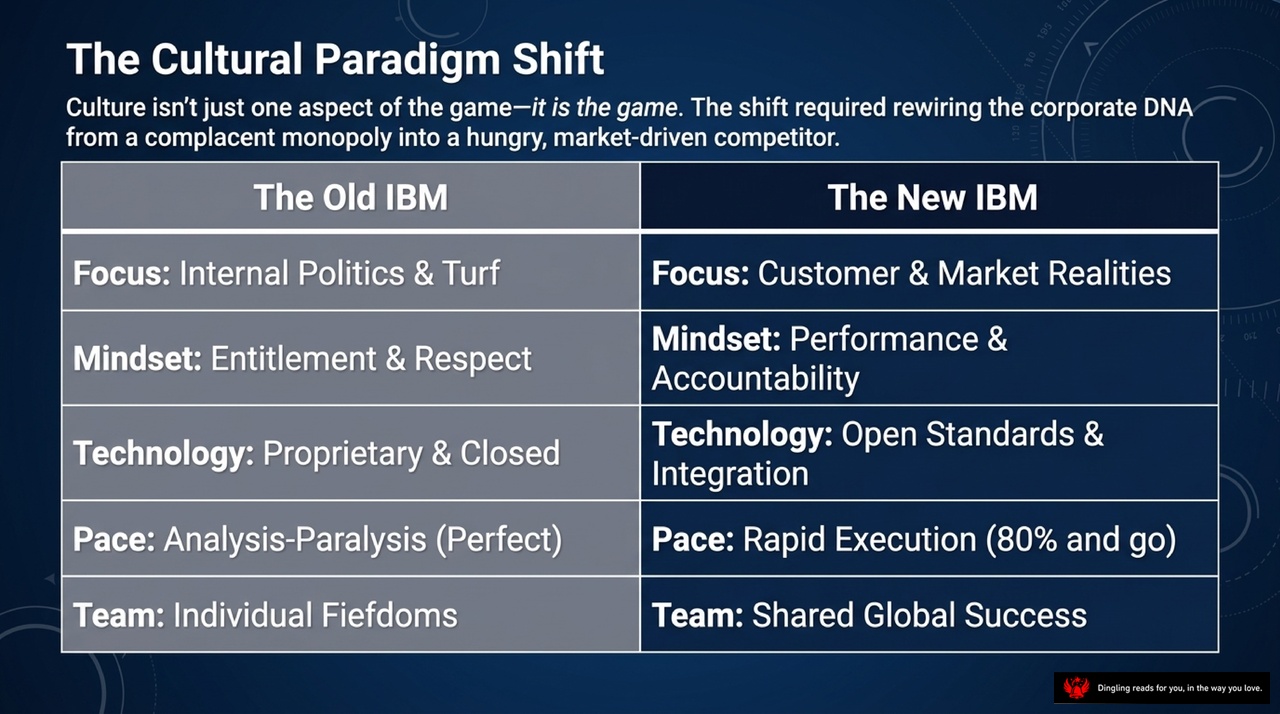
The cultural paradigm shift wasn't just about tweaking a few policies; it was about completely rewiring the corporate DNA of a once-complacent monopoly into a hungry, market-driven competitor. As the slide illustrates, the transformation required moving from internal politics and turf wars to a laser focus on customer and market realities. The old mindset of entitlement and respect gave way to a new culture built on performance and accountability. We stopped relying on proprietary, closed technology and embraced open standards and integration. Perhaps most critically, we traded the paralysis of seeking perfection for the rapid execution of an "80% and go" approach. Instead of isolated fiefdoms, we built a team dedicated to shared global success. This shift proved that culture isn't just one aspect of the game—it is the game itself.
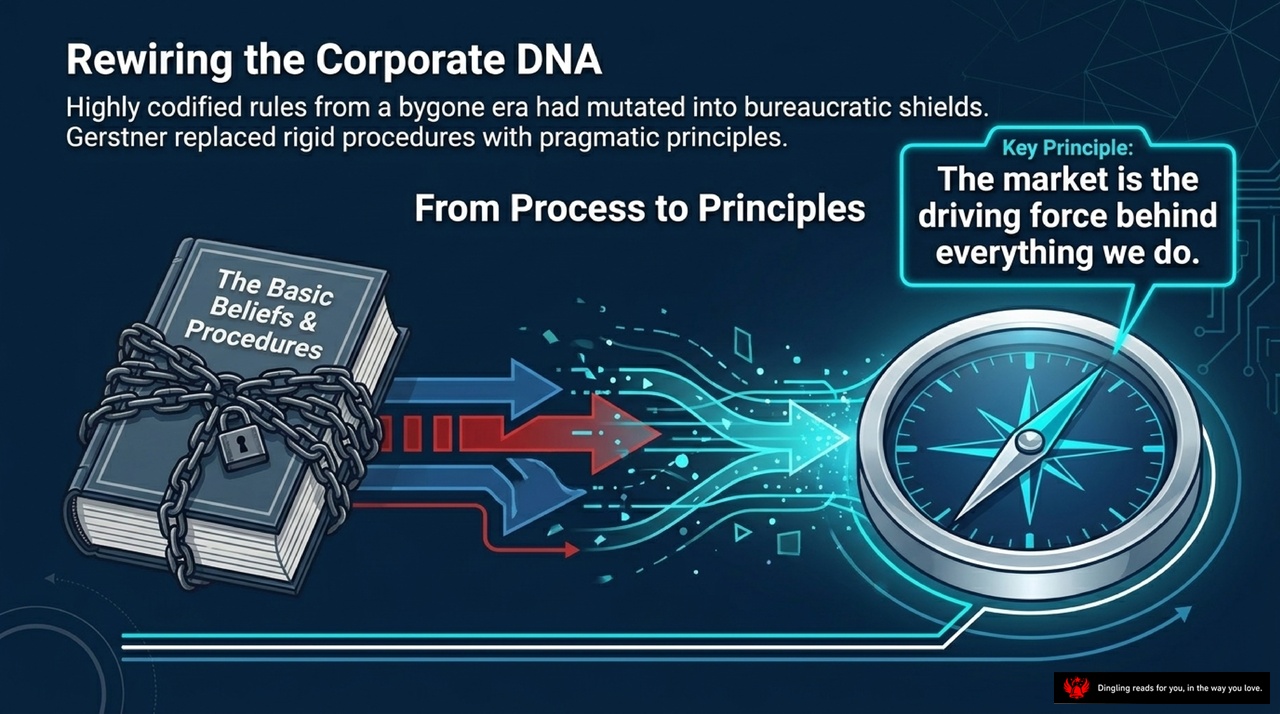
When we talk about fixing a giant like IBM, the first instinct is often to tighten the rules. But in the 90s, IBM was drowning in what we'd now call bureaucratic bloat—layers of rigid procedures that had nothing to do with the customer and everything to do with protecting the status quo. The old guard believed that strict hierarchy and internal consensus were the keys to success. They thought if you just followed the right process, the results would take care of themselves.
But the market was screaming a different story. While IBM was busy arguing over internal turf, competitors were winning because they moved faster and cared more about what the client actually needed. The image of the "supercomputer" was becoming a liability, not an asset. The company was losing its way, trapped in a self-perpetuating cycle of denial and inaction.
This is where the shift happened. We had to move from a culture of "process" to a culture of "principles." We realized that rules are just suggestions until they serve a purpose, but principles are the compass that guides us when the map is unclear. We stopped trying to manage every detail and started focusing on the market as the ultimate driving force. If the market says a product is obsolete, we stop making it. If the customer wants speed, we cut the red tape that slows us down.
It wasn't about being less disciplined; it was about being more relevant. We replaced the old, suffocating beliefs with a new set of pragmatic principles that put the customer first, demanded speed, and embraced failure as a necessary step toward success. It was a painful break from the past, a decision to stop being a fortress and start being a partner. Because in the end, no amount of internal perfection matters if you've lost your way in the real world.
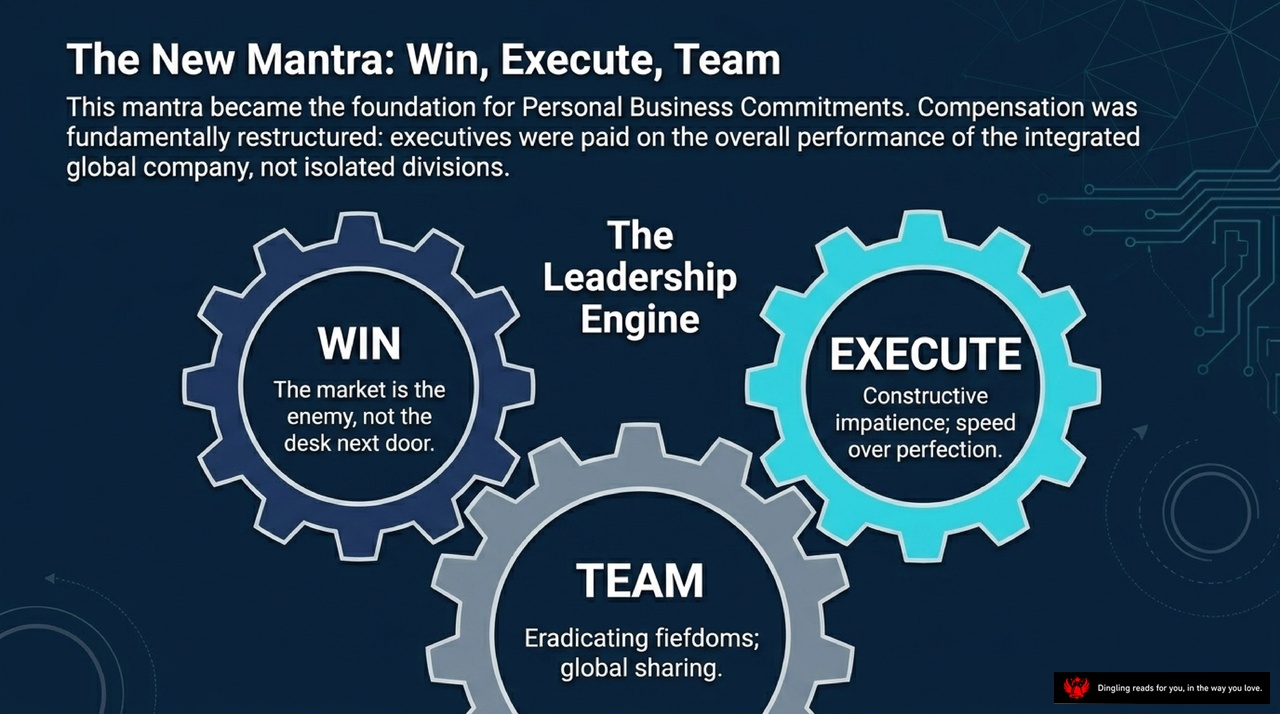
Imagine your company as a complex machine where every gear must turn in perfect sync to drive forward. But for decades, IBM was stuck in a state of internal friction, with departments acting like isolated fiefdoms rather than a unified team. To fix this, we introduced a new mantra: Win, Execute, Team.
First, we had to **Win**. The core philosophy was simple but radical: the market is the enemy, not the person sitting at the desk next to you. We shifted our focus entirely outward, treating competitors and customer needs as the only things that truly mattered.
Next came the need to **Execute**. We realized that perfection was the enemy of progress. We embraced "constructive impatience," prioritizing speed over flawless execution because in a fast-moving market, being first often matters more than being perfect.
Finally, we had to **Team**. This meant eradicating the silos that had paralyzed us. We moved from a culture of "my department" to "our company," fostering global sharing and collaboration so that no employee worked in isolation.
These three gears—Win, Execute, and Team—became the foundation of our leadership engine. By restructuring compensation to reward overall company performance rather than isolated divisional results, we aligned everyone's interests. This shift transformed IBM from a slow-moving giant into a dynamic, integrated global powerhouse, proving that when a team moves together with speed and a shared purpose, even the largest elephant can dance.

Great institutions are the lengthened shadows of their leaders. Institutional change is not managed; it is led.
As we dive into Phase 4: Personal Leadership, look at this dashboard. It's all about one thing: Passion.
To truly lead an institution, you must visibly model the passion required to win. Let's break down the four key drivers here.
First, Visibility. This means leading from the front, not hiding behind a desk. You have to be out there, meeting customers and facing the world yourself.
Second, Direct Action. You need to dismantle that old "presiding administrator" mindset. Stop just managing meetings and start doing the work.
Third, Candor. This is about banning corporate jargon and hidden agendas. Speak plainly and honestly.
And finally, Constructive Impatience. This is a crucial mindset: hating losing more than loving winning.
When leaders embody these four principles, they create a culture where everyone feels the urgency and the drive to succeed. That is how you turn a massive organization into a dynamic, winning force.
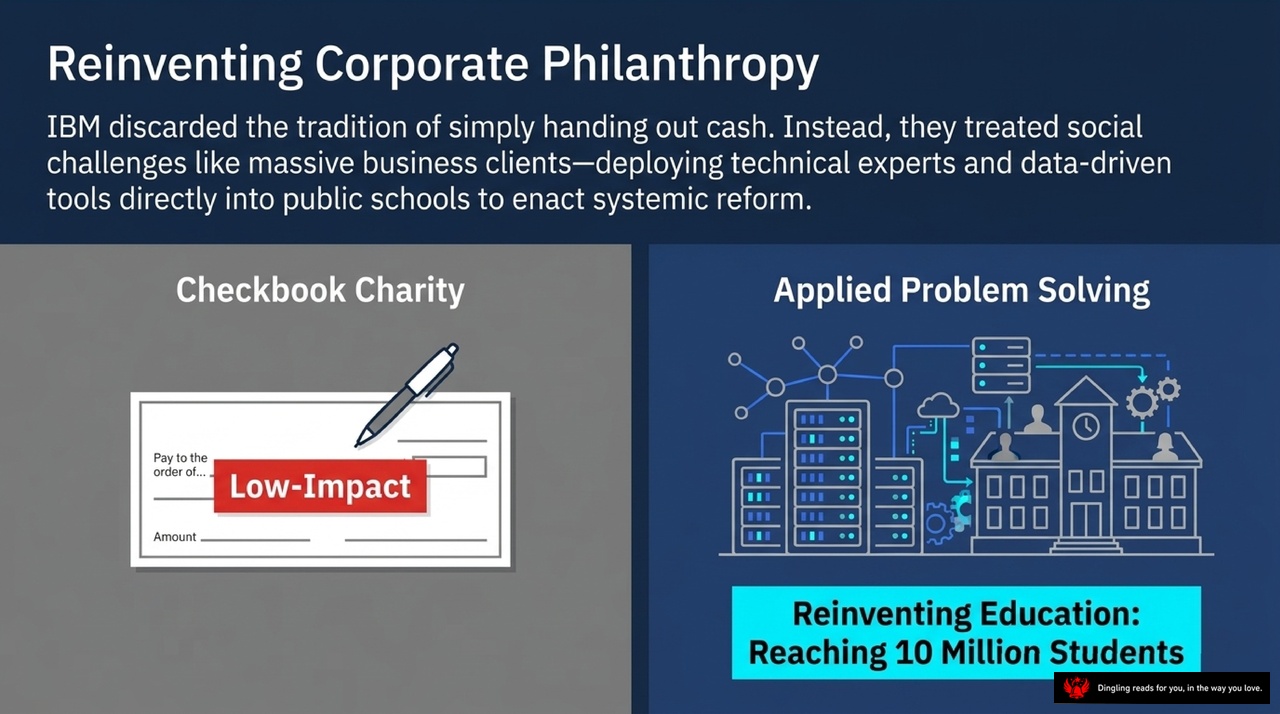
Checkbook Charity versus Applied Problem Solving. For decades, corporate philanthropy was defined by one simple action: writing a check. It was low-impact, transactional, and ultimately, it did very little to solve the root causes of social problems. But IBM decided to change the game entirely. Instead of handing out cash, they reimagined philanthropy as a massive business challenge. They stopped treating social issues as charity projects and started treating them like high-stakes client engagements.
This shift meant deploying their top technical experts and data-driven tools directly into public schools, not to give resources away, but to enact systemic reform. By reinventing education with this applied problem-solving approach, IBM didn't just donate; they partnered to reach 10 million students and transform the learning environment from the inside out. This is the power of moving from simple charity to strategic, applied innovation.

Strategy is merely a document; culture is the game itself. This slide captures the absolute truth of what happened at IBM. While we spent years rewriting our business plans, the real transformation required a brutal, uncompromising rewiring of our human DNA. Look at the text: it highlights that IBM survived only because we aligned a brilliant structural strategy with a complete cultural overhaul. We couldn't just change the org chart; we had to change how people thought and worked together.
The image asks a critical question: What outdated orthodoxies are currently holding your organization back? For IBM, those orthodoxies were the belief that we could operate in a vacuum, that "respect for the individual" meant protecting every employee regardless of performance, and that our internal hierarchy was more important than our customers. We had to kill those old beliefs. We replaced them with a new reality where execution mattered more than planning, and teamwork trumped individual glory.
Today, I want you to apply this lens to your own teams. Are you stuck trying to fix a strategy that your culture actively sabotages? Or are you clinging to old rules that no longer serve your market? The gap between where you are and where you need to be isn't a lack of a better plan; it's a lack of a different culture. Don't just write a new mission statement. Demand execution. Demand teamwork. And most importantly, be willing to tear up the old playbook to build a new one that actually works.