
Why Family Hurts: Complete Chapter-by-Chapter Summary
Welcome to today's session. The image before us features a tightly knotted rope, symbolizing the complex, often tangled nature of family dynamics. The title asks a profound question: "Why Family Hurts." This isn't just about arguments or conflicts; it's about uncovering the hidden psychological patterns that shape our lives.
The core insight we explore is that the couple's relationship is the cornerstone of the entire family system. It acts as the stabilizing force, determining the emotional climate and the mental well-being of every member. When parents prioritize their own connection, creating a bond of mutual respect and nourishment, that love naturally flows to the children, fostering a healthy cycle of growth.
However, many families mistakenly place the parent-child relationship above the marital one. This inversion often leads to the child being burdened with the role of "family savior," forcing them to manage parental emotions and expectations. This not only steals their childhood but also teaches them unhealthy relationship models. True healing begins when we recognize that a secure, loving partnership between parents is the best gift we can give our children. By prioritizing the couple, we create a safe harbor where everyone can truly thrive.

The Cycle of Family Psychology isn't just a theory; it's a mirror reflecting how we actually live. Look at this diagram: it starts with Phase 1, The Root. Before you even turn five, your childhood experiences are quietly shaping your inner world, setting the stage for everything that follows. This foundation often repeats itself in your adult life because, as the center of our circle reminds us, your relationships as a grown-up are largely just projections of how you felt with your parents.
Then comes Phase 2, The Catalyst. Think of romantic love as an unconscious attempt to fix the past. We often subconsciously treat our partners like the ideal parents we never had, hoping they can heal our childhood wounds. But when we reach Phase 3, The Symptom, things get complicated. Unresolved tension between parents doesn't just vanish; it gets transferred onto the children, starting the cycle all over again.
This is why understanding this cycle is so powerful. If we realize that our current struggles are often echoes of the past, we can stop blindly repeating the same mistakes. Instead of letting our parents' unresolved issues define our marriage or our parenting, we have the chance to break the loop. We can choose to see our partners as real people, not just tools to fix our childhood, and raise children who don't have to carry the weight of our unfinished business.

Have you ever stopped to think that your sense of "self" is actually a reflection of how others see you? As the slide suggests, "Existence equals being perceived." For an infant, feeling real isn't about having a body; it's about feeling seen.
This is where the mother becomes the "First Mirror." When a mother responds with empathy and joy, she reflects back a warm, unbroken image. The child looks into this mirror and feels, "I exist, and I am valuable." This creates what the diagram calls the "True Self"—a person who feels safe, connected, and worthy of love.
But what happens when that mirror cracks? The slide shows a shattered reflection representing the "False Self." This occurs when a mother is unresponsive or demands that the child cater to her moods. In that moment, the child learns a devastating lesson: "I must hide my feelings to survive." Instead of seeing themselves as valuable, they learn that their true emotions are dangerous. They fracture their own identity to stay safe, growing up with a hidden, broken core.
This early dynamic sets the stage for a lifetime. If we aren't seen and validated in those first moments, we spend our entire lives desperately trying to be seen, often by attracting people who can't truly hold our weight. But if we can heal that broken mirror, we can stop hiding and finally step into our authentic selves.

Romance is often described as a unique form of psychological healing, but what happens when that healing turns into a repetition of our past? The slide highlights a profound truth: we don't choose partners based on our real parents, but on the ideal parents we wished we had. Look at the two sides of this image. On the left, we see the "Honeymoon Phase." It's beautiful but deceptive. During this time, both partners regress to their childhood states. They offer each other the unconditional love they desperately craved as kids, pretending to be the perfect parents they never had. It feels like a fairy tale because it mirrors the safety of being a child.
However, as the slide shows on the right, this inevitably leads to "The Crisis Phase." The honeymoon ends, and the illusion shatters. Suddenly, your partner is no longer the ideal parent; they are viewed as the real, flawed parent from your childhood. All those suppressed childhood angers and disappointments are unfairly directed at your spouse. The wires connecting the child to the shadowy figure represent these deep, unconscious emotional ties that pull us back into old patterns.
This dynamic explains why some relationships fail so quickly. We are unconsciously searching for a "good parent" to fix our childhood wounds. But when reality hits, and our partner cannot meet these impossible expectations, the relationship collapses. True growth comes when we realize that our partner is not there to save us or complete us. Instead of seeking an ideal parent, we must learn to see our partner as a real, imperfect human being. Only by breaking this cycle of seeking parental approval can we find a healthy, lasting love.

Have you ever noticed how the rules of the workplace completely fall apart the moment you walk through your front door? We often unconsciously bring the "power rules" of our careers into our homes, turning our sanctuary into a second battlefield. Instead of a place for understanding and care, the house becomes a zone for control, competition, and conquest.
This is what psychologists call "power pollution." Whether it's a high-powered executive who continues to give orders at home, a manager who weighs every relationship in terms of profit and loss, or even someone who takes out their frustrations from work by trying to dominate their family, the result is the same: a cold, rigid, and suffocating atmosphere. When we treat our partners and children as objects to be managed rather than humans to be cherished, we destroy the very foundation of intimacy.
The antidote to this power dynamic is simple but profound: we must make "cherishing" the main melody of our family life. This means drawing a clear boundary between work and home. When you walk through that door, leave your job title and your urge to control behind. Replace commands with understanding, and conquest with acceptance. Remember, home is not an extension of your career or a place to prove your value; it is a harbor designed to heal your fatigue. Only when we look at our family members with a soft, cherishing gaze can we truly transform our home into a place where love flourishes.

Many parents mistakenly believe that spoiling their children is an act of selfless love, but the psychological truth is quite different: the essence of spoiling is actually parental narcissism. When parents indulge their kids without limits, they aren't just satisfying their children; they are projecting their own unmet childhood needs onto them, trying to fill their own inner voids with their child's happiness.
This "over-packaging" of love has a devastating effect on a child's self-efficacy—their belief in their own ability to succeed. When a toddler tries to reach a ball ten feet away, stumbling and falling, that struggle is the very process through which they build confidence and independence. But a spoiling parent rushes in to grab the ball, inadvertently teaching the child that they don't need to try, and that their success depends entirely on someone else's help. Over time, these children lose the courage to face challenges, becoming fragile and dependent the moment life gets hard.
True love isn't about shielding a child from every obstacle or providing them with the latest material possessions to fill an emotional gap. Real love is about seeing the child's true needs and giving them the freedom to explore, make mistakes, and grow into their own capable, independent selves. Instead of controlling their lives with a suffocating "I know best" attitude, parents should step back, offer a safe harbor of unconditional support, and let their children find their own way. Only by respecting their child's independence and stepping out of the role of a controller can parents truly give the gift of freedom, allowing their children to grow into their full potential.
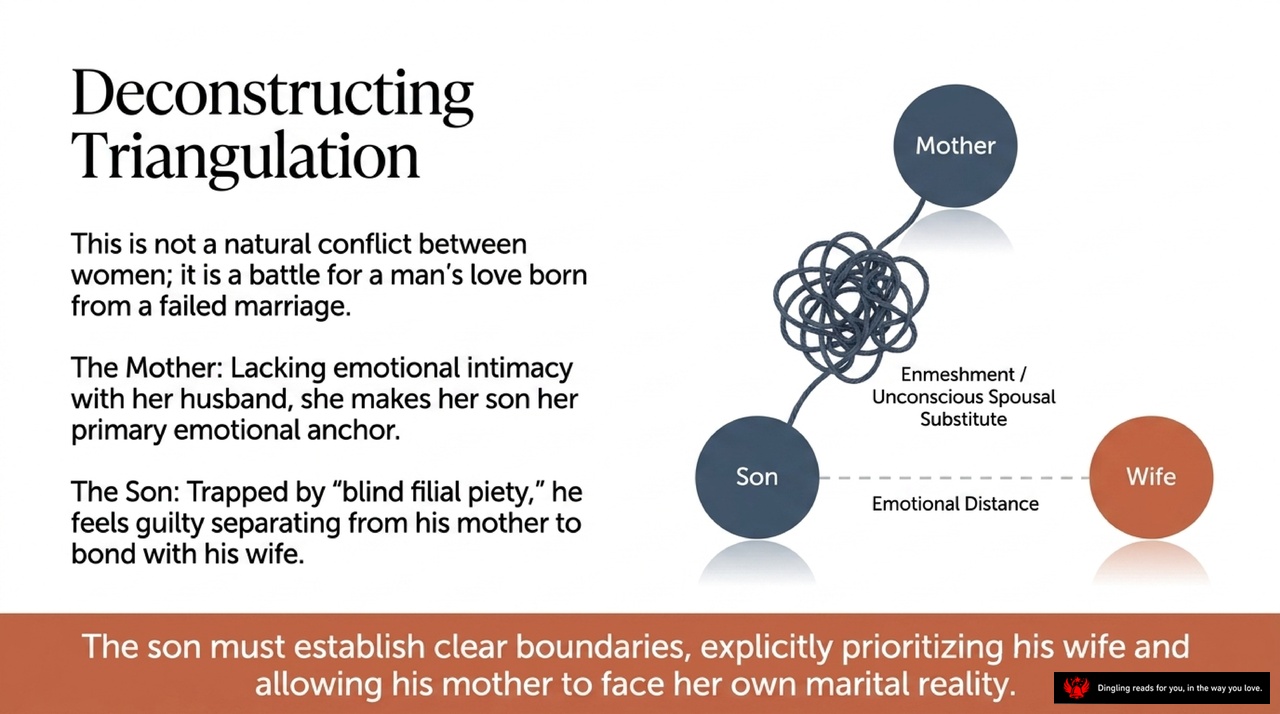
Let's cut through the noise of "mother vs. wife" drama. This isn't a natural battle between women; it's a desperate fight for a man's love, sparked by a broken marriage. Look at the diagram: the mother and son are tangled in a knot labeled "Enmeshment," while the wife sits far away, separated by an "Emotional Distance." Why? Because the mother, lacking true intimacy with her husband, has made her son her primary emotional anchor. She's using him as a substitute for the spouse she lost. Meanwhile, the son is trapped by blind filial piety, feeling guilty about leaving his mother to bond with his wife. To fix this, the son must establish clear boundaries, explicitly prioritizing his wife and allowing his mother to finally face her own marital reality.

Spoiling isn't love; it's a subtle form of control. Think about it: when a parent says, "I love my child too much to see them struggle. I will do everything for them," they aren't actually serving the child. They are projecting their own inner child onto them. Instead of nurturing the real person in front of them, they are over-satisfying their own unmet childhood needs. This creates a narcissistic extension where the child becomes an extension of the parent, erasing their independent boundaries.
What we often call "over-love" is actually "over-hindering." By removing every obstacle, we destroy the child's self-efficacy. We leave them unable to cope with the external reality of the world. True love isn't about shielding them from every fall; it's about giving them the space to stand up on their own. Spoiling creates dependency, not security. It's time to stop controlling and start empowering.

The heavy burden of parental anxiety isn't just a feeling; it's a psychological inheritance that gets passed down from society, through parents, and finally crushes the child. Imagine a three-tiered tower where the foundation is shaky because the middle layer has stopped growing.
At the top, we have Society. But the real problem starts in the middle: the Parent. When parents stop their own psychological growth, they don't just feel anxious; they unconsciously transfer that anxiety and their own unfulfilled ambitions onto their children. This is the mechanism at work. Instead of being a separate, independent human—a "You"—the child gets reduced to a tool, an "It," designed solely to prove the parent's worth to society.
This "I vs. It" relationship is where the damage happens. The parent sees the child not as a person with their own dreams, but as an extension of themselves. The result? The child's life energy is completely drained. Yes, they might achieve academic success, appearing perfect on the outside. But underneath, they are suffering from severe depression, a deep sense of emptiness, or turning into extreme passive-aggressive rebels.
The tragedy is that these children aren't failing because they lack talent; they are failing because they were never allowed to be themselves. They spent their entire childhood carrying the weight of their parents' unfinished lives. To break this cycle, parents must first stop using their children as a safety net for their own insecurities and start honoring them as independent individuals.

When a marriage is falling apart, something heartbreaking often happens: the child steps in to become the family's protector. As our slide illustrates, this is a tragic but common phenomenon. Children instinctively act as the glue, trying to force their parents to stop fighting and unite to "fix" the child.
But how does this happen? The method is subtle yet devastating. Subconsciously, the child develops severe behavioral issues, physical illnesses, or academic failures. These problems aren't random; they are a cry for help designed to pull the parents' attention away from their conflict and onto the child's suffering. The child feels that their only value lies in being the reason for the parents to come together.
This dynamic creates a toxic cycle where the child is forced to sacrifice their own childhood and well-being just to save the family unit. It's a heavy burden that no child should carry. As we've discussed, the solution lies in breaking this cycle. Parents must explicitly tell the child: "Our relationship problems are ours to solve. You do not need to save us." Only when parents take full responsibility for their own relationship can the child finally be released from the role of the family savior and allowed to grow into a healthy, independent individual.
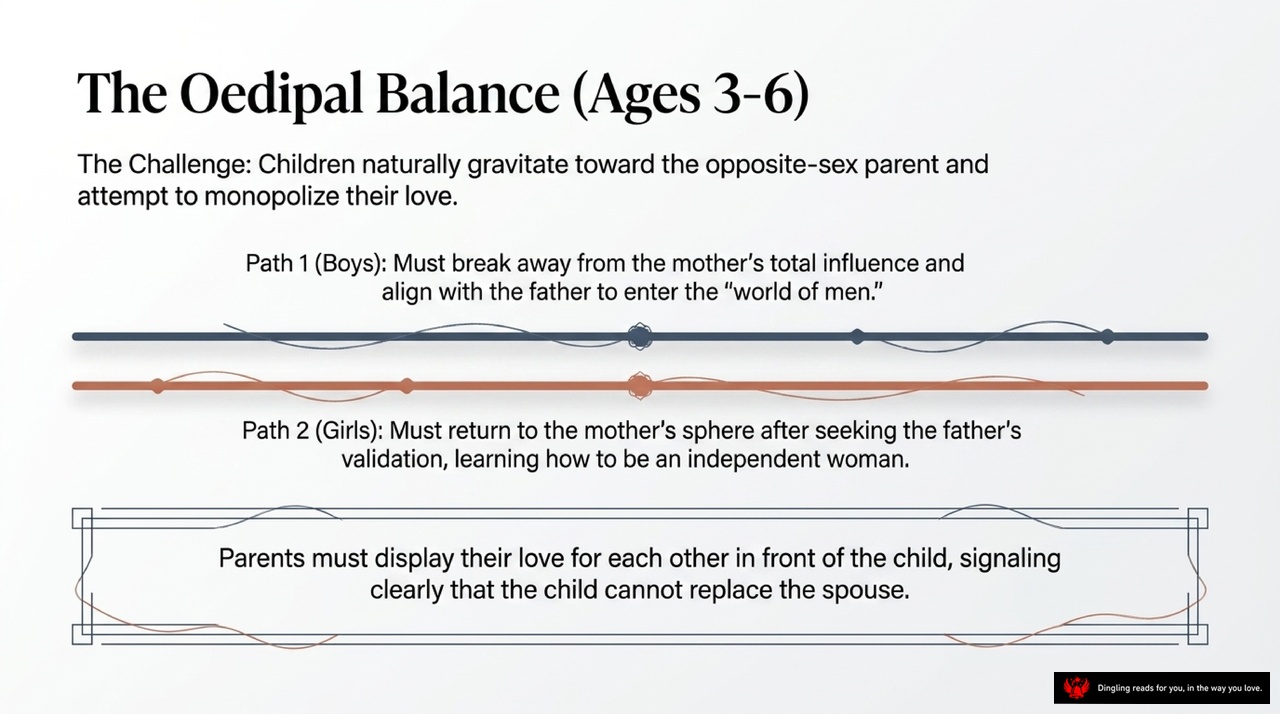
Today's slide focuses on a critical developmental phase: the Oedipal Balance, which unfolds between ages three and six. It's a time when children naturally gravitate toward the opposite-sex parent, often trying to monopolize their love. This is the core challenge parents must navigate.
For boys, the path involves breaking away from the mother's total influence and aligning with the father to enter the "world of men." It's about stepping out of the maternal sphere to find their own identity. For girls, the journey is slightly different; they must first seek the father's validation and then return to the mother's sphere, learning how to be an independent woman.
But here is the most crucial rule for parents: you must display your love for each other in front of the child. By modeling a healthy, loving partnership, you signal clearly that the child cannot replace the spouse. This isn't just about affection; it's about defining boundaries. When parents prioritize their relationship, the child learns their proper place in the family structure, allowing them to develop a secure sense of self and gender identity without confusion.

Let's dive into the most critical boundary in any healthy family: the line between the workplace and home. As this slide clearly illustrates, we operate under two completely different rule sets. In the workplace, power rules. It's a domain focused on logic, right versus wrong, efficiency, and solving problems. We are there to compete, control, and conquer. But the moment you walk through your front door, you must leave those power dynamics behind.
The home operates on "cherishing rules." Here, the objective facts matter far less than how the other person feels. In a family, acknowledging a feeling is the ultimate truth. When a family member vents, they aren't asking for a logical solution; they are seeking emotional connection. If you offer advice or try to "fix" their problem with your workplace logic, you actually block that connection. You are bringing the wrong tool to the wrong room. To truly nurture your family, you have to switch gears: trade your need to control for your desire to understand, and replace efficiency with empathy.

Love and separation are eternal themes that shape our entire lives. Look at this image: a tree gently releasing a leaf into the light. This simple moment captures a profound truth often misunderstood by parents. Healthy families are filled with love, yet they also deeply understand and encourage separation. This might sound paradoxical, but it is the very essence of true parenting.
The purpose of parenting is not to keep your children forever, but to push them out into a broader world to live independent, autonomous lives. True love requires the courage to let go. Without separation, love becomes entanglement—a suffocating bond that stifles growth. Without love, separation becomes abandonment, leaving the child alone and afraid.
Think about your own childhood. Did you feel safe when your parents let you explore the backyard alone? Or did you feel anxious because they held on too tight? The most loving thing a parent can do is to be a secure base, watching from the branches of the tree while the leaf floats away, ready to catch it if needed, but trusting the wind to guide the journey.
We often fear separation because it feels like loss. But in reality, separation is the gift of individuality. It allows us to become our own selves, to make our own choices, and to build our own lives. When we embrace this balance of love and separation, we create a space where both parents and children can truly thrive. Love gives us the strength to let go, and separation gives us the freedom to fly.
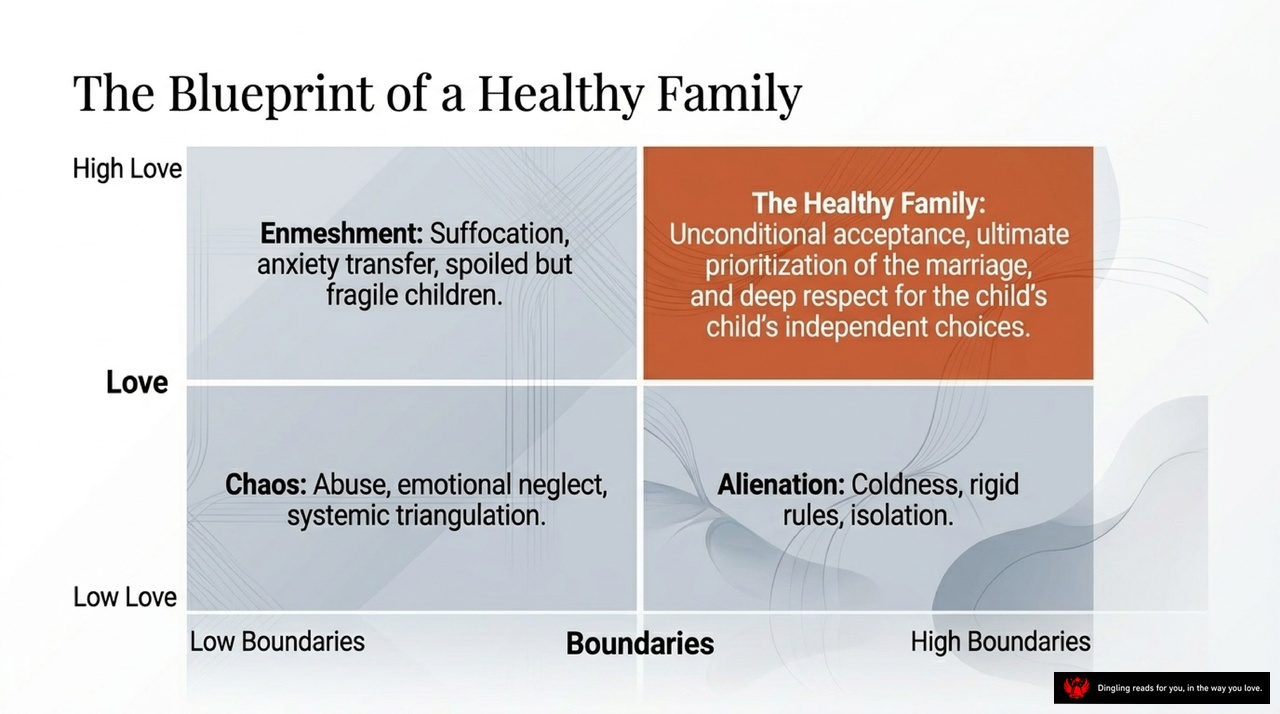
Imagine a family not as a tangled knot, but as a perfectly balanced blueprint. Look at this grid: it maps out four distinct family dynamics based on two simple factors—how much love flows between the parents, and how clearly the boundaries are drawn.
In the top right, where we have high love and high boundaries, lies the ideal: the Healthy Family. This is the sweet spot. Here, we see unconditional acceptance, a marriage that is truly prioritized above all else, and a deep respect for the child's independent choices. It's the only quadrant where everyone thrives.
Now, look at the top left. High love, but low boundaries. This is "Enmeshment." It sounds warm, but it's actually suffocating. You have anxiety transfer, spoiled yet fragile children, and a total lack of individual space. It's love without limits, which ultimately destroys the child's ability to stand on their own.
Move down to the bottom left. Low love, low boundaries. This is "Chaos." Here, we find abuse, emotional neglect, and systemic triangulation. When parents don't respect each other and don't set limits, the home becomes a battlefield of pain and confusion.
Finally, the bottom right: Low love, but high boundaries. This is "Alienation." It's a cold, rigid environment filled with isolation. The parents are distant, the rules are harsh, and the child is left feeling alone and unseen.
The lesson is clear: you need both. You need the warmth of high love to feel safe, and the strength of high boundaries to grow up. Without either, the family blueprint crumbles.

A healthy family isn't just about how much we give to our children; it's built on two essential pillars: unconditional love and the courage to separate. Too often, we trap the people we love most in a cycle of suffocation and control by failing to prioritize our spouses, respecting our children's boundaries, or healing our own childhood wounds. When we blindly repeat the psychological patterns of our past, we deny our family the freedom to truly live. But the question we must ask ourselves is: are you brave enough to break this cycle? True love means allowing your children to become independent individuals rather than extensions of yourself. It means realizing that while parenting is a journey, it is not a destination where we stay forever. By prioritizing the connection between partners and honoring the natural process of separation, we create a safe space where everyone can grow, breathe, and thrive as their authentic selves.