
Why Information Grows: Complete Chapter-by-Chapter Summary
Welcome to the book club for *Why Information Grows* by César Hidalgo. Today, we're diving into the core question that changes everything: Why does information grow?
The cover sets the stage perfectly. It asks us to look at the evolution of order, moving from atoms all the way to economies. But here is the book's most provocative claim: the secret to economic growth isn't the accumulation of capital. Instead, it lies in the universe's relentless battle to create physical order.
Think about this for a moment. When you buy a Bugatti Chiron for over two million dollars, what are you actually paying for? You aren't paying for the atoms. If you crashed that car into a wall, the weight would stay the same, but the value would vanish instantly. Why? Because the value wasn't in the metal; it was in the specific arrangement of those parts. That arrangement is information. That specific order is the physical embodiment of human imagination.
This book argues that the economy is essentially a system for making the intangible tangible. It's the mechanism we use to turn ideas into objects. When we build a product, we are freezing our knowledge and technology into a physical form that can be shared and used. This process of "concretizing imagination" is what drives our progress forward.
So, as we turn the page, we will explore how this battle for physical order starts from the very physics of the universe and scales up to shape the global economy. Let's begin.

The universe has a built-in tendency to fall apart. It naturally drifts toward disorder, chaos, and entropy. This is what physicists call the "Cosmic Default"—an eternal battle where everything eventually decays into randomness. Think of it like a spilled glass of water; without constant effort, it just spreads out until it's uniform and useless.
But look at our planet. Earth is a massive anomaly in this chaotic universe. Instead of decaying, we are building immense physical order. From the intricate double helix of DNA to the sprawling skylines of modern cities, we are creating dense oases of complexity. We are taking atoms and arranging them into biological life, machines, and economies that defy the natural trend toward chaos.
This slide captures the core tension of our story: while the cosmos pulls everything apart, human imagination and social networks are pulling everything together. We are fighting the cosmic tide by encoding our ideas into solid objects—products, tools, and systems. These aren't just piles of matter; they are containers of information, holding the knowledge and technology that allow us to do things we couldn't do alone. This constant struggle against entropy, where we use energy to build order, is the very engine of human progress.
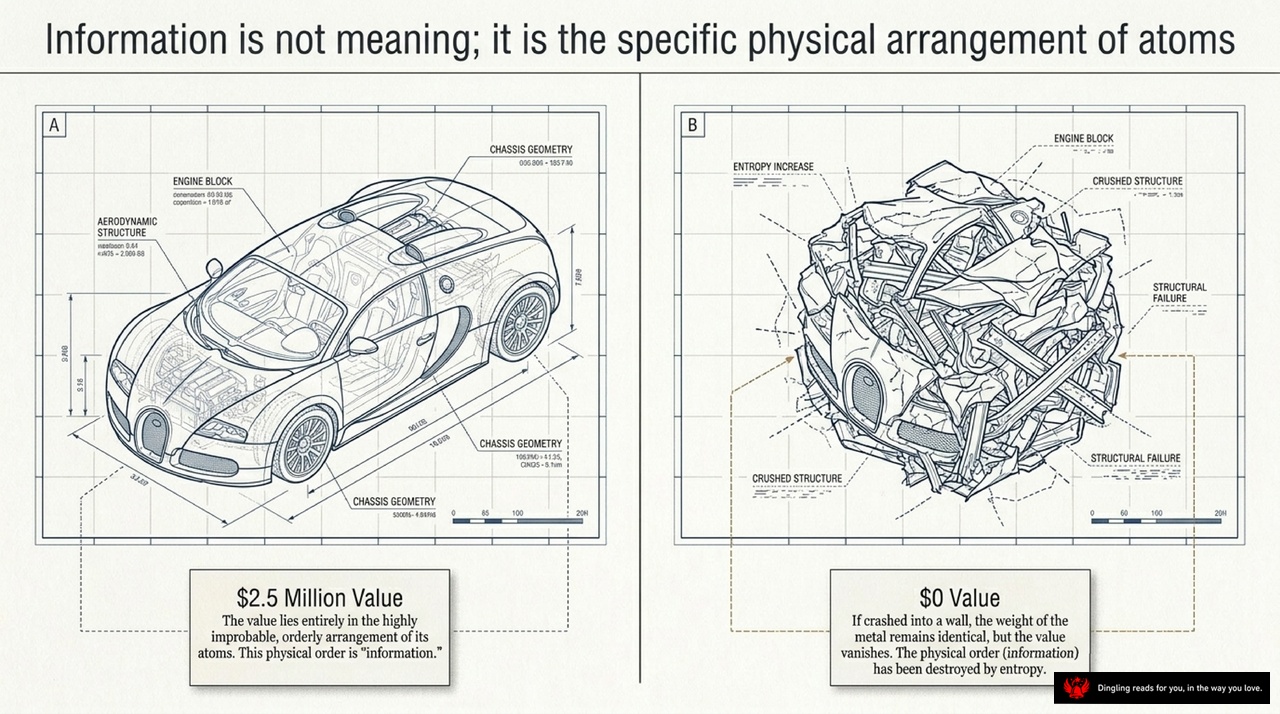
Imagine you just won a Bugatti Veyron, the most expensive car in the world, priced at a staggering $2.5 million. You drive it to a cliff and crash it. In an instant, that sleek, aerodynamic masterpiece becomes a twisted pile of scrap metal. Here is the mind-bending reality: the weight of the car hasn't changed. The engine block is still there, the copper wiring is still there, and the steel chassis is still there. But the value? It has vanished completely, dropping from $2.5 million to $0.
Why? Because the value of this car never resided in the atoms themselves. It lived entirely in their specific, highly improbable physical arrangement. That precise order—the way the parts fit together to create a functional machine—is what we call "information." When the car crashes, entropy increases, the structure fails, and that delicate order is destroyed. The information is gone, even though the matter remains.
This distinction is crucial. A crushed car and a functioning car are made of identical substances, but they hold vastly different amounts of value because one possesses a complex, ordered structure while the other is in a state of random chaos. This physical order is the essence of information. It explains why a simple sheet of paper is worth little, but that same paper folded into a specific origami crane becomes something else entirely. The information isn't in the paper; it's in the pattern. And just like that car, our entire economy, our technologies, and even our lives are built on this invisible architecture of physical order.

The universe doesn't just exist; it actively generates and protects order through a sophisticated three-part physical engine. This slide breaks down that engine into three distinct stages: Out-of-Equilibrium Flows, Crystallization, and Matter Computing.
First, look at the left side. We have **Out-of-Equilibrium Flows**. Imagine water draining from a bathtub. That swirling vortex isn't random chaos; it's a temporary, spontaneous order created by energy moving through a system. This is the universe's way of creating structure, but here's the catch: this order is fragile. Without a constant flow of energy, the vortex collapses back into disorder. It's a fleeting state.
Next, the middle panel shows **Crystallization**. This is where the magic happens. Solid matter—like the lattice structure of a crystal, or even the double helix of DNA—acts as a freezer for time. It takes that temporary order from the flowing energy and locks it in place. Think of it as capturing a snapshot of a dynamic process and making it permanent. This "freezing" protects the order from the natural decay of entropy, turning a fleeting moment into a stable, enduring structure.
Finally, on the right, we see **Matter Computing**. Once the order is frozen in matter, that matter gains the ability to process information. Look at the diagram blending a biological cell with a microchip. Matter isn't just static; it's an active processor. It takes environmental inputs, calculates the best response to survive, replicates itself, and generates even more order. From bacteria to complex human brains, this is how matter computes its way toward greater complexity.
So, the story is clear: Energy flows create temporary patterns, solid matter freezes those patterns into lasting structures, and those structures then compute their way into the future. This three-part engine is the fundamental reason why the universe is moving from chaos toward ever-greater order.

Humans are unique because we export our imagination into solid matter. Look at the two blueprints on this slide. On the left, we see a natural fruit specimen—an apple. Its structure is defined by DNA and biochemical reactions, a biological order created long before human markets existed. It survives because of chemistry, not because of a design in someone's mind.
Now, look at the right side. This is a manufactured product spec, specifically an iPhone. Notice the TrueDepth camera, the MagSafe coil, the Li-ion battery pack. Every single component here was not found in nature; it was born in a human mind first. The iPhone existed as an idea before it ever existed as a physical object. This is crystallized imagination. While the apple is a product of nature, the iPhone is a product of human order.
This distinction is the key to understanding our economy. Products are not just objects; they are the physical manifestation of human thought battling against entropy. When we buy a complex device, we aren't just buying metal and plastic; we are buying the accumulated knowledge and technology of thousands of people, frozen into a solid form. This ability to turn abstract ideas into tangible reality is what allows us to build a future that no single person could ever imagine alone.
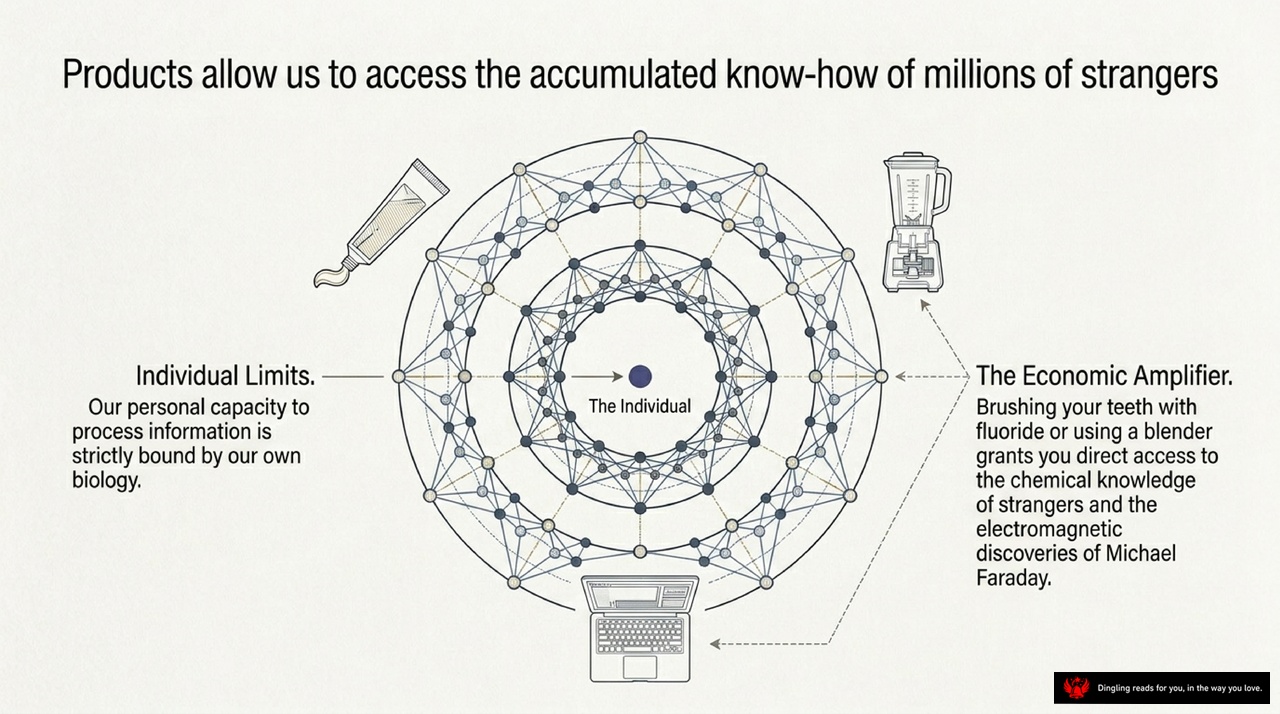
Look at this diagram. It perfectly captures a fundamental truth about our modern world: products allow us to access the accumulated know-how of millions of strangers.
On the left, we see "Individual Limits." Our biology is the hard ceiling for how much information we can process. No matter how hard you try, your brain has a finite capacity. You can't reinvent the wheel or master advanced chemistry on your own.
But look at the right side: "The Economic Amplifier." This is where the magic happens. When you use a toothpaste tube or a blender, you aren't just holding plastic and metal. You are instantly accessing the chemical knowledge of chemists, the engineering insights of mechanical designers, and the historical discoveries of figures like Michael Faraday. The product acts as a bridge, collapsing the gap between your individual limitations and the collective genius of humanity.
The complex network in the center represents this vast web of human knowledge. Products are the physical nodes that let us tap into it. Without this amplification, our capabilities would remain stuck at the level of our biology. With it, we can do things that would be impossible for a single person. This is the engine of progress: turning abstract human knowledge into tangible objects that anyone can use.

While information zips across the globe instantly, practical know-how remains stubbornly anchored to the ground. As this slide illustrates, there is a fundamental divide between what we can easily share and what we actually need to succeed.
On the left, we see "Information," depicted as a light feather. This represents explicit knowledge—things like chemical formulas, blueprints, or data on a USB drive. This is highly mobile; it can travel across borders and oceans without friction. For example, knowing the exact formula for a lithium-ion battery is easy to transmit anywhere in the world.
However, look at the right side. This is "Know-How," symbolized by a heavy anvil. This represents tacit knowledge—unspoken, experiential capability stored in human nervous systems. It is socially learned and incredibly difficult to transfer. While you can email the battery formula to anyone, you cannot simply email the physical and organizational expertise required to actually manufacture that battery at scale. That deep, practical know-how is geographically heavy. It stays where the people and the specific social networks are.
So, while the world is connected by data, true innovation and production depend on where that heavy, embedded expertise lives.
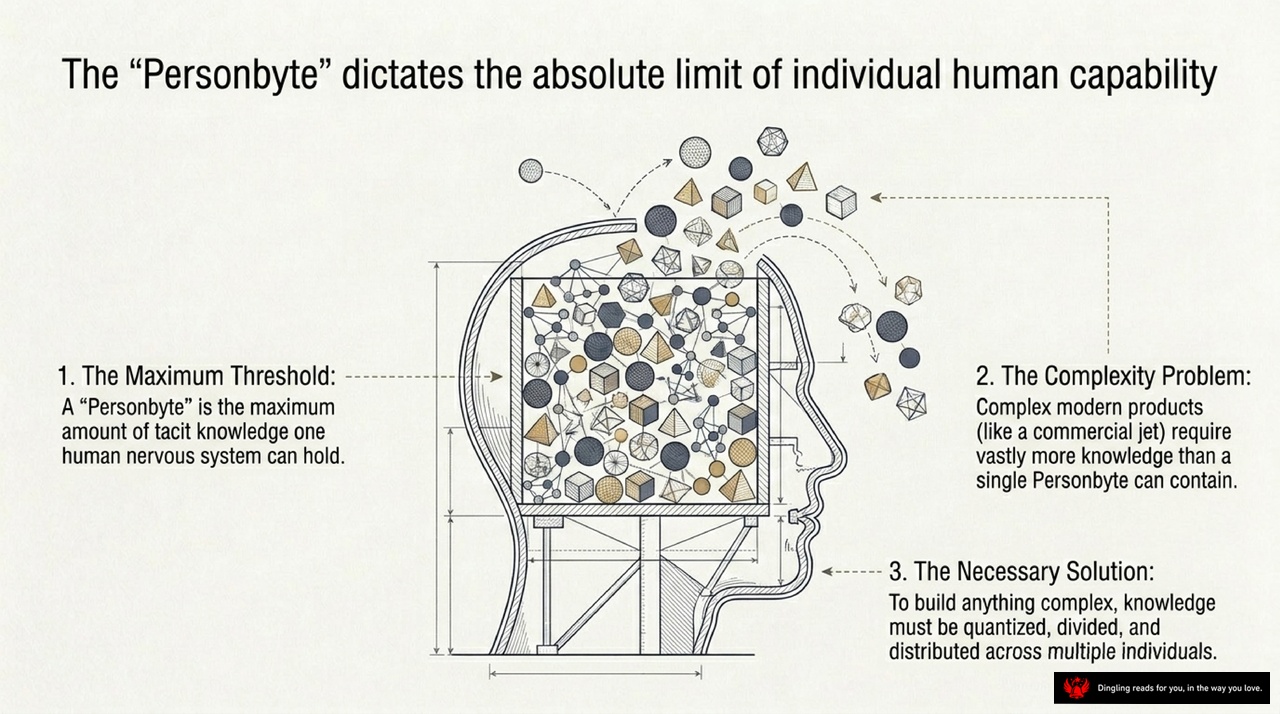
The slide breaks down a powerful concept: the "Personbyte." Think of it as the absolute ceiling of what one human brain can hold. It's the maximum amount of tacit knowledge—those skills and intuitions you can't easily write down—that fits inside a single nervous system.
But here's the problem: modern products, like a commercial jet, require vastly more knowledge than a single person can contain. No one individual has the capacity to know everything needed to build a plane from scratch.
So, what's the solution? We have to quantize, divide, and distribute that knowledge across multiple individuals. This is the necessary evolution of how we build complexity. Instead of relying on one genius, we build networks. We break down the impossible task into manageable pieces, assigning each part to a different expert.
This diagram shows exactly that flow: knowledge fragments entering the mind, hitting the "Personbyte" limit, and then spilling out to be distributed across a wider group. It explains why global collaboration isn't just a nice idea—it's a physical necessity. Without this distribution, we simply couldn't create the complex technologies that define our modern world. The limit of the individual forces us to build the collective.
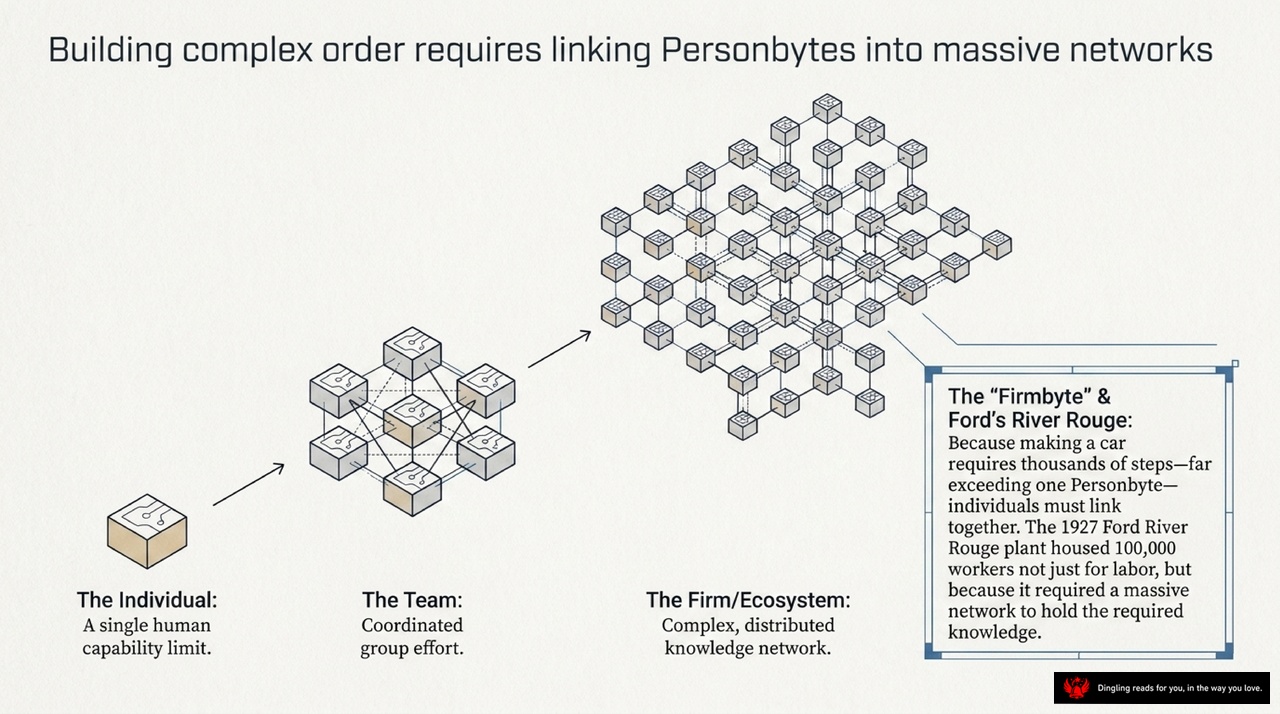
Building complex order isn't magic; it's about linking individual "Personbytes" into massive, interconnected networks. As the slide illustrates, we start with the individual—a single human has a hard ceiling on what they can know or do. But when you move to a team, you're no longer limited by one brain; you're leveraging coordinated group effort. And when you scale up to a firm or an entire ecosystem, you create a complex, distributed knowledge network that can solve problems no single person ever could.
Think about Ford's River Rouge plant from the 1920s. It wasn't just a factory; it was a "Firmbyte." Why? Because building a car requires thousands of steps—far exceeding what one person can handle. That plant housed 100,000 workers not just to provide labor, but to house a massive network capable of holding the required knowledge. The car itself was just the output; the real value was the intricate web of people and processes that made it possible.
This is the core insight: to build anything truly complex, you must link individual capabilities into a vast social structure. The slide shows this progression clearly—from the solitary cube of one person, to a small cluster of a team, and finally to the sprawling grid of a global ecosystem. Without these massive networks, we would remain trapped at the limits of our individual biology. It's only by connecting our minds that we can create the sophisticated world we live in today.

Social trust acts as the invisible glue holding our complex knowledge networks together. Think of the intricate web in the center of this slide: connecting individual "Personbytes" into a powerful "Firmbyte" isn't free. As the diagram highlights, every link carries a hidden price tag. Transaction costs, management overhead, and constant friction are always threatening to pull these networks apart.
However, the solution lies in viewing trust not just as a virtue, but as essential infrastructure. In societies where people trust one another, they can organically build and maintain much larger networks without getting bogged down in bureaucracy. These expansive networks act as a massive repository for know-how, allowing us to create far more complex products than we could alone.
Consider the difference between a high-trust environment and a low-trust one. In a high-trust society, you don't need to spend months negotiating contracts or verifying every detail with a stranger; the trust itself does the work, lowering the cost of connection. This allows knowledge to flow freely across the network, fueling innovation. Conversely, without this trust, the cost of connection becomes so high that networks remain small, fragmented, and incapable of generating the complex solutions we need today. Ultimately, it's the level of social trust that determines whether we remain a collection of isolated individuals or evolve into a cohesive, powerful global engine for progress.
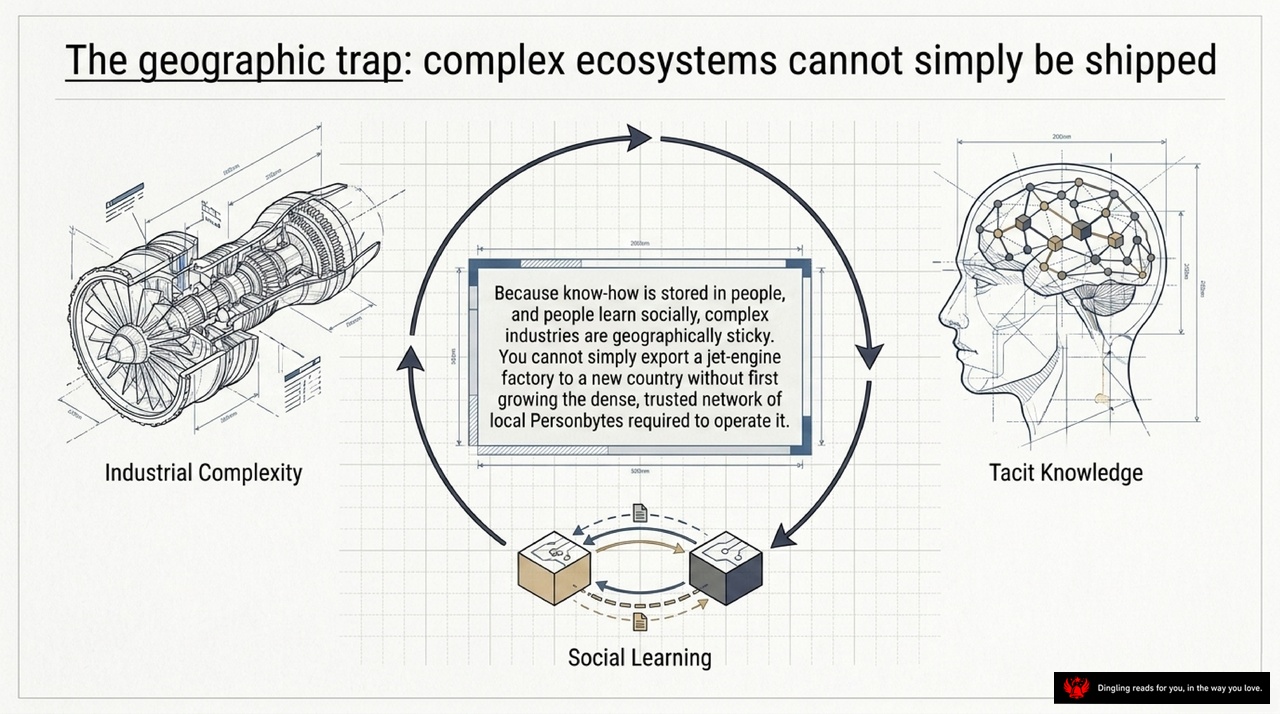
The geographic trap is a powerful concept: complex ecosystems simply cannot be shipped. As the slide illustrates, trying to export a jet-engine factory to a new country without first building the local foundation is like trying to move a brain without the neural pathways to support it.
This is because know-how is stored in people, and people learn socially. That's why complex industries are geographically sticky. You cannot just copy a blueprint and expect success. You need to grow a dense, trusted network of local "Personbytes"—the individuals who hold the tacit knowledge required to operate the system.
Look at the cycle here: it starts with industrial complexity, which relies on social learning. Knowledge isn't just in manuals; it's in the interactions between people. That social learning builds up tacit knowledge, which in turn fuels further industrial complexity. It's a self-reinforcing loop that takes time to build.
This explains why some nations dominate high-tech manufacturing while others remain stuck exporting raw materials. The gap isn't just about capital or resources; it's about the invisible architecture of trust and social networks that allows complex ideas to take root and thrive. You can't skip the hard work of building that local ecosystem.

The Economic Complexity framework fundamentally redefines how we understand growth, shifting the focus from financial wealth to the accumulation of real, tangible order.
On the left, you see **Traditional Economics**. It measures success by aggregate inputs like labor, capital, and GDP. It treats a dollar of raw copper the same as a dollar of microchips, focusing purely on financial wealth and resource allocation. In this view, the value is in the stuff itself.
But look at the right side: **Complexity Economics**. This approach argues that what truly matters is the diversity and ubiquity of the products a country can actually make. It treats products not as commodities, but as unique, crystallized manifestations of networked know-how. Instead of just counting money, it focuses on the accumulation of physical order and computational capacity.
This is a massive shift. It suggests that a nation's future isn't determined by how much money it has today, but by how complex the web of knowledge embedded in its products is. When we move from selling raw materials to manufacturing intricate goods, we aren't just trading objects; we are exporting the very capability to solve problems. This framework reveals that economic growth is really just the physical manifestation of our collective ability to organize information into something useful.

What a country makes strictly predicts its future prosperity. Look at this chart: we're plotting export diversity and complexity from the year 2000 against per capita GDP. The trend is undeniable. At the top right sits Singapore, boasting high complexity and high GDP. In the middle, we have Chile with medium complexity and medium GDP. And at the bottom left, Pakistan, characterized by low complexity and low GDP.
The core insight here is captured in that box on the right: the 10-to-15-year horizon. Countries that produce highly complex, exclusive products organically pull their GDP upward. To earn more, an economy must physically build more complex order.
Think of it this way: a country's wealth isn't just about how much stuff it exports, but *what* it exports. If a nation only exports raw materials or simple goods, it's stuck in a low-complexity trap. But if it manufactures intricate, high-value products—think of the advanced machinery, electronics, or pharmaceuticals—it's signaling that its society possesses deep knowledge, sophisticated technology, and strong social networks.
This complexity acts as a self-reinforcing engine. Creating complex products requires a skilled workforce, reliable infrastructure, and trusted institutions. Once a country builds this capability, it attracts more investment, fosters innovation, and naturally climbs the ladder of prosperity. It's a physical reality: the ability to create complex order is the single strongest predictor of a nation's long-term economic success. So, when we look at trade data, we aren't just seeing numbers; we're seeing a country's potential for the next decade and beyond.

The global economy isn't just a marketplace for trading goods; it's a massive, distributed biological computer actively fighting against chaos. As this slide illustrates, our economic systems are vast processing networks where human minds link up to establish trust and turn imagination into solid matter. By connecting these dots across the world—from population density to organic economic flows—we create a structure that pushes back against the cosmic tide of entropy.
Look at the transition from the world map to the circuit board. This visual shift represents the core idea: we are building a crystallized computation architecture using silicon and human ingenuity. Every product we create, from a simple tool to a complex machine, is a way of encoding information into physical reality. This process allows us to store knowledge, bypass the limits of individual memory, and solve problems that no single person could tackle alone.
In essence, the economy functions like a supercomputer. It takes the raw energy of the world and the scattered ideas in our heads, processes them through social and technological networks, and outputs a world of order and complexity. Without this collective computing power, we would be stuck in a state of high entropy—disorder and decay. But by continuously innovating and connecting, we maintain a low-entropy state, creating a sustainable and evolving civilization. This is the fundamental magic of the economic system: turning fleeting thoughts into permanent, tangible progress.

Economic growth isn't just about making more stuff; it's the universe's ultimate way of turning chaos into physical order. Think about it: our minds have a unique superpower to take pure imagination and crystallize it into matter. That's how we move from a jumble of raw elements to a world of structured, valuable things.
But here's the critical question for you right now: What distinct know-how are *you* contributing to this global network? Every single product you help create—from a simple tool to a complex machine—is a snapshot of human knowledge and imagination made real. When you contribute your specific skills, you aren't just adding a part; you're helping weave a complex order that benefits everyone.
Consider the difference between a pile of metal and a running car. The metal is just matter; the car is information made physical. Your unique expertise is the invisible code that transforms that raw matter into something useful. So, ask yourself: What specific piece of the puzzle do you hold? How does your ability to process information and solve problems help the entire system generate new value and order?
In a world driven by this networked capacity, your distinct know-how is the fuel that keeps the engine of economic growth running. It's the bridge between what we can imagine and what we can touch.