
Why Nations Fail: Complete Chapter-by-Chapter Summary

Welcome to today's session on *Why Nations Fail* by Daron Acemoglu and James A. Robinson. We are here to tackle one of the most persistent questions in human history: why are some nations rich and thriving while others remain trapped in poverty?
The image before us sets the stage for our entire journey. It highlights a powerful, counterintuitive truth: poverty and prosperity are not determined by geography, culture, or ignorance. Instead, they are the result of deliberate choices made by those in power to build either extractive or inclusive institutions.
Think of Nogales, Arizona, as a real-world example. Just across the border in Mexico, the geography, climate, and even the people are nearly identical. Yet, the American side boasts high incomes, excellent public services, and democratic freedom, while the Mexican side struggles with low education, poor infrastructure, and weak institutions. The difference isn't the land; it's the rules of the game.
In this book, we will explore how institutions shape everything from economic growth to political stability. We'll debunk common myths about geography and culture, examine historical examples like the rise of England versus the decline of Spain, and look at modern cases to understand how inclusive institutions foster innovation and wealth, while extractive ones lead to stagnation and failure.
So, let's dive in and understand how the choices we make about our institutions determine our destiny.

Look at this striking split-screen comparison of Nogales. On the left is Nogales, Arizona, USA, and on the right is Nogales, Sonora, Mexico. They share the exact same geography, the same culture, and even the same neighbors, yet their realities are worlds apart.
In the US side, you see a thriving reality: an average income of roughly $30,000, paved road networks, and reliable utilities. The governance here is built on democratic representation and secure property rights, ensuring public health with high life expectancy and access to Medicare.
Just across the border, the picture changes drastically. In Mexico, the average income drops to about $10,000. Infrastructure crumbles into poor road conditions and erratic utilities. Governance is marred by historical corruption and high entry barriers for business. The result is a public health crisis with high infant mortality and lower life expectancy.
This isn't about luck or geography; it's a powerful example of how institutions shape destiny. When you have inclusive institutions that protect rights and encourage innovation, you get prosperity. When you have extractive institutions that concentrate power and suppress opportunity, you get stagnation. The border doesn't create the gap; the rules on either side do.

So, why do some nations thrive while others remain trapped in poverty? The answer isn't geography, culture, or ignorance—it's institutions.
Look at this slide: "Diagnosing Poverty: Debunking the False Hypotheses." We're here to smash three common myths that have fooled the world for centuries.
First, the "Geography Myth." Many believe that tropical climates breed laziness or that poor soil limits agriculture. But history tells a different story. The Aztecs and Incas, living in the tropics, were historically richer than many North American tribes. Even today, Nogales, Arizona, and Nogales, Sonora, share nearly identical geography and climate, yet their economic outcomes are worlds apart. One side is prosperous; the other is struggling. Why? Not because of the land, but because of the rules.
Second, the "Culture Myth." Some argue that certain religions or national work ethics prevent modernization. But look at North and South Korea. They share an identical cultural heritage, yet today, their wealth gap is ten times greater. Culture doesn't drive the gap; institutions do.
Finally, the "Ignorance Myth." This is perhaps the most dangerous lie: that poor leaders simply don't know the right economic policies. The truth is, disastrous policies are often enacted not out of ignorance, but as deliberate political strategies to buy loyalty and maintain power.
The reality is simple: poverty isn't an accident. It's the result of extractive institutions that concentrate power in the hands of a few, stifling innovation and opportunity. Only inclusive institutions can unlock the true potential of a nation.

Today's slide breaks down the core argument of the book: the true engine of a nation's success is its institutional design. Specifically, it contrasts "Inclusive Institutions" with "Extractive Institutions."
Look at the top half, labeled "Inclusive Institutions." This is the blueprint for prosperity. On the political side, you see a scale representing "Broad Power." The text explains this as pluralistic: power is distributed broadly, checks and balances prevent any single group from seizing total control, and the state is strong enough to enforce laws. On the economic side, we see an open gate with a rising graph. This represents "Open Access." It means secure property rights, an unbiased legal system, and a level playing field where anyone can choose their profession. When these two pillars align, they encourage innovation and investment, creating a self-reinforcing cycle of growth.
Now, look at the bottom half, labeled "Extractive Institutions." This is the trap that leads to stagnation. Politically, this is "Narrow Power," depicted by a hand holding a crown over a crowd. It describes an absolutist system where power is concentrated in the hands of a narrow elite with few constraints. Economically, this is "Closed Access," shown by a locked box and handcuffs. These institutions are designed specifically to extract wealth from the majority to benefit a small subset. They feature high barriers to entry, forced labor, and insecure property rights. In such a system, the elite have no incentive to improve public services or foster innovation because they don't need to; they simply take what they can.
The slide illustrates that the difference between a thriving nation and a struggling one often comes down to this fundamental choice: Do you build a system that empowers everyone to participate and compete, or do you build a system designed solely to enrich a few at the expense of the many? History shows that inclusive institutions create a virtuous cycle of wealth creation, while extractive institutions lead to a vicious cycle of poverty and inequality.

Let's dive into the mechanics of prosperity, breaking down exactly how a society moves from political rules to long-term economic growth. Think of it as a three-part machine.
First, we have the engine block: pluralistic political institutions. This is the foundation. It creates the rules of the game and, crucially, gives citizens the power to constrain politicians. If leaders abuse their power, the people have the ability to vote them out. Without this check, everything else falls apart.
Next, those political rules drive the gears: inclusive economic institutions. When politicians are forced to compete for the votes of a broad electorate, they are compelled to provide public goods, protect property rights, and prevent monopolies. They can't just enrich a small clique; they have to satisfy the wider population to stay in power. This creates an environment where everyone has a stake in the system.
Finally, this setup produces the output: creative destruction. Because citizens feel safe and their rights are protected, they have the incentive to invest and innovate. New technologies replace old ones, driving sustainable, long-term growth. Old industries might die, but new ones rise, and the economy evolves rather than stagnating.
Look at the arrows connecting these boxes. It's a causal chain. You can't have the output without the gears, and you can't have the gears without the engine block. If you remove the ability of citizens to hold leaders accountable, the whole system collapses into extractive institutions where power is used to exploit rather than create. This simple framework explains why some nations thrive while others remain trapped in poverty.

Imagine two sides of the same coin: Thomas Edison in the USA and Carlos Slim in Mexico. The slide contrasts two distinct paths to wealth: innovation versus extraction.
On the left, we see Edison, representing the "Innovation" path. His environment was defined by a highly competitive banking system and an accessible patent framework, protected by laws like the Sherman Antitrust Act. Instead of hoarding power, he chose to innovate. By harnessing an inclusive market, he patented groundbreaking inventions like the lightbulb and the phonograph. The result? He didn't just get rich; he created entirely new industries and lifted the living standards of society as a whole.
On the right stands Carlos Slim, the embodiment of the "Extraction" model. His environment was starkly different: monopolistic banking, high barriers to entry, and a culture of political favoritism. Rather than building something new, Slim used extraction. He leveraged political connections to purchase the privatized Telmex monopoly and utilized legal loopholes, specifically the Amparo, to block any potential competitors. The outcome was wealth generated by cornering existing markets and charging exorbitant prices, which ultimately stifled broader economic growth.
This comparison highlights a fundamental truth: wealth isn't just about how much money you make, but *how* you make it. Innovation drives progress and benefits everyone, while extraction enriches a few at the expense of the many and the future.
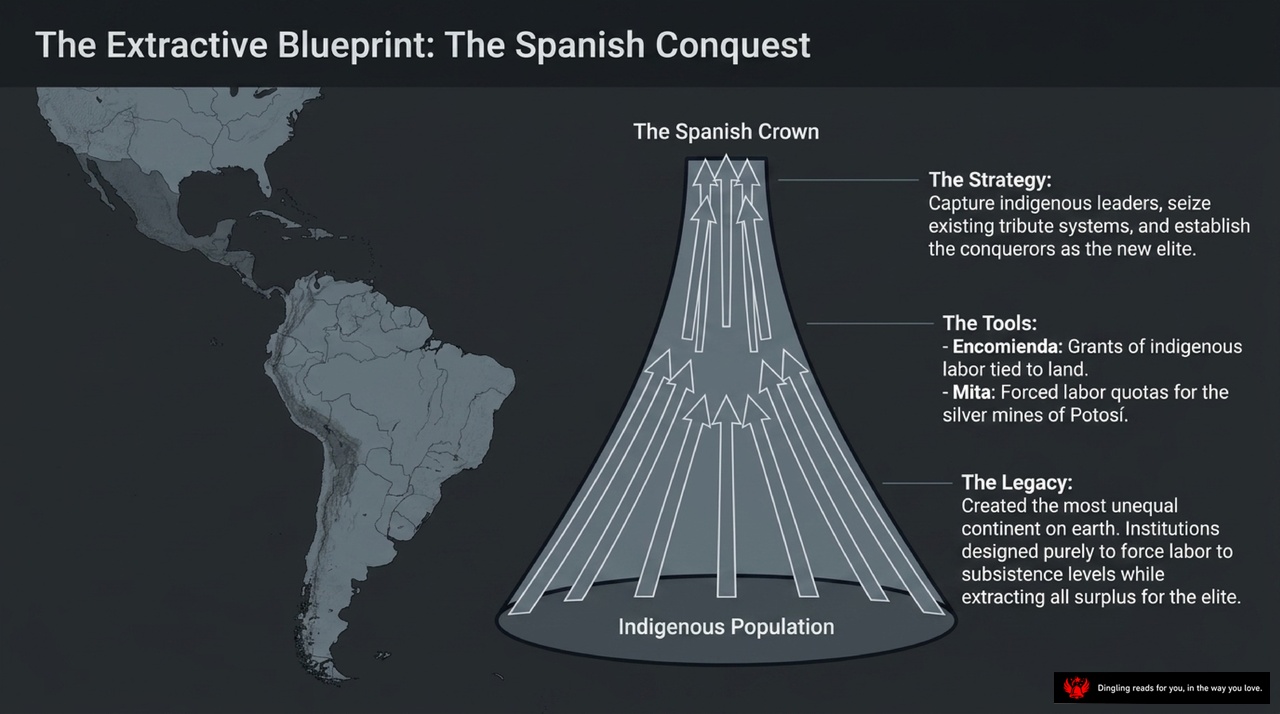
Today's slide, "The Extractive Blueprint: The Spanish Conquest," visualizes a terrifyingly efficient funnel designed to drain wealth from the bottom to the top. Look at that map of the Americas; it wasn't just a battlefield, it was a factory floor. At the wide base sits the Indigenous Population, representing the vast majority of people. At the narrow peak is The Spanish Crown, the ultimate beneficiary. The arrows flowing upward illustrate the flow of resources, but more importantly, the flow of power.
This blueprint relied on three specific mechanisms. First, The Strategy: capturing indigenous leaders and seizing existing tribute systems to install conquerors as the new elite. Second, The Tools: specifically the *Encomienda*, which granted indigenous labor tied to land, and the *Mita*, a forced labor quota system for the silver mines of Potosí. These weren't just random acts of violence; they were institutionalized methods of extraction. The result, labeled as The Legacy, was the creation of the most unequal continent on earth. Institutions were designed purely to force labor to subsistence levels while extracting all surplus for the elite.
This extractive blueprint left a scar that lasted for centuries. Unlike the inclusive institutions that developed in North America, this system created a path dependency where power remained concentrated in the hands of a few, while the many were systematically excluded from prosperity. It explains why, despite sharing the same geography and climate, the development trajectories of North and South America diverged so sharply. The seeds of this inequality were sown here, in the colonial era, and they continue to shape the economic and political landscape of the Western Hemisphere today.

Look at this slide, "The Jamestown Pivot: When Coercion Fails." It maps out a critical turning point in American history, showing how the English settlers in Jamestown almost destroyed themselves by trying to force labor, only to find a better path in 1618.
It starts with Phase 1: The Spanish Model Fails. The goal was simple but brutal—capture the local chief and force native populations to provide food and gold. But reality hit hard. There was no gold, the population density was low, and the natives simply refused to be coerced. This taught the Europeans an early lesson: force doesn't work when you can't control the people.
Then comes Phase 2: Coercing the Settlers Fails. The English tried a different approach, but with similar results. The goal was to force English settlers into harsh labor regimes under the threat of death. But the reality was just as grim. The settlers fled to the frontier because they couldn't stand the abuse. The Company couldn't enforce coercion in an open landscape. You can't build a stable society on fear alone, especially when your workforce is running away.
This failure led directly to Phase 3: The Inclusive Pivot in 1618. This is the moment Jamestown saved itself. The solution was a radical shift: implementing the 'Head-right system' and creating the General Assembly. The lesson here is profound. To survive, the elite were forced to grant property rights, land, and political representation to the settlers to incentivize hard work. Instead of using a whip, they used an incentive. By giving settlers a stake in the land and a voice in the government, they turned potential rebels into motivated partners. This pivot from coercion to inclusion is the exact foundation that would later help shape the broader American constitutional tradition, proving that freedom and property rights are far more powerful engines for growth than force ever could be.

Look at this chart. It captures a pivotal moment in history where tiny institutional differences were amplified by a critical juncture, leading to divergent paths for nations.
In 1588, England, France, and Spain were actually quite similar. As the slide notes under "Institutional Drift," England only had slightly stronger parliamentary limits on the Crown. But then came the expansion of Atlantic Trade, marked by that vertical yellow line—the Critical Juncture.
This is where the story splits. For England, the path went up. Because the Crown couldn't monopolize trade, a new class of wealthy merchants emerged. As the text explains, this growing merchant class challenged the King, forcing the Glorious Revolution of 1688. This shift paved the way for the Industrial Revolution.
In contrast, look at the downward trend for Spain and France. Labeled as "Absolutist," their crowns monopolized trade, centralizing wealth and deepening absolutism. Instead of empowering a broad class of innovators, these systems concentrated power in the hands of a few, stifling the very economic growth that the trade boom could have provided.
So, the lesson here is clear: it wasn't geography or culture that decided their fate. It was the political choice to either open up power to a diverse group of people or to keep it locked behind a wall of elite control. That small difference in 1588 ultimately defined the modern world.

Look at this graph. It tells a dark story about the "Illusion of Extractive Growth." You see that steep curve on the left? That represents rapid initial growth. It happens when absolute power simply reallocates resources—moving labor from farms to factories, or forcing children to pick cotton instead of going to school. But then, the line hits a hard ceiling labeled "The Extractive Limit." Without innovation, the growth just plateaus and eventually collapses.
History gives us two perfect examples of this trap. First, the Soviet Union. From the 1930s to the 1970s, central planning commanded massive industrial output, creating a temporary boom. But because the system lacked incentives for technological innovation, it eventually led to a sudden, total collapse. Second, look at modern Uzbekistan. The state extracts wealth by forcing 2.7 million children out of school annually to pick cotton. Sure, there is growth for the elite, but structural poverty is guaranteed for the masses.
The core takeaway here is crucial: extractive systems have a deep-seated fear of "Creative Destruction." They actively block new technologies that might threaten their political monopoly. Whether it's a 17th-century queen rejecting a knitting machine to protect weavers, or a modern dictator keeping kids off the land to harvest cotton, the logic is the same. When power is concentrated in the hands of a few, they will always resist the changes that could disrupt their control. That is why these systems can grow fast, but they can never sustain true, long-term prosperity.

Look at this cycle: The Virtuous Circle of Inclusion. It shows how a society can keep itself healthy and growing. It starts with Pluralistic Political Institutions, where power isn't held by one person or group, but is spread widely across society. When power is shared, we get Inclusive Economic Institutions. This means a level playing field for everyone—fair patent protections and free entry into the market, so anyone with an idea can compete.
When everyone can compete fairly, the gains go to a rising middle class, creating Broad Wealth Distribution. Money isn't hoarded by a narrow elite; instead, it circulates, giving more people the chance to invest and innovate. This economic success then strengthens the middle class, which demands and protects those inclusive rules. Finally, when the system works for everyone, an empowered public activates Checks & Balances. If a monopoly tries to take over and threaten the system, the people use the law to break it up, preventing a return to absolute rule.
This loop feeds on itself. Inclusive politics create fair markets, fair markets lift everyone up, and a broad middle class keeps the system honest. Contrast this with extractive systems where power is concentrated, leading to stagnation and inequality. The key takeaway? True prosperity doesn't come from a few rich people or a strong leader alone; it comes from a system where power is distributed, opportunities are open, and the many can check the few.

The slide you're looking at illustrates what we call the "Iron Law of Oligarchy"—a deadly cycle that traps nations in poverty. It starts at the top with extractive political institutions, where absolute power is concentrated in the hands of a single ruler. This unchecked power naturally leads to extractive economic institutions next, funneling the nation's wealth directly into the ruler's inner circle rather than benefiting the public.
Because this system offers so much profit to those in power, it creates a massive incentive for others to overthrow the government by force. Rival factions are constantly motivated to seize control. But here's the trap: when rebels successfully take power, they don't create a new system. Instead, they become the new elite, seizing the same extractive machinery to enrich themselves. They restart the entire cycle, ensuring that the country remains stuck in this vicious loop of oppression and stagnation. This is why so many nations struggle to break free from poverty—the system is designed to preserve the power of a few, at the expense of everyone else.

Here is the spoken-word script for Slide 12, tailored for an American audience with natural, engaging delivery.
**Slide 12 Script:**
"Let's cut through the noise. We've been taught to see poverty as a tragic accident—a sign that a nation has 'failed' because of bad geography, culture, or just sheer bad luck. That's the illusion, and it's dangerous because it lets us off the hook. If a country is just 'broken,' then fixing it is just a matter of sending in experts or aid. But the reality is far more uncomfortable and empowering: poverty isn't an accident. It is the exact, intended output of a system working perfectly as designed.
Think of these 'poor nations' not as broken machines, but as highly efficient extraction engines. These are what we call extractive institutions. They aren't failing; they are succeeding at their specific job: siphoning wealth from the masses and concentrating it in the hands of a narrow elite. Whether it's a dictator in the Congo, a corrupt oligarchy in Venezuela, or even a rigged democracy in places like Argentina, the mechanism is the same. The system is so well-oiled that it actively suppresses innovation and punishes anyone who tries to create too much wealth, because that threatens the elite's grip on power.
So, when you look at the map of global inequality, don't look for mistakes. Look for the design. The gap between rich and poor nations isn't a result of bad luck or lack of intelligence; it's the result of a deliberate political choice to keep power concentrated. And until we understand that poverty is a feature, not a bug, of these systems, we'll keep trying to fix the symptoms while ignoring the engine that's actually causing the crash."
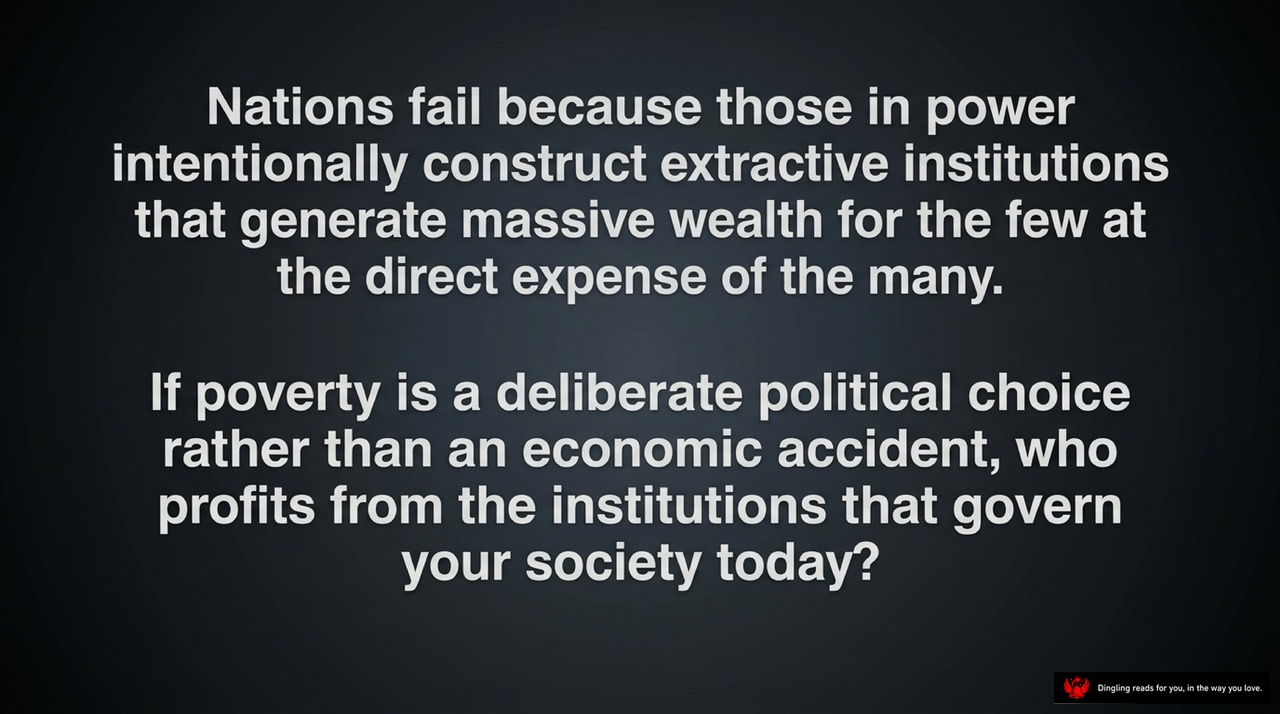
Look at this slide. It poses a hard-hitting question: Nations fail because those in power intentionally construct extractive institutions that generate massive wealth for the few at the direct expense of the many. If poverty is a deliberate political choice rather than an economic accident, who profits from the institutions that govern your society today?
This isn't just theory; it's a stark reality we see everywhere. Think about the Congo, where kings and elites historically plundered the land through slavery and arbitrary taxes, leaving the population with no incentive to produce anything. Or look at the Soviet Union under Stalin. On the surface, it seemed like an economic miracle with rapid industrialization, but that growth was entirely dependent on extracting resources from the countryside through forced collectivization, ignoring any real innovation.
The same pattern appears in modern examples like Uzbekistan, where children are forced to pick cotton instead of going to school, enriching a dictator's family while the majority lives in poverty. Or consider the "crony capitalism" in Egypt, where a small group of businessmen, tied closely to the government, privatized state assets at rock-bottom prices to build massive monopolies, leaving ordinary citizens with no chance to compete.
These aren't accidental failures. They are the result of systems designed to squeeze wealth from the many to feed the few. When power is concentrated in the hands of a few elites, the rules of the game change. Innovation stops because it threatens their status, and growth becomes impossible because the majority has nothing left to invest. The slide asks you to look at your own society and ask: are the rules here built to lift everyone up, or are they rigged to keep the top few in charge, no matter what happens to the rest of us?