
Xue Zhaofeng's Economics Lectures: Complete Chapter-by-Chapter Summary
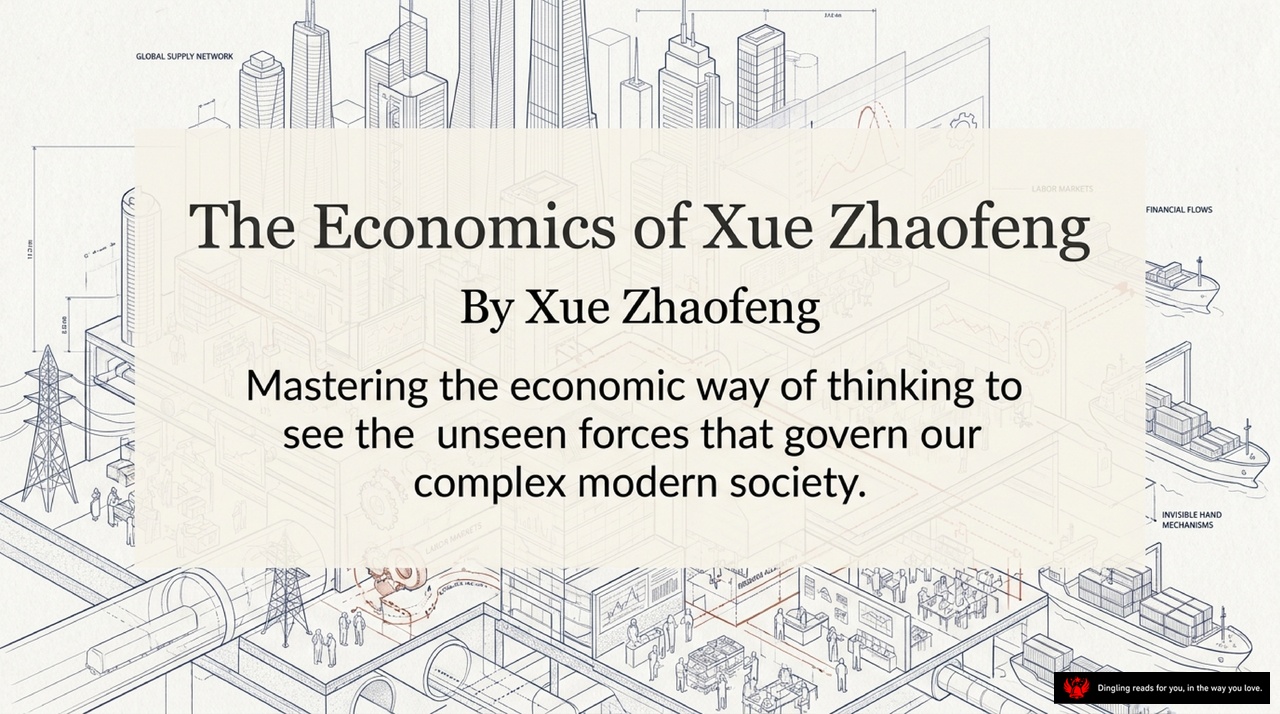
Welcome to the book club. Today, we're diving into "The Economics of Xue Zhaofeng," written by Xue Zhaofeng himself. This isn't just another economics textbook—it's a guide to seeing the invisible forces that shape our modern world. As the cover shows, it's about mastering economic thinking to understand how everything from global supply chains to labor markets and financial flows actually works behind the scenes. Whether you're curious about why things cost what they do or how big systems move, this book will help you see the hidden mechanics running our society. Let’s get started.

Have you ever stopped to think about how society actually works? On the left, we see intuition—what drives us in our daily lives. It’s that gut feeling, the empathy we feel for people close to us, and the intentions we read from their faces. It’s personal, immediate, and deeply human.
But on the right, there’s something bigger: economic thinking. This isn’t just about money—it’s about how millions of strangers, who’ve never met, coordinate, survive, and even create order out of chaos. Think global trade, stock markets, or even how a city functions without a single person directing it all.
The key takeaway? Economic laws are inescapable. Even in a WWII POW camp, prisoners didn’t need a central planner to create currency, set exchange rates, or establish prices—they did it on their own. That’s the power of human coordination at scale.
So whether you’re navigating a small circle of friends or a global economy, remember: human behavior follows patterns. And understanding those patterns is the first step to making sense of the world.
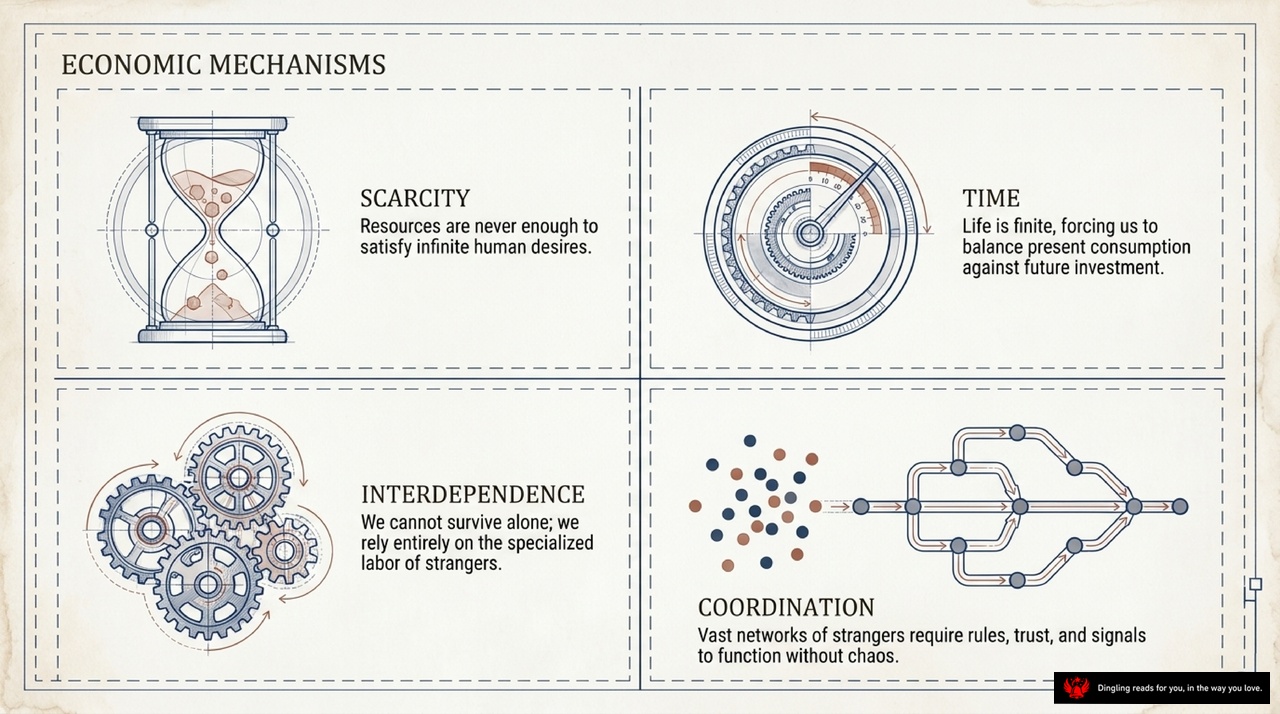
So, let’s dive into the core engines that drive our economy—four simple but powerful mechanisms that shape how we live, work, and interact every single day.
First up: Scarcity. You’ve probably heard this before, but it’s more than just a buzzword. It’s the reality that no matter how much we want or need, resources are always limited. We can’t have everything, and that’s what makes choices matter. Whether it’s time, money, or even attention, scarcity forces us to prioritize.
Next, Time. This one’s personal. Life is finite, and that means we’re constantly juggling what we want to do now versus what we need to invest in for later. Every decision we make—from buying a coffee to saving for retirement—is a trade-off between present consumption and future security.
Then there’s Interdependence. Think about it: you didn’t grow your own food, make your clothes, or build your house. You rely on a global network of people doing things you can’t or don’t want to do yourself. We’re all part of a massive web of specialized labor, and that’s what makes modern life possible.
Finally, Coordination. Imagine millions of strangers trying to work together without chaos. That’s where rules, trust, and signals come in. Markets, laws, social norms—they’re all tools we use to align our actions and keep the system running smoothly.
These four forces—scarcity, time, interdependence, and coordination—are the invisible hands guiding our economic world. And understanding them? That’s the first step to making smarter choices, not just for yourself, but for everyone around you.

Here is the spoken script for Slide 3.
**Slide 3 Script**
Look at this diagram. It’s flipping the script on what we usually think "cost" means. We tend to equate cost with effort—the hard work of knitting socks or the physical labor of building a plane. But in economics, that effort is actually irrelevant.
The real cost is what you give up. This is the concept of opportunity cost. In this scenario, a worker stands at a fork in the road. Path A is making socks; Path B is building an airplane. If they choose Path A, the cost isn't the sweat they put into the socks. The cost is the airplane they *didn't* build.
Notice how the diagram crosses out "Sunk Costs" and "Hard Work." It’s telling us to ignore the past and ignore the physical struggle. The only thing that matters is the divergent path you didn't take. By choosing socks, you are paying with the value of the airplane. Profit, then, is just the upside of that trade. It’s the windfall you get when you successfully swap a low-value use of a resource for a high-value one.
Here is the spoken-word script for Slide 4, tailored for a US audience.
**Slide 4: The Ultimate Test of an Economist: The Seen vs. The Unseen**
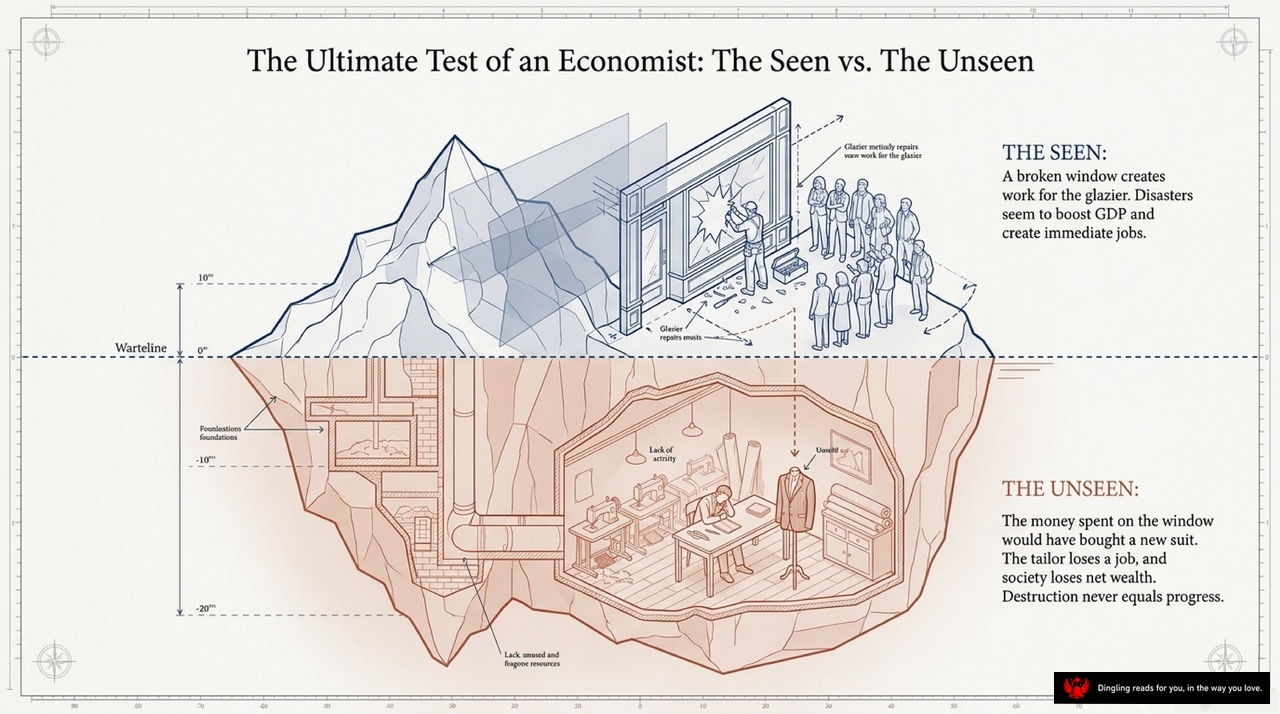
Let’s look at the most famous, yet most misunderstood, thought experiment in economics: the Broken Window Fallacy.
On the surface, what you see is simple. A shop window shatters, and a glazier rushes in to fix it. He gets paid, and the community sees a burst of activity. It feels like a disaster has created a job and boosted the economy. This is "The Seen"—the immediate, visible action that we can touch and feel.
But the real story is happening underground. This is "The Unseen." That money paid to the glazier never reached the tailor. Without that window repair, the tailor would have sold a new suit to the shop owner. Now, the tailor has lost a sale, and his business has shrunk.
The critical insight here is that destruction is not a net gain. We haven't created anything new; we’ve simply shifted resources from making a new product to repairing an old one. We’ve destroyed wealth to create the illusion of economic growth. In a free market, the only true test of an economist is understanding the difference between what we see and what we are blindly ignoring.

Imagine you’re trying to help low-income families find a place to live. The goal is simple: cap the rent at $60, even though the market rate is $100. On paper, that sounds like a win. But what actually happens when you enforce that rule?
The policy implementation hits a wall. That $60 cap doesn’t deliver affordable housing—it just creates artificial scarcity. And here’s the twist: competition doesn’t disappear. It just changes form. Instead of bidding up rent, people now compete through backdoor channels.
Look at what unfolds: black markets emerge where landlords charge under the table. Bribes become part of the deal. Buildings fall into disrepair because there’s no incentive to maintain them. Hiring turns into nepotism. And the most painful outcome? Long lines of people waiting for a chance to rent—because everyone knows the system is rigged.
The real cost isn’t just financial. It’s the $40 of value that gets completely dissipated into friction. Price ceilings don’t solve the problem—they just make it more expensive, more unfair, and more inefficient.
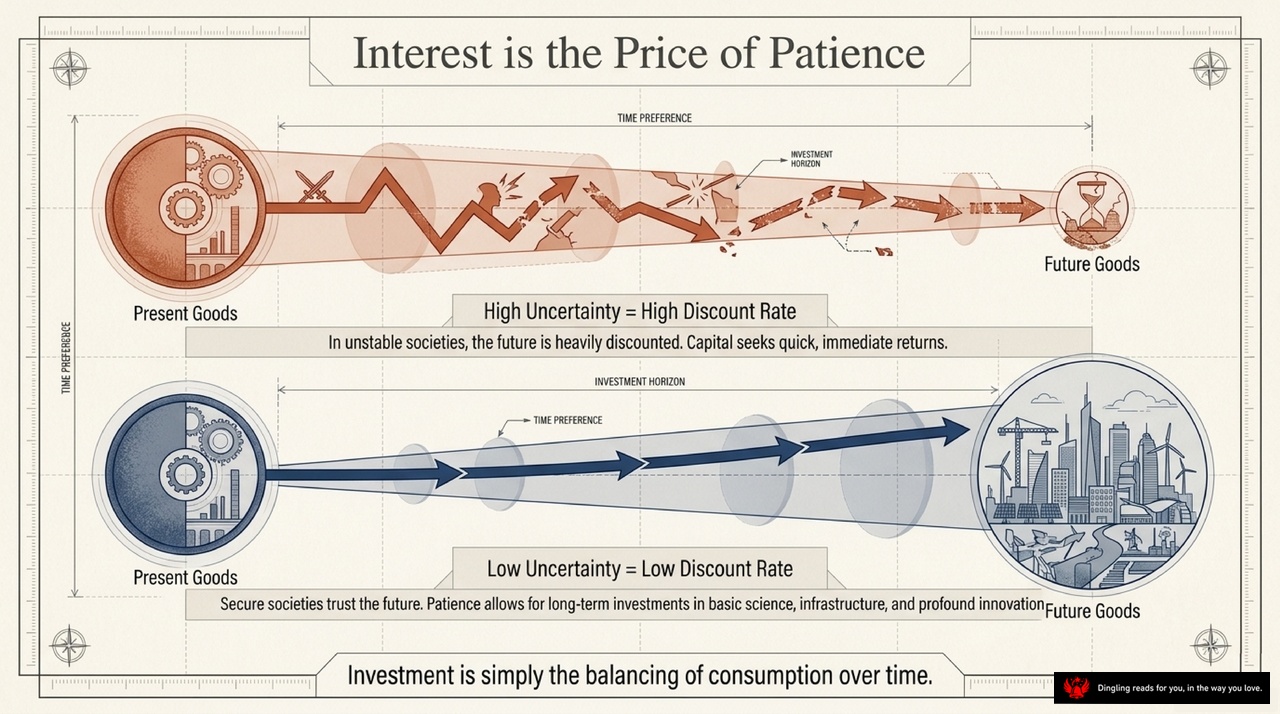
Interest is the price of patience. Look at this diagram—it’s not just about money. It’s about how we value today versus tomorrow, and what kind of society we’re building.
In unstable societies, the future feels risky. People don’t trust it. So, capital rushes for quick returns. That’s why high uncertainty leads to a high discount rate. The future gets heavily discounted. You see it in the jagged, broken arrows—short-term thinking, no room for long-term investment. Infrastructure, science, innovation—they get pushed aside.
Now, flip to the blue path. This is what happens in secure societies. Trust is high. The future is seen as reliable. So, the discount rate drops. People are willing to wait. That’s why you see smooth, steady arrows leading to a thriving city with wind turbines, skyscrapers, and green spaces. Patience isn’t just a virtue—it’s an economic force. It unlocks long-term investments in basic science, infrastructure, and profound innovation.
At the core, investment is simply balancing consumption over time. You’re choosing to spend less now so you can live better later. But whether that trade-off pays off depends entirely on how much you trust the future.

Here is the spoken-word script for Slide 7, tailored for an American audience.
**Slide 7: The Magic of Comparative Advantage**
Let’s talk about the real magic of the economy. It’s not about being the best at everything. Look at this diagram. On the left, you have Country A, which is highly efficient. It can build airplanes and socks faster than anyone else. On the right, you have Country B, which is highly inefficient. It’s slower at making both.
But here is the game-changer: Specialization. Notice the arrows? Country A focuses entirely on airplanes, and Country B focuses entirely on socks. Even though Country B is worse at everything, it still has a comparative advantage in socks. By specializing where their internal opportunity cost is lowest, they trade. Country A imports socks, and Country B imports airplanes.
The result? Trade. By trading with strangers and focusing on what they do relatively best, total global wealth mathematically increases. You don’t need to be the best to win; you just need to be the best at the right thing.
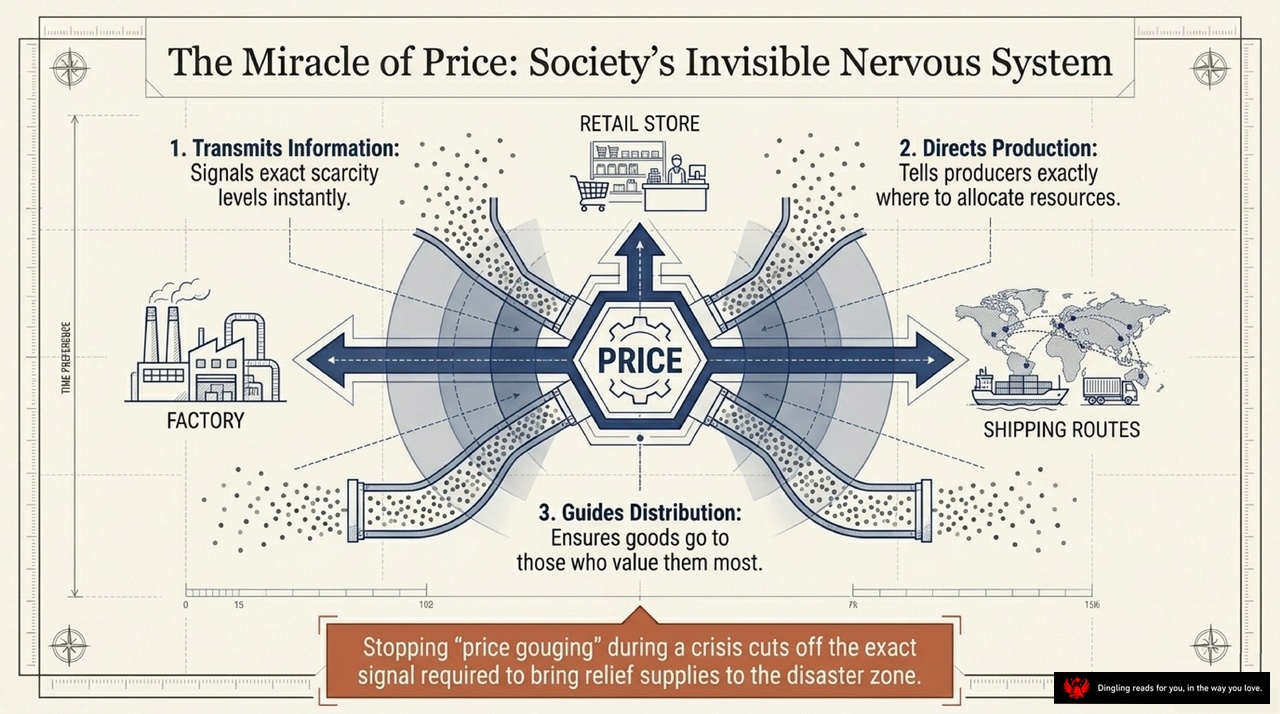
Imagine this: your economy isn’t a giant machine controlled from the top, but more like a living organism—sensing, adjusting, and responding in real time. At the heart of it all? Price. Think of it as society’s invisible nervous system.
When demand spikes—say, during a storm or pandemic—prices rise instantly. That’s not “greed,” it’s information. It tells factories to ramp up production, retailers to restock, and shipping routes to reroute goods where they’re needed most. Without that signal, resources get stuck, shelves stay empty, and help never arrives.
But here’s the catch: when we ban “price gouging” in emergencies, we cut off that very signal. Good intentions end up backfiring—because you can’t fix a broken system by silencing its feedback loop. Let the price do its job. Trust the miracle.
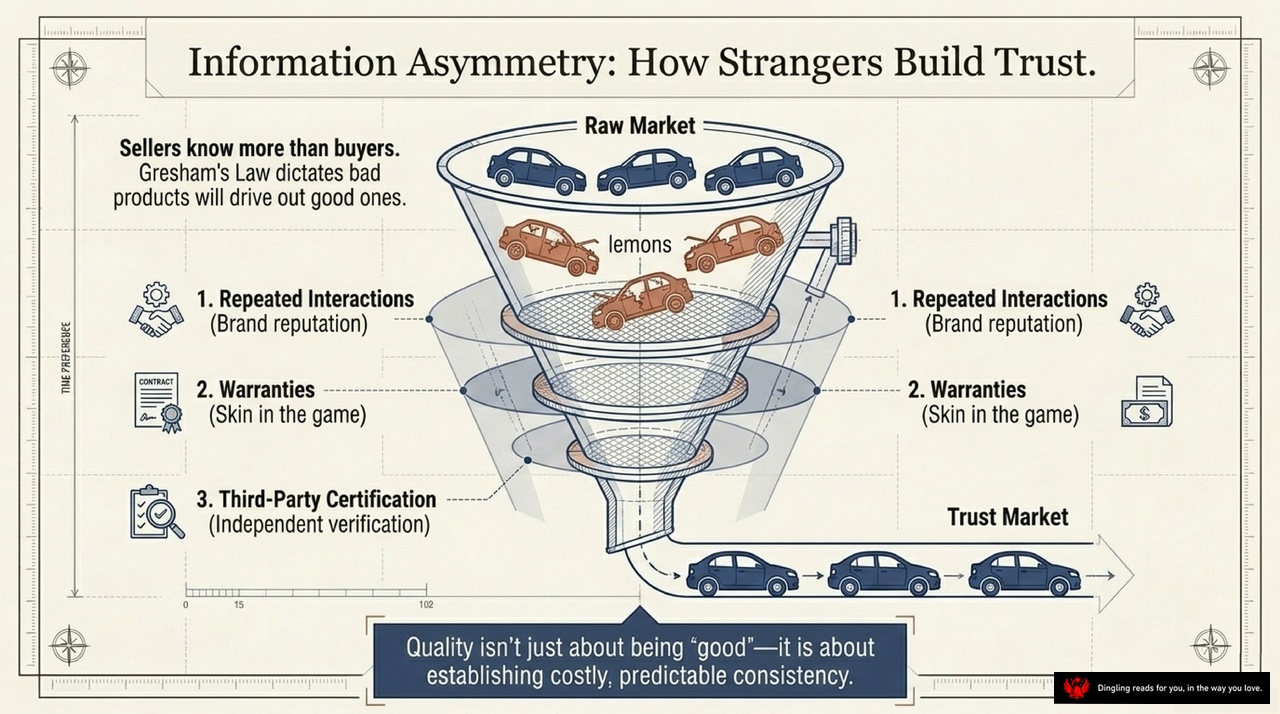
Here is the spoken-word script for Slide 9, tailored for a US audience.
**Slide 9 Script:**
"In the raw market, information asymmetry is the silent killer of trust. Sellers know everything about their product, while buyers are flying blind. This imbalance triggers Gresham’s Law: bad products, or 'lemons,' drive out the good ones. If you can’t prove your quality, why would anyone pay a premium for it?
To fix this, we need to filter the market. The first lever is **Repeated Interactions**. When a brand sticks around, it builds a reputation. You aren’t just buying a product; you’re betting on a history. Next, we introduce **Warranties**. This is the concept of 'skin in the game.' A seller risks their own money to guarantee quality, signaling that they believe in their product enough to stand behind it. Finally, we add **Third-Party Certification**. Independent verification removes the bias entirely.
By stacking these layers, we transform a raw market into a **Trust Market**. As the bottom of this funnel shows, the result isn't just a 'good' product; it’s a system of **costly, predictable consistency**. That is the only way strangers can safely do business."

Alright, here is the spoken script for Slide 10, tailored for an American audience.
**Slide 10 Script**
Let's look at the core logic of why a company even exists. We need to decide who gets to be the boss. On the left, you see "Fixed Wage Earners." These are employees with generic skills and easily measurable output. Their deal is simple: they get a guaranteed paycheck, protected from the ups and downs of the market. They take a salary, not the risk.
On the right, we have the boss, labeled here as "The Residual Claimant." This person holds firm-specific skills and produces hard-to-measure daily output. The deal here is much different. The boss absorbs the ultimate risk. They take home the residual profit—or the loss—only after everyone else has been paid their fixed wages.
Notice the arrows at the top. The boss is the one facing the volatility and risk. Firms exist to pool resources for greater output, but the boss manages the team specifically because they are the residual claimant. They own the risk, so they get to call the shots.
Hey everyone, welcome back to the book club. Today we're diving into a concept that's often misunderstood but has a massive impact on your wallet: inflation.
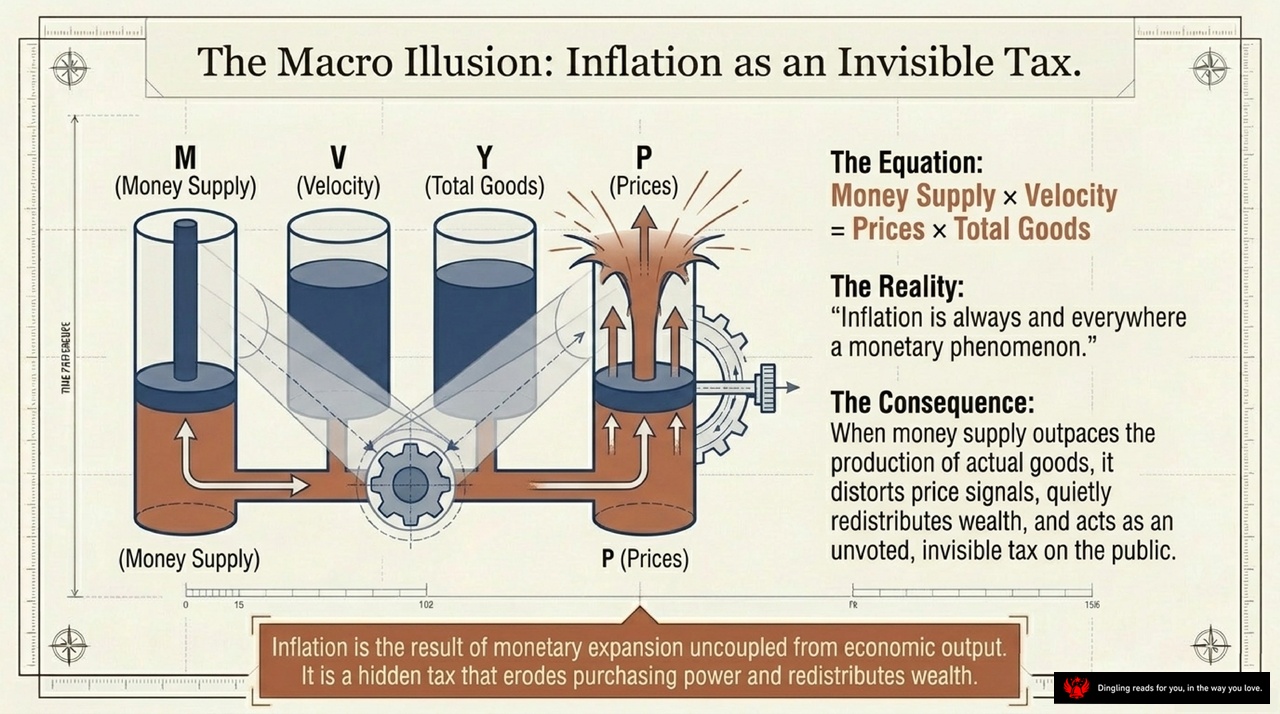
This slide is titled "The Macro Illusion: Inflation as an Invisible Tax." It’s using a visual metaphor to explain something complex—how money flows through the economy and why printing too much of it without producing real goods leads to price spikes.
On the left, you see four cylinders labeled M, V, Y, and P. These stand for Money Supply, Velocity, Total Goods, and Prices. The diagram shows how money (M) moves through the system, interacts with how fast it circulates (V), and what goods are available (Y), ultimately affecting prices (P).
The equation on the right says: Money Supply × Velocity = Prices × Total Goods. That’s the Quantity Theory of Money in action. It means if you increase the amount of money in the system without increasing the number of goods, prices go up.
The slide calls this “The Reality”: Inflation is always and everywhere a monetary phenomenon. That’s a quote from Milton Friedman, one of the most influential economists of the 20th century. He’s basically saying that inflation isn’t caused by bad policies or external shocks—it’s about how much money is being created.
Then comes the consequence: When money supply outpaces actual production, it distorts price signals, quietly redistributes wealth, and acts as an unvoted, invisible tax on the public. That last line hits hard. You didn’t vote for inflation, but it still takes your purchasing power away.
At the bottom, it says: Inflation is the result of monetary expansion uncoupled from economic output. It’s a hidden tax that erodes purchasing power and redistributes wealth.
So here’s the takeaway: Inflation isn’t just rising prices—it’s a redistribution mechanism disguised as normal market behavior. And understanding this helps you see why controlling money supply matters more than you might think.
Let’s keep going.

Let’s talk about the illusion of public choice.
On this slide, we see two powerful ideas shaping how democracy actually works: the Median Voter Theorem and Rational Ignorance.
Imagine a bell curve representing where voters stand on economic policy. Politicians don’t aim for the mathematically best policy — they aim to win. And the easiest way to win? Move toward the center, right where the median voter lives. That’s why platforms from both left and right keep converging toward the middle. It’s not about ideology anymore — it’s about positioning.
But here’s the twist: most voters don’t even realize this is happening. Why? Because of rational ignorance. Your single vote rarely changes an election outcome. So there’s no real cost to staying uninformed or voting emotionally. This creates a quiet trap — economic biases and protectionist policies can slip through without much resistance.
In short, the system isn’t broken because of bad actors — it’s broken by incentives. Politicians chase the center, and voters stay silent. That’s the illusion of public choice.
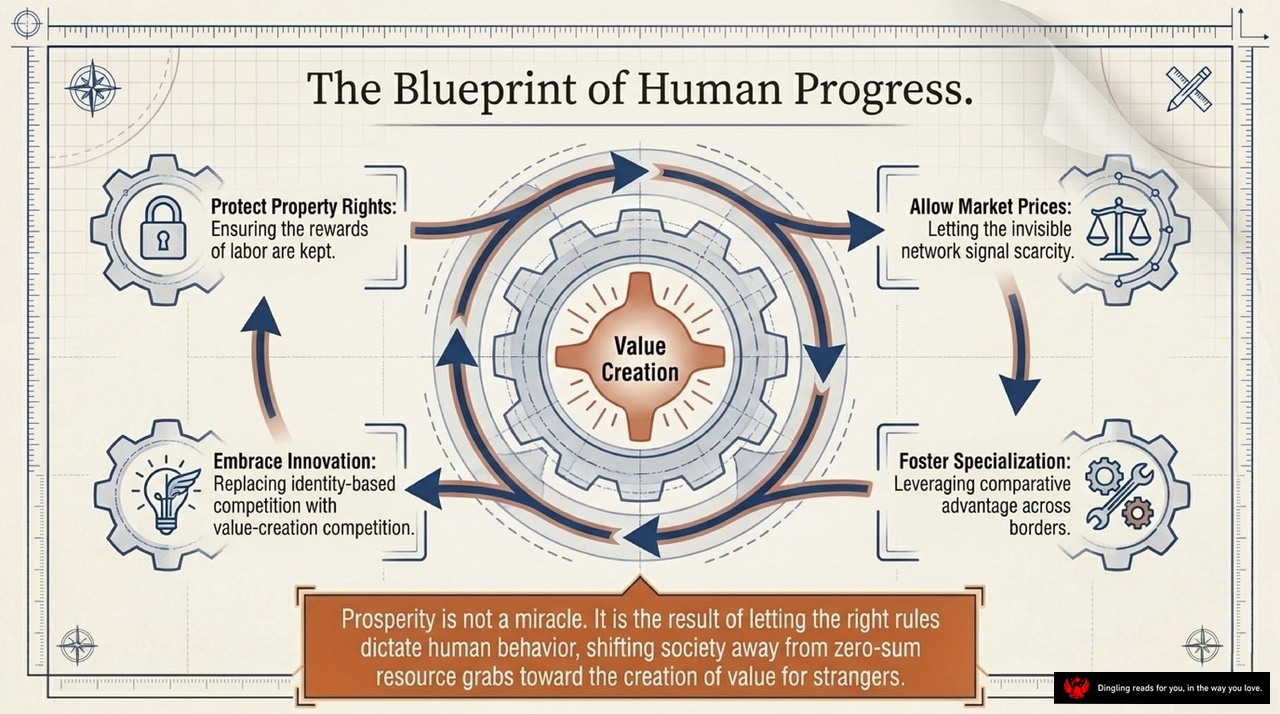
So, what’s the blueprint for human progress? It’s not magic. It’s not a secret formula handed down from the past. It’s a system—a cycle of five interlocking gears, each one driving the next.
At the center is value creation. That’s the engine. But how do you get people to create value for strangers, not just for themselves? First, you need to protect property rights. When people know their labor and ideas are safe, they’re more willing to invest time and energy into building something new.
Next, let market prices speak. These aren’t just numbers on a screen—they’re signals. They tell us where resources are scarce and where they’re abundant. When prices work freely, they guide people to where they’re needed most.
Then, encourage specialization. People aren’t better at everything. But when they focus on what they do best—and trade with others who do something else better—the whole society becomes more efficient.
And finally, embrace innovation. Not the kind that’s about beating someone else, but the kind that creates real value. Replace competition based on identity with competition based on contribution.
Put it all together, and you get prosperity. Not because we got lucky, but because we built a system where the right rules shape behavior. We moved away from zero-sum fights over resources and toward creating value for everyone—even those we don’t know.
That’s the blueprint. And it’s still working today.
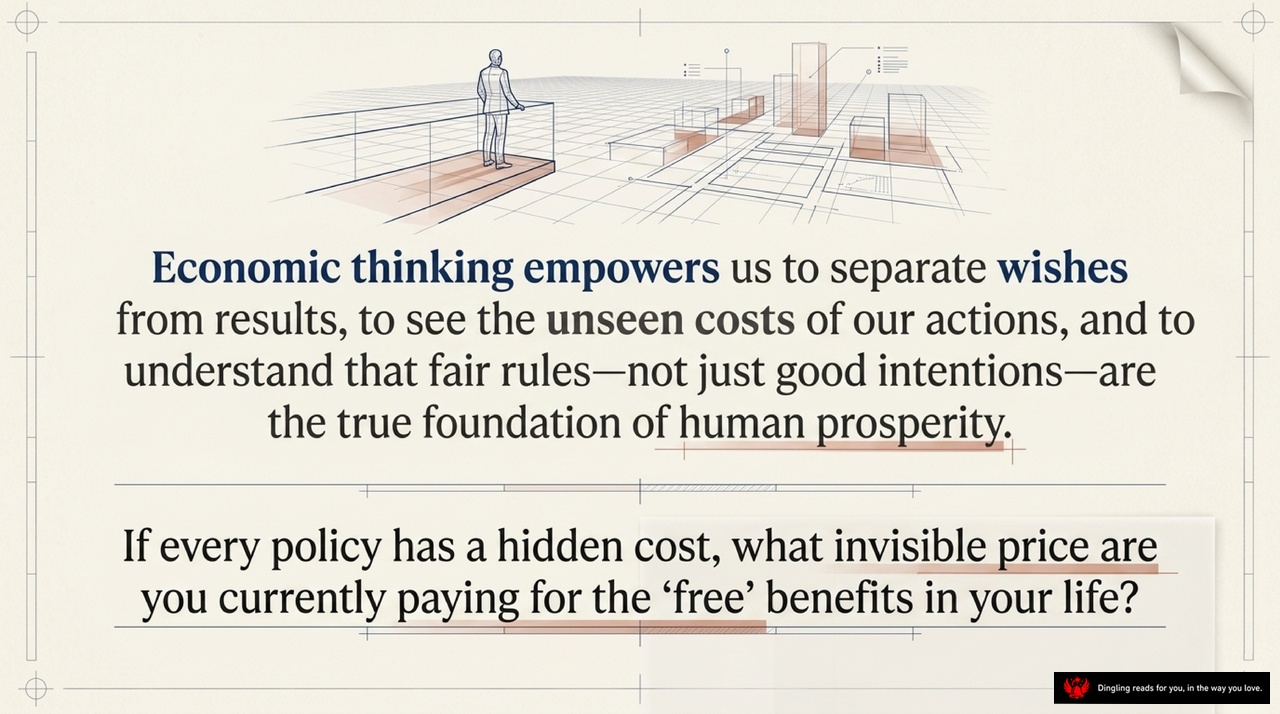
Hey, have you ever stopped to think about what you’re really paying for the things you take for granted? Like free Wi-Fi, public parks, or even clean air? We often assume these benefits come without a cost—but they don’t. Every policy, every convenience, has an invisible price tag.
This slide is asking us to look deeper. It says economic thinking helps us separate our wishes from the actual results. It reminds us that behind every action—every choice we make or support—there are unseen costs. And more importantly, it tells us that fairness in rules, not just good intentions, is what truly builds human prosperity.
So, when you hear about “free” benefits in your life, pause and ask yourself: What’s the hidden cost? Who’s really paying? And how can we make smarter choices—not just for ourselves, but for everyone around us?