
Year Zero: A History of 1945: Complete Chapter-by-Chapter Summary

Welcome to *Year Zero: A History of 1945* by Ian Buruma. The title itself captures the essence of this pivotal year: a world wiped clean, ready to be rebuilt from the ashes. Look at this image behind us—a landscape of total devastation. This isn't just a backdrop; it is the reality of 1945. The modern world was not forged in the clean triumph of victory, but in the chaotic, traumatic, and morally compromised aftermath of global destruction.
While we often celebrate 1945 as a moment of pure liberation, the truth was far messier. Millions of displaced people, from the liberated camps of Europe to the shattered cities of Asia, faced a grim reality. In places like Bergen-Belsen, survivors were so emaciated that their bodies could not even digest the food the Allies dropped. In Japan and Germany, cities lay in ruins, and the very concept of "home" had vanished. This was not a simple ending; it was a terrifying beginning where humanity had to decide whether to repeat the past or build something entirely new. As we move forward, we will explore how this year of zero shaped the world we live in today.

The slide contrasts the glittering illusion of victory with the brutal silence of reality. On the left, we see "The Facade of Victory"—the myth that 1945 was a purely heroic turning point where liberty triumphed over fascism in a sunlit morning. We celebrate the ticker-tape parades, the ecstatic crowds in London and Paris, and the immediate belief that normalcy had returned. But look to the right: "The Reality of Year Zero." This wasn't a peaceful dawn; it was a year of unprecedented moral and physical chaos.
The ground truth is stark: starvation, mass displacement, and psychological trauma. In cities like Tokyo, Berlin, and Warsaw, the silence of the ruins was deafening. There was no normal civilian life, only the desperate hum of black markets as people scavenged for survival. While the victors danced, the defeated—and even some liberators—faced a world where the very concept of "normal" had been obliterated, replaced by a desperate struggle to rebuild from absolute zero.

On the left, we see a timeline mapping the harrowing journey of survival: from the depths of labor camps in Berlin, to the lowest ebb of starvation in the rubble, and finally, the absurd return to "normalcy" where hazing rituals clashed with concentration camp trauma. On the right, a stark black-and-white photo captures a moment of intense, almost manic celebration—men and women raising their glasses in a toast, their faces lit up with a joy that feels both triumphant and deeply fragile.
This image perfectly illustrates the central theme at the bottom: "The Illusion of the Status Quo." The caption explains that this bizarre return to fraternity hazing wasn't just about cruelty; it was a desperate psychological coping mechanism. After enduring such unspeakable horrors, survivors found themselves unable to face a new, unknown reality. Instead, they desperately tried to resurrect a familiar past, even if that past was as brutal as the present.
This psychological need to erase an unbearable present by clinging to old norms is exactly what the timeline depicts. Whether it's the Dutch student surviving Allied bombings and Stalin's organs, or the survivors in Utrecht submitting to humiliating rituals, the human instinct to find safety in the familiar is overwhelming. The celebratory photo on the right isn't just a party; it's a collective gasp for air, a frantic attempt to prove that life, in some recognizable form, has returned. Yet, as the timeline shows, for many, that "normalcy" was a cruel illusion, masking the deep scars of a war that had fundamentally shattered their world.

Picture this: Summer 1945. The war is over, but the world isn't fixed. Look at this matrix—it's the reality check for everyone left standing. On one side, "The Victor." The Allies, the Red Army, the Canadians. Well-fed, armed, carrying chocolate and cigarettes. They feel triumphant, like saviors. But here's the dark twist: they are also immune to local laws, capable of unchecked brutality, like the Soviets in Berlin.
Then, look at "The Liberated." Nations like France, the Netherlands, Poland. Physically, they are starving, infrastructure destroyed, dependent on Allied aid like Operation Manna. Psychologically? They are euphoric but deeply insecure, plagued by guilt and suspicion. Morally? They are desperate to reclaim their masculinity and honor, often through violent purges of collaborators. It's a fragile, angry freedom.
Finally, "The Vanquished." Germany and Japan. Homeless, destitute, navigating apocalyptic ruins. Their national mythologies have collapsed completely. There is only shock, shame, and apathy. Morally, they have abandoned ideology entirely. Ideology is dead; only base survival remains. This is where the old rules don't apply anymore.
This matrix captures the brutal truth: victory didn't bring a utopia. It just created three very different worlds, all struggling to find a moral footing in the ashes.

The slide contrasts two powerful post-war realities: the conqueror's bold appeal and the defeated's crushing crisis of masculinity. On the left, we see the "Conqueror's Appeal," where liberated women in Germany and Japan actively sought warmth and protection from well-fed American soldiers, swapping years of occupation for the glamour of GIs. This wasn't just about sex; it was a desperate escape from oppressive pre-war patriarchal structures, as seen in the rise of the "Panpan Girls" in Japan and the "Panpan Girls" in Germany, who used fraternization to find liberation.
On the right, the "Crisis of Masculinity" is starkly illustrated by the plummeting graph of traditional male authority. German and Japanese men returned as broken, destitute figures, unable to protect their nations or their families. Dutch and French men, having failed to defend their countries in 1940, found themselves sidelined by towering, resource-rich American and Canadian forces. This emasculation of the defeated created a deep psychological wound, as traditional male roles evaporated, leaving a generation struggling to redefine their identity amidst the ruins of war.

Look at this diagram. It captures the brutal, twisted economy that took hold in the ruins of Germany and Japan right after the war. On the left, we see the "Source of Wealth"—the occupiers. For the soldiers, it was PX rations: Nylons, Lucky Strikes, Spam, and Hershey's bars. But for the locals? That wealth became "The Currency of the Flesh." In Japan, fraternization and institutionalized brothels like the RAA turned women into currency. In Germany, it was the same, with "horizontal collaboration" becoming a desperate survival strategy.
This flow leads directly to the center: "The Black Market." In the ruins, cigarettes weren't just tobacco; they were hard currency. Panpan girls in Japan and Ruinenmädchen in Germany traded their bodies for cigarettes, which they then used to buy the essentials listed on the right: "The Core Objective"—calories, eggs, coal, penicillin, and shelter. Survival was the only metric that mattered.
But the most striking part is the bottom section: "The Flattening of Class." This brutal economy completely erased pre-war hierarchies. Starving aristocrats were forced to trade ancestral kimonos and heirlooms to peasant farmers just to buy black-market potatoes. As the chart notes, in this era, survival rewarded opportunism, not pedigree. The old world order had collapsed, and in its place was a raw, unforgiving struggle for the next breath.

Look at this map titled "The Ironies of Liberation." It captures one of the darkest paradoxes of World War II: the moment of victory was also the moment of mass displacement.
On the right, we see "The Largest Forced Migration." While the Allies at Potsdam claimed they were sanctioning an orderly and humane transfer of ethnic Germans, the reality was brutal. Over 11 million ethnic Germans were expelled from regions like Silesia, the Sudetenland, and East Prussia. The arrows on the map show the chaotic flow of this movement. Millions didn't just lose their homes; they died from starvation, exposure, or revenge killings in the process.
On the left, under "The Hostile Homecoming," the slide highlights the tragic irony for concentration camp survivors. When they finally returned to places like Poland, expecting gratitude and empathy, they found their homes occupied instead. Rather than being welcomed as heroes, they faced guilt-driven hostility and new pogroms from former neighbors who had stolen their property during the war.
The conclusion at the bottom drives home this heartbreaking lesson: In Year Zero, victimhood did not guarantee sanctuary. Being a victim of the Axis powers did not automatically make you safe from the vengeance of your neighbors. This slide reminds us that the end of a war often brings new conflicts, as the cycle of displacement and retribution continues long after the guns fall silent.

The Post-War Justice Spectrum isn't just a chart; it's a map of the messy, human reality that unfolded once the guns finally fell silent. We see four distinct paths nations took to handle the aftermath. On the far left, we have Wild Vengeance, where the mob takes over. We see public head-shavings of collaborators and brutal beatings in places like Prague. The motive here isn't law; it's about purging national shame and deflecting guilt by punishing the vulnerable. Next, we move to Summary Executions, driven by the Resistance. This involves extrajudicial killings of fascists and local rivals, motivated by a desire to settle old scores under the guise of patriotic liberation. Then, we find Institutional Justice, the path of The State. This is where we see the Nuremberg and Tokyo Trials, formal tribunals for top leaders, aiming to re-establish the rule of law and absorb the public's thirst for vengeance. Finally, on the far right, we have Opportunistic Amnesia, chosen by The Pragmatists. Here, the action is quietly dropping denazification while retaining fascist bureaucrats and police. The motive is survival: preventing total administrative collapse and pivoting to fight the emerging Cold War. As we look at this spectrum, it becomes clear that there was no single version of justice. From the chaos of the mob to the cold calculations of state survival, every nation chose a different lane, leaving a legacy that still shapes our world today.

Look at this slide. It captures a pivotal moment in history where two very different paths emerged from the same trauma: the path of revenge and the path of reconstruction. On the left, we see Abba Kovner and the philosophy of NAKAM, or "Revenge." The image of the eye perfectly illustrates their belief: an eye for an eye. They operated on the conviction that Jewish blood could not be shed without biblical retribution, fearing that without this vengeance, the world would forget. Their plan, known as Plan A, was extreme—poisoning the water supplies of major German cities to kill six million Germans. Tragically, this plan was thwarted by a lack of mainstream Zionist support, leaving the trauma of the Holocaust trapped entirely in the past.
But look to the right. We see David Ben-Gurion and the philosophy of Reconstruction. Here, the image of the trowel building a wall symbolizes a shift from vengeance to pragmatism. Ben-Gurion believed that the survival of the Jewish people required a state, not a massacre. His plan focused on extracting survivors from the DP camps of Europe to build and defend a new nation of Israel. The result was transformative: moving away from the blood-soaked soil of Europe to forge a new future, effectively relegating revenge to the margins of history. This slide reminds us that while the impulse for revenge is natural, the choice to build a future instead of dwelling in the past is what ultimately defines a people's legacy.
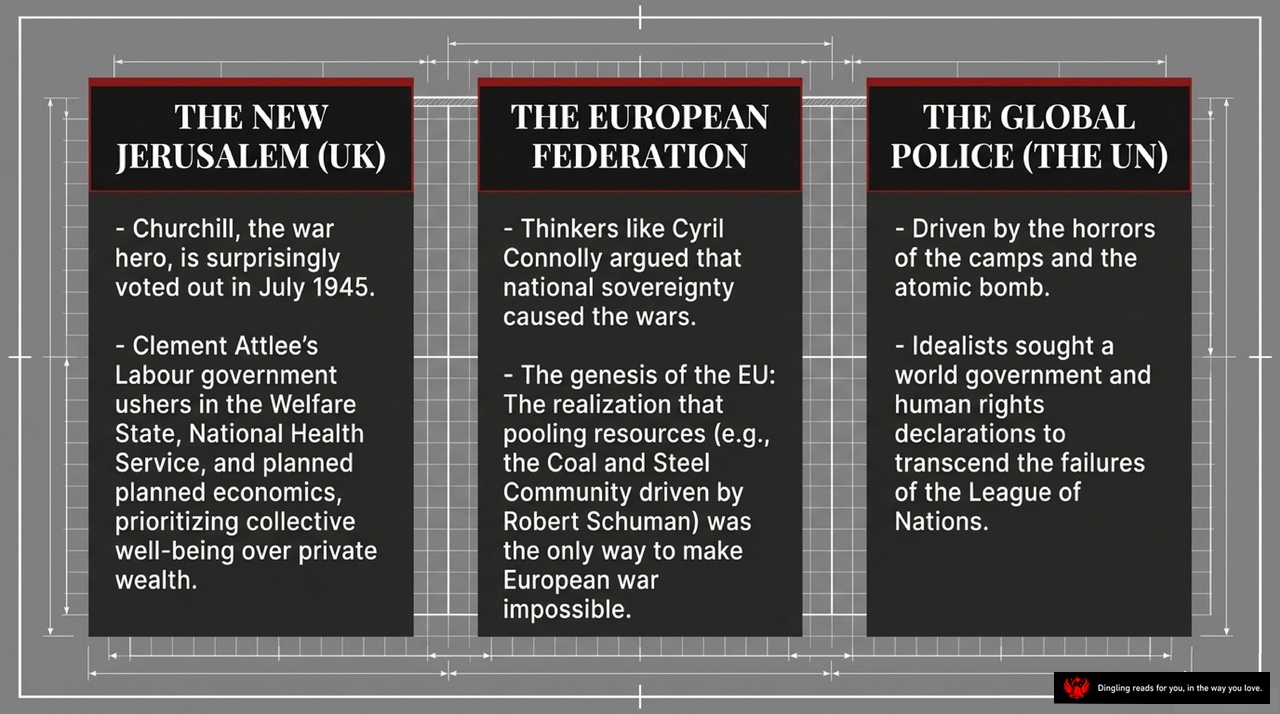
Looking at this slide, we see three distinct visions for the post-war world: The New Jerusalem in the UK, The European Federation, and The Global Police via the UN. These weren't just abstract ideas; they were desperate attempts to prevent history from repeating itself.
First, let's look at the UK, labeled "The New Jerusalem." This reflects the surprising shift in British politics right after the war. Even though Churchill was the war hero, he was voted out in July 1945. In his place, Clement Attlee's Labour government took charge, ushering in the Welfare State, the National Health Service, and planned economics. The logic here was clear: after the horrors of war, the priority shifted from private wealth to collective well-being. It was a belief that a just society could be engineered through government planning.
Moving to the center, we have "The European Federation." This vision was driven by thinkers like Cyril Connolly, who argued that national sovereignty was actually the root cause of the wars. The genesis of what would become the EU wasn't just about trade; it was a realization that pooling resources—like the Coal and Steel Community driven by Robert Schuman—was the only way to make war in Europe impossible. By binding economies together, they hoped to make the idea of fighting each other obsolete.
Finally, on the right, is "The Global Police (The UN)." This model was born directly from the horrors of the concentration camps and the atomic bomb. Idealists sought a world government and human rights declarations to transcend the failures of the old League of Nations. They wanted a global authority to enforce peace and protect human dignity on a scale that no single nation could achieve alone.
Together, these three pillars—the social reform of the UK, the economic union of Europe, and the global governance of the UN—formed the blueprint for a new world order, hoping to build a peace that was robust enough to survive the test of time.

The map in front of us reveals a world that has fractured, split right down the middle by a jagged red line. This visual isn't just about geography; it represents the shattering of the Allied unity we thought we had built together. Look at the top left: "The Yalta & Potsdam Betrayals." What happened here is that the facade of our partnership crumbled. Stalin secured Eastern Europe as a massive buffer zone, completely ignoring the Atlantic Charter's promises of self-determination. He turned a promise of freedom into a reality of occupation.
Move your eyes to the right side of the map: "Molotov's Tactics." This wasn't just passive expansion; it was an active strategy. At the London conference, Soviet diplomacy worked tirelessly to humiliate Western powers. This wasn't a fight against a common enemy anymore; it was a signal that the Grand Alliance was dead, and we were sliding straight into Cold War brinkmanship. The trust was gone, replaced by suspicion and maneuvering.
Finally, look at the bottom left corner: "The Partitioned World." The ideals of unified liberation gave way to brutal realpolitik. Germany and Korea were sliced in half. China descended into civil war. The "Blank Slate"—the hope that the world could be rebuilt from scratch—was instantly drawn over by superpower proxy battles. The red line on this map isn't just a crack; it's the scar of a world that chose sides over shared values, setting the stage for decades of conflict.

Look at this split screen. On the left, we see "The Idealistic Failure," and on the right, "The Pragmatic Pivot." It perfectly captures the harsh reality of post-war Germany and Japan.
The Allies initially tried to force 23 million Germans to fill out these 131-question ideological purity tests, hoping to root out the Nazis. But as the text notes, this proved logistically impossible and was widely falsified. Re-education efforts often fell flat because starving citizens cared about coal and food, not democratic lectures.
So, the U.S. and conservative allies made a sharp pivot. As Ruth Andreas-Friedrich famously said, "If you want to eat, you better not have been a Nazi. So they weren't." Realizing they needed experienced administrators to build bulwarks against Communism in West Germany and Japan, the Allies quietly rehabilitated former fascists, industrialists, and bureaucrats.
The result? Former war criminals were given a "Top Secret: Approved" stamp, effectively allowing them to manage the new economic miracles. While the Allies preached democracy and anti-fascism, they ultimately prioritized stability and economic recovery over justice, letting the very people who built the old regime steer the new one.

Look at this split-screen from 1945. On the left, we see the euphoric celebrations in Paris and the brutal reality of combat in Southeast Asia. On the right, the text exposes a harsh truth: the "Ignored Voices of 1945." While Europe toasted the defeat of fascism, the victors immediately crushed independence movements in Malaya, Indochina, and the Dutch East Indies, perpetuating the myth of global liberation.
But the war had awakened Asia. Japanese victories over Western powers shattered the myth of white supremacy, forcing a reckoning. This tension boiled over in the Syrian Crisis of May 1945, where French forces used American lend-lease weapons to bombard Damascus. Syrian leaders were left asking the ultimate question: Where is the Atlantic Charter now? Where are the Four Freedoms?
The outcome was a profound betrayal. The UN Charter promised well-being but sidestepped decolonization entirely. Instead of freedom, this compromise set the stage for decades of bloody anti-colonial wars, leaving the voices of those fighting for their future forever unheard in the official history of victory.

Welcome to this pivotal moment in our story: the fragile, often contradictory architecture of the modern world. As we look at this slide, we see that the peace we inherited wasn't built on a clean slate or pure justice. Instead, it was a highly functional truce forged by burying the past, forgiving the unforgivable, and terrified collaboration in the shadow of the atomic bomb. This is what we call "The Year Zero Compromise."
This compromise sits at the intersection of three powerful forces. First, we have Unresolved Trauma. Millions were displaced, and while vengeance was subsumed, deep psychological scars remained buried under the mandate to move on. Then, there is Pragmatic Amnesia. This was the deliberate forgetting of wartime complicity, a strategy used to reinstate compromised elites and ensure economic survival and state function. Finally, we see Utopian Institutions. These were genuine, desperate attempts to engineer peace through the UN, the Welfare State, and the European Union.
These elements combined created a complex reality. The war had ended, but the world was still reeling from unresolved trauma and the need for pragmatic forgetting. Yet, amidst the ashes, there was a desperate hope that new institutions could finally secure a lasting peace. This tension between the need to forget and the desire to build a better future defined the post-war era.
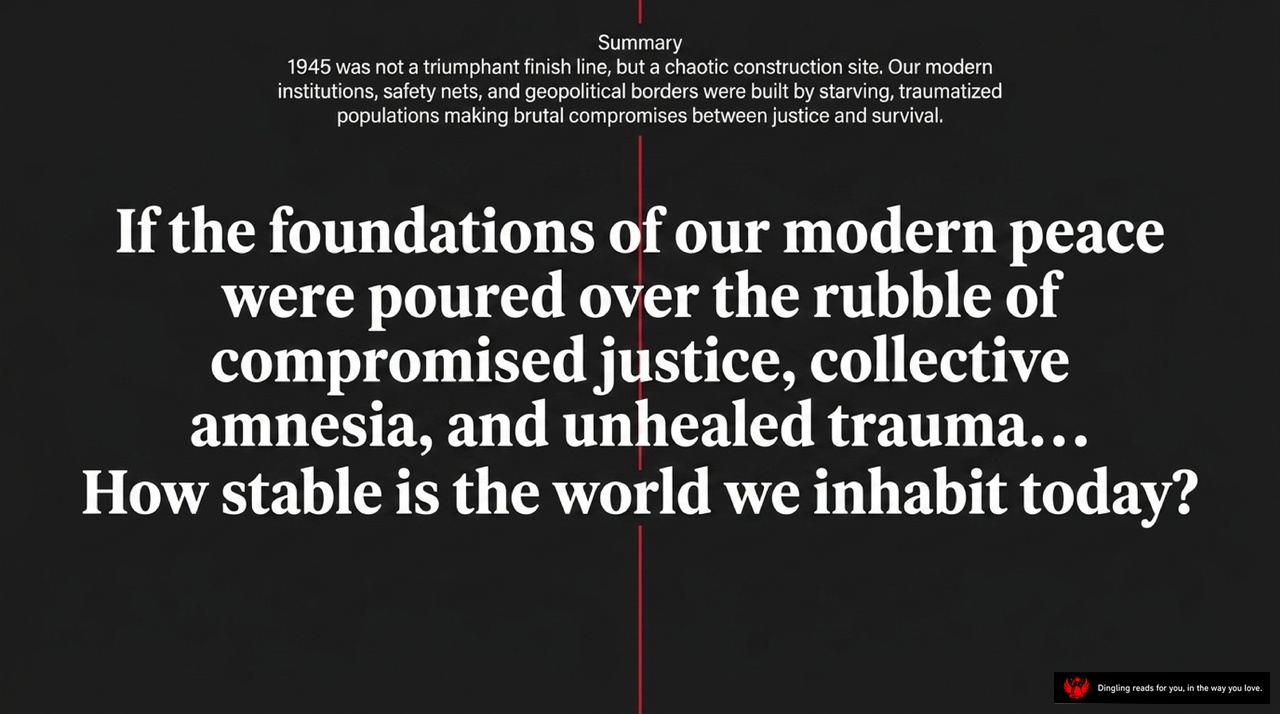
So, where did our modern peace actually come from? It wasn't a triumphant finish line in 1945. As the slide reminds us, it was more like a chaotic construction site. The foundations of the institutions, safety nets, and borders we live with today were poured right over the rubble of compromised justice, collective amnesia, and unhealed trauma.
Think about what happened right after the fighting stopped. Millions of liberated people didn't feel grateful; they felt hungry, traumatized, and desperate. In places like Bergen-Belsen, survivors were so starved that even a piece of ham could kill them, forcing a brutal compromise between justice and survival. In Japan and Germany, the defeated nations faced a different kind of collapse. Instead of pure justice, we saw a messy mix of revenge and amnesia. In Poland, Jewish survivors were often driven out by neighbors who had stolen their homes. In Japan, the US military prioritized rebuilding the economy over punishing war criminals, letting figures like Shigeru Yoshida—who had overseen forced labor—rise to power.
Even the trials themselves were a compromise. The Nuremberg trials established new laws for "crimes against humanity," but they couldn't catch everyone, and many former Nazis quietly slipped back into positions of power to help rebuild their countries. We traded total justice for stability. We chose to bury the past rather than fully confront it, hoping that by building a new world on top of the old ruins, we could prevent another catastrophe. But the question remains: how stable is the world we inhabit today, built on these unresolved contradictions?