



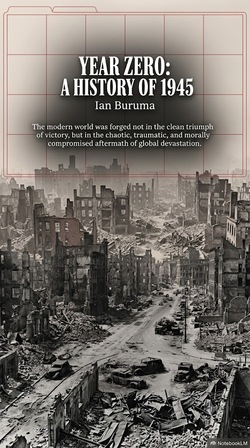
Buruma shatters the 1945 myth by showing how 1945 was actually a year of collapse, moral confusion, and raw chaos rather than a clean victory parade.
Your Review
Buruma shatters the 1945 myth by showing how 1945 was actually a year of collapse, moral confusion, and raw chaos rather than a clean victory parade.

Hard truth about 1945 victory.

This book changed my view of history completely.

Buruma exposes how 1945 was not a fresh start but a year where survival often trumped morality, sowing seeds for future global conflicts. The detailed accounts of the Hunger Winter in the Netherlands, where families boiled tulip bulbs and died from eating too much Allied food too fast, are haunting. The story of Jewish survivors returning to Poland only to face pogroms and neighbors who stole their homes illustrates the brutal betrayal that occurred. Furthermore, the book details how the rush to rebuild Germany and Japan led to compromises where justice was sacrificed for stability, allowing former Nazis and war criminals like Kishi Nobusuke to return to power. The narrative of the Cossack refugees being deceived and sent to the Gulag, or the whitewashing of Unit 731 scientists by the US, shows the dark side of political expediency. These events prove that the year we remember as triumphant was actually a time of moral confusion, ethnic cleansing, and the birth of the Cold War, making the book a necessary, eye-opening read for anyone who thinks 1945 was simply a happy ending.

Buruma exposes how 1945 wasn't a clean victory parade but a year of raw chaos where morality blurred, revealing that the seeds of our current global conflicts like the Cold War and ethnic tensions were actually sown in that messy year when old rules collapsed and survival trumped everything, making the myth of a fresh start feel dangerously distant from the uncomfortable reality of millions clinging to humanity amid the ruins. 80

A sober look at 1945's true chaos.

The analysis of denazification failures shows how former Nazis returned to power, undermining justice for economic recovery.

Buruma shatters the 1945 victory myth by exposing how the year actually sowed seeds for future global conflict and inequality.

Buruma shows how displacement forced new nationhood ideas, shaping modern refugee systems.

Buruma argues that 1945 compromises like letting Unit 731 leaders go free for data or sparing Emperor Hirohito prioritized power over justice, creating a global order defined by strategic advantage rather than idealism, which explains why the Cold War erupted so quickly as Allies traded accountability for stability while building systems that still shape our refugee policies and nationhood today.

A stunning reminder that 1945 was not a clean victory but a messy year where justice was traded for stability, as seen in the immunity granted to Unit 731 scientists and the forced expulsion of Germans.

Reading about the Pan-Pan girls in Japan, I felt how young women traded companionship for survival, using broken English slang to navigate a new world where they reclaimed control over their lives despite stigma, showing that adapting to chaos allowed them to find dignity even as old grudges boiled over into violence across continents.

1945 was not a clean victory but a messy, chaotic year of collapse.
Buruma shatters the 1945 victory myth with raw truth about suffering.

Buruma details how Dutch starvation killed many people, showing that the Hunger Winter was a man-made disaster where families boiled tulip bulbs to survive while black market restaurants served rich meals to wealthy patrons nearby, proving that survival often trumped morality and equality in that chaotic year when old rules no longer applied and neighbors betrayed each other for food.

Buruma explains how 1945 trials established accountability for mass violence, though political expediency sometimes overrode fair process, creating a complex legacy where justice balanced with reconstruction needs.

The book breaks the myth of a perfect victory year.

Buruma reveals how 1945 was actually a year of collapse where survival often trumped morality, forcing survivors to choose between justice and stability while rebuilding shattered nations from the ruins of war.

A powerful reminder that 1945 was not a clean fresh start but a messy year where survival often trumped morality and old rules no longer applied.

The story of Dutch families eating tulip bulbs to survive the Hunger Winter hit me hard.