
You Are What You Risk: Complete Chapter-by-Chapter Summary
Welcome to today’s session on *You Are What You Risk* by Michele Wucker. This isn’t just about personal choices—it’s about how the way we take risks shapes our teams, our cultures, and even our future on a global scale. Think of it like a fingerprint: your risk profile is unique, and it leaves a mark on everything around you. We’ll explore how understanding this can help us build more resilient organizations and make better decisions in uncertain times. Let’s dive in.
Hey everyone, let’s dive into something that shapes every single one of our decisions, often without us even realizing it: risk.
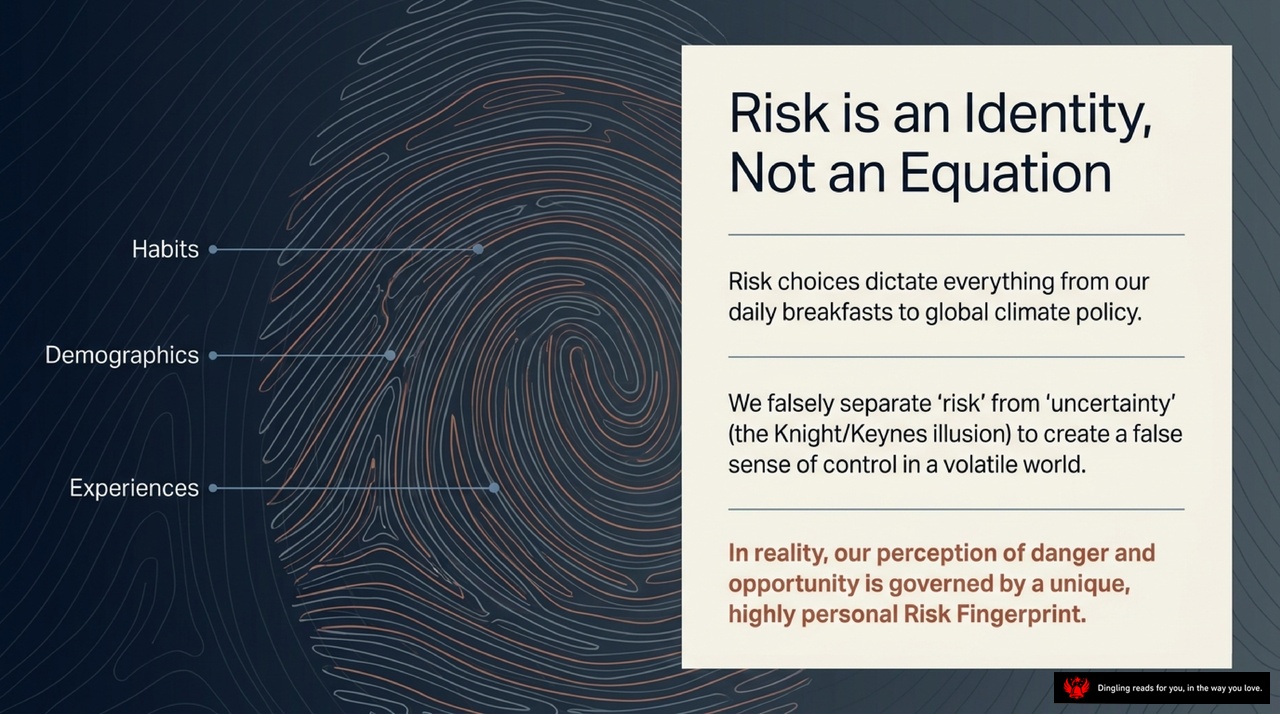
This slide is all about a powerful idea: **Risk is an Identity, Not an Equation**. That means it’s not something you can just plug numbers into and solve like a math problem. Instead, how you see and respond to risk is deeply personal—it’s tied to who you are.
Look at that fingerprint on the left. That’s your **Risk Fingerprint**. It’s made up of three key parts: your **habits**, your **demographics**, and your **experiences**. These shape how you make choices—from what you eat for breakfast to how you feel about investing in the stock market or even how you view global issues like climate change.
We often think we can separate “risk” from “uncertainty,” but that’s a trap. Economists call it the Knight-Keynes illusion. In reality, we use the idea of risk to make the world feel more predictable than it really is. But in a fast-changing, volatile world, that false sense of control can actually keep us from making better decisions.
So next time you’re faced with a tough choice, ask yourself: *What’s my risk fingerprint?* Because your perception of danger and opportunity isn’t universal—it’s uniquely yours. And that matters more than you think.
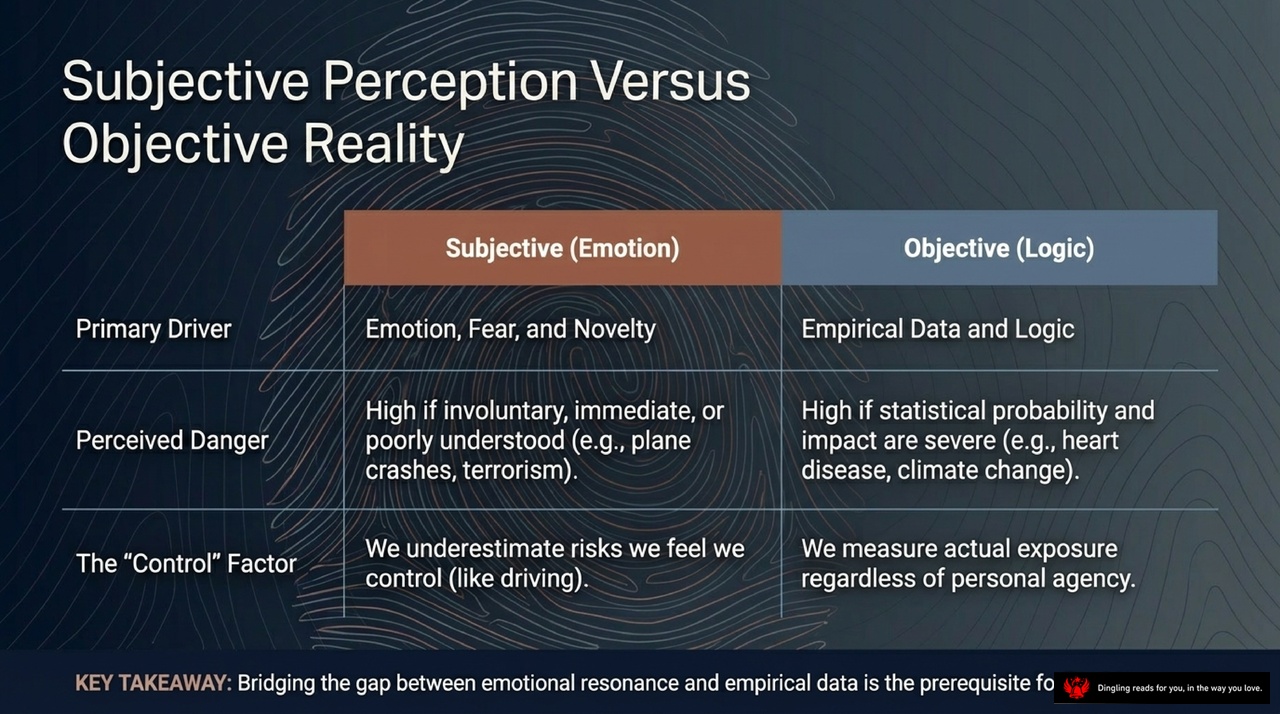
So, let’s talk about how we actually see the world versus how it really is. This slide breaks down the big difference between what we *feel*—our subjective experience—and what’s *true*—objective reality.
On the left, you’ve got “Subjective,” which is driven by emotion, fear, and novelty. That’s why plane crashes feel terrifying even though they’re statistically rare. We’re wired to react to things that are immediate, involuntary, or just strange.
On the right, “Objective” is all about logic and data. Heart disease, for example, kills far more people than terrorism, but we don’t feel it the same way because it’s slow, predictable, and less dramatic.
Then there’s the “Control” factor. We tend to underestimate risks we think we can manage—like driving—while overreacting to things we can’t control, like pandemics or climate change.
The key takeaway here? To make smart decisions, we need to bridge the gap between how we feel and what the facts actually say. Emotion gets us started—but data keeps us safe.
Alright, here is the spoken-word script for Slide 3, tailored for a US audience.
**Slide 3: The Anatomy of a Risk Fingerprint**
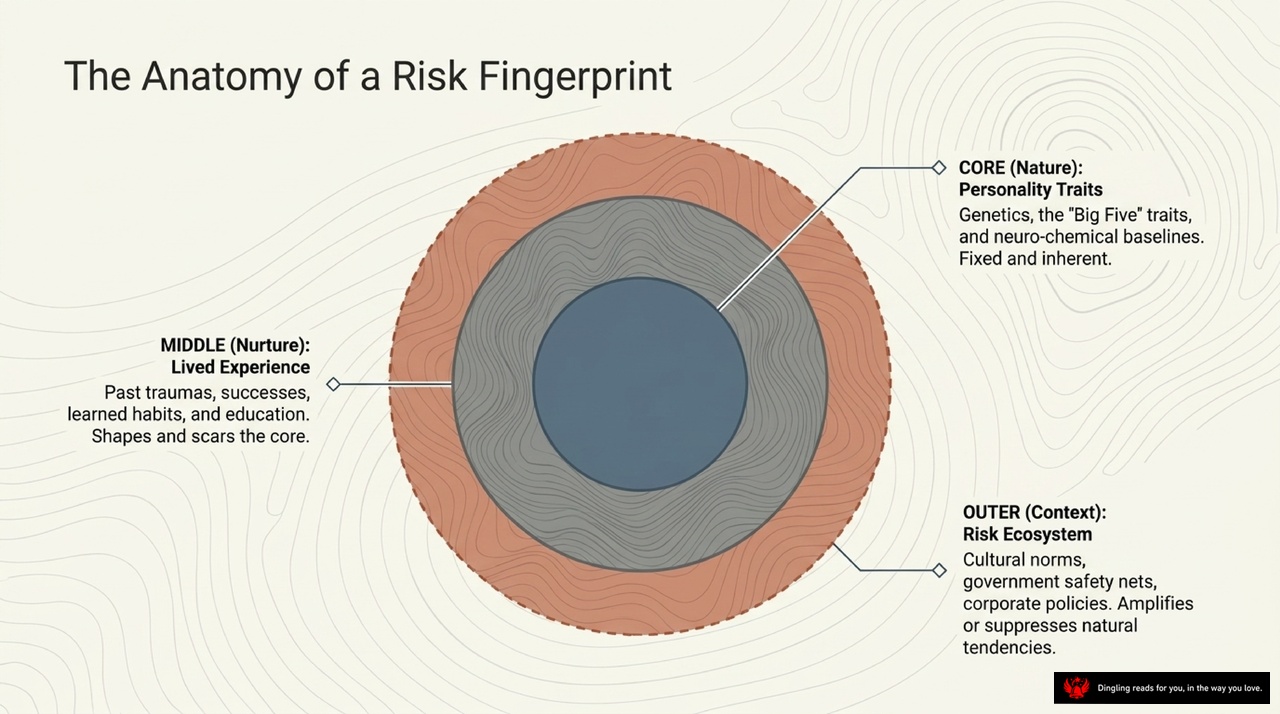
"Let’s zoom in on the diagram we just saw. This visual is a roadmap for understanding why we all react to risk differently. Think of this circle as a fingerprint. It’s not just one thing; it’s a complex interaction of three layers.
At the very center, labeled 'Core,' is our nature. This is the non-negotiable stuff: your genetics, your baseline personality traits, and your neurochemistry. It’s what you were born with.
Moving outward to the 'Middle' layer, we have nurture. This is your lived experience. It’s the past traumas you survived, the successes you built, and the habits you learned. This layer acts as a buffer or a lens, shaping and sometimes scarring that inner core.
Finally, the outermost layer is the 'Context.' This is the risk ecosystem surrounding you. It includes cultural norms, government safety nets, and corporate policies. This environment doesn't just sit there; it actively amplifies or suppresses your natural tendencies.
So, the next time you feel a surge of fear or confidence, don't just blame yourself. Look at the anatomy of your risk fingerprint. It’s the unique collision of your nature, your history, and your environment."

Here is the verbatim script for Slide 4.
**Slide 4: The Biometric Risk Loop**
"Let’s look at the engine that drives this behavior. This is what we call the Biometric Risk Loop.
It all starts with **Step 1: Environmental Stimulus**. Think of this as the trigger. It’s not just the stock market; it’s the physical world around you. It’s cold temperatures, spicy food, or even a fast-paced rhythm in a song.
When that happens, your body doesn’t wait for your brain to analyze the situation. Instead, it triggers **Step 2: Biological Bypass**. External stimuli effectively bypass your rational centers. You aren’t thinking; you are reacting.
This leads to **Step 3: Chemical Release**. To deal with that bypass, your body self-soothes or gets excited. It floods you with chemicals like cannabinoids or serotonin to calm you down, or dopamine to get you pumped up.
Finally, we reach **Step 4: Altered Risk Tolerance**. Because of that chemical cocktail, your body registers a risk before your conscious mind even notices it. Suddenly, you find yourself unexpectedly accepting a higher level of financial, physical, or social risk.
This isn’t a flaw; it’s a biological loop. Your body is constantly registering risk and changing your tolerance, often without you realizing it."

Slide 5: The Demographic Illusion. We’ve all heard the stereotypes—women are naturally cautious, taller men are bolder, and white males are simply wired to take risks. But what if those aren’t truths at all? What if they’re illusions built on context, privilege, and perception?
Let’s break it down. First, the gender myth. Society expects women to be risk-averse, but the reality? It’s not about gender—it’s about awareness. Women aren’t avoiding risk; they’re assessing it. They’re not afraid of taking calculated social risks, like starting a business or investing in their future. They’re just more aware of the consequences.
Next, the physical bias. We’re told that taller, stronger people are naturally bolder. But here’s the twist: physical strength doesn’t translate to boldness in unrelated areas. A muscular person might be confident in the gym, but that doesn’t mean they’re more likely to gamble with their finances or take a career risk. Physical prowess inflates confidence, but it doesn’t change behavior outside that context.
Finally, the “white male effect.” This one’s subtle but powerful. We assume white men have a higher baseline risk appetite, but the truth is, their risk tolerance is tied to systemic privilege. When you’re in control of institutions, you perceive less danger because you’re shielded by them. You don’t have to worry about losing everything because the system is stacked in your favor.
So, what’s the takeaway? Risk isn’t about who you are—it’s about where you stand. It’s about the context, the privileges you hold, and the systems you operate within. The demographic illusion tricks us into thinking risk is fixed, but in reality, it’s fluid, shaped by the world around us.
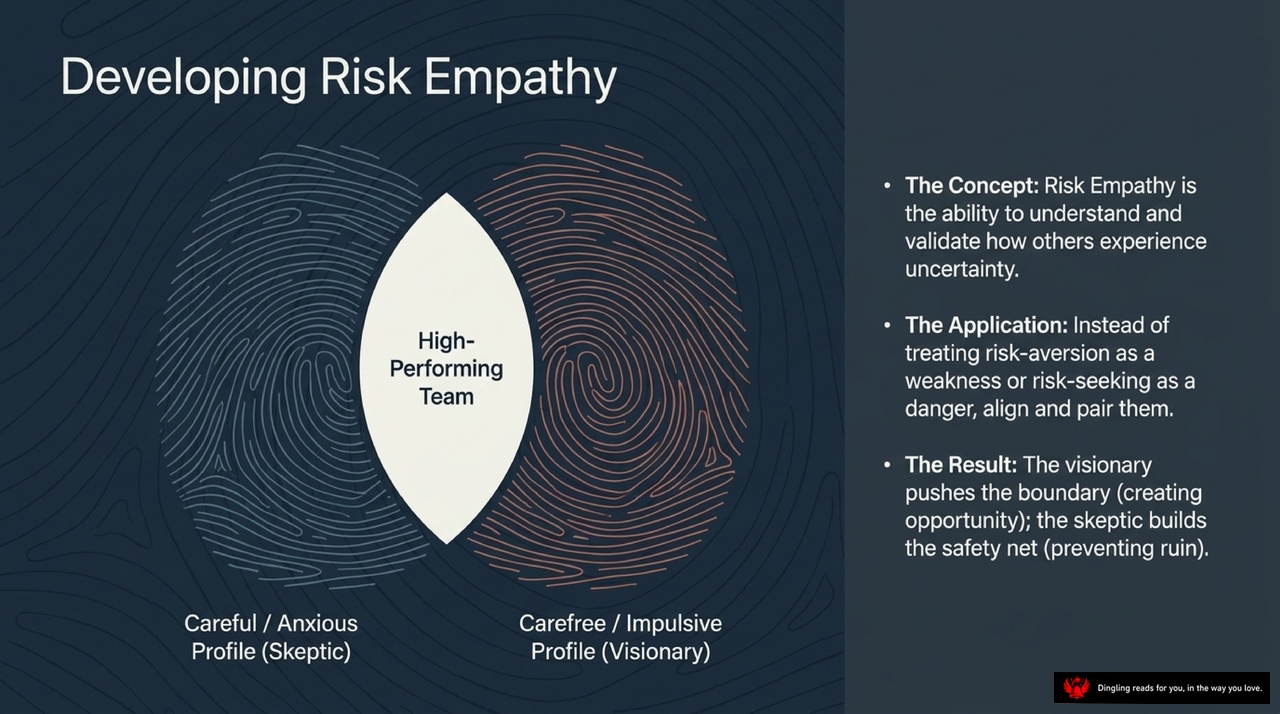
Let’s talk about what it really takes to build a high-performing team. It’s not about finding people who all think the same way. In fact, some of the most effective teams are made up of two very different personalities: the Careful / Anxious Profile, often called the Skeptic, and the Carefree / Impulsive Profile, known as the Visionary.
Look at this slide. On one side, you’ve got the Skeptic—the one who worries, analyzes, and builds the safety net. On the other, the Visionary—the one who sees opportunity, pushes boundaries, and takes risks. Together, they form a High-Performing Team.
But here’s the key: this doesn’t happen by accident. It requires what we call Risk Empathy. That’s the ability to understand and validate how others experience uncertainty. Instead of treating risk-aversion as a weakness or risk-seeking as a danger, you align and pair them.
When the Visionary pushes the boundary and creates opportunity, the Skeptic builds the safety net and prevents ruin. That balance is what turns a group of individuals into a team that actually delivers results. So next time you’re building or leading a team, don’t just look for agreement—look for this kind of complementary tension. That’s where real performance lives.
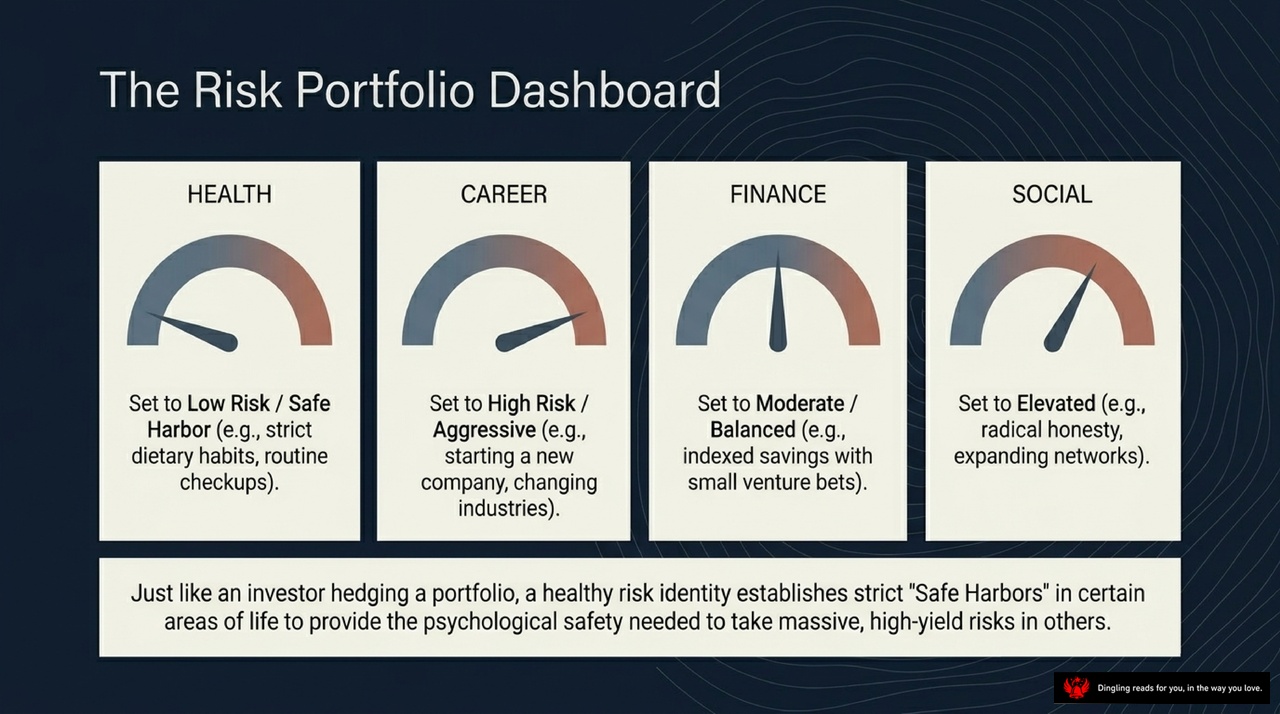
Imagine your life not as a single gamble, but as a diversified portfolio—just like the stock market. Today, we’re looking at “The Risk Portfolio Dashboard,” a powerful mental model that helps you decide where to play it safe and where to take bold risks.
In this dashboard, you’re asked to set four key areas of your life to different risk levels. Think of it as tuning your personal risk identity for maximum impact and long-term success.
First, **Health**—set to *Low Risk / Safe Harbor*. This means building strong foundations: eating well, sleeping enough, getting regular checkups. These aren’t just habits; they’re your safety net. You don’t want to lose your health in a high-stakes bet.
Next, **Career**—set to *High Risk / Aggressive*. This is where you push boundaries: starting a business, switching industries, or taking on challenging projects. Why? Because real growth often comes from stepping into the unknown.
Then, **Finance**—set to *Moderate / Balanced*. Don’t go all-in on crypto or real estate, but don’t just park money under the mattress either. Think indexed savings, small venture bets, and steady compounding. You want growth without ruin.
Finally, **Social**—set to *Elevated*. This means being radically honest, expanding your network, and challenging yourself socially. It’s okay to be awkward, to speak up, to connect deeply. These are high-yield social risks that pay off in trust, influence, and opportunity.
The key insight? Just like an investor hedges a portfolio, you too need “safe harbors” in some areas so you can confidently take massive, high-yield risks in others. Protect what matters most, then go all-in where the upside is greatest.
This isn’t about being reckless—it’s about being strategically bold. And that’s how you build a life that’s both secure and wildly rewarding.
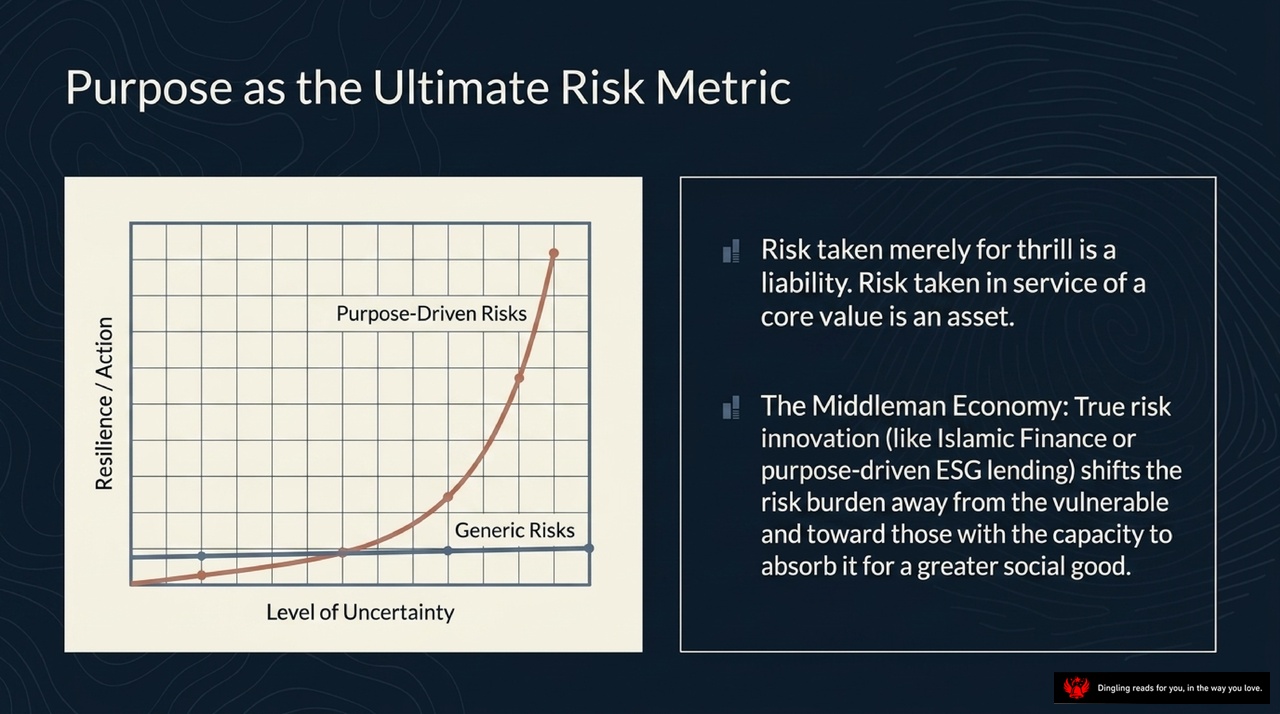
Purpose as the Ultimate Risk Metric.
Look at this chart. It plots Resilience against the Level of Uncertainty. You see two distinct paths. The flat line at the bottom represents Generic Risks. These are the risks we face in a standard, predictable world. They are manageable, and they don't require much action.
But then, look at the curve that shoots upward. This is Purpose-Driven Risk. Here, as uncertainty increases, resilience doesn't just stay flat; it explodes. This is the key insight: Risk taken merely for thrill is a liability. It's a burden. But risk taken in service of a core value is an asset. When you act on purpose, you don't just survive the uncertainty; you thrive in it.
This concept is the heart of the Middleman Economy. True risk innovation, like Islamic Finance or purpose-driven ESG lending, shifts the risk burden away from the vulnerable and toward those with the capacity to absorb it for a greater social good. In other words, we stop treating risk as something to be feared or hidden. We start treating it as a tool to be deployed for a purpose.
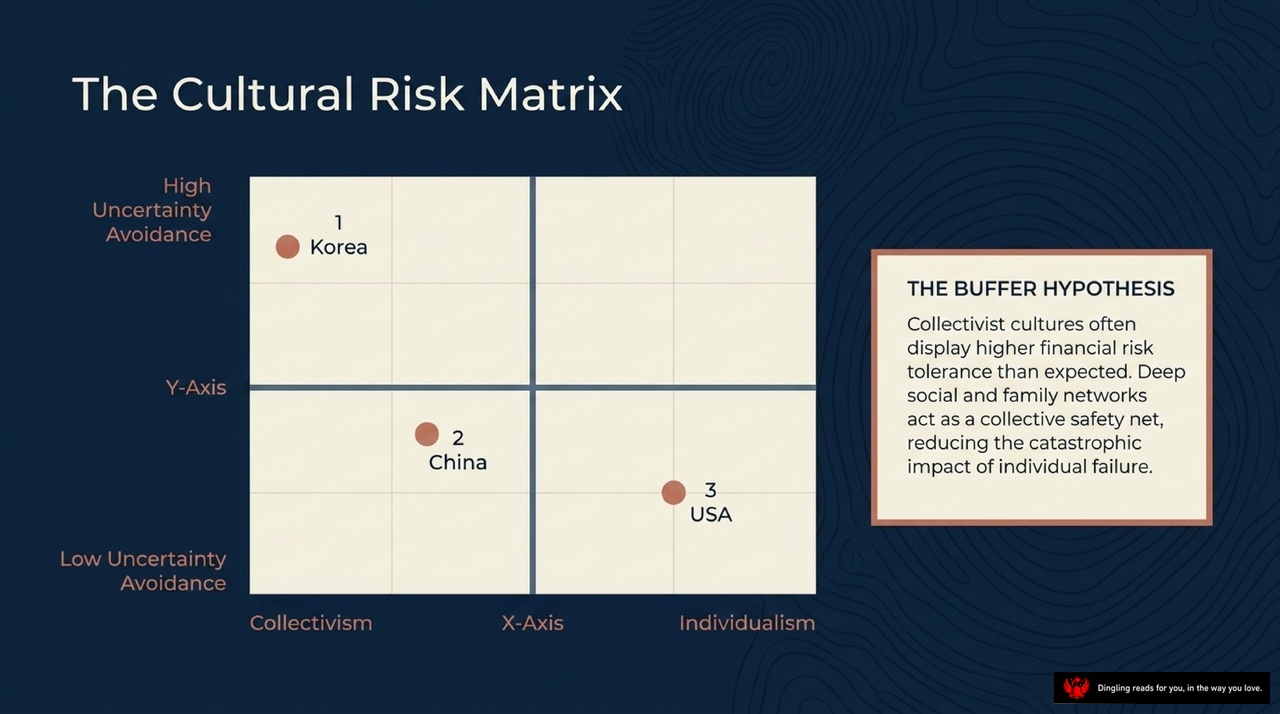
Look at this Cultural Risk Matrix. It’s not just a chart—it’s a window into how different societies actually think about risk.
On the X-axis, we’ve got Collectivism versus Individualism. Korea and China sit on the collective side, while the U.S. is firmly individualistic. On the Y-axis, we’re measuring Uncertainty Avoidance. Korea’s high on that scale, meaning people there prefer stability and predictability. China and the U.S. are lower, more comfortable with ambiguity and change.
Now here’s the twist: despite Korea’s high uncertainty avoidance, it still shows up as a high-risk culture in our model. Why? Because of what’s called the Buffer Hypothesis. In collectivist societies like Korea and China, deep social and family networks act as a safety net. If one person fails financially, the community steps in. That reduces the catastrophic impact of individual failure—and paradoxically, makes people more willing to take risks.
So even though Korea avoids uncertainty in daily life, its cultural structure actually encourages financial risk-taking. That’s the counterintuitive insight we’re uncovering here.
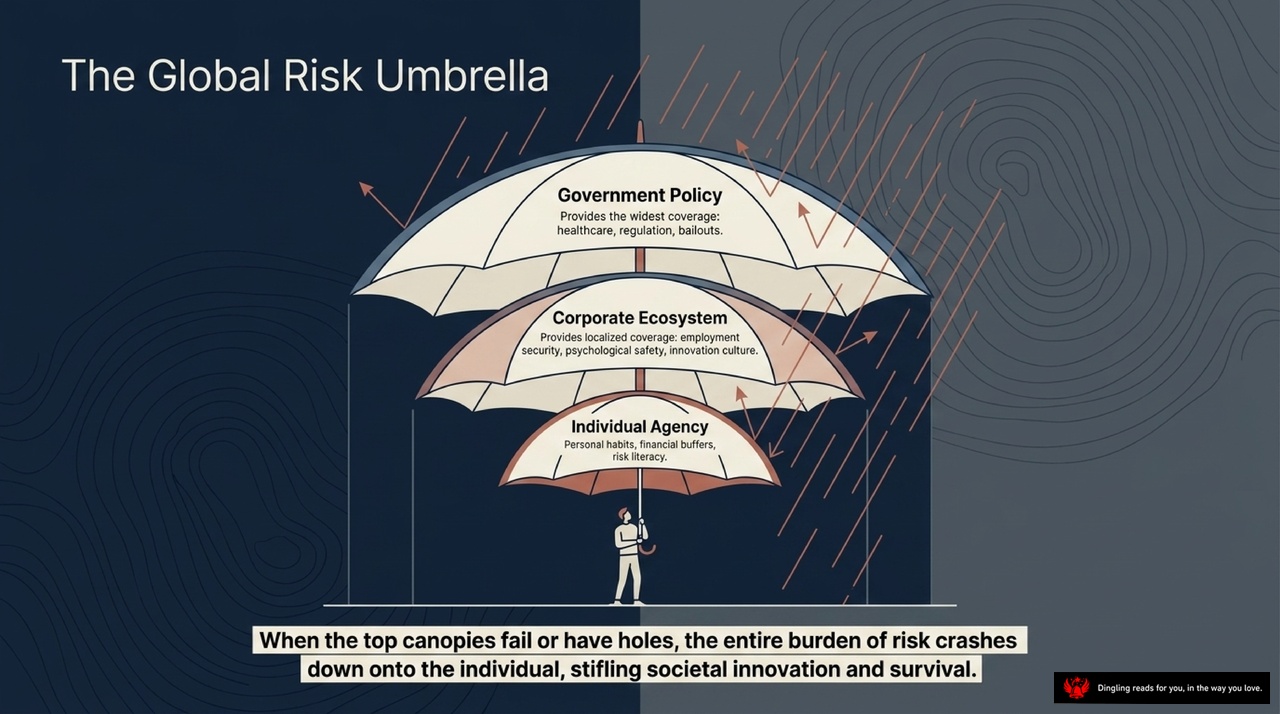
Imagine you're walking through a storm. You're not alone—you're under three layers of protection. First, there's the big umbrella overhead: Government Policy. It offers the broadest shield, covering healthcare, regulation, and even bailouts when things go wrong. Beneath that, the Corporate Ecosystem steps in, providing a more focused layer of safety—job security, mental well-being, and a culture that encourages innovation. And finally, in your hands, you hold the smallest umbrella: Individual Agency. This is where personal habits, financial buffers, and risk literacy come into play. Together, these three layers form what we call the Global Risk Umbrella. But here’s the hard truth: when the top canopies fail or have holes—when government support wavers or corporate structures crumble—the entire weight of risk crashes down onto you. That’s not just stressful; it’s stifling. It crushes your ability to innovate, to grow, and simply to survive. So the question isn’t just how to hold your own umbrella—it’s how to ensure the bigger ones above you don’t collapse.
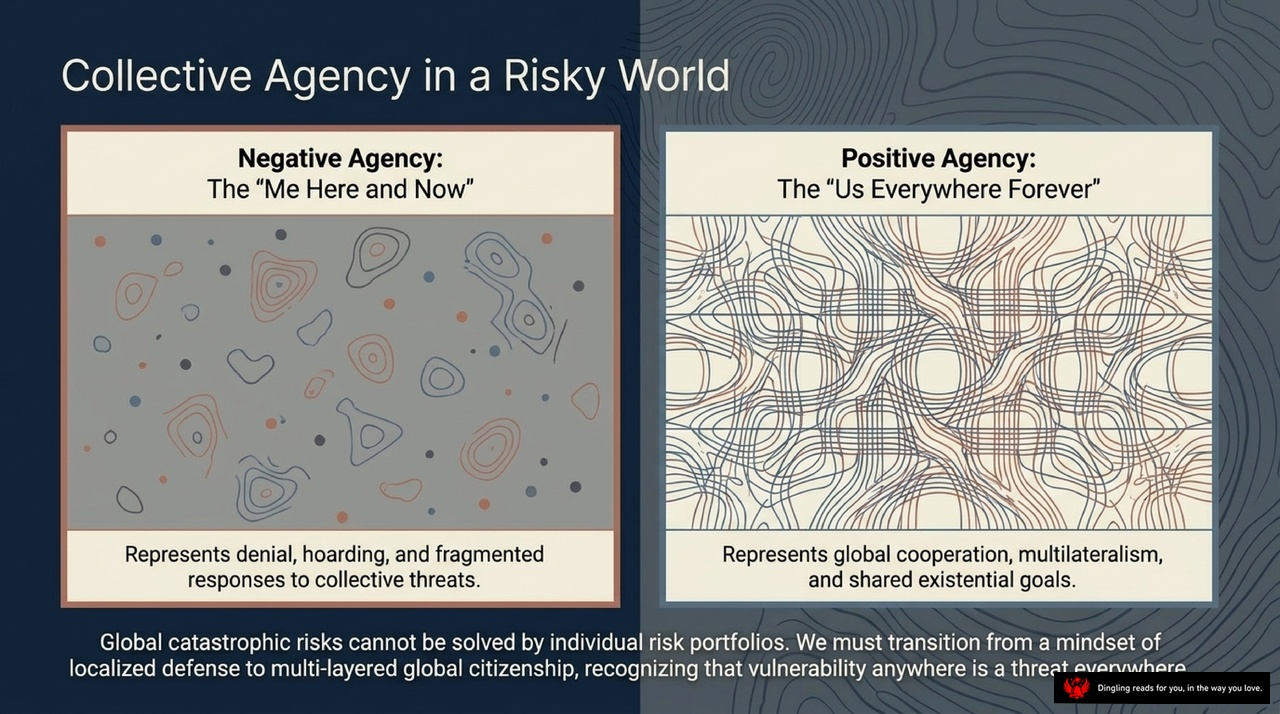
So, we’re standing in a risky world—and the question isn’t just *what* risks face us, but *how* we choose to respond. This slide breaks it down into two opposing forces: Negative Agency and Positive Agency.
On the left, you see “Negative Agency: The ‘Me Here and Now’”—a scattered, disconnected map of isolated fears. It represents denial, hoarding, and fragmented reactions to threats that don’t respect borders or time. Think of it as each person or nation acting alone, protecting only their own backyard while ignoring the storm brewing elsewhere.
On the right? “Positive Agency: The ‘Us Everywhere Forever’”—a tightly woven network of interconnected lines. This is global cooperation, multilateralism, and shared existential goals. It’s about recognizing that vulnerability anywhere is a threat everywhere. When one part of the system shakes, all parts feel it.
The bottom line? Global catastrophic risks can’t be solved by individual risk portfolios. We must transition from a mindset of localized defense to multi-layered global citizenship. The choice isn’t just philosophical—it’s practical. Will we act as isolated actors… or as a unified humanity facing the same future?

Let’s be honest—most of us have been taught to fear risk. We’ve been told it’s something to avoid, to minimize, to manage like a budget line item. But what if that’s the whole problem? What if risk isn’t the enemy at all?
This slide is asking us to flip the script. It says: “Risk is not merely a threat to be managed; it is the fundamental currency of human agency.” That means your choices—yes, even the scary ones, even the uncertain ones—are what shape who you are, who you become, and what kind of world you leave behind.
Think about it: every time you take a leap, whether it’s starting a business, moving to a new city, or speaking up in a meeting, you’re investing in your future self. You’re choosing the kind of life you want to live. And yes, that means taking risks. Not recklessly—but intentionally.
The second line hits hard: “Are you choosing the risks that define you, or are you letting your fears choose for you?” That’s the real question. Because when we don’t choose our risks, someone else does—for us, through our silence, our hesitation, our comfort zones.
So here’s the challenge: don’t wait for safety to arrive. Don’t wait for permission. Start choosing the risks that align with your values, your dreams, your truth. Because the person you become depends on the risks you take today.