
You Can Be a Stock Market Genius: Complete Chapter-by-Chapter Summary
Welcome to today's session on how anyone can become a stock market genius. This isn't about having a fancy MBA degree or managing billions in capital. It's about realizing that the very constraints holding back professional investors are the exact freedoms you have as an individual.
As you see on this slide, the core idea is simple yet powerful: You can find hidden profits in the stock market's secret corners. While Wall Street managers are often trapped by massive fund sizes and the pressure to constantly diversify their portfolios, you are free to focus on fewer, higher-quality opportunities. You aren't forced to chase short-term trends or ignore small-cap stocks just because they are too small for a giant fund.
The real advantage lies in flexibility. While experts are stuck analyzing crowded markets and following herd behavior, you can dive into unconventional areas—like distressed assets, corporate spin-offs, or complex merger deals—that institutions often overlook or avoid. By doing the hard work of independent research and understanding the true value behind these special events, you can spot opportunities that others miss.
Remember, being a genius investor isn't about knowing everything; it's about knowing where to look when everyone else is looking away. It's about patience, deep analysis, and the courage to buy when others are fearful. With the right mindset and a bit of curiosity, you can turn the market's complexity into your greatest asset. Let's dive in and explore how to unlock these hidden treasures.
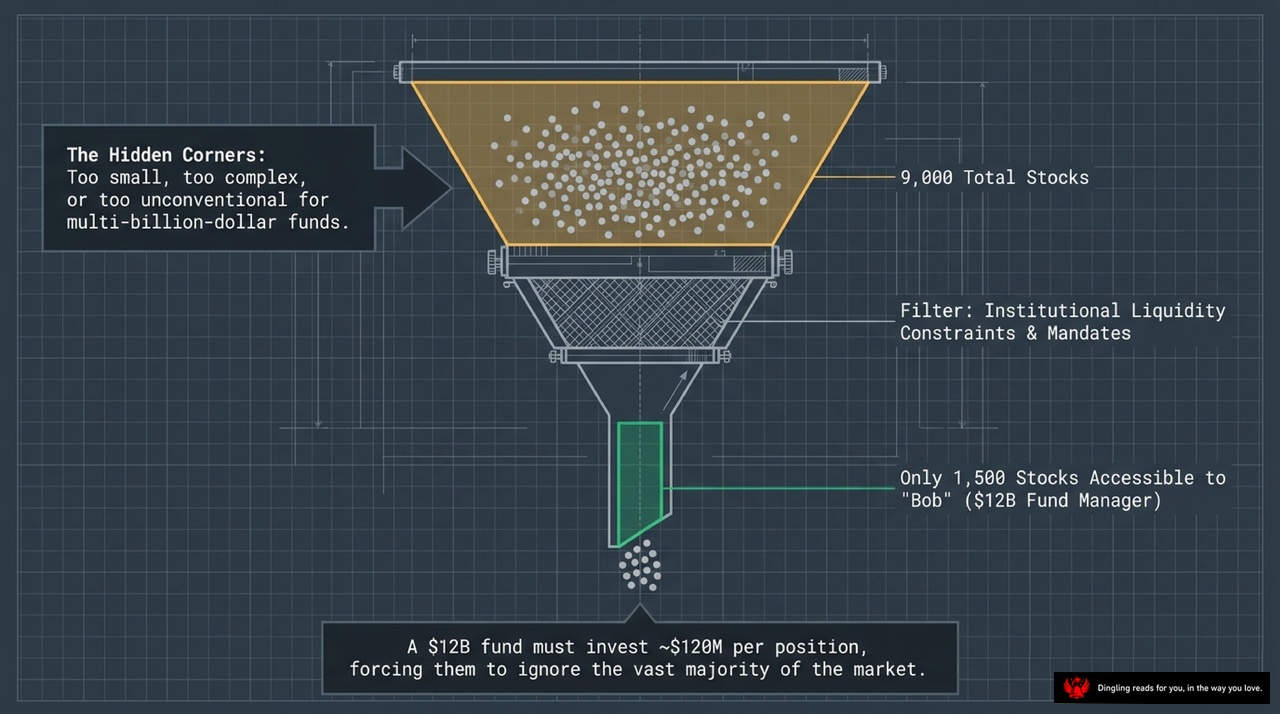
Imagine you are a massive institutional fund manager, managing twelve billion dollars. You might think you have all the power in the world, but you are actually trapped in a very narrow corridor. Look at this funnel. At the top, there are 9,000 total stocks available in the market. But as soon as money flows through, it hits a filter labeled "Institutional Liquidity Constraints & Mandates."
Why? Because of simple math. If you are managing a twelve-billion-dollar fund, you can't afford to buy tiny pieces of small companies. The image tells us clearly: a fund of your size must invest roughly twelve million dollars per single position. That means you simply cannot buy companies that are too small, too complex, or unconventional. You are forced to ignore the vast majority of the market.
Only 1,500 stocks remain accessible to you, the "Bob" in this story. These are the only safe, liquid, large-cap names you can touch. But here is the irony: the hidden corners of the market—the ones too small or too messy for your multi-billion-dollar fund—are exactly where the greatest opportunities lie.
This diagram illustrates the biggest trap for professional investors: their own size. They are forced to ignore the vast majority of the market just to meet their minimum position sizes. While you are stuck in this crowded, expensive lane, a smart individual investor can skip the filter entirely. You can dive into those "hidden corners," find the undervalued assets that institutions are too big to touch, and build wealth by doing what the experts are physically unable to do.
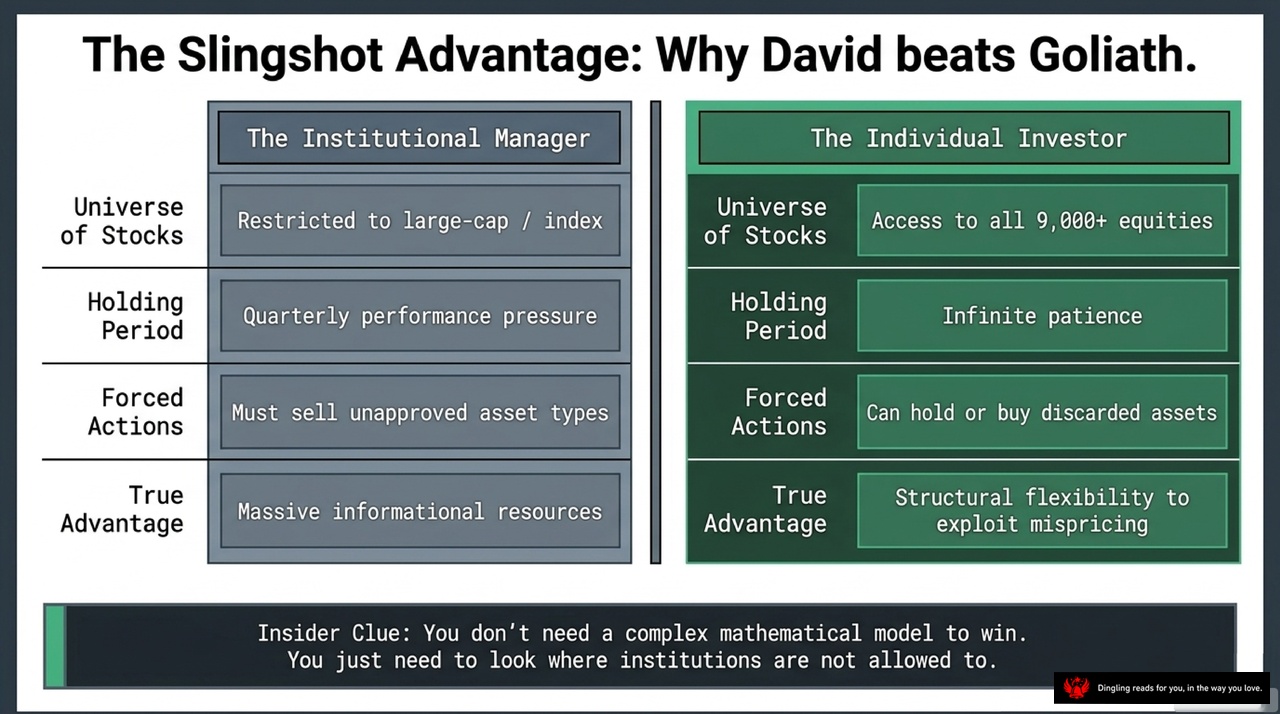
The slide you see here flips the script on a classic investing myth: the idea that big institutions like mutual funds are unbeatable giants and individual investors are just small fish. In reality, the slide reveals a counter-intuitive truth—David often beats Goliath not because he's stronger, but because the giant is shackled by rules that don't bind you.
Look at the left side, representing the Institutional Manager. They are trapped. Their universe of stocks is restricted to large-cap and index funds, meaning they simply cannot touch the thousands of smaller companies where hidden gems often hide. They face quarterly performance pressure, forcing them to sell winners too early or panic during dips. They must sell unapproved asset types and, ironically, their massive informational resources often lead to crowded trades that destroy alpha.
Now look at the right side: The Individual Investor. While you lack their data centers, you possess structural flexibility. You have access to all 9,000+ equities, not just the big names. You have infinite patience, allowing you to hold through volatility while institutions are forced to trim positions. You can buy the "discarded assets" that institutions are forced to dump. Your true advantage isn't better data; it's the ability to exploit mispricing in areas where institutions are legally or structurally forbidden to go.
The insider clue at the bottom is the golden rule: You don't need a complex mathematical model to win. You just need to look where institutions are not allowed to. By avoiding the crowded trades of the giants and focusing on the overlooked corners of the market, you turn their limitations into your greatest opportunity.

Look at this map titled "The Map of Hidden Profits." It visualizes the exact battlefield where smart money operates, right in the center sits the "Corporate Catalyst"—the engine that drives value creation through corporate events like spinoffs, mergers, and restructurings.
Surrounding this catalyst are five specific opportunities that the average investor completely misses. First, on the top left, we see "Spinoffs." These are discarded divisions with hidden leverage. When a company splits off a non-core business, the market often panics and sells the new stock cheap, ignoring the fact that the parent company is now lighter and more valuable.
Next, bottom left, is "Restructurings." Here, hidden value is exposed simply by shedding toxic assets. Think of a bloated corporation selling off its failing divisions; the remaining core business often skyrockets in value, creating a massive gap between the stock price and its true worth.
Moving to the bottom center, we have "Recapitalizations & LEAPs." This is where extreme leverage meets capped downside. By using tools like Long-Term Equity Anticipation Securities, or LEAPs, you can replicate the high returns of a leveraged buyout while protecting your capital if things go wrong. It's essentially borrowing the company's future growth to boost your own returns today.
On the top right, look at "Merger Securities." These are exotic derivatives dumped by index funds during big acquisitions. When a mega-merger happens, institutions sell complex securities like warrants and preferred stock because they don't fit their portfolios. But these often contain hidden value, like the right to buy stock at a fraction of its future price, which can multiply in value once the deal closes.
Finally, bottom right, is "Bankruptcies." These are orphan stocks emerging with clean slates. While everyone runs away from bankruptcy, the real opportunity lies in the senior debt or the new stock issued after the company reorganizes. Often, the market prices these at zero, not realizing the company might emerge as a cash-rich, debt-free winner.
The key takeaway from this diagram is simple: professional investors are shackled by size and regulations, forcing them to ignore these messy, complex, but highly profitable corners of the market. You, however, are free. By studying these five areas—spinoffs, restructurings, leverage plays, merger scraps, and bankruptcy resets—you can find the hidden profits that the giants simply walk right past.

So, here's the secret weapon that separates the casual investor from the true alpha hunter: you don't need to be a genius; you just need to be where the smart money is forced to run.
Look at this chart. It's not just a graph; it's a map of the "Valley of Mispricing." It shows exactly how a spinoff works in your favor. When a parent company distributes shares, the market often overreacts, sending the new stock into a sharp decline. This isn't random chaos; it's what the slide calls "Blind Institutional Liquidation." Big index funds are forced to sell these new stocks because they don't fit the strict rules of their mandates. The result? A massive oversupply of shares hitting the market with no demand to match.
That steep drop creates the "Valley of Mispricing." This is where the real opportunity lies. While institutions are mindlessly dumping shares, the smart money is watching. The slide highlights "The Value Realization" phase, where the price stabilizes at a rock-bottom level. This is "The Smart Buy Zone." You buy right when the index funds are selling without even looking at the price.
The math is undeniable: spinoffs routinely beat the S&P 500 by 10% annually simply because the initial supply violently exceeds demand. By understanding these mechanics, you stop chasing hot tips and start buying undervalued assets at the bottom of the valley. That's how you exploit forced institutional dumping to build wealth.

Look at this blueprint-style checklist on the screen. It's all about how to spot a "goldmine" spinoff versus a "danger" zone. The core idea here is simple but powerful: you need to follow the insiders. The slide shows that the greatest returns happen when management's wealth is tied directly to the spinoff's success.
On the left, we see a company with heavy debt weighing down the equity. But when that debt is stripped away during a spinoff, the equity value can double instantly. That's the math behind the magic. On the right, the slide gives us a clear warning system. If management stays with the parent company, it's a danger zone—they have no skin in the game. But if management moves to the new spinoff and is heavily incentivized by stock options, that's your goldmine. They are now working for themselves, not just the parent company.
This connects perfectly to the book's argument about why special event investing beats the crowd. Professional investors are often too big or too risk-averse to touch these complex deals, but you can. By digging into SEC filings to check management's stock options and incentives, you can find these hidden opportunities before the market realizes them. Don't just look at the price; look at who is in charge and how much they stand to gain. That's where the real profit is hiding.
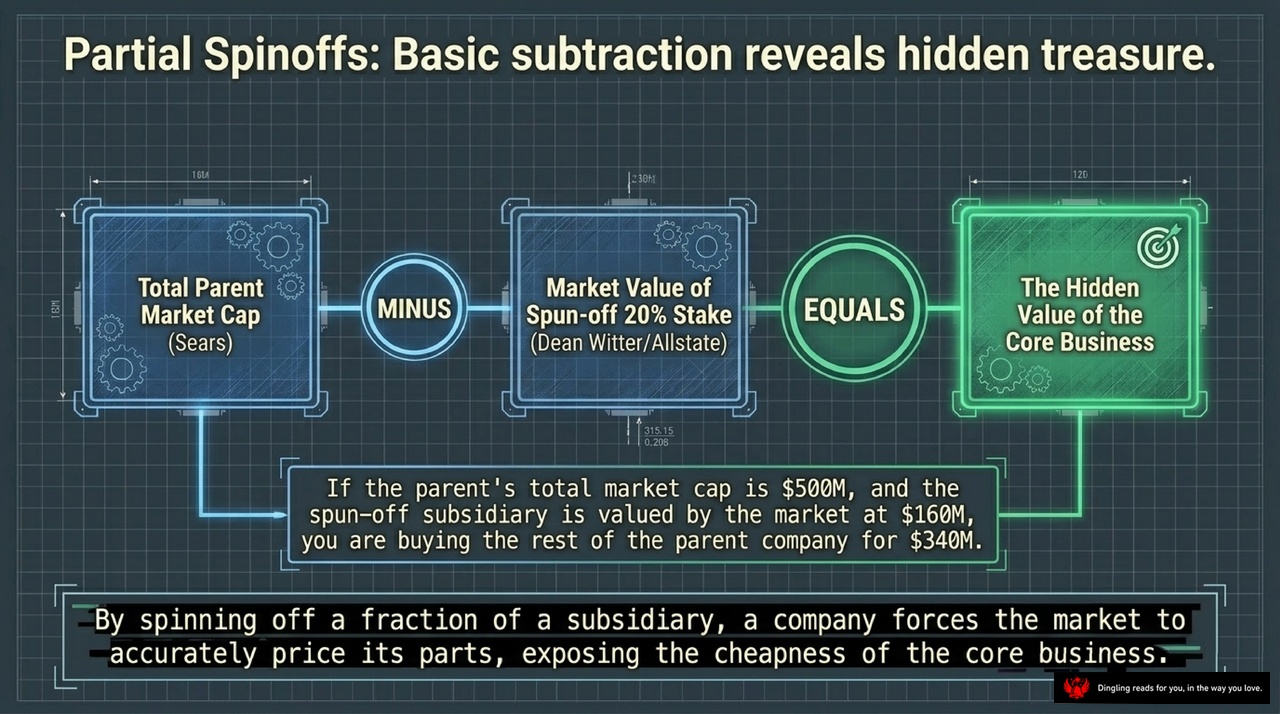
Partial spinoffs are like a financial magic trick where simple subtraction reveals a hidden treasure. As the slide illustrates, you take the total market cap of the parent company, like Sears, and subtract the market value of the spun-off stake, such as the 20% share of Dean Witter or Allstate sold to the public. What remains is the true, hidden value of the core business that the market often ignores.
Think of it this way: if the parent company is worth $500 million, and the spun-off subsidiary is valued at $160 million, you are essentially buying the rest of the parent company for only $340 million. By spinning off just a fraction of a subsidiary, the company forces the market to accurately price its individual parts. This exposes the cheapness of the core business, which was previously buried under the conglomerate discount. Instead of chasing hot trends, smart investors look for these structural shifts where the math clearly shows a bargain, allowing them to uncover value that everyone else is missing.
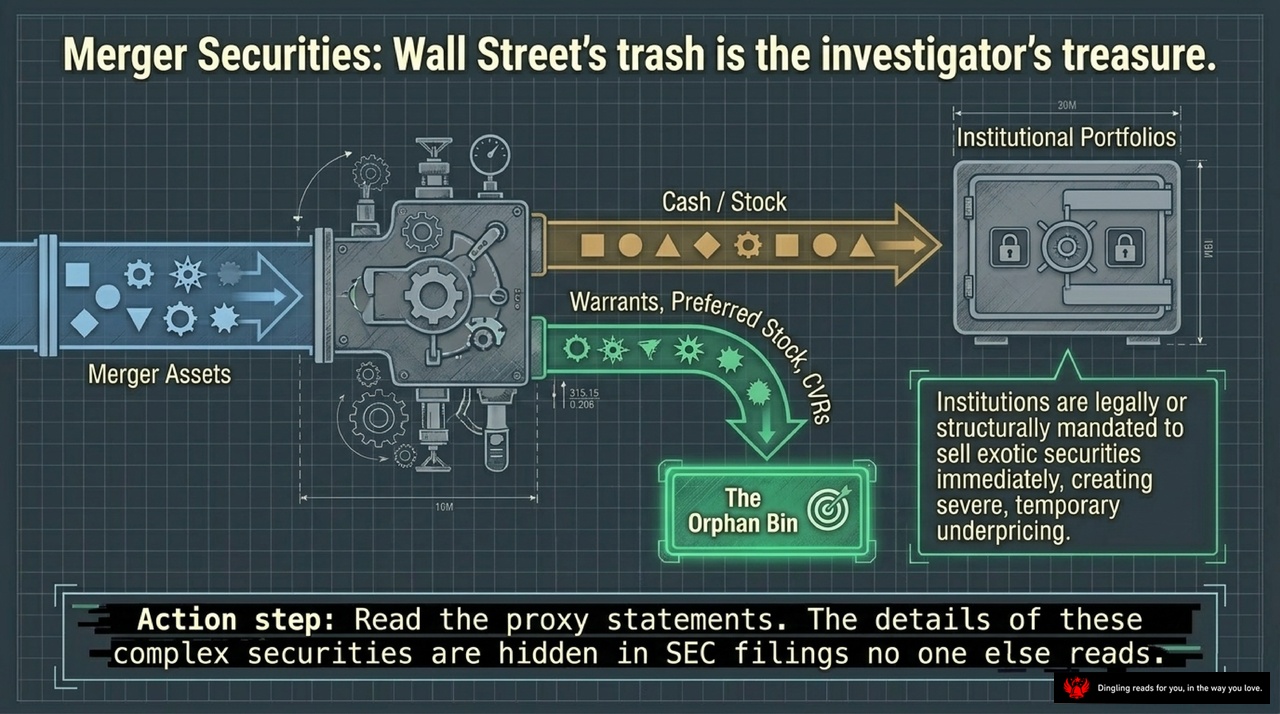
Wall Street loves to tell you that their "trash" is worthless, but for the sharp investigator, that discarded material is actually pure gold. Look at this diagram: it shows how merger assets get sorted into two streams. The first stream, labeled "Cash / Stock," flows safely into institutional portfolios like a locked safe. These big funds are happy with standard assets. But the second stream, the green path labeled "Warrants, Preferred Stock, CVRs," gets dumped into "The Orphan Bin." Why? Because institutions are legally or structurally mandated to sell these exotic securities immediately, creating severe, temporary underpricing.
This is your golden ticket. While the pros are forced to offload complex securities to meet their mandates, you can step in and buy them at a discount. The text at the bottom gives you the action step: read the proxy statements. The details of these complex securities are hidden in SEC filings that no one else reads. By digging into those documents, you can find the hidden value that the market has overlooked, turning what Wall Street calls trash into your personal treasure.

Look at this chart comparing the "Risk Arbitrage Trap" against the "Margin of Safety." On the left, you see a classic setup where the profit potential is a tiny sliver—just 80 cents—but the downside risk is a massive cliff of $14.00. This is the trap many investors fall into: risking a fortune to make pennies. If the deal breaks, that permanent loss destroys the entire portfolio.
Now, look at the right side. This is the Margin of Safety approach. Here, there is a solid "Asset Value Floor" protecting your capital. Above that floor, you have genuine "Fundamental Upside." This isn't about gambling on a deal that might collapse; it's about buying quality assets at a discount, ensuring that even if the market turns against you, your downside is limited.
The key takeaway, written right at the bottom, is simple but powerful: Never risk dollars to make pennies. Always prioritize downside protection. Professional investors often get trapped chasing small arbitrage gains while ignoring the catastrophic risks. But you have the freedom to ignore those traps. By focusing on the Margin of Safety, you build a fortress around your portfolio. You don't need to be right about every future price movement; you just need to be right about the value floor. That buffer is what allows you to sleep soundly and stay in the game when others are forced to panic sell.
So, here is the real secret to beating the market: stop chasing the crowd and start hunting where the big institutions are terrified to look.
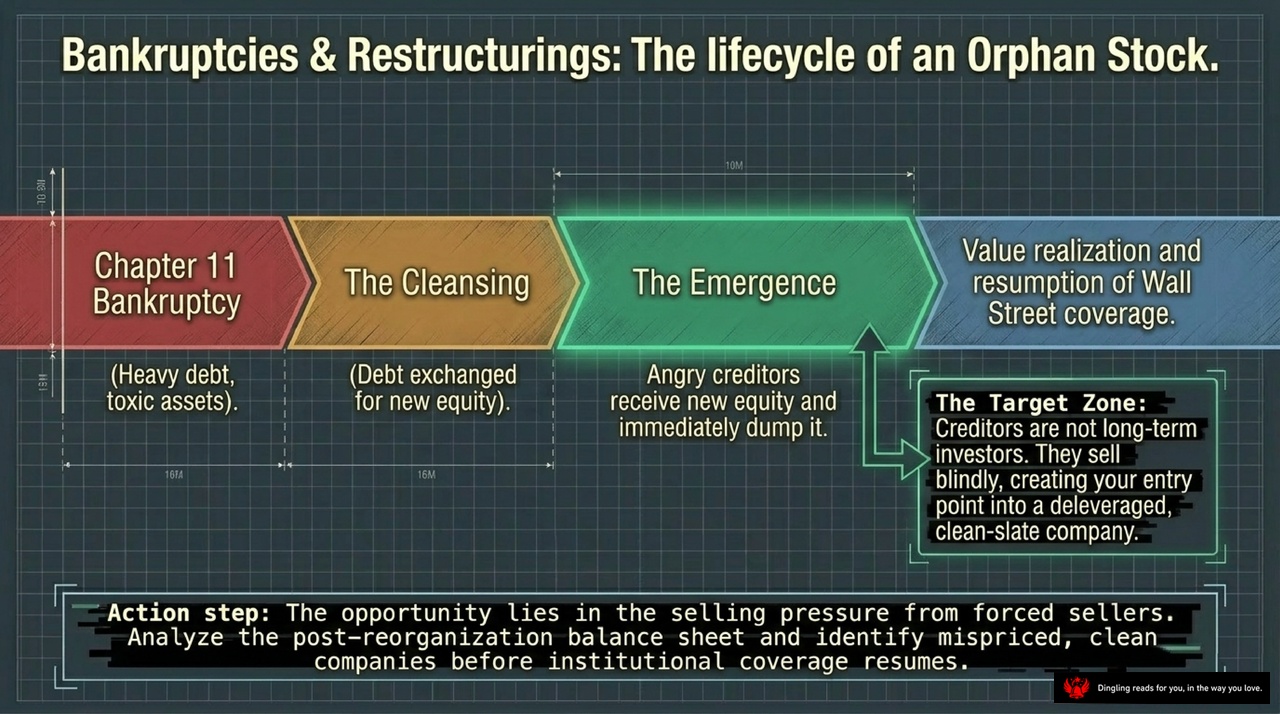
Look at this timeline. We are talking about the lifecycle of what the book calls an "Orphan Stock"—a company that gets abandoned by Wall Street because it's messy, debt-ridden, or just too complicated. But that abandonment creates your golden opportunity.
First, you have **Chapter 11 Bankruptcy**. The company is drowning in heavy debt and toxic assets. It's the ultimate red flag for most investors. But then comes **The Cleansing**. This is where the magic happens. The company exchanges that toxic debt for new equity, effectively wiping the slate clean. The bad stuff is gone, and the balance sheet is reset.
But here is the trap. Once the company emerges in **The Emergence** phase, angry creditors who got new shares immediately dump them. They aren long-term believers; they are just looking to get out. This creates massive selling pressure, crashing the stock price and wiping out any remaining institutional interest.
That is exactly where you want to be. This is **The Target Zone**. While the smart money is fleeing, you are looking at a completely de-leveraged, clean-slate company trading at a fraction of its true value. The book tells you the action step right here: analyze the post-reorganization balance sheet. Ignore the noise. Look for those mispriced, clean companies before Wall Street analysts even wake up to start covering them again.
Don't wait for the party to start. Buy the ticket while the venue is empty.
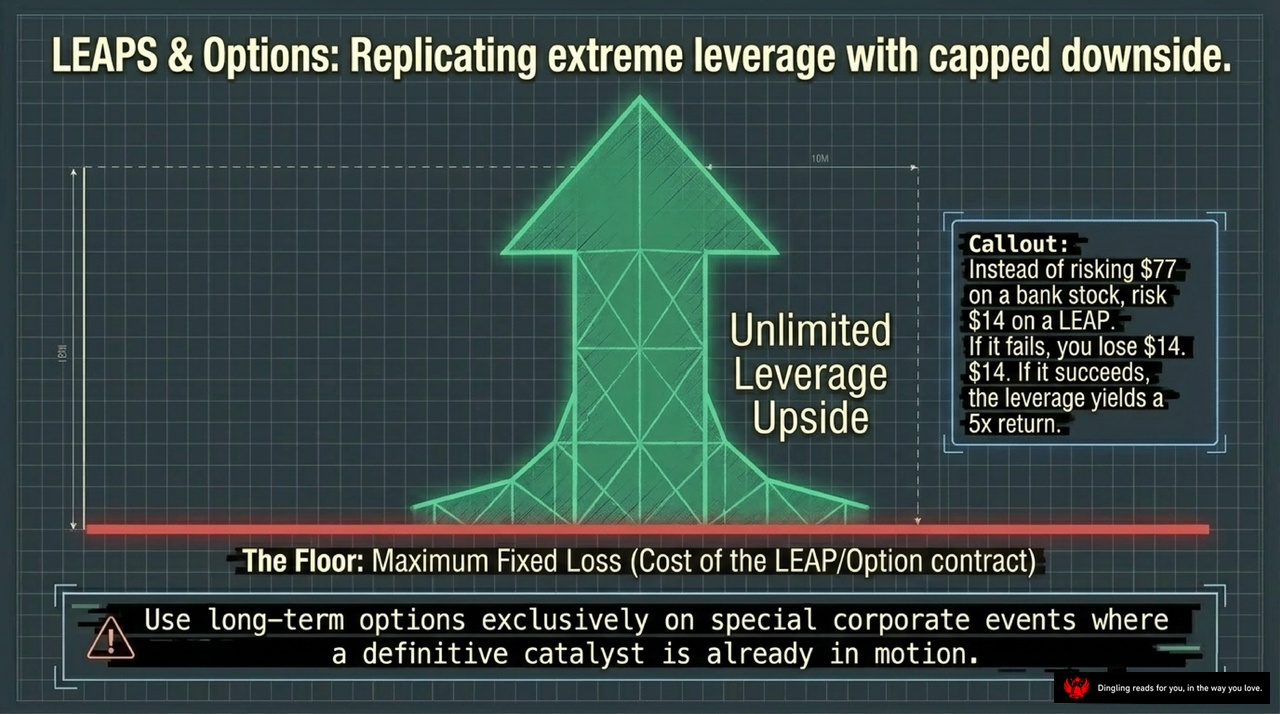
Imagine you're looking at a blueprint for extreme wealth, but instead of steel beams, we're using financial contracts. This slide breaks down the magic of LEAPS and options: replicating massive leverage while capping your downside. Look at that giant green arrow—it represents unlimited upside potential. If the company you bet on succeeds, your returns can skyrocket, potentially five times your initial investment, as the callout box clearly shows.
Instead of risking $77 on a shaky bank stock, you only risk $14 on a LEAP. If the deal fails, you simply lose that $14. But if it succeeds, the leverage yields a 5x return. That is the power of this strategy. The red line at the bottom is crucial—it's "The Floor," representing your maximum fixed loss, which is just the cost of the contract. You know exactly how much you can lose before you even buy.
However, there's a strict rule here, highlighted by the warning icon: use these long-term options exclusively on special corporate events where a definitive catalyst is already in motion. Don't just buy options on any random stock; wait for the specific event that will drive the price up. This discipline turns a high-risk gamble into a calculated, high-reward investment strategy.
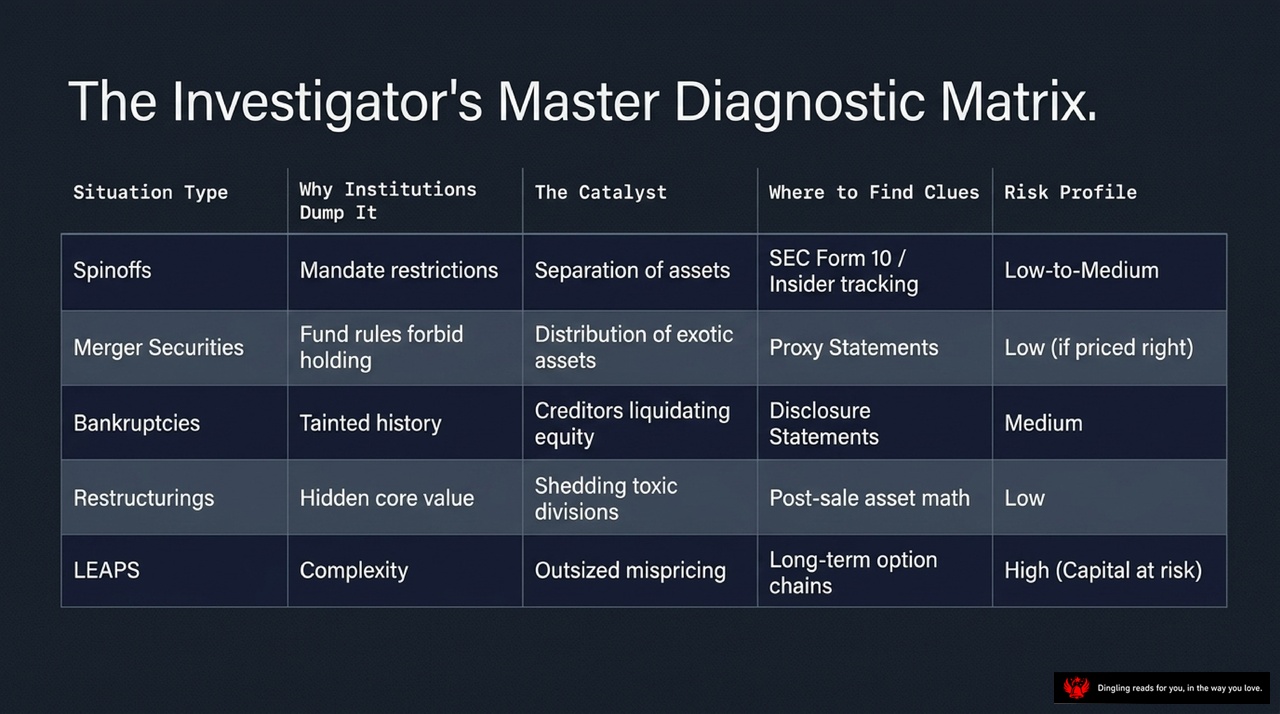
Look at this "Investigator's Master Diagnostic Matrix." Think of it as your personal cheat sheet for spotting opportunities that the big institutions simply can't see.
Why do they miss these deals? It all comes down to their constraints. As the text explains, massive funds are like "clumsy beasts." A fund manager managing 12 billion dollars can't touch small-cap stocks because the minimum position size would be too huge. They are forced to stick to big, crowded names. Plus, they are obsessed with diversification. Statistically, holding 500 stocks reduces non-market risk by 99%, but it also dilutes your focus. You end up holding mediocre ideas just to fill a portfolio, rather than betting big on the few truly exceptional opportunities you've found.
This matrix shows you exactly where to look when they dump their positions. Take "Spinoffs." Institutions sell them off because of mandate restrictions or because the new company is too small for their rules. The catalyst is the separation of assets. You find clues in SEC Form 10 filings or insider tracking. The risk is low-to-medium. Or look at "Merger Securities." Funds can't hold certain exotic assets due to fund rules, so they sell them. You find the details in Proxy Statements. If priced right, the risk is low.
Then there are "Bankruptcies." Institutions avoid them because of "tainted history," but that's where creditors are liquidating equity. Check the Disclosure Statements. The risk is medium. "Restructurings" happen when a company sheds toxic divisions to reveal hidden core value. You do the post-sale asset math yourself. The risk is low. Finally, there are "LEAPS." Institutions stay away because of complexity and outsized mispricing. You look at long-term option chains. The risk is high because capital is at risk, but the potential reward is massive.
The core lesson here is independence. While Wall Street is busy following the herd and managing their rigid constraints, you have the freedom to dig into these ignored corners. Whether it's reading a proxy statement or calculating post-split asset values, your ability to do the work yourself is your biggest advantage. Don't just watch the headlines; use this matrix to find the specific situations where the smart money is forced to sell, creating your entry point.

The Synthesis: The three pillars of hidden market profits.
Look at this diagram. It's the blueprint for beating the market, but it's simple once you see it. You need the precise overlap of three specific forces to create a mathematical advantage that traditional stock-picking simply cannot replicate.
First, you must **Exploit Structural Constraints**. This means finding forced selling. You're looking for situations where big institutions are physically forced to dump shares because of their size or rules.
Second, **Follow Insider Incentives**. You need to watch where management puts their own money. When executives have their wealth tied to the stock, they are often buying things the market has missed.
Third, **Demand a Margin of Safety**. You must strictly limit your downside risk. Never pay full price for a great idea; only buy when there is a significant buffer between the price and the true value.
When these three circles intersect in the center, you find **The Asymmetric Edge**. This is where the real money is made. It's not about predicting the future; it's about structuring your trade so that your potential loss is capped, but your potential gain is unlimited. If you can master this overlap, you stop chasing hot tips and start capturing the hidden profits that everyone else ignores.
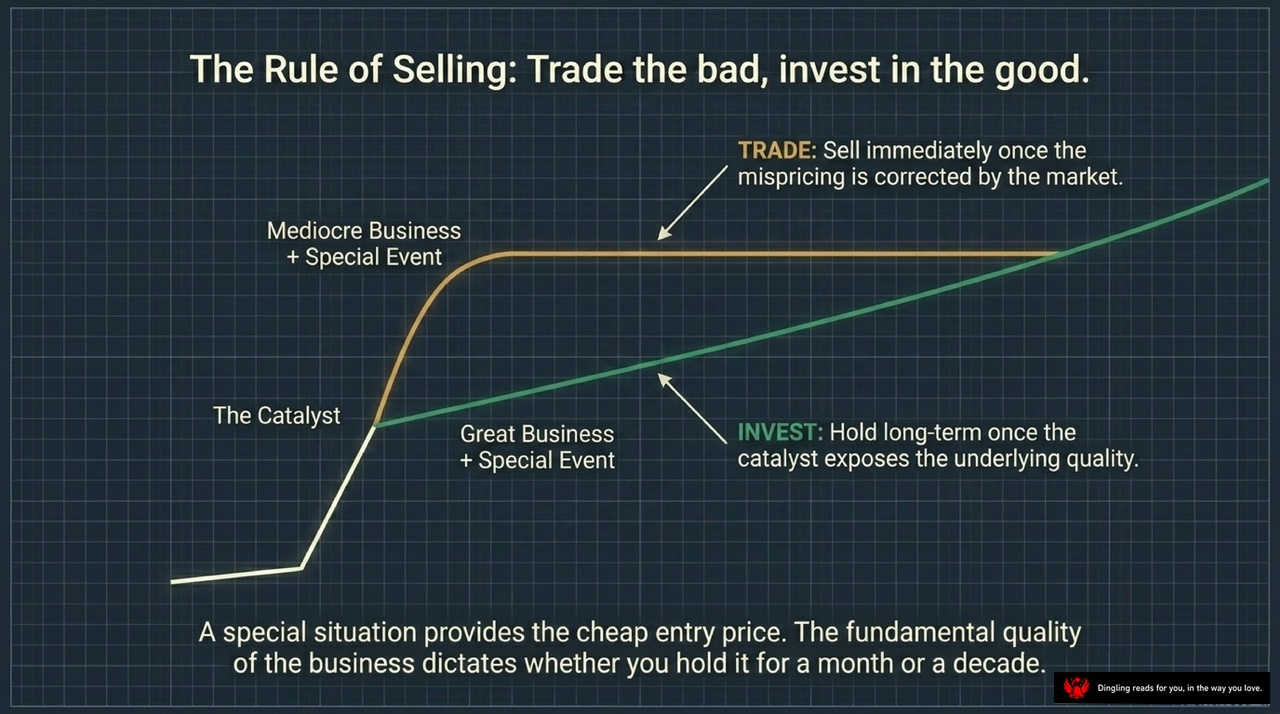
The Rule of Selling: Trade the bad, invest in the good. This simple principle is the heartbeat of special situation investing. Look at the chart: when a mediocre business gets boosted by a special event, the stock skyrockets. That's the "trade" moment. You sell immediately once the market corrects the mispricing. It's about taking profit before the hype runs out.
But here's the flip side. When a great business hits a catalyst, the stock might look shaky at first. That's the "invest" moment. You hold long-term because the underlying quality will eventually shine through. Think of it like this: a special situation gives you a cheap entry price, but it's the fundamental quality of the business that decides whether you hold it for a month or a decade.
The market often gets it wrong. It overreacts to temporary events or underestimates long-term value. Your job is to see through the noise. If the business is weak and the event is just a one-time boost, sell fast. If the business is strong and the event is just a speed bump, buy in and wait. It's not about predicting the future; it's about understanding what's real versus what's just a flash in the pan. Master this, and you'll stop chasing trends and start capturing value.

The vault is open. This isn't just a metaphor; it's the fundamental truth of the stock market. The greatest opportunities aren't found by trying to out-predict the giants on Wall Street. In fact, those giants are often too big, too slow, and too constrained to see the real treasure. They are trapped in their own size and rules, forced to ignore the hidden corners where the real value lies.
Think about it: a massive fund manager managing billions simply cannot touch small-cap companies or niche sectors without breaking their own rules. They are forced to hold hundreds of stocks just to dilute risk, which often means buying mediocre companies just to fill a portfolio. They are also shackled by quarterly performance reviews, forcing them to chase short-term trends instead of planting seeds for the future.
But you? You are free. You don't have the baggage of institutional mandates. You can dig where the experts dare not go. You can focus on a few high-conviction ideas instead of spreading yourself thin. You can ignore the noise of the mainstream media and the panic of the crowd.
This is the essence of special situations investing. It's about finding the "toxic assets" that everyone is fleeing, or the undervalued subsidiaries hidden inside a conglomerate, or the complex bonds in a bankruptcy that are trading for pennies on the dollar. When the market is terrified and selling everything in sight, that is exactly when you should be looking to buy.
The question isn't whether you can beat the experts. The question is, are you willing to do the digging? Are you willing to read the SEC filings, analyze the cash flows, and wait patiently while everyone else is running away? Because the market's hidden treasures are always buried right there, waiting for the one person brave enough to pick them up.