
You Can Heal Your Life: Complete Chapter-by-Chapter Summary

Welcome to today's session. Imagine a beautiful flower blooming against a dark, cracked stone background, filled with gold. This image perfectly captures the core message of Louise L. Hay's book, *You Can Heal Your Life*.
The text on this slide tells us that this book is a transformative blueprint. It invites us to rewrite our thoughts, release the past, and unlock the deep connection between our mind and our physical health.
In our journey, we often forget that we were once perfect babies, born with a sense of complete worth. But over time, we let outside voices shape us, filling ourselves with doubts and fears. This book offers the key to healing that inner child, helping us realize that our thoughts create our reality. By changing our mindset, we don't just improve our lives; we literally heal our bodies and unlock a new, vibrant chapter in our existence.
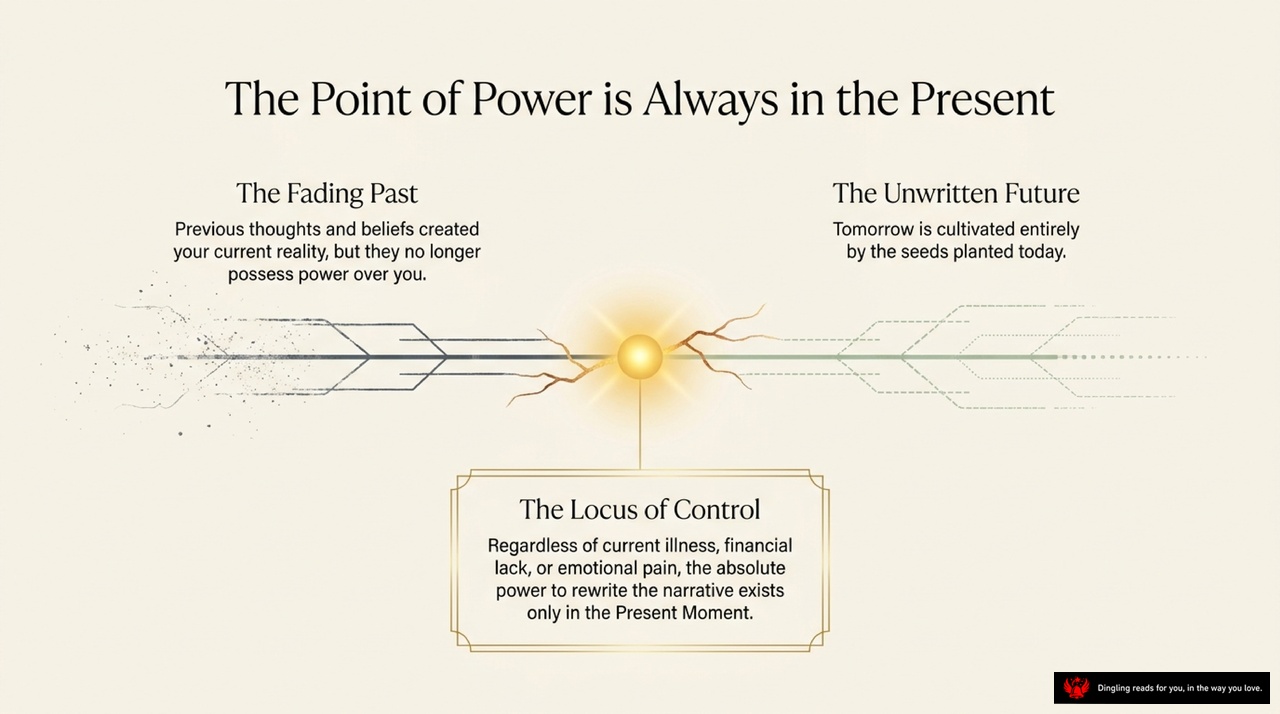
The power of your life isn't hidden in yesterday's regrets or tomorrow's unknowns; it lives entirely right here, in this present moment. As the slide illustrates, the past is fading away—those old thoughts and beliefs that shaped your reality no longer hold the keys to your future. Meanwhile, tomorrow remains unwritten, waiting to be cultivated by the seeds you plant today. This is the absolute locus of control. No matter what challenges you face right now, whether it's illness, financial stress, or emotional pain, the only time you truly have the power to rewrite your story is right now. You cannot change what has already happened, and you cannot guarantee what will happen next, but you have complete authority over your response in this very second. By anchoring yourself in the present, you stop being a prisoner of your history and become the architect of your future.

Let's dive into the roots of that familiar, heavy feeling: "I'm not good enough." It's not just a fleeting thought; it's a deep-seated belief built over layers of our lives. Think of it like a tree, where the surface struggles are just the branches, but the real story is hidden underground.
At the very foundation, in Layer 1, we have our Childhood Imprints from ages 0 to 5. This is where it all starts. During those early years, we absorbed the fears, anxieties, and criticisms of our parents and authority figures, treating them as absolute truth. We learned to believe "I am not enough" before we even had the words to question it.
As we grew, Layer 2 kicked in: Societal and Educational Reinforcement. Schools and society handed us a specific rulebook. Grades became the only measure of worth, and peer rejection felt like a life sentence. We started internalizing these external expectations, convincing ourselves that our value depended entirely on how well we fit into someone else's mold.
Then comes Layer 3: The Internalized Critic. This is the adult mind adopting the voice of that critical parent from our childhood. It's a loop of self-blame that never stops, constantly repeating that we are flawed or inadequate. We've taken the harsh words from the outside and made them our own inner voice.
Finally, at the top, Layer 4 reveals Adult Self-Sabotage. This is the unconscious manifestation of that deep-seated unworthiness. It shows up as poor health, toxic relationships, and financial struggles. We might find ourselves pushing people away or making bad decisions, not because we want to fail, but because our subconscious believes we don't deserve success.
So, the "I'm not good enough" narrative isn't a random glitch. It's a structured system built from our earliest memories, reinforced by school and society, and now driving our adult life. But understanding these layers is the first step to realizing that none of these layers are the truth. We can start to clear them out and reconnect with the real us.

Diagnosing Your Internal Resistance isn't just about noticing what we do or say; it's about digging deep to find the root cause. Think of this slide as a three-step diagnostic tool for your inner struggles.
First, look at the blue section: Behavioral Avoidance. This is the physical act of running away from the pain. It's not just laziness; it's a sophisticated defense mechanism. We procrastinate, we create fake busyness to fill the silence, or we change the subject when things get too deep. We are literally avoiding the inner work because it feels unsafe.
Next, the green section: Verbal Excuses. This is the story we tell ourselves to justify the avoidance. We say, "It won't work for my specific situation," or "I'm too old to change." We might even blame others, saying, "They need to change before I can heal." These aren't facts; they are protective shields designed to keep us comfortable in our current state.
Finally, the orange section: Core Beliefs, which are the roots of everything. This is the hard truth. Behind the avoidance and the excuses lies a deep-seated fear. It's often a fear of the unknown, where we prefer familiar pain over unfamiliar freedom. It's a fear of losing our identity or the "right to be the victim." And perhaps most painfully, it's that deep, unspoken belief that we simply do not deserve to be fully healed.
So, when you feel stuck, don't just fight the behavior or argue with your excuses. Ask yourself: What is the core belief driving this? Because you cannot uproot the tree without digging into the soil.

Imagine your mind as a garden, but instead of flowers, it's overrun by toxic weeds. Today's slide reveals what we call "The Toxic Quartet"—four specific mental habits that silently sabotage our health from the inside out. Look at the four corners: Resentment, Criticism, Guilt, and Fear. These aren't just passing moods; they are deep-rooted beliefs that physically manifest as disease.
Take Resentment, for instance. It's the habit of refusing to forgive and replaying old injuries. The slide tells us this is dangerous because it "eats away at the self," historically linked to tissue-destroying illnesses like cancer. It's like letting a rotting branch stay in your tree; eventually, the whole structure weakens.
Then there's Criticism. This is the constant judgment of yourself and others. The physiological impact here is creating rigidity and tension, which leads directly to joint pain and arthritis. When you are always judging, your body stays locked in a state of defense, never relaxing.
Next is Guilt. This is the habit of punishing yourself for past choices, stuck in that endless "should" loop. The slide explains that guilt always seeks punishment, creating a baseline of physical and emotional suffering. You can't heal if you are constantly beating yourself up.
Finally, Fear. This is anticipating threat and lacking trust in the universe. The result? Severe systemic tension, ulcers, and even hair loss. Your body prepares for a battle that isn't there, draining your vital energy.
Notice the center of the image? It says "Disease & Dis-ease." That hyphen is crucial. Disease is a biological condition, but "dis-ease" is a state of being out of harmony. These four weeds—Resentment, Criticism, Guilt, and Fear—are the roots of that dis-ease. They are the invisible forces that turn your inner garden into a battlefield, proving that how you think directly dictates how you feel physically. To heal, we must first identify and pull out these toxic habits before they can choke our vitality.
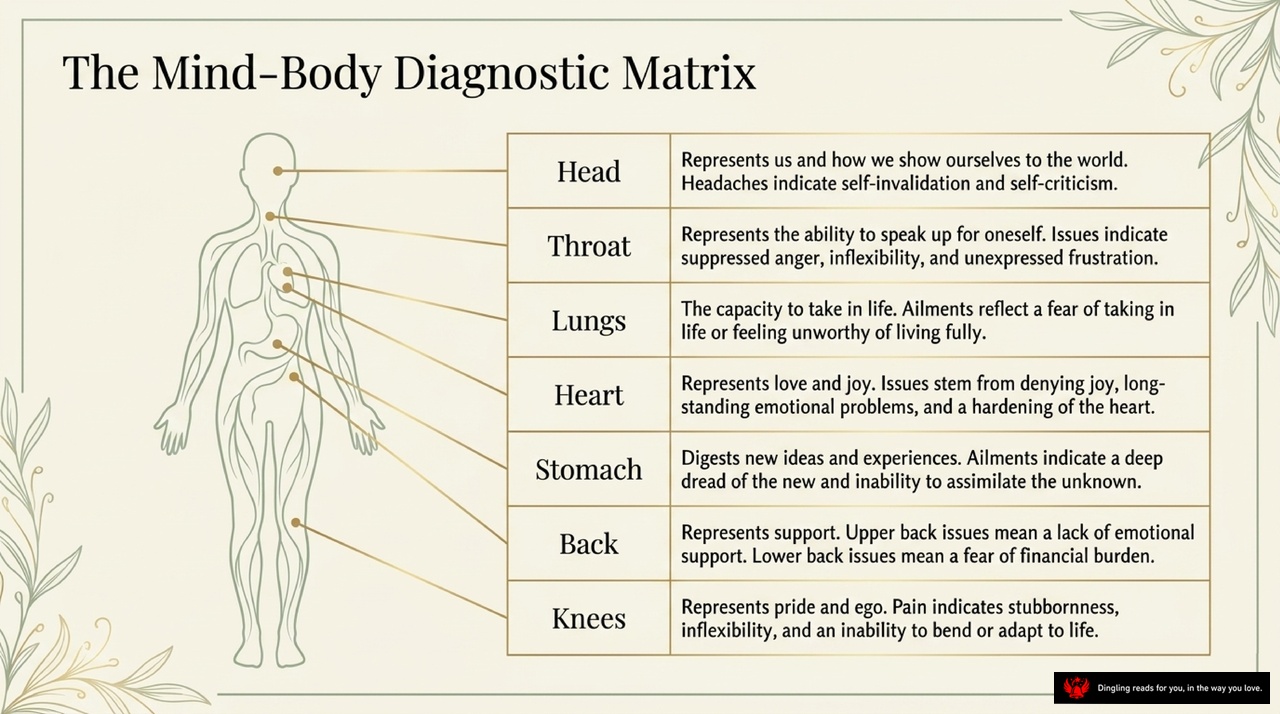
Welcome to the Mind-Body Diagnostic Matrix. Think of your body not just as a machine, but as a sophisticated communication system that speaks the language of your emotions. When we feel pain or tension, it's often our subconscious trying to tell us something about our inner world.
Let's start at the top. Your **Head** represents how you show yourself to the world. If you're suffering from headaches or migraines, it might be a sign that you're struggling with self-criticism or feeling like your worth isn't being validated by others.
Move down to your **Throat**. This area governs your ability to speak up for yourself. Tightness or pain here often points to suppressed anger, an inability to say "no," or frustration that you're holding onto instead of expressing.
Your **Lungs** are about your capacity to take life in and breathe fully. If you feel anxious or have breathing issues, it could reflect a deep fear of living fully or a feeling that you aren't worthy of the joy life has to offer.
Right in the center, your **Heart** is the seat of love and joy. Pain in this area often stems from denying your own happiness, holding onto old emotional wounds, or a sense that your heart has become hard and closed off.
Below that, your **Stomach** is where you digest new ideas and experiences. Discomfort here usually indicates a deep dread of the unknown or an inability to adapt to new situations and people.
Now, look at your **Back**. This represents the support you feel in your life. Issues in your upper back often signal a lack of emotional support, while pain in your lower back can point to a fear of financial burden or instability.
Finally, your **Knees** represent your pride and ego. Pain here can indicate stubbornness, inflexibility, or an inability to bend and adapt to the changing tides of life.
By understanding this matrix, you can stop ignoring your body's signals and start listening to the wisdom it holds.

Today's slide, "Step 1: The Power of Radical Forgiveness," uses a striking bridge metaphor to illustrate a life-changing shift. On the left, we see "Holding On"—a state where we feel trapped in the past, consuming the poison of resentment while expecting others to suffer, and essentially giving our abusers permanent residency in our minds. This is the heavy, dark side of the bridge.
But the true transformation happens in "The Shift." This is the critical pivot point. The first action is understanding that perpetrators were often acting out of their own limited awareness and unhealed trauma. The second, equally powerful action is forgiving yourself for past mistakes made while operating in survival mode. This is where the bridge opens up.
On the right side, we find "Letting Go." This isn't just about forgetting; it's about reclaiming your present-moment power and dissolving the root causes of physical and emotional disease. By choosing to let go, you stop feeding the prison of the past. As the quote at the bottom beautifully reminds us: "Forgiveness is the act of setting a prisoner free, only to discover the prisoner was you." This step is the key to unlocking your own freedom and reclaiming your life.

Welcome back. Today, we're diving deep into the transformative power of **Radical Self-Love & Mirror Work**.
On the left, we see the **Destructive Cycle**. This is the trap so many of us live in. The mechanism here is simple but painful: constant self-criticism, minimizing our achievements, and endlessly comparing ourselves to others. We judge ourselves by standards that aren't ours. The result? We lock our minds in a prison of unworthiness. We actively block our own healing, prosperity, and the ability to build healthy relationships. We become our own worst critics, and that voice becomes the loudest one in our heads.
But on the right, we have the antidote: **The Restorative Practice**. This is where we reclaim our power. The mechanism is straightforward yet profound: looking directly into your own eyes in a mirror and vocalizing absolute acceptance. No hiding, no flinching. Just honest, unfiltered connection with yourself.
The result of this practice is magical. It bypasses the critical adult ego and directly comforts the inner child that has been neglected for so long. It unlocks your innate healing capacities, allowing you to see your true worth.
To anchor this shift, we use a **Core Affirmation**: "I love you. I really, really love you. I approve of myself exactly as I am."
This isn't about ignoring your flaws; it's about embracing your humanity. When you practice this daily, you stop feeding the destructive cycle and start building a foundation of genuine self-love. You become the safe harbor you've been waiting for, creating the peace and strength necessary to thrive in every area of your life.

Today, we are shifting our reality through a powerful tool called "The Language Shift Matrix." Look at this split screen: on the left, we have the language of limitation, and on the right, the language of empowerment. This isn't just about swapping words; it's about rewiring our entire mindset to move from a place of struggle to a place of strength.
First, let's look at motivation. When we tell ourselves, "I should do this," we are operating out of guilt and obligation. That creates resistance. But when we shift to, "I could do this," we instantly unlock a sense of agency and possibility. We move from being forced to being empowered.
Next, consider our relationship with abundance. Saying, "I do not want to be poor or sick," keeps us fixated on what we lack, fighting against a negative future. However, declaring, "I am open to the abundance and health of the universe," changes everything. It stops the internal battle and invites us to welcome the positive. Instead of fighting the shadow, we step into the light.
Then, there is how we see others. The belief that "Everyone is out to get me" triggers our survival instinct, putting us in a constant state of threat detection. It isolates us. But flipping this to, "Everyone is deeply helpful to me," transforms our subconscious filter. Suddenly, we stop seeing enemies and start spotting opportunities. We realize that people are generally supportive, not predatory.
Finally, let's talk about self-compassion. When we believe, "It is all my fault," we are trapping ourselves in self-punishment and shame. That mindset never leads to growth. Instead, adopting the phrase, "I am doing the best I can with the understanding I have," brings us back to reality and grace. It allows us to learn from mistakes without destroying our self-worth.
By consciously making these shifts, we stop reprogramming ourselves with limiting beliefs and start building a life grounded in confidence, openness, and kindness. The power to reprogram reality starts with the very first sentence you speak to yourself today.
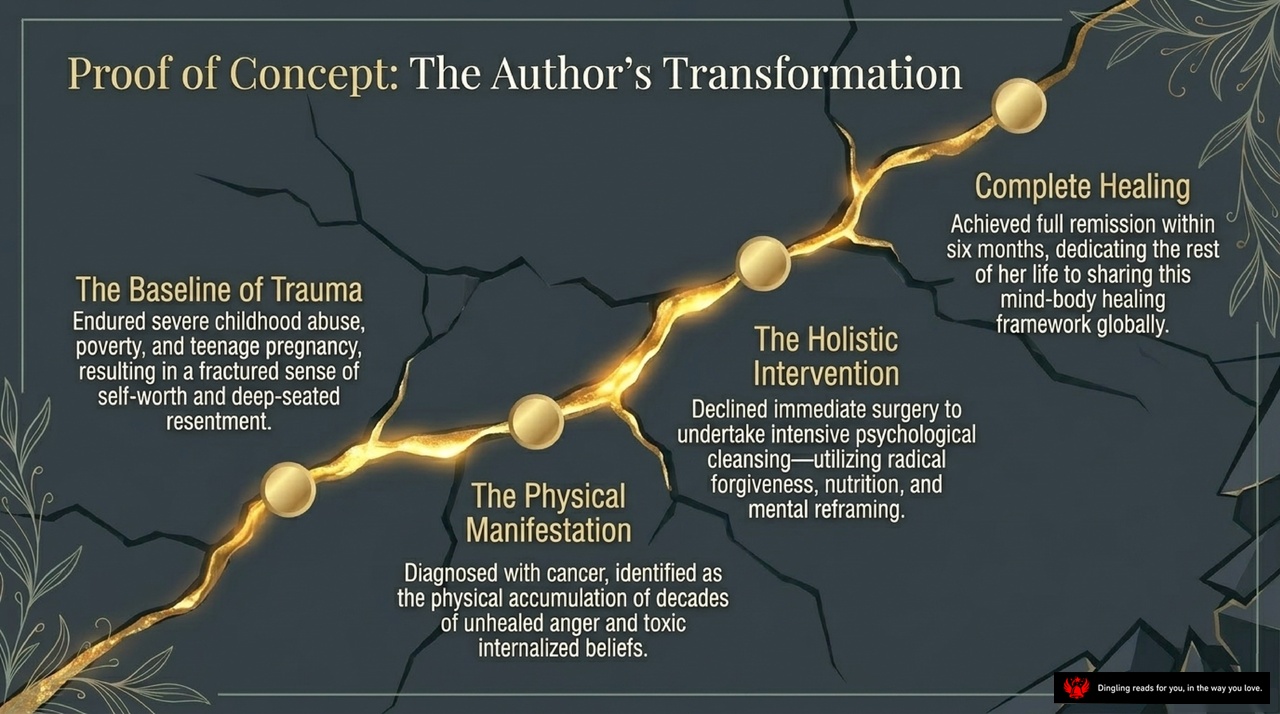
Look at this golden path on the screen. It's not just a timeline; it's the author's own journey from deep pain to total healing. Let's walk through these four stages together.
It all starts with "The Baseline of Trauma." The author endured severe childhood abuse, poverty, and teenage pregnancy. These weren't just events; they shattered her sense of self-worth and planted deep-seated resentment. That broken foundation led directly to "The Physical Manifestation." When she was diagnosed with cancer, she realized it wasn't just a random disease. It was the physical accumulation of decades of unhealed anger and toxic beliefs she had swallowed.
Instead of rushing into immediate surgery, she chose "The Holistic Intervention." She declined the standard medical fix to instead undertake intensive psychological cleansing. This was a radical shift—using forgiveness, nutrition, and mental reframing to heal the root cause, not just the symptom. And the result? "Complete Healing." Within just six months, she achieved full remission. Today, she is dedicating her life to sharing this powerful mind-body framework globally.
This story proves that our bodies are never just physical; they are the map of our inner world. When we finally heal the mind, the body follows.
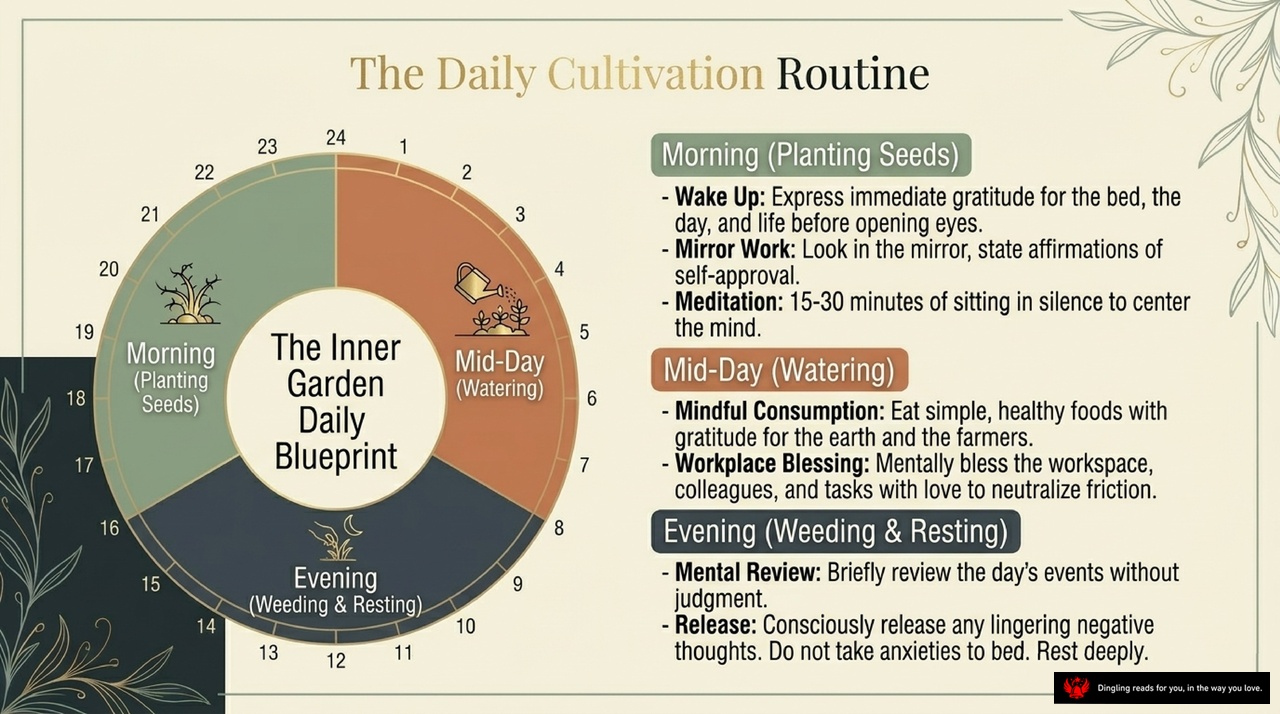
Imagine your day not as a checklist of tasks, but as the daily cultivation of an inner garden. Think of yourself as a gardener tending to your own soul, where every moment offers a chance to plant, water, and nurture growth.
Start your morning by planting seeds. Before you even open your eyes, take a moment to express immediate gratitude for your bed, the day, and life itself. This simple act sets a positive tone. Then, step in front of the mirror and offer yourself affirmations of self-approval, treating yourself with the same kindness you'd offer a friend. Follow this with 15 to 30 minutes of silent meditation to center your mind, clearing away the mental clutter so you can focus on what truly matters.
As the day progresses into mid-day, shift your focus to watering your garden. Practice mindful consumption by eating simple, healthy foods while acknowledging the earth and the farmers who grew them. Before you dive into your work, mentally bless your workspace, your colleagues, and your tasks with love. This intentional act of blessing helps neutralize friction and creates a harmonious environment where you can thrive.
As evening falls, it's time for weeding and resting. Take a few minutes to mentally review the day's events without judgment. Notice what happened, but don't get stuck in criticism or regret. Then, consciously release any lingering negative thoughts or anxieties. Don't carry them into your sleep; instead, let them go so you can rest deeply and recharge.
By following this blueprint, you transform your routine from a series of obligations into a sacred practice of self-care and growth. You become the gardener of your own life, cultivating resilience, peace, and joy in every season.
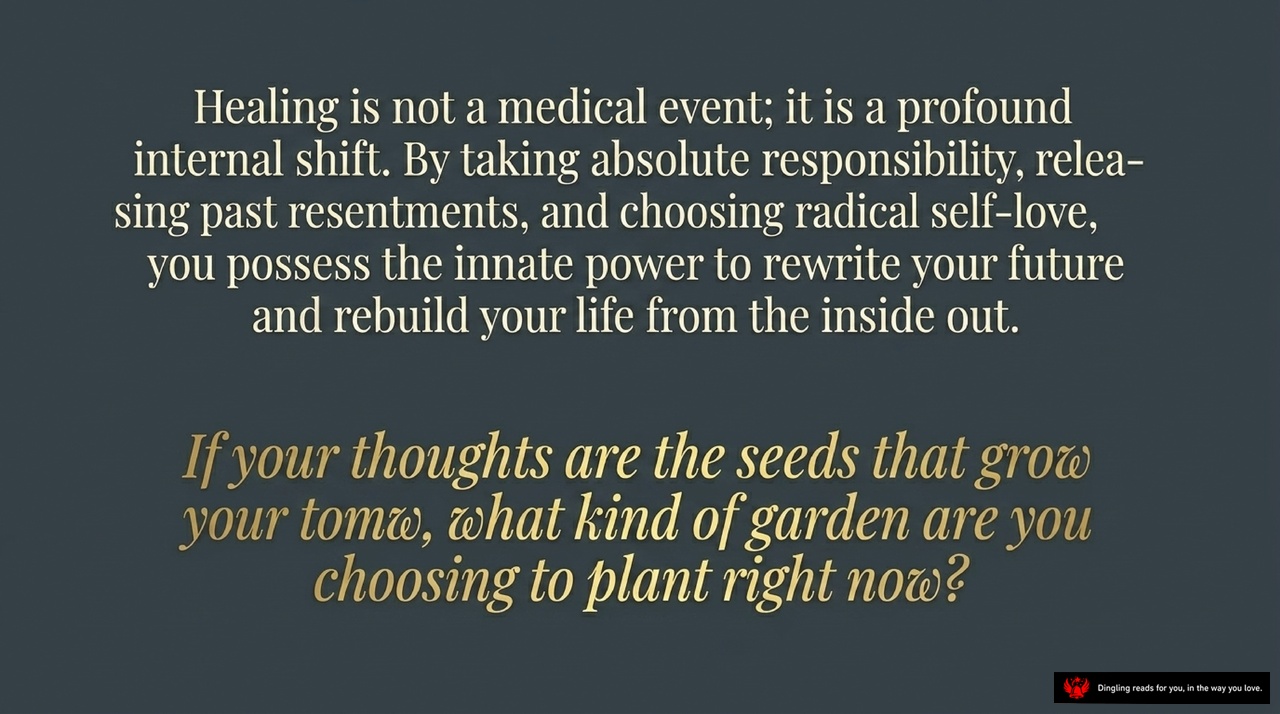
Healing isn't about a doctor's prescription; it's a profound internal shift. As the text reminds us, when you take absolute responsibility, release past resentments, and choose radical self-love, you unlock the innate power to rewrite your future and rebuild your life from the inside out. Think of your thoughts as the seeds you plant today. If your mindset is toxic, you'll only grow a garden of anxiety and self-doubt. But if you choose to cultivate kindness, compassion, and self-acceptance, you are planting the seeds for a thriving, peaceful life. True healing comes from within, not from fixing the outside world. So, right now, ask yourself: what kind of garden are you choosing to plant? The power to grow the life you want lies entirely in the seeds you decide to nurture today.