
Your Erroneous Zones: Complete Chapter-by-Chapter Summary
Welcome to your journey toward mastering your mind. Today, we are diving into Wayne W. Dyer's powerful concept of "Your Erroneous Zones." Imagine life as a complex maze, and for too long, we've been walking in circles, trapped by self-defeating behaviors that quietly steal our happiness. The good news is, you don't have to stay lost.
The core message here is simple yet revolutionary: you have the power to take charge of your own happiness. It starts with one crucial realization—your feelings are not dictated by the world around you, but by your own thoughts. When you shift from blaming external events to owning your internal choices, you unlock true freedom. By eliminating these erroneous zones in your thinking, you stop being a victim of circumstances and start becoming the architect of your own joy. Master your mind, break free from the patterns that hold you back, and step into a life where you are finally in control.

Imagine a simple yet powerful blueprint for taking control of your life, right here in front of us. We are looking at three connected nodes that reveal the true source of your happiness.
The first node is **Thought**. It reminds us that we control what enters our mind. You are the gatekeeper. The second node is **Emotion**. This is where many people get stuck, believing their feelings are physical reactions forced upon them by the world. But look at the connection: our feelings are actually physical reactions to our *thoughts*. The third and final node is **Mastery**. Because you control your thoughts, you ultimately control how you feel.
This leads us to the most important message at the bottom of this slide. It challenges the very idea of a "nervous breakdown." The text states clearly that emotions are not things that happen to you; they are reactions you choose. There is no such thing as a nervous breakdown because nerves do not break. When you feel overwhelmed, you are not a victim of your biology; you are making a choice to interpret a situation in a way that causes pain.
Think about it: if you can choose to think differently, you can choose to feel differently. Instead of spiraling into anger or anxiety, you have the power to pause, shift your internal narrative, and decide on a response that serves you. This slide isn't just about theory; it's an invitation to stop blaming the world and start owning your internal world. By realizing that your emotions are choices, you unlock the ultimate freedom to design the life you want, one thought at a time.

Today's slide breaks down the concept of the "Locus of Control," which is essentially the difference between being a victim and being the master of your own life. On the left, we see "External Control," or the victim mindset. Here, the focus is on blaming others, luck, or even genetics for how you feel. You might hear yourself saying things like, "You hurt my feelings," or "He makes me mad." The result? Emotional dependency and stagnation, where you feel manipulated by outside forces.
On the right, we have "Internal Control," or the master mindset. The focus shifts to taking absolute responsibility for your emotional responses. Instead of saying, "I can't help it," you start saying, "I chose to feel hurt" or "I am in charge." This shift leads to growth, self-actualization, and true emotional freedom.
The core message here is simple but powerful: you are not a puppet being pulled by external strings. Every emotion is a choice you make in that very moment. By moving from the vocabulary of blame to the vocabulary of choice, you reclaim your power and stop waiting for the world to fix you.

Imagine time not as a straight line, but as a battlefield where your attention is constantly being pulled in two dangerous directions. Look at this diagram: "The Illusion of Time." It shows how we get trapped between the "Left Drain: Guilt" of the past and the "Right Drain: Worry" of the future, both sucking our energy away from "The Present."
Let's talk about the left side first. This is the trap of immobilization due to past actions. We often feel paralyzed by guilt, thinking that if we just felt enough remorse, history would change. But the truth is brutal and liberating: guilt cannot alter what has already happened. No amount of regret will rewrite yesterday. When you stay stuck in the past, you aren't living; you're just re-enacting a movie you've already watched.
Now, look to the right. This is the "Right Drain: Worry." We get immobilized again, this time by future hypotheticals. We worry about things that haven't happened yet, convincing ourselves that anxiety will prepare us for the future. But here is the hard reality: worry cannot alter the future. It only destroys the present. Every minute you spend worrying about a catastrophe that might never occur is a minute stolen from the only moment you can actually control.
So, what is the solution? The diagram tells us clearly: The only time you can ever truly experience anything is right here, in the middle. Living effectively means maximizing the present. It's not about ignoring the past or predicting the future; it's about refusing to let them steal your now. If you stop the flow of guilt to the left and the flood of worry to the right, you reclaim your life. You stop being a prisoner of time and become the master of your moment.

Have you ever felt stuck, trapped in a box that you can't seem to escape? The slide you're seeing right now is called "The 'I Am' Trap," and it perfectly illustrates a mental prison many of us build for ourselves. Look at the figure in the center, surrounded by labels like "I am shy," "I am bad at math," or "I am uncoordinated." These aren't just descriptions; they are walls.
The mechanism behind this trap is simple yet powerful: we use these labels as convenient, built-in excuses to avoid risks, effort, and the hard work of change. When you tell yourself, "I am shy," you are essentially saying, "I am a finished product." And here's the hard truth: if you are a finished product, you cannot grow. You stop evolving because you've decided that's just who you are.
But there is a way out, and it lies in the synthesis section on the right. The key is to replace those absolute labels with present-tense choices. Instead of saying, "I am Italian" or "I am bad at this," you shift your language to, "Until now, I have chosen to be..." This tiny linguistic shift changes everything. It reminds you that your identity is not fixed; it is a series of choices you make every single day. You are not defined by your past or your perceived limitations; you are defined by what you choose to do right now. By breaking free from these "I am" traps, you unlock the potential to rewrite your story and become the person you are meant to be.

Look at this seesaw. On one side, we have your **Self-Worth**, represented by that single, solid orange cube. On the other, we have a towering stack of **External Approval**. This visual perfectly illustrates **The Approval Paradox**: the people who receive the most respect and approval in life are those who never seek it and remain true to themselves.
The trap here is equating your personal value with the shifting opinions of others. When you need approval, you are essentially saying that someone else's opinion is more important than your own. But let's be honest, trying to please everyone is a mathematical impossibility. **The Rule of 50%** tells us that in any situation, expect 50% of people to disagree with you. Anticipating this reality frees you from the exhausting need to please everyone.
So, how do we tip the balance back in our favor? The secret is simple: stop chasing the stack of approval and focus on building that solid cube of self-worth. Remember, the people who are most respected are often the ones who are too busy being themselves to care about what others think. They don't climb the other side of the seesaw; they simply stand firm on their own ground. When you stop seeking validation from the crowd, you actually become the most valued person in the room.

Imagine a rigid grid of rules, traditions, and etiquette that you follow without even questioning them. This is what the slide calls "Blind Conformity"—living by "Shoulds" and "Musts" that you don't truly believe in. It's like being trapped in a maze where the walls are built by society, not by your own values. The result? A toxic mix of resentment, anxiety, and a nervous, robotic compliance that drains your life.
But what if there was a way out? Right in the center of this diagram is "The Filter." This is your moment of awakening. Instead of blindly following the path, you stop and ask the critical questions: Who actually made this rule? Does it truly serve me? Does it protect anyone, or is it just a cage for my freedom?
When you pass through this filter, the rigid grid dissolves into open, winding paths. This leads you to "Authentic Spontaneity." This isn't about being reckless; it's about setting your own internal moral standards and trusting your own judgment over societal expectations. The outcome is psychological freedom and behavior that feels genuinely like you.
The tyranny of the Shoulds ends the moment you decide to take control of your own compass.

Look at this slide: "The Fairness Trap." It breaks down a mindset shift that can completely change how you navigate life. On the left, we see a bird eating a worm in nature, labeled simply as "Nature," and below that, two identical desks in "Human Society." This visual contrast is the core of the argument.
The text on the right explains the trap. First, it addresses "The Myth": the idea that fairness is a cosmic rule. The slide rightly points out that the universe doesn't keep a ledger of equality. It's not "fair" to the worm, and nature operates on survival, not equity.
Then, it moves to "The Reality." Demanding that life be fair is often just an avoidance tactic. When you complain that things aren't fair, you distract yourself from taking action to improve your own life because you're too busy obsessing over someone else's situation. It's a mental dead end.
Finally, the slide offers "The Antidote." Stop looking at other people's plates. Your life isn't measured by how it compares to theirs, but by your own goals and actions. In human society, we often fall into this trap of jealous comparison, but true freedom comes from measuring your success on your own terms, not by trying to match a world that has no obligation to be fair to you.

Imagine a cycle that keeps us trapped in a loop of unproductive behavior. We call it "The Procrastination Cycle," and it starts with a simple, yet deceptive thought: The Wish. We tell ourselves, "I hope things get better," hoping that our problems will magically resolve without our input. But this wish quickly transforms into The Delay. We convince ourselves, "I will do it tomorrow," pushing our responsibilities into an imaginary future where we feel less pressure.
However, this delay isn't just about laziness; it triggers The Emotion. As time slips away, feelings of boredom, anxiety, and stagnation begin to creep in. Instead of facing these feelings, we create The Excuse. We rationalize our inaction by thinking, "I didn't have enough time anyway," or blaming external circumstances. This excuse then feeds back into our wish, restarting the cycle.
The core truth here, as highlighted in our text, is that procrastination is simply the art of escaping today. Critics wait and complain, but Doers act. We often mistake boredom for a reason to stop, but in reality, boredom is merely a byproduct of our own procrastination. By breaking this cycle and choosing to act in the present moment, we reclaim our freedom and stop letting the past or the future dictate our happiness.

Exploring the Unknown isn't just a phrase; it's the core of how we unlock our potential. Look at that diagram: we all start in the center, our "Safe Zone," where everything feels predictable and comfortable. But here's the hard truth we need to face: that comfort is actually a cage. The text reminds us that "predictability guarantees zero growth." If you only do what you are certain will succeed, you are already psychologically dead.
We are conditioned to fear the unknown, clinging to safety and confusing predictability with survival. But absolute security is an illusion. To truly live, we must move outward into the "Growth Zone." This shift requires a fundamental change in perspective. We need to treat failure merely as a result, not a reflection of our worth. Instead of fearing the mystery, we should embrace it as the ultimate source of excitement and self-actualization. So, stop staying in the safe circle. Step out, embrace the uncertainty, and let the unknown be the engine of your growth.
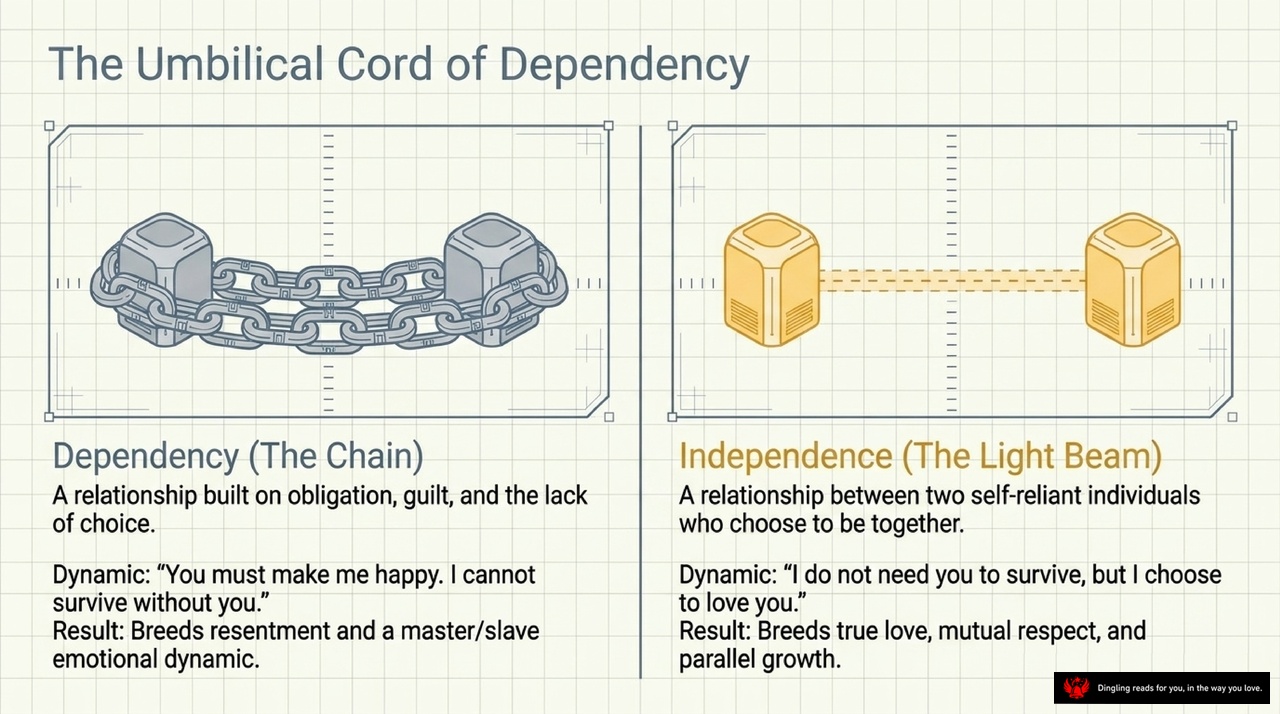
Imagine two distinct ways of connecting with the people we love. On the left, we see a heavy chain labeled "Dependency." This is a relationship built on obligation, guilt, and a terrifying lack of choice. The dynamic here is desperate: "You must make me happy. I cannot survive without you." This creates a master-slave emotional dynamic where resentment inevitably breeds.
On the right, we see a light beam connecting two independent cubes, representing "Independence." This is a relationship between two self-reliant individuals who simply choose to be together. The dynamic shifts to something powerful and free: "I do not need you to survive, but I choose to love you." This fosters true love, mutual respect, and parallel growth.
The key takeaway is this: true intimacy doesn't come from needing someone to complete you, but from choosing to share your life with someone who is already whole. When you move from the chain to the light beam, you stop breeding resentment and start building a partnership where both people can thrive.
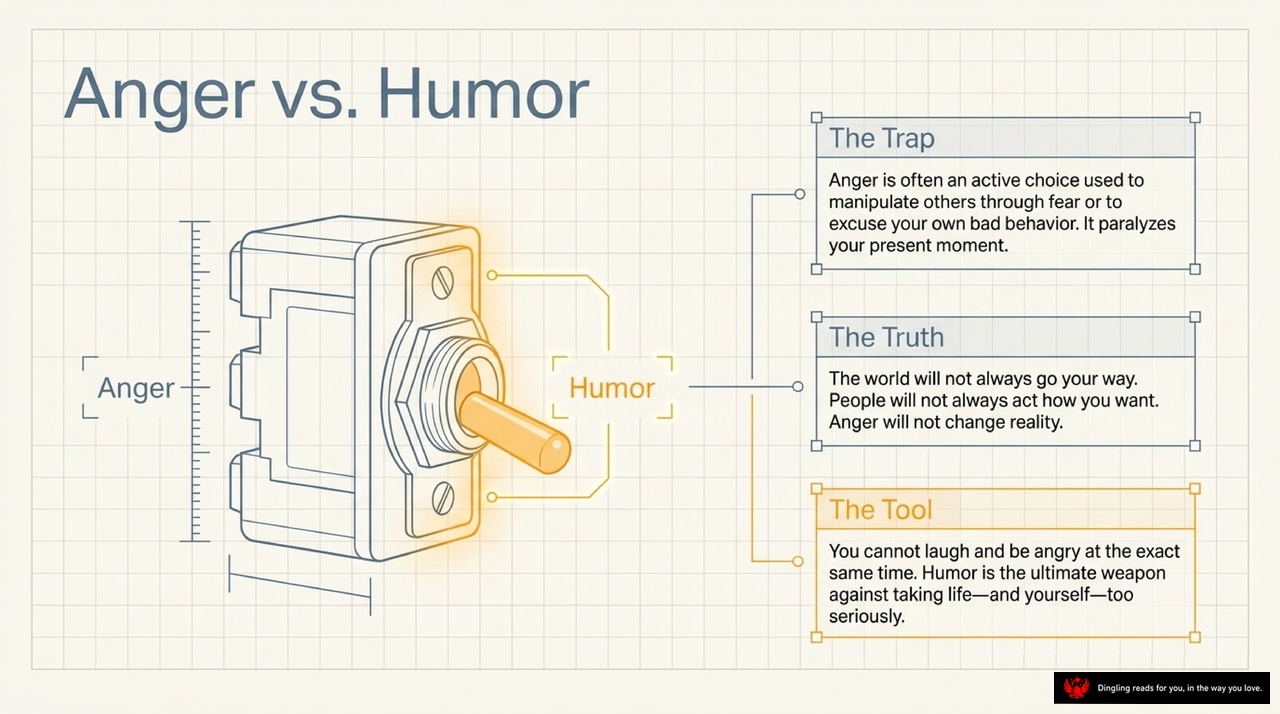
Look at this switch. On the left, we have "Anger," and on the right, we have "Humor." This slide perfectly captures a powerful truth from the book: you cannot be angry and laughing at the same time. It's a simple choice, but one that defines your entire day.
Let's talk about "The Trap." The text warns us that anger is often an active choice we make to manipulate others through fear or to excuse our own bad behavior. It paralyzes us in the present moment. But here is "The Truth": the world will not always go your way, and people will not always act how you want. Anger will not change reality. It's a dead end.
So, what is the solution? Look at "The Tool." Humor is described as the ultimate weapon against taking life—and yourself—too seriously. Instead of letting anger take over, you can choose to laugh. You can shift your perspective. When you choose humor, you stop being a victim of circumstances and start being the master of your own reaction. It's about refusing to take things so seriously that they stop you from living. So, the next time you feel that switch flipping toward anger, try flipping it the other way. Choose humor. Choose freedom.

Look at this synthesis chart. We're breaking down the "Psychological Payoff" of our negative habits. Here's the core idea: we aren't just accidentally stuck; we are deliberately holding onto these behaviors because they feel "safe." They are our invisible shields against the hard, risky work of actually changing our lives.
First, let's look at **Guilt and Worry**. The hidden payoff here is that we avoid taking the risk of acting in the present. By worrying about what might happen or feeling guilty about what we've done, we create a comfortable excuse to do nothing right now. It's a safety mechanism that keeps us from facing the uncertainty of today.
Next is **Seeking Approval**. This behavior helps us avoid taking responsibility for defining our own self-worth. When we constantly look to others for validation, we hand over the steering wheel of our identity. We stop asking, "Who am I?" and start asking, "What do they think of me?"
Then we have **Procrastination**. Its hidden payoff is avoiding the possibility of failure and the effort of doing. By putting things off, we protect ourselves from the pain of trying and potentially failing. We choose the safety of inaction over the risk of action.
Finally, there's **Anger**. This isn't just an outburst; it's a tool to manipulate others through fear and to excuse poor communication. When we get angry, we often shut down the conversation and control the narrative, avoiding the vulnerability of honest dialogue.
The core insight at the bottom of this slide sums it all up: We keep these negative habits because they protect us. But remember, true freedom comes from stepping out of these "safe" zones and taking responsibility for our own lives.

Look at this pentagon chart here. We call this the "Anatomy of a Self-Actualized Person." It's not just a pretty graphic; it's a blueprint for the kind of life we actually want to live. Notice how every single point on this shape is pushed outward? That's the goal. We aren't aiming for a balanced, average life. We are aiming for maximum intensity in five specific areas.
First, look at the top point: **Present-Focused**. The text says they "enjoy everything, complain about nothing." This is the antidote to our culture's obsession with saving for a future that never arrives. A self-actualized person doesn't wait for tomorrow to be happy; they find joy in the "now."
Next, move to the right side: **Internally Driven**. This is crucial. The slide notes they "reject hero worship" and need no external validation. They don't look to politicians or celebrities to tell them who they are. Their worth comes from within, not from the applause of a crowd.
Below that, we see **Action-Oriented**. The description is simple but powerful: "Doers, not critics." They aren't stuck analyzing every problem or fearing the unknown. They are unafraid to jump in and just do the work.
Now, look at the bottom left: **Independent**. This doesn't mean being alone; it means loving purely by choice. They don't stay in relationships or jobs out of obligation or dependency. They stay only because they choose to.
Finally, the bottom point: **Self-Acepting**. This is the foundation. They maintain high self-worth regardless of failure or rejection. They know their value isn't tied to a grade, a job, or a compliment.
If you can embody these five traits—living in the present, trusting your own judgment, taking action, choosing your connections freely, and accepting yourself completely—you move from the center of this chart to the outer edge. That is where true freedom and happiness live.

True growth begins the moment you decide to stop looking for a stamp of approval from the outside world. As the slide reminds us, stepping out of the safety of external validation means taking full responsibility for your own mind, emotions, and actions. Too often, we treat our feelings like weather patterns controlled by the sky—blaming traffic, bosses, or strangers for our mood. But the truth is far more empowering: you are the architect of your internal experience.
Consider this: if you are the sum of your choices, what are you choosing right now? Are you choosing to react with anger because the world didn't go your way, or are you choosing to see the situation with humor and resilience? We can retrain our brains to respond with calm instead of chaos, just as we learn to drive a manual transmission through practice. When you shift from seeking control over others to mastering your own reactions, you unlock a profound freedom. You stop being a prisoner of circumstance and become the author of your life. So, take a deep breath and ask yourself: am I living my life, or am I just reacting to everyone else's? The power to choose your next move is always in your hands.