
Your Strategy Needs a Strategy: Complete Chapter-by-Chapter Summary
Welcome to today's session. We're diving into a powerful new framework for business strategy, introduced by Martin Reeves, Knut Haanaes, and Janmejaya Sinha from the BCG Bruce Henderson Institute.
The core message on this slide is striking: "Your Strategy Needs a Strategy." It sounds paradoxical, but it's the truth. In today's world of unprecedented volatility, a one-size-fits-all approach to strategy simply doesn't work anymore. The old playbook of picking a single method and sticking with it is obsolete.
Instead, the authors propose a "Strategic Palette." Think of it as an artist's palette. Just as a painter mixes different colors to create the perfect shade for a specific scene, a leader must mix different strategic approaches to match their specific business environment.
The goal is clear: align your strategic approach to your unique environment so you can survive and win. Whether your market is stable and predictable, or chaotic and unpredictable, there is a specific strategic tool designed for that exact situation. By understanding the nuances of your environment—its predictability, malleability, and severity—you can choose the right strategy from your palette and deploy it effectively. This isn't just about having a strategy; it's about having the right strategy for the right moment.

Look at this slide, and let's be honest: the old playbook is officially dead. The title says it all—the "Death of One-Size-Fits-All Strategy." Why? Because the gap between winners and losers is now at a historical high, and volatility has compressed company lifespans so drastically that 75% of industries are seeing a 50% cut in how long businesses survive.
Here's the hard truth: classical strategic planning relies on predictability. But today's world is multidimensional and unpredictable. If you try to force a rigid, traditional framework onto a chaotic environment, you aren't just failing—you're taking a fast track to obsolescence. You can't use the same strategy for a stable market and a crisis zone. To survive, leaders must stop guessing and start matching the right strategic approach to the specific reality they face. It's not about having a single plan for the whole company anymore; it's about adapting your strategy to the environment you're actually in.
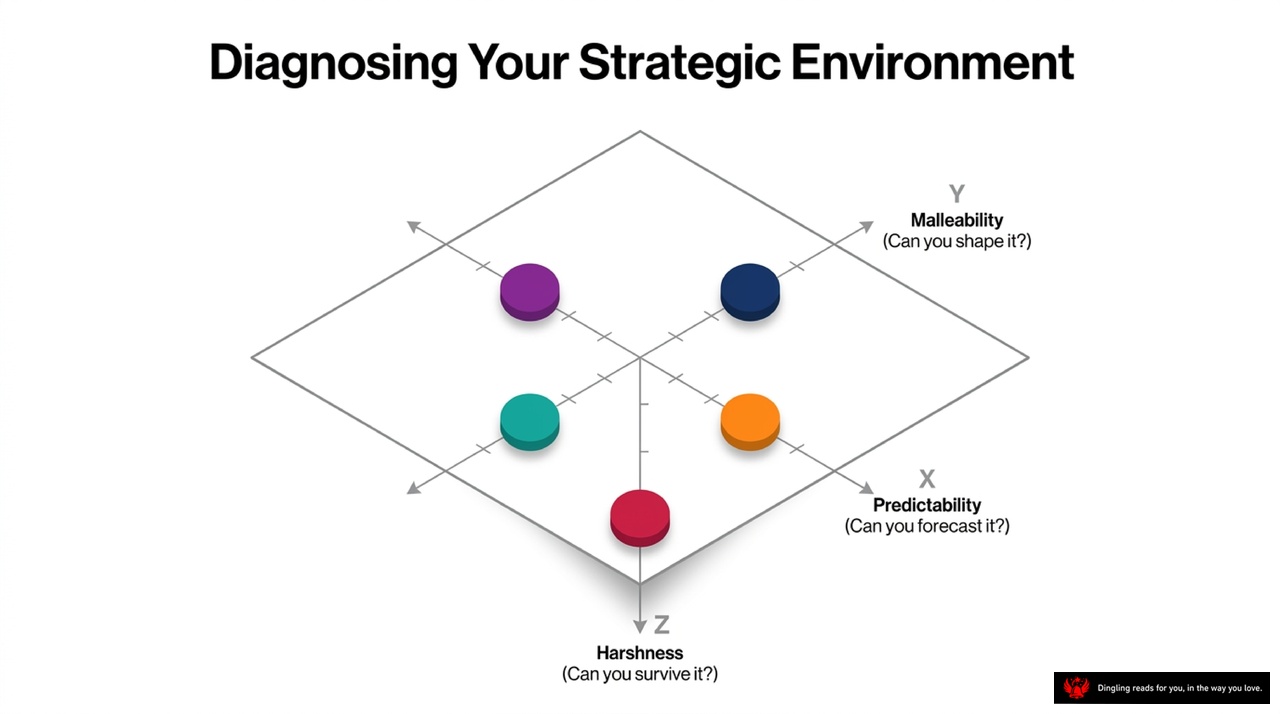
Diagnosing Your Strategic Environment isn't just about looking at a chart; it's about asking the hard questions that define your reality. Imagine a 3D space where your survival depends on three critical axes. First, look at the X-axis: Predictability. Can you actually forecast what's coming next? Second, check the Y-axis: Malleability. Do you have the power to shape the rules, or are you just along for the ride? Finally, gaze down at the Z-axis: Harshness. Is the environment so brutal that survival itself is the only goal?
When you map your business against these dimensions, you land in one of five distinct zones, each demanding a completely different playbook. If you're in a predictable but unchangeable zone, you play the classic game of scaling. If the world is chaotic and you can't influence it, you must adapt at lightning speed. If you can predict and shape the future, you seize the vision. If the rules are undefined but you can influence them, you coordinate an ecosystem. And if the environment is too harsh to survive, your only move is to cut costs and pivot for survival.
The danger lies in misdiagnosing your position. Many leaders overestimate their ability to control the future, ignoring the harsh reality of their environment. By accurately diagnosing where you stand on this strategic map, you stop guessing and start executing the right strategy for your specific moment.
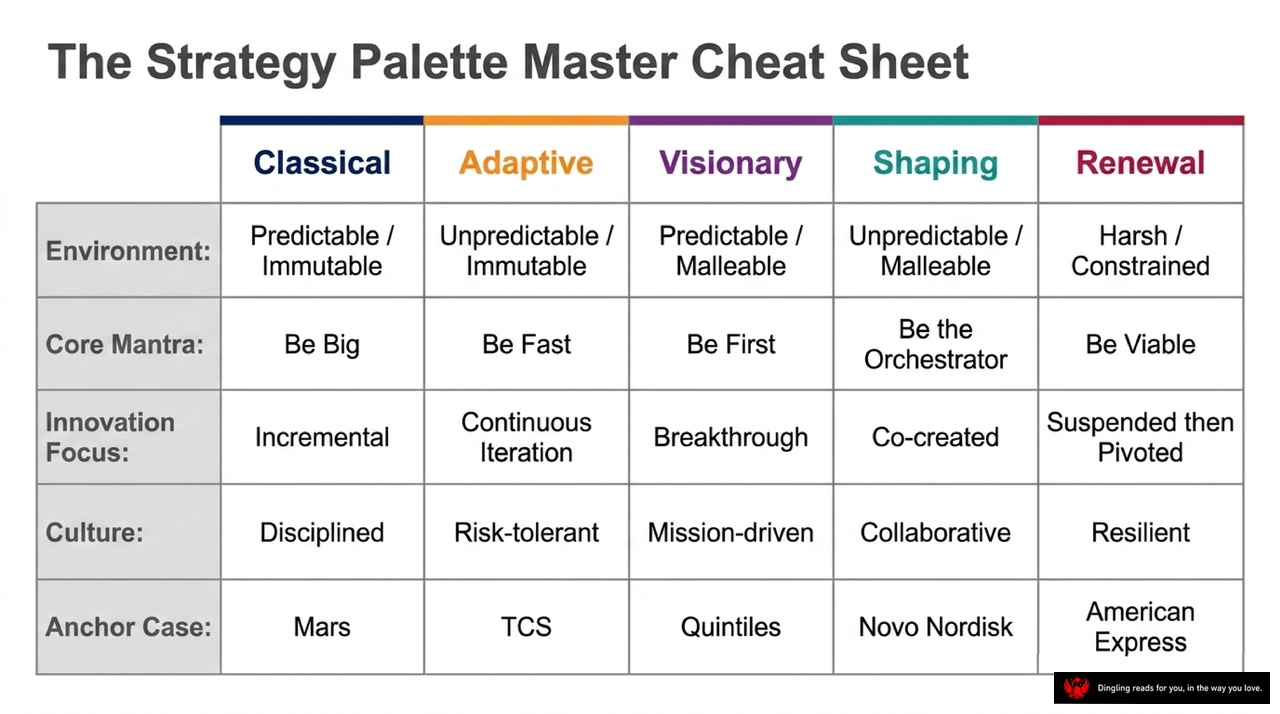
This slide is your ultimate "Strategy Palette Master Cheat Sheet." Think of it as the control panel for navigating any business environment. At the top, we see the five core environments: Classical, Adaptive, Visionary, Shaping, and Renewal.
Let's break down what this chart tells us. On the left, we have the three dimensions that define your reality: Predictability, Malleability, and Harshness.
If your world is predictable but immovable, you're in a **Classical** environment. Your mantra is "Be Big." You focus on incremental innovation, maintain a disciplined culture, and look to companies like Mars as your anchor case.
When things are unpredictable and you can't change them, you need an **Adaptive** strategy. Here, speed is everything. Your mantra is "Be Fast." You thrive on continuous iteration, embrace a risk-tolerant culture, and follow the TCS playbook.
If you can predict the future and shape it, you're in a **Visionary** setting. Your mantra is "Be First." You aim for breakthrough innovation, build a mission-driven culture, and look to Quintiles as your guide.
When the environment is unpredictable but you can still shape it, you enter a **Shaping** environment. Your mantra is to "Be the Orchestrator." You focus on co-creating value, foster a collaborative culture, and learn from Novo Nordisk.
Finally, if the environment is harsh and constrained, your only goal is survival. This is the **Renewal** phase. Your mantra is "Be Viable." You pivot after suspending old ideas, build a resilient culture, and study how American Express recovered from the crisis.
This single grid connects the dots between your external reality and your internal strategy. It tells you exactly which mindset, innovation focus, and cultural trait you need to win in every specific situation.

The Classical Strategy is designed for the stable, predictable environments where the rules of the game don't change. Think of it as the "Be Big" approach: you don't need to reinvent the wheel or chase every new trend. Instead, you focus on building sustainable advantages through scale, differentiation, or deep capabilities.
In these settings, growth is incremental and disruption is low. The goal is to hit the bullseye with precision. As the slide illustrates, this strategy relies on high predictability and low malleability. You analyze the market deeply, plan rigorously, and execute efficiently to lock in your position.
Consider giants like Mars or UPS. They dominate not because they are the first to try new things, but because they are the best at optimizing what already works. They use long-term planning and top-down execution to turn small, steady improvements into massive, lasting returns. While startups might be chasing the next big thing, classical strategists are quietly building unassailable fortresses of efficiency and brand loyalty. In a stable world, being the biggest and most predictable is the ultimate competitive edge.

The slide outlines the "Classical Operating Model," a framework designed for stable, predictable environments where the goal is simply to grow larger. Think of it as the playbook for established giants like Mars or UPS. The core logic is a strict sequence: first, you analyze the market; second, you plan a detailed roadmap; and third, you execute with precision. In this world, strategy isn't about guessing the future; it's about finding the most efficient spot within a known structure.
The slide breaks down the anatomy of an organization using this model. Information flows from the top down, relying on centralized data and analytics. Innovation isn about radical disruption; it's incremental and process-driven, focusing on fine-tuning what already works. The culture is disciplined and rule-based, prioritizing efficiency and consistency over chaos. Finally, leadership is top-down and focused, ensuring everyone aligns with a single, clear direction.
This approach works brilliantly when the rules of the game are clear and the competition is stable. It's about leveraging scale, protecting margins, and maintaining a dominant market position. However, as we'll see in later chapters, this rigid, sequential approach often fails when the environment becomes unpredictable or when a company needs to invent new markets rather than just occupy them. For now, though, the Classical Model remains the gold standard for executing in a mature, competitive landscape.
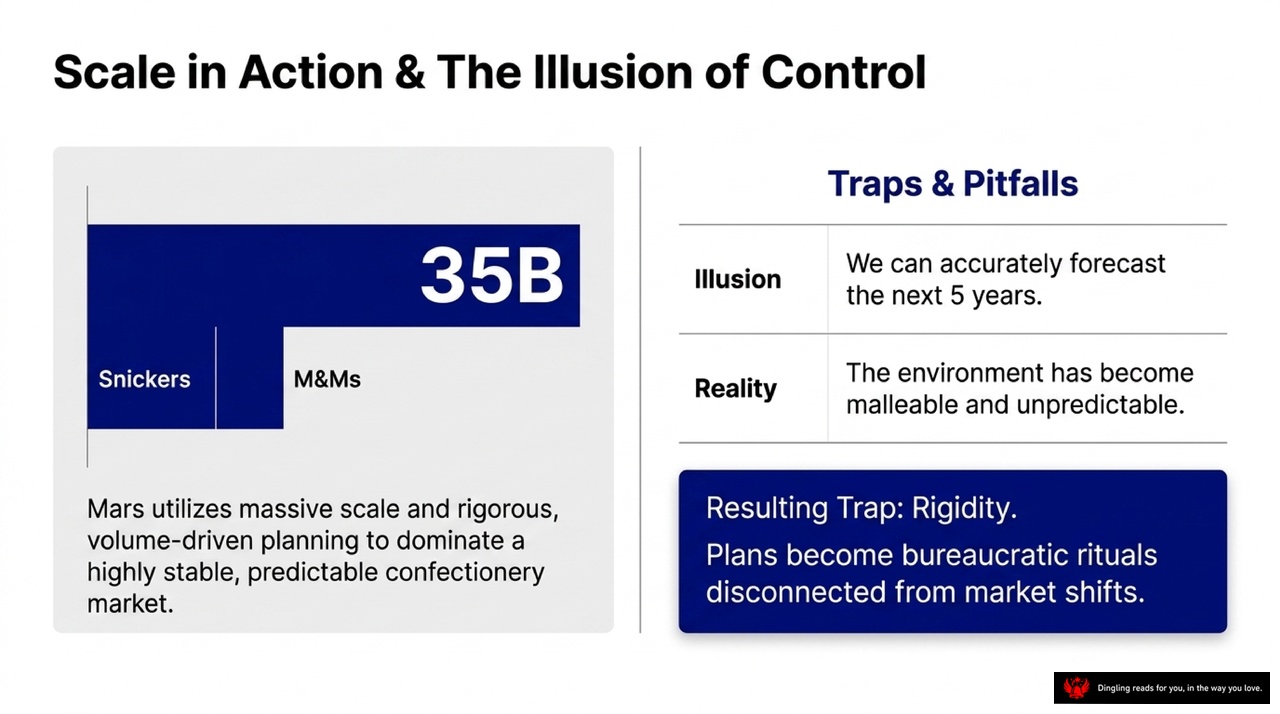
Scale in Action and the Illusion of Control: Mars, M&M's, and the Trap of Rigidity
Today's slide tackles a critical blind spot in corporate strategy: the illusion of control. Look at the left side—Mars, a massive $35 billion powerhouse dominating the confectionery market with giants like Snickers and M&M's. Their success story is built on massive scale and rigorous, volume-driven planning. This works brilliantly in a stable, predictable environment where the rules don't change overnight. You plan for five years, execute with precision, and dominate.
But here is the hard truth on the right side: this model creates a dangerous trap. The slide calls it "The Illusion of Control." We often fall into the belief that we can accurately forecast the next five years. That is the illusion. The reality is that the business environment has become malleable and unpredictable. When you rely on long-term planning in a shifting world, your plans turn into bureaucratic rituals—rigid structures disconnected from actual market shifts. This rigidity is the resulting trap. It prevents you from adapting when the ground moves beneath you.
So, while Mars's scale is impressive, it highlights a specific risk: assuming stability where there is none. If your environment is volatile, clinging to a five-year forecast isn't a strategy; it's a liability. True resilience means recognizing when the environment has changed and being willing to abandon the plan, not just the execution. Don't let the comfort of a rigid structure blind you to the chaos happening right outside your window.

The slide highlights "The Adaptive Strategy," a vital approach for navigating chaotic and unpredictable markets. As the text explains, this strategy is deployed when the environment is volatile and traditional long-term planning fails. Instead of trying to predict the future, successful companies like Tata Consultancy Services and Zara embrace a cycle of "change, choice, and expansion." They prioritize speed over scale, using rapid experimentation to capture fleeting advantages before competitors do.
Look at the visual metaphor here: a central square representing your core business is surrounded by branching paths. This illustrates the core logic of the adaptive strategy—continuously testing new directions, quickly filtering out what doesn't work, and doubling down on what does. Unlike the "classic" strategy of building a fortress for the long term, the adaptive strategy is about agility. It's not about having one perfect plan; it's about having the speed to pivot when the market shifts. As the slide emphasizes, success in these unpredictable environments requires continuous experimentation to find and exploit temporary advantages. If you can't keep up with the pace of change, the strategy itself becomes the obstacle.
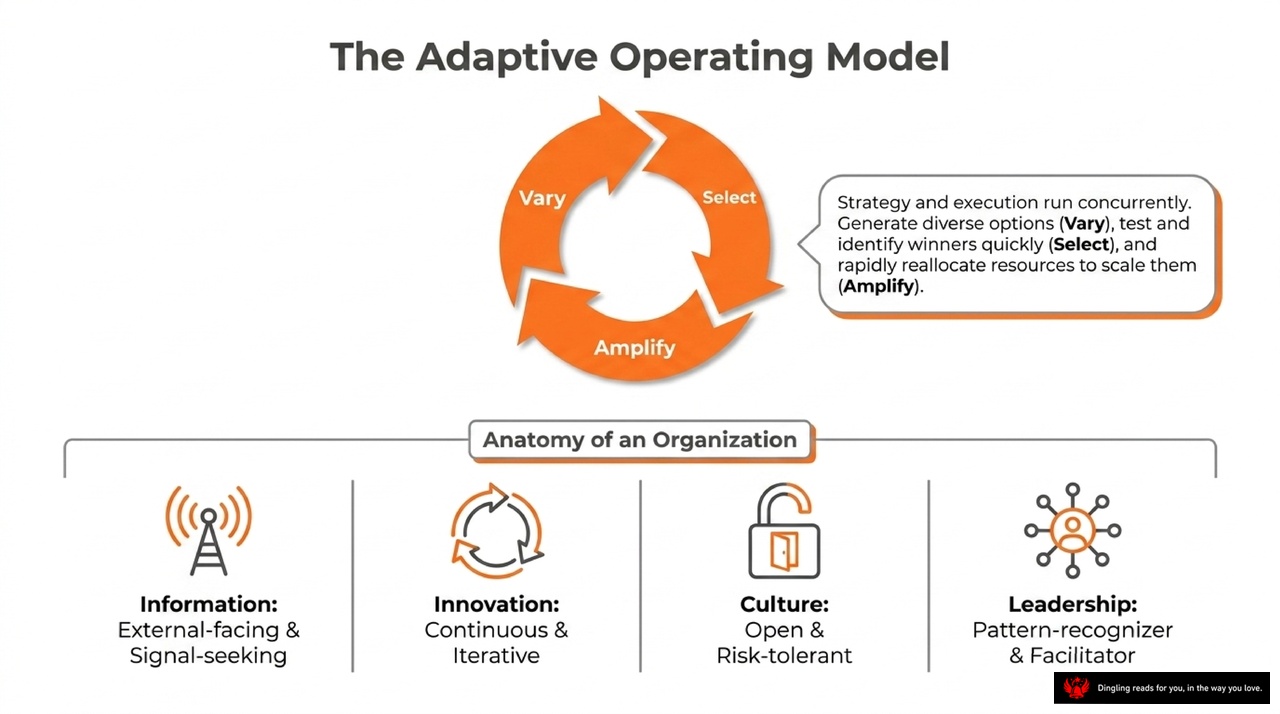
The Adaptive Operating Model isn't just a diagram; it's the rhythm of survival in a volatile world. At its heart lies a simple, powerful loop: Vary, Select, and Amplify. Instead of betting everything on one long-term plan, you generate diverse options, test them quickly to find the winners, and then rapidly reallocate resources to scale what works. It's about running strategy and execution simultaneously, not sequentially.
But this model only works if your organization is built right. Look at the four pillars below. First, your Information system must be external-facing and signal-seeking, constantly scanning the horizon for changes. Second, Innovation needs to be continuous and iterative, not a once-a-year event. Third, your Culture has to be open and risk-tolerant; you need to celebrate smart failures, not punish them. Finally, Leadership must shift from being a controller to a pattern-recognizer and facilitator. You aren't just managing tasks anymore; you're curating an ecosystem where the right strategies can emerge and thrive. When these four elements align with the Vary-Select-Amplify cycle, you stop guessing and start adapting with precision.

Today's slide tackles a critical mindset shift: moving from rigid planning to iterative growth. Look at the cycle on the left—Explore, Enable, Evangelize, and Exploit. This isn't a linear roadmap; it's a feedback loop designed for volatility. TCS navigates the chaotic tech landscape by avoiding rigid, top-down cash cows. Instead, they continuously test and scale small initiatives across autonomous units.
But here's the trap many fall into, listed on the right. We often live in an illusion, believing we must stick to our initial optimization plan. The harsh reality? The market moves faster than our planning cycle ever can. When we ignore this, we get stuck in a "Slow Response" trap, missing out on critical, temporary market windows that define success. True growth comes from embracing this cycle, not freezing in a plan that has already become obsolete.

When you have the power to create or recreate an entire industry, you aren't just playing the game—you're writing the rules. This is the **Visionary Strategy**.
Look at that grid in the top right. It maps out the environment as **Predictable** or **Unpredictable**, and **Malleable** or **Immutable**. The Visionary Strategy lives in that top-right quadrant: an environment that is predictable enough to plan for, but malleable enough for you to actually shape its trajectory.
This strategy is deployed when you have the power to introduce a breakthrough product or business model that defines the future. As the slide emphasizes, "Be First." It's not about reacting to a market that already exists; it's about creating one that doesn't.
Think of it as navigating a maze where you get to draw the path. Companies like 3M or early tech disruptors use this approach to set the standard rather than follow it. They rely on a clear, forward-looking vision to guide their actions, knowing that by moving fast and seizing the initiative, they can lock in a dominant position before the competition even realizes the game has changed.
In this environment, the goal is simple but demanding: be the first to define what success looks like, and then execute with enough speed and conviction to make that vision reality.
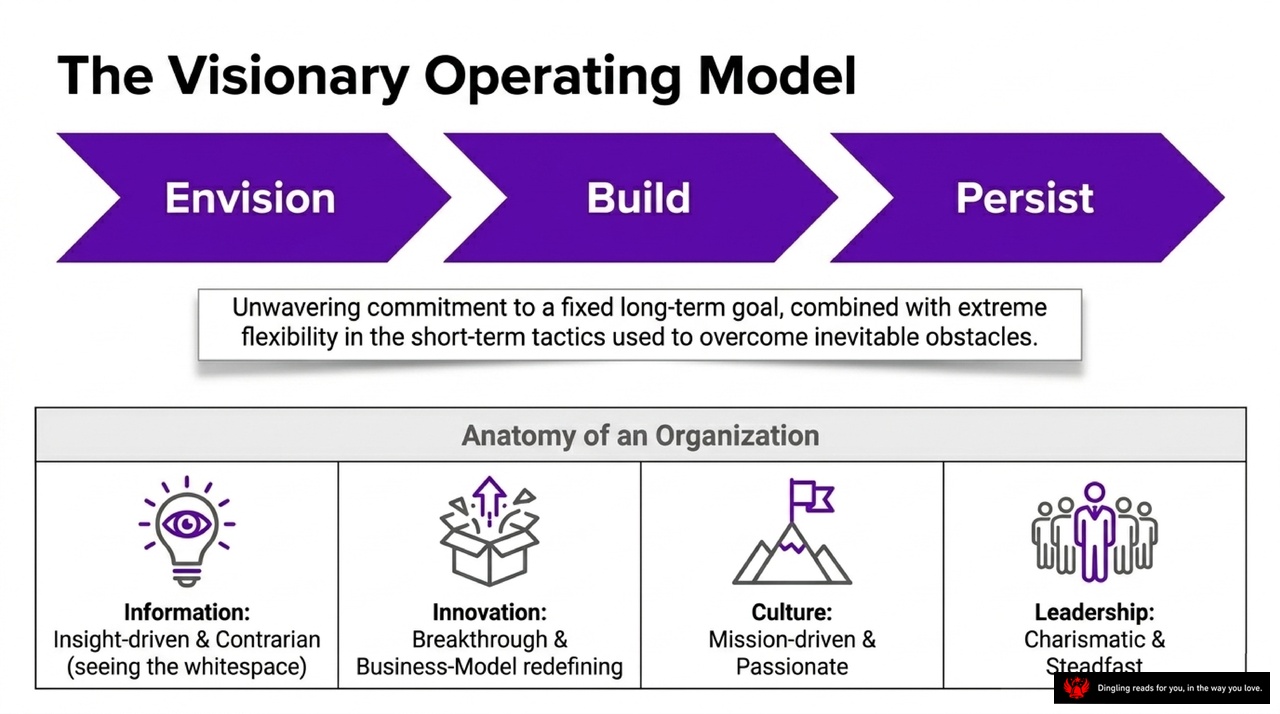
Today's slide introduces what we call "The Visionary Operating Model." Think of this as the master framework for navigating uncertainty. It's built on a simple but powerful three-step rhythm: Envision, Build, and Persist.
At the heart of this model is a specific definition of visionary leadership: it's the unwavering commitment to a fixed long-term goal, combined with extreme flexibility in the short-term tactics used to overcome inevitable obstacles. You hold the destination steady, but you're willing to completely change your vehicle or route when the road gets blocked.
Let's break down the anatomy of an organization that successfully executes this model. First, you need **Information** that is insight-driven and contrarian. This means seeing the whitespace—spotting opportunities others ignore. Second, you need **Innovation** focused on breakthroughs and redefining the entire business model, not just tweaking the product. Third, your **Culture** must be mission-driven and passionate, aligning every employee with the long-term vision rather than just quarterly targets. Finally, **Leadership** needs to be charismatic and steadfast. They must inspire belief in the future while remaining rock-solid in their commitment to it.
This model isn't about rigid planning; it's about creating an organization that can predict the future enough to build for it, while remaining agile enough to survive the journey there.
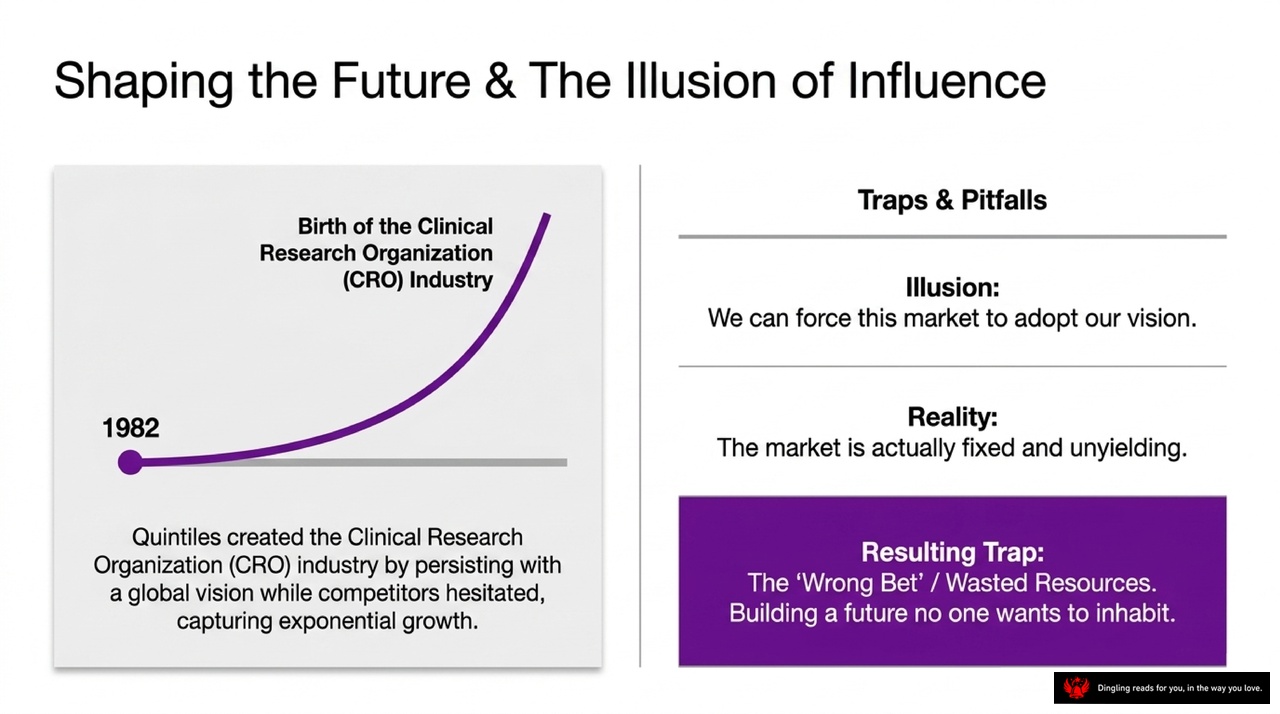
Imagine a company that dared to predict the future before anyone else did. In 1982, Quintiles saw an inefficiency in clinical trials that others ignored. While competitors hesitated, Quintiles bet big on a global vision, effectively creating the entire Clinical Research Organization industry from scratch. That bold move led to exponential growth, turning a niche idea into a dominant global force.
But here's the hard truth: this success created a dangerous illusion. Many leaders today fall into the trap of thinking, "We can force this market to adopt our vision." They assume that if they just push hard enough, they can shape the future to their liking. But the reality is often much stiffer. The market is actually fixed and unyielding. When you try to build a future that no one wants to inhabit, you end up making the "Wrong Bet." You waste precious resources chasing a direction that simply doesn't exist.
The lesson is clear: don't confuse your desire for influence with the ability to control the market. True success comes from understanding where you can actually make an impact, rather than pretending you can rewrite the rules of the world.

The Shaping Strategy is all about stepping out as the conductor of your own business ecosystem. When you find yourself in an unpredictable environment that is still in its early, formative stages, you quickly realize you can't dictate the market on your own. Success here isn't about being the solo hero; it's about building a thriving ecosystem where multiple stakeholders co-create value and share the risk together.
Think of yourself as the orchestrator. Just like a conductor doesn't play every instrument but ensures the whole symphony harmonizes, your role is to bring together doctors, patients, regulators, and suppliers—like Novo Nordid did when entering the Chinese diabetes market—to define the rules of the game. In these chaotic, early-stage industries, no single company can build the market alone. You need to coordinate diverse interests, align incentives, and foster collaboration to create a network effect that benefits everyone.
This approach turns uncertainty into an opportunity. Instead of trying to predict the future or fight for dominance against established giants, you leverage the malleability of the environment to shape it with your partners. By deploying this strategy, you don't just survive the volatility; you actively build the very industry you want to lead. So, when the rules are still being written, don't just play the notes—become the one who conducts the orchestra.
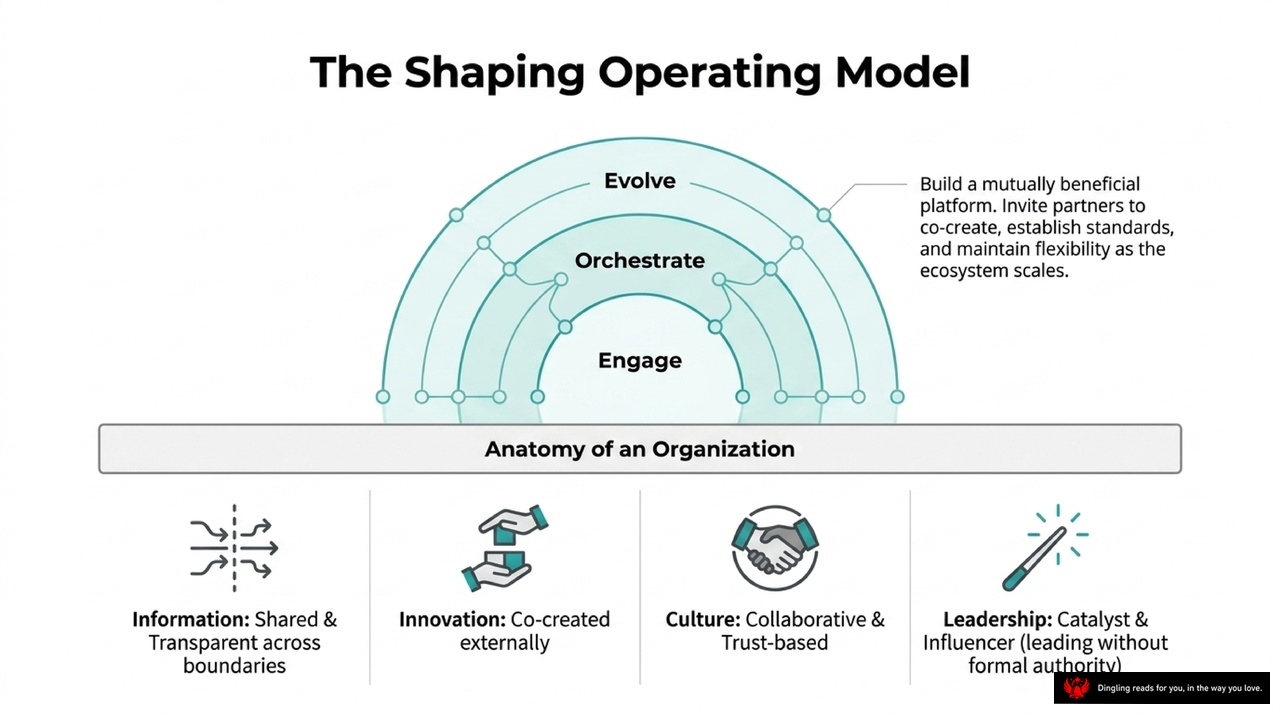
The Shaping Operating Model isn't just a static diagram; it's a dynamic blueprint for how modern organizations actually function. Notice the three concentric rings: Engage, Orchestrate, and Evolve. This structure sits atop the "Anatomy of an Organization," which is built on four foundational pillars: Information that flows transparently across boundaries, Innovation co-created externally, a Culture based on trust and collaboration, and Leadership that acts as a catalyst rather than relying on formal authority.
Think of this as an ecosystem. At the core, you engage with your partners. As you move outward, you orchestrate the system by setting standards and inviting co-creation. And at the outermost layer, you evolve, building a mutually beneficial platform that scales with flexibility. This model proves that successful companies don't just manage resources; they cultivate an environment where information is shared, innovation happens outside the walls, culture is built on trust, and leaders empower others to lead without needing a title. It's a shift from controlling a hierarchy to nurturing a living, breathing ecosystem that adapts and grows together.

Orchestrating Ecosystems & The Control Trap
Here's a powerful lesson from Novo Nordisk's entry into the Chinese diabetes market in the 90s. Facing an unpredictable early-stage environment, they didn't try to control everything themselves. Instead, they built an entire ecosystem—partnering with health authorities, patient groups, and doctors to create a hub of education and treatment. By offering mutual benefit rather than just selling products, they captured 60% of the market share.
But this slide highlights a critical warning for leaders today. Many fall into the "Control Trap," believing the illusion that they must own and control every node in their value chain to succeed. The reality, as Novo proved, is that true value relies on the autonomous participation of external partners. When you try to extract too much value or dictate terms, you drive partners away, leading to platform failure or total isolation. The smartest strategy isn't about being the boss of the whole game; it's about becoming the essential orchestrator who makes the game winnable for everyone else.

When the environment turns hostile—shattered by external shocks or plagued by a prolonged strategic mismatch—survival becomes the only priority. This is where the Renewal Strategy takes over. As the slide illustrates, when life is on the line, you cannot chase growth; you must first preserve your capital. The focus temporarily narrows to one thing: staying alive.
Think of it as hitting a target with a single, sharp arrow. In these harsh conditions, the goal isn't expansion; it's consolidation. You must ruthlessly cut costs, shed non-core assets, and stop bleeding resources until the storm passes. Only once you've secured your footing can you think about resuming growth. It's a stark reality, but for companies facing existential threats, it's the only path forward. This isn't about failure; it's about the disciplined, temporary shift required to ensure you're still here to fight another day.
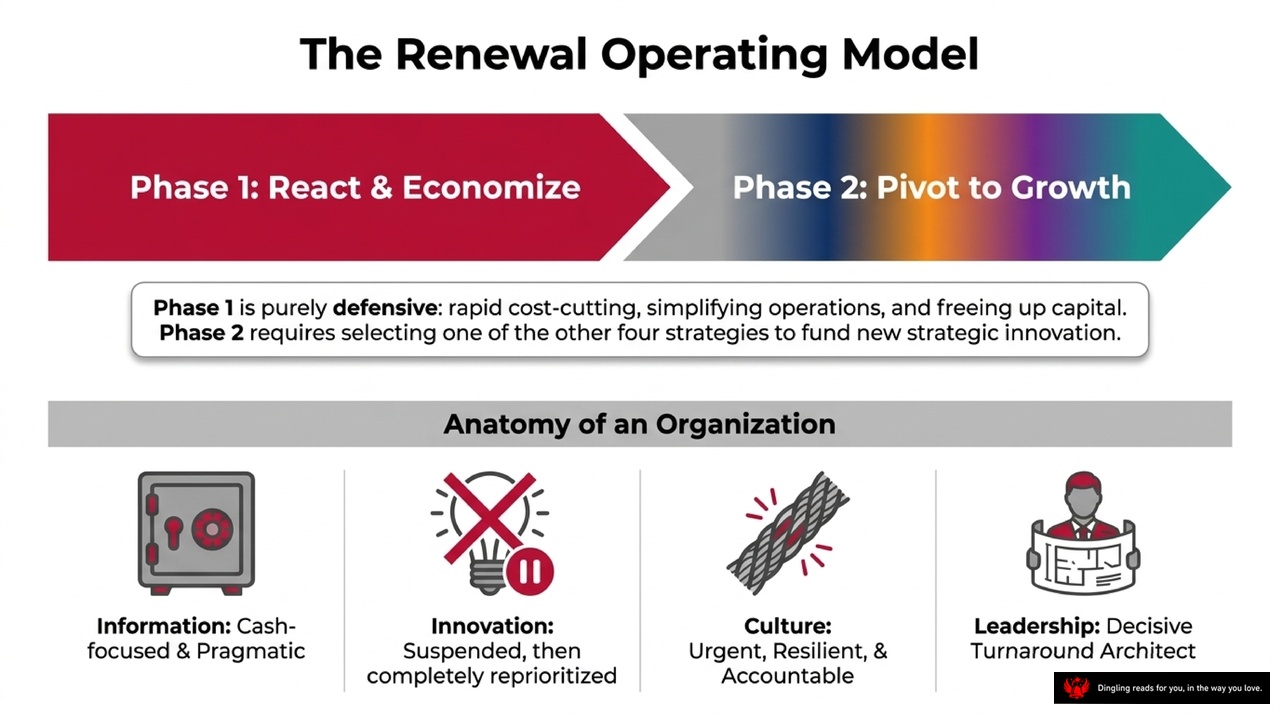
Welcome back to our deep dive into the Strategic Palette. Today, we're looking at a critical framework for navigating the "Anatomy of an Organization" during a turnaround.
As we see on the screen, the path to renewal is divided into two distinct phases. Phase 1 is purely defensive. It's about reacting and economizing—rapid cost-cutting, simplifying operations, and freeing up capital to stop the bleeding. But Phase 2 is where the real work begins: pivoting to growth. This requires selecting one of the other four strategic archetypes to fund new strategic innovation. You can't just cut costs forever; you need a new engine to drive the future.
This shift in strategy demands a complete reimagining of the organization's core components. Look at the "Anatomy of an Organization" section below. First, Information must change from being merely cash-focused and pragmatic to becoming a real-time radar for survival. Second, Innovation cannot just be suspended and reprioritized; it must be reimagined entirely to fit the new reality. Third, the Culture needs to shift from standard operating procedures to something urgent, resilient, and accountable. And finally, Leadership transforms into the decisive "Turnaround Architect."
This isn't just about restructuring; it's about rewriting the DNA of the company to survive the crisis and thrive in the new environment.

Surviving the shock and avoiding the starvation trap isn't just about cutting costs; it's about strategic reinvention. As we saw with Ken Chenault at American Express during the 2008 financial crisis, the graph on the left tells a powerful story. While costs were aggressively slashed, those freed resources weren't wasted—they were explicitly invested in digital platforms and new partnerships, driving an 800% increase in stock price. This proves a critical point highlighted in the "Reality" box on the right: you cannot shrink your way to greatness.
Many leaders fall into the "illusion" trap, believing that cost-cutting alone will save the company. Instead, this often leads to the "Death Spiral," where foundational capabilities required for future growth are destroyed. The real path forward, as shown in Chenault's success, is to use the savings from efficiency to fuel innovation and pivot toward the next phase of growth. True survival comes from protecting your core capabilities while aggressively investing in the future, ensuring that today's cuts don't become tomorrow's limitations.

What if you are PepsiCo? Imagine managing a global giant that operates in multiple environments simultaneously. The key to mastering this complexity lies in the "Art of Ambidexterity."
As shown on your screen, this art is defined by two dimensions: how you structure your organization and how you shift over time. On the horizontal axis, we look at **Separation** versus **Switching**. Separation means different units run different strategies at the same time—like keeping your core cash cows safe while deploying adaptive teams to test new markets. Switching, on the other hand, involves the entire firm changing its strategy as the environment shifts.
Vertically, we consider **Self-Organization** versus **External Ecosystems**. Self-organization allows autonomous units to choose their own strategies, a model famously used by Haier. External Ecosystems, exemplified by Apple, involve sourcing different strategic capabilities from outside partners rather than building them all internally.
This framework isn't just theoretical; it's the hallmark of modern strategic mastery. By combining these approaches, leaders can protect their classical core businesses while aggressively pursuing disruptive innovation. It allows a single company to be both efficient and agile, ensuring that no matter how the market changes, you always have the right strategic tool for the job.

Leaders are no longer just planners; they are the chief architects of the strategic canvas, orchestrating diverse environments to win tomorrow's volatile markets.
As you see here, the core challenge is simple yet profound: are you trying to win with yesterday's static playbook? The reality is that leaders must diagnose the terrain, segment the organization, and disrupt the status quo when environments shift.
This is why we need a dynamic approach. Instead of relying on a single strategy, great leaders act as architects, deploying different strategic gears for different business units. Some parts of your company might need the stability of a "Classic" strategy to maximize scale, while others require the speed of an "Adaptive" strategy to survive rapid change. Perhaps a new division needs the boldness of a "Visionary" strategy to create a future that doesn't exist yet, or the coordination of an "Ecosystem" strategy to shape emerging rules.
The key is matching the right strategy to the right environment. By balancing these different modes—whether it's optimizing for efficiency, exploring for innovation, or pivoting for survival—you create a resilient organization capable of navigating uncertainty. Don't just plan for the future; architect it by aligning your strategic tools with the specific demands of each part of your business.