
Yu Jun's Product Methodology: Complete Chapter-by-Chapter Summary
Welcome to Yu Jun's Product Methodology. Imagine the entire globe as a complex, interconnected web where every dot represents a user and every line a transaction. This isn't just a map; it's the stage where modern product management plays out.
As we dive in, think of product management not as a job title, but as a definitive framework that transforms how we build things. It turns product management into a science of human psychology, economic transaction, and ultimate value creation.
In the past, this role looked very different. Back in the 1920s, a product manager at Procter & Gamble was essentially a brand manager. Their job was simple: build a brand identity and push it through channels. By the 90s, in the software era, they became project managers, focused on delivering features that sales teams promised to clients.
But today, the game has changed completely. The internet lowered the cost of copying information, allowing a single product to reach hundreds of millions of users overnight. This means we can't just build features; we must design entire ecosystems. We also live in an era of rapid iteration, where user feedback loops are instantaneous.
So, what is the core of this new methodology? It all comes down to one powerful concept: "Product is Transaction."
Every time a user interacts with your app—swiping, clicking, or buying—they are making a conscious choice. They are trading something they value, like their time or attention, for the benefit your product provides. If that benefit feels greater than the cost, the transaction succeeds. If not, they leave.
This shift in perspective is everything. It moves us away from guessing what users want and starts us with understanding the economics of their behavior. We need to ask: What is the user paying for? Is it money? Is it time? And what are they getting back?
By viewing every feature as a mechanism to facilitate this exchange, we stop chasing vanity metrics and start building sustainable value. We learn to balance the user's desire for utility with the company's need for profit, creating a system where both sides win.
This is the foundation of Yu Jun's Product Methodology. It's a map for navigating the complexity of the digital age, helping you turn abstract user needs into concrete, profitable, and human-centric products. Let's explore how to master this transaction model together.

The evolution of the product manager isn't just a career path; it's a reflection of how the world has changed. Look at this timeline: we moved from the FMCG era, where success was driven by sales and marketing with heavy physical production costs, to the software era, focused on rigid project management and on-time delivery. But the real game-changer is the Internet Era, highlighted here in red.
In this new world, the driver shifts to information distribution and user experience. The goal transforms from simply delivering fixed requirements to architecting high-frequency value exchanges at a massive scale. Why is this possible? Because the core constraint has been overridden. In the past, you were limited by the high cost of manufacturing or slow software deployment. Today, the marginal cost of reproducing information is nearly zero. This means a product can scale to millions of users instantly without the physical limits of the past.
This shift changes everything for the product manager. The ceiling for this role is now infinitely higher. It's no longer about managing production costs or sticking to a schedule; it's about engineering optimal value exchanges. You have the power to reach billions, test ideas instantly, and optimize based on real user behavior. This era demands a different kind of thinker—one who understands that the product is essentially a transaction, and your job is to make that exchange as efficient and valuable as possible for everyone involved.
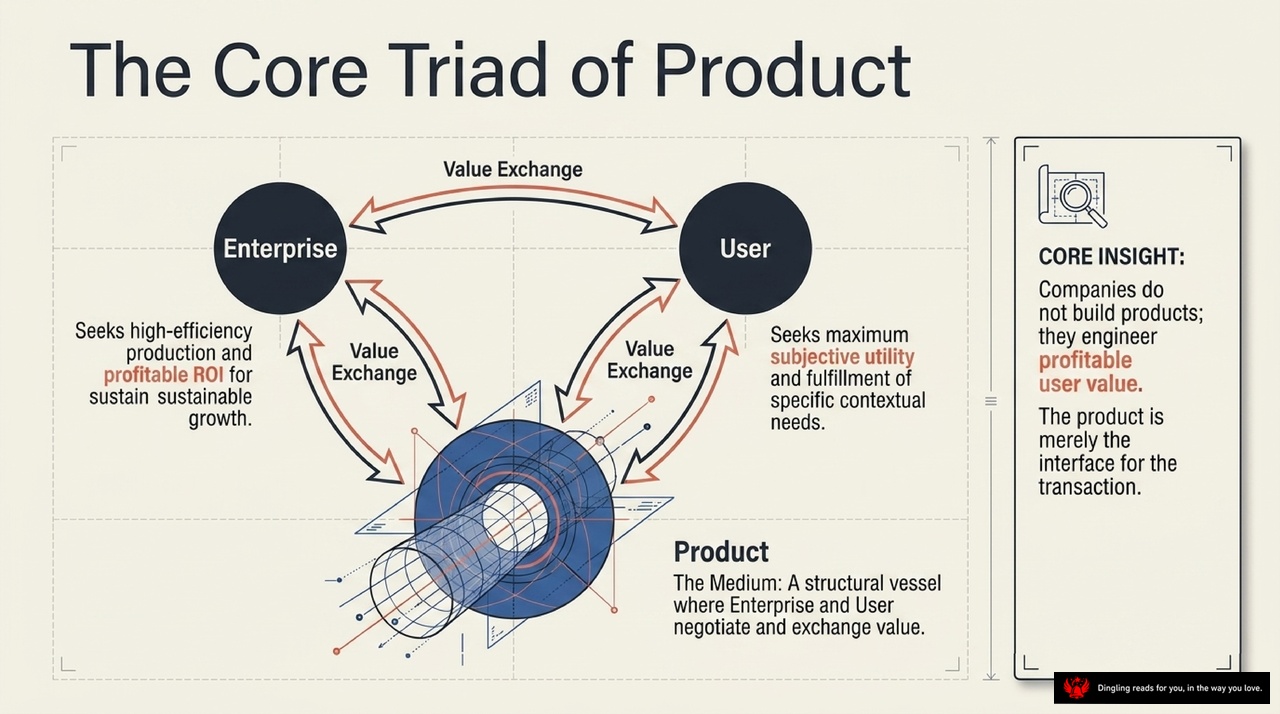
Imagine your product not as a physical object or a software app, but as a dynamic interface for a continuous transaction. This is the heart of "The Core Triad of Product." In this model, the **Enterprise** and the **User** are the two poles, connected by the **Product**, which acts as the medium where value is negotiated and exchanged.
On one side, the **Enterprise** seeks high-efficiency production and a profitable ROI to sustain growth. On the other, the **User** seeks maximum subjective utility, looking for specific needs to be fulfilled within their unique context. The arrows between them represent "Value Exchange"—a constant loop where the company delivers a solution, and the user provides value, whether that's money, time, or data.
Here is the core insight: companies do not actually build products in the traditional sense; they engineer profitable user value. The product itself is merely the interface for this transaction. A good product must satisfy three conditions simultaneously: it must be useful to the user, profitable for the enterprise, and fair in how it distributes benefits across the entire supply chain. Without this balance, the transaction breaks, and the product fails. This triad reminds us that every product decision is ultimately about facilitating a sustainable exchange of value.

So, here's the reality check that often trips up even seasoned designers: a "user" isn't a real person. In fact, a single natural person can represent 100 different "users" within the exact same app. Look at the diagram here—we see one silhouette, but it branches into three distinct contexts. In Context A, that same person is heading home from a bar and needs the cheapest possible ride. In Context B, they are rushing to the airport for a critical flight and need a highly reliable, premium ride. And in Context C, they are driving to the hospital and need an immediate, fast ride.
The core insight here is that a product captures contexts, not people. If you design for the person, you fail because their needs change based on the situation. But if you design for the specific collection of needs within a context, you hit the mark. This means your product isn't solving for "John"; it's solving for "John trying to get to the airport on time." Understanding this shift from a static human profile to a dynamic set of situational needs is the very first pillar of building a product that actually works.
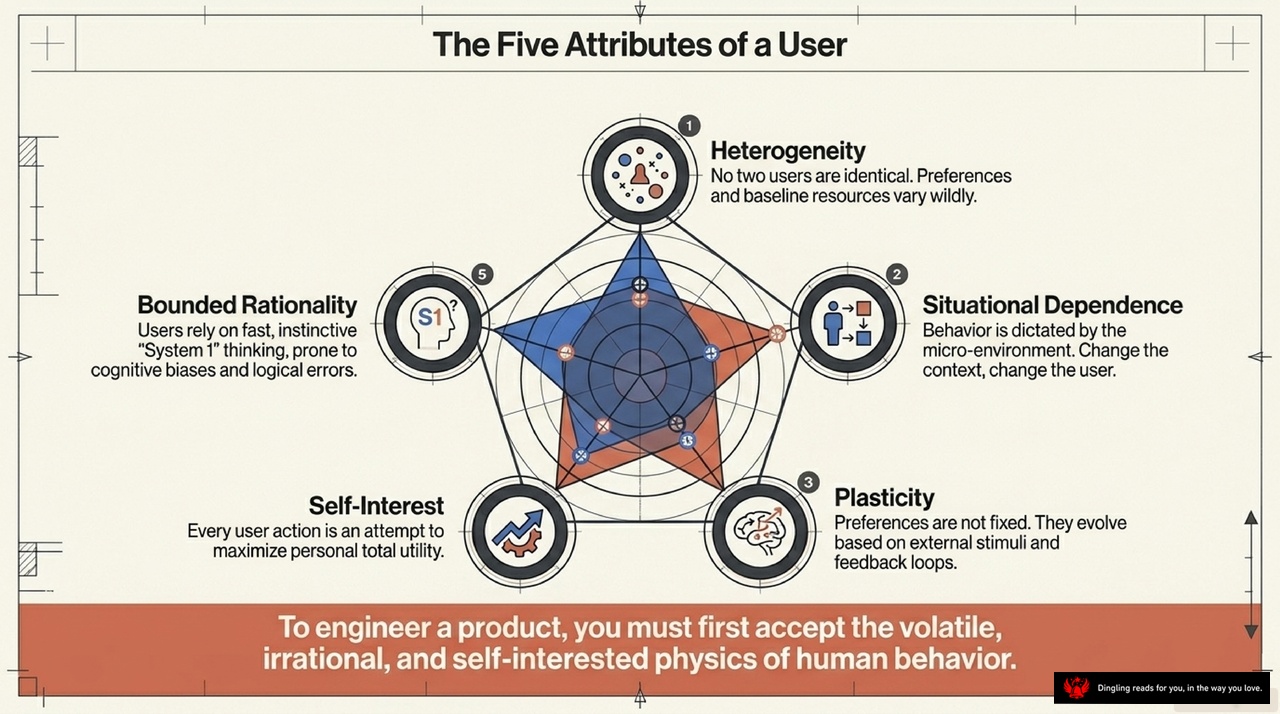
To engineer a product, you have to stop pretending humans are logical robots. You must first accept the volatile, irrational, and self-interested physics of human behavior. This slide breaks down the five core attributes that define every single user you will ever encounter.
First, remember **Heterogeneity**. No two users are identical. Their preferences and baseline resources vary wildly. You cannot build for an average; you must design for the spectrum.
Second is **Situational Dependence**. Behavior isn't fixed; it is dictated by the micro-environment. Change the context, and you change the user. A person's needs shift instantly based on where they are and what is happening around them.
Third, consider **Plasticity**. Preferences are not set in stone. They evolve based on external stimuli and feedback loops. Your job is to create loops that help users grow with your product.
Fourth lies **Self-Interest**. Every user action is essentially an attempt to maximize personal total utility. They are not doing it for you; they are doing it for themselves.
Finally, we have **Bounded Rationality**. Users rely on fast, instinctive "System 1" thinking. They are prone to cognitive biases and logical errors because their brain prioritizes speed over perfection.
When you combine these five attributes, you realize that trying to engineer a perfectly rational system is a mistake. Instead, you must design for these specific human constraints. By understanding that users are diverse, context-driven, adaptable, self-motivated, and cognitively limited, you unlock the ability to build products that actually work in the real world.

Look at this "User Value Formula." It breaks down exactly why some products win while others fail. The equation is simple: User Value equals New Experience minus Old Experience minus Switching Cost.
Think of it as a battle for the user's attention. First, you need to maximize your New Experience. This is about delivering superior tech, better distribution, or a rock-solid UX that feels fresh and exciting. But here's the catch: you have to overcome the user's Old Experience. If a user is already comfortable with a competitor, you are fighting against their baseline. That's why targeting users with zero prior experience often yields the highest perceived value—they have nothing to lose.
Then, there's the friction of change, known as Switching Cost. This includes the cognitive load, time delays, and even monetary costs a user faces when leaving their current spot. If this friction is too high, your value drops to zero, no matter how good your product is. A product only truly wins if the net positive utility remains undeniably greater than zero. In a world where users can switch instantly, you must constantly innovate to make the new experience worth the trouble of leaving the old one.

Think of every interaction you have with a product not just as a feature click, but as a real economic transaction. As the slide illustrates, this is the core of the Transaction Model: the product *is* the transaction. Whether it's a paid purchase, a free scroll, or simply opening an app, the user is always paying a cost—be it money, time, data, or opportunity cost—and expecting a return in utility.
On the left side of this balance, we have Utility. This isn't just about features; it's the subjective value the user gets. It could be saving time, gaining social status, feeling safe, or just having fun. On the right side, we see the Cost. This goes beyond the sticker price; it includes direct costs like data privacy, but also opportunity costs—what else could you be doing with that time?
The magic happens when Expected Utility outweighs Costs. If the value you feel is greater than what you give up, the transaction succeeds. This is the Product Manager's ultimate job: architecting a sustainable ecosystem where every party achieves a positive utility balance. By understanding this dynamic, we stop guessing and start designing systems where value exchange happens naturally and efficiently.
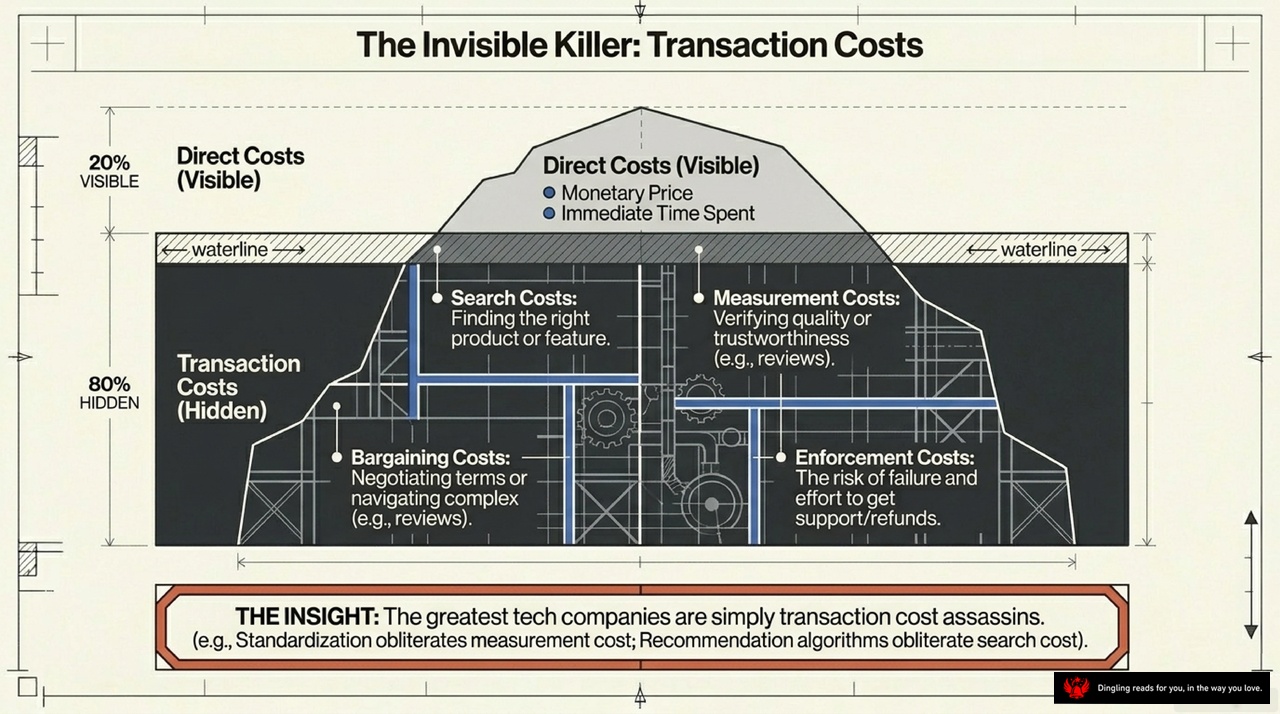
Look at this iceberg. We often think the price tag on a product is the only cost we care about, but that's just the tip of the tower—only 20% of the real cost is visible. The other 80%? That's the invisible killer: transaction costs.
Think about your last big purchase. You didn't just pay the sticker price. You spent hours searching for the right item, reading endless reviews to verify quality, negotiating terms with salespeople, and worrying about what happens if you need a refund. These are the hidden giants: search costs, measurement costs, bargaining costs, and enforcement costs. They are the friction that slows down every single transaction in our economy.
Here's the insight that changes everything: the greatest tech companies aren't just building cool features; they are transaction cost assassins. They realize that if they can eliminate the friction, they win. Standardization kills the need to measure quality personally. Recommendation algorithms like the ones we use every day obliterate the search cost entirely. By making it effortless to find what we want and trust what we buy, they unlock value that was previously locked behind those invisible barriers. In the world of product design, your goal isn't just to make a better product, but to make the act of using it cheaper and easier than the alternative.
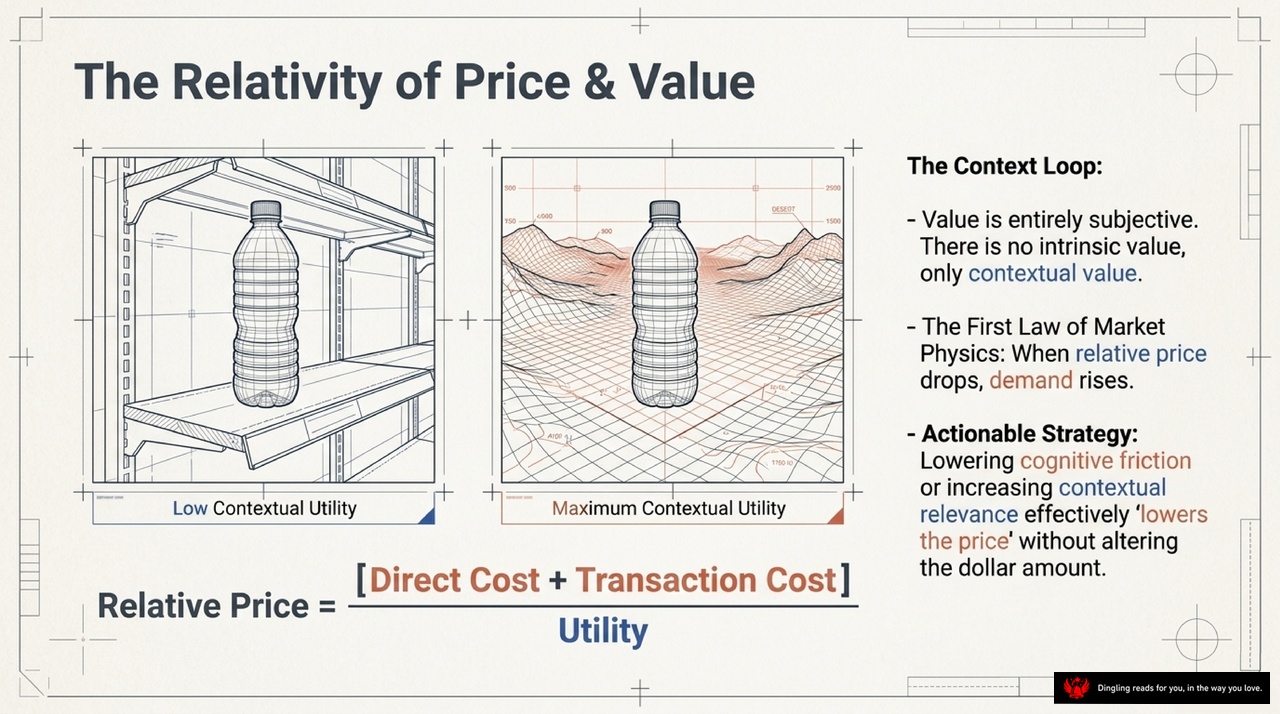
The Relativity of Price & Value isn't just a theory; it's the engine driving every smart product decision. Look at these two scenarios: a water bottle on a sparse shelf versus one surrounded by a rich, relevant context. The first has low contextual utility, making it feel less valuable, while the second maximizes it. This visual perfectly illustrates the core equation at the bottom: Relative Price equals Direct Cost plus Transaction Cost, divided by Utility.
Here's the game-changer: value is entirely subjective. There is no intrinsic value, only contextual value. As the First Law of Market Physics states, when relative price drops, demand rises. But here's the actionable strategy for you: you don't always need to lower the actual dollar amount. Instead, lower cognitive friction or increase contextual relevance. By doing this, you effectively lower the price in the user's mind without altering the cost. Whether you are building a feature or optimizing a flow, remember that the goal is to make the user feel they are getting more utility for less effort. That is how you win.

Pillar 3: The Anatomy of Decision Making. How do you actually make a call when the data is missing or the stakes are high? The answer lies in understanding where you stand on this matrix.
Look at the axes: Information availability on the bottom, and the complexity of variables on the left. This simple grid defines your entire decision strategy.
In the bottom right, we have Data-Driven decisions. You have high information and low-to-medium complexity. This is the sweet spot for optimization, A/B testing, and efficiency. It's the "science" of product management. But remember the limitation: it looks backward. It can't predict black swans.
Move up to the top right: Logic-Driven. Here, you have medium information but medium-to-high complexity. This requires aligned cognitive frameworks and systemic design. It's about "talking the same language" with your team. However, it's highly dependent on shared mental models. If your team doesn't share the same understanding, your logic collapses.
Finally, the top left is the hardest zone: Subjective Judgment. Low information, infinite complexity. This is navigating extreme uncertainty where no data exists yet. This is the mark of an elite Product Manager. You can't rely on charts or flowcharts here; you must engineer a future that data cannot yet see. You need deep simulation of user and transaction models to make the call.
The best PMs don't just pick one method. They read the room, assess the information and complexity, and choose the right tool for the job. That is the true anatomy of decision making.
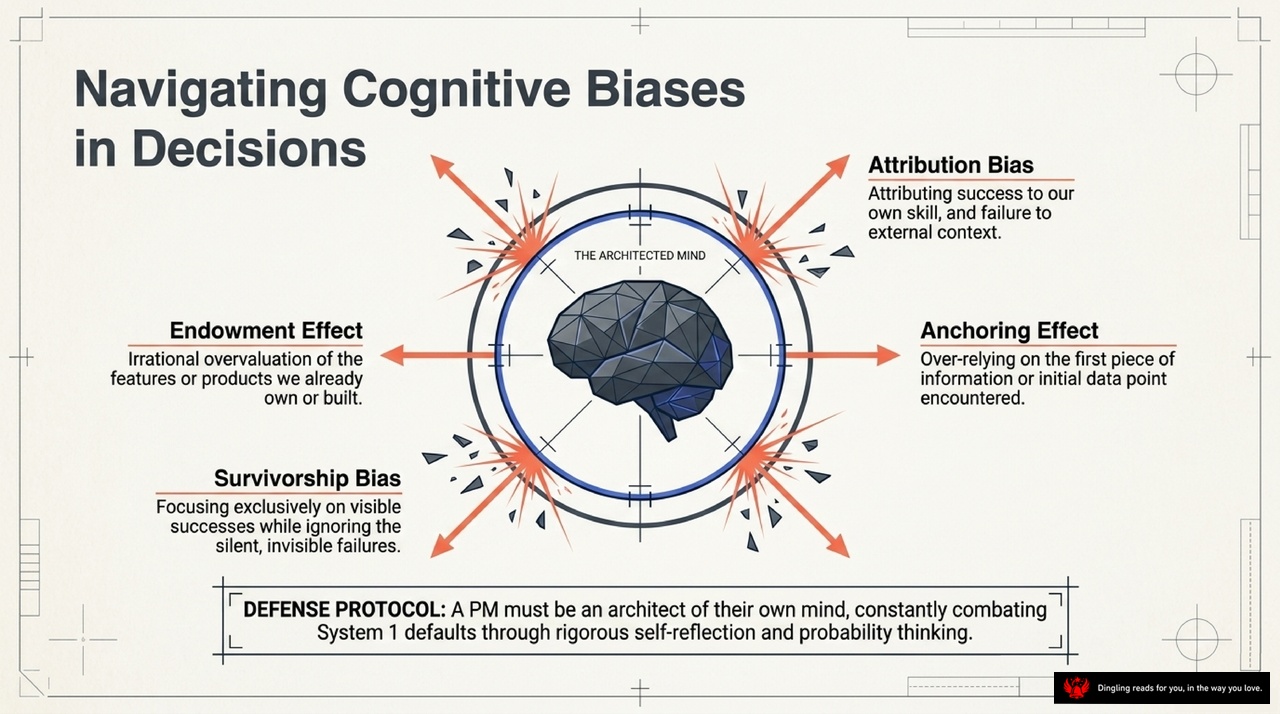
Navigating Cognitive Biases in Decisions
So, how do we actually make better decisions as Product Managers? The truth is, our brains are wired to take shortcuts, and these shortcuts often lead us astray. This slide outlines the five major cognitive biases that act like traps around our "Architected Mind."
First, look at the **Attribution Bias**. We have a natural tendency to attribute our own successes to our personal skill, while blaming failures on external circumstances. It's a classic self-deception that keeps us from learning from our mistakes.
On the opposite side, we have the **Anchoring Effect**. This happens when we rely too heavily on the first piece of information we encounter. If that initial data point is skewed, our entire decision-making process gets pulled off course, even if better data appears later.
Then there's the **Endowment Effect**. This is that irrational overvaluation of things we already own or have built. We tend to think our products are worth more simply because we created them, ignoring the objective market reality.
We also suffer from **Survivorship Bias**. This is the trap of focusing exclusively on the visible successes—like the companies that made it big—while completely ignoring the silent, invisible failures that never got noticed. If you only study the winners, you'll build a strategy that guarantees failure.
Finally, we have the **Peak-End Rule**, which dictates that our memory of an experience is based less on the average of our feelings and more on the peak moment and the end. If we design a product with a great start but a terrible ending, users will remember it negatively, regardless of the overall quality.
To defend against all of this, we need a strict **Defense Protocol**. As PMs, we must become the architects of our own minds. We can't rely on intuition alone. We need to constantly combat these System 1 defaults by engaging in rigorous self-reflection and applying probability thinking to every single decision we make. Only then can we navigate these biases and make truly rational choices.
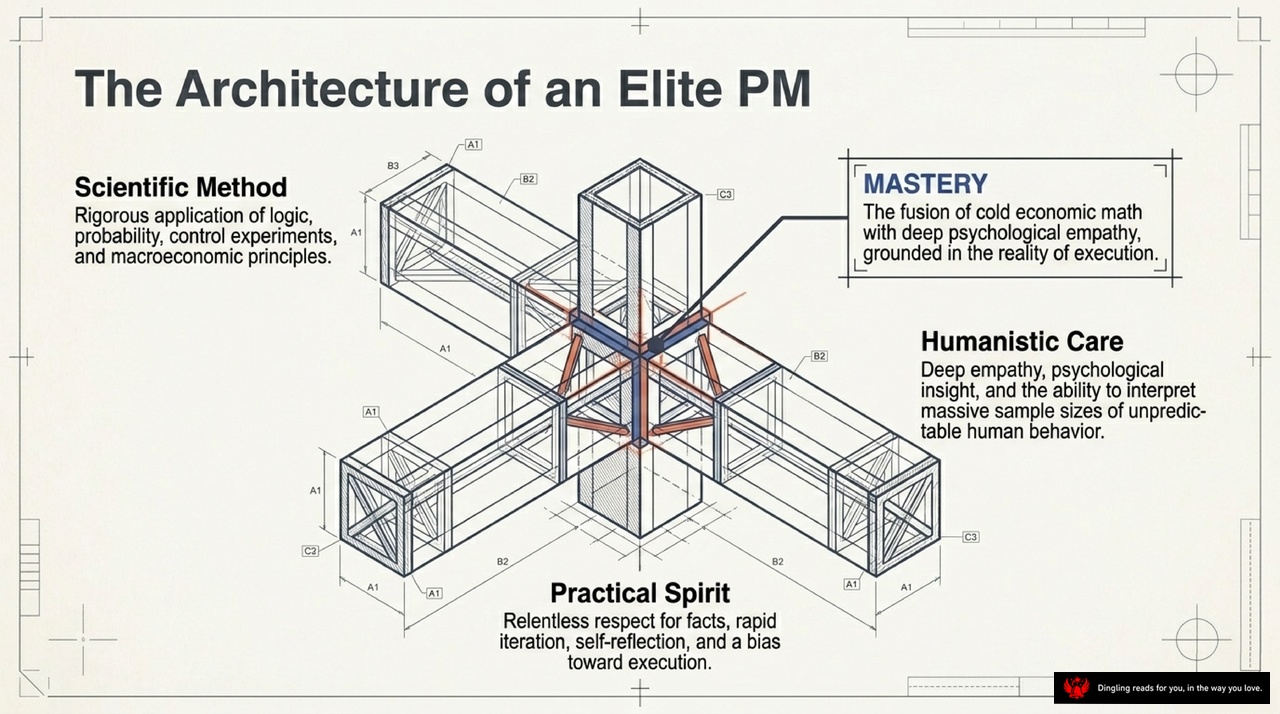
Look at this blueprint titled "The Architecture of an Elite PM." It visualizes the perfect product manager not as a single skill, but as a complex structure built on four interconnected pillars.
First, on the left, we have the "Scientific Method." This is the foundation. It's about rigorously applying logic, probability, and control experiments, much like an engineer or a scientist. You aren't just guessing; you are using macroeconomic principles to make your decisions high-confidence and data-driven.
Then, look at the bottom center: "Practical Spirit." This is the engine of execution. It demands a relentless respect for facts, rapid iteration, and constant self-reflection. It's a bias toward action, ensuring that your ideas don't just stay on paper but get shipped and tested in the real world.
On the right, we see two critical human elements. The top one is "Mastery." This is the fusion of cold, hard economic math with deep psychological empathy. It's grounded in the messy reality of execution, where you must balance the numbers with the people. Below that is "Humanistic Care." This is about deep empathy and psychological insight. An elite PM needs the ability to interpret massive sample sizes of unpredictable human behavior, understanding that behind every data point is a complex human story.
Ultimately, these four components—Scientific Method, Practical Spirit, Mastery, and Humanistic Care—form the structural integrity of a top-tier product manager. It's a system where logic meets empathy, and theory meets relentless execution.

So, what actually makes a Product Manager valuable? It's not just about years on the job. Today, we're breaking down the exact equation that defines PM Value. As you can see on the screen, the formula is simple but powerful: PM Value equals Experience multiplied by Platform Fit, multiplied by Wisdom.
Let's look at the first factor: Experience. This isn't just about time served. It's about your familiarity with production cycles and specific domains. Here's the catch—this variable mathematically plateaus after roughly five years. Once you hit that five-year mark, simply adding more years won't linearly increase your value; you've hit a ceiling with pure experience alone.
Next, we have Platform Fit. This is the environmental multiplier. Your value relies heavily on the ecosystem you're working in. Think about it: transferring domains or jumping to a completely different company doesn't just change your job; it resets this multiplier. A great product manager in a mature tech giant might be less effective in a chaotic startup, and vice versa. Your skills must align with the specific environment to truly multiply your impact.
Finally, and perhaps most importantly, is Wisdom. This is the ultimate differentiator, representing your cognitive level. While experience has a ceiling, wisdom is the ability to process complex variables, overcome your own biases, and apply logic across totally distinct, high-uncertainty contexts. This is what allows you to thrive when the rules change.
So, remember this: Experience gets you in the door, Platform Fit amplifies your work, but Wisdom is the only variable that truly scales your long-term value.
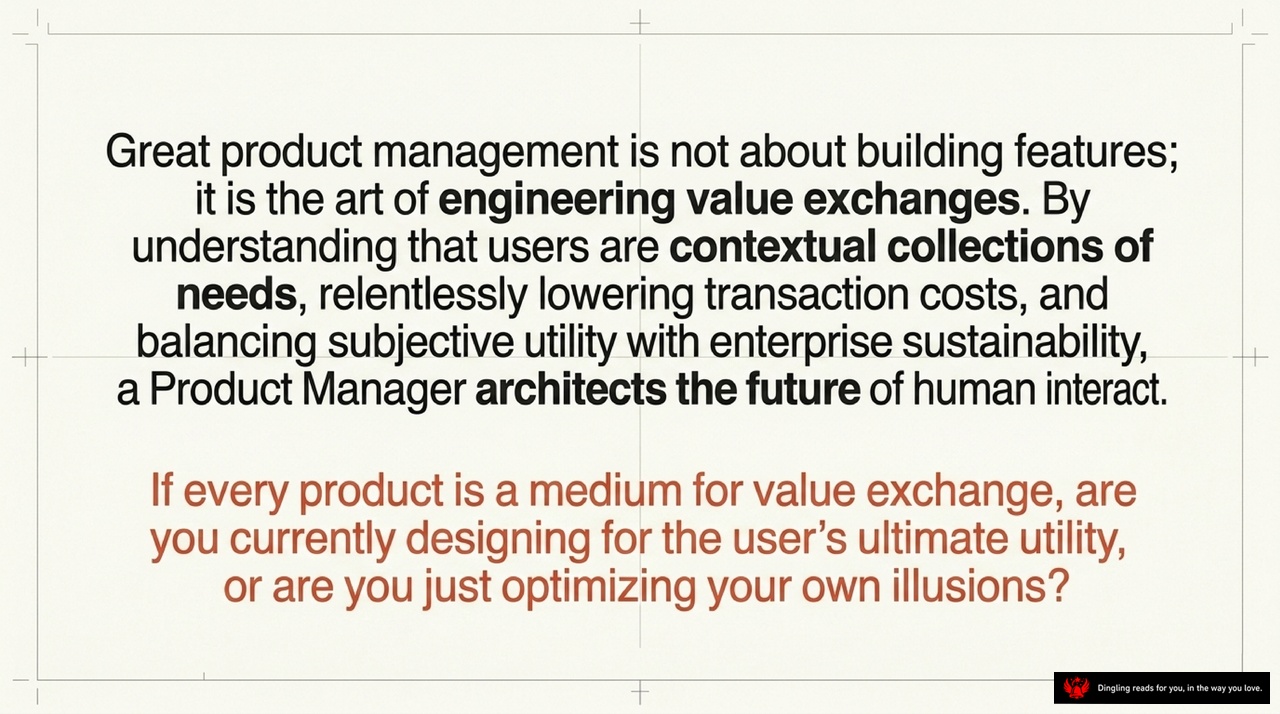
Great product management isn't about simply stacking features; it's the art of engineering value exchanges. Think of every product as a medium for swapping value between you and the user. You need to understand that users aren't just individuals; they are contextual collections of needs. Their desires shift based on the situation, their resources, and even their mood at that exact moment.
To succeed, you must relentlessly lower transaction costs—whether that's time, money, or mental effort—while balancing what feels useful for the user with what keeps your business sustainable. When you master this balance, you aren't just building an app; you are architecting the future of human interaction. But here's the hard question to ask yourself: Are you currently designing for the user's ultimate utility, or are you just optimizing your own illusions?