
Zero to One: Complete Chapter-by-Chapter Summary
Welcome to the world of *Zero to One*, written by Peter Thiel. Today, we're not just talking about moving forward; we're talking about moving forward by making things new. The core idea is simple yet profound: the future isn't about going from one to many, which is just copying and globalization. That's horizontal progress. True progress comes from going from zero to one. It's about creating something entirely new, something that didn't exist before.
Most people think the future is about competing in a crowded market, but Thiel argues the opposite. He believes that competition is actually the enemy of progress because it leads to mediocrity. To build a truly valuable company, you need to escape competition and create a monopoly. This doesn't mean being evil or predatory; it means being the best at something no one else can do. Think about it: why does Google make so much more profit than the airlines? Because Google dominates its niche, while airlines are stuck in a race to the bottom.
But how do you find these opportunities? Thiel suggests looking for "contrarian truths"—ideas that the majority gets wrong. If everyone agrees on something, it's probably not a good business opportunity. You need to find a secret, a small market where you can dominate, and then expand from there. It's about being the last company in your industry, not the first.
So, what does this mean for you? It means you need to think differently. Don't just follow the crowd. Don't assume that if everyone else is doing it, it's the right path. Instead, ask yourself: what is the one thing that no one else is doing, but that could change the world? That's the essence of zero to one. That's how you build a company that lasts, a company that doesn't just survive, but thrives by being uniquely different.
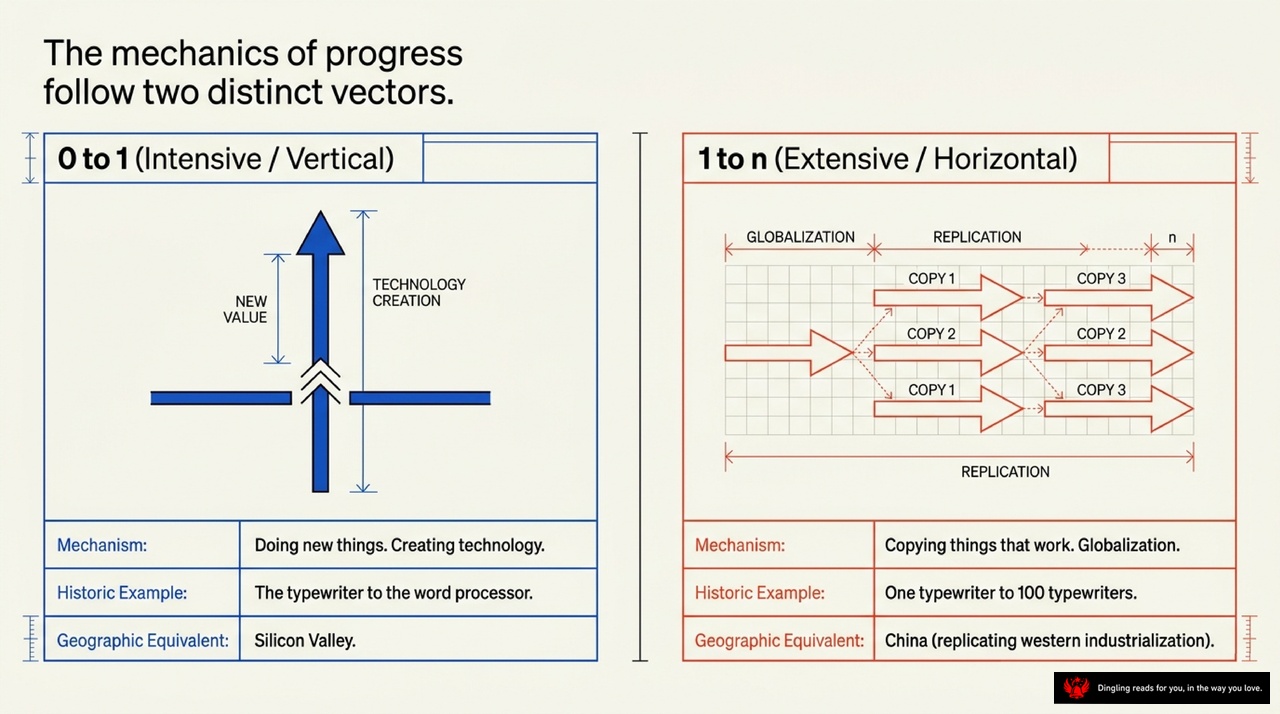
Progress doesn't happen in a straight line; it moves along two distinct vectors. Today, we're looking at the mechanics of how the world actually changes. On the left, you see the "0 to 1" path. This is intensive, vertical growth. It's about doing something new, creating technology from scratch, and generating new value. Think of the leap from the typewriter to the word processor. This is the Silicon Valley model, where a small group of innovators creates a monopoly by being the first. It's the engine of true progress.
On the right, we have the "1 to n" path. This is extensive, horizontal growth. It's about replication and globalization. It takes something that already works and copies it everywhere. Think of one typewriter becoming a hundred. This is the model of many emerging markets, where the goal is to replicate Western industrialization. While necessary, this path alone doesn't create a better future; it just spreads the status quo.
The core lesson here is that relying solely on 1 to n replication is unsustainable. Without the 0 to 1 breakthroughs that create new technology and efficiency, we are just running faster on a broken treadmill. True progress requires us to stop copying and start creating, moving from a world of mere expansion to one of genuine innovation.

Look at this slide. It challenges the very way we think about building a company. On the left, we see "The 1999 Dogma"—the old-school playbook that told us to make safe, incremental advances, stay lean and flexible, fight in crowded markets, and believe that good products sell themselves. These were the lessons from the dot-com crash, born out of fear and past trauma. But on the right, we have "The Contrarian Blueprint." This is the new reality. It argues that boldness is far superior to triviality. It suggests that a bad plan is actually better than no plan at all. It warns us that fighting in competitive markets destroys profits, and it shatters the myth that product alone drives sales, reminding us that sales matter just as much as the product itself.
The core message here is a shift from reacting to the past to designing for the future. Instead of copying what worked before or trying to outperform a crowded competitor, the contrarian path demands you find a unique angle, create a monopoly, and embrace the power of sales. Don't just iterate blindly; have the courage to be different, to take bold risks, and to build a business model that others haven't thought of yet. That is how you move from 1 to N, and then from 0 to 1.

Competition is a destructive ideology that distracts from value creation. Look at the slide: it contrasts the "Marx Model," where conflict arises from difference, with the "Shakespeare Model," where conflict arises from sameness. In the business reality shown below, you see how this plays out. When Google and Microsoft fight—whether it's Windows versus Chrome OS, Bing versus Google Search, or Surface versus Nexus—they are trapped in a cycle of profit margin destruction. They are fighting over the same territory, wasting resources on irrelevant battles. But notice the blue line: Apple. Apple doesn't compete directly with them in the same way. Instead, it captures external market value by creating something entirely new. While the competitors are busy destroying each other's margins, Apple grows. The lesson is clear: true innovation isn't about beating a rival who does the same thing. It's about creating a new game entirely, rendering the old competition irrelevant.

Have you ever noticed how life consistently rewards the few while leaving the many behind? Whether it's the massive earthquakes that dwarf all smaller ones combined, the dominance of a few mega-cities over countless small towns, or the fact that a handful of monopolies capture the vast majority of corporate profits, we are living under a universal law known as the Power Law.
Most people, especially those outside the tech world, mistakenly believe that success follows a normal distribution—a bell curve where average performers make up the bulk of the outcome. This mindset leads investors to "spray and pray," hoping that a few winners will balance out many losers. But this approach fails because the reality of high-impact investing is not a bell curve; it is a Power Law. A tiny fraction of companies—like Facebook or Instagram—generate returns that dwarf the sum of all other investments in a fund.
This principle applies directly to your own life. You cannot diversify your career like a hedge fund. If you spread your time across too many projects, you dilute your impact. The smartest move isn't to do everything a little bit; it's to find the one specific path where you can dominate. As the saying goes, a single good market is worth more than all other markets combined.
But here is the hardest truth to accept: the world is full of secrets. We are conditioned to believe that everything is already solved—that we've optimized the game. This "flat world" delusion kills innovation. It's why giants like Hewlett-Packard eventually stagnated; once they stopped believing in undiscovered secrets, they stopped inventing. The most valuable opportunities lie in the unknown, in the "human secrets" that no one has cracked yet. Whether it's Airbnb finding the hidden value in spare bedrooms or Uber unlocking idle car capacity, the next generation of giants will be built by those who dare to believe that the world still holds hidden, game-changing secrets waiting to be found.

Have you ever stopped to wonder why the wealthiest companies in history aren't the ones that try to please everyone, but the ones that dominate a specific niche? Today's slide breaks down exactly how to build that kind of unshakeable monopoly. It's not about being the biggest; it's about building a "monopolistic moat" with five concentric rings of defense.
At the very center is Proprietary Technology. This is the core engine. It's not just being slightly better; it has to be an order of magnitude, ten times better than the closest substitute. Think of PayPal versus mailing physical checks, or Google's search speed versus everyone else. If you don't have this massive gap, you're just competing in a crowded market.
Surrounding that core are two powerful accelerators: Network Effects and Economies of Scale. Network effects mean your product becomes exponentially more useful as more people use it, but here's the catch—it must start in a tiny, concentrated market to ignite. You can't start global; you have to start local. Economies of scale ensure that as your user base explodes, your marginal costs drop toward zero. This is why software companies scale so much faster than service businesses like yoga studios.
Finally, the outermost ring is Branding. But listen closely to this: a strong brand is completely hollow if it isn't supported by the inner three rings of structural value. Apple is the perfect example. Their brand is powerful, but it's only strong because of the proprietary technology inside the phone, the network of developers, and the scale of their ecosystem. If you just try to slap a logo on a mediocre product, the moat collapses.
The lesson here is simple but often ignored: don't try to conquer the whole world from day one. Start small, dominate that tiny niche with superior tech and network effects, and let the rest of the world follow you. That is the structural architecture of a true monopoly.

Look at this chart. It reveals the single biggest secret in venture capital: venture returns don't follow a normal distribution. Instead, they obey a power law.
See that blue curve on the left? That's the reality. It shows that the best investment in a successful fund equals or outperforms the entire rest of the fund combined. In fact, a tiny handful of companies generate the vast majority of the returns, while the rest of the portfolio often just breaks even or fails.
Now, look at that bell curve in the middle with the big red X over it. That represents the "Spray and Pray Fallacy." This is the trap most people fall into. They assume returns are normally distributed, so they think if they just invest in enough companies, the average winners will cancel out the losers, leaving them with a steady, predictable profit.
But that logic is completely wrong for early-stage investing. You cannot rely on averaging out risk. If you scatter your bets across hundreds of mediocre companies hoping for a few winners, you will fail because those winners won't be big enough to save you.
The takeaway is clear: You are not a portfolio. You cannot treat your capital like a diversified mutual fund. Instead, you must focus entirely on the singularity of massive potential. You need to find those rare, one-in-a-million companies with the power to create a new market, and pour your resources into them. That is the only way to win in the world of venture capital.
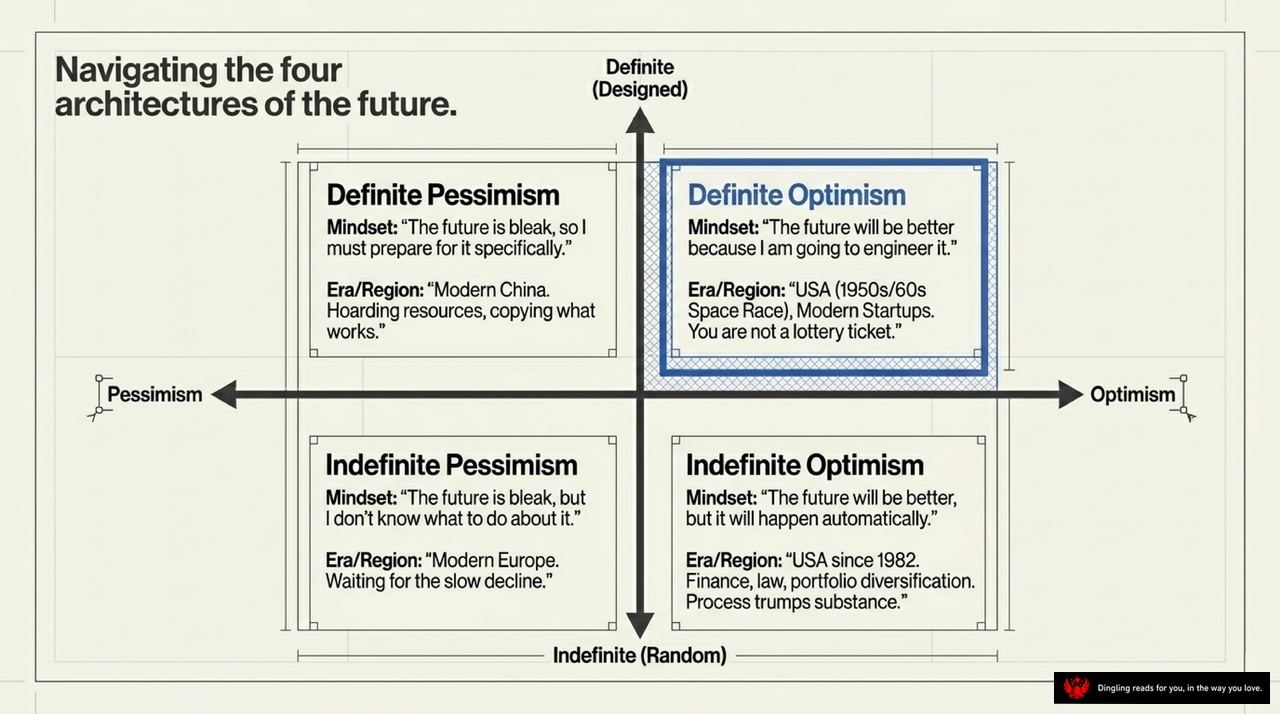
Imagine a world where the future isn't a mystery, but a blueprint. Today's slide, "Navigating the four architectures of the future," maps out exactly how we think about tomorrow. It's a simple two-by-two grid, but it reveals why some societies thrive while others stagnate. The vertical axis represents certainty: is the future designed, or is it random? The horizontal axis asks about our attitude: are we optimistic or pessimistic?
Look at the top right quadrant, highlighted in blue: "Definite Optimism." This is the mindset of the future you actually want. It combines the belief that things will get better with the hard work to engineer that change. As the text says, the mindset here is: "The future will be better because I am going to engineer it." This isn't just hope; it's action. It's the spirit of the US during the Space Race in the 50s and 60s, where engineers didn't wait for miracles—they built them. It's also the DNA of modern startups that tell you, "You are not a lottery ticket."
Contrast that with the other three quadrants. To the left, you have "Definite Pessimism." Here, people believe the future is bleak, so they prepare by hoarding resources or copying what worked before. Think of modern China's approach to resource management; it's a defensive strategy against a grim outlook. Below that lies "Indefinite Pessimism," where the future feels bleak and unpredictable, leading to a passive wait for decline—a mindset often seen in modern Europe today. Finally, in the bottom right, we have "Indefinite Optimism." This is the most dangerous trap. People believe the future will get better automatically, so they don't do anything. They rely on finance, law, and diversification, letting the market do the work for them. This was the dominant US mindset since 1982, where process trumped substance.
The lesson is clear: if you want to shape your destiny, you must reject the other three architectures and commit to "Definite Optimism." Don't just hope for a better future; design it. Don't wait for the market to save you; build the tools that will. This is the only path from 0 to 1, the only way to move from a random world to a designed one.
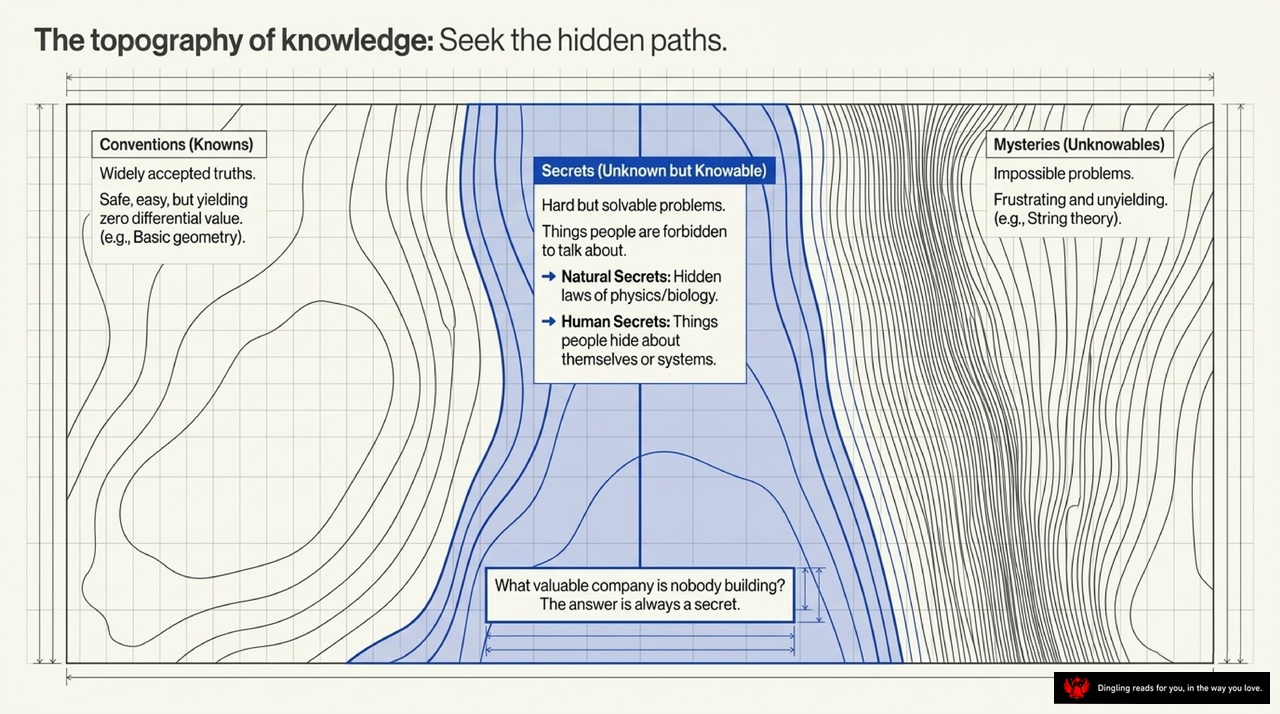
Imagine the landscape of knowledge not as a flat map, but as a topography filled with hidden paths. Today's slide reveals a crucial distinction: we must move beyond "Conventions," the safe, widely accepted truths like basic geometry that yield zero new value, and avoid "Mysteries," those impossible problems like string theory that are frustrating and unyielding. Instead, true breakthroughs lie in the blue zone labeled "Secrets"—the unknown but knowable. This is where the real opportunity exists, split into "Natural Secrets," like hidden laws of physics, and "Human Secrets," things people hide about themselves or their systems.
Think about it: what valuable company is nobody building? The answer is always a secret. History shows us that every great idea, from Pythagoras' geometry to the modern internet, started as a secret known only to a few before becoming common sense. But today, many have lost faith in these hidden paths, convinced that only easy problems remain or that impossible ones are the only challenge left. This mindset led to failures like Therac-25 or the collapse of Silicon Valley's early dreams.
The lesson is clear: don't stay on the familiar road. You must identify those difficult but solvable problems that others are too afraid to touch or simply haven't discovered yet. Whether it's a hidden flaw in a biological system or a unique market dynamic, finding these secrets is the only way to create something truly new. As we've seen with companies like PayPal or Tesla, the path to greatness isn't about copying the known; it's about seeking the hidden paths in the topography of knowledge.

Thiel's Law reminds us of a hard truth: if a startup gets its foundation wrong, it cannot be fixed later. The diagram on this slide illustrates the three pillars of any organization—Ownership, Control, and Possession. Ownership is about who legally holds the equity, like founders and investors. Possession refers to who actually operates the machinery day-to-day, such as founders and managers. And Control is the formal governance, typically handled by the Board of Directors.
Look closely at the red warning triangles connecting these pillars. Misalignment here is fatal. For instance, if large boards representing Control fight with founders who hold Possession due to misaligned timelines, the entire structure collapses. This is why the rule at the bottom is so critical: keep the board small, ideally between three to five people, and ensure everyone is full-time. As the slide emphasizes, "You are either on the bus or off the bus." Part-time directors or distant investors create friction that kills innovation. A successful startup requires these three elements to be perfectly aligned from the very beginning, because early errors in structure are impossible to repair once the company grows.

Calibrating culture: Find the exact space between nihilism and dogmatism.
Look at this spectrum. On the far left, we have "The Consulting Firm." Here, the trait is purely transactional. You get high talent, but zero connection. The result? Employees check in and check out. There is no shared mission. It's efficient, but it's hollow.
Move to the far right, "The Cult." Here, the trait is total devotion, but it's fundamentally wrong about reality. The result is blind dogmatism. You have loyalty, but you're marching toward a cliff because you refuse to see the truth.
Now, look at the middle. This is the Sweet Spot. The slide calls it "The Mafia." Don't get scared by the name; think of it as a tribe of like-minded individuals fiercely devoted to a unique mission. This is where extreme alignment meets reality. You get the passion of the cult without the blindness, and the focus of the firm without the detachment.
Most companies fail because they slide too far to one side. They become either soulless bureaucracies or cults of personality. The goal is to find that exact space in the middle where you can build something truly great. That is the calibration of culture.
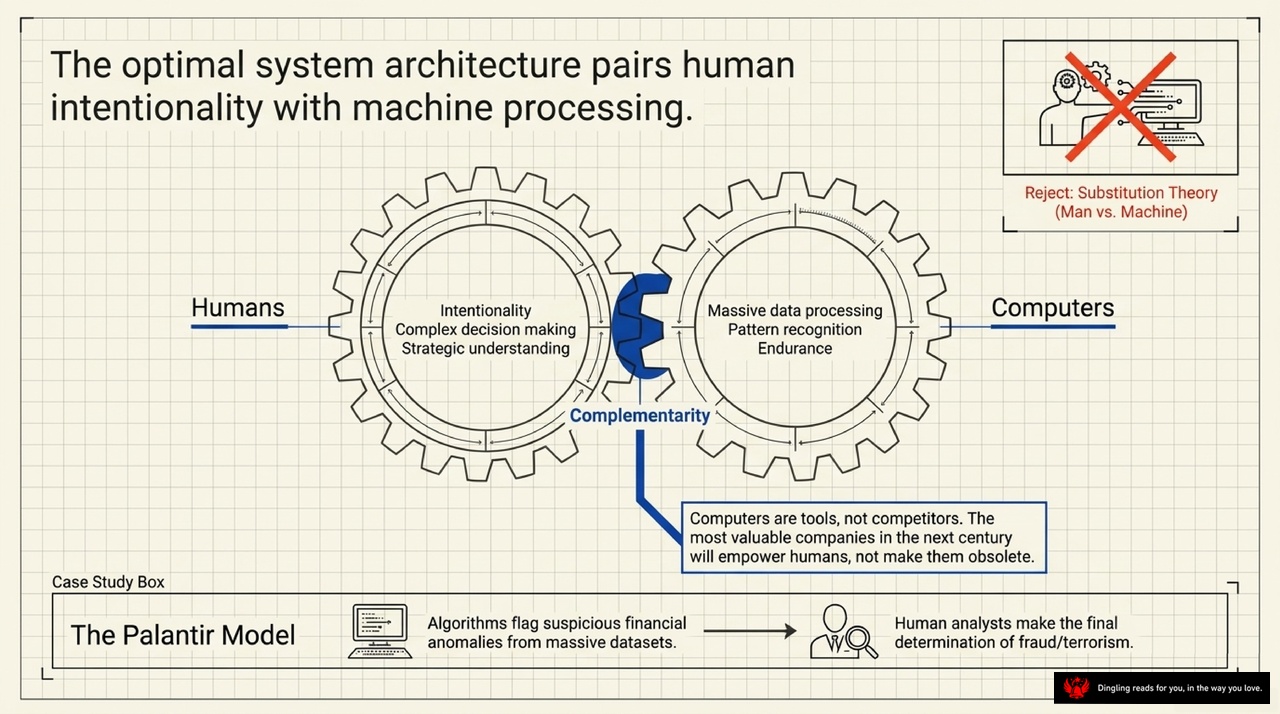
The slide clearly argues that the future of business isn't about humans fighting machines, but rather pairing human intentionality with machine processing. It explicitly rejects the "Substitution Theory"—the idea that AI will replace us—highlighting that computers are tools, not competitors. The diagram illustrates this through two interlocking gears: humans provide intentionality, complex decision-making, and strategic understanding, while computers excel at massive data processing, pattern recognition, and endurance. This concept of "Complementarity" is the key to the optimal system architecture.
To make this concrete, the slide points to "The Palantir Model" as a real-world case study. Here, algorithms don't make the final call; instead, they flag suspicious financial anomalies from massive datasets, and human analysts step in to make the final determination on fraud or terrorism. This mirrors the text's core insight: machines are incredible at crunching numbers and finding patterns, but they lack the context to understand *why* something matters. As the book explains, relying solely on data without human judgment is a trap. We need the "dumb" power of machines to handle the scale, paired with the "smart" judgment of humans to interpret the results.
Ultimately, the most valuable companies in the next century won't be those that try to automate humans away, but those that empower them. By leveraging the machine's endurance to process what a human could never handle alone, and using human intuition to guide the strategy, we create a system that is far greater than the sum of its parts. This is the path from 0 to 1: not replacing the human element, but amplifying it through technology.
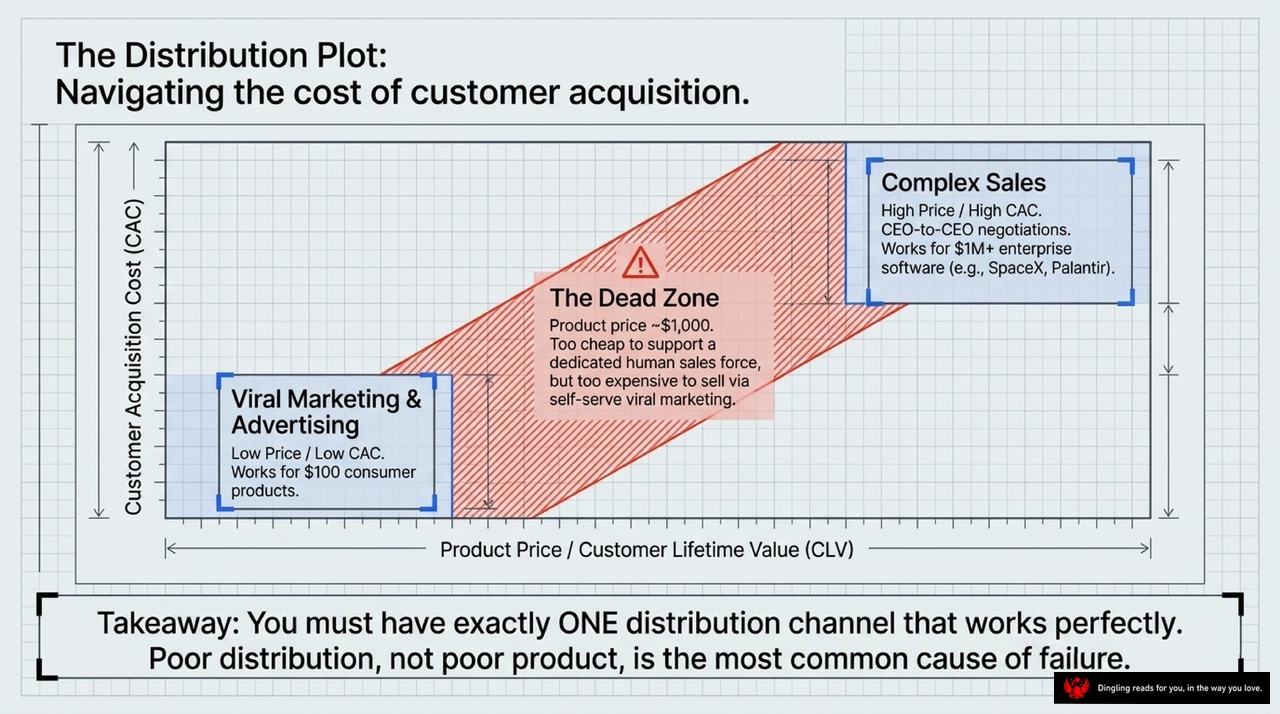
Look at this Distribution Plot. It maps the cost of acquiring a customer against the price of your product. On the left, you have Viral Marketing and Advertising. This works for low-priced consumer goods, maybe a $100 item, where the cost to get a customer is naturally low. On the far right, you see Complex Sales. This is for high-priced enterprise software, like SpaceX or Palantir, where you need CEO-to-CEO negotiations and the customer acquisition cost is massive.
But look at the middle. That red hatched area is what I call The Dead Zone. Here, your product is priced around $1,000. It's too cheap to justify hiring a dedicated human sales force, yet it's too expensive to sell through self-serve viral marketing. Most startups get stuck right here. They try to run ads that are too costly, or they try to build a sales team that is too expensive for their margins. The result? They bleed cash and die.
The core takeaway from this slide is simple but brutal: You must have exactly ONE distribution channel that works perfectly. Poor distribution, not a poor product, is the most common cause of failure. If you are in the dead zone, you have to innovate. Either find a way to lower your costs so you can sell yourself, or raise your price and value so you can hire a sales team. Don't try to be everything to everyone. Find that one specific path that works, master it, and then scale. That is how you move from a struggling startup to a dominant monopoly.
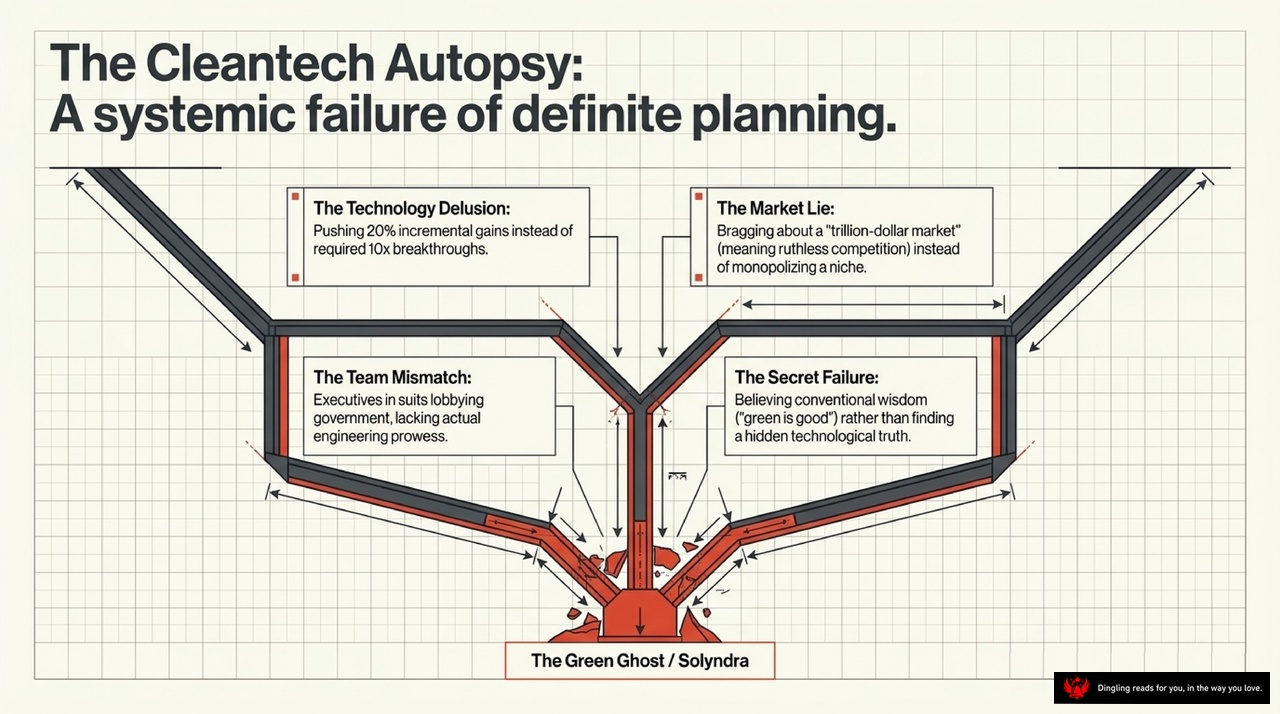
The Cleantech Autopsy reveals a brutal truth: the entire industry failed not because of bad intentions, but because of rigid, definite planning. Look at the diagram—it breaks down exactly why these "green" dreams collapsed. First, there's the Technology Delusion. Instead of chasing the necessary 10x breakthroughs, companies were content with pushing for mere 20% incremental gains. That's not innovation; that's maintenance. Then, there's the Market Lie. Everyone bragged about a "trillion-dollar market," assuming that meant easy money, when in reality, it just meant entering a battlefield of ruthless competition where no one could truly monopolize a niche.
But the real killers were deeper. We see The Team Mismatch: executives in suits lobbying governments, completely lacking the actual engineering prowess required to build the future. They were selling a fantasy to regulators, not building the product. And finally, The Secret Failure: everyone believed the conventional wisdom that "green is good," blindly assuming the technology would just work, rather than hunting for a hidden, specific technological truth. All these forces converged on one fatal outcome: The Green Ghost. Take Solyndra. They tried to force a solution that didn't exist, ignoring the physics and the market reality. This wasn't a failure of ethics; it was a systemic failure of planning. We can't just wish for a cleaner world; we need the kind of radical, 10x thinking that actually creates monopoly, not just competition.
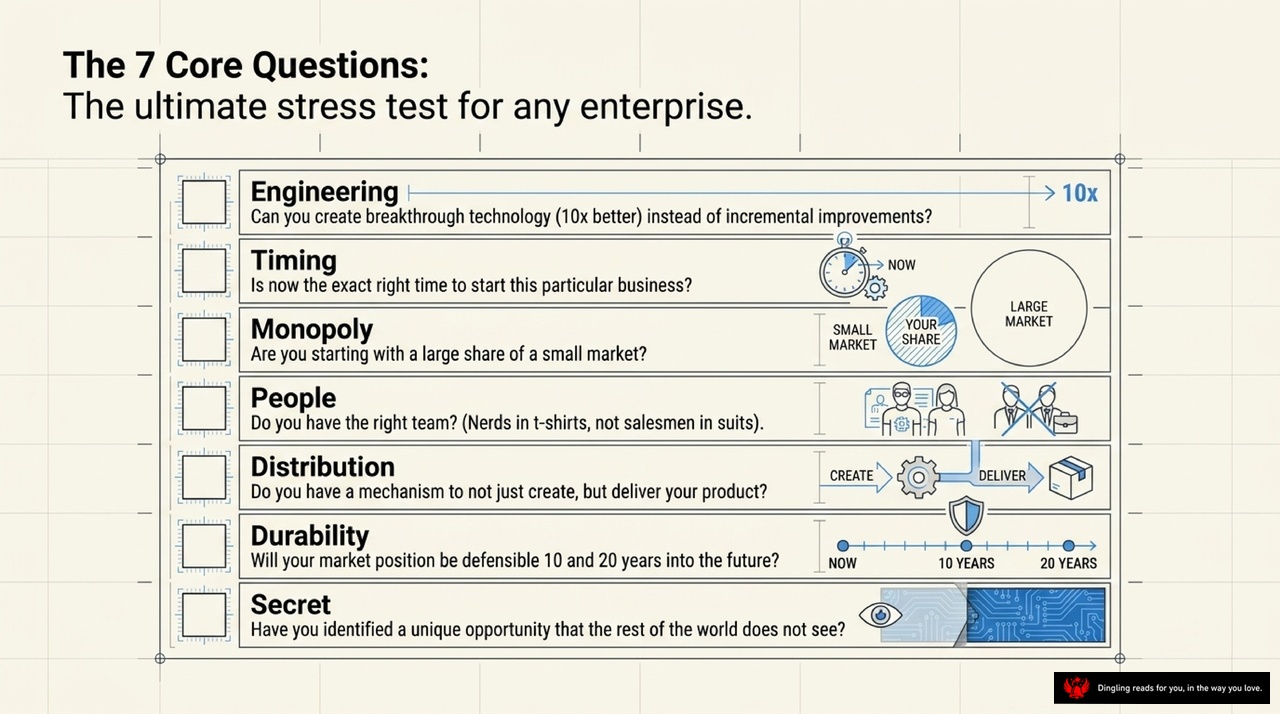
Today's slide lays out the ultimate stress test for any enterprise: The 7 Core Questions. If you want to build a company that lasts, you can't just have a good idea; you have to pass these seven filters.
First, look at Engineering. Are you creating breakthrough technology that is 10 times better, or just doing incremental improvements? Second, Timing. Is this the exact right moment to start? Third, Monopoly. Are you starting with a large share of a small market, rather than fighting for a tiny piece of a huge one? Fourth, People. Do you have the right team? Think nerds in t-shirts, not salesmen in suits. Fifth, Distribution. Do you have a mechanism not just to create the product, but to actually deliver it to the customer? Sixth, Durability. Will your market position be defensible 10 and 20 years into the future? And finally, the most critical one: Secret. Have you identified a unique opportunity that the rest of the world simply does not see?
Most companies fail because they get one or two of these wrong. They might have great technology but miss the timing, or they have the right team but lack a sustainable distribution model. But the real differentiator is often the "Secret." If everyone sees the same opportunity, everyone competes, and no one wins. The goal is to find that hidden path, that specific niche where you can dominate before the rest of the world catches on. When you answer these seven questions with a resounding "yes," you aren't just building a business; you are building a monopoly that can survive for decades.
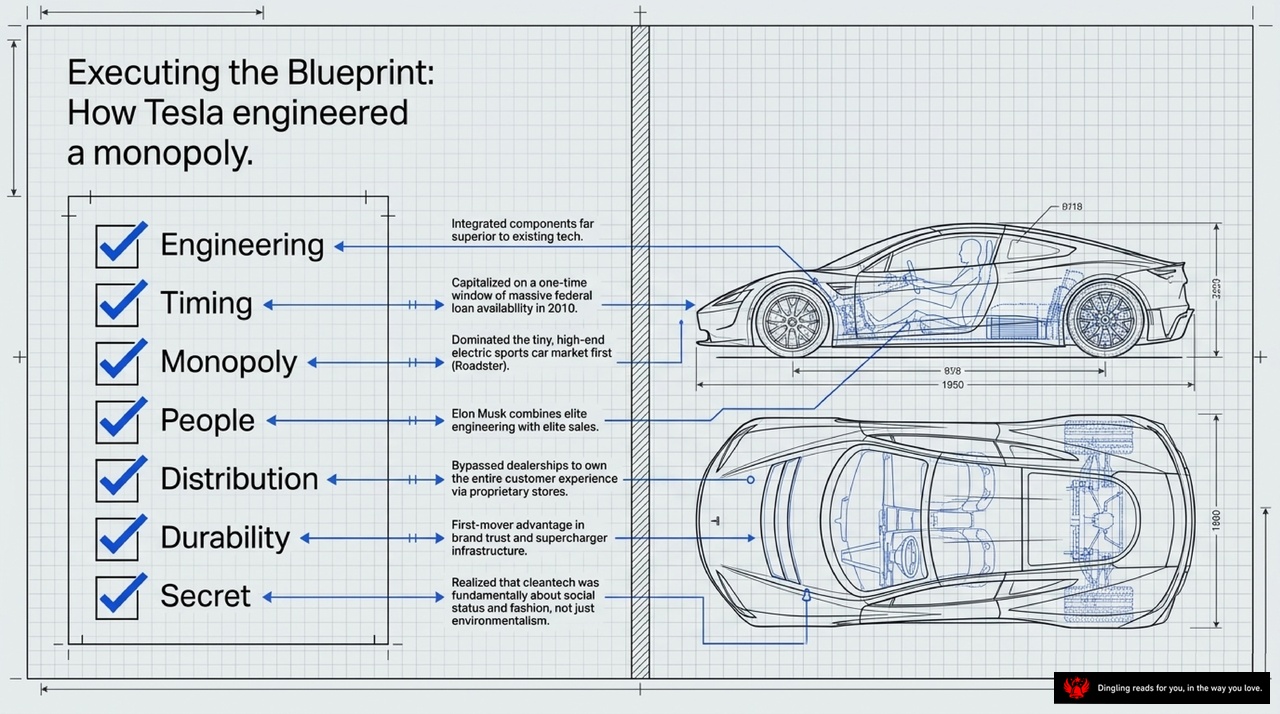
Look at this blueprint. It isn't just a car; it's the master plan for how Tesla engineered a monopoly.
First, let's talk about the **Engineering**. Tesla didn't just copy existing tech; they integrated components that were far superior to anything else on the market. Then, look at the **Timing**. They capitalized on a one-time window of massive federal loan availability in 2010. While others were waiting, Tesla secured the fuel it needed to take off.
This led directly to their **Monopoly**. By dominating the tiny, high-end electric sports car market first with the Roadster, they set the standard before anyone else could catch up. This was all made possible by the **People**—specifically Elon Musk. He combined elite engineering with elite sales skills, acting as the bridge between the garage and the global stage.
Next is **Distribution**. Tesla bypassed the traditional dealerships entirely. By owning the entire customer experience via proprietary stores, they controlled the narrative and the quality of service, something no other automaker could do.
This created incredible **Durability**. Their first-mover advantage in brand trust and their proprietary supercharger infrastructure meant that once you were in the ecosystem, you stayed. Finally, there was the **Secret**. Most people thought clean tech was just about environmentalism. But Tesla realized something deeper: it was fundamentally about social status and fashion. They didn't sell a car to save the planet; they sold a lifestyle that made people feel like the future had arrived.
By nailing all seven of these pillars, Tesla didn't just enter the market; they built a fortress that competitors still struggle to breach today.
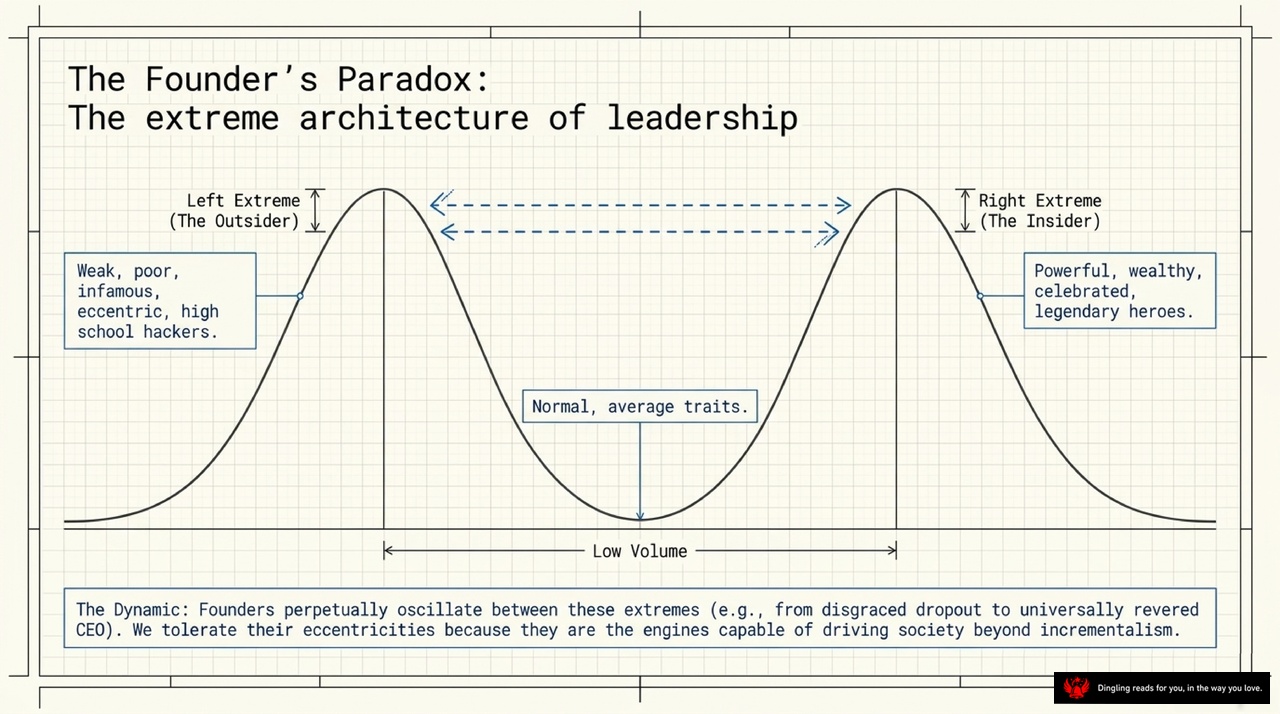
Imagine a world where leadership isn't about being average, but about living on the edge of two extremes. Today's slide reveals what Peter Thiel calls "The Founder's Paradox": the extreme architecture of leadership. Look at this graph. It shows that successful founders don't sit in the middle of the normal curve. Instead, they oscillate between two poles. On the left, we have the "Outsider"—the weak, the poor, the eccentric, and yes, even the high school hackers. On the right, we have the "Insider"—the powerful, the wealthy, the celebrated, and the legendary heroes.
Most people think leaders need to be safe, average, and predictable. But the reality is that society tolerates these eccentricities precisely because they are the only engines capable of driving us beyond incrementalism. As the text notes, founders perpetually swing between these extremes. Think of it like this: you might start as a disgraced dropout or a misunderstood outsider, and through your relentless drive to create something new, you eventually become a universally revered CEO. This isn't just a career path; it's a fundamental shift in how we view value. We need that tension between being an outsider who sees what others miss and an insider who has the power to make it happen. Without this oscillation, without the willingness to be extreme and different, we would never move from 0 to 1. We would just be stuck copying the status quo. So, the next time you look at a leader, don't just ask if they are normal. Ask if they are willing to live on the extreme edges of society to build a future that no one else can imagine.
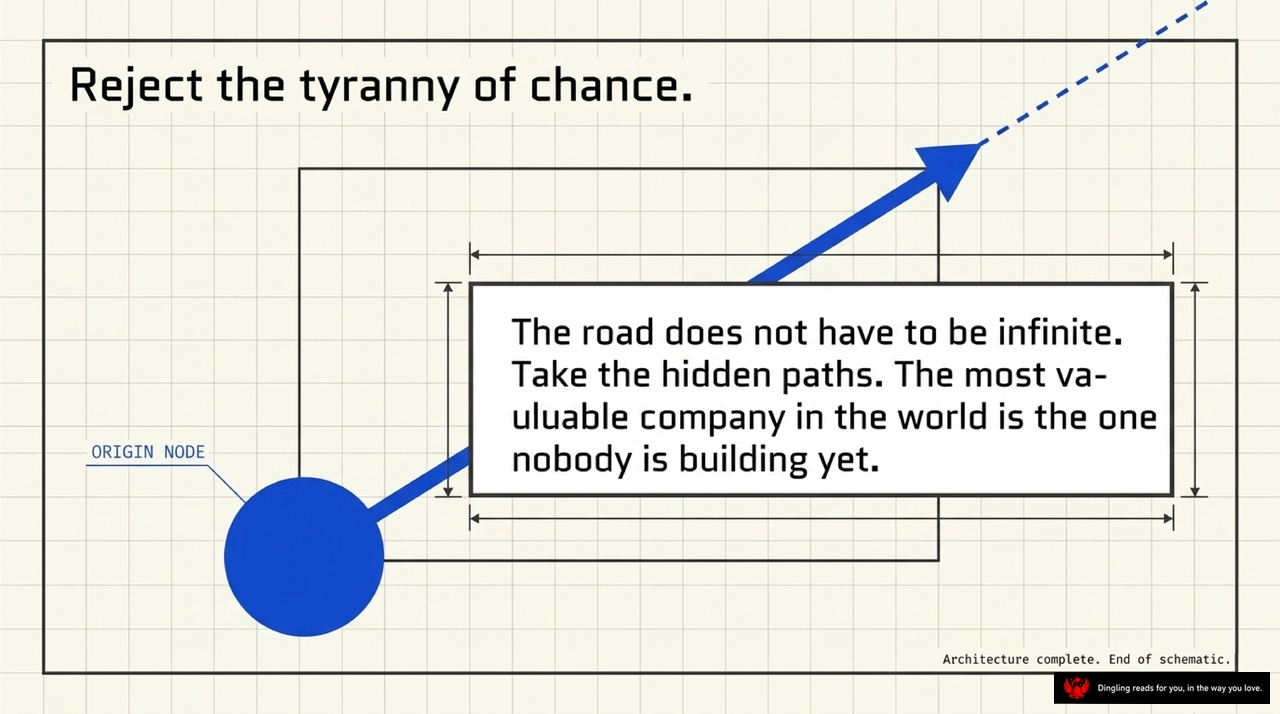
Stop treating your future like a lottery ticket. The slide right now is screaming one thing: "Reject the tyranny of chance." We've been taught to believe that success is random, that you're either part of the "lucky sperm club" or you're not. But that mindset is a trap. It's the "uncertain optimism" that paralyzed the 20th century, where people waited for the future to happen instead of building it.
Look at that diagram. It starts at an "Origin Node." This is your starting point. The text on the screen says, "The road does not have to be infinite. Take the hidden paths." This is the antidote to the chaotic, scatter-shot approach most of us take. Instead of trying to copy what everyone else is doing—the global, 1-to-N path of globalization—you need to find the 0-to-1 path. The most valuable company in the world is the one nobody is building yet.
Think about it. If you only follow the crowded, obvious roads, you are competing in a zero-sum game where everyone loses. But if you reject the tyranny of chance and actively seek out those hidden paths, you create a monopoly. You create something new that no one else can copy. You stop being a passenger in a random world and become the driver of your own destiny. So, stop waiting for luck. Start looking for the secret that only you can uncover, and build the future from scratch.