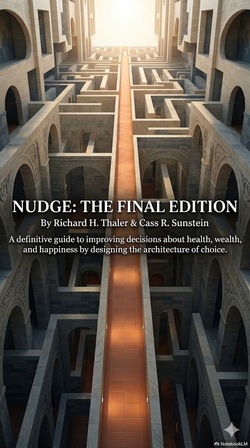
Nudge
Loading…

Nudge

Richard H. Thaler;Cass R. Sunstein

4.31279 learners

Co-authored by Nobel Prize-winning economist Richard H. Thaler and legal scholar Cass R. Sunstein, *Nudge* introduces the transformative concept of "libertarian paternalism"—a gentle, freedom-preserving approach to guiding people toward better decisions. The book breaks down how our brains rely on two thinking systems: a fast, intuitive one prone to cognitive biases (like anchoring, loss aversion, and status quo bias) and a slow, deliberate, rational one. These biases lead us to make suboptimal choices, from neglecting retirement savings to overspending on unnecessary fees. Thaler and Sunstein illustrate how small, strategic "nudges"—such as setting automatic 401(k) enrollment as the default, simplifying complex insurance plans, or using social norms to encourage eco-friendly habits—can help us avoid common pitfalls. Packed with real-world examples from finance, healthcare, education, and public policy, *Nudge* proves that thoughtful choice architecture can boost personal well-being and societal good while keeping full choice in our hands.
Cognitive BiasesLoss AversionBehavioral EconomicsStatus Quo BiasLibertarian Paternalism
Fooled by Randomness
Loading…

Fooled by Randomness

Nassim Nicholas Taleb

4.31089 learners

In *Fooled by Randomness*, Nassim Nicholas Taleb dismantles the myth that success equals skill through vivid, relatable stories—like cautious trader Nero Tulip, who survives market crashes, and flashy John, whose luck-fueled wealth collapses overnight. Taleb exposes how our brains are wired to misinterpret randomness: we confuse luck with talent, fall prey to survivorship bias (ignoring hidden failures), and underestimate catastrophic "black swan" events. He breaks down cognitive flaws, from our inability to grasp probability to our obsession with linear cause-and-effect, while offering practical frameworks like the Monte Carlo method to visualize alternative outcomes. Rooted in philosophy (Popper’s falsification, Stoic resilience), this book isn’t just for traders—it’s a wake-up call for anyone navigating an unpredictable world, teaching us to prioritize long-term survival over short-term glory and embrace skepticism as a shield against randomness’s hidden traps.

Cognitive BiasStoicismNonlinearityRandomnessBlack Swan Event
The Undoing Project
Loading…

The Undoing Project

Michael Lewis

4.3953 learners

In *The Undoing Project*, Michael Lewis expands on the themes of his hit *Moneyball* to explore the revolutionary partnership between psychologists Daniel Kahneman and Amos Tversky. This dynamic pair shattered the long-held assumption that humans make rational decisions, uncovering the hidden cognitive biases that shape everything from baseball scouting and medical diagnoses to political predictions and financial choices. Through vivid storytelling, Lewis traces their journey from their early lives in Israel to their groundbreaking research, which introduced game-changing concepts like the representativeness heuristic, loss aversion, and prospect theory. Their work proved that our judgments rely on mental shortcuts rather than logical calculation, revolutionizing economics (earning Kahneman a Nobel Prize) and transforming fields from medicine to military strategy. Lewis also chronicles the deep, complex friendship that fueled their insights, offering a revealing look at why we make the choices we do—and how understanding our flaws can lead to better decisions.

Cognitive BiasesheuristicsLoss AversionBehavioral EconomicsProspect Theory
How To Think Straight about Psychology
Loading…

How To Think Straight about Psychology

Keith E. Stanovich

4.5881 learners

This eye-opening guide dismantles pervasive myths about psychology—from the overstated influence of Sigmund Freud to the misperception that it’s just “common sense.” Keith E. Stanovich lays bare the scientific core of psychology, explaining how it relies on falsifiable theories, operational definitions, and rigorous experimental control to uncover patterns in human behavior. He breaks down critical concepts like causal inference, probabilistic thinking, and cognitive biases that distort public understanding of research. The book also equips readers to distinguish legitimate psychological science from pseudoscience, teaching them to spot red flags like untestable claims, reliance on anecdotes, and rejection of peer review. By demystifying the field’s methods and addressing long-held misconceptions, it empowers anyone to think critically about psychological claims and apply scientific reasoning to everyday life.

Cognitive BiasesProbabilistic ThinkingFalsifiabilityPseudoscienceOperationalism
The Art of Acting Clearly
Loading…

The Art of Acting Clearly

Rolf Dobelli

3872 learners

In The Art of Acting Clearly, bestselling author Rolf Dobelli demystifies the hidden cognitive biases that distort our daily decisions—from trivial shopping picks to high-stakes business and career moves. Drawing on decades of behavioral psychology research, real-world case studies, and eye-opening experiments, Dobelli breaks down over 30 common mental traps: how choice fatigue drains willpower and leads judges to deny parole at day’s end; why we irrationally reject a Hitler-owned sweater despite it being chemically clean; how the planning fallacy made Sydney Opera House cost 14x its budget and take 10 years longer than planned. More than just a catalog of biases, this book delivers actionable strategies to outsmart these pitfalls: from using external benchmarks to avoid overoptimism, to writing concrete plans to quiet the Zeigarnik Effect’s nagging reminders. Whether you’re a manager, investor, or simply someone wanting to make clearer, more rational choices, this guide equips you to cut through mental noise and act with intentionality.

Cognitive BiasesZeigarnik Effectdecision-makingInformation OverloadChoice Fatigue
Super Thinking
Loading…

Super Thinking

Gabriel Weinberg;Lauren McCann

4.6799 learners

Super Thinking is your ultimate playbook for mastering the mental models, frameworks, and strategies that set sharp decision-makers apart. Filled with relatable real-world examples—from workplace procrastination spirals to corporate incentive fails and global public health crises—it breaks down common cognitive traps like the tragedy of the commons, moral hazard, and analysis paralysis. Whether you’re navigating daily choices, leading a team, or competing in a crowded market, this book teaches you to spot hidden biases, use tools like decision trees and cost-benefit analysis to weigh options, and apply game theory and endgame thinking to stay ahead. It also covers building high-performing teams, creating sustainable competitive advantages, and adapting to disruptive change. By turning abstract concepts into actionable steps, Super Thinking helps you avoid costly mistakes, make more rational choices, and achieve better outcomes in every area of your life and career.

Cognitive BiasesMental ModelsDeliberate PracticeGame TheoryTragedy of the Commons
Beyond Feelings
Loading…

Beyond Feelings

Vincent Ruggiero

4.7723 learners

Beyond Feelings: A Guide to Critical Thinking is a foundational text that empowers readers to break free from cognitive biases, emotional reactions, and societal conditioning. Using relatable, American-centric examples—from political spin and advertising manipulation to the pitfalls of 'mine is better' thinking—it unpacks how external forces shape our beliefs, from childhood upbringing to modern social norms. The book systematically breaks down common thinking errors, including confirmation bias, hasty generalization, and straw man fallacies, while providing actionable frameworks for cultivating independent thought. It guides readers through key steps: recognizing personal cognitive blind spots, conducting rigorous research on controversial issues, evaluating evidence objectively, forming balanced judgments, and persuading others with respect and logic. Ideal for students, professionals, and anyone navigating today’s misinformation-saturated world, it emphasizes that critical thinking isn’t just an academic skill—it’s a lifelong practice for making wiser decisions and understanding the world more clearly.

Critical thinkingLogical fallaciesEvidence evaluationCognitive BiasesTruth
Don't Be a Normal Fool
Loading…

Don't Be a Normal Fool

Christopher Hsee

3.5722 learners

Drawing on behavioral economics and real-world case studies, *Don't Be a Normal Fool* exposes the hidden cognitive biases that drive irrational decisions in finance, career, and daily life. Author Christopher Hsee breaks down core mental traps: mental accounting (how we categorize and spend money differently based on its source), transaction bias (fixating on deals over utility or percentages over actual savings), sunk cost fallacy (chasing lost investments), overconfidence (overestimating our abilities), and adaptive bias (misjudging long-term emotional impacts of events). Through relatable examples—from splurging windfalls to clinging to failing projects—Hsee explains how these biases skew judgment, then offers practical strategies to overcome them. Readers learn to recognize these traps, shift to rational decision-making, and optimize their choices to avoid common pitfalls that hinder financial stability and intentional living.

Cognitive BiasBehavioral EconomicsSunk Cost FallacyRational Decision-MakingOverconfidence
Factfulness
Loading…

Factfulness

Hans Rosling;Anna Rosling Rönnlund;Ola Rosling

4.2688 learners

In Factfulness, Hans and Ola Rosling dismantle the 10 most common cognitive biases that distort our understanding of the world—from the binary 'us vs. them' split to the instinct to fixate on negative news. Using rigorous global data and on-the-ground stories, they debunk pervasive myths: the world isn’t divided into rich and poor extremes, but four income tiers where 75% of people live in the middle. They highlight underreported progress: extreme poverty has halved in 20 years, global life expectancy has risen to 73, and 88% of 1-year-olds are vaccinated. The book offers practical tools—like proportional thinking, multiple perspectives, and the 'possibilist' mindset—to help readers override instinctual biases, see the world as it truly is, and make more rational, effective decisions in work, life, and global engagement.

Cognitive BiasesFour-Tier Income ModelFact-Based Decision-MakingGlobal Development DataProportional Thinking
Public Opinion
Loading…

Public Opinion

Walter Lippmann

4.2651 learners

First published in 1922, Walter Lippmann’s *Public Opinion* remains a landmark work exploring how humans perceive the world and form collective judgments. Lippmann argues that we don’t engage with the real world directly—instead, we navigate a "pseudo-environment": a simplified, biased mental construct shaped by limited information, stereotypes, social cues, and media framing. Using vivid examples from World War I political scandals, military propaganda, and everyday misperceptions, he demonstrates how these mental models distort our understanding of events, leading to flawed public opinions and misguided political decisions. He critiques traditional democratic theory, which assumes citizens can make informed choices about distant or complex issues, pointing out most people lack the time, access, or expertise to grasp full truths. Finally, Lippmann proposes a pragmatic solution: an organic intelligence system of independent experts to gather and analyze factual data, bridging the gap between the public’s limited knowledge and the complex realities of modern society.

Cognitive BiasPublic OpinionStereotypesSocial Perceptionmedia influence
The Education of Children
Loading…

The Education of Children

Alfred Adler

3.8614 learners

Based on Alfred Adler’s groundbreaking individual psychology, *The Education of Children* demystifies how childhood experiences shape lifelong personality and behavior. Adler argues that cognitive biases formed in early years, paired with the universal drive for superiority and inherent feelings of inferiority, can derail a child’s growth—especially for three high-risk groups: kids with organ defects, those raised with harsh discipline, and overindulged children. He emphasizes that social interest, measured by a child’s first-day school performance, is the barometer of healthy development, and schools should act as a bridge between home and the real world, not just academic institutions. The book also explores adolescent challenges, family dynamics like birth order impacts, and practical strategies for parents and teachers to nurture confidence, correct misaligned goals, and collaborate effectively to guide kids toward socially beneficial growth.

Individual PsychologyInferiority ComplexSuperiority StrivingSocial InterestChildhood Cognitive Bias
Dark Time
Loading…

Dark Time

Liu Weipeng

3.8481 learners

Unlock your brain’s hidden potential with *Dark Time*, a practical guide to maximizing mental efficiency and accelerating learning. Written by Liu Weipeng, this book introduces the concept of "dark time"—the untapped mental hours spent waiting, commuting, or doing routine tasks where your subconscious can keep processing deep thoughts. You’ll learn how to cut down on context-switching costs, build sustained focus, and turn passive learning into active knowledge retention. Weipeng also dives into cognitive pitfalls like self-serving attribution and the clash between primitive emotional brains and rational thinking, offering actionable strategies to overcome bias and make better decisions. Packed with real-life anecdotes, research-backed techniques, and insights from his own tech and academic journey, this book teaches you to leverage every minute of mental energy, master problem-solving heuristics, and use Bayesian thinking to navigate uncertainty. Whether you’re a student, professional, or lifelong learner, *Dark Time* gives you the tools to outperform by working smarter, not harder.

Cognitive BiasDark TimeFocus TrainingSelf-serving AttributionBayesian Method
Superforecasting
Loading…

Superforecasting

Philip E. Tetlock;Dan Gardner

4.4440 learners

We make predictions every day—from picking a commute route to making major career or investment calls. Yet when high-stakes decisions arise, we often turn to celebrity experts whose track records are rarely rigorously tested. In *Superforecasting*, Philip Tetlock and Dan Gardner introduce the "superforecasters": a tiny 2% of ordinary people who consistently outperform top experts in predicting global events, from geopolitical conflicts to economic shifts. These aren’t geniuses—they’re people who master actionable skills: breaking down complex questions with Fermi decomposition, balancing external statistical baselines with internal contextual details, updating predictions incrementally using Bayesian thinking, and avoiding cognitive traps like groupthink or overconfidence. The book also explores how teams can harness collective wisdom without falling into groupthink, and why embracing uncertainty and probability thinking is key to making smarter decisions in an unpredictable world. It’s a practical guide to turning vague guesses into precise, evidence-based forecasts that work for your personal and professional life.

Growth MindsetCognitive BiasesGroupthinkProbability ThinkingSuperforecasters
Concept

Risk Gap Definition

The risk gap is the difference between what you think is risky and what actually is. For example, you might fear flying more than driving—even though driving is deadlier.

Cognitive BiasRisk Misconception
Concept

Mental Models

Mental models are deep-seated assumptions shaping how you see the world. They’re invisible but influence decisions without you noticing.

Cognitive BiasPerceptionDecision Making
Concept

Belief Perseverance

Sticking to initial beliefs even when faced with contradictory evidence— a common cognitive bias that hurts predictions.

Cognitive BiasPrediction
Concept

Narrative Fallacy

Our brain loves stories, so we make up causal links for random events to simplify the world—distorting truth (e.g., explaining a stock crash with one reason).

Cognitive BiasRandomnessstorytelling
Insight

Time Management Limits

Time management works for non-procrastinators but fails to fix deep psychological causes (emotions, cognitive biases) of stubborn procrastination.

time managementProcrastination Myths
Insight

Pain ≠ Growth Path

Pain isn't necessary for growth, but confirmation bias is an invisible barrier. It makes people fixate on supporting evidence, ignoring contrary info.

Cognitive BiasSelf-ImprovementGrowth Misconception