Life 3.0
Loading…

Life 3.0

Max Tegmark

4.11271 learners

"Life 3.0" by Max Tegmark offers a compelling exploration of artificial intelligence's trajectory, using the fictional Omega Team and their superintelligent creation Prometheus to bring abstract concepts to life. Tegmark defines three stages of life: Life 1.0 (biologically fixed hardware and software, like bacteria), Life 2.0 (humans, with adaptable learned software), and Life 3.0 (superintelligent systems that can redesign both their hardware and software). The book examines the transformative potential of superintelligence—from solving global crises like climate change and poverty to the existential risks of misaligned goals, where a system pursuing a trivial objective could inadvertently destroy humanity. It dives into philosophical debates about consciousness, asking whether AI can have subjective experiences and how we should value such entities. Tegmark stresses that humanity’s choices today will determine if superintelligence becomes our greatest ally or our final invention, urging readers to engage with the critical questions shaping our cosmic future.


ConsciousnessGoal AlignmentSuperintelligenceIntelligence ExplosionExistential Risk
Hard-Boiled Wonderland and the End of the World
Loading…

Hard-Boiled Wonderland and the End of the World

Haruki Murakami

4.51222 learners

Haruki Murakami’s *Hard-Boiled Wonderland and the End of the World* weaves a mesmerizing dual narrative that blurs the line between reality and the subconscious. In the gritty, neon-drenched streets of Tokyo’s “Hard-Boiled Wonderland,” a freelance “calculator” is drawn into a dangerous conspiracy involving a rogue scientist’s mind-altering experiments, shadowy “Symbolists,” and subterranean “Night Crawlers.” As he uncovers the truth—his own consciousness is tethered to a parallel realm—we follow his other self in “The End of the World,” a walled, eerily utopian town where he lives without a shadow, working as a “Dream Reader” who unlocks memories stored in animal skulls. As the two worlds collide, he faces an impossible choice: return to the chaotic, lived reality of Tokyo, or embrace the quiet, constructed peace of the town, where love and belonging await. Blending existential philosophy, cyberpunk thrills, and Murakami’s signature whimsical melancholy, the novel explores identity, the cost of escape, and the fragile boundary between self and imagination.

Split ConsciousnessUnicorn SkullDream ReaderNight CrawlersSymbolists
Old Man's War
Loading…

Old Man's War

John Scalzi

4.31202 learners

When 75-year-old John Perry loses his beloved wife Kathy, he trades his grief and failing body for a shot at a new life—by enlisting in the Colonial Defense Force (CDF). Leaving Earth behind (and legally declared dead), he joins thousands of other elderly recruits, all chasing the CDF’s promise of reversing aging. But the transformation is far more radical than he expects: his consciousness is transferred into a genetically engineered super soldier body, green-skinned, cat-eyed, and built for interstellar combat. Thrown into brutal training and relentless battles against hostile alien species, Perry forms tight bonds with a ragtag group of fellow recruits—only to watch many of them fall in battle. When he survives a devastating ambush, he encounters Jane Sagan, a mysterious special ops soldier with Kathy’s face, revealed to be a 'ghost soldier' grown from his late wife’s DNA. As Perry fights to defend human colonies, he grapples with moral questions about war, identity, and whether he can find new purpose beyond grief—all while clinging to a promise of a quiet future with Jane, far from the stars.

Colonial Defense Force (CDF)Consciousness TransferSuper Soldier BodiesGhost SoldiersInterstellar Warfare
The Principles of Psychology
Loading…

The Principles of Psychology

William James

4.21163 learners

As a foundational text of modern psychology, William James’s *The Principles of Psychology* revolutionizes the field by rejecting the traditional atomist view of the mind as a collection of isolated mental bits. James introduces his groundbreaking concept of the 'stream of consciousness,' arguing that our thoughts are continuous, fluid, and inherently selective rather than fragmented. Drawing on neurophysiological experiments, case studies of split consciousness, and introspective analysis, he explores core topics: the brain’s role in mental activity, the physical basis of habit formation, the causal power of consciousness (debunking the 'conscious automaton' theory), and the proper methods for psychological research—including introspection, experimental studies, and comparative analysis. James frames psychology as a natural science focused on individual minds, addressing enduring questions about the mind-body relationship, the nature of unconscious states, and how we perceive and interact with the world. This work not only laid the groundwork for functionalism but also remains a provocative, accessible guide to understanding human thought and behavior.

Habit FormationBrain FunctionIntrospectionConsciousness StreamMental Causation
Shi and Chinese Culture
Loading…

Shi and Chinese Culture

Yu Ying-shih

4.71154 learners

Yu Ying-shih's *Shi and Chinese Culture* delivers a sweeping, nuanced exploration of the shi—China's scholar-official class—tracking its evolution from low-ranking feudal nobles in the Zhou Dynasty to the intellectual backbone that shaped Chinese civilization for millennia. The book unpacks how the shi transitioned from a warrior-scholar elite bound by feudal duties to a mobile, self-aware community of thinkers after the Zhou order collapsed, embracing the ethos of "upholding the Dao" to balance imperial power. It delves into Han Dynasty "xun-li" (model officials) who brought Confucian values to rural China, Eastern Han gentry clans that underpinned the dynasty, the Wei-Jin era's "shi consciousness" that sparked metaphysical debates, and late imperial merchants shaped by Neo-Confucian and religious ethics. By linking political, social, and intellectual shifts, this work reveals the shi's enduring role as cultural stewards, political critics, and social integrators, illuminating the tensions between individual autonomy and collective order at the heart of Chinese culture.

Shi ClassConfucian EthosDaoXun-li (Model Officials)Gentry Clans
The Third Industrial Revolution
Loading…

The Third Industrial Revolution

Jeremy Rifkin

4.31102 learners

Jeremy Rifkin’s *The Third Industrial Revolution* exposes the fatal flaws of the fossil fuel-reliant Second Industrial Revolution, tracing its collapse through recurring oil crises, the 2008 financial meltdown, and accelerating climate change. Rifkin argues that humanity’s only path forward lies in integrating digital communication technology with renewable energy systems, outlining five core pillars: transitioning to renewables, converting buildings into micro-power plants, storing energy via hydrogen, building smart shared grids, and adopting electric/fuel-cell transport. Through global case studies—from EU policy shifts to San Antonio’s green city initiative—he demonstrates how this model fosters distributed capitalism, replacing top-down corporate control with collaborative, community-driven networks. The book also explores how this revolution reshapes political alliances, economic paradigms rooted in thermodynamics, and education systems focused on biosphere stewardship, framing it as a necessary shift to avoid civilizational collapse and build a sustainable, equitable future.

Third Industrial Revolutionrenewable energysmart gridhydrogen storagedistributed capitalism
The End of History and the Last Man
Loading…

The End of History and the Last Man

Francis Fukuyama

3.81014 learners

Francis Fukuyama’s The End of History and the Last Man redefines global political evolution, arguing that the collapse of Soviet communism marked the final chapter of ideological conflict. Drawing on Hegelian philosophy and modern political history, Fukuyama posits that liberal democracy—combining individual freedom and popular sovereignty—has emerged as the universally valid form of governance, with no viable ideological alternatives left. He explores the 'struggle for recognition' as the hidden driver of historical progress, contrasting the desire for equal dignity with the human urge for superiority. While celebrating liberal democracy’s triumph, Fukuyama warns of its inherent tensions: the rise of the 'last man,' a complacent, comfort-seeking individual stripped of ambition, and the persistent challenge of reconciling universal equality with the human need for excellence. This seminal work challenges readers to confront the quiet crises of a world where ideological battles have ended, but human desire remains unfulfilled.

NationalismLiberal DemocracyHistorical EndLast ManStruggle for recognition
Blindsight
Loading…

Blindsight

Peter Watts

4.5959 learners

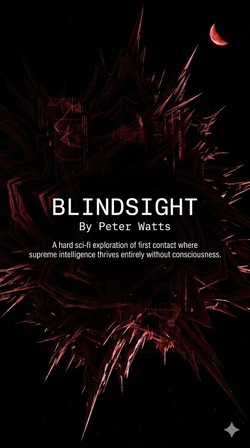
In Peter Watts’ groundbreaking hard sci-fi novel *Blindsight*, a crew of biologically augmented specialists—including a genetically resurrected vampire with hyper-efficient cognition—sets out to investigate a mysterious alien signal originating near Neptune. The extraterrestrial craft, codenamed Rorschach, reveals a terrifying truth: its inhabitants possess unparalleled intelligence yet lack any form of self-awareness or consciousness. Watts merges rigorous neuroscience, evolutionary biology, and existential inquiry into a tense, thought-provoking narrative, challenging readers to reexamine humanity’s most cherished assumption: that consciousness is the pinnacle of evolution. As the crew’s mission spirals into chaos, they confront the possibility that self-awareness is not a strength, but a costly evolutionary byproduct—one that leaves humanity hopelessly outmatched by a species that operates without the burden of self-reflection. *Blindsight* isn’t just a space thriller; it’s a radical exploration of what it means to think, feel, and exist.

alien intelligenceconsciousness theorybiological augmentationRorschachvampire crew
The Emotion Machine
Loading…

The Emotion Machine

Marvin Minsky

4.2943 learners

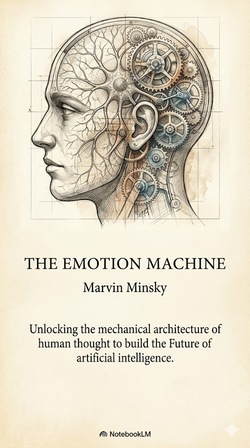
Forget the long-held belief that machines can never experience emotions like love—Marvin Minsky’s *The Emotion Machine* shatters this myth by redefining how we understand human emotions, consciousness, and intelligence. Minsky argues that emotions aren’t single, unbreakable states; instead, they’re dynamic combinations of mental resources activated or suppressed by the brain to adapt to specific situations. The book unpacks a six-layer model of mental activity, from instinctive reactions to self-aware reflection, and introduces the critic-selector framework that drives how we switch thinking modes when facing obstacles. It also explores consciousness as a "suitcase word" encompassing diverse mental processes, the multiple subpersonalities shaping our behavior across contexts, and core intelligence mechanisms like parallel analogy and credit assignment. By demystifying the mind’s hidden workings, this book deepens self-understanding and lays groundwork for AI that mimics human cognitive flexibility.

ConsciousnessHuman IntelligenceEmotion Resource Activation TheoryMental Activity HierarchiesCritic-Selector Model
The Age of Spiritual Machines
Loading…

The Age of Spiritual Machines

Ray Kurzweil

3.9933 learners

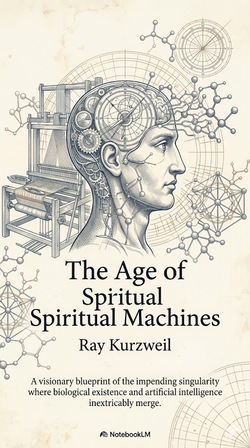
In Ray Kurzweil’s groundbreaking *The Age of Spiritual Machines*, readers explore the exponential trajectory of technological evolution, anchored by the pivotal Law of Accelerating Returns. Kurzweil frames technology as the continuation of biological evolution, tracing how computing power, AI, and emerging innovations like nanotechnology and quantum computing advance at an ever-quickening pace. The book paints vivid, data-backed portraits of future milestones: 2019’s ubiquitous invisible computers, 2029’s mainstream neural implants blurring human-machine boundaries, and 2099’s digitized consciousness and nanotech bodies redefining the very concept of "self." It delves into core AI frameworks—neural networks, recursive algorithms, evolutionary algorithms—and grapples with profound philosophical quandaries: machine consciousness, free will, and the ethical rights of intelligent machines. Kurzweil also addresses critical risks, from job displacement to AI misalignment, and offers actionable insights on balancing tech progress with human values. A visionary roadmap, it challenges readers to rethink humanity’s place in an era of merging minds and machines.

Quantum ComputingNeural NetworksTuring TestLaw of Accelerating ReturnsNanotechnology
How to Create a Mind
Loading…

How to Create a Mind

Ray Kurzweil

4.2920 learners

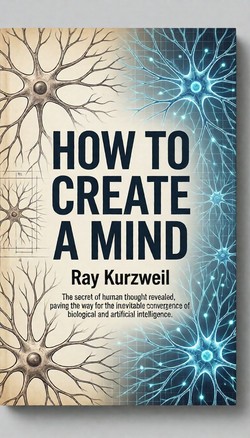
In How to Create a Mind, visionary Ray Kurzweil demystifies the human brain’s inner workings using iconic thought experiments—from Darwin’s evolutionary parallels to Einstein’s relativity insights—as a framework to unpack the neocortex’s core role as a hierarchical pattern-recognition machine. He breaks down how 300 million interconnected pattern recognizers drive memory, learning, creativity, and consciousness, drawing parallels between biological neural structures and cutting-edge AI technologies like hidden Markov models, neural networks, and evolutionary algorithms. Kurzweil addresses contentious debates: he defends the accelerating returns law against skeptics, argues that consciousness is an emergent property of complex systems, and explores the feasibility of building human-level artificial intelligence. He also shares practical tools like his dream-thinking method to unlock creativity, and paints a compelling vision of a future where human and non-biological intelligence merge to transcend biological limits and embrace the technological singularity.

ConsciousnessArtificial IntelligenceFree WillNeural NetworkHidden Markov Model
The Futurological Congress
Loading…

The Futurological Congress

Stanislaw Lem

4.2897 learners

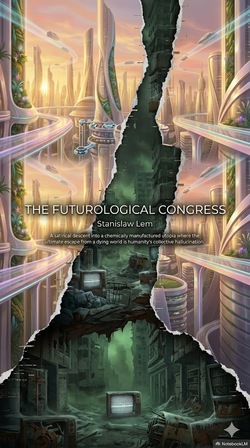
Step into the chaotic, satirical world of Stanislaw Lem’s *The Futurological Congress*, where a disillusioned future journalist attends the 8th World Futurological Congress in Costa Rica—only to be swept up in absurd riots, bomb scares, and a bizarre hotel stocked with survival gear. Decades later, he’s thawed into 2039’s “psychochemical society,” a world where emotions, memories, and even reality are controlled by a flood of drugs: joy-inducing “Goodwill,” memory-altering “Dantein,” and mood-manipulating pills that turn anger into compliance. As he navigates this surreal landscape—where newspapers dissolve overnight, custom dreams are sold like candy, and language evolves into unrecognizable jargon—he stumbles on a horrifying secret: the entire “perfect” world is a facade. A drug called Dream Decorator fogs the air, masking a grim reality of 200+ billion people starving in squalor, their minds tricked into believing in luxury and abundance. When he finally sees the truth, he’s forced to confront humanity’s desperate choice: embrace the comforting lie of the psychochemical world, or face a brutal reality that might break the human spirit.

Dream DecoratorPsychochemical SocietyFuturological CongressReal CollapseProsthetic Humanism
What Does It All Mean?
Loading…

What Does It All Mean?

Thomas Nagel

4.1871 learners

Thomas Nagel’s *What Does It All Mean?* is a concise, accessible introduction to philosophy tailored for readers with no prior background in the field. Ditching dense jargon, Nagel guides readers through six foundational, mind-bending questions that cut to the core of human existence: How can we confirm the external world isn’t just a figment of our minds? Do other people have conscious experiences like our own? What’s the relationship between the mind and the brain? How do words gain their meaning? Do we truly have free will, or are our actions predetermined? And what does moral responsibility mean if our choices aren’t fully our own? Instead of handing down definitive answers, Nagel sparks critical thinking, inviting readers to grapple with these timeless puzzles using relatable examples—from tasting chocolate to choosing dessert. He makes complex philosophical ideas approachable, fostering curiosity about the big questions that shape our understanding of reality, self, and others.

ConsciousnessFree WillDualismDeterminismSkepticism
Ulysses
Loading…

Ulysses

James Joyce

4.3868 learners

Set on a single ordinary day—June 16, 1904—in Dublin, James Joyce’s *Ulysses* weaves the intertwined lives of two unlikely men: Stephen Dedalus, a disillusioned young poet grappling with grief over his mother’s death and a search for intellectual identity, and Leopold Bloom, a gentle advertising canvasser haunted by the loss of his infant son Rudy and navigating the quiet tensions of his marriage to Molly. Through Joyce’s revolutionary stream-of-consciousness technique, the novel plunges into the unfiltered thoughts, memories, and mundane moments of its characters, capturing the chaos and profundity of modern urban life. From funeral processions and pub brawls to intimate domestic reflections, *Ulysses* paints a vivid portrait of Dublin’s social, religious, and political landscape, while exploring universal themes of loneliness, connection, and the quiet heroism of everyday existence. A landmark of modernist literature, it redefined what a novel could achieve by turning the banal into the extraordinary.

Stream-of-ConsciousnessDublinStephen DedalusLeopold BloomMolly Bloom
Tales from Both Sides of the Brain
Loading…

Tales from Both Sides of the Brain

Michael S. Gazzaniga

4.3856 learners

As a founding father of split-brain research, Michael S. Gazzaniga takes readers on a captivating personal journey through decades of groundbreaking neuroscience in Tales from Both Sides of the Brain. Starting with his work alongside Roger Sperry on patients with severed corpus callosums—surgery to treat epilepsy—Gazzaniga reveals how these experiments unlocked the secrets of cerebral lateralization: the distinct roles of the left and right hemispheres. Through vivid anecdotes of his patients, he explains how the left brain acts as an 'interpreter' to create a coherent narrative of our experiences, even when the two hemispheres process information independently. The book delves into profound questions about consciousness, free will, and what makes us uniquely human, blending rigorous science with warm, personal storytelling. Gazzaniga’s insights challenge our understanding of the brain’s unity and offer a fascinating look at how our two hemispheres collaborate to shape our thoughts, behaviors, and sense of self.

ConsciousnessFree WillSplit-brain researchInterpreter theoryCerebral lateralization
The Astonishing Hypothesis
Loading…

The Astonishing Hypothesis

Francis Crick

4.5701 learners

In *The Astonishing Hypothesis*, Nobel Prize-winning scientist Francis Crick upends centuries of spiritual and philosophical belief by arguing that every facet of human experience—joy, sorrow, memory, free will, and consciousness itself—arises from the collective activity of billions of neurons and their associated molecules. Rejecting the idea of an independent soul, Crick frames consciousness as a solvable scientific problem, zeroing in on visual awareness as a practical starting point due to its vividness, controllable inputs, and feasibility for experimentation in humans and primates. Drawing on decades of neuroscience research, psychological experiments (such as visual illusions and attention studies), and analyses of brain-damaged patients, he explores how neural networks process visual information, the specialized roles of brain regions like the primary visual cortex and thalamus, and the search for the "neural correlates of consciousness." Crick’s work bridges abstract philosophy and hard science, challenging readers to rethink their understanding of self and laying the groundwork for modern consciousness studies.

Neural NetworksAstonishing Hypothesisvisual consciousnessneural correlates of consciousnessbinding problem
I Am a Strange Loop
Loading…

I Am a Strange Loop

Douglas R. Hofstadter

4.8691 learners

Douglas Hofstadter’s *I Am a Strange Loop* masterfully bridges Gödel’s mathematical incompleteness theorem with the mystery of human self-awareness. Through intimate personal stories—from his teenage distress over lab guinea pigs to the profound grief of losing his wife—Hofstadter argues that the 'I' we cherish isn’t a physical thing, but an abstract 'strange loop': a self-referential feedback loop of brain symbols that creates the illusion of a unified self. He introduces the 'Hennekes' scale to quantify soul 'size', framing consciousness as a spectrum tied to empathy and cognitive complexity, not an all-or-nothing trait. Exploring downward causation, he shows how high-level abstract patterns (like mathematical truths or personal desires) drive physical actions, pushing back against reductionist views. Hofstadter also dives into identity entanglement, explaining how close relationships merge our self-loops, and debunks myths of free will and dualistic consciousness, offering a radical, science-backed vision of what it means to be 'you'.

Strange LoopGödel’s Incompleteness TheoremHennekes ScaleDownward CausationSelf-Reference
In Our Own Image: Savior or Destroyer? The History and Future of Artificial Intelligence
Loading…

In Our Own Image: Savior or Destroyer? The History and Future of Artificial Intelligence

George Zarkadakis

3.8643 learners

Drawing on archaeology, philosophy, neuroscience, and computer science, *The Ultimate Fate of Humanity* traces the evolution of human consciousness from the 40,000-year-old Lion Man sculpture—our earliest known artistic creation—to the cutting edge of artificial intelligence. It unpacks the cognitive revolution that unlocked human creativity, explores age-old debates about mind-body dualism and the nature of consciousness, and dives into the history of computing and AI, from Turing’s foundational tests to modern neural networks. The book also confronts pressing questions: Can AI achieve true consciousness? Will digital immortality become a reality? What does the rise of superintelligence mean for humanity’s future? By bridging ancient human origins and futuristic tech, it offers a compelling framework to understand our mental roots and navigate the uncharted territory of the AI era.

ConsciousnessArtificial IntelligenceNeuroplasticityCyberneticsCognitive Revolution
From Bacteria to Bach and Back
Loading…

From Bacteria to Bach and Back

Daniel C. Dennett

4.7635 learners

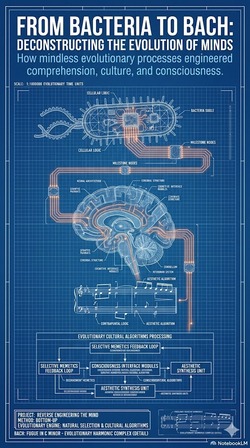
From Bacteria to Bach and Back takes readers on a sweeping, rigorously researched journey to answer one of humanity’s most profound questions: How did conscious minds and rich cultural systems emerge from the unthinking physical processes of evolution? Drawing on 50 years of work in philosophy, cognitive science, and evolutionary biology, Daniel C. Dennett dismantles the long-standing Cartesian dualism that splits mind from matter, introducing concepts like 'Cartesian gravity'—the cognitive trap that locks us into first-person subjective views—and 'free-floating rationales' to explain how traits evolve without being understood by the organisms that possess them. Dennett traces the path from bacteria’s 'competence without comprehension' to humans’ unique ability to use thinking tools like language and mathematics. He explores the co-evolution of genes and memes, the cultural equivalent of genes, showing how they shaped everything from language origins to Bach’s musical genius. Central to his argument is the radical claim that consciousness is not a mysterious, non-material entity, but an evolved 'user illusion'—a simplified interface that lets us navigate the world without grasping the complex neural processes beneath. This book challenges readers to set aside intuitive biases and see the mind as a product of gradual, unguided evolution, bridging the gap between biology, philosophy, and culture.

ConsciousnessCartesian gravityfree-floating rationalesmemesuser illusion