The Metamorphosis
Loading…

The Metamorphosis

Franz Kafka

4.51343 learners

Franz Kafka’s *The Metamorphosis* is a haunting, surreal masterwork that lays bare the quiet cruelty of alienation and family duty. When traveling salesman Gregor Samsa wakes up one morning trapped in the body of a giant beetle, his world collapses—not just because of his physical transformation, but because of his family’s shifting reactions. At first, his mother, father, and sister show tentative concern, but as Gregor can no longer work to support their debt-ridden household, their care curdles into disgust and resentment. Trapped in his room, Gregor grapples with his loss of identity, his unfulfilled dreams (like sending his sister to music school), and the slow erosion of the love he once took for granted. Kafka’s sparse, visceral prose turns this absurd premise into a raw meditation on what it means to be seen, valued, and discarded in a world that reduces people to their productivity. By the story’s tragic end, Gregor’s death brings his family a twisted sense of relief, forcing readers to confront the harsh truth of how easily we can become invisible to those we love most.
Alienationexistential despairGregor SamsaMetamorphosisFamily Obligation
The Power of Now
Loading…

The Power of Now

Eckhart Tolle

4.41285 learners

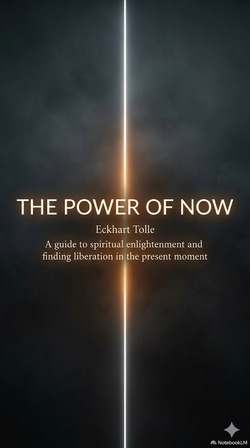
In *The Power of Now*, Eckhart Tolle dismantles the illusion that our identity is tied to constant, compulsive thinking. He reveals how identifying with the mind traps us in cycles of past regret and future anxiety, fueling a "pain-body"—a reservoir of unresolved emotional pain that hijacks our lives when triggered. Tolle guides readers to awaken to the present moment, the only true reality, by cultivating conscious awareness: observing the mind without judgment, anchoring attention in the inner body’s energy field, and embracing surrender to what is. Through practical, accessible practices, he shows how breaking free from mind-identification unlocks lasting peace, connects us to our essential, unmanifested self, and transforms daily experiences into opportunities for spiritual awakening. This isn’t just self-help—it’s a roadmap to ending suffering and living in alignment with life’s inherent joy.

EgoPresent Moment AwarenessPain BodyMind IdentificationUnmanifested State
A Sentimental Education
Loading…

A Sentimental Education

Hannah McGregor

3.81174 learners

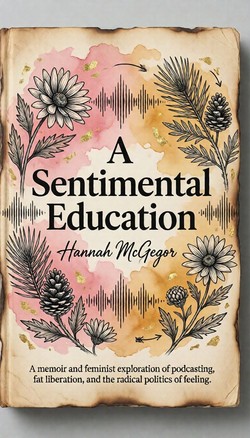
Hannah McGregor’s *A Sentimental Education* is a raw, incisive blend of memoir, cultural criticism, and feminist scholarship that confronts the tangled legacies of settler colonialism, sentimental culture, and bodily autonomy. Drawing on her experience as a white Canadian settler, McGregor unpacks her family’s complicity in colonial violence—from her Mennonite ancestors’ role in Canada’s westward expansion to the erasure of Indigenous land stewardship. She interrogates the gendered and racialized roots of sentimentalism, exposing how 19th-century narratives reinforced white supremacy and how modern iterations still marginalize queer, fat, and BIPOC voices. Weaving in her mother’s radical feminist care, her struggles with body image and fat liberation, and her groundbreaking work on podcasts like *Witch, Please*, McGregor argues for radical softness and ferocious care as acts of resistance. Rejecting academic elitism, she champions accessible, collaborative knowledge-making that centers marginalized experiences, offering a blueprint for living ethically in a world shaped by systemic injustice.

MemoirSettler colonialismSentimental cultureFeminist carePodcast scholarship
Van Gogh: The Life
Loading…

Van Gogh: The Life

Steven Naifeh;Gregory White Smith

3.91161 learners

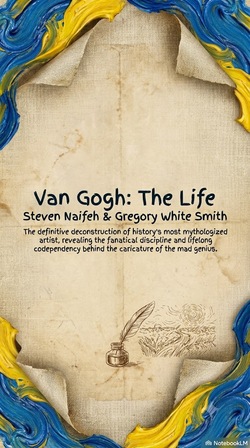
"Van Gogh: The Life" delivers an unflinching, deeply researched portrait of Vincent van Gogh’s turbulent journey from a lonely, misunderstood Dutch child to the post-impressionist genius whose works now captivate the world. Drawing on extensive letters and firsthand accounts, authors Steven Naifeh and Gregory White Smith trace his fraught relationships—especially with his overbearing mother, strict father, and loyal yet conflicted brother Theo—his brief, intense religious fervor, and his gradual, obsessive embrace of art. The book delves into his struggles with mental illness, social isolation, and repeated rejection by the art establishment, from his dark early peasant portraits to the vibrant, explosive colors of his southern French works. It reveals how every heartbreak, manic episode, and quiet moment of inspiration shaped his iconic canvases, painting a vivid picture of a man who turned pain into timeless beauty, even as the world failed to recognize his talent in his lifetime.

Vincent van GoghTheo van GoghPaul GauguinStarry NightThe Potato Eaters
The Count of Monte Cristo
Loading…

The Count of Monte Cristo

Alexandre Dumas

41139 learners

Edmond Dantès, a bright, ambitious young sailor on the cusp of becoming captain and marrying his beloved Mercédès, is betrayed by jealous rivals—his envious shipmate Danglars and his fiancée’s suitor Fernand Mondego. Wrongfully labeled a Napoleon sympathizer, he’s locked away in the brutal Château d'If, a prison where he loses all hope of freedom. But fate intervenes when he meets the brilliant Abbé Faria, a fellow prisoner who educates him in science, literature, and strategy, and reveals the location of a massive hidden treasure on Monte Cristo Island. After a daring escape, Dantès transforms into the mysterious, ultra-wealthy Count of Monte Cristo, returning to Paris to orchestrate elaborate revenge against those who destroyed his life. As his vengeance unfolds, he confronts the hollow cost of hatred, ultimately choosing redemption over endless fury, leaving readers with a timeless lesson about hope, patience, and the thin line between justice and vengeance.

RedemptionEdmond DantèsCount of Monte CristoAbbé FariaSpada Treasure
The Ego and the Id
Loading…

The Ego and the Id

Sigmund Freud

4.61070 learners

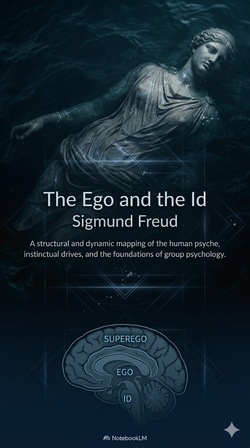
Sigmund Freud’s *Ego & Id* lays the foundational framework for modern psychoanalytic theory, unpacking the hidden structures of the human mind and the primal forces driving behavior. Freud breaks down mental life into three interconnected components: the id, the raw, pleasure-seeking reservoir of instincts; the ego, the rational mediator between the id’s demands and external reality; and the superego, the internalized moral compass shaped by childhood experiences. Beyond this tripartite model, the book explores the tension between the pleasure principle and the compulsion to repeat, delves into the libido-fueled dynamics of group psychology, and examines how repressed instincts and unconscious conflicts manifest in neuroses. Drawing on clinical case studies and evolutionary insights, Freud challenges conventional views of consciousness, arguing that most mental activity operates outside our awareness. This seminal work not only revolutionized psychology but also provided a lens to understand human motivation, relationships, and the roots of psychological distress.

RepressionEgoIdSuperegoLibido
Giles Goat-Boy
Loading…

Giles Goat-Boy

John Barth

4.31053 learners

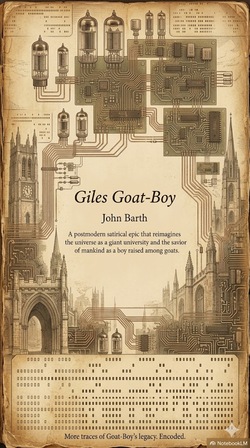
Raised as a goat boy by a disgraced scholar on a remote farm, Billy Boxfurs—later renamed George—spends his childhood frolicking with goats, learning simple truths about kindness and boundaries. But a fateful fall over the fence thrusts him into the chaotic, absurd world of New Tammany College, where he’s cast as the prophesied "Great Tutor. Navigating cutthroat campus politics, a tyrannical AI system called WESCAC, and a ragtag cast of eccentric characters—from ruthless power-player Morris Stoker to compassionate Anastasia—George grapples with his fractured identity: is he a goat, a human, or something in between? As he confronts false rules, staged trials, and the mind-bending paradox of "passing through failure," he uncovers that the line between success and ruin is far blurrier than institutions want you to believe. This sharp postmodern satire skewers institutional hypocrisy, explores the fluidity of identity, and asks: what does it really mean to "graduate" from the chaos of life?

George GilesBilly BoxfursNew Tammany CollegeWESCACSpearman's Law
Zhuangzi
Loading…

Zhuangzi

Zhuang Zhou

4.41009 learners

Dive into the whimsical, profound world of Zhuangzi, a foundational text of Chinese Daoism packed with playful fables and radical wisdom that challenges rigid societal norms. Through tales like the giant Peng bird soaring 90,000 li, the butcher Paoding who masters the 'Way' of butchering without dulling his knife, and Zhuang Zhou’s dream of being a butterfly (or vice versa), Zhuangzi explores core ideas: the contrast between small-mindedness and great vision, the relativity of right and wrong, and the power of 'wu wei'—non-forced action aligned with nature’s flow. He argues that 'uselessness' can be a superpower, protecting one from harm and enabling authentic living. Zhuangzi also frames life and death as natural cycles, urging readers to let go of attachment to fame, wealth, and rigid morality to embrace 'xiaoyao'—unfettered freedom of the spirit. Whether critiquing hypocritical scholars or guiding readers through chaos, this text invites redefining success and finding peace in harmony with nature.

Dao (The Way)Xiaoyao (True Freedom)Wu Wei (Non-Action)RelativismNaturalness
The Expensive Peace
Loading…

The Expensive Peace

Ji Chen

3.5995 learners

Dive into the tangled diplomacy, internal power struggles, and devastating aftermath of the First Sino-Japanese War in The Expensive Peace. Ji Chen unpacks the lead-up to the 1894 conflict, from the superficial cordiality between the Qing Dynasty and Meiji Japan to the eruption of war over Korea. The book lays bare the Qing court’s bitter divide between war hawks and peace advocates, tracking Li Hongzhang’s desperate, unauthorized attempts to avoid battle and the court’s fumbling efforts to seek foreign mediation as losses mounted. It chronicles the dramatic Shimonoseki negotiations—including Li’s assassination attempt that forced minor Japanese concessions—and the signing of the 1895 Treaty of Shimonoseki, which stripped China of Taiwan, the Liaodong Peninsula, and imposed crippling war reparations. Ji also explores the Three-Power Intervention that forced Japan to return Liaodong (for a hefty ransom) and the lasting scars of this 'expensive peace' on China’s national identity, urging readers to move beyond resentment to learn critical historical lessons.

Qing DynastyIto HirobumiTreaty of ShimonosekiFirst Sino-Japanese WarLi Hongzhang
Economic Development and Value Choice
Loading…

Economic Development and Value Choice

Chen Chunhua

3.6969 learners

Against the backdrop of China’s seismic shift from a planned economy to a socialist market economy, *Economic Development and Value Choice* by Chen Chunhua explores the intense clash between rapid economic growth and evolving personal values. Rooted in a 1992 research project tracking value transformations across decades, this book draws on extensive surveys of students, workers, and urban/rural residents to unpack the dynamic two-way relationship between economic progress and value systems. It delves into Marxist theories of human nature, the dialectical bond between individuals and society, and critiques prevalent value distortions like egoism, money worship, and hedonism during the transition. The book argues for the enduring relevance of social value principles, emphasizing that personal fulfillment must align with societal progress. It also outlines pathways to self-realization and transcendence, guiding readers to navigate the chaos of economic change, clarify their value coordinates, and achieve meaningful growth for both themselves and their communities.

Socialist Market EconomySelf-TranscendenceMarxist Human Nature TheorySocial Value PrincipleValue Choice
The Man Who Solved the Market
Loading…

The Man Who Solved the Market

Gregory Zuckerman

4.3918 learners

Follow the extraordinary journey of Jim Simons, a mathematical prodigy who traded a career in academia and top-secret code-breaking for a shot at conquering Wall Street. Starting as a child math whiz—reciting squares by age 3 and dissecting logic paradoxes by 4—Simons went on to become a renowned geometer and NSA cryptographer before launching Renaissance Technologies, a hedge fund that redefined investing with data-driven, algorithmic strategies. Alongside a team of eccentric geniuses, from code-breakers to IBM speech recognition experts, he built the Medallion Fund, which delivered unprecedented annual returns (often exceeding 60% after fees) for decades, outperforming every other fund in history. This book traces his triumphs, from beating the 1998 financial crisis to navigating the 2007 "quant quake," as well as internal conflicts, political controversies, and personal losses that shaped his legacy. It reveals how Simons turned market chaos into profit by leveraging math to exploit human biases, proving the market isn’t random—it’s a puzzle waiting to be solved.

Renaissance TechnologiesMedallion FundQuantitative InvestingAlgorithmic TradingMachine Learning
Dealing with Darwin
Loading…

Dealing with Darwin

Geoffrey A. Moore

4.3872 learners

"Dealing with Darwin" by Geoffrey A. Moore is a definitive playbook for businesses navigating the unforgiving pace of market evolution. Drawing on real-world case studies from Cisco, Intel, Apple, and Southwest Airlines, the book demystifies how to build and sustain competitive advantage through targeted innovation. Moore breaks down the category lifecycle into growth, mature, and decline stages, outlining 14 distinct innovation types tailored to each phase—from disruptive technology and platform innovation to value engineering and experience-driven tweaks. He contrasts two core business architectures: complex systems (for enterprise clients) and scale operations (for mass markets), detailing how to align innovation strategies with organizational strengths. Beyond strategy, Moore provides actionable frameworks to overcome organizational inertia, including core-periphery analysis to reallocate resources to high-impact innovation and a "resource cycling" model to upskill teams without cultural erosion. This guide equips leaders to avoid commodity traps, outadapt competitors, and thrive in Darwinian markets.

Disruptive InnovationOrganic InnovationCategory LifecycleM&A InnovationComplex Systems Architecture
Principles of Economics
Loading…

Principles of Economics

N. Gregory Mankiw

4.3803 learners

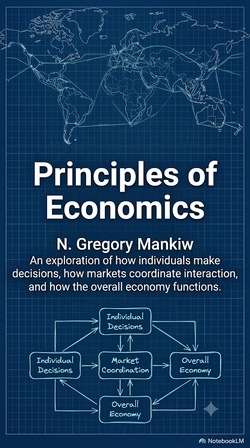
Gregory Mankiw’s *Principles of Economics* is the definitive introductory guide for anyone seeking to understand how economies function at every level—from individual choices to global markets. Anchored by 10 core principles grouped into three pillars—individual decision-making, interpersonal trade, and macroeconomic performance—the book demystifies complex concepts with relatable, real-world examples: from why airlines sell last-minute tickets cheap to how Reagan-era tax policies reflected the Laffer Curve. It covers foundational models like the circular-flow diagram and production possibility frontier, dives into microeconomics (supply and demand, market structures, consumer choice) and macroeconomics (inflation, unemployment, economic growth), and explores critical topics such as trade policy, market failures, taxation, and income inequality. Designed to be accessible yet rigorous, it equips readers to decode daily economic decisions, evaluate policy impacts, and think critically about how resources are allocated in society.

ExternalitiesComparative AdvantageOpportunity costInvisible HandProduction Possibility Frontier
Willpower
Loading…

Willpower

Roy F. Baumeister;John Tierney

4794 learners

Written by renowned researchers Roy F. Baumeister and John Tierney, *Willpower* distills decades of scientific studies and real-world examples to demystify self-control. The book reveals that willpower is a finite, shared mental resource—every act of self-regulation, from resisting junk food to managing emotions, draws from the same internal "account." It explains core concepts like ego depletion, how glucose fuels cognitive discipline, and why decision fatigue leads to impulsive choices. Readers will learn actionable strategies: setting realistic goals to avoid burnout, using precommitment tactics to beat temptation, leveraging social accountability (such as AA’s 12-step program), and how parenting styles shape children’s self-control. It also addresses common pitfalls, like the "what-the-hell" effect that derails diets, and offers evidence-based fixes to build lasting self-discipline. Whether you aim to quit a habit, boost productivity, or improve relationships, *Willpower* turns intentional choices into automatic, sustainable habits.

goal managementSelf-ControlEgo DepletionGlucoseDecision Fatigue
Priceless
Loading…

Priceless

William Poundstone

4.5556 learners

From the infamous McDonald's coffee lawsuit that revealed how jury awards are swayed by psychological anchors to the sneaky tactics retailers use to inflate your spending, *Priceless* by William Poundstone demystifies the hidden psychology of value and pricing. Drawing on decades of behavioral economics, psychophysics, and real-world experiments, the book shows our sense of "fair" pricing isn’t based on cold math—it’s shaped by relative comparisons, cognitive shortcuts, and subtle environmental cues. Poundstone breaks down core concepts like anchoring effect, arbitrary coherence, and loss aversion, explaining how they drive everything from consumer choices to negotiation outcomes. He unpacks businesses’ go-to tricks—decoy products, "free" offers, tiered pricing—and explores how social factors like gender, appearance, and group pressure influence financial decisions. Whether you want to outsmart marketers, negotiate a better salary, or understand your own irrational spending, *Priceless* turns complex insights into actionable takeaways for everyday life.

Loss AversionProspect TheoryAnchoring EffectPricing strategiesArbitrary Coherence
Positioning in the 21st Century
Loading…

Positioning in the 21st Century

Al Ries;Laura Ries;Simon Zhang

4.5461 learners

Updated for the digital, global age, *Positioning in the 21st Century* redefines the classic positioning framework for modern businesses. Drawing on real-world case studies from Tesla, Apple, Great Wall Motors, and Jack Sewing Machines, the book breaks down how globalization, urbanization, and technological disruption reshape consumer mindsets. It emphasizes core strategies like category differentiation—capitalizing on emerging niche markets instead of chasing fusion—subtractive innovation to cut non-essential features for clarity, and leveraging visual hammers and memorable slogans to embed brand identities deeply. The text also highlights the shift from ad-driven launches to PR-first brand building, and the power of multi-brand portfolios to avoid dilution while capturing new opportunities. For both B2C and B2B enterprises, it offers actionable principles to dominate mindshare, navigate binary market dynamics, and thrive in an era where specialization beats broad appeal.

Category DifferentiationVisual HammerMulti-brand StrategyPR-driven LaunchGlobal Positioning
Scenario

Mother's Ferocious Care

McGregor’s mom Teresa used 'ferocious care': she tore pesticide signs (signed as 'Fierce One-Breasted Woman') and imagined a chest-hole sculpture to defy cancer.

ResistanceMotherhoodRadical Care
Scenario

Pass It On Tattoo

McGregor’s tattoo has 'Pass it on' (her podcast’s sign-off). It’s a reminder to share small, hard-won insights—care and knowledge are meant to be passed, not hoarded.

CareTattooKnowledge Sharing