
The Art of Acting Clearly
Loading…

The Art of Acting Clearly

Rolf Dobelli

3872 learners

In The Art of Acting Clearly, bestselling author Rolf Dobelli demystifies the hidden cognitive biases that distort our daily decisions—from trivial shopping picks to high-stakes business and career moves. Drawing on decades of behavioral psychology research, real-world case studies, and eye-opening experiments, Dobelli breaks down over 30 common mental traps: how choice fatigue drains willpower and leads judges to deny parole at day’s end; why we irrationally reject a Hitler-owned sweater despite it being chemically clean; how the planning fallacy made Sydney Opera House cost 14x its budget and take 10 years longer than planned. More than just a catalog of biases, this book delivers actionable strategies to outsmart these pitfalls: from using external benchmarks to avoid overoptimism, to writing concrete plans to quiet the Zeigarnik Effect’s nagging reminders. Whether you’re a manager, investor, or simply someone wanting to make clearer, more rational choices, this guide equips you to cut through mental noise and act with intentionality.
Cognitive BiasesZeigarnik Effectdecision-makingInformation OverloadChoice Fatigue
The Information
Loading…

The Information

James Gleick

4.5479 learners

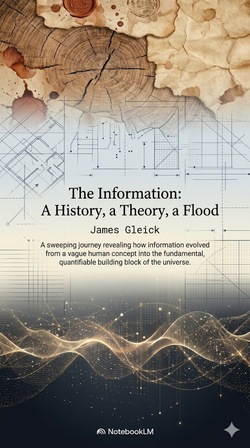
James Gleick’s The Information is a sweeping, engaging exploration of how information has shaped human civilization from ancient times to the digital age. Starting with early information carriers—from African talking drums that used redundancy to beat ambiguity to the first alphabet systems that rewrote human thought—the book traces the evolution of how we encode, transmit, and store knowledge. It delves into the origins of English dictionaries, the mechanical computing dreams of Charles Babbage and Ada Lovelace, and the telegraph revolution that erased time and space barriers. At its core, the book celebrates Claude Shannon’s groundbreaking 1948 information theory, which introduced the 'bit' as the universal unit of information and laid the groundwork for modern computing, communications, and even molecular biology. Gleick then expands into far-reaching impacts: from Norbert Wiener’s cybernetics to DNA’s genetic code, Richard Dawkins’ 'meme' concept, and quantum information’s challenge to physical laws. Finally, it confronts modern information overload, asking how we can reclaim meaning in a world drowning in data.

Information OverloadInformation TheoryDNAMemeClaude Shannon
View

Over-Collecting Info Delays Decisions

Spending weeks collecting info (searching, meetings) often delays decisions without improving accuracy. Most people already have enough ideas—they just need to act.

ProductivityDecision MakingInformation Overload
Insight

GTD Fits Modern Work Needs

GTD became globally popular because it perfectly solves the pain points of knowledge workers in the digital age, who face endless information overload and blurred work-life boundaries.

ProductivityModern WorkGTD Value
No more