
The Scholar's Blueprint
Loading…

The Scholar's Blueprint

Yan Gengwang

31083 learners

The Scholar's Blueprint is a practical, experience-driven guide to mastering historical research from veteran Chinese historian Yan Gengwang. Drawing on decades of hands-on work, Yan breaks down core principles for studying Chinese history: balancing deep specialization with broad, cross-disciplinary knowledge, avoiding overly narrow time constraints in dynastic studies, prioritizing holistic 'big picture' research over isolated topics, and mining fresh insights from common, widely available sources instead of chasing rare materials. He also shares actionable tips for academic writing—from choosing the right structure (like outline formats for dense research) to proper source citation and rigorous revision. Beyond technical skills, Yan emphasizes the personal discipline needed for long-term scholarly success: setting ambitious goals, maintaining consistent effort, and focusing on research over fame or power. The book also includes his own academic journey, reflections on towering figures like Qian Mu and Chen Yinque, and lessons from mentors, making it invaluable for aspiring historians and seasoned scholars alike.
Institutional HistoryAcademic WritingHistorical Research MethodsChinese HistoriographySource Criticism
Peaks and Valleys
Loading…

Peaks and Valleys

Yan Buke

3.71042 learners

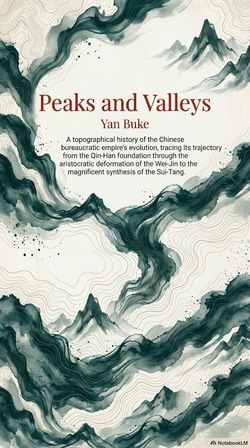
"Peaks and Valleys" uses an innovative institutional framework to unpack China’s imperial bureaucracy from the Qin-Han dynasties to the Northern and Southern Dynasties. Framing the era as cycles of "normalcy" and "aberration," it details how the Qin and Han built a golden peak of centralized autocracy, merit-based governance, and Confucian orthodoxy—establishing a lasting template for imperial rule. The Wei-Jin and Northern/Southern Dynasties brought a valley of political upheaval: clan aristocrats monopolized power, foreign regimes introduced hybrid systems, and imperial authority weakened. Yet even in chaos, institutions evolved, including the three-department system, legal reforms, and early exam-based selection. The Northern Dynasties, through Hu-Han cultural fusion and strong warrior-led autocracy, revived bureaucratic norms, laying the groundwork for the Sui-Tang golden age. This book reveals how China’s imperial system maintained continuity through fluctuations, highlighting its remarkable resilience and adaptive strength.

Institutional HistoryMeritocracyImperial BureaucracyNormal GovernanceAberrant Politics
No more