
Madness and Civilization
Loading…

Madness and Civilization

Michel Foucault

4.6586 learners

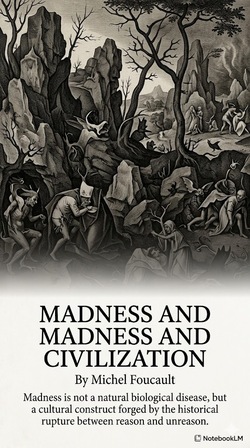
In *Madness and Civilization*, Michel Foucault upends traditional views of mental illness by tracing how Western society has constructed, marginalized, and controlled 'madness' over centuries. Starting with medieval leper isolation—whose exclusionary structures persisted long after the disease faded—Foucault explores the Renaissance's 'fool ships,' which banished the insane as both outcasts and objects of mythic fascination. He dissects the 17th-century rise of mass confinement, where madpeople were locked alongside beggars, criminals, and the unemployed not for treatment, but to enforce social order and moral discipline. Finally, he exposes the 19th-century asylum as a site of subtle, pervasive control: what seemed like humanitarian reform (e.g., Pinel removing chains) was actually a new system of moral judgment, silence, and surveillance. Foucault argues madness is not a natural medical condition but a product of power dynamics, revealing how rationality has defined itself by suppressing the irrational.

rationalityMoral ControlMadnessPower DynamicsIrrationality
Quote

Keynes on Market Irrationality

"The market can stay irrational longer than you can stay solvent." Keynes' warning about relying on models to predict market behavior—even logical trades can fail if timing is off.

MarketIrrationalityKeynes
Concept

Public Goods Tragedy

Individuals acting in self-interest deplete shared resources. E.g., overfishing or overgrazing—each takes more, leading to collapse for everyone.

Collective IrrationalityShared Resources
Golden Sentence

Newton on Human Madness

"I can calculate the motion of heavenly bodies, but not the madness of people." Newton said this after losing money in the South Sea Bubble, reflecting frustration with human irrationality.

QuoteNewtonSouth Sea Bubble
Golden Sentence

Love’s Irrationality

Love is irrational—you can’t explain why you fall for someone; it just happens.

RelationshipsLoveIrrationality
Concept

Zero Risk Bias

You overvalue the state of zero risk so much that you are willing to pay far more to eliminate a tiny remaining risk than the actual benefit it brings.

Risk ManagementDecision MakingIrrationality
Insight

Passionate Love Value

Passionate love is a rare privilege. It’s irrational, intense, and can last—like Foucault’s long-term bond with Deleuze.

RelationshipsIrrationalityPassionate Love
No more