
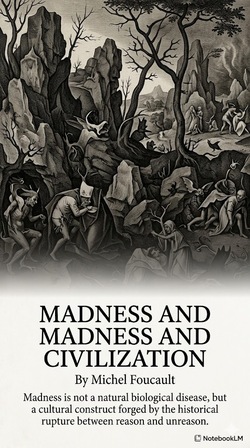
Madness and Civilization
Loading…

Madness and Civilization

Michel Foucault

4.6586 learners

In *Madness and Civilization*, Michel Foucault upends traditional views of mental illness by tracing how Western society has constructed, marginalized, and controlled 'madness' over centuries. Starting with medieval leper isolation—whose exclusionary structures persisted long after the disease faded—Foucault explores the Renaissance's 'fool ships,' which banished the insane as both outcasts and objects of mythic fascination. He dissects the 17th-century rise of mass confinement, where madpeople were locked alongside beggars, criminals, and the unemployed not for treatment, but to enforce social order and moral discipline. Finally, he exposes the 19th-century asylum as a site of subtle, pervasive control: what seemed like humanitarian reform (e.g., Pinel removing chains) was actually a new system of moral judgment, silence, and surveillance. Foucault argues madness is not a natural medical condition but a product of power dynamics, revealing how rationality has defined itself by suppressing the irrational.
rationalityMoral ControlMadnessPower DynamicsIrrationality
King Lear
Loading…

King Lear

William Shakespeare

4.4423 learners

William Shakespeare’s *King Lear* is a searing tragic masterpiece that dissects the corrosive nature of power, pride, and filial betrayal. When the aging king decides to divide his kingdom among his three daughters based on their declarations of love, his youngest and most loyal child, Cordelia, refuses to indulge in empty flattery, earning his wrath and banishment. His elder daughters, Goneril and Regan, shower him with false praise, only to turn on him once they seize power, stripping him of his retinue and leaving him to wander a storm-ravaged wilderness, driven to madness. Parallel to Lear’s downfall is the story of the Earl of Gloucester, whose illegitimate son Edmund plots to usurp his brother Edgar’s inheritance, ultimately leading to Gloucester’s brutal blinding for aiding Lear. As Cordelia returns with French forces to rescue her father, the play hurtles toward a devastating climax: Cordelia is captured and executed, Lear dies of grief, Goneril and Regan destroy each other, and Edmund’s late confession comes too late to undo the carnage. Through its raw exploration of human cruelty and fragile loyalty, the play exposes the catastrophic cost of unchecked ego and the emptiness of performative affection.

King LearCordeliaGonerilReganEdmund
Scenario

Lu Zilin's Downfall

Lu Zilin lost power, his family declined, and he went mad. He was found frozen to death in a ditch, ending his life of chasing power.

DownfallMadnessLu Zilin
Concept

Low Latent Inhibition

People with this can't ignore small details. It can spark creativity (artists) or madness (schizophrenia) depending on dopamine regulation.

Mental HealthCreativityDopamine
Scenario

Katerina's Street Performance

Katerina, mad from poverty, makes her kids sing/dance to beg—she collapses coughing blood as onlookers mock.

PovertyMadnessKaterina
Quote

Dream is Short Madness

Dream is a short madness, and madness is a long dream. Schopenhauer's quote links dreams (dopamine unbound) to schizophrenia (unregulated dopamine).

Mental HealthDreamsDopamine
Concept

Deer Eye Stone Cure

A sacred stone from the Seven-Ringed Deer. It cures Calistro's madness when rubbed on his face—symbolizing nature's healing power and animal-human links.

HealingSacred ObjectNature's Power
Quote

Madness is Land's Cry

"Madness isn't just illness—it's the land speaking when no one listens. Calistro's madness was the earth's warning about the curse."

MadnessLand's VoiceIndigenous Insight
Scenario

Ergueta's Roulette Madness

Ergueta claims Jesus revealed roulette secrets to him, says he can win big. Erdosain thinks he's crazy but holds a tiny hope.

MadnessHopegambling
Scenario

Puppet Game

The astrologer hangs puppets, assigns roles (Erdosain as jester). He talks to them, planning revolution.

RevolutionMadnesspuppet metaphor
Quote

Love Beyond Sanity

The line between sanity and madness is blurry. She was trapped in pre-1953, but her love for me was always clear and warm.

Mental HealthMemoryLove
View

Hamlet’s Feigned Madness

Hamlet pretends to be mad to hide his revenge plans. It lets him observe others without suspicion and test their true intentions.

RevengeMadnessDeception
Scenario

Hospitalization in Arles

After the ear incident, Van Gogh was hospitalized in Arles. He alternated between lucidity and madness, with no clear diagnosis from doctors.

Mental BreakdownArles PeriodHospitalization
Concept

What Is Scurvy?

Scurvy comes from lack of Vitamin C. Sailors got it bad: blue/black skin, joint pain, madness. It killed more in Anson’s fleet than storms or battles. Fresh fruits cure it—they missed lime chances.

ScurvyNaval Health