The Extended Phenotype
Loading…

The Extended Phenotype

Richard Dawkins

4.21066 learners

Richard Dawkins’ *The Extended Phenotype* redefines evolutionary biology by shifting focus from individual organisms to the genes that drive them. Using the Necker Cube illusion as a metaphor, Dawkins argues that a gene’s influence doesn’t stop at an organism’s body—it extends to the entire world shaped by that organism’s behavior. This includes beaver dams, spider webs, parasite-induced host behavior changes, and even cultural memes, all labeled “extended phenotypes” shaped by natural selection. The book dismantles gene determinism, explaining how genes interact with environments to produce traits probabilistically, not absolutely. It also explores evolutionary constraints like time lag, genetic variation limits, and the asymmetric “life/dinner principle” in species arms races. Dawkins frames genes as the core “replicators” of evolution, introduces memes as cultural replicators, and delves into outlaw genes that prioritize their own survival over the genome. By redefining organisms as temporary “survival machines” for genes, this work offers a radical, eye-opening framework to understand life’s evolutionary logic.
Evolutionary Arms RacememesExtended PhenotypeGene Selection TheoryReplicators
The Beginning of Infinity
Loading…

The Beginning of Infinity

David Deutsch

4.1860 learners

In *The Beginning of Infinity*, David Deutsch redefines the foundations of human progress, arguing that the Enlightenment’s true legacy isn’t just rebellion against authority—but a tradition of critical inquiry centered on explanatory knowledge. Unlike empirical dogma or toolist science, which prioritizes prediction over understanding, Deutsch shows that the ability to create coherent, testable explanations is the engine of infinite knowledge growth. He explores how this principle applies across disciplines: from the counterintuitive logic of multiverse theory (the only consistent interpretation of quantum mechanics) to the evolution of memes, distinguishing between rational ideas that thrive on criticism and anti-rational ones that stifle creativity in static societies. Deutsch also champions a radical philosophical optimism: every problem, from disease to resource scarcity, stems from insufficient knowledge, not inherent limits. As universal interpreters, humans possess the unique ability to transcend biological and environmental constraints, unlocking endless potential to reshape our world and explore the cosmos. This book isn’t just a scientific treatise—it’s a manifesto for embracing curiosity, error correction, and the boundless future of human innovation.

Explanatory knowledgeCritical traditionUniversal interpreterMultiverse theoryMemetic evolution
From Bacteria to Bach and Back
Loading…

From Bacteria to Bach and Back

Daniel C. Dennett

4.7635 learners

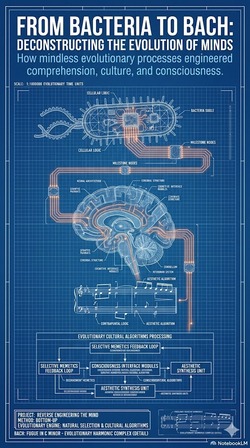
From Bacteria to Bach and Back takes readers on a sweeping, rigorously researched journey to answer one of humanity’s most profound questions: How did conscious minds and rich cultural systems emerge from the unthinking physical processes of evolution? Drawing on 50 years of work in philosophy, cognitive science, and evolutionary biology, Daniel C. Dennett dismantles the long-standing Cartesian dualism that splits mind from matter, introducing concepts like 'Cartesian gravity'—the cognitive trap that locks us into first-person subjective views—and 'free-floating rationales' to explain how traits evolve without being understood by the organisms that possess them. Dennett traces the path from bacteria’s 'competence without comprehension' to humans’ unique ability to use thinking tools like language and mathematics. He explores the co-evolution of genes and memes, the cultural equivalent of genes, showing how they shaped everything from language origins to Bach’s musical genius. Central to his argument is the radical claim that consciousness is not a mysterious, non-material entity, but an evolved 'user illusion'—a simplified interface that lets us navigate the world without grasping the complex neural processes beneath. This book challenges readers to set aside intuitive biases and see the mind as a product of gradual, unguided evolution, bridging the gap between biology, philosophy, and culture.

ConsciousnessCartesian gravityfree-floating rationalesmemesuser illusion
The Information
Loading…

The Information

James Gleick

4.5479 learners

James Gleick’s The Information is a sweeping, engaging exploration of how information has shaped human civilization from ancient times to the digital age. Starting with early information carriers—from African talking drums that used redundancy to beat ambiguity to the first alphabet systems that rewrote human thought—the book traces the evolution of how we encode, transmit, and store knowledge. It delves into the origins of English dictionaries, the mechanical computing dreams of Charles Babbage and Ada Lovelace, and the telegraph revolution that erased time and space barriers. At its core, the book celebrates Claude Shannon’s groundbreaking 1948 information theory, which introduced the 'bit' as the universal unit of information and laid the groundwork for modern computing, communications, and even molecular biology. Gleick then expands into far-reaching impacts: from Norbert Wiener’s cybernetics to DNA’s genetic code, Richard Dawkins’ 'meme' concept, and quantum information’s challenge to physical laws. Finally, it confronts modern information overload, asking how we can reclaim meaning in a world drowning in data.

Information OverloadInformation TheoryDNAMemeClaude Shannon
Insight

Cultural Evolution’s Lamarckian Traits

Unlike genes, memes can pass on acquired changes (e.g., modified words) directly—this is a Lamarckian feature of cultural evolution.

Lamarckismmemescultural evolution
Concept

Meme Reconstruction

Memes aren’t just copied—we reconstruct them using our own ideas. This is why good memes (like science) stay accurate.

CultureCreativitymemes
Concept

Meme as Replicator

Memes are ideas that replicate through human minds. They evolve—good ones (like science) survive criticism; bad ones suppress it.

CultureEvolutionIdeas
Insight

Cultural Evolution is Darwinian

Memes compete for attention, replicate, and evolve—just like genes, but faster and through cultural rather than biological means.

memescultural evolutionDarwinism
Insight

Memes Are Real

Memes exist as cultural entities (words, ideas) that influence behavior and evolution—even if they aren’t physical objects.

Realitymemescultural evolution
Golden Sentence

Do Something Over Nothing

The real gap is never between good and bad creation, but between doing nothing and doing something. Even silly cat memes are way better than total passive consumption.

ActionMindsetCreation
Concept

Meme Definition

A meme is the smallest cultural unit that copies and spreads between human brains via imitation. It can be a catchphrase, a melody, a religious belief or a social trend.

Dawkinscultural evolutionMeme
Concept

Meme As Culture Replicator

Meme is the cultural equivalent of gene, it spreads via human imitation, including slogans, ideas, customs, and evolves much faster than biological genes.

CultureEvolutionMeme
Concept

Cultural Evolution in Finance

Financial culture evolves like species—via variation, selection, replication. For example, 'Greed is good' (from Wall Street) spread as a meme, shaping behavior until the 2008 crisis corrected it.

cultural evolutionMemeFinance Culture
Concept

Memes

Cultural units (ideas, tunes, behaviors) that replicate and evolve via selection—similar to genes but faster and through cultural transmission.

cultural evolutionDennettReplication
Concept

Reciprocal vs Parasitic Memes

Reciprocal memes help hosts (e.g., language), while parasitic ones harm or don’t help (e.g., useless rumors).

Adaptationmemescultural evolution
No more