Late Bloomers
Loading…

Late Bloomers

Rich Karlgaard

4.41285 learners

In a culture obsessed with "making it big by 30"—fueled by Forbes’ 30 Under 30 lists, SAT mania, and tech giants’ youth-focused hiring—Rich Karlgaard’s *Late Bloomers* dismantles the myth that early success equals lifelong achievement. He exposes the toxic toll of this hype: skyrocketing teen anxiety and depression, cutthroat college admissions arms races, and rampant age discrimination in the workplace. Drawing on neuroscience (the prefrontal cortex doesn’t fully mature until 25), psychology, and real-life stories—from Morgan Freeman to Geraldine Weiss—Karlgaard argues that late bloomers thrive because of their unique strengths: curiosity, empathy, resilience, and wisdom forged through life’s setbacks. He offers actionable strategies for breaking free from societal pressure: learning to strategically abandon unfit paths, managing self-doubt with self-compassion, and seeking environments that nurture your growth. This book is a rallying cry for anyone who feels left behind by the "success by 30" narrative, proving that your greatest achievements can come at any age when you embrace your own timeline.
ResilienceSelf-EfficacyPrefrontal CortexLate BloomersCrystallized Intelligence
Understanding Human Nature
Loading…

Understanding Human Nature

Alfred Adler

4.51269 learners

Alfred Adler’s *Understanding Human Nature* lays the foundational framework of individual psychology, redefining how we perceive human behavior through a social, purpose-driven lens. Rejecting fragmented views of the mind, Adler argues that all actions are guided by a hidden pursuit of superiority, shaped by childhood experiences, family dynamics, and the innate need for social connection. He explores how inferiority feelings—rooted in early struggles or perceived weaknesses—drive either constructive growth or destructive compensation, and how a lack of social interest fuels isolation, aggression, or withdrawal. Packed with clinical case studies and real-world observations, this classic offers practical tools to decode personality traits, resolve interpersonal conflicts, and foster healthy development in children and adults alike. It challenges the idea of fixed 'character' and empowers readers to recognize and redirect unhelpful behavioral patterns, building more meaningful relationships and a deeper understanding of themselves and others.

Life StyleChildhood DevelopmentIndividual PsychologyInferiority ComplexSocial Interest
To Sell Is Human
Loading…

To Sell Is Human

Daniel H. Pink

4.41214 learners

In *To Sell Is Human*, Daniel H. Pink dismantles the outdated idea that selling is only for career salespeople, revealing that 8 out of 9 Americans engage in "non-sales selling" every day—persuading colleagues to collaborate, convincing funders to back projects, or even getting kids to stick to bedtime routines. He tracks the fall of traditional sales models (like Fuller Brush’s iconic door-to-door approach) as information parity transforms the marketplace, where buyers often know more about products than sellers do. Pink introduces the new ABCs of modern influence: Attunement (empathic perspective-taking), Buoyancy (resilience amid constant rejection), and Clarity (uncovering hidden needs instead of just solving stated problems). He also shares actionable strategies, from crafting concise, engaging pitches to using improvisational techniques for unscripted conversations, and emphasizes that service—improving others’ lives—is the ultimate key to authentic persuasion. This book redefines selling as a universal life skill, essential for success in both work and daily interactions.

PersuasionClarityNon-sales sellingAttunementBuoyancy
The Principles of Psychology
Loading…

The Principles of Psychology

William James

4.21163 learners

As a foundational text of modern psychology, William James’s *The Principles of Psychology* revolutionizes the field by rejecting the traditional atomist view of the mind as a collection of isolated mental bits. James introduces his groundbreaking concept of the 'stream of consciousness,' arguing that our thoughts are continuous, fluid, and inherently selective rather than fragmented. Drawing on neurophysiological experiments, case studies of split consciousness, and introspective analysis, he explores core topics: the brain’s role in mental activity, the physical basis of habit formation, the causal power of consciousness (debunking the 'conscious automaton' theory), and the proper methods for psychological research—including introspection, experimental studies, and comparative analysis. James frames psychology as a natural science focused on individual minds, addressing enduring questions about the mind-body relationship, the nature of unconscious states, and how we perceive and interact with the world. This work not only laid the groundwork for functionalism but also remains a provocative, accessible guide to understanding human thought and behavior.

Habit FormationBrain FunctionIntrospectionConsciousness StreamMental Causation
How to Know a Person
Loading…

How to Know a Person

David Brooks

41118 learners

In *How to Know a Person*, New York Times columnist David Brooks shares his transformative journey from an emotionally guarded, intellectually focused man to someone who prioritizes deep human connection. Drawing on personal anecdotes—from his awkward teenage years to the wake-up call of fatherhood—and rigorous research in psychology, sociology, and neuroscience, Brooks unpacks the hidden barriers that prevent us from truly seeing others: seven common psychological habits like self-centeredness and static thinking. He introduces the concept of "brighteners" vs. "diminishers," outlining the traits of those who lift others up through curiosity, patience, and respect. The book breaks down actionable skills: the three core components of empathy (mirroring, mentalization, and care), how to navigate difficult conversations without conflict, and the power of narrative thinking to understand someone’s life story. Brooks also addresses the growing crisis of social isolation in America, linking it to social media’s shallow interactions and a decline in moral education. Offering practical tools for every stage of life—from understanding personality traits via the Big Five model to supporting loved ones through depression—this book is a guide to breaking through isolation, building meaningful relationships, and finding purpose in seeing others fully.

Social IsolationEmpathetic understandingBrightener vs. diminisherBig Five traitsNarrative identity
Conversations with God
Loading…

Conversations with God

Neale Donald Walsch

4.31057 learners

In 1992, Neale Donald Walsch hit rock bottom—his relationships shattered, career stalled, health failing—so he poured his rage and despair into a letter to God. What followed was a three-year, unscripted dialogue that redefined his understanding of the divine, life, and himself. This collection of intimate conversations dismantles rigid, traditional views of God as a distant judge, revealing a playful, loving presence that exists in every moment, every emotion, and every being. Walsch explores universal questions: the nature of suffering (it’s a choice of resistance, not a given), the illusion of separation (all souls are one), the truth of reincarnation (a voluntary soul growth journey), and how our thoughts and words create our reality. He also challenges societal norms, warning of the danger of out-of-control technology without spiritual balance, and calls for a shift to a unified, shared-resource civilization. Ultimately, these conversations are a roadmap to awakening—reminding readers that they are divine beings, capable of creating a life of joy, unity, and purpose by reconnecting with their true selves and the universal love at the core of all existence.

Spiritual AwakeningNon-resistanceUnconditional LoveDivine unitySoul evolution
Dune Messiah
Loading…

Dune Messiah

Frank Herbert

4.3997 learners

Set in the brutal, spice-rich universe of Arrakis, *Dune Messiah* picks up where *Dune* left off: Paul Atreides, now Emperor Muad'Dib, is trapped between the godhood his followers thrust upon him and the crushing weight of a galaxy-spanning jihad he can’t stop. Surrounded by conspirators—shape-shifting Tleilaxu, manipulative Bene Gesserit, and paranoid Spacing Guild navigators—Paul struggles to retain his humanity while fending off plots to dethrone him. When the Tleilaxu send Gola Harkonnen, a cloned weapon with echoes of his fallen friend Duncan Idaho, Paul faces his greatest test: trusting a man who might be a puppet. As visions of his beloved Chani’s death loom, Paul confronts the cost of power, the fragility of prophecy, and whether he can break free from the destiny that chained him. In the end, loss forces him to abandon his imperial crown, choosing to return to the desert as a man rather than rule as a god, leaving his twin heirs to carry the Atreides dynasty’s fate.

Bene Gesseritsandwormsmelange spicePaul Muad'DibTleilaxu Face Dancer
The Grand Chessboard
Loading…

The Grand Chessboard

Zbigniew Brzezinski

4.2973 learners

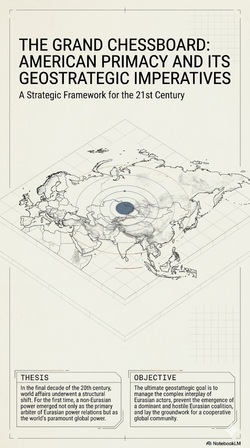
In Zbigniew Brzezinski’s seminal geopolitical work *The Grand Chessboard*, he frames Eurasia as the critical battleground for sustaining America’s status as the world’s first true global superpower. Brzezinski traces the evolution of U.S. hegemony, contrasting it with historical empires like Rome, China, and Mongolia to highlight its unique democratic, economic, and cultural foundations. He breaks down Eurasia into a strategic 'chessboard,' identifying core geostrategic players (France, Germany, Russia, China, India) and pivotal states (Ukraine, Azerbaijan, Turkey) that shape regional dynamics. The book dissects America’s key challenges: fostering a unified yet aligned Europe, guiding Russia toward integration rather than imperial revival, balancing power in Central Asia’s volatile 'Eurasian Balkans,' and managing the delicate U.S.-China-Japan triangle in East Asia. Brzezinski concludes that America must act as a stabilizing arbiter, building a cooperative framework to share global responsibility while preserving its leadership for at least a generation, noting it may be the last global superpower in history.

US-China RelationsSoviet CollapseEurasian geopoliticsglobal hegemonygeostrategic players
So Good They Can’t Ignore You
Loading…

So Good They Can’t Ignore You

Cal Newport

4.2950 learners

In a culture fixated on the "follow your passion" myth, Cal Newport’s *So Good They Can’t Ignore You* rewrites the rulebook for career success. Newport dismantles the dangerous idea that you must start with a pre-existing passion to find fulfillment, arguing this approach leaves most people frustrated and unfulfilled. Instead, he champions the craftsman mindset: prioritize building rare, valuable skills through deliberate practice to accumulate "career capital"—the tangible expertise that gives you leverage to claim autonomy, shape your work, and discover satisfaction over time. Using real-world examples from software engineers to freelance writers, he outlines actionable steps: identify high-impact stretch projects, focus on mastering skills that are scarce and valuable in your field, and avoid chasing passion at the cost of mastery. By becoming so indispensable that others can’t ignore you, you don’t just land a job you tolerate—you build a career you control, with the freedom to define success on your own terms.

Deliberate PracticeCraftsman MindsetCareer CapitalPassion HypothesisCareer Autonomy
Officialdom Unmasked
Loading…

Officialdom Unmasked

Li Baojia

4.1928 learners

Set in the late Qing Dynasty, *Officialdom Unmasked* pulls back the curtain on the rotten core of imperial Chinese bureaucracy through a series of darkly humorous, interconnected tales. Follow naive scholar Zhao Wen as he stumbles through cutthroat Beijing officialdom after passing the imperial exam, watch schemers like Mao Deguan buy fake credentials or sell family members to climb ranks, and witness corrupt officials like Diao Maipeng embezzle millions from widows and manipulate court cases to save their skins. From local magistrates ignoring people’s suffering to curry favor with superiors, to provincial leaders groveling before foreign powers to avoid diplomatic trouble, every story lays bare the greed, hypocrisy, and absurdity that defined late Qing officialdom. Li Baojia’s sharp satirical pen doesn’t just mock individual crooks—it exposes a system where corruption wasn’t an exception, but the rule, making this classic a timeless critique of power and greed.

Late Qing officialdomofficial title traffickingembezzlementsycophancyforeign appeasement
The Interpretation of Dreams
Loading…

The Interpretation of Dreams

Sigmund Freud

4.3770 learners

Sigmund Freud’s seminal work *The Interpretation of Dreams* revolutionizes the study of dreams by rejecting outdated, superstitious or superficial approaches to unlock the hidden workings of the human subconscious. Freud introduces his groundbreaking theory that dreams are not random, meaningless occurrences but disguised fulfillments of repressed wishes—often rooted in childhood memories, sexual instincts, or unacknowledged conflicts. Using his own 'Irma’s Dream' as a case study, he demonstrates how to decode dreams through free association, breaking down key mechanisms like condensation (compressing complex ideas into simple images), displacement (shifting emotional intensity to trivial details), and symbolism (using universal or personal imagery to represent hidden desires). He also analyzes common 'typical dreams'—such as nudity, falling, or losing teeth—revealing their deep psychological roots. More than a guide to dream analysis, this book lays the foundation for psychoanalysis, offering a transformative lens to understand human behavior, unresolved trauma, and the quiet forces shaping our waking lives.

Oedipus ComplexWish FulfillmentSubconscious DesireDream InterpretationDream Condensation
The Master and Margarita
Loading…

The Master and Margarita

Mikhail Bulgakov

4.2730 learners

Step into the surreal, chaotic streets of 1930s Moscow where Woland—Satan himself—arrives with his ragtag entourage: the mischievous cat Behemoth, the smooth-talking Koroviev, and the deadly Azazello. What starts as a provocative debate with skeptical writers at Patriarch’s Ponds spirals into a series of bewildering, supernatural pranks that expose the hypocrisy of the city’s literary elite. Interwoven with this modern chaos is the ancient tale of Pontius Pilate, the Roman governor crippled by guilt after sentencing Jesus Christ to death, a story that haunts a reclusive writer known only as “the Master.” When the Master is driven mad by criticism and institutional betrayal, his loyal lover Margarita makes a daring deal with Woland to reunite with him, embracing witchcraft and hosting a wild satanic ball in exchange for their eternal peace. Blending dark humor, biting social satire, and timeless themes of love, guilt, and redemption, *The Master and Margarita* is a bold, unforgettable masterpiece that challenges beliefs and defies expectations.

MoscowRedemptionWolandMargaritaThe Master
The Paradox of Choice
Loading…

The Paradox of Choice

Barry Schwartz

4.3700 learners

In *The Paradox of Choice*, Barry Schwartz exposes the hidden toll of America’s endless obsession with options. From supermarket shelves packed with 30,000+ products to overwhelming choices in healthcare, education, and careers, he reveals that surplus selection doesn’t boost happiness—it triggers decision paralysis, regret, and even depression. Through iconic experiments like the jam study (where 6 options drove 10x more purchases than 24), Schwartz breaks down why more choices often leave us less satisfied. He distinguishes between "maximizers" who chase the "best" option at the cost of joy, and "satisficers" who settle for "good enough" and thrive. The book also explores cognitive biases (anchoring, framing) and psychological traps (hedonic treadmill, social comparison) that amplify our struggles. Finally, Schwartz offers practical strategies to reclaim control: focus on high-impact choices, embrace satisficing, limit social comparisons, and use secondary decisions to simplify daily life. A must-read for anyone feeling overwhelmed by modern life’s endless choices.

Hedonic TreadmillRegretSocial ComparisonOpportunity costDecision paralysis
I Am a Strange Loop
Loading…

I Am a Strange Loop

Douglas R. Hofstadter

4.8691 learners

Douglas Hofstadter’s *I Am a Strange Loop* masterfully bridges Gödel’s mathematical incompleteness theorem with the mystery of human self-awareness. Through intimate personal stories—from his teenage distress over lab guinea pigs to the profound grief of losing his wife—Hofstadter argues that the 'I' we cherish isn’t a physical thing, but an abstract 'strange loop': a self-referential feedback loop of brain symbols that creates the illusion of a unified self. He introduces the 'Hennekes' scale to quantify soul 'size', framing consciousness as a spectrum tied to empathy and cognitive complexity, not an all-or-nothing trait. Exploring downward causation, he shows how high-level abstract patterns (like mathematical truths or personal desires) drive physical actions, pushing back against reductionist views. Hofstadter also dives into identity entanglement, explaining how close relationships merge our self-loops, and debunks myths of free will and dualistic consciousness, offering a radical, science-backed vision of what it means to be 'you'.

Strange LoopGödel’s Incompleteness TheoremHennekes ScaleDownward CausationSelf-Reference
The Rings of Saturn
Loading…

The Rings of Saturn

W.G. Sebald

4.5667 learners

Set against the windswept coast of Suffolk, W.G. Sebald’s *The Rings of Saturn* unfolds as a meandering, meditative walk through time, memory, and decay. As Sebald traverses desolate marshes, crumbling manors, and ghostly coastal towns, his journey weaves together fragments of forgotten history, literary ghosts, and intimate encounters. He delves into the life of Thomas Browne, whose skull was exhumed and reburied decades after death; Joseph Conrad’s formative years in Lowestoft, where he found his voice in English; and Edward FitzGerald’s reclusive life translating the Rubaiyat. Along the way, he confronts the collapse of herring populations, the scars of war and colonialism, and the quiet erosion of nature—from dying forests to abandoned radar stations. Blending travelogue, biography, and philosophical reflection, the book captures the haunting weight of time, where the past lingers in every ruin, every fading memory, and every stretch of desolate shore.

Silk Industrycollective memorySuffolk CoastThomas BrowneJoseph Conrad
Salt Sugar Fat
Loading…

Salt Sugar Fat

Michael Moss

4.3608 learners

In *Salt Sugar Fat*, investigative journalist Michael Moss pulls back the curtain on the $1 trillion processed food industry, revealing how corporations weaponize the science of taste, neuroscience, and consumer psychology to hook Americans on products loaded with salt, sugar, and fat. Through riveting case studies—from Coca-Cola’s global expansion and Kraft’s Lunchables to cereal giants’ battle for kid consumers—Moss exposes how industry scientists like Howard Moskowitz identified the "bliss point" of flavor, the exact ratio of these three ingredients that triggers intense, repeated cravings. He also unpacks the industry’s aggressive pushback against health regulations, from lobbying against salt limits to using tobacco-style marketing tactics to boost sales. Blending rigorous research with gripping storytelling, the book lays bare the hidden costs of our hyper-processed diet: skyrocketing rates of obesity, hypertension, and diabetes, while empowering readers to make more informed food choices by understanding the forces shaping their cravings.

food marketingBliss PointHigh-Fructose Corn SyrupProcessed FoodsPhilip Morris
No Rules Rules
Loading…

No Rules Rules

Reed Hastings;Erin Meyer

4.4581 learners

From a $40 late fee that sparked a revolution to navigating the 2001 dot-com bust, Reed Hastings and Erin Meyer pull back the curtain on Netflix’s unconventional corporate culture in *No Rules Rules*. This book breaks down how Netflix built its global streaming empire by prioritizing extreme talent density—cutting underperformers to assemble a team of high-caliber innovators who thrive on mutual accountability. It dives into core practices like radical transparency, the 4A feedback framework, unlimited paid time off, and ditching rigid expense approvals, all rooted in the belief that trust and responsibility outperform red tape. Packed with real-world anecdotes, this playbook shows how freedom paired with clear context drives unprecedented innovation, making it a must-read for leaders and anyone looking to reimagine workplace dynamics.

Freedom & Responsibility CultureTalent DensityRadical TransparencyKeeper TestContext-Based Management
The Story of My Experiments with Truth
Loading…

The Story of My Experiments with Truth

Mohandas K. Gandhi

4.2545 learners

This intimate autobiography traces Mohandas K. Gandhi’s lifelong journey of moral experimentation and unwavering pursuit of truth, from his humble, flawed childhood in Porbandar to his emergence as a global leader of nonviolent resistance. Gandhi candidly recounts his early mistakes—secret meat-eating, theft, youthful marital jealousy—alongside formative moments that shaped his core beliefs: his vow of vegetarianism, encounters with texts like the Bhagavad Gita and the Sermon on the Mount, and racial injustices in South Africa that sparked his development of Satyagraha (truth force). The book details his decades organizing for Indian diaspora rights in South Africa, his return to India to lead grassroots anti-colonial movements, and his radical commitment to simplicity, celibacy, and self-purification. More than a memoir, it’s a raw, reflective record of one man’s relentless effort to align his life with his principles, offering timeless insights into nonviolence, justice, and moral courage.

Truthnonviolent resistanceSatyagrahaCelibacyVegetarianism
Models of My Life
Loading…

Models of My Life

Herbert A. Simon

4.3480 learners

Models of My Life is the compelling autobiography of Herbert A. Simon, a Nobel Prize-winning polymath whose work redefined economics, psychology, computer science, and management. From his curious Milwaukee childhood—where he devoured encyclopedias, explored wilderness, and nurtured interdisciplinary thinking—to his transformative years at the University of Chicago, Simon’s journey reveals how he shattered academic silos. He introduced the groundbreaking theory of bounded rationality, challenging neoclassical economics’ perfect rationality assumption with the pragmatic concept of 'satisficing' (seeking good-enough solutions). Alongside Allen Newell, he co-founded artificial intelligence, creating the Logic Theorist program and pioneering cognitive science research. The memoir also chronicles his role in building Carnegie Mellon’s innovative business school, his engagement in social and political issues, and his international collaborations. More than a career retrospective, it offers insights into Simon’s life philosophy: embracing limited rationality as a guide for both scientific inquiry and everyday decision-making. This book is a must-read for anyone interested in the intersection of science, innovation, and human behavior.

Artificial IntelligenceCognitive ScienceBounded RationalitySatisficingLogic Theorist
Digital Minimalism
Loading…

Digital Minimalism

Cal Newport

4.5464 learners

In an era where we spend an average of two hours daily on social media—trapped by tech giants’ billion-dollar addiction designs—Cal Newport’s *Digital Minimalism* offers a radical framework to reclaim control of your time and attention. Newport pulls back the curtain on how platforms like Facebook use intermittent positive reinforcement and social validation loops to hijack our brains, comparing these tactics to tobacco companies’ manipulation. He introduces digital minimalism: a philosophy centered on curating your digital life to only include tools that align with your core values, while intentionally letting go of the rest. The book walks readers through a 30-day digital declutter to reset habits, explores the critical role of solitude in fostering creativity and mental health, advocates for quality leisure over passive scrolling, and outlines actionable strategies for the attention resistance movement. Real-world case studies illustrate how this approach leads to deeper connections, increased productivity, and a more meaningful, intentional life.

Digital MinimalismDigital DeclutterAttention EconomySolitudeQuality Leisure