Best Books on Power Dynamics

Power Dynamics Total 4 books

Cosmologies and the Modern World summary and key insights by Alan Macfarlane
Loading…

Cosmologies and the Modern World

Alan Macfarlane

3.11107 learners

Based on Alan Macfarlane’s 1982 Cambridge University lecture notes (updated with 30 years of new insights), *Cosmologies and the Modern World* traces 500 years of paradigm shifts in Western social science. It unpacks how changing worldviews—from cyclical time in pre-1700 Europe to Enlightenment progress, 19th-century evolutionary theory, mid-20th-century structuralism, and today’s global rebalancing—shaped disciplines like anthropology, sociology, and history. Drawing on thinkers like Thomas Kuhn, Michel Foucault, and Franz Boas, the book links time perception to technological change, political power, and colonial bias, critiquing the imperial arrogance embedded in 19th-century evolutionary frameworks. It also addresses 21st-century disruptions: AI’s rise, renewable energy innovations, and the shifting East-West power dynamic, offering a nuanced look at how intellectual paradigms reflect and drive global societal change.
The Water of Canglang summary and key insights by Yan Zhen
Loading…

The Water of Canglang

Yan Zhen

2.61122 learners

Chi Dawei, a promising graduate from Beijing University of Chinese Medicine, inherits his father’s legacy as a disgraced former doctor who clung to traditional scholar ethics. Fueled by youthful idealism, he dreams of reforming public health, but his entry into a provincial health bureau shatters his naive beliefs. Navigating cutthroat office politics, clashing with opportunistic colleagues like Ding Xiaohuai, and grappling with a failed relationship with Xu Xiaoman, Chi finds his principles tested at every turn. When family pressures—his son’s limited access to elite education, cramped living conditions, and medical emergencies—mount, he’s forced to abandon lofty ideals to survive. Climbing the bureaucratic ladder, he confronts the moral compromises of power, yet retains a flicker of his father’s integrity. This raw, unflinching novel tracks one man’s journey from principled idealist to seasoned bureaucrat, exploring the tension between personal dignity, survival, and the quiet struggle to keep one’s soul intact in a world driven by power and pragmatism.

The Elephant in the Room summary and key insights by Eviatar Zerubavel
Loading…

The Elephant in the Room

Eviatar Zerubavel

4.5622 learners

Eviatar Zerubavel’s *The Elephant in the Room* explores the pervasive phenomenon of "open secrets"—truths everyone recognizes but collectively chooses to ignore. Drawing on vivid examples from history, politics, and daily life—from *The Emperor’s New Clothes* to Nazi-era complicity, academic cover-ups, and family taboos—Zerubavel unpacks the social, psychological, and power-driven mechanisms behind this conspiracy of silence. He explains how norms, hierarchy, fear of embarrassment, and retaliation fuel this collective denial, turning unspoken truths into invisible "elephants" looming in every room. The book also examines the heavy costs of ignoring these truths: psychological trauma, eroded trust, and perpetuated injustice. Finally, it offers actionable insights into breaking this cycle—from using humor to spark dialogue to leveraging collective action—urging readers to confront the unspoken and reclaim honesty in private and public spaces.

Madness and Civilization summary and key insights by Michel Foucault
Loading…

Madness and Civilization

Michel Foucault

4.6586 learners

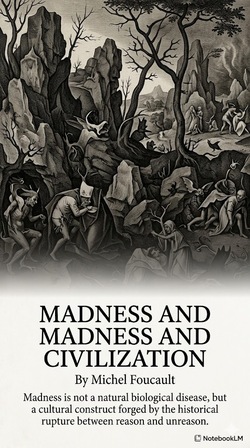
In *Madness and Civilization*, Michel Foucault upends traditional views of mental illness by tracing how Western society has constructed, marginalized, and controlled 'madness' over centuries. Starting with medieval leper isolation—whose exclusionary structures persisted long after the disease faded—Foucault explores the Renaissance's 'fool ships,' which banished the insane as both outcasts and objects of mythic fascination. He dissects the 17th-century rise of mass confinement, where madpeople were locked alongside beggars, criminals, and the unemployed not for treatment, but to enforce social order and moral discipline. Finally, he exposes the 19th-century asylum as a site of subtle, pervasive control: what seemed like humanitarian reform (e.g., Pinel removing chains) was actually a new system of moral judgment, silence, and surveillance. Foucault argues madness is not a natural medical condition but a product of power dynamics, revealing how rationality has defined itself by suppressing the irrational.