
Economic Development and Value Choice: Complete Chapter-by-Chapter Summary
Welcome to today's session on Chen Chunhua's groundbreaking work, *Economic Development and Value Choice*. Set against the backdrop of soaring skyscrapers and the relentless march of modernization, this book tackles a profound question that defines our era: how do we navigate the turbulent intersection of market wealth and human dignity?
As we stand on the brink of a new century, traditional moral compasses are shifting. We live in a time of intense value oscillation, where the boundaries of what is "right" are constantly being redrawn, and the pursuit of economic growth often seems to overshadow the deeper purpose of personal and social evolution. Chen Chunhua invites us to look beyond the numbers. He reminds us that true modernization isn't just about changing systems or adopting new technologies; it's about the modernization of the human spirit itself.
The core of this journey is understanding our own humanity. We are not just biological creatures driven by instinct; we are social beings shaped by complex relationships and conscious choices. As the book explores, the ultimate goal of development is to transform the "traditional person" into the "modern person"—someone who possesses self-awareness, critical thinking, and the courage to choose their own path. It's about moving from passive survival to active creation, from blind conformity to responsible freedom.
In a world where material success is often equated with worth, Chen challenges us to find a new coordinate system. He argues that our value isn't defined by how much we earn, but by how we contribute, how we relate to others, and how we uphold our dignity amidst the chaos of change. This isn't just an economic analysis; it's a call to reawaken our souls. It's a reminder that while the economy drives our society, it is our values that must steer it.
So, as we dive deeper into this text, let's ask ourselves: In the rush toward economic prosperity, are we losing our way? How do we build a future that honors both our ambition and our humanity? The answers lie in the pages ahead, waiting for us to discover the ultimate purpose of our own evolution.

We stand at a crossroads, caught between unprecedented wealth and a deep, unsettling anxiety. As the slide illustrates, economic acceleration has unlocked tools to conquer scarcity, yet we are suffering from a distinct loss of purpose. This is the paradox of our time: we have mastered the market, but are we mastering life?
Look at the tangled lines below the upward arrow. This represents "value confusion." In a rapidly changing world, traditional moral compasses have shifted. We see a rise in relativism, where right and wrong become fluid, and the pursuit of self-interest often overshadows collective good. Surveys from the 90s revealed a troubling trend: a significant majority of young people prioritized personal interests over social needs, viewing the world through a lens of individual gain rather than shared responsibility.
But here lies the critical question: Are we merely becoming subservient components of the market economy, or are we truly mastering it? The text warns that while the market drives material progress, it can also distort our values, leading to a culture of hedonism and materialism where money becomes the ultimate measure of worth. However, the solution isn't to reject the market, but to reorient our values. True human development requires balancing personal ambition with social contribution. We must move beyond the "self" and embrace the "we," recognizing that our individual potential is only fully realized when we contribute to the greater good. By anchoring our choices in a sense of shared responsibility and purpose, we can transform economic power into a force for human liberation, ensuring that our progress lifts us all, rather than leaving us lost in the chaos of our own making.

True human essence cannot exist in isolation. As we explore the layers of what it means to be human, we see that our identity is built on three distinct but interconnected attributes.
First, we have our Natural Attribute. This isn't just about raw animal instinct; it's our fundamental biological needs—like eating, drinking, and loving—elevated by our conscious purpose. We transform mere survival into meaningful experiences.
Moving inward, we find our Thinking Attribute. This is the uniquely human spark: our capacity for self-reflection and the ability to ask "Why?" It's what separates us from the rest of the nature, allowing us to question our existence and shape our own path.
But at the very center lies our Social Attribute, which is the defining core of humanity. We are the sum of our social relations. Without connection to others, without the web of relationships that binds us, we cannot achieve true actualization. We are not isolated islands; we are defined by our interactions.
So, remember this: while we possess natural drives and unique minds, our true essence flourishes only when we connect. We are social beings, and our humanity is found in our relationships with one another.
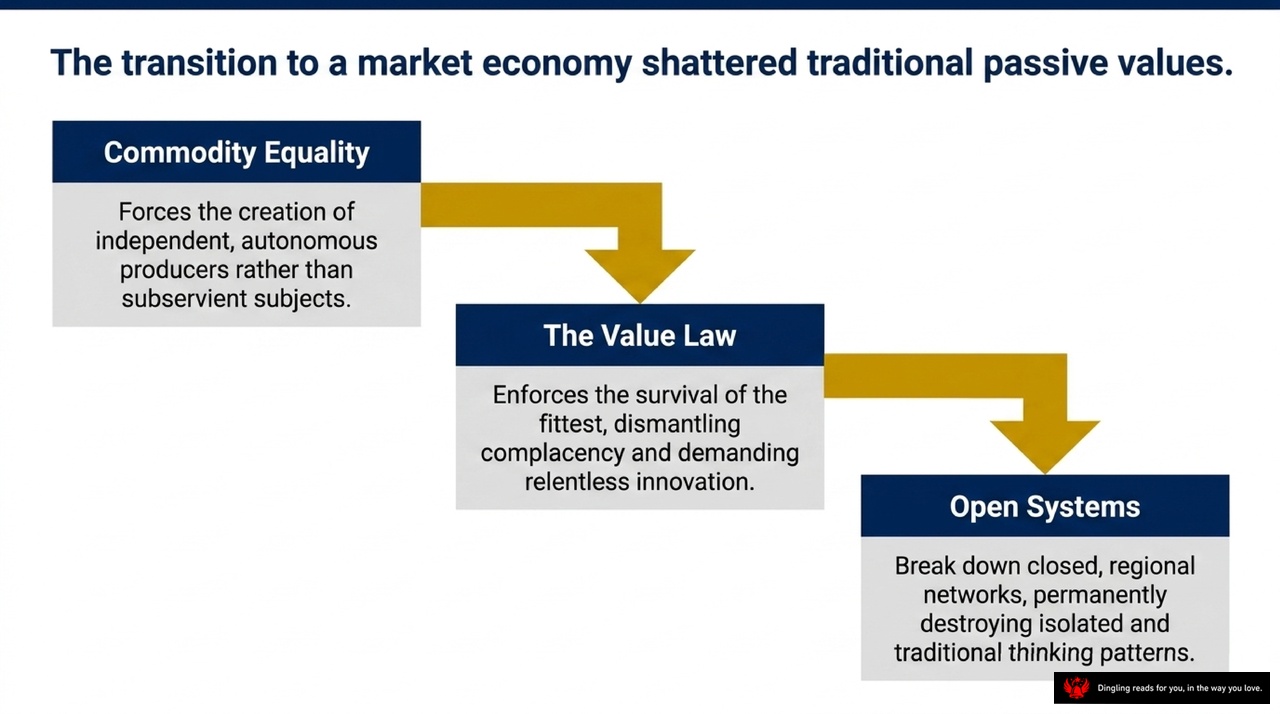
The slide we see here captures a profound truth: the shift to a market economy didn't just change how we make money; it shattered our old, passive ways of thinking. Let's break down this transformation into three powerful shifts.
First, look at **Commodity Equality**. In the old days, people were often just subjects, waiting for orders. But the market forces us to become independent, autonomous producers. You can't just be a follower anymore; you have to stand on your own two feet and make your own decisions.
Next, we hit **The Value Law**. This is the engine of the market. It enforces the survival of the fittest. It ruthlessly dismantles complacency and demands relentless innovation. If you're lazy or satisfied with the status quo, the market will simply leave you behind. It's a constant push to improve, to be better, and to stay relevant.
Finally, this leads to **Open Systems**. The market breaks down those closed, regional networks that used to isolate us. It destroys those old, traditional thinking patterns that kept us stuck in the past. Now, you have to think globally, adapt quickly, and embrace change.
In short, the market economy didn't just change our wallets; it forced a complete reinvention of who we are. It moved us from passive followers to active creators, from comfortable complacency to relentless innovation, and from isolated traditions to an open, connected world.
When we talk about the "inner value" of life, we're really talking about one thing above all: creation. Thomas Paine once said, "An honest man is the noblest work of God," and that nobility comes from our unique ability to create. It's not reserved for geniuses; it's the very essence of what it means to be human.
Think about it: animals act on instinct, but humans actively shape their own destiny. Whether it's the first stone tool chipped by a caveman or the latest probe sent to the edge of the universe, every act of creation pushes the boundaries of what's possible. This is the engine of progress. It's not just about changing the world around us; it's about transforming ourselves in the process. When we create, we unlock our full potential, moving from who we were to who we could be.
But here's the most powerful part: creation gives our finite lives infinite meaning. Death is inevitable, but those who leave behind something meaningful—whether it's the *Shiji* written by Sima Qian, the *Compendium of Materia Medica* compiled by Li Shizhen, or the epic *Faust* penned by Goethe over 60 years—transcend time. Their work lives on, proving that while our bodies fade, our impact remains.
True value isn't about how much money you make or how high your title is. It's about taking responsibility for your choices and contributing to something bigger than yourself. As we navigate a complex world, remember: your worth is defined not by what you consume, but by what you create.
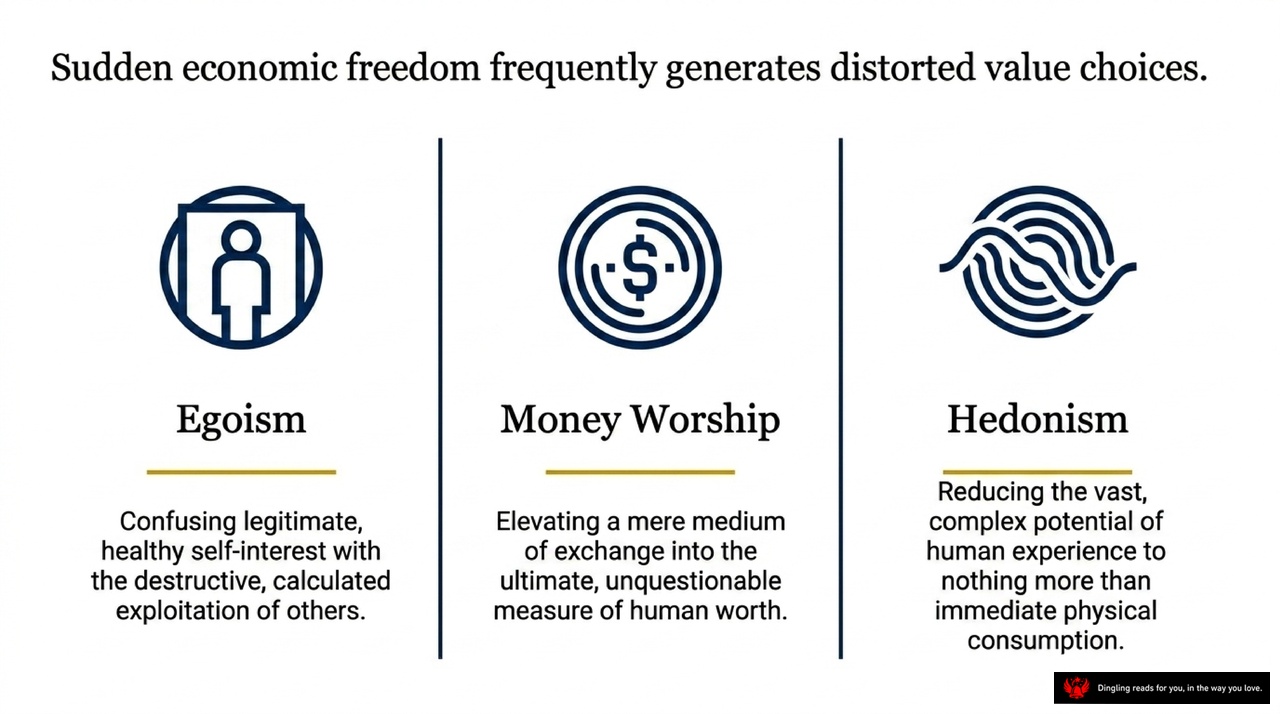
Imagine a world where happiness is defined solely by the next purchase, the next vacation, or the latest status update. This is the trap of hedonism, a mindset that mistakes material comfort for a fulfilled life. The text warns us that when we make pleasure our only goal, we don't rise above animals; we simply become creatures driven by instinct, devoid of higher purpose. It's a dangerous illusion to think that life is just a dream meant to be enjoyed until it ends.
The real cost of this "hedonistic trap" is spiritual emptiness. Even if you have everything money can buy, you can still feel a deep, crushing void because you've lost your ambition and your connection to something greater than yourself. True happiness isn't found in passive consumption; it's forged in the fires of creation and contribution. As the book reminds us, the happiest people aren't those who eat and play, but those who work hard, create wealth, and dedicate their lives to a cause larger than themselves.
So, how do we escape? By shifting our focus from "what can I get" to "what can I give." We must reject the idea that life is short, so we should rush to enjoy it. Instead, we should recognize that our value comes from our efforts and our impact on the world. The path to a meaningful life isn't paved with luxury goods, but with the courage to strive for something noble, to leave a mark that lasts beyond our own fleeting existence.
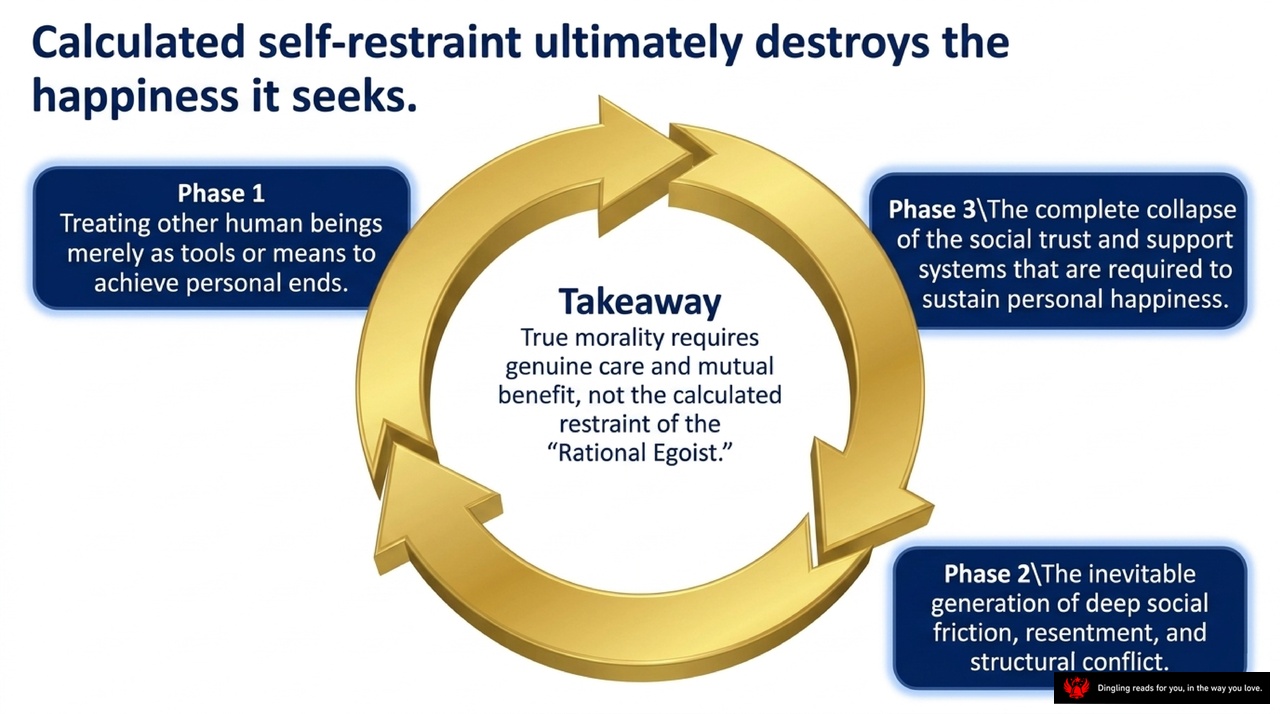
In the rush of rapid economic growth, we often find ourselves in a strange paradox: we are the lucky beneficiaries of opening up, yet we are more confused than ever. While we clearly know that living solely for pleasure is like being a zombie, we still feel lost and uncertain when striving for ideals. Late at night, many young people ask themselves the same question: What is the purpose of my life? What direction should I take? But they find no clear answers.
This confusion isn't limited to students; it permeates our entire society. From the rush to study abroad and the rise of superstition, to超前 consumption and frequent job-hopping, these social issues have left us wondering: What is wrong with our society? Some blame economic development, but looking at countries like Japan and South Korea, we see that economic growth doesn't automatically lead to social chaos. The real culprit is our skewed value system. When traditional standards of right and wrong blur, and we see that "good intentions don't always lead to good results," chaos inevitably follows.
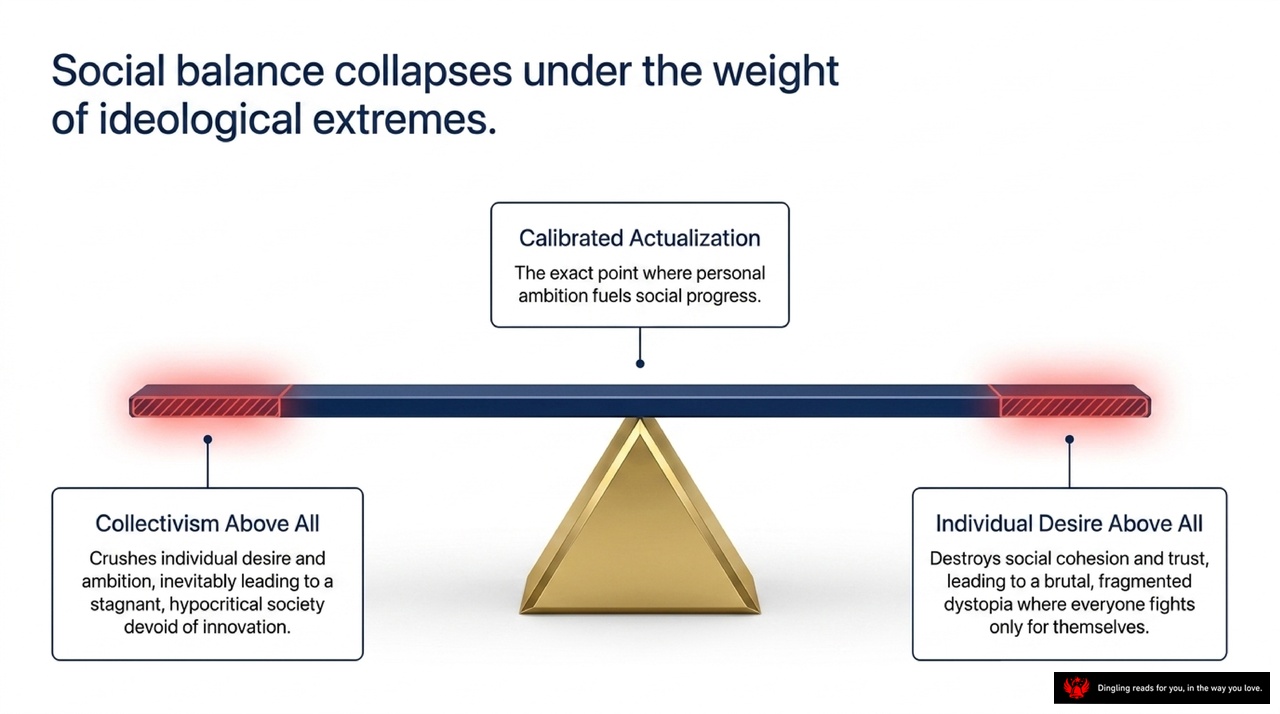
So, how do we judge what truly matters? We must reject the extreme view that "the whole is always supreme," which can become a tool for privilege. Equally dangerous is the opposite extreme: putting personal desires above everything. If everyone chases their own selfish needs without limits, society collapses into a war of all against all. Neither extreme works.
The answer lies in a balanced approach: "Rational Self-Interest." This isn't about being selfish; it's about recognizing that while we naturally care about ourselves, our personal well-being is deeply tied to the health of society. We must move beyond blind altruism that ignores our own needs, and also beyond ruthless egoism that harms others. True value is found where individual growth and social progress meet. Only by establishing a clear, reasonable standard for evaluating life can we navigate this turbulent time and find our true path.

We do not engineer human beings to serve the economy; we engineer the economy to provide the material foundation for the comprehensive, free development of the individual. Think of this not as a pyramid where humans are merely the base, but as a dynamic structure where the economy is the essential machinery designed to eradicate scarcity and build the wealth necessary for human flourishing. At the very top sits our ultimate goal: Human Development. This is the singular, ultimate purpose of everything we build. The takeaway is clear: the economy exists to serve us, not the other way around. We shape our economic systems to create the conditions where every person can realize their full potential, ensuring that material progress always points toward the liberation and growth of the individual.

Let's talk about what it truly means to leave a mark on this world. We all face the inevitable question: "What should I become?" The answer lies not in escaping our limits, but in fully unleashing our unique talents. Think of the four archetypes from Greek mythology—Tantalos, Prometheus, Sisyphus, and Oedipus. Each represents a different struggle against nature, society, meaninglessness, and fate. Their stories remind us that life is a constant battle, yet it is within this struggle that we find our true purpose.
True self-realization isn't about avoiding failure or waiting for perfect conditions; it's about taking responsibility for your own design. It starts with trusting yourself and staying true to your own conscience. When you commit to your own path, you stop being a passenger in your own life. You become the architect of your destiny, shaping your career, your character, and your attitude. At the heart of this design is your core value system—your compass for navigating life's challenges.
But the journey doesn't end with personal growth. Self-realization is also about transcending the self. It means embracing the full spectrum of human experience, celebrating both triumphs and failures. It's about expanding your "small self" into a "greater self," connecting your personal dreams with the needs of the world. When you do this, you realize that overcoming the fear of death isn't about living forever; it's about creating something that outlives you.
Consider the artists, philosophers, and innovators who shaped history. Their work remains relevant centuries later because they contributed something meaningful to humanity. This is the essence of immortality—not biological survival, but the enduring impact of your ideas and actions. As the ancient Chinese philosophy teaches, true legacy is built through virtue, achievement, and wisdom.
And let's not forget the power of solitude. Great minds often find their deepest insights in quiet moments alone. Loneliness isn't a curse; it's a space for reflection and growth. It's where you connect with your inner self and prepare to face the world with clarity and purpose.
Ultimately, the goal is to live a life of significance. To seek truth, goodness, and beauty. To turn the awareness of our own mortality into a driving force for action. When you dedicate yourself to a noble cause, when you create something that brings value to others, you transcend the limitations of time. You become part of something greater than yourself. That is the highest form of human achievement. That is how you achieve true immortality.

True individual development requires structural alignment across three dimensions, just like a temple standing on three pillars. Think of your life not as a random collection of events, but as a cohesive structure where every part supports the other.
The first pillar is your **Physical & Intellectual foundation**. This is the bedrock requirement. It's about building baseline health, stamina, and sharpening your cognitive capabilities. Without this physical and mental strength, you simply don't have the energy or the sharp mind needed to tackle the challenges of modern life.
The second pillar is your **Spiritual & Moral core**. This acts as your internal compass. It involves developing strong ideals, cultivating an appreciation for beauty and culture, and forging unbreakable willpower. This is what gives your life direction and integrity, ensuring you don't get lost when the winds of change blow.
The third pillar is **Objectification**, which represents your external action. This is the crucial step of translating your inner potential and moral intent into tangible contributions to society. It's about moving from simply "being" to actively "doing," leaving a mark on the world through your work and interactions.
As the book reminds us, the essence of human nature lies in our social relationships and our ability to create. True value isn't found in isolation; it emerges when you align these three dimensions. When your physical strength, moral character, and social contributions work in harmony, you achieve comprehensive human development. You stop drifting and start building a life that is both deeply personal and meaningfully connected to the world around you.
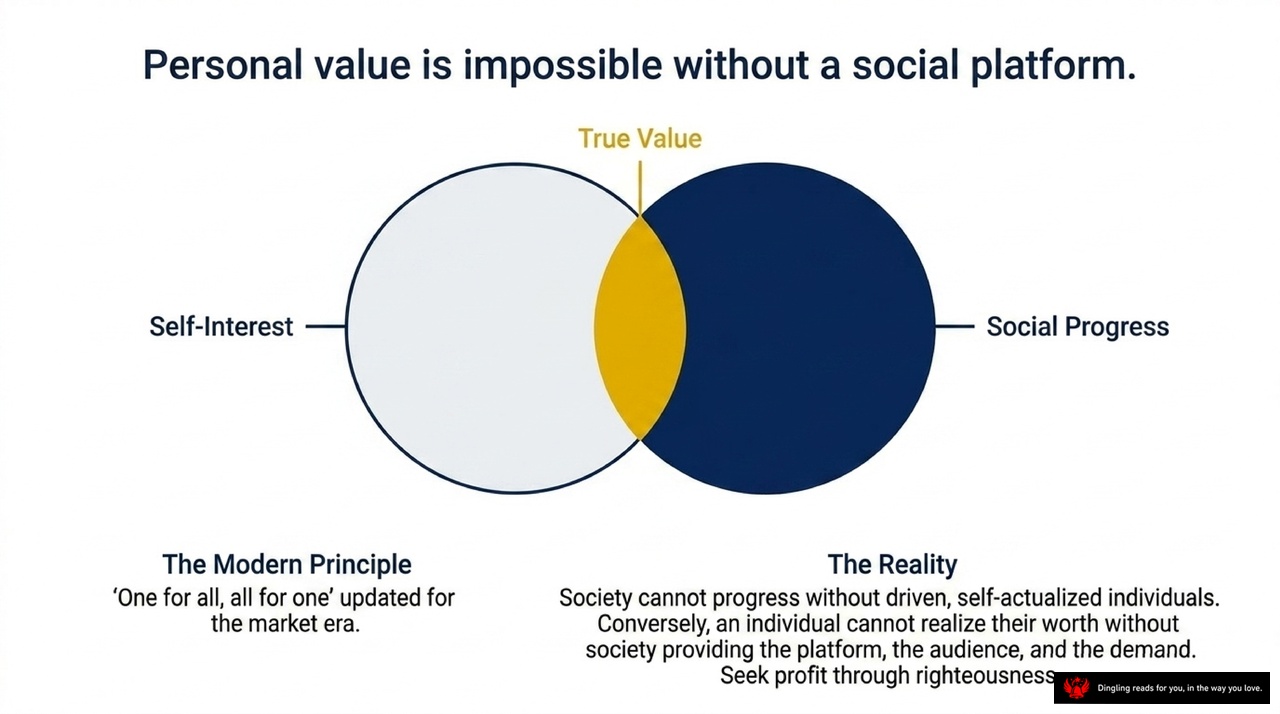
In the modern era, we often face a fundamental dilemma: how do we balance our personal ambitions with the needs of society? Today's slide offers a powerful answer through a simple yet profound Venn diagram. It illustrates that personal value and social progress are not opposing forces, but rather two circles that must overlap to create something greater.
On the left, we have "Self-Interest," representing the drive to achieve our own goals and realize our potential. On the right, we see "Social Progress," symbolizing the advancement of our community and the betterment of the world around us. The magic happens in the golden intersection where these two circles meet. This is labeled as "True Value."
The diagram clearly states that "Personal value is impossible without a social platform." This isn't just a slogan; it's a reality. As the text explains, society cannot progress without driven, self-actualized individuals pushing forward. Conversely, an individual cannot truly realize their worth without society providing the necessary platform, audience, and demand. Think of it this way: your unique talents are like a seed. Without the rich soil of a supportive society and the opportunity to connect with others, that seed may never bloom.
The slide also introduces "The Modern Principle," updating the old idea of "One for all, all for one" for our market-driven age. It reminds us that seeking profit should always be grounded in righteousness. True success comes when we align our self-interest with the greater good. When we contribute to social progress, we inadvertently create the very conditions that allow us to thrive personally. So, don't see your success as a zero-sum game. Instead, view your growth as a catalyst for the world's advancement. In this dynamic balance, you and society rise together, creating a legacy that is both personally fulfilling and socially meaningful.
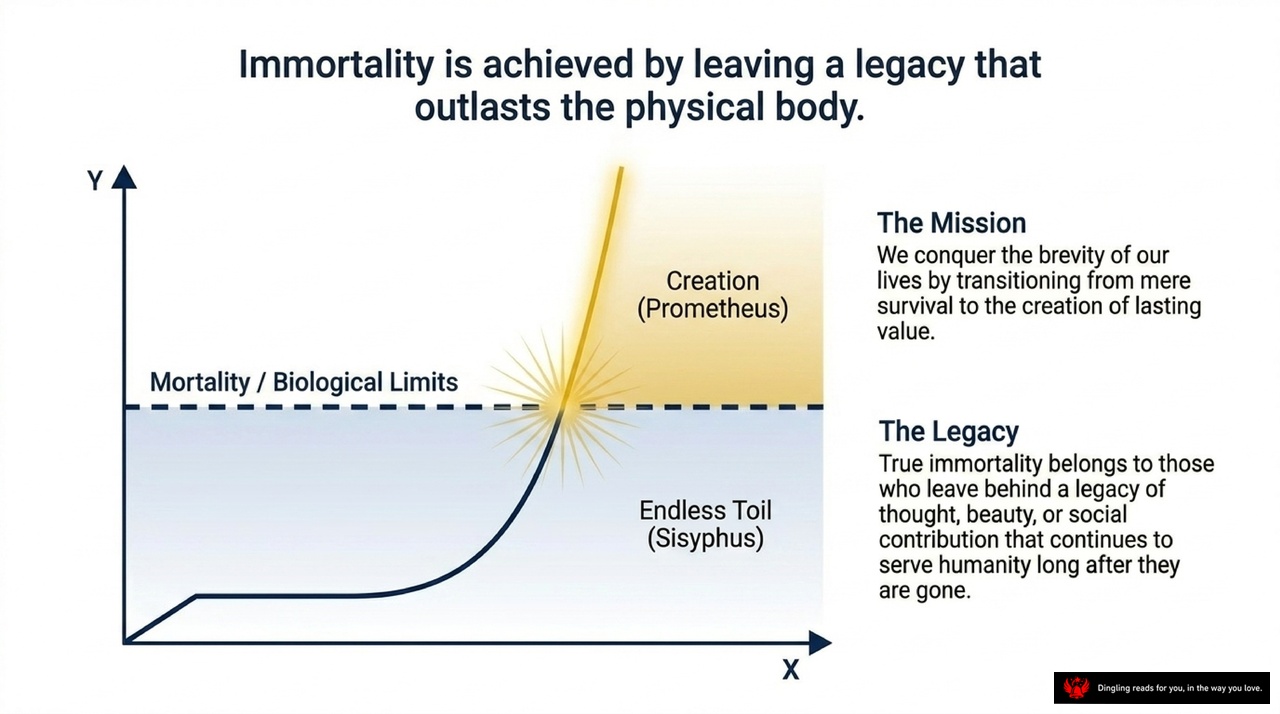
Today's slide captures a profound truth: immortality isn't about keeping your body alive forever; it's about leaving a legacy that outlasts your physical existence. Look at this curve. Below the dashed line labeled "Mortality," we see the trap of "Endless Toil," likened to Sisyphus—a life of repetitive struggle that yields no lasting value once we're gone. But cross that threshold into "Creation," and you enter the realm of Prometheus. This is the shift from mere survival to generating lasting value.
The slide defines this clearly under "The Mission": we conquer the brevity of our lives by transitioning from simple survival to creating something that endures. This is the core of "The Legacy." True immortality belongs to those who leave behind a legacy of thought, beauty, or social contribution that continues to serve humanity long after they are gone. It's not about how long you live, but how deeply your work resonates. As the text reminds us, life's value lies not in its length, but in its content. By creating something that outlasts us, we break free from the cycle of endless toil and achieve a form of immortality that truly matters.

Look at this chart. It maps the evolution of human values from passive compliance to holistic self-actualization. We see three distinct stages: the Traditional Economy, the Unchecked Market Economy, and finally, The Transcendent Society.
In the traditional model, wealth was often ignored or even despised. The individual was expected to be subservient to the collective, with social stability as the ultimate goal. This is the era of conformity, where personal desires were suppressed for the sake of the group.
Then came the unchecked market economy. Here, the view of wealth shifted to obsessive accumulation. The individual became an isolated competitor, fighting for survival in a cutthroat environment. The ultimate goal narrowed down to hedonistic consumption—chasing pleasure and material goods above all else. This is the trap of modern consumerism, where we compete alone and measure our worth by what we buy.
But the chart points us toward a third path: The Transcendent Society. In this vision, wealth is redefined not as an end, but as a foundational tool—a means to support life, not a master to serve it. The individual transforms from an isolated competitor into an empowered creator, free to innovate and express their full potential. And the ultimate goal? Comprehensive self-actualization. It's about realizing your true potential while contributing meaningfully to the world.
This shift isn't just about economics; it's about reclaiming our humanity. Instead of being passive followers or selfish competitors, we can become active creators who find fulfillment in building something greater than ourselves. That is the promise of moving from the old ways to this transcendent future.
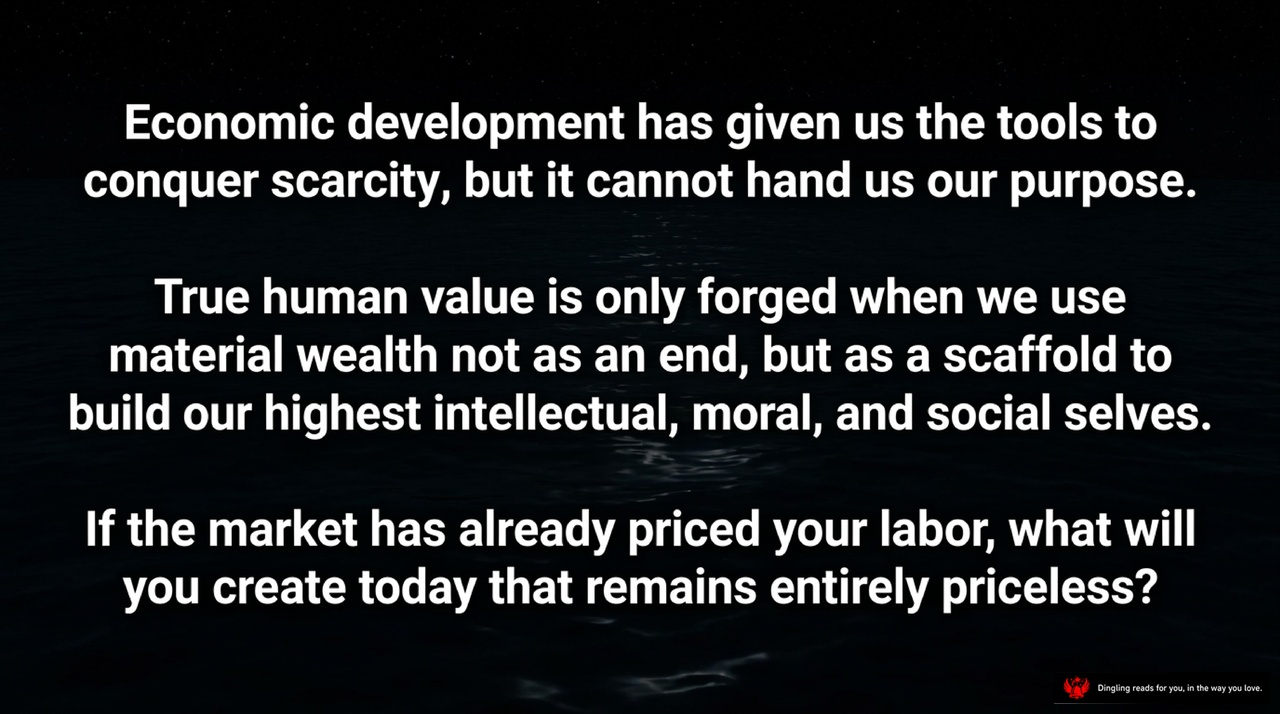
Economic development has handed us the tools to conquer scarcity, but it hasn't given us our purpose. That's the hard truth we face today. We often treat material wealth as the end goal, but true human value is only forged when we use those resources as a scaffold to build our highest intellectual, moral, and social selves.
Think about it: if the market has already priced your labor, what will you create today that remains entirely priceless? It's not about the paycheck; it's about what you leave behind that money can't buy. In a world where everything seems to have a price tag, the only thing that truly matters is your contribution to the greater good, your integrity, and the unique spark of your character.
We need to stop chasing just wealth and start chasing value. When we align our personal growth with the needs of society, we transform from mere economic units into meaningful human beings. Your worth isn't defined by what you can buy, but by how you help others, how you innovate, and how you stand for what's right. Let's make sure that in our pursuit of success, we never lose sight of our humanity and the priceless value we bring to the world.