
Eight Crises: Complete Chapter-by-Chapter Summary

Welcome to our book club session on Wen Tiejun's *Eight Crises*. Today, we're diving into a powerful idea that reshapes how we view China's economic miracle. The slide you see right now captures the core thesis: China's success isn't just a straight line of growth; it's a history of cyclical macroeconomic crises absorbed by its rural foundations.
Think of it this way: while many developing nations fell into a "development trap" by blindly copying Western models, China found a unique path. It turned its vast rural base into a massive shock absorber. When cities faced economic downturns, inflation, or debt crises, the countryside stepped in. Through the "scissors difference" in prices, cheap labor, and land resources, the rural sector silently funded industrialization and soaked up the costs of urban instability.
This "cost-shifting" logic explains why China could survive eight major crises over the decades. The rural foundation acted as a safety valve, allowing the economy to achieve a "soft landing" repeatedly. Without this unique buffer, the pressure would have shattered the urban system entirely. As we explore the book, we'll see exactly how these eight crises unfolded and why the relationship between the city and the countryside was the key to China's survival and rise.

The Myth of the Unbroken Miracle isn't just a catchy title; it's the central argument of this slide. On the left, you see the "Myth": the belief that post-1949 China followed a single, unbroken trajectory of miraculous growth, boasting an average of 8% annual GDP expansion. But look at the right side. That cracked stone reveals the "Reality." Behind that smooth growth curve lay a history of cyclical, predictable capitalist crises. From 1949 to 2009, China didn't avoid the "Development Trap" by magic; it survived by developing a unique mechanism to survive its inevitable crashes.
The book argues that China's rapid capital accumulation was fraught with these very crises. While the narrative often paints a picture of uninterrupted success, the data tells a different story. The nation's stability wasn't built on avoiding failure, but on finding a way to absorb the shock of it. This slide challenges us to stop viewing China's history as a straight line and start seeing it as a series of managed disruptions. It's a story not of a perfect miracle, but of a resilient nation that learned to bend without breaking, turning potential economic collapses into opportunities for structural survival.

The image on the screen illustrates a critical concept known as the "Cost-Transfer Mechanism." It depicts a heavy block labeled "Urban/Industrial Capital" pressing down on a layer of earth, while red arrows show pressure being pushed downward into the "Rural/Agricultural Sector." This visual perfectly captures how China survived by internalizing the costs of development that other nations often export.
Unlike many developing nations that fall into a "Development Trap" because they cannot externalize the institutional costs of industrialization like Western colonizers did, China utilized a unique strategy. Through an Urban-Rural Dual Structure, the state systematically transferred the burdens of urban capital deficits—such as unemployment and inflation—downward into the rural agrarian base. This allowed the urban sector to achieve a "soft landing," ensuring stability while the industrial engine accelerated.
This mechanism was essential for China's survival. While the urban block bears the pressure, the rural sector acts as a shock absorber, absorbing the economic shocks that would otherwise destabilize the entire system. This internalization of costs is what allowed China to navigate crises that would have toppled other developing economies.

Look at this diagram, "The Anatomy of the Rural Sponge." It illustrates a brilliant, yet often overlooked, survival strategy that kept China stable during decades of global economic shocks. Think of the top stone beam labeled "Urban Capital Volatility & Economic Shocks" as the pressure from the outside world—financial crises, market crashes, and instability. Below that, three sturdy pillars hold up the entire structure, preventing it from collapsing.
The first pillar is "Institutional Separation," or what we call the dual structure. This is the strict household registration system, or *hukou*. It acted like a gatekeeper, structurally isolating the countryside. While the city rushed to industrialize, this system trapped labor and resources in the rural areas, effectively serving as a reserve force for urban growth without letting everyone flood in at once.
Next, we have "Land as Insurance." This is the heart of the sponge. Because collective land was distributed equally, it provided a non-market, risk-free asset for every peasant. Even if you lost your job in the city, you always had a plot of land to fall back on for basic survival. It wasn't just about farming; it was a safety net that guaranteed no one was left behind in poverty, no matter how bad the economy got.
The third pillar is "Village Rationality." This refers to the traditional communal and kinship structures within villages. These communities didn't need the state to provide welfare. Instead, they internally absorbed the costs of excess labor. When the city couldn't take more workers, the village took them in, bypassing the need for expensive government social security programs.
Together, these three mechanisms allowed China to act as a giant shock absorber. When the global economy hit a wall, the rural sector absorbed the blow, allowing the urban economy to reset and recover. This unique blend of policy, land rights, and community spirit is exactly why China avoided the "development traps" that trapped so many other nations, turning a potential crisis into a manageable adjustment.

The Stratigraphy of Volatility: 1958–2009. This chart maps the eight major economic shocks that hit China over six decades, revealing a clear evolution from internal struggles to global integration.
Look at the timeline. The first era, from 1958 to 1976, is labeled "Primitive Accumulation." During this period, China faced three major spikes: the Soviet withdrawal in the late 50s, the "Third Front" defense construction in the 60s, and Western equipment import debt in the mid-70s. The visual shows these shocks striking a layered rock formation, symbolizing how the state absorbed these costs by transferring them to the countryside, keeping the urban system stable while the rural sector bore the burden.
Then, from 1978 to 1997, we enter the "Marketization Costs" phase. This era saw four distinct spikes: reform deficits, price reform inflation, the Triangle Debt Crisis, and the Asian Financial Crisis. Notice how the cracks in the rock layer deepen. This period marked the painful transition as China tried to balance domestic reforms with opening up to the world, often facing severe inflation and debt traps that previous generations had avoided.
Finally, the chart culminates in 1997–2009 with "Global Integration." Here, the rock becomes dark and fractured, representing a new vulnerability. The last two spikes—the 1997 Asian Crisis and the 2008 Global Financial Tsunami—show that as China became deeply integrated into the global economy, it was no longer immune to external shocks. The 2008 crisis, imported from the West, hit China hardest, exposing the limits of relying on external demand.
This stratigraphy tells a powerful story: China's path wasn't linear. It moved from hiding behind the rural sector to navigating marketization, and finally to facing the full force of global volatility. Understanding these layers is key to grasping why today's economic challenges are so complex.
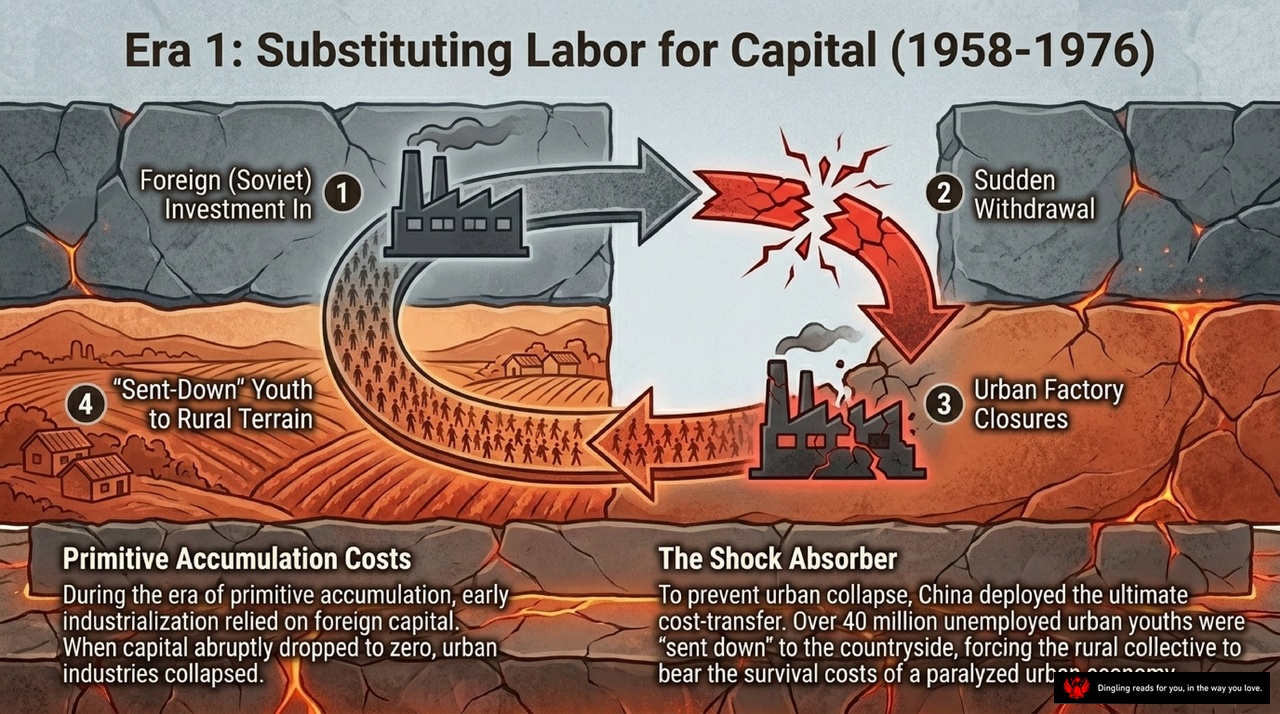
Era 1: Substituting Labor for Capital (1958-1976)
Look at this cycle. It tells the story of China's first great industrial gamble. In the 50s, foreign capital from the Soviet Union poured in to build our factories, but when that support suddenly vanished, the urban economy crashed. To save the day, the government pulled a desperate move: it closed the city factories and sent over 40 million unemployed urban youth back to the countryside. This "Shock Absorber" strategy allowed the rural collective to bear the survival costs of a paralyzed urban economy, preventing total societal collapse. It was a painful transfer of primitive accumulation costs, but it bought us time to rebuild.
Now, let's fast forward to the 90s. We faced another crisis—fiscal, financial, and foreign exchange deficits hitting all at once. The government's budget share of GDP plummeted to just 12.6%, making it impossible to even pay public servants' salaries. To cope, the state again turned to the countryside. It extracted resources from farmers to cover urban debts and launched a massive land grab to fund industrialization. This era saw the rise of "land finance," where local governments became addicted to selling land to fill their coffers, leading to severe environmental damage and the loss of millions of homes for farmers.
But here's the twist: while the city faced a hard landing with mass layoffs and social unrest, the rural sector actually became the engine of recovery. By lifting the ban on private rural enterprises, the countryside industrialized on its own, absorbing the displaced urban workers and driving the economy back up. So, from the 50s to the 90s, the pattern remained the same: when the city hit a wall, the rural sector absorbed the shock, acting as the ultimate safety valve for the entire system.

Era 2: The Price of Marketization (1978-1994)
Welcome to the second chapter of our journey, where we dive into the turbulent decade from 1978 to 1994. This wasn't just a period of growth; it was a high-stakes gamble on marketization that came with a heavy price tag.
As we look at the diagram, the core engine driving this era was the shift toward **Decentralized Local Governments**. Think of it as handing the keys to the cities and counties. While this unleashed incredible energy, it also led to **Overheating: Blind Industrial Expansion**. Local officials, desperate to show results, threw money at factories without a clear plan for demand. This rapid, unchecked expansion quickly created a toxic mix of **Inflation, Triangle Debt, & Mass Layoffs**.
The consequences were severe. We saw **massive domestic debt** and **hyperinflation** spiral out of control. The infamous "Triangle Debt"—a cycle where state-owned enterprises borrowed from each other until no one could pay—crippled the economy. The system was so stressed that the pressure gauge on the right is practically in the red.
So, how did the state survive this shock? It used a strategy we call **The Shock Absorber**. Instead of letting the city collapse, the state stabilized the core by initiating **mass layoffs of urban workers**. Millions of skilled workers were suddenly "let go," often without severance or social safety nets. But the cost didn't stop there. The state extracted an agricultural surplus from the countryside through extreme **'price scissors'**, artificially lowering food prices for the city while keeping rural costs high. This effectively shifted the burden downward, onto the farmers and the rural core.
This era taught us a hard lesson: when you expand industrial capacity blindly without a plan, the debt you create today becomes the crisis of tomorrow. And when the system hits a wall, the pain is often paid by those who have the least power to resist.

1994: The Pivot to Global Markets
Imagine the Chinese economy as a high-stakes seesaw in 1994. On one side, a massive, burning weight labeled "1994 Fiscal Crisis," where central revenue had plummeted to less than 12% of GDP. It was a tipping point so severe that even paying public sector salaries became impossible. But instead of collapsing, the state used this crisis as a lever to launch China onto a new trajectory.
At the center of this pivot was the "Tax Sharing Reform." This wasn't just about balancing books; it was a strategic move to reclaim fiscal power from the local level. By tightening the central government's grip, the state forced municipalities to find new ways to survive. This led to the "Commodification of Rural Land," or "Land Finance." Essentially, rural land was transformed into an asset that could be sold and leveraged, creating a massive new engine for growth that shifted the cost of urbanization onto the countryside.
Simultaneously, this reform unleashed the "Export-Driven Global Factory." With the domestic market constrained and local governments desperate for revenue, China aggressively redirected its massive overcapacity outward. The country pivoted hard toward the global economy, becoming the world's workshop. This dual strategy—internalizing costs through land finance and externalizing production through exports—didn't just solve the fiscal crisis; it fundamentally rewired China's economy, embedding it deep into the global market system and setting the stage for decades of rapid expansion.

Era 3: The Imported Crises (1997 & 2008). Look at this map. As China integrated into the US-dominated global financial system, its vulnerability fundamentally shifted. The red ripples you see here aren't just lines; they represent catastrophic external demand shocks hitting China's vast, export-reliant manufacturing base.
Here's the critical insight: The 1997 Asian Financial Crisis and the 2008 Global Financial Tsunami were not internal capital failures. They weren't about China's domestic economy breaking down on its own. Instead, they were direct consequences of the external world closing its doors. When the US and its allies faced their own crises, they stopped buying Chinese goods. That sudden halt in demand shattered China's growth engine, which had become dangerously dependent on exports.
In 1997, the Asian crisis exposed how fragile China's export-driven model was, forcing a painful adjustment. But the 2008 shock was far more severe. It was a global financial tsunami originating from Wall Street that swept away China's gains. The lesson is clear: once China became deeply embedded in a system where the US sets the rules, its economic stability became tied to the health of the American economy. When that system faltered, China absorbed the brunt of the damage. This era marks a turning point where China could no longer rely on internal buffers alone; it had to navigate the turbulent waves of a global system it helped build but could not fully control.

Shifting Paradigms: Internal vs. Imported Crises
Let's dive into how China's approach to economic crises has fundamentally changed over the last few decades. The slide highlights a clear divide between two distinct eras: the pre-1994 period of Internal Crises and the post-1997 era of Imported Crises.
Back in the pre-1994 days, China faced domestic overheating and capital deficits. The government's response was to contract the state, cut welfare, and send urban labor to the countryside. The heavy social burden? It was internalized by rural collectives, who effectively absorbed the poverty and instability.
But the game changed completely after 1997. As China integrated into the global economy, crises shifted from internal to imported. Suddenly, the origin of the crisis wasn't local; it was global financial contagion and a collapse in foreign demand. Instead of shrinking, the policy response flipped to massive state expansion, stimulus packages, and heavy infrastructure spending. This time, the social burden didn't stay in the countryside. It was borne by displaced migrant workers and manifested in ecological degradation.
Essentially, China moved from a strategy of pushing costs into the rural hinterland to one of pumping money into the urban economy to fight external shocks. This shift defined the modern era of China's development, turning the nation into a buffer against global financial storms, but at a new cost for its urban and environmental future.
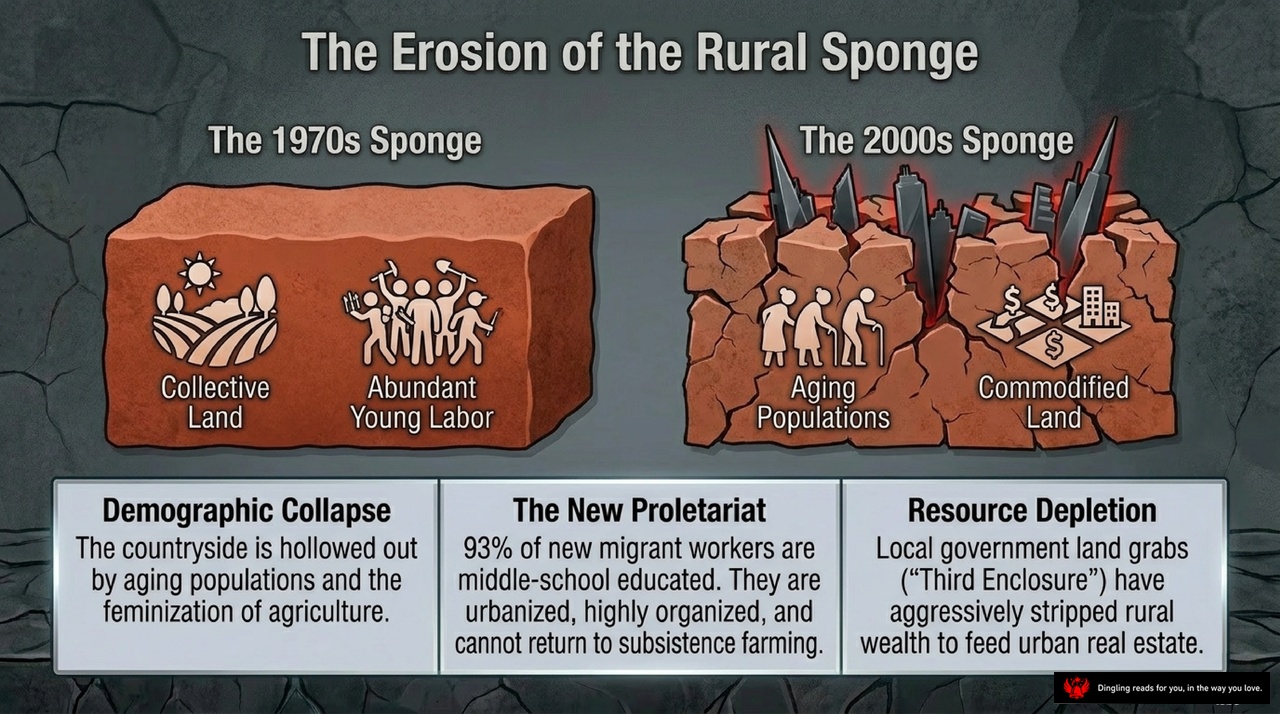
The 1970s sponge was full and resilient, built on collective land and a workforce of young, energetic laborers ready to build the future. But fast forward to the 2000s, and that same sponge is cracked and crumbling under immense pressure. Instead of vibrant fields, we see aging populations and a shift toward commodified land, where value is extracted rather than created. This erosion is driven by three critical forces: a demographic collapse that hollows out the countryside, the rise of a new proletariat trapped in urban areas with limited prospects, and the aggressive depletion of resources by local governments. As rural areas lose their stability, the once-reliable buffer that protected the nation's economy is now under threat, forcing us to confront the urgent reality of how to rebuild a sustainable foundation for the future.

Look at this graphic illustrating how China rebuilt its economic buffer in 2005. The image shows "Central Government Wealth" pouring trillions into infrastructure, effectively reconstructing a rural safety net that was previously cracking under pressure. This wasn't just about building roads; it was a strategic move to create an "Artificially Reconstructed Rural Buffer" capable of absorbing massive shocks.
The text on the right explains the logic behind this "New Rural Construction" initiative. Recognizing that the rural foundation had become too brittle, the state shifted its strategy in 2005. By preemptively injecting trillions of RMB into rural infrastructure, the government artificially reconstructed a shock absorber. This proactive approach paid off when the 2008 global crisis hit. Unlike previous crises where the pain was transferred elsewhere, this revitalized rural buffer successfully absorbed over 20 million displaced migrant workers. This prevented a systemic social collapse, allowing the economy to land softly despite the external storm. It was a masterclass in using internal structural strength to neutralize external financial threats.

Look at this map. It illustrates what we call "The Geopolitical Escape Route." While the traditional maritime export route from China to the West is shown as a fading path, a new, powerful corridor is emerging. This is the Eurasian and Afro-Asian land bridge, connecting China directly to the Global South.
This shift isn't just about geography; it's a strategic pivot born from necessity. As the text explains, China recognizes the danger of relying on the volatile, financialized capitalism of the West. To break free from the trap of exchanging real manufacturing wealth for toxic Western debt, Beijing is utilizing its massive industrial capacity to build continental infrastructure.
This represents a physical and economic reorientation. Instead of being dependent on the Dollar, China is aligning with the Global South to create a self-sustaining system. By building these land bridges, China is effectively escaping the cycle of "re-dependence," securing its growth through trade with neighboring nations rather than through debt to the West. This is a fundamental change in how the world's economic power is flowing.

For the past sixty years, China's unique path to industrialization relied on a specific, albeit heavy, strategy: using its vast rural agrarian foundation as a shock absorber. When volatile cycles hit the industrial and financial sectors, the rural economy absorbed the blow, allowing the urban system to avoid hard landings. However, as the image suggests, that rural "sponge" is now saturated. Land has been commodified, and the traditional buffer has reached its limit.
This brings us to a critical question: When the foundation can no longer absorb the shocks of the city, where will the costs of the next crisis fall? The era of relying solely on the countryside to protect the urban core is ending. As we move forward, the burden of these inevitable economic adjustments will increasingly shift back onto the very rural areas that once shielded us, forcing a reimagining of how China balances growth with stability.