



This book explains China's rise perfectly.
Your Review
This book explains China's rise perfectly.

I was surprised to learn the market reforms started from rural survival acts.

This book completely changed my view of China's rise by showing how ordinary farmers and street vendors, not government plans, actually built the market economy through risky grassroots experiments that leaders only adopted later.

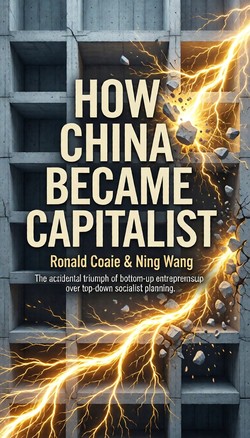
Coase and Wang prove that China's market growth came from ordinary people solving their own survival problems on the fringes of the socialist system, not from any clever top-down masterplan designed by Beijing. Their detailed examples of the Xiaogang Village farmers secretly dividing communal land to feed their families during the famine years, and the township enterprises ignoring bans to create jobs for surplus workers, make it clear that these were accidental revolutions driven by grassroots innovators who had little to lose and everything to gain. This bottom-up approach, where hesitant local officials eventually followed successful experiments rather than leading them, challenges the dominant Western narrative that authoritarian regimes can simply get things done faster through ironclad five-year plans and state-owned giants. By reexamining history through this lens of edge revolutions and pragmatic leadership that prioritized results over ideology, the authors show how China avoided catastrophic collapse by allowing market forces to take root in the margins while adapting to the reality that decentralized, market-aligned methods produced far more food and prosperity than rigid central planning ever could, offering a powerful lesson for other nations struggling to escape stagnation or lift their people out of poverty through flexible, iterative reforms instead of grand blueprints.

I was shocked to learn that top leaders didn't plan China's market reforms but just followed successful grassroots experiments after the facts proved them right, which completely shifts my understanding of how economic transitions actually happen when rigid blueprints fail and local innovators like the farmers in Xiaogang Village take risks to survive, showing that pragmatic adaptation to real problems matters more than ideological purity in driving growth and lifting millions out of poverty without needing a perfect masterplan first.

I found the story of Xiaogang Village farmers surprising. They risked prison to split communal land secretly because hunger forced them to break official rules, proving that bottom-up survival actions often succeed where top-down government plans fail. The book explains how local officials later copied these successful experiments instead of stopping them, showing that China's market economy grew from ordinary people solving real problems rather than from a grand blueprint designed by Beijing. This insight challenges the common Western belief that authoritarian states can efficiently engineer economic miracles through strict central control, suggesting instead that flexibility and allowing grassroots innovation to flourish are the true drivers of development. Understanding this shift helps explain why China avoided the collapse seen in other socialist countries transitioning to markets, as pragmatic leaders prioritized feeding people over ideological purity. The narrative clearly connects historical context with economic outcomes without relying on complex jargon, making it accessible for anyone interested in how unexpected local actions can reshape entire nations. It also highlights the importance of leaders who listen to reality rather than dogma, a lesson relevant for policymakers worldwide facing similar challenges in balancing tradition with necessary change.

Coase and Wang show that China's market growth came from bottom-up edge revolutions where local farmers and entrepreneurs broke rules to survive, proving that successful economic transformation often happens through spontaneous grassroots innovation rather than top-down government masterplans, which challenges the common belief that authoritarian states can efficiently engineer prosperity through centralized five-year plans and state-owned enterprise dominance, while also highlighting how pragmatic leaders like Deng Xiaoping eventually adapted policies to support these unintended but vital experiments, suggesting that flexible governance and tolerance for local trial-and-error are crucial for developing nations seeking to escape stagnation without relying on rigid ideological dogma or external blueprints.

This book shatters the myth that China's rise was a top-down plan, showing instead how grassroots edge revolutions accidentally drove real change.

This book challenges the myth of China's top-down success.

The authors convincingly argue that China's market economy emerged from accidental grassroots edge revolutions rather than a deliberate top-down masterplan orchestrated by Beijing, which fundamentally challenges the dominant Western narrative that credits the state with China's economic miracle and suggests that ordinary people solving their own problems often drive more transformative change than government bureaucrats drafting grand plans, making this a radical rethink of how economic development happens globally. This insight has profound implications for countries around the world, whether they are struggling to escape socialist stagnation or trying to lift their people out of poverty, as it highlights the importance of pragmatic leadership willing to prioritize results over ideology and recognize when a grassroots experiment is working even if it does not fit their original vision, proving that successful transitions often emerge from bottom-up experimentation rather than centralized blueprints. By reexamining China's transition through this lens, we see that the most transformative economic changes come from allowing bottom-up innovation to flourish even when it defies official doctrine, offering a critical lesson that the most efficient systems arise from the dispersed knowledge and actions of millions rather than the limited vision of a small group of policymakers, which aligns with Adam Smith's exploration of the invisible hand and resonates deeply with China's unplanned transformation driven by ordinary people facing desperate circumstances.

This book completely changes how I see China's economic rise by showing that ordinary people, not government planners, actually drove the market reforms through their desperate but innovative survival strategies in places like Xiaogang Village and urban street corners, proving that bottom-up experimentation often works better than rigid state blueprints when leaders stay pragmatic enough to adapt to these unexpected local successes rather than trying to force a perfect ideological model from above that ignores real human needs on the ground.

The book challenges the idea that China's success was a deliberate masterplan. Instead, Ronald Coase and Ning Wang show how ordinary people like the farmers in Xiaogang Village secretly divided communal land to survive, creating a market economy from the bottom up without government orders. This bottom-up approach explains why local innovations, such as township enterprises and street vendors, thrived despite official bans, forcing hesitant policymakers to adapt rather than lead the revolution. The authors argue that China's transition wasn't about rigid state control but pragmatic leadership that prioritized real results over ideological purity, allowing spontaneous order to flourish even when it defied socialist dogma. By focusing on these edge revolutions, the book reveals how decentralized actions solved hunger and unemployment better than top-down plans, offering a powerful lesson for other nations struggling with economic reform.