
Peaks and Valleys: Complete Chapter-by-Chapter Summary
Welcome to our book club session on *Peaks and Valleys* by Yan Buke. This stunning cover art, with its flowing ink wash mountains and valleys, perfectly captures the book's central metaphor: the rise and fall of China's bureaucratic empire.
The title, *Peaks and Valleys*, isn't just poetic; it's the historical arc Yan Buke traces. We are looking at a topographical history of the Chinese bureaucratic state, moving from the foundational peaks of the Qin and Han dynasties, through the chaotic valleys of the Wei, Jin, and Northern and Southern Dynasties, and finally to the magnificent synthesis of the Sui and Tang.
Think of it as a journey where the empire constantly struggles to maintain its core identity—emperor's absolute power, centralization, and a professional bureaucracy—against the forces that try to pull it off course. The book argues that while the landscape changed dramatically, the underlying political structure remained resilient, eventually returning to its original form but stronger than before. This is the story of how China's political DNA survived a millennium of turbulence to shape the world we know today.

On this slide, we see a dynamic diagram illustrating the core tension that shaped Chinese history: the constant negotiation between rigid **Political Institutions** and fluid **Political Forces**. On the left, the red boxes represent the stable structure—**Laws & Codes**, **Rank & Grade Hierarchies**, and **Departmental Architecture**. These were the rules of the game, designed to create a predictable, rational bureaucracy.
But look at the right side. The green circles represent the **Political Forces** that constantly pushed against those rules: **Autocratic Emperors** seeking absolute power, **Aristocratic Families** trying to preserve their privileges, **Legalist Clerks** enforcing strict laws, and **Confucian Scholars** advocating for moral governance.
The central red sphere, **The Political System**, isn't a static object. It's the result of the friction between these two sides. As the text at the bottom reminds us, "History is not just the design of institutions, but the continuous negotiation between these structures and the political factions fighting for power."
Think of it like a tug-of-war. The emperors and the legalist administrators wanted a tight, centralized system where the law was supreme. But the aristocratic families and Confucian scholars constantly pulled back, demanding flexibility, tradition, and their own influence. This isn't a story of one side winning forever. Instead, it's a cycle of oscillation. Sometimes, the state leans rigid, like the Qin Dynasty, with harsh laws and weak scholars. Other times, it becomes soft and aristocratic, like the Eastern Jin, where powerful families effectively ruled.
The brilliance of this system lies in its ability to absorb these shocks. Even when the "forces" tried to break the "institutions," the underlying logic of the bureaucracy—its documents, its ranks, and its departments—always pulled the system back toward a functional center. This constant push and pull created a unique political rhythm, preventing total collapse while allowing for slow, evolutionary change. It was a system that survived for two millennia not because it was perfect, but because it was flexible enough to let these opposing forces coexist in a dynamic balance.

The Chinese state didn't just move forward in a straight line; it spiraled upward. As this chart illustrates, history is defined by its peaks and valleys. We see two distinct high points: the Qin-Han Empire and the Sui-Tang Empire.
At the first peak, the Qin-Han era, the state achieved high centralization and laid a solid bureaucratic foundation. This was the establishment of the "normal state," where imperial power, central authority, and a professional bureaucracy formed a unified system.
But history isn't static. After that first peak came a long descent into a valley—the Wei-Jin and Southern Dynasties. This was the "abnormal state." Here, we saw the fragmentation of the aristocracy and a severe deformation of institutions. The old order broke down, and for a time, the system seemed lost.
However, this valley wasn't just a dark age. It was actually an incubator. The chaos and institutional failures of this period forced necessary upgrades. These lessons allowed the system to rebuild stronger. That's why we see the second peak: the Sui-Tang Empire. Here, the state didn't just return to the past; it rebuilt the empire and synthesized those new institutional upgrades into a higher level of governance.
So, the trajectory of Chinese history is a cycle of descent and return. The descent into the valley was not merely a collapse, but the essential preparation required to reach the second, even higher peak.
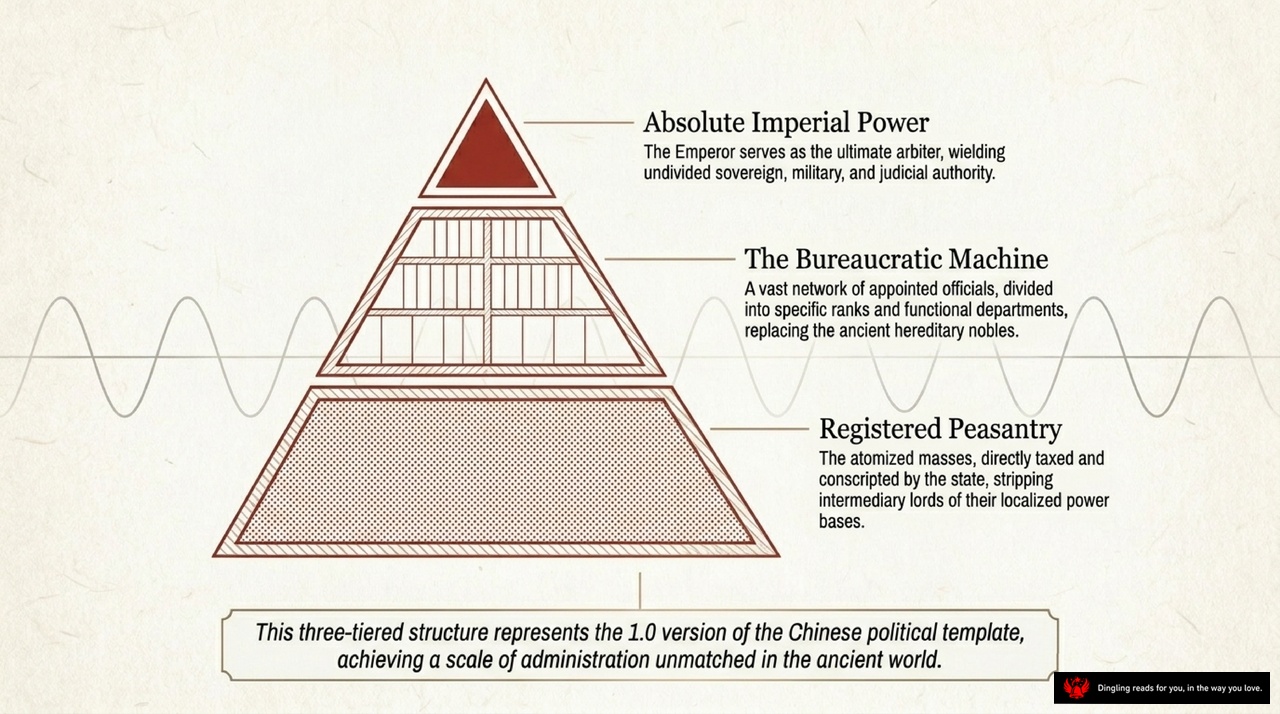
Look at this pyramid. It visualizes the "1.0 version" of the Chinese political template: a three-tier structure that achieved an administrative scale unmatched in the ancient world. At the very top sits **Absolute Imperial Power**. Here, the Emperor serves as the ultimate arbiter, wielding undivided sovereign, military, and judicial authority. This isn't just a title; it's the engine of the entire system.
Beneath the Emperor lies **The Bureaucratic Machine**. This is a vast network of appointed officials, divided into specific ranks and functional departments. Crucially, this system replaced the ancient hereditary nobles. Instead of power passing down through bloodlines, it flowed through merit and appointment. This machine ensured that the Emperor's will could be executed efficiently across the vast empire.
At the base, supporting the entire structure, is the **Registered Peasantry**. These are the atomized masses, directly taxed and conscripted by the state. By stripping intermediary lords of their localized power bases, the state brought these farmers directly under imperial control. This eliminated the "feudal" middlemen that plagued other ancient civilizations.
This pyramid illustrates a fundamental shift. Unlike the West, where power was often fragmented among local lords, this Chinese model created a centralized, rational, and highly efficient state. The Emperor commands the top, the bureaucracy executes the middle, and the peasantry provides the foundation. Together, they formed a stable, self-reinforcing system that would define Chinese history for two millennia.

The Qin and early Han empires were run by pragmatic "Legalist Clerks"—strict bureaucrats who followed the law, managed taxes, and kept the archives, acting as obedient tools for the emperor. In contrast, the "Confucian Scholars" offered moral guidance, legitimized the ruler's power through tradition, and served as a flexible check against absolute tyranny.
The chart shows how these two groups formed a "Dual Engine." The Qin Dynasty relied solely on the Clerks' rigid machinery and collapsed under its own weight. The Han Dynasty, however, stabilized the empire by blending both forces: using Legalist mechanics for efficient administration beneath a Confucian moral exterior. This unique fusion created a resilient system that balanced order with ethical restraint, allowing the imperial structure to endure for centuries.
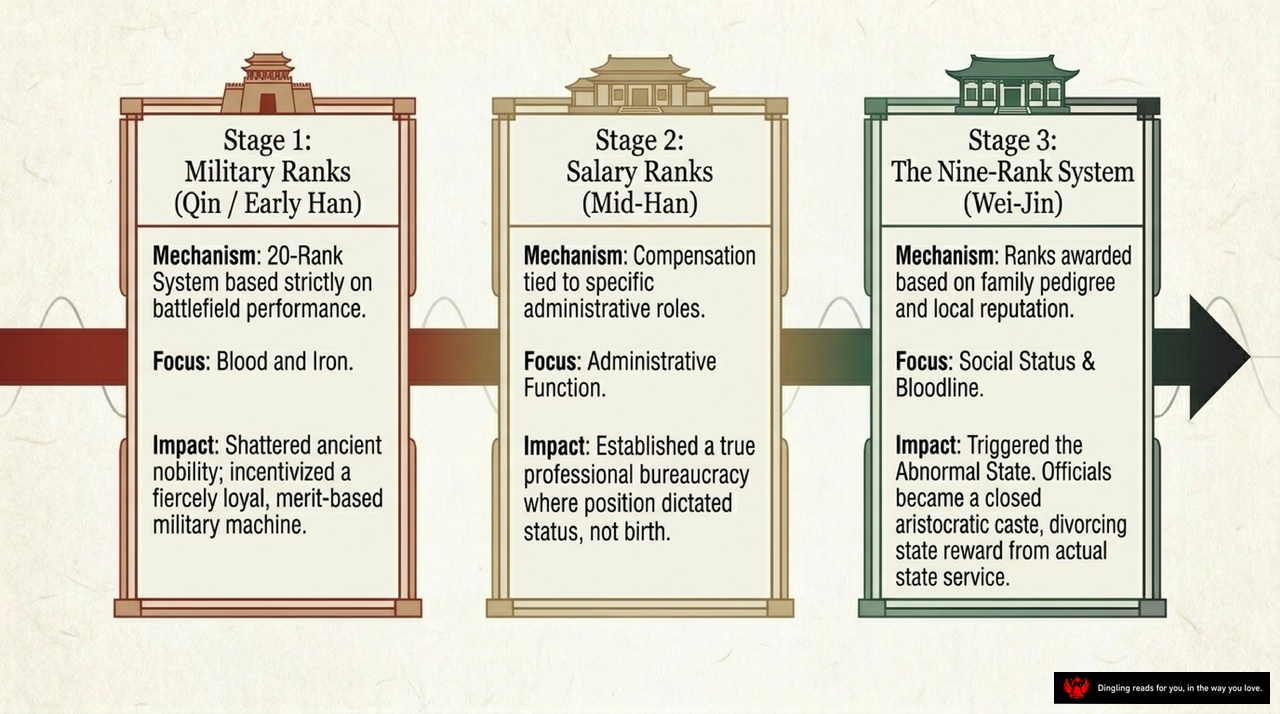
Looking at this timeline, we see the dramatic evolution of China's bureaucratic system from the Qin Dynasty through the Wei and Jin periods. The chart breaks it down into three distinct stages, each with a unique mechanism and focus.
In Stage 1, the Qin and Early Han eras, the system was built on Military Ranks. It relied on a strict 20-Rank System where your status depended entirely on battlefield performance. The focus here was purely "Blood and Iron." This merit-based approach shattered ancient nobility and created a fiercely loyal military machine where position was earned through service, not birth.
Moving to Stage 2, the Mid-Han period introduced Salary Ranks. The mechanism shifted to tying compensation to specific administrative roles rather than military deeds. The focus moved to Administrative Function. This established a true professional bureaucracy where status was dictated by the job you held, not your family background, creating a more stable and efficient civil service.
Finally, in Stage 3, the Wei and Jin era saw the rise of The Nine-Rank System. Here, the mechanism changed completely: ranks were awarded based on family pedigree and local reputation. The focus shifted to Social Status and Bloodline. This triggered what the chart calls an "Abnormal State." Officials became a closed aristocratic caste, divorcing state rewards from actual state service. Power was no longer about what you did, but who your ancestors were, fundamentally distorting the relationship between the state and its rulers.
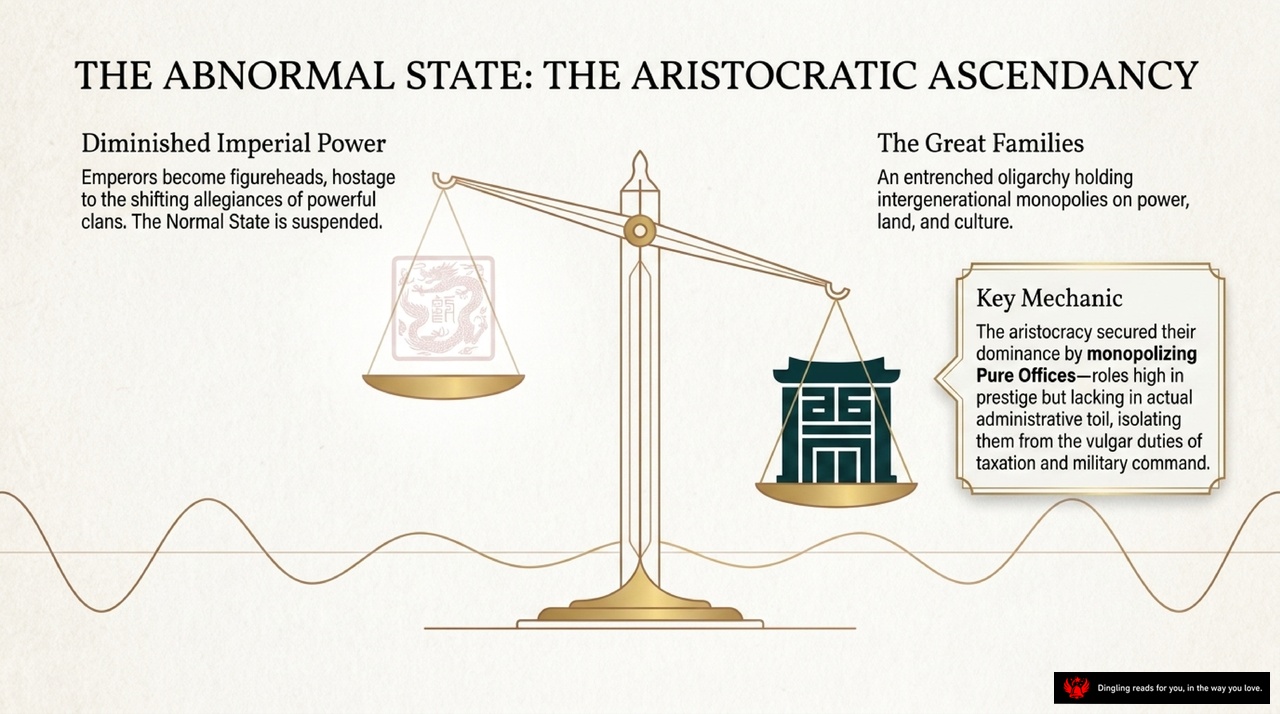
Imagine a scale, perfectly balanced in the ideal "Normal State" of the empire, where the Emperor's authority holds firm against the weight of governance. But now, look at this image: the balance has tipped violently to the right. On the left, the Imperial Power has plummeted, leaving emperors as mere figureheads, hostages to the shifting loyalties of powerful clans. The "Normal State" is suspended.
On the right, we see the rise of the Great Families. This is an entrenched oligarchy, an aristocracy that has secured intergenerational monopolies over power, land, and culture. They didn't just accumulate wealth; they perfected a key mechanic: monopolizing "Pure Offices." These were roles high in prestige but lacking in actual administrative toil. By isolating themselves from the vulgar duties of taxation and military command, they elevated their status while offloading the real work of running the state.
This imbalance defines the "Abnormal State" of the Aristocratic Ascendancy. It was a period where the rigid structure of the empire twisted under the weight of these powerful families, creating a political reality where the throne was occupied, but the true power resided in the halls of the great clans.
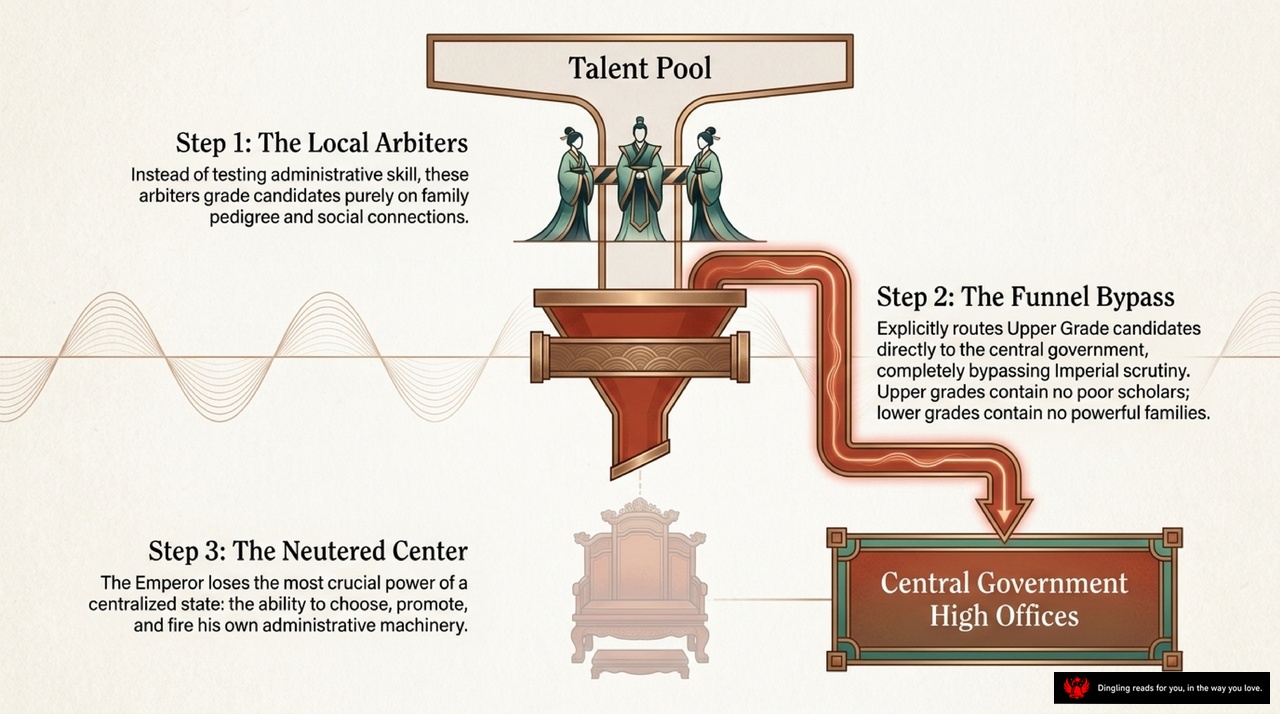
Look at this flowchart. It illustrates a critical failure in the ancient Chinese state: the systematic dismantling of the Emperor's power to control his own government.
It starts at the top with the **Talent Pool**. Ideally, this is where the best administrators rise. But Step 1, **The Local Arbiters**, hijacks the process. Instead of testing for administrative skill, these local officials grade candidates purely on family pedigree and social connections. They aren't looking for talent; they are looking for lineage.
This rigged selection leads directly to Step 2, **The Funnel Bypass**. Here is the fatal flaw: the system explicitly routes upper-grade candidates straight to the central government, completely bypassing any Imperial scrutiny. The result is a perfect segregation: the top offices are filled by powerful families, while the lower grades are left to the poor scholars. The Emperor never gets a chance to choose or evaluate the people running the empire.
Finally, we reach Step 3, **The Neutered Center**. Because the Emperor cannot choose, promote, or fire his own administrative machinery, he loses the most crucial power of a centralized state. The throne becomes a hollow shell, while the real power lies with the hereditary aristocracy that filled the **Central Government High Offices**. This is the essence of the "abnormal" political state during the Wei, Jin, and Northern and Southern Dynasties—a system where the ruler rules over a government he does not control.

Imagine the surface of the Chinese political landscape as a turbulent ocean, where dynastic turnovers, empty talk, and military weakness create a chaotic storm. But beneath these waves, powerful hidden currents were steadily reshaping the empire.
Look at the first current: Legal Evolution. While the surface was confused by local rules, deep down, the chaos was being slowly rationalized. This wasn't just about making laws; it was the quiet foundation for a unified, sophisticated legal code that would eventually bind the entire realm together.
The second current is Departmental Maturation. Above, the administration looked messy, but below, the inner court was maturing. The chaotic structures were refining into the highly structured Three Departments, creating a streamlined executive workflow that would become the engine of imperial governance.
Finally, the third current: Seeds of Examination. As aristocratic indulgence choked the system from above, central authorities began experimenting with written exams. This was a desperate countermeasure against hereditary privilege, a revolutionary idea that would eventually allow talent to rise from the common people, breaking the grip of the old aristocracy.
These hidden currents were not just reforms; they were the essential evolution that pulled China back from the brink of collapse, setting the stage for the great reunification of the Tang Dynasty.
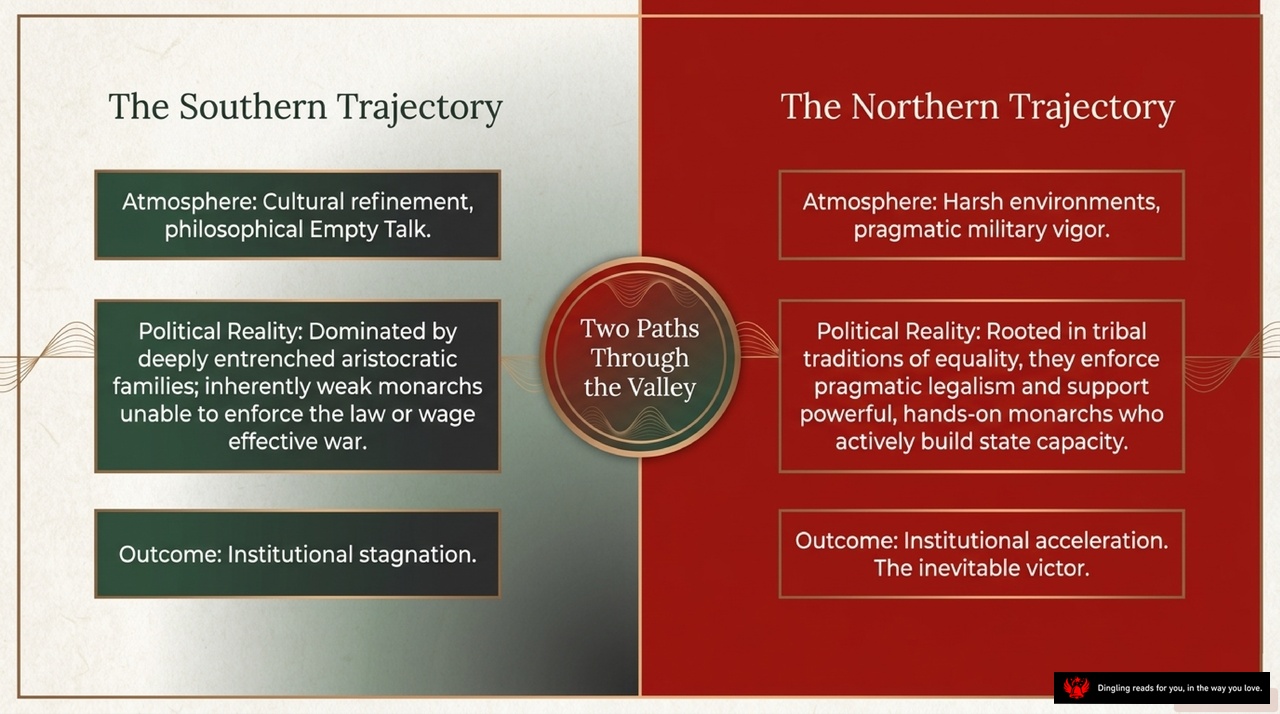
On this slide, we see the decisive divergence between two paths: The Southern Trajectory and The Northern Trajectory. The South is defined by cultural refinement and philosophical empty talk, where power is dominated by entrenched aristocratic families. Because their monarchs are inherently weak and unable to enforce the law or wage effective war, the outcome is inevitable institutional stagnation.
In stark contrast, look at the North. Its atmosphere is harsh, demanding pragmatic military vigor. Politically, it remains rooted in tribal traditions of equality but evolves into a system that enforces pragmatic legalism. Crucially, the North supports powerful, hands-on monarchs who actively build state capacity. This drive for centralization leads to institutional acceleration, making the North the inevitable victor.
While the South stagnated under the weight of privilege, the North's focus on state-building and military strength allowed it to eventually reclaim the throne. This victory wasn't just military; it was a triumph of a centralized, efficient bureaucracy over a fragmented, aristocratic elite. The North's path ultimately restored the normal axis of imperial power, paving the way for the great reunification of the Sui and Tang dynasties.

The Crucible of Imperial Resurgence: How Chaos Forged the Next Dynasty
Look at this diagram. We are witnessing the "Crucible of Imperial Resurgence." This isn't just a cycle of destruction; it's a pressure cooker that transforms the very foundation of the state.
On the left, we see the three forces that collide. First, **Alien Imperial Power**. These are rulers who don't fit the old Han aristocratic mold. They wield absolute, unapologetic authority, completely detached from traditional cultural networks. Second, the **Military Aristocracy**. Unlike the old nobility based on bloodlines, this new elite is built on battlefield utility and state service. They rise because they can fight and govern, not because of their family name. Third, the **Tribal Armed Masses**. Here, egalitarian tribal traditions are translated into the Equal-Field System, turning nomadic warriors into a directly-taxed agrarian infantry. This is the mass mobilization that stabilizes the frontier.
When these three elements mix, they create a potent force. As the text on the right explains, this mixture leads to **The Reaction: Renewed Bureaucratic Centralization**.
This pressure crushes the old cultural monopolies. The chaotic, decentralized power of the previous era—the era of powerful families and fragmented rule—is broken. The system is forced to reset. It forcefully restores the "Normal State": the classic triad of the Emperor, the Bureaucrats, and the Peasants.
In short, the chaos of the "Alien" rulers and the "Military" tribes didn't destroy the empire; it reforged it. By breaking the old aristocratic structures, it paved the way for a stronger, more centralized bureaucracy that would eventually lead to the great Tang and Song dynasties. The crucible didn't break the mold; it made it harder and more durable.

Imagine the Chinese political landscape as a high-stakes game of chess where two powerful but distinct forces were locked in a stalemate. On one side sat the Cultural Aristocracy, the scholars and literati who held all the prestige, education, and soft power, yet lacked the hard muscle to rule. On the other side were the Military Warlords, the generals with armies and land, who commanded real power but lacked the cultural legitimacy and administrative finesse needed to govern effectively. Neither could win alone; the scholars needed protection, and the generals needed a reason to rule.
This is where the Dual-Award Mechanism comes in. It was the brilliant, mechanical solution that solved this deadlock. By actively awarding military generals with prestigious civil titles and bestowing military ranks upon civil scholars, the state created a hybrid elite. This wasn't just a compromise; it was a fusion. The result was the creation of a singular, integrated state hierarchy. The sharp distinction between the "Pure" and the "Vulgar" was shattered, forging a new elite loyal to the central state above all else. This mechanism didn't just balance power; it built the foundation for a unified empire that would define China for centuries.
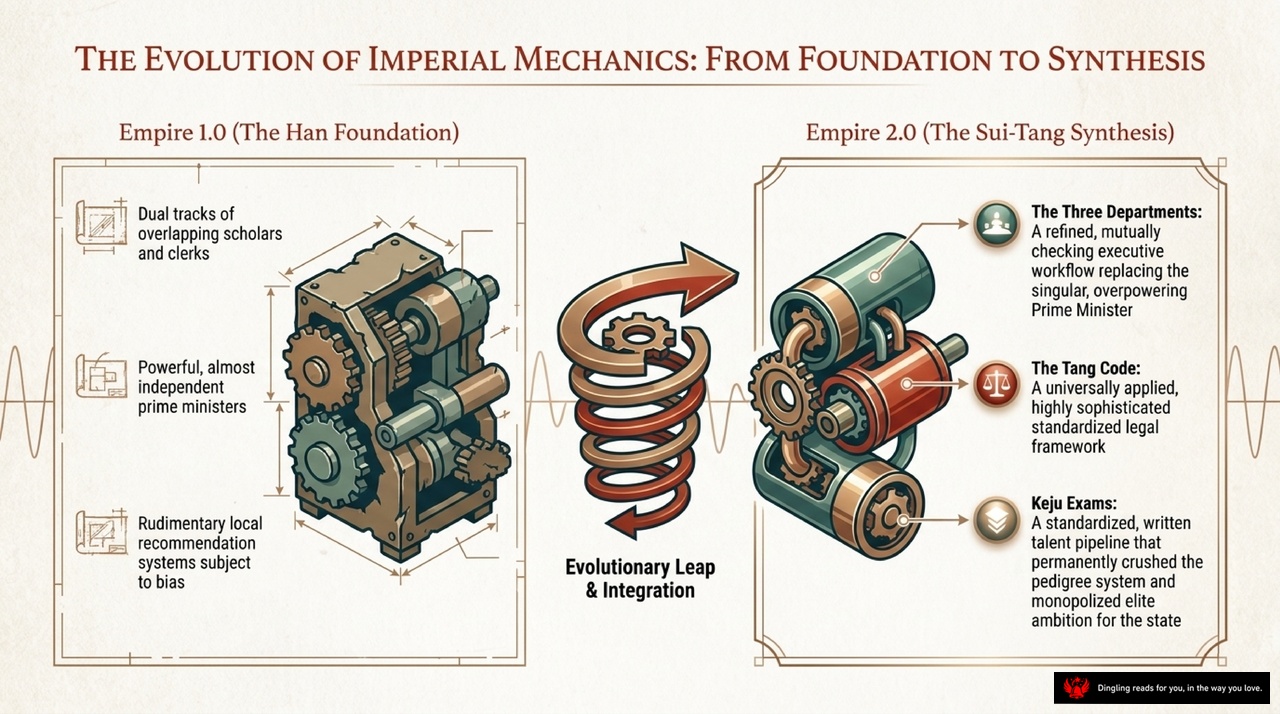
Imagine the Chinese Empire not as a static machine, but as one that constantly reinvented itself to survive. This slide captures a pivotal moment: the transition from Empire 1.0, the Han Foundation, to Empire 2.0, the Sui-Tang Synthesis.
On the left, we see the early Han system. It was powerful but had structural flaws. You had dual tracks of overlapping scholars and clerks, which often created confusion. The prime ministers were incredibly powerful, almost independent, which made them potential rivals to the Emperor. Furthermore, the local recommendation systems were rudimentary and easily biased by family connections, limiting who could rise to power.
But history demanded an upgrade. The evolution was driven by a need for integration and stability. This led to the Sui-Tang synthesis on the right. First, they replaced the overpowering Prime Minister with "The Three Departments," a refined system of mutual checks and balances that kept the executive workflow efficient but the Emperor safe.
Second, they introduced "The Tang Code," a universally applied, highly sophisticated legal framework. This standardized the rules for everyone, reducing arbitrary rule and creating a predictable environment for administration.
Finally, they revolutionized talent acquisition with the "Keju Exams." This was a standardized, written pipeline that permanently crushed the old aristocratic privilege system. It monopolized elite ambition for the state, ensuring that talent, not just birth, determined your future.
This "Evolutionary Leap" transformed a fragile foundation into a robust, integrated empire capable of lasting centuries.
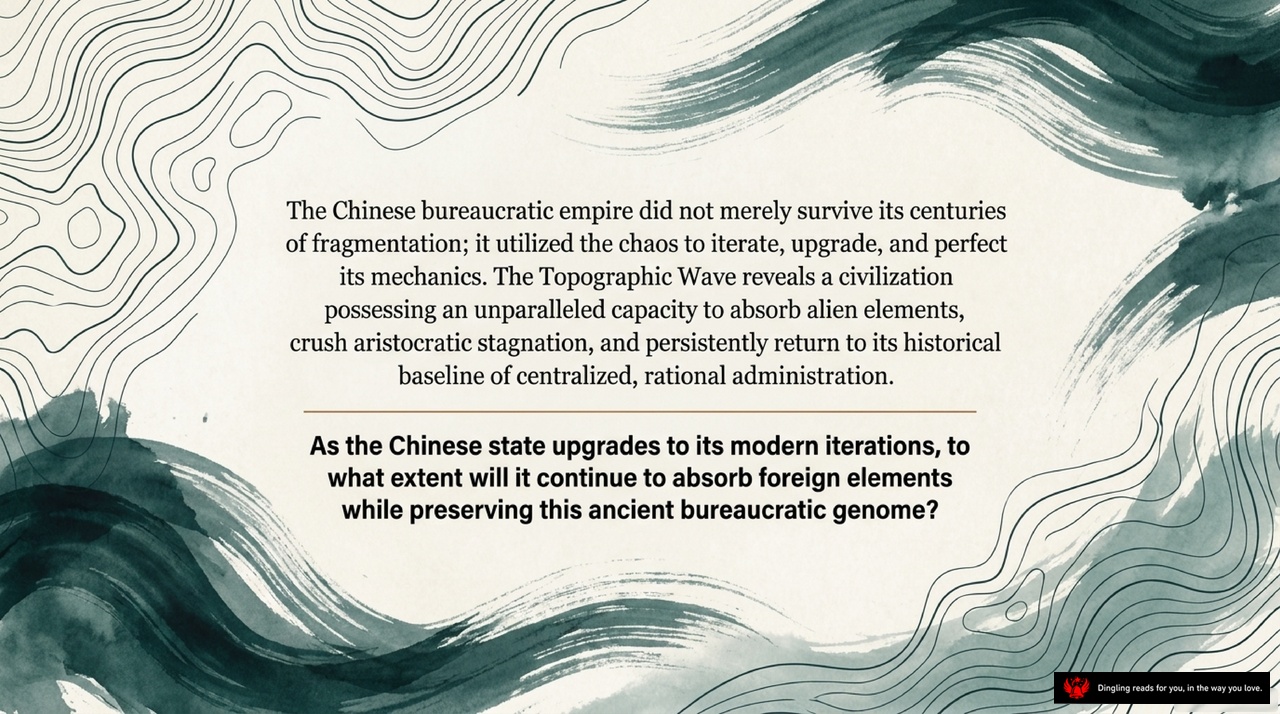
Look at this striking visual of swirling lines and ink waves—it perfectly captures the dynamic tension at the heart of Chinese history. The slide highlights a crucial insight: the Chinese bureaucratic empire didn't just survive centuries of fragmentation; it used chaos to iterate, upgrade, and perfect its very mechanics.
As the text explains, the "Topographic Wave" reveals a civilization with an unparalleled ability to absorb foreign elements, crush aristocratic stagnation, and constantly return to its historical baseline of centralized, rational administration. Think of it as a self-correcting system. When the political structure gets too rigid or the aristocracy takes over—like during the chaotic period of the Three Kingdoms or the rise of powerful clans—the system flexes, absorbs the shock, and then snaps back to its core identity.
Now, look at the bottom of the slide. It poses a profound question for our modern era: As the Chinese state upgrades to its modern iterations, to what extent will it continue to absorb foreign elements while preserving this ancient bureaucratic genome? This isn't just about history; it's about understanding the DNA of the state today. The lesson is clear: China's power lies in this unique resilience—the ability to learn from the outside world without losing its own fundamental character.